pith. machine review for the scientific record. sign in

math.HO

History and Overview

Biographies, philosophy of mathematics, mathematics education, recreational mathematics, communication of mathematics, ethics in mathematics

0
math.HO 2026-05-14 2 theorems

Infinitesimals formalized without axiom of choice

A philosophical history of infinitesimals

Ringinals enable Leibnizian analysis in a conservative extension of ZF set theory, challenging standard philosophical assumptions.
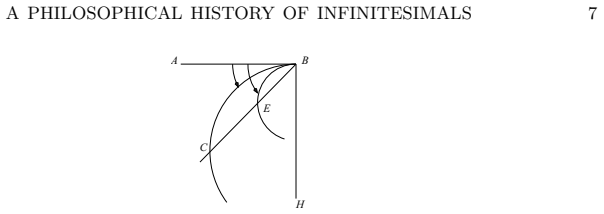
Figure from the paper full image
abstract click to expand
We explore the issue of providing a foundational framework for Leibnizian infinitesimals in the light of modern standard and nonstandard approaches. We outline a trichotomy of ordinals, cardinals and ringinals as a historiographic tool. A ringinal is a concept of infinite number, arithmetic in nature, different from Cantor's transfinite ordinals and cardinals. The continuum is not necessarily identifiable with R; even if one seeks such an identification, infinitesimals are not ruled out. Analysis with unlimited numbers (via the predicate standard) is possible in a conservative extension of Zermelo-Fraenkel set theory and in this sense is epistemologically 'safe'. We sketch a recent theory of infinitesimal analysis that formalizes Leibnizian definitions and heuristic principles while eschewing both the axiom of choice and ultrafilters, thus challenging received philosophical views on the nature of infinitesimals.
0
0
math.HO 2026-05-13 Recognition

Three perspectives explain who brings programming into math class

Diverse yet consistent: How mathematicians position computational thinking across research and teaching

Real-world focused mathematicians integrate computation readily while theory-focused ones keep it separate, per interviews at a long-experi

abstract click to expand
Recent research in mathematics education points to an "epistemic clash" when programming and computational thinking (CT) are leveraged alongside more established forms of mathematical thinking (MT). The emergence of generative AI emphasises the need to understand the mechanisms shaping relations between CT and MT. We address this need by analysing interviews with 15 mathematicians on their use of computations across their teaching and research activities. The interviews were conducted at a critical site with a history of integrating computations across its science and mathematics programs for more than 20 years. Drawing on Cultural Historical Activity Theory and Communities of Practice theory, we consider MT and CT as methodologies grounded in practice. We identify three perspectives shaping how mathematicians position CT: mathematical theory considered as a source of control, computations as a source of pragmatic reach, and real-world impact as a source of legitimacy. This three-perspectives model explains why mathematicians who emphasise real-world impact are most likely to carry programming into teaching, whereas those who position theoretical mathematics as authoritative are least likely to do so. Mathematicians working on numerical algorithms occupy an uneasy intermediate position. Our findings suggest that the perceived clash between MT and CT is not purely epistemic, but also ontological, as it depends on how computations are positioned within the goal of doing mathematics. For mathematics education, this implies that perceived meaningful integration with CT is mediated by context, and that more extensive use can be stabilised by leveraging authentic learning goals external to mathematics.
0
0
math.HO 2026-05-11 Recognition

Elementary methods recover Ramanujan notebook identities

Learning from Ramanujan: Elementary Approaches to Profound Ideas

Telescoping sums, partial fractions, and Fourier analysis make several profound entries accessible and reveal their connections.

abstract click to expand
We revisit several entries from Ramanujan's notebooks which follow from more elementary arguments than a first glance may suggest. Our goal is to demystify these results through more accessible proofs, while also shining some light on the web of interconnections within the notebooks and demonstrating the continuing relevance of Ramanujan's methods. Classical and modern tools, such as multisection, telescoping sums, partial fraction decomposition and Fourier analysis, are employed to reprove and extend identities originally presented without explanation. These contributions try not only to enrich our understanding of Ramanujan's intuition but also to offer new avenues for exploration in number theory, special functions and mathematical analysis.
0
0
math.HO 2026-05-11 2 theorems

Derivations make Beltrami's hyperbolic disc model fully explicit

Notes on Beltrami's Essay

The distance formula, angle sum proof, and equations for special curves now follow directly from the 1868 mapping to a Euclidean disc.

abstract click to expand
Eugenio Beltrami published his seminal 'Essay on the Interpretation of Non-Euclidean Geometry' in 1868, where he showed that geodesics on a surface of constant negative curvature can be mapped as straight lines on a Euclidean disc. More importantly he showed that figures on the disc would satisfy the identities of hyperbolic geometry characteristic of a surface of negative curvature. However Beltrami did not always give a full explanation of the equations which he used. These notes are an attempt to provide a derivation of some of his principal results, including his formula for hyperbolic distance on the disc, his proof that the sum of the (hyperbolic) angles of a triangle on the disc is less than two right angles and his equations for circles, equidistants and horocycles.
0
0
math.HO 2026-05-08

Transversality makes statistical degeneracies non-generic

Notes on Transversality and Statistical Degeneracies in Distributional Models

Pathologies such as non-identifiability arise only from special non-transverse alignments of the kernel feature map.

abstract click to expand
These notes provide a pedagogical introduction to the role of transversality theory in the analysis of statistical degeneracies within the framework of distributional statistical models. The classical question of when a statistical model is well-behaved - in the sense of being identifiable, having non-singular Fisher information, and admitting robust estimation - is reformulated as a question about the geometry of a kernel-induced feature map. Statistical pathologies correspond to geometric degeneracies of this map, and transversality theory provides a precise language for understanding when and why such degeneracies are non-generic. The exposition is organised in three parts. Part I surveys the statistical phenomena that motivate the geometric treatment: representation failure, non-identifiability, moment indeterminacy, singular information, nuisance parameters, and the Behrens-Fisher problem. Part II develops the necessary geometric toolkit - smooth maps, Sard's theorem, transversality, jets, stratifications, and the parametric transversality theorem - at a level accessible to students with a background in analysis and linear algebra but no prior exposure to differential topology. Part~III returns to the statistical problems of Part~I and shows how each one admits a unified geometric interpretation as a transversality condition on the feature map. These notes are a pedagogical companion to the research paper Labouriau (2026) "Transversality and Geometric Regularisation in Distributional Statistical Models" (arXiv:2605.04536 [math.ST]), expanding its arguments with motivating examples, geometric intuition, and exercises aimed at advanced Master's and PhD students with a background in mathematical statistics and measure theory. They are designed to support seminars or reading groups.
0
0
math.HO 2026-05-06

Al-Tusi treatise gives full spherical trig formulas with proofs

Spherical trigonometry before the modern era:The treatise of Nasir al-Din al-Tusi

The 13th-century work on the complete quadrilateral moves beyond Menelaus theorem to a proved system for astronomy and geometry.

Figure from the paper full image
abstract click to expand
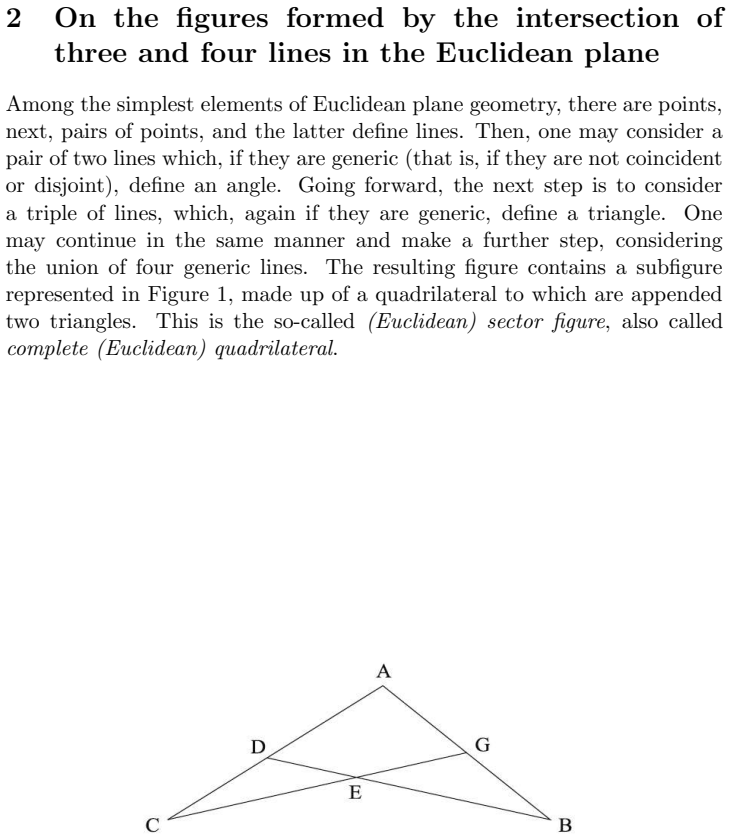
This is an overview of Nasir al-Din al-Tusi's Treatise of the quadrilateral, an invaluable 13th century document on spherical geometry which was translated into French in 1891. The title we are using here is the one given by the translator (Alexandre Carath{\'e}odory). A title which is closer to the original Arabic is ''Disclosing the secrets of the secant figure.'' The term ''secant figure'', to which the title refers, is the so-called ''complete (spherical) quadrilateral'', that is, the figure that underlies what we call today Menelaus' Theorem. This theorem gives a formula that was extensively used by astronomers in their computations and the establishment of their tables since the first century AD, notably by Ptolemy, in the absence of the spherical trigonometric formulae that were discovered later. Nasir's treatise contains much more than Menelaus' theorem, since we find there a complete system of spherical trigonometric formulae, with complete proofs. The treatise includes at the same time invaluable historical information on the discovery of the trigonometric formulae by the Arab mathematicians of the Middle-Ages and the transformation of the field of spherical trigonometry that this discovery led to. The final version of this paper will appear in the book Spherical geometry in the eighteenth century, I: Euler, Lagrange and Lambert, edited by Renzo Caddeo and Athanase Papadopoulos, Springer, 2026.
0
0
math.HO 2026-05-06

Tables replace arithmetic in Conway's Doomsday rule

Table-Based Encodings for Conway's Doomsday Algorithm: Vectorized Doomsdays and Doomyears

Vectorized doomsdays and Doomyears turn year and month offsets into lookups that exploit 28-year cycles and month gaps.

abstract click to expand
Conway's Doomsday Algorithm (1973) determines the day of the week for any date in the Gregorian calendar via three additive components: a century anchor, a year offset, and a month-day offset. The century anchor is a fixed four-entry table. The other two components require live arithmetic: the year offset demands computing $y + \lfloor y/4 \rfloor \pmod{7}$, and the month-day offset requires a subtraction that can produce negative intermediate values. We present two new encoding schemes that replace both arithmetic steps with structured table lookups. The first, vectorized doomsdays, re-encodes each month's doomsday date as a two-digit number whose tens and units digits represent the backward and forward gaps (respectively) from the nearest multiples-of-seven month anchors. A directional crossing rule (the "square knot rule") pairs the target date's gap with the opposite-direction digit, reducing the month-day offset to a single-digit addition. The second, Doomyears, encodes the year-offset function as a navigational lookup exploiting the 28-year periodicity of the Gregorian weekday cycle. Together with Conway's century anchor table, these form a unified system we call the Calamity Tables. We prove correctness, establish self-verification properties, analyse the internal structure of both encodings, and compare the cognitive complexity of the Calamity Table system against the standard arithmetic method.
0
0
math.HO 2026-05-05

AI generates full math paper matching advanced undergrad work

Using Large Language Models as a Co-Author in Undergraduate Quantum Group Research

The resulting manuscript derives a new explicit formula for a quantum group central element and completes the task in under a minute instead

abstract click to expand
This article describes the use of Claude CLI and its Opus 4.6 model, as a tool for writing an entirely AI-generated mathematics research paper. The resulting paper is comparable in scope and quality to papers previously produced by advanced undergraduate students in eight-week summer REU programs advised by the author. The main result is a new explicit formula for a central element of $U_q(\mathfrak{so}_{12})$, which can be used for an interacting particle system with Markov duality. Using SageMath and a sparse PBW-basis pairing matrix that admits symbolic inversion, Claude reduced the central-element computation by several orders of magnitude: a calculation that took 60 hours in a 2023 Python implementation completed in under a minute on a laptop. The article reflects on the implications for undergraduate research mentorship: if generative AI can now produce research of REU caliber, advisors must select problems that better demonstrate the qualities valued by graduate admissions committees. Limitations including poor runtime estimates and literal handling of differing mathematical conventions are documented.
0
0
math.HO 2026-05-05

Reminiscences mark Robert V

Robert V. Kohn (1953-2026)

Colleagues record thoughts on his life and contributions at the Courant Institute.

Figure from the paper full image
abstract click to expand
The article is dedicated to the memory and enduring legacy of Professor Robert V. Kohn, Courant Institute, NYU. In this memorial article, we record thoughts and reminiscences of his exemplary life.
0
0
math.HO 2026-04-28

Disused definitions of key math concepts could be revived profitably

The history of three wrong definitions

Historical review of equivalence relations, Cauchy sequences, and metric spaces suggests their earlier versions offer overlooked benefits.

abstract click to expand
The topic is the history of the concepts of equivalence relation, Cauchy sequence, and metric space. The thesis is that disused definitions of these notions could profitably be revived.
0
0
math.HO 2026-04-22

Selected problems bridge intuition and formal probability

Designing for the Development of Probabilistic Thinking: A Design-Based Research Study in Lower Secondary Education

Design study tests tasks that build communication skills and help students move from everyday chance ideas to abstract concepts.

Figure from the paper full image
abstract click to expand
Drawing on the Data and Predictions strand of the Indicazioni Nazionali per il curricolo 2012, this study proposes a problem based instructional approach to the teaching of probability. More specifically, the study adopts a design based research methodology structured in a single cycle consisting of two teaching interventions in the same class, carried out in two consecutive years. Within this framework, a set of carefully selected problems is employed to foster students engagement. These problems are designed not only to introduce probabilistic concepts, but also to stimulate students' communicative and argumentative skills. The selected tasks provide opportunities to promote key process goals (such as reasoning and proving, communicating, representing, and making connections) which are often overshadowed by a predominant focus on content goals. This approach aims to support teachers in addressing the difficulties they frequently encounter in guiding students conceptualization processes, particularly in bridging the gap between students intuitive reasoning and formal abstraction. At the same time, it seeks to help students develop more robust and flexible forms of thinking, enabling them to better navigate situations involving uncertainty in everyday life.
0
0
math.HO 2026-04-22

Calculus begins with integrals as Riemann sums and yields derivatives via FTC

Integral-Differential Calculus

Defining areas first, verifying standard integrals by direct sum manipulation, and crossing the fundamental theorem produces the full set of

abstract click to expand
We give an exposition of the Newton-Leibniz calculus. We begin by defining the integral as a limit of Riemann sums, verify the integrals of the standard catalog of functions by direct manipulation, prove the substitution lemmas as theorems about Riemann sums, cross the Fundamental Theorem of Calculus, and harvest the differential calculus on the other side.
0
0
math.HO 2026-04-21

Algebraic graph theory links symmetries to group actions

Algebraic Graph Theory

An introduction covers strongly regular graphs, Steiner systems, and automorphism groups with Petersen and Paley examples plus SageMath code

Figure from the paper full image
abstract click to expand
This note provides an introduction to selected topics in algebraic graph theory, including strongly regular graphs, Steiner systems, and automorphism groups. We describe constructions and properties of notable graphs such as the Petersen graph, Paley graphs, Hamming graphs, and the Hoffman-Singleton graph, with emphasis on their symmetry and combinatorial structure. Connections with permutation groups are also discussed. Computational examples using SageMath are included to illustrate key concepts and to compute automorphism groups and related invariants.
0
0
math.HO 2026-04-20

Hurwitz lectures deliver substitution proof of Galois theorem

Adolf Hurwitz and the Fundamental Theorem of Galois Theorie: The K\"onigsberg Lectures of 1890-1891

Preserved 1890-91 notes show the fundamental theorem taught through root substitutions at Koenigsberg.

Figure from the paper full image
abstract click to expand
In the winter semester of 1890--1891 Adolf Hurwitz delivered a lecture course at the Albertina University in K\"onigsberg entitled -Theorie der algebraischen Gleichungen-. These lectures contain a particularly clear presentation of the ideas of Evariste Galois and, in particular, a proof of the fundamental theorem of Galois theory formulated in the language of substitutions. The present paper analyzes Hurwitz's treatment of this result on the basis of his lecture notes preserved in the ETH Library in Zurich (Hs 582:66), together with material from his Mathematisches Tagebuch 23 (Hs 582:23). After placing the K\"onigsberg lectures in their historical context, we give an overview of their mathematical content and reconstruct in detail Hurwitz's argument leading to the fundamental theorem.
0
0
math.HO 2026-04-20

Memories detail Solomon Marcus discussions on math topics

Memories with Solomon Marcus

Possible talks include topology conjectures, self-dual geometry, Boolean algebras, and Yang-Baxter maps.

abstract click to expand
I was interested in the work of Solomon Marcus in Mathematical Linguistics as a high-school student. Later, I had the opportunity to discuss with him about many topics. He was a polymath. We wrote a paper together, and I refereed an editorial paper about his work in 2021. Samples of (possible) discussions are presented: some topology conjectures, a self-dual theorem in geometry, results about Boolean algebras, a B-ring Euler formula, Yang-Baxter maps and a discussion on sequences and series. A short appendix on poetry is also included.
0
0
math.HO 2026-04-17

The paper describes a construction for an interactive art piece

A Braid Box

An interactive physical art installation illustrates the braid groups and their action on the free group by showing that all planar point…

Figure from the paper full image
abstract click to expand
We give a method for constructing an interactive art piece which illustrates two different definitions of the braid groups, along with their faithful action on the free group. The box also demonstrates how all motions of points in the plane can be realized by motions in a single T-shaped subspace of the plane. This helps students and those who are not specialists in algebraic topology to understand these important topological objects.
0
0
math.HO 2026-04-15

Decomposition lessons lift primary math scores by 18 points

From Manipulation to Abstraction: The Impact of Flexible Decomposition on Numerical Competence in Primary School

A 12-week concrete-to-abstract program on breaking down large numbers yields bigger, longer-lasting gains than standard teaching.

abstract click to expand
This study examines the effectiveness of a structured instructional approach to decomposition and recomposition of large numbers in six primary school classes (three Year 4 and three Year 5, N = 120) using a quasi - experimental design with a control group. The 12 - week intervention is grounded in the Concrete Pictorial Abstract (CPA) progression. The experimental groups achieved average gains of 34.0 points (Year 4) and 29.6 points (Year 5) out of 100, significantly higher than the control groups (16.4 and 11.1 points; p < .001). The Time Group interaction in the mixed ANOVA reached {\eta}^2p = .931. The ANCOVA with the pre - test as covariate estimated an adjusted difference of 18.25 points (F(1,117) = 2,978.10, p < .001, \eta^2p = .962), confirming the robustness of the effect after controlling for baseline differences. Four-week retention exceeded 97% in the experimental group. Internal reliability of the instrument was satisfactory (Cronbach's {\alpha} = .735).
0
0
math.HO 2026-04-14

Evolution algebras spread from genetics to other fields in 15 years

A historical perspective of Tian's evolution algebras

A review traces their introduction for non-Mendelian rules and the subsequent growth in applications across disciplines.

abstract click to expand
Even if it has been less than a decade and a half since Tian introduced his concept of evolution algebras to represent algebraically non-Mendelian rules in Genetics, their study is becoming increasingly widespread mainly due to their applications to many scientific disciplines. In order to facilitate further research on the topic, this paper deals with the past and present research on these kind of algebras, together with the most relevant topics regarding them.
0
0
math.HO 2026-04-13

Hypergraph ties entries to content hashes for flexible links

Astrolabe: A Content-Addressable Hypergraph for Semantic Knowledge Management

SHA-256 identifiers plus arbitrary-width ordered references and plugin records connect informal text to formal structures.

Figure from the paper full image
abstract click to expand
Existing knowledge management tools either preserve prose but lose structural relationships, or capture relationships but restrict edge semantics to fixed vocabularies. We introduce Astrolabe, a content-addressable hypergraph for semantic knowledge management. Entries are identified by the SHA-256 hash of their content, carry an ordered reference list of arbitrary width, and store an opaque record string interpreted by plugins. The structure admits two orthogonal decompositions: by width and by depth. We demonstrate the framework with a plugin bridging informal and formal mathematics.
0
0
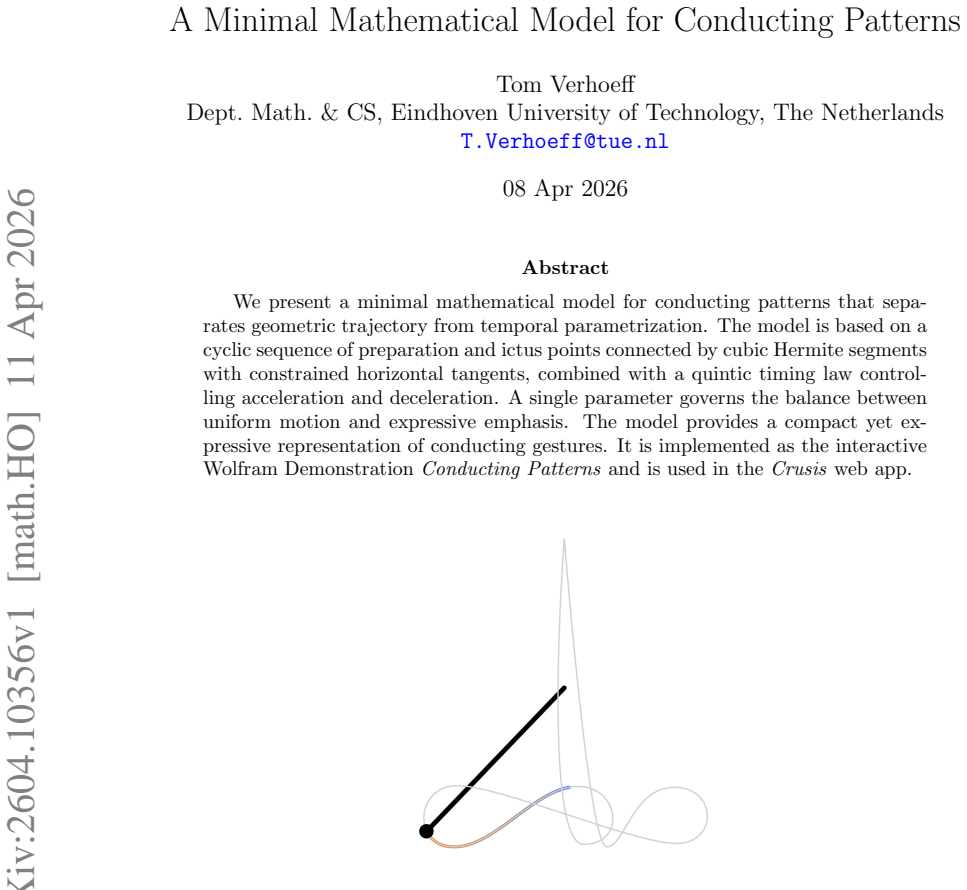
math.HO 2026-04-13

Conducting gestures reduced to cubic segments and quintic timing

A Minimal Mathematical Model for Conducting Patterns

A single parameter balances uniform motion against expressive emphasis along a cyclic path of preparation and beat points.

Figure from the paper full image
abstract click to expand
We present a minimal mathematical model for conducting patterns that separates geometric trajectory from temporal parametrization. The model is based on a cyclic sequence of preparation and ictus points connected by cubic Hermite segments with constrained horizontal tangents, combined with a quintic timing law controlling acceleration and deceleration. A single parameter governs the balance between uniform motion and expressive emphasis. The model provides a compact yet expressive representation of conducting gestures. It is implemented as the interactive Wolfram Demonstration "Conducting Patterns" and is used in the Crusis web app.
0
0
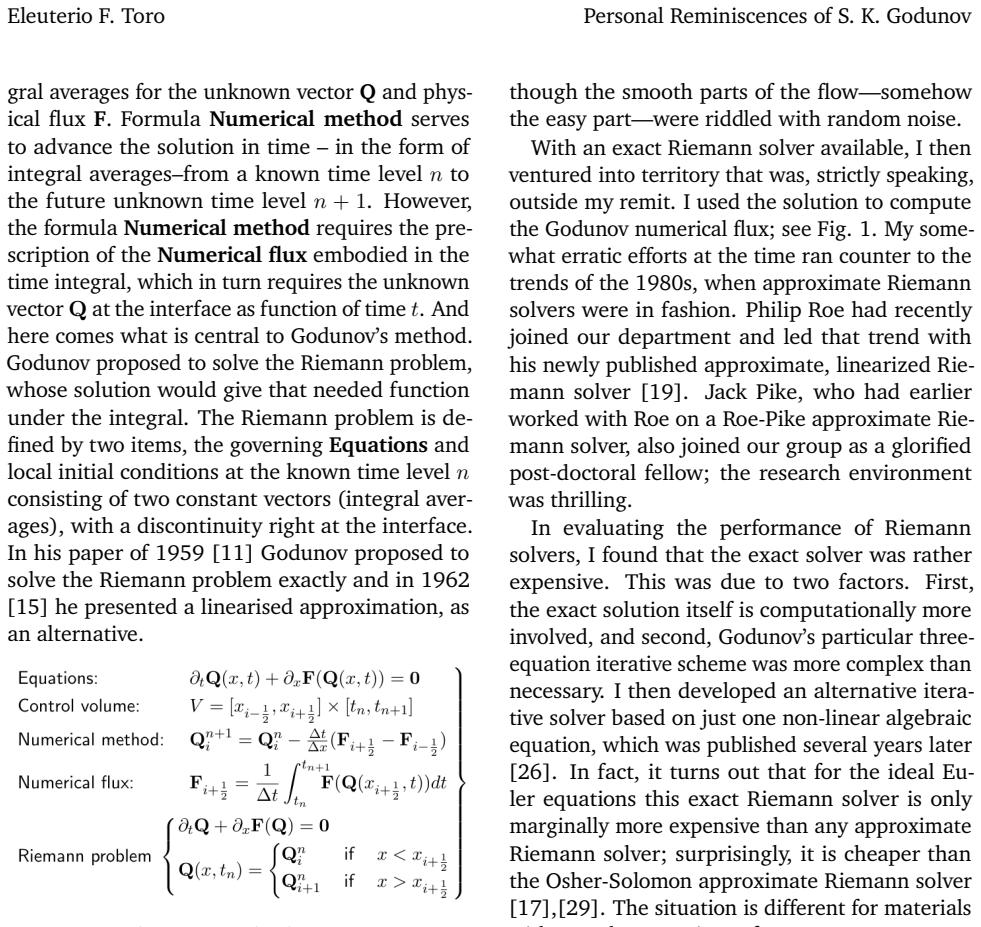
math.HO 2026-04-13

Reminiscences show Godunov's ideas reaching across sciences

Reminiscences of S. K. Godunov. The Russian Mathematician

Accounts of meetings from Lake Tahoe to Novosibirsk trace lasting effects on research careers in academia and industry.

Figure from the paper full image
abstract click to expand
These personal reminiscences of the great Russian mathematician Sergey K. Godunov (1929-2023) arose from a request by his daughter, Ekaterina, to contribute a piece to a book she is writing about her father's life. I was honoured to accept this invitation and to give written form to the rewarding experience of conducting research on themes pioneered by Professor Godunov, interacting with him personally on several memorable occasions, and helping to establish research collaboration with his Novosibirsk group. Our association began at a conference in Lake Tahoe (USA) in 1995 and was followed by a number of subsequent meetings, notably in Novosibirsk, Manchester, Oxford, and Cambridge. Briefer encounters also took place in the Porquerolles Island (France), in Lyon (France), and in St. Petersburg (Russia). These notes bear witness to the global impact of Godunov's mathematical creativity across multiple branches of science, as well as to its lasting influence on the careers of generations of mathematicians in both academia and industry.
0
0
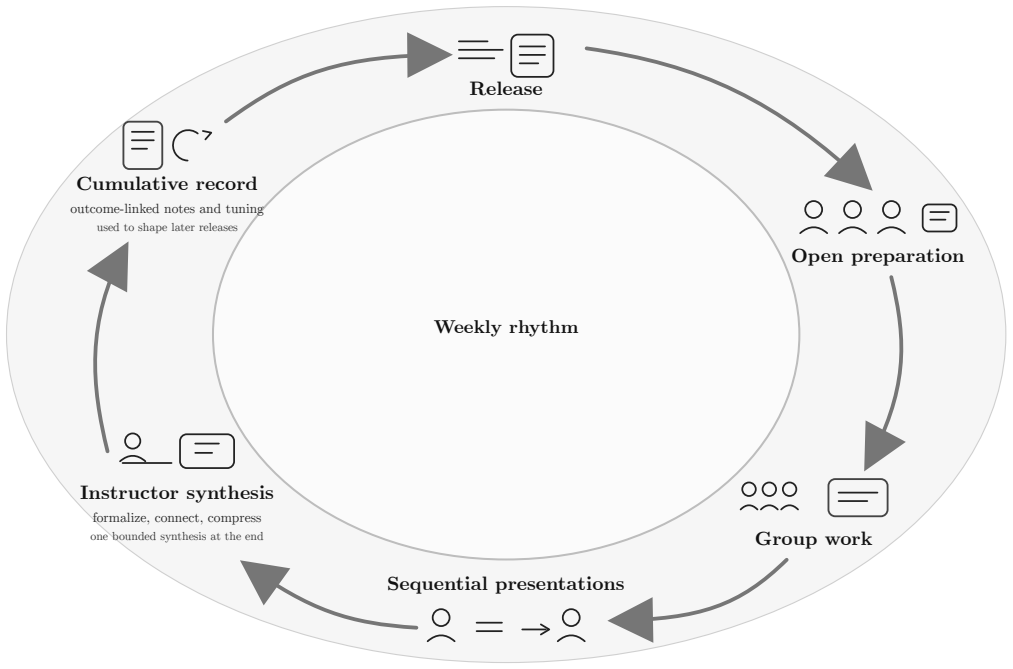
math.HO 2026-04-10

Live oral checks replace written work to verify math understanding

Open Preparation, Human Explanation, and Instructor Synthesis: A Human-Scale Methodology for AI-Rich Higher Education

Weekly cycles of open preparation, explanation, and instructor synthesis maintain evidence of learning in AI-assisted service courses.

Figure from the paper full image
abstract click to expand
In AI-rich higher education, polished written mathematics has become easier to produce than trustworthy evidence of understanding. This article develops a human-scale methodology for service mathematics, with informatics as its main running case. Its central move is not prohibition of tools but relocation of evidential trust. Students prepare openly, often with digital assistance, but grade-relevant evidence shifts toward live explanation, contingent questioning, and cumulative observation against course outcomes. The design is guided by Realistic Mathematics Education, question-first task construction, short human-scale mathematical tasks, and instructor synthesis after student attempt. It contributes a weekly operational cycle, a realism framework distinguishing professional, disciplinary, and experiential realism, a middle-out white-box / black-box stance on tools, a bounded role for retrieval-grounded AI assistants for students and teachers, and a cumulative oral-evidence model for small and medium cohorts. The paper also provides concrete implementation artifacts: process figures, an ecology of problem types, time-budget estimates, an evidence hierarchy, and a five-grade oral rubric. This is a methodology paper rather than an effectiveness study. Its claim is that the proposed design is pedagogically coherent, operationally plausible for human-scale teaching settings, and responsive to current concerns about AI, oral evidencing, and active learning in undergraduate mathematics education.
0
0
math.HO 2026-04-10 Recognition

Old Babylonian ratio is ancestor of the radian

AnOldBabylonian coefficient, its origin and impact on our understanding of measures on circles, including the radian measure

Harmonizing Nippur and Gudea measures produced a scaling factor refined into pi and the arc-to-radius unit.

Figure from the paper full image
abstract click to expand
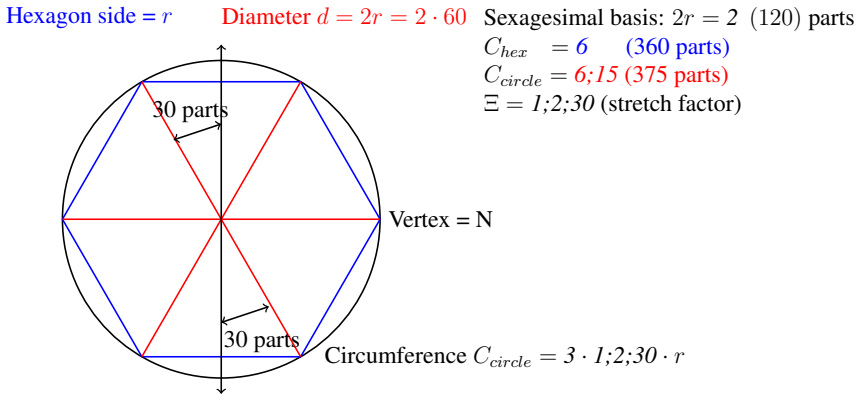
This study reconstructs the origin of a constant, here called $\Xi$ (Xi), as a primary scaling factor in Old Babylonian mathematics and astronomy. $\Xi$ arises from the practical necessity of precise measurements on the sky or a circle, through the harmonization of length-measure systems. The analysis of the Nippur measure (with its famous cubit) and the Gudea measure shows that $\Xi = 375/360$ represents the ratio of these established Old Babylonian measure systems. As a precision factor for circumference calculations, it remained in use until today. In Ptolemy's work, we find a slightly refined value of $\Xi = 377/360$. A further refinement of this coefficient led to our modern $\pi$, which still incorporates the two Old Babylonian components of a demonstrably two-stage calculation and refinement process. The accuracy increased by only 0.5\% compared to the first ratio. This factor, attested on several Old Babylonian cuneiform tablets including those from Susa, demonstrates the profound understanding of sexagesimal logic. The relative sexagesimal notation (60 = 1 = 1/60) enabled the universal application of $\Xi$ and its reciprocal for highly accurate calculations of arc-length on circular segments. This investigation leads ultimately to a surprising consequence: the modern radian measure is a direct descendant of this Old Babylonian coefficient.
0
0
math.HO 2026-04-08 3 theorems

Ferrar's formulas yield new generalizations via Mellin link

Analogues of a formula of Ferrar: what I have learned from Semyon Yakubovich

The transform connects summation identities to Dirichlet series behavior, allowing analogues learned from Yakubovich to be derived.

abstract click to expand
W. L. Ferrar seems to have been the first mathematician to clearly draw a connection between the functional aspects of a summation formula and the behavior of the Dirichlet series underlying it. Taking a formula due to him as a starting point, I will describe some new generalizations of Ferrar's formulas and how these were actually obtained after learning a great deal from Semyon. I also present a very concise overview of the underlying theory of summation formulas and how the Mellin transform has been the link between mine and Professor Yakubovich's interests.
0

browse all of math.HO → full archive · search · sub-categories