Recognition: unknown
Photon pairs, squeezed light and the quantum wave mixing effect in a cascaded qubit system
Pith reviewed 2026-05-10 17:01 UTC · model grok-4.3
The pith
Suppressing the coherent Rayleigh component in a cascaded qubit system makes the probe dynamics equivalent to a qubit driven by coherent light plus broadband squeezed vacuum, enforcing a selection rule that suppresses odd-photon sidebands.
A machine-rendered reading of the paper's core claim, the machinery that carries it, and where it could break.
Core claim
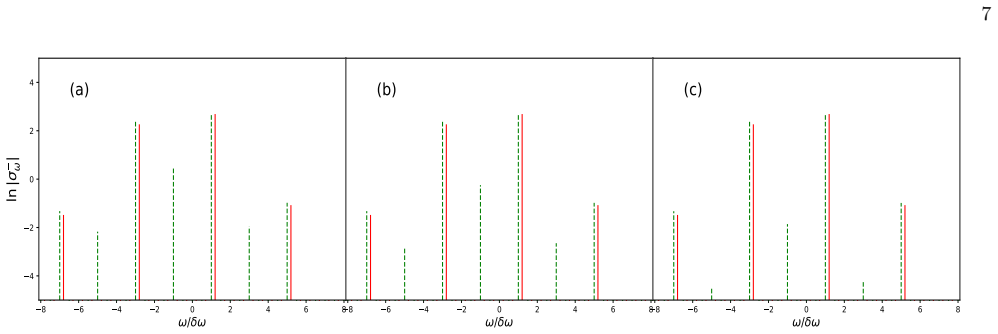
Starting from the field correlation functions of the source qubit’s resonance fluorescence, the authors derive an effective master equation for the probe. When the coherent Rayleigh component is suppressed, this master equation becomes identical to the one for a qubit driven by a coherent tone together with broadband squeezed light. The equivalence immediately implies a selection rule for the quantum wave mixing spectrum: sidebands associated with processes that take an odd number of photons from the source field are strongly suppressed. Numerical integration of the full cascaded Hamiltonian for varying decay-rate ratios confirms that correlated photon pairs participate in the mixing.
What carries the argument
The effective master-equation reduction derived from the source qubit’s two-time field correlation functions, which encodes the anomalous correlations of the fluorescence once the Rayleigh component is removed.
If this is right
- Sidebands linked to odd-photon processes from the source are strongly suppressed in the quantum wave mixing spectrum.
- Amplitudes of the remaining peaks can be used to extract photon statistics of the incident nonclassical field.
- The equivalence and the associated selection rule hold across a range of radiative-decay-rate ratios between the two qubits.
- Correlated photon pairs from the source actively participate in the quantum wave mixing processes.
Where Pith is reading between the lines
- The same cascaded geometry could serve as an indirect probe of squeezing in fluorescence without requiring homodyne detection.
- The odd-photon suppression rule might be turned into a spectral filter that favors even-photon processes in larger quantum circuits.
- Extending the cascade to more qubits would likely produce richer selection rules reflecting higher-order photon correlations.
Load-bearing premise
The fluorescence incident on the probe is fully captured by its second-order correlation functions with dominant anomalous terms and without sizable higher-order corrections from the cascaded geometry.
What would settle it
Numerical or experimental QWM spectra that continue to show unsuppressed odd-photon sidebands after the Rayleigh component has been suppressed would falsify the claimed equivalence to squeezed-light driving.
Figures



read the original abstract
We develop a theoretical description of quantum wave mixing (QWM) in a cascaded waveguide-QED system of two superconducting qubits, where the probe is driven by an external coherent tone and by the resonance fluorescence of a strongly driven source qubit. Starting from the field correlation functions of the source emission, we derive an effective master-equation treatment for the probe and identify the regime in which the incident fluorescence is characterized by anomalous correlations. When the coherent Rayleigh component of the source spectrum is suppressed, the probe equations of motion become equivalent to those for a qubit driven by a coherent tone and broadband squeezed light. This equivalence implies a selection rule for the peaks of the QWM spectrum, with a strong suppression of sidebands associated with processes involving an odd number of photons taken from the source field. Numerical simulations of the full cascaded two-qubit model for different ratios of radiative decay rates unambiguously confirm the participation of correlated photon pairs in QWM processes. The current research illustrates that the analysis of peak amplitudes can be used to probe photon statistics in the incident nonclassical field.
Editorial analysis
A structured set of objections, weighed in public.
Referee Report
Summary. The paper develops a theoretical description of quantum wave mixing (QWM) in a cascaded waveguide-QED system of two superconducting qubits. The probe qubit is driven by an external coherent tone together with the resonance fluorescence emitted by a strongly driven source qubit. Starting from the source's field correlation functions, the authors derive an effective master equation for the probe and identify the regime of anomalous correlations. They show that suppressing the coherent Rayleigh component renders the probe dynamics equivalent to those of a qubit driven by a coherent tone plus broadband squeezed light, which in turn implies a selection rule that strongly suppresses QWM sidebands associated with an odd number of photons extracted from the source field. Full numerical simulations of the cascaded two-qubit model for varying radiative decay-rate ratios are presented to confirm the participation of correlated photon pairs, with the suggestion that peak-amplitude analysis can serve as a probe of the incident field's photon statistics.
Significance. If the claimed equivalence holds without significant higher-order corrections, the work establishes a concrete link between QWM spectral features and squeezed-light driving, providing a potentially useful diagnostic for nonclassical photon statistics in waveguide-QED experiments. The approach of deriving the effective master equation directly from measured correlation functions and the use of full-model numerics are constructive elements that strengthen the manuscript.
major comments (1)
- [Numerical simulations and results] The central claim of equivalence (and the resulting selection rule for odd-photon sidebands) rests on the assertion that second-order anomalous correlations suffice once the Rayleigh component is suppressed. The manuscript states that full cascaded numerics 'unambiguously confirm' correlated-pair participation, yet does not report a direct, quantitative side-by-side comparison of the QWM spectrum (or individual peak amplitudes) obtained from the effective squeezed-light master equation versus the two-qubit cascaded simulation in the Rayleigh-suppressed regime. Such a comparison is required to bound possible residual effects from retardation, multi-photon scattering, or higher-order correlation functions inherent to the cascaded geometry.
minor comments (1)
- [Abstract and Introduction] The abstract and introduction would benefit from an explicit statement of the range of decay-rate ratios explored in the numerics and the precise criterion used to identify the 'Rayleigh-suppressed regime'.
Simulated Author's Rebuttal
We thank the referee for their careful reading, positive assessment of the manuscript's significance, and constructive feedback. We address the single major comment below and will revise the manuscript to incorporate the requested comparison.
read point-by-point responses
-
Referee: The central claim of equivalence (and the resulting selection rule for odd-photon sidebands) rests on the assertion that second-order anomalous correlations suffice once the Rayleigh component is suppressed. The manuscript states that full cascaded numerics 'unambiguously confirm' correlated-pair participation, yet does not report a direct, quantitative side-by-side comparison of the QWM spectrum (or individual peak amplitudes) obtained from the effective squeezed-light master equation versus the two-qubit cascaded simulation in the Rayleigh-suppressed regime. Such a comparison is required to bound possible residual effects from retardation, multi-photon scattering, or higher-order correlation functions inherent to the cascaded geometry.
Authors: We agree that an explicit quantitative side-by-side comparison between the effective squeezed-light master equation and the full cascaded two-qubit simulation would strengthen the central claim and help quantify any deviations. The analytical derivation establishes that, once the coherent Rayleigh component is suppressed, the probe equations of motion match those of a qubit driven by a coherent tone plus broadband squeezed light, relying on the second-order anomalous correlations of the source field. The full-model numerics for varying radiative decay-rate ratios demonstrate the predicted suppression of odd-photon sidebands, consistent with correlated-pair participation. However, the manuscript does not include a direct overlay or quantitative match of the spectra and peak amplitudes from the two approaches. In the revised manuscript we will add this comparison (e.g., overlaid QWM spectra and peak-amplitude tables) in the Rayleigh-suppressed regime, thereby bounding possible residual effects from retardation, multi-photon scattering, or higher-order correlations. revision: yes
Circularity Check
Derivation from source correlations to effective squeezed-light equivalence is independent
full rationale
The paper begins with the source qubit's computed field correlation functions (including anomalous terms), substitutes them into the probe's cascaded master equation, and demonstrates algebraic equivalence to the known squeezed-vacuum driving equations once the coherent Rayleigh component is removed. This step is a direct comparison of operators and correlation functions rather than a self-definition, fitted-parameter renaming, or self-citation chain. The subsequent selection rule for odd-photon sidebands follows from the established squeezed-light selection rules applied to the derived equivalence. Full two-qubit numerics are presented as external confirmation, not as the source of the equivalence itself. No load-bearing step reduces to its own input by construction.
Axiom & Free-Parameter Ledger
axioms (2)
- standard math Standard quantum-optics master-equation formalism and field-correlation functions apply to the cascaded waveguide-QED system
- domain assumption A regime exists in which the source fluorescence exhibits anomalous correlations allowing reduction to squeezed-light driving
Reference graph
Works this paper leans on
-
[1]
Astafiev, A
O. Astafiev, A. M. Zagoskin, A. Abdumalikov, Y. A. Pashkin, T. Yamamoto, K. Inomata, Y. Nakamura, and J. Tsai, Science327, 840 (2010), URLhttp://science. sciencemag.org/content/327/5967/840
2010
-
[2]
I.-C. Hoi, C. Wilson, G. Johansson, J. Lindkvist, B. Per- opadre, T. Palomaki, and P. Delsing, New Journal of Physics15, 025011 (2013), URLhttp://dx.doi.org/ 10.1088/1367-2630/15/2/025011
-
[3]
A. A. Abdumalikov, O. V. Astafiev, Y. A. Pashkin, Y. Nakamura, and J. S. Tsai, Phys. Rev. Lett.107, 043604 (2011), URLhttps://link.aps.org/doi/10. 1103/PhysRevLett.107.043604
2011
-
[4]
A. V. Vasenin, S. V. Kadyrmetov, A. N. Bolgar, A. Y. Dmitriev, and O. V. Astafiev, Phys. Rev. Lett.133, 073602 (2024), URLhttps://link.aps.org/doi/10. 1103/PhysRevLett.133.073602
2024
-
[5]
Mlynek, A
J. Mlynek, A. Abdumalikov, C. Eichler, and A. Wallraff, Nature Communications5, 5186 (2014)
2014
-
[6]
Mirhosseini, E
M. Mirhosseini, E. Kim, X. Zhang, A. Sipahigil, P. B. Dieterle, A. J. Keller, A. Asenjo-Garcia, D. E. Chang, and O. Painter, Nature569, 692 (2019), URLhttps: //www.nature.com/articles/s41586-019-1196-1
2019
-
[7]
Yin and J.-Q
X.-L. Yin and J.-Q. Liao, Phys. Rev. A108, 023728 (2023), URLhttps://link.aps.org/doi/10. 1103/PhysRevA.108.023728
2023
-
[8]
A. Y. Dmitriev, R. Shaikhaidarov, V. N. Antonov, T. H¨ onigl-Decrinis, and O. V. Astafiev, Nature Commu- nications8, 1352 (2017), ISSN 2041-1723, URLhttps: //doi.org/10.1038/s41467-017-01471-x
- [9]
-
[10]
W. V. Pogosov, A. Y. Dmitriev, and O. V. Astafiev, Phys. Rev. A104, 023703 (2021), URLhttps://link. aps.org/doi/10.1103/PhysRevA.104.023703
-
[12]
C. W. Gardiner and P. Zoller,Quantum noise(Springer, 2004)
2004
-
[13]
Z. Peng, S. de Graaf, J. Tsai, and O. Astafiev, Nature Communications7, 12588 (2016), URLhttps://link. aps.org/doi/10.1103/PhysRevX.6.031004
-
[14]
T. H¨ onigl-Decrinis, I. V. Antonov, R. Shaikhaidarov, V. N. Antonov, A. Y. Dmitriev, and O. V. Astafiev, Phys. Rev. A98, 041801 (2018), URLhttps://link.aps.org/ doi/10.1103/PhysRevA.98.041801
-
[15]
A. Y. Dmitriev, A. V. Vasenin, S. A. Gunin, S. V. Remizov, A. A. Elistratov, W. V. Pogosov, and O. V. Astafiev, Phys. Rev. A111, 043715 (2025), URLhttps: //link.aps.org/doi/10.1103/PhysRevA.111.043715
-
[16]
G. Nienhuis, Phys. Rev. A47, 510 (1993), URLhttps: //link.aps.org/doi/10.1103/PhysRevA.47.510
-
[17]
H. F. Arnoldus and G. Nienhuis, Journal of Physics B: Atomic and Molecular Physics17, 963 (1984), URL https://doi.org/10.1088/0022-3700/17/6/011
-
[18]
A. V. Vasenin, A. Y. Dmitriev, S. V. Kadyrmetov, and A. O. V., AIP Conference Proceedings2241, 020036 (2020)
2020
-
[19]
D. F. Walls, Nature306, 141 (1983)
1983
-
[20]
C. W. Gardiner and C. M. Savage, Optics Communica- tions50, 173 (1984), ISSN 0030-4018
1984
-
[21]
Schnabel, ArXiv e-prints (2023)
R. Schnabel, ArXiv e-prints (2023)
2023
-
[23]
P. A. Apanasevich, Opt. Spektrosk14, 612 (1963)
1963
-
[24]
B. R. Mollow, Phys. Rev.188, 1969 (1969), URLhttps: //link.aps.org/doi/10.1103/PhysRev.188.1969
-
[25]
Carmichael,An Open Systems Approach to Quantum Optics, Lecture Notes in Physics Monographs (Springer Berlin, Heidelberg, 1991)
H. Carmichael,An Open Systems Approach to Quantum Optics, Lecture Notes in Physics Monographs (Springer Berlin, Heidelberg, 1991)
1991
-
[26]
M. Mehmet, H. Vahlbruch, N. Lastzka, K. Danzmann, and R. Schnabel, Phys. Rev. A81, 013814 (2010), URLhttps://link.aps.org/doi/10.1103/PhysRevA. 81.013814
-
[27]
C. W. Gardiner and A. S. Parkins, Phys. Rev. A 50, 1792 (1994), URLhttps://link.aps.org/doi/10. 1103/PhysRevA.50.1792
1994
-
[28]
C. A. Schrama, G. Nienhuis, H. A. Dijkerman, C. Stei- jsiger, and H. G. M. Heideman, Phys. Rev. A 45, 8045 (1992), URLhttps://link.aps.org/doi/10. 1103/PhysRevA.45.8045
1992
-
[29]
C. L. Phillips, A. J. Brash, D. P. S. McCutcheon, J. Iles-Smith, E. Clarke, B. Royall, M. S. Skolnick, A. M. Fox, and A. Nazir, Phys. Rev. Lett.125, 043603 (2020), URLhttps://link.aps.org/doi/10. 1103/PhysRevLett.125.043603
2020
-
[30]
C. W. Gardiner, Phys. Rev. Lett.70, 2269 (1993), URL https://link.aps.org/doi/10.1103/PhysRevLett.70. 2269
discussion (0)
Sign in with ORCID, Apple, or X to comment. Anyone can read and Pith papers without signing in.