Recognition: 2 theorem links
· Lean TheoremNormal contact of metainterfaces: the roles of finite size and microcontact interactions
Pith reviewed 2026-05-10 17:32 UTC · model grok-4.3
The pith
Metainterface design assumptions hold for sparse asperities but break down at close spacing or finite elastic bases
A machine-rendered reading of the paper's core claim, the machinery that carries it, and where it could break.
Core claim
By systematically varying the spatial arrangement of asperities, their interdistance and the size of their elastic base in full 3D finite element models, we confirm that the literature assumptions of independent asperities on a linear elastic half-space are valid in the conditions previously used, but identify specific conditions under which they fail, providing critical insights into the robustness and practical limitations of the metainterface design strategy.
What carries the argument
The metainterface, an array of discrete asperities whose geometry is inverse-designed to control macroscopic friction through the observed proportionality between friction force and real contact area under normal load, with the key test being whether the asperities remain mechanically independent on a half-space.
If this is right
- The existing inverse-design strategy remains reliable for the sparse asperity layouts used in prior experimental metainterfaces.
- Reducing asperity spacing below a critical multiple of their diameter induces mechanical interactions that alter local contact areas.
- Finite-thickness elastic bases change the compliance and therefore the contact-area evolution compared with the infinite half-space idealization.
- The identified failure regimes supply concrete guidelines for adjusting the design procedure when denser or more compact metainterfaces are required.
Where Pith is reading between the lines
- Future optimization loops could include a correction term for neighbor interactions once the critical spacing threshold is crossed.
- Experimental metainterfaces built on substrates of controlled finite thickness would directly test the predicted deviation from half-space behavior.
- The same independence assumption appears in many other multi-scale rough-surface contact models and may warrant similar parametric checks.
- Accounting for base-size effects could allow metainterface designs on thin films or layered materials without loss of predictive accuracy.
Load-bearing premise
Asperities are placed on a linear elastic half-space and behave independently from each other.
What would settle it
A 3D simulation or experiment in which the total real contact area or pressure distribution deviates measurably from the sum of isolated asperity predictions when inter-asperity distance drops below a few asperity diameters or when the elastic substrate thickness becomes comparable to the asperity spacing.
Figures


read the original abstract
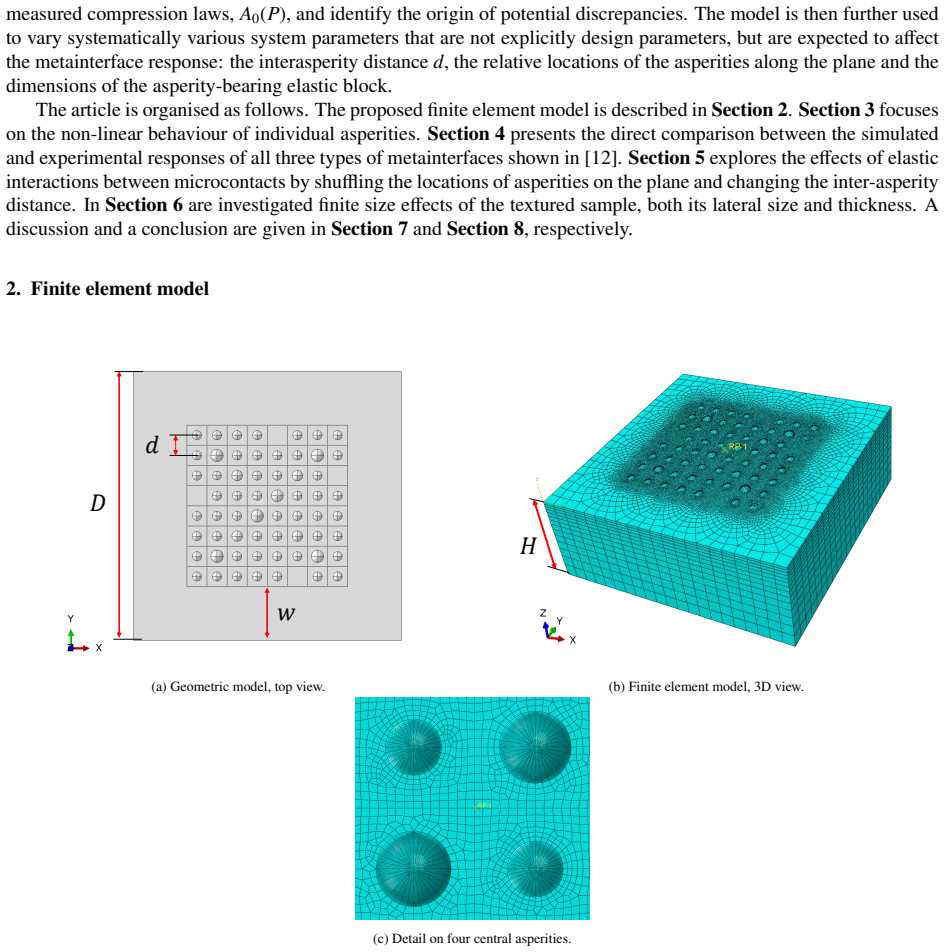
The design of contact interfaces that meet quantitatively a specified friction law (friction force vs normal force) is challenging due to the multi-scale and multi-physics nature of contact interactions. Recently, a concept was proposed to address this question in the case of dry elastic microarchitected contact interfaces, so-called metainterfaces. These take their macroscopic friction properties from an array of discrete asperities whose geometrical descriptors are optimized through an inverse design phase. Such design is based on the experimentally-observed proportionality between friction force and real contact area under pure compression, reducing the friction problem to a simpler contact mechanics problem of designing the contact area. In this context, the design strategy assumes that asperities are placed on a linear elastic half-space and behave independently from each other. Both assumptions are likely to fail in experimental realizations of metainterfaces, potentially inducing discrepancies between the actual and target behaviours. Here, we use full 3D finite element modelling to critically assess the validity of those two assumptions in existing experimental metainterfaces, and their potential impact on the design quality. The results first confirm the validity of the strategy, in the conditions in which it was used in the literature. Then, by systematically varying the spatial arrangement of asperities, their interdistance and the size of their elastic base, we identify conditions under which the literature assumptions fail. Our findings provide critical insights into the robustness and practical limitations of the metainterface design strategy and guidelines for its future improvements.
Editorial analysis
A structured set of objections, weighed in public.
Referee Report
Summary. The manuscript uses 3D finite-element simulations of arrays of elastic asperities to test two assumptions underlying the metainterface inverse-design strategy: that asperities rest on a linear-elastic half-space and interact independently. The simulations first recover the literature regime in which these assumptions hold, then systematically vary asperity arrangement, spacing, and substrate thickness to delineate the parameter ranges in which the assumptions break down.
Significance. If the numerical results are reliable, the work supplies concrete, falsifiable bounds on the validity of the simplified contact-mechanics model used for metainterface design. This directly informs experimental fabrication tolerances and indicates when more complete elastic-interaction models must be retained, thereby strengthening the link between theoretical design and realizable friction behavior.
major comments (2)
- [Methods] Methods section: no mesh-convergence study, element-size sensitivity data, or quantitative error metrics (e.g., relative change in contact-area or force upon refinement) are reported. Because the central claim rests on identifying precise breakdown thresholds under controlled variations of spacing and base thickness, the absence of these controls leaves the quantitative boundaries only partially supported.
- [Results] Results, comparison figures: the manuscript does not state the material parameters (E, ν) or the precise geometric ratios at which deviations exceed a stated tolerance (e.g., 5 %). Without these values the practical guidelines offered for future designs remain qualitative rather than directly usable.
minor comments (2)
- [Figures] Figure captions should explicitly label the half-space reference solution and the finite-base cases so that the reader can immediately distinguish the two.
- [Abstract] The abstract states that assumptions 'fail' under certain conditions but does not indicate the magnitude of the resulting error in predicted contact area or friction force; a single quantitative example would improve clarity.
Simulated Author's Rebuttal
We thank the referee for the constructive comments, which help strengthen the rigor and usability of our numerical validation of the metainterface design assumptions. We will revise the manuscript to address both major points by adding the requested mesh-convergence analysis and by making material parameters and deviation thresholds explicit and quantitative.
read point-by-point responses
-
Referee: [Methods] Methods section: no mesh-convergence study, element-size sensitivity data, or quantitative error metrics (e.g., relative change in contact-area or force upon refinement) are reported. Because the central claim rests on identifying precise breakdown thresholds under controlled variations of spacing and base thickness, the absence of these controls leaves the quantitative boundaries only partially supported.
Authors: We agree that a mesh-convergence study is necessary to fully support the quantitative breakdown thresholds. In the revised manuscript we will add a dedicated subsection (or appendix) to the Methods section that reports the mesh refinement protocol, the element sizes used across the different geometries, and quantitative error metrics including the relative change in total contact area and reaction force between successive refinements. These data will confirm that the chosen discretization yields changes below 1 % in the quantities of interest, thereby reinforcing the reliability of the reported thresholds. revision: yes
-
Referee: [Results] Results, comparison figures: the manuscript does not state the material parameters (E, ν) or the precise geometric ratios at which deviations exceed a stated tolerance (e.g., 5 %). Without these values the practical guidelines offered for future designs remain qualitative rather than directly usable.
Authors: We will explicitly state the linear-elastic material parameters (Young’s modulus E and Poisson’s ratio ν) employed in the simulations within the Methods section. In addition, we will augment the Results section with the precise geometric ratios (asperity spacing and elastic-base thickness, both normalized by asperity radius) at which the deviation in contact area from the independent half-space prediction exceeds 5 % and 10 %. These thresholds will be extracted directly from the existing simulation sweeps and presented in a new table or annotated figure to convert the guidelines into quantitative, directly usable design rules. revision: yes
Circularity Check
Numerical validation study with no circular derivation chain
full rationale
The paper performs 3D FEM simulations to test two explicit assumptions (asperities on linear elastic half-space, independent behavior) by directly embedding full interactions and finite-size effects, then comparing outcomes across controlled variations in spacing, arrangement, and substrate thickness. No derivation, prediction, or first-principles result is claimed that reduces by construction to fitted inputs or prior self-citations; the reported confirmation of literature regimes and identification of breakdown conditions follow from the numerical method capturing the omitted physics. This is a direct validation exercise rather than a self-referential chain.
Axiom & Free-Parameter Ledger
axioms (2)
- domain assumption Linear elastic constitutive behavior of the substrate
- domain assumption Asperity independence under the tested loads
Lean theorems connected to this paper
-
IndisputableMonolith/Cost/FunctionalEquation.leanwashburn_uniqueness_aczel unclearThe design strategy assumes that asperities are placed on a linear elastic half-space and behave independently from each other... we use full 3D finite element modelling to critically assess the validity of those two assumptions
-
IndisputableMonolith/Foundation/RealityFromDistinction.leanreality_from_one_distinction unclearelastic interactions are fundamentally long-ranged... Uz(r) = −a²/πR [...] decays as ∼1/r
Reference graph
Works this paper leans on
-
[1]
B. Bona, M. Indri, Friction compensation in robotics: an overview, in: Proceedings of the 44th IEEE Conference on Decision and Control, IEEE, 2005, pp. 4360–4367
2005
-
[2]
A. I. Vakis, V . A. Yastrebov, J. Scheibert, L. Nicola, D. Dini, C. Minfray, A. Almqvist, M. Paggi, S. Lee, G. Limbert, et al., Modeling and simulation in tribology across scales: An overview, Tribology International 125 (2018) 169–199
2018
-
[3]
Sahli, G
R. Sahli, G. Pallares, A. Papangelo, M. Ciavarella, C. Ducottet, N. Ponthus, J. Scheibert, Shear-induced anisotropy in rough elastomer contact, Physical Review Letters 122 (21) (2019) 214301
2019
-
[4]
Y . Xu, J. Scheibert, N. Gadegaard, D. M. Mulvihill, An asperity-based statistical model for the adhesive friction of elastic nominally flat rough contact interfaces, Journal of the Mechanics and Physics of Solids 164 (2022) 104878
2022
-
[5]
Z. Liu, R. D. Howe, Beyond coulomb: Stochastic friction models for practical grasping and manipulation, IEEE Robotics and Automation Letters 8 (8) (2023) 5140–5147. 16
2023
-
[6]
Basdogan, F
C. Basdogan, F. Giraud, V . Levesque, S. Choi, A review of surface haptics: Enabling tactile e ffects on touch surfaces, IEEE transactions on haptics 13 (3) (2020) 450–470
2020
-
[7]
Worobets, J
J. Worobets, J. W. Wannop, Influence of basketball shoe mass, outsole traction, and forefoot bending sti ffness on three athletic movements, Sports Biomechanics 14 (3) (2015) 351–360
2015
-
[8]
H. L. Costa, J. Schille, A. Rosenkranz, Tailored surface textures to increase friction - a review, Friction 10 (9) (2022) 1285–1304
2022
-
[9]
Z. Wang, R. Ye, J. Xiang, The performance of textured surface in friction reducing: A review, Tribology International 177 (2023) 108010
2023
-
[10]
Scheibert, S
J. Scheibert, S. Leurent, A. Prevost, G. Debrégeas, The role of fingerprints in the coding of tactile information probed with a biomimetic sensor, Science 323 (5920) (2009) 1503–1506
2009
-
[11]
Lamping, S
F. Lamping, S. N. Gorb, K. M. de Payrebrune, Frictional properties of a novel artificial snakeskin for soft robotics, Biotribology 30 (2022) 100210
2022
-
[12]
Aymard, E
A. Aymard, E. Delplanque, D. Dalmas, J. Scheibert, Designing metainterfaces with specified friction laws, Science 383 (6679) (2024) 200– 204
2024
-
[13]
Craster, S
R. Craster, S. Guenneau, M. Kadic, M. Wegener, Mechanical metamaterials, Reports on Progress in Physics 86 (9) (2023) 094501
2023
-
[14]
P. M. Mariano, Homogenization of complex lattices for metamaterials: open problems and conjectures, Crystals 12 (5) (2022) 612
2022
-
[15]
J. R. Barber, Contact mechanics, V ol. 20, Springer, 2018
2018
-
[16]
J. A. Greenwood, J. P. Williamson, Contact of nominally flat surfaces, Proceedings of the royal society of London. Series A. Mathematical and physical sciences 295 (1442) (1966) 300–319
1966
-
[17]
Berman, C
A. Berman, C. Drummond, J. Israelachvili, Amontons’ law at the molecular level, Tribology letters 4 (2) (1998) 95–101
1998
-
[18]
F.-C. Hsia, S. Franklin, P. Audebert, A. M. Brouwer, D. Bonn, B. Weber, Rougher is more slippery: How adhesive friction decreases with increasing surface roughness due to the suppression of capillary adhesion, Physical Review Research 3 (4) (2021) 043204
2021
-
[19]
Liang, Y
X. Liang, Y . Xing, L. Li, W. Yuan, G. Wang, An experimental study on the relation between friction force and real contact area, Scientific Reports 11 (1) (2021) 20366
2021
-
[20]
Enachescu, R
M. Enachescu, R. Van den Oetelaar, R. Carpick, D. Ogletree, C. Flipse, M. Salmeron, Observation of proportionality between friction and contact area at the nanometer scale, Tribology Letters 7 (2) (1999) 73–78
1999
-
[21]
Degrandi-Contraires, C
E. Degrandi-Contraires, C. Poulard, F. Restagno, L. Léger, Sliding friction at soft micropatterned elastomer interfaces, Faraday discussions 156 (1) (2012) 255–265
2012
-
[22]
Sahli, G
R. Sahli, G. Pallares, C. Ducottet, I. Ben Ali, S. Al Akhrass, M. Guibert, J. Scheibert, Evolution of real contact area under shear and the value of static friction of soft materials, Proceedings of the National Academy of Sciences 115 (3) (2018) 471–476
2018
-
[23]
J. C. Mergel, R. Sahli, J. Scheibert, R. A. Sauer, Continuum contact models for coupled adhesion and friction, The Journal of Adhesion 95 (2019) 1101–1133
2019
-
[24]
re-vitalized
M. Ciavarella, V . Delfine, G. Demelio, A “re-vitalized” greenwood and williamson model of elastic contact between fractal surfaces, Journal of the Mechanics and Physics of Solids 54 (12) (2006) 2569–2591
2006
-
[25]
A fferrante, G
L. A fferrante, G. Carbone, G. Demelio, Interacting and coalescing hertzian asperities: A new multiasperity contact model, Wear 278 (2012) 28–33
2012
-
[26]
ABAQUS, Abaqus 6.11, Dassault Systèmes Simulia Corporation, Providence, RI, USA 3 (2011) 73
2011
-
[27]
Lengiewicz, M
J. Lengiewicz, M. de Souza, M. A. Lahmar, C. Courbon, D. Dalmas, S. Stupkiewicz, J. Scheibert, Finite deformations govern the anisotropic shear-induced area reduction of soft elastic contacts, Journal of the Mechanics and Physics of Solids 143 (2020) 104056
2020
-
[28]
J. C. Mergel, J. Scheibert, R. A. Sauer, Contact with coupled adhesion and friction: Computational framework, applications, and new insights, Journal of the Mechanics and Physics of Solids 146 (2021) 104194
2021
-
[29]
D. T. Nguyen, P. Paolino, M. Audry, A. Chateauminois, C. Fretigny, Y . Le Chenadec, M. Portigliatti, E. Barthel, Surface pressure and shear stress fields within a frictional contact on rubber, The Journal of Adhesion 87 (3) (2011) 235–250
2011
-
[30]
Wriggers, T
P. Wriggers, T. A. Laursen, Computational Contact Mechanics, V ol. 2, Springer, 2006
2006
-
[31]
Alart, A
P. Alart, A. Curnier, A mixed formulation for frictional contact problems prone to Newton like solution methods, Computer Methods in Applied Mechanics and Engineering 92 (3) (1991) 353–375
1991
-
[32]
Pietrzak, A
G. Pietrzak, A. Curnier, Large deformation frictional contact mechanics: continuum formulation and augmented Lagrangian treatment, Computer Methods in Applied Mechanics and Engineering 177 (3-4) (1999) 351–381
1999
-
[33]
Segedin, The relation between load and penetration for a spherical punch, Mathematika 4 (2) (1957) 156–161
C. Segedin, The relation between load and penetration for a spherical punch, Mathematika 4 (2) (1957) 156–161
1957
-
[34]
T. Mu, R. Li, C. Linghu, Y . Liu, J. Leng, H. Gao, K. J. Hsia, Nonlinear contact mechanics of soft elastic spheres under extreme compression, Journal of the Mechanics and Physics of Solids 203 (2025) 106229
2025
-
[35]
K. L. Johnson, Contact mechanics, Cambridge university press, 1987
1987
-
[36]
interaction
M. Ciavarella, J. Greenwood, M. Paggi, Inclusion of “interaction” in the greenwood and williamson contact theory, Wear 265 (5-6) (2008) 729–734
2008
-
[37]
E. K. Dimitriadis, F. Horkay, J. Maresca, B. Kachar, R. S. Chadwick, Determination of elastic moduli of thin layers of soft material using the atomic force microscope, Biophysical journal 82 (5) (2002) 2798–2810
2002
-
[38]
Ladevèze, A
P. Ladevèze, A. Nouy, O. Loiseau, A multiscale computational approach for contact problems, Computer Methods in Applied Mechanics and Engineering 191 (43) (2002) 4869–4891
2002
-
[39]
Giacoma, D
A. Giacoma, D. Dureisseix, A. Gravouil, M. Rochette, Toward an optimal a priori reduced basis strategy for frictional contact problems with latin solver, Computer Methods in Applied Mechanics and Engineering 283 (2015) 1357–1381
2015
-
[40]
Zeka, P.-A
D. Zeka, P.-A. Guidault, D. Néron, M. Guiton, On the benefits of a multiscale domain decomposition method to model-order reduction for frictional contact problems, Computer Methods in Applied Mechanics and Engineering 429 (2024) 117171
2024
-
[41]
Zeka, P.-A
D. Zeka, P.-A. Guidault, D. Néron, M. Guiton, Control of the accuracy and improvement of the convergence rate of a latin-based multiscale strategy for frictional contact problems, Computer Methods in Applied Mechanics and Engineering 446 (2025) 118268
2025
-
[42]
Pham-Ba, J.-F
S. Pham-Ba, J.-F. Molinari, Adhesive wear regimes on rough surfaces and interaction of micro-contacts, Tribology Letters 69 (3) (2021) 107
2021
-
[43]
Djourachkovitch, N
T. Djourachkovitch, N. Blal, N. Hamila, A. Gravouil, Multiscale topology optimization of 3d structures: A micro-architectured materials database assisted strategy, Computers & Structures 255 (2021) 106574. 17
2021
discussion (0)
Sign in with ORCID, Apple, or X to comment. Anyone can read and Pith papers without signing in.