Recognition: unknown
Active Transport as a Mechanism of Microphase Selection in Biomolecular Condensates
Pith reviewed 2026-05-10 17:25 UTC · model grok-4.3
The pith
Stochastic binding to motor proteins followed by active transport generates long-range repulsion that arrests coarsening and selects finite condensate size.
A machine-rendered reading of the paper's core claim, the machinery that carries it, and where it could break.
Core claim
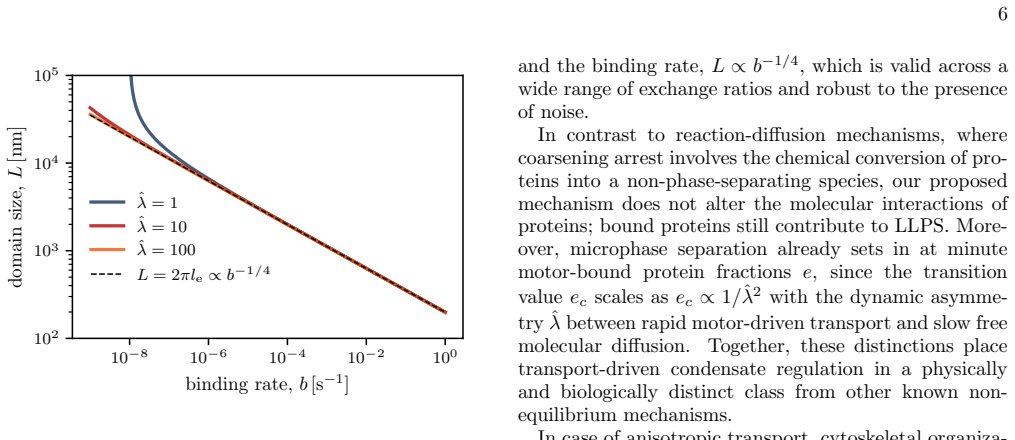
Stochastic binding of phase-separating proteins to cytoskeletal motor proteins, followed by active redistribution along filament networks, generates an effective long-range repulsion that arrests coarsening and selects a finite condensate size. Analysis of a minimal diffusion-transport model by linear stability theory and three-dimensional simulations shows the transition from macroscopic to microphase separation occurs at remarkably low binding fractions, with condensate size scaling as the inverse fourth root of the binding rate.
What carries the argument
The minimal diffusion-transport model with stochastic binding and release to motors, which produces an effective long-range repulsion between condensates.
If this is right
- Condensate sizes can be tuned sublinearly from nanometers to micrometers by adjusting motor binding rates.
- In anisotropic filament networks the mechanism drives a transition from spherical to cylindrical condensate shapes.
- The size selection operates independently of the thermodynamic parameters that control phase separation itself.
- The process supplies a spatiotemporally programmable route to organizing condensates inside cells.
Where Pith is reading between the lines
- Cells could dynamically resize condensates by modulating motor activity without changing protein concentrations or interaction strengths.
- Similar transport principles could be used to engineer synthetic emulsions whose domain sizes and shapes are controlled by external motor inputs.
- The mechanism may combine with other proposed controls such as chemical reactions or surface tension to produce robust size homeostasis.
Load-bearing premise
The minimal diffusion-transport model with stochastic binding and release accurately represents the dominant physics in real cytoskeletal environments at the low binding fractions considered.
What would settle it
Direct measurement of whether condensate sizes remain finite and follow the predicted b to the minus one-fourth scaling when motor binding rates are varied in a reconstituted system with controlled cytoskeletal filaments.
Figures


read the original abstract
Cells control the size and organization of biomolecular condensates formed by liquid-liquid phase separation (LLPS), but multiple mechanisms likely contribute to this control and remain to be fully elucidated. Here we propose a transport-driven mechanism in which stochastic binding of phase-separating proteins to cytoskeletal motor proteins, followed by active redistribution along filament networks, generates an effective long-range repulsion that arrests coarsening and selects a finite condensate size. A minimal diffusion-transport model, analyzed by linear stability theory and three-dimensional simulations, reveals a transition from macroscopic to microphase separation at remarkably low binding/release fractions, corresponding to minute motor-bound populations. Tuning motor binding rates $b$ or transport velocities enables sublinear control of condensate sizes ($L \sim b^{-1/4}$) from nanometers to micrometers. In anisotropic cytoskeletal environments, transport asymmetry drives morphological transitions from spherical to cylindrical condensates. Operating independently of thermodynamic parameters, this mechanism provides a versatile, spatiotemporally programmable route to condensate organization and informs the design of synthetic active emulsions with tunable architectures.
Editorial analysis
A structured set of objections, weighed in public.
Referee Report
Summary. The paper proposes that stochastic binding of LLPS proteins to cytoskeletal motors, followed by active transport along filaments, produces an effective long-range repulsion that arrests coarsening and selects finite condensate sizes. A minimal diffusion-transport model is analyzed via linear stability theory and 3D simulations, showing a transition to microphase separation at low binding/release fractions, sublinear size control (L ~ b^{-1/4}), and morphology shifts from spherical to cylindrical condensates in anisotropic networks. The mechanism is presented as independent of thermodynamic parameters.
Significance. If the central claim holds, the work identifies a tunable, active-matter route to microphase selection that operates at minute motor-bound populations and yields analytically emergent scaling rather than fitted parameters. This adds a spatiotemporally programmable control layer to condensate organization with direct implications for both cellular size regulation and the design of synthetic active emulsions.
minor comments (3)
- [Model and linear stability analysis] The abstract states that the scaling L ~ b^{-1/4} emerges from the equations; the main text should explicitly derive or show the linear-stability step that produces this exponent (e.g., the dispersion relation or the effective repulsion term) rather than only reporting the numerical result.
- [Numerical methods] Parameter values and the precise definition of the binding/release fraction should be tabulated or clearly stated in the methods section so that the claim of 'remarkably low' fractions can be reproduced from the published equations.
- [Simulation results] Figure captions for the 3D simulations should include the grid resolution, time-stepping scheme, and boundary conditions to allow independent verification of the reported finite-size selection.
Simulated Author's Rebuttal
We thank the referee for their positive summary of our work and the recommendation for minor revision. The referee accurately captures the proposed mechanism of active transport generating effective long-range repulsion, the transition to microphase separation at low binding fractions, the sublinear size scaling, and the morphological transitions in anisotropic networks. No specific major comments were raised requiring detailed rebuttal.
Circularity Check
No significant circularity; scaling and microphase selection emerge directly from the diffusion-transport equations
full rationale
The paper defines a minimal model coupling diffusion of phase-separating proteins to stochastic binding/release and directed active transport along filaments. Linear stability analysis of the resulting PDE system and 3D simulations produce the transition to finite-size selection and the reported L ~ b^{-1/4} scaling as direct consequences of the transport term at low binding fractions. No parameter is fitted to the target size or morphology; the effective long-range repulsion is generated by the model's own dynamics rather than imposed by definition, self-citation, or renaming of prior results. The derivation remains self-contained against the model's stated assumptions.
Axiom & Free-Parameter Ledger
free parameters (2)
- motor binding rate b
- transport velocity
axioms (1)
- domain assumption The system is adequately described by a minimal diffusion-transport model with stochastic binding/release
Forward citations
Cited by 1 Pith paper
-
Coexistence of patterned phases in chemically active multicomponent mixtures
A Lyapunov functional is derived for chemically active mixtures, producing a generalized Gibbs phase rule that governs coexistence of multiple patterned phases via modular combination.
Reference graph
Works this paper leans on
-
[1]
Alberti, A
S. Alberti, A. Gladfelter, and T. Mittag, Cell176, 419 (2019)
2019
-
[2]
C. P. Brangwynne, J. Cell Biol.203, 875 (2013)
2013
-
[3]
A. A. Hyman, C. A. Weber, and F. J¨ ulicher, Annu. Rev. Cell Dev. Biol.30, 39 (2014)
2014
-
[4]
Shin and C
Y. Shin and C. P. Brangwynne, Science357, eaaf4382 (2017)
2017
-
[5]
Vecchi, P
G. Vecchi, P. Sormanni, B. Mannini, A. Vandelli, G. G. Tartaglia, C. M. Dobson, F. U. Hartl, and M. Vendrus- colo, Proc. Natl. Acad. Sci. U.S.A.117, 1015 (2020)
2020
-
[6]
Alert, P
R. Alert, P. Tierno, and J. Casademunt, Nat. Commun. 7, 13067 (2016)
2016
-
[7]
E. Stroo, M. Koopman, E. A. A. Nollen, and A. Mata- Cabana, Front. Neurosci.11, 10.3389/fnins.2017.00064 (2017)
-
[8]
Linsenmeier, L
M. Linsenmeier, L. Faltova, C. Morelli, U. Ca- passo Palmiero, C. Seiffert, A. M. K¨ uffner, D. Pinotsi, J. Zhou, R. Mezzenga, and P. Arosio, Nat. Chem.15, 1340 (2023)
2023
-
[9]
S. C. Glotzer, E. A. Di Marzio, and M. Muthukumar, Il Nuovo Cimento D16, 1171 (1994)
1994
-
[10]
S. C. Glotzer, E. A. Di Marzio, and M. Muthukumar, Phys. Rev. Lett.74, 2034 (1995)
2034
-
[11]
J. J. Christensen, K. Elder, and H. C. Fogedby, Phys. Rev. E54, R2212 (1996)
1996
-
[12]
Carati and R
D. Carati and R. Lefever, Phys. Rev. E56, 3127 (1997)
1997
-
[13]
Zwicker, A
D. Zwicker, A. A. Hyman, and F. J¨ ulicher, Phys. Rev. E 92, 012317 (2015)
2015
-
[14]
J. D. Wurtz and C. F. Lee, Phys. Rev. Lett.120, 078102 (2018). 8
2018
-
[15]
Hondele, R
M. Hondele, R. Sachdev, S. Heinrich, J. Wang, P. Vallot- ton, B. M. A. Fontoura, and K. Weis, Nature573, 144 (2019)
2019
-
[16]
Kirschbaum and D
J. Kirschbaum and D. Zwicker, J. R. Soc. Interface.18, 20210255 (2021)
2021
-
[17]
H. H. Schede, P. Natarajan, A. K. Chakraborty, and K. Shrinivas, Nat. Commun.14, 4152 (2023)
2023
-
[18]
Ziethen, J
N. Ziethen, J. Kirschbaum, and D. Zwicker, Phys. Rev. Lett.130, 248201 (2023)
2023
-
[19]
H¨ afner and M
G. H¨ afner and M. M¨ uller, Soft Matter19, 7281 (2023)
2023
-
[20]
Zippo, D
E. Zippo, D. Dormann, T. Speck, and L. S. Stelzl, Nat Commun16, 4649 (2025)
2025
-
[21]
T. S. Harmon and F. J¨ ulicher, Phys. Rev. Lett.128, 108102 (2022)
2022
-
[22]
V. S. Doan, I. Alshareedah, A. Singh, P. R. Banerjee, and S. Shin, Nat. Commun.15, 7686 (2024)
2024
- [23]
-
[24]
Rossetto, G
R. Rossetto, G. Wellecke, and D. Zwicker, Phys. Rev. Res.7, 023145 (2025)
2025
-
[25]
Litschel, C
T. Litschel, C. F. Kelley, X. Cheng, L. Babl, N. Mizuno, L. B. Case, and P. Schwille, Nat. Commun.15, 4986 (2024)
2024
- [26]
-
[27]
X. Wei, J. Zhou, Y. Wang, and F. Meng, Phys. Rev. Lett. 125, 10.1103/PhysRevLett.125.268001 (2020)
-
[28]
J. X. Liu, M. P. Haataja, A. Koˇ smrlj, S. S. Datta, C. B. Arnold, and R. D. Priestley, Nat Commun14, 6085 (2023)
2023
-
[29]
R. W. Style, Phys. Rev. X8, 10.1103/Phys- RevX.8.011028 (2018)
-
[30]
T. Yokoyama, Y. Qiang, D. Zwicker, and A. Nikoubash- man, Molecular simulations of phase separation in elastic polymer networks (2025), arXiv:2511.22300 [cond-mat]
-
[31]
Q. Bodini–Lefranc, J. Schindelwig, D. Weidinger, L. En- gleder, and S. F¨ urthauer, Arrested coarsening, oscilla- tions, and memory from a conserved phase separating nucleator in a self-straining cytoskeletal network (2025), arXiv:2509.07181 [cond-mat]
-
[32]
M. A. Kiebler and K. E. Bauer, Nature Reviews Neuro- science25, 711 (2024)
2024
-
[33]
N. P. Tsai, Y. C. Tsui, and L. N. Wei, Neuroscience159, 647 (2009)
2009
-
[34]
Loschi, C
M. Loschi, C. C. Leishman, N. Berardone, and G. L. Boccaccio, Journal of Cell Science122, 3973 (2009), https://journals.biologists.com/jcs/article- pdf/122/21/3973/2119574/3973.pdf
2009
-
[35]
Cochard, A
A. Cochard, A. Safieddine, P. Combe, M.-N. Benassy, D. Weil, and Z. Gueroui, EMBO J42, EMBJ2023114106 (2023)
2023
-
[36]
Foret, EPL71, 508 (2005)
L. Foret, EPL71, 508 (2005)
2005
-
[37]
Garcke, J
H. Garcke, J. Kampmann, A. Ratz, and M. R. Roger, Math. Models Methods Appl. Sci.26, 1149 (2016)
2016
-
[38]
Schmid, Biochim
F. Schmid, Biochim. Biophys. Acta, Biomembr.1859, 509 (2017)
2017
-
[39]
D. T. Gillespie, J. Chem. Phys.113, 297 (2000)
2000
-
[40]
Paul and J
W. Paul and J. Baschnagel,Stochastic Processes, 2nd ed. (Springer Berlin, Heidelberg, 2013)
2013
-
[41]
Y. I. Li and M. E. Cates, J. Stat. Mech.2020, 053206 (2020)
2020
-
[42]
Ohta and A
T. Ohta and A. Ito, Phys. Rev. E52, 5250 (1995)
1995
-
[43]
S. A. Brazovskii, Soviet Physics JETP41, 85 (1975)
1975
-
[44]
Ohta and K
T. Ohta and K. Kawasaki, Macromolecules19, 2621 (1986)
1986
-
[45]
J. P. Gillies, S. R. Little, A. Siva, W. O. Hancock, and M. E. DeSantis, J. Biol. Chem.301, 108358 (2025)
2025
-
[46]
J. J. Hummel and C. C. Hoogenraad, J. Cell Biol.220, e202105011 (2021)
2021
-
[47]
A. J. Firestone, J. S. Weinger, M. Maldonado, K. Bar- lan, L. D. Langston, M. O’Donnell, V. I. Gelfand, T. M. Kapoor, and J. K. Chen, Nature484, 125 (2012)
2012
-
[48]
E. A. Kumar, D. S. Tsao, and M. R. Diehl, Biophys. J. 107, 279 (2014)
2014
-
[49]
Q. Geng, J. J. Keya, T. Hotta, and K. J. Verhey, EMBO J43, 3192 (2024)
2024
-
[50]
A. T. Lombardo, S. R. Nelson, G. G. Kennedy, K. M. Trybus, S. Walcott, and D. M. Warshaw, Proc. Natl. Acad. Sci. U.S.A.116, 8326 (2019)
2019
-
[51]
S. E. Cason and E. L. F. Holzbaur, Nat Rev Mol Cell Biol23, 699 (2022)
2022
-
[52]
Berry, C
J. Berry, C. P. Brangwynne, and M. Haataja, Rep. Prog. Phys.81, 046601 (2018)
2018
-
[53]
Supplementary material: Active transport as a mech- anism of microphase selection in biomolecular conden- sates, See Supplemental Material athttps://TBD.com/ SI.pdffor full model derivations, linear stability analy- sis, numerical details and supplemental movies of droplet formation (2025), uRL inserted by publisher
2025
-
[54]
L. Qiao, N. Ilow, M. Ignacio, and G. W. Slater, Phys. A: Stat. Mech. Appl.604, 127676 (2022). Supplementary Material: Active Transport as a Mechanism of Microphase Selection in Biomolecular Condensates Le Qiao, 1,∗ Peter Gispert, 1 Lukas S. Stelzl, 2, 3 and Friederike Schmid 1,† 1Institute of Physics, Johannes Gutenberg University Mainz, D55099 Mainz, Ger...
2022
discussion (0)
Sign in with ORCID, Apple, or X to comment. Anyone can read and Pith papers without signing in.