Recognition: no theorem link
A Model Context Protocol Server for Quantum Execution in Hybrid Quantum-HPC Environments
Pith reviewed 2026-05-10 18:25 UTC · model grok-4.3
The pith
An MCP server lets LLM agents autonomously run quantum workflows on hybrid HPC and QPU hardware from natural language prompts.
A machine-rendered reading of the paper's core claim, the machinery that carries it, and where it could break.
Core claim
The central claim is that an MCP server for quantum execution enables an LLM agent to take natural language prompts as input and autonomously invoke tools that handle the full quantum workflow, including code interpretation, resource management on hybrid platforms, and execution on emulated or remote quantum hardware.
What carries the argument
The Model Context Protocol (MCP) server, which exposes a set of callable tools that the LLM agent uses to translate prompts into quantum operations, OpenQASM pipelines, and CUDA-Q executions on hybrid environments.
If this is right
- LLM agents can execute quantum sampling and expectation-value calculations without manual code or resource management.
- Automated workflows become possible for hybrid platforms that combine classical HPC with quantum accelerators.
- Asynchronous pipelines allow remote quantum hardware to be used inside agent-driven loops.
- AI systems gain the ability to abstract hardware interaction details through a standardized protocol layer.
Where Pith is reading between the lines
- The same MCP pattern could be adapted to other resource-intensive scientific domains that need AI agents to control specialized hardware.
- Combining this execution layer with separate hypothesis-generation models would create more complete autonomous research loops.
- Deployment on physical quantum devices rather than emulators would provide a direct test of error handling in real noisy environments.
Load-bearing premise
An LLM agent can reliably interpret natural language prompts to manage QPUs and HPC clusters correctly without errors or human oversight.
What would settle it
Running the system on a prompt that requires scheduling a circuit on a real QPU and observing either a resource-allocation failure, an incorrect circuit execution, or a result that deviates from the expected sampling statistics.
Figures



read the original abstract
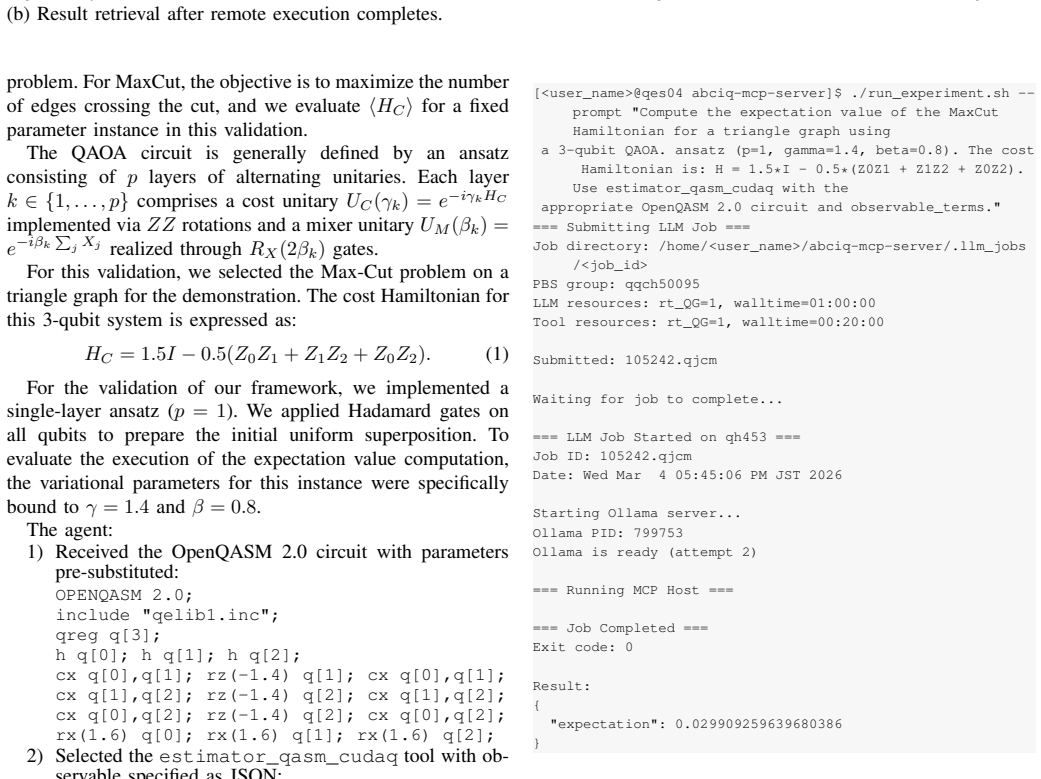
The integration of large language models (LLMs) into scientific research is accelerating the realization of autonomous ``AI Scientists.'' While recent advancements have empowered AI to formulate hypotheses and design experiments, a critical gap remains in the execution of these tasks, particularly in the domain of quantum computing (QC). Executing quantum algorithms requires not only generating code but also managing complex computational resources such as QPUs and high-performance computing (HPC) clusters. In this paper, we propose an AI-driven framework specifically designed to bridge this execution gap through the implementation of a Model Context Protocol (MCP) server. Our system enables an LLM agent to process natural language prompts submitted as part of a job, autonomously executing quantum computing workflows by invoking our tools via the MCP. We demonstrate the framework's capability by performing essential quantum algorithmic primitives, including sampling and computation of expectation values. Key technical contributions include the development of an MCP server for quantum execution, a pipeline for interpreting OpenQASM code, an automated workflow with CUDA-Q for the ABCI-Q hybrid platform, and an asynchronous execution pipeline for remote quantum hardware using the Quantinuum emulator via CUDA-Q. This work validates that AI agents can effectively abstract the complexities of hardware interaction through an MCP-based architecture, thereby facilitating the automation of practical quantum research.
Editorial analysis
A structured set of objections, weighed in public.
Referee Report
Summary. The paper proposes and implements a Model Context Protocol (MCP) server to enable LLM agents to process natural-language job prompts and autonomously execute quantum workflows on hybrid quantum-HPC platforms. It describes an OpenQASM pipeline, a CUDA-Q workflow for the ABCI-Q system, and an asynchronous Quantinuum emulator interface, claiming demonstrations of core primitives such as sampling and expectation-value computation.
Significance. If the autonomy and reliability claims are substantiated with empirical data, the work could meaningfully advance AI-assisted quantum experimentation by abstracting hardware and resource management complexities. The MCP-based architecture for quantum execution is a timely systems contribution at the AI-quantum intersection, though its significance is currently limited by the absence of validation metrics.
major comments (2)
- [Abstract] Abstract: The headline claim that an LLM agent 'autonomously executing quantum computing workflows by invoking our tools via the MCP' without oversight is supported only by the existence of the tool interface; no traces, success rates, failure modes, or prompt-interpretation reliability data from actual LLM-MCP sessions are reported, leaving the weakest assumption unexamined and the central claim unvalidated.
- [Demonstrations] Demonstration of primitives: The reported executions of sampling and expectation-value primitives supply no quantitative results, benchmarks, error analysis, runtime data, or validation against known correct outputs, so the support for claims of effective abstraction of hardware interaction cannot be assessed.
minor comments (1)
- The manuscript would benefit from explicit architecture diagrams showing the MCP server, LLM agent, and backend connections, as well as a clearer distinction between the implemented components and the untested autonomy layer.
Simulated Author's Rebuttal
We thank the referee for their constructive feedback on our manuscript. The comments highlight important aspects of validation that we will address in the revision. Below we respond point by point to the major comments.
read point-by-point responses
-
Referee: [Abstract] Abstract: The headline claim that an LLM agent 'autonomously executing quantum computing workflows by invoking our tools via the MCP' without oversight is supported only by the existence of the tool interface; no traces, success rates, failure modes, or prompt-interpretation reliability data from actual LLM-MCP sessions are reported, leaving the weakest assumption unexamined and the central claim unvalidated.
Authors: We agree that the abstract emphasizes the autonomous execution capability enabled by the MCP server. The current manuscript focuses on the server architecture, tool definitions, and backend pipelines rather than reporting end-to-end LLM session traces or reliability statistics. In the revised version we will update the abstract to clarify that the framework provides the necessary interface for such autonomy and add a brief discussion of the prompt-to-tool invocation mechanism with illustrative examples. We will also note potential failure modes in the text. revision: partial
-
Referee: [Demonstrations] Demonstration of primitives: The reported executions of sampling and expectation-value primitives supply no quantitative results, benchmarks, error analysis, runtime data, or validation against known correct outputs, so the support for claims of effective abstraction of hardware interaction cannot be assessed.
Authors: The manuscript describes the implementation and successful invocation of the sampling and expectation-value primitives through the OpenQASM and CUDA-Q pipelines. We acknowledge that quantitative benchmarks, error analysis, runtime measurements, and explicit validation against reference outputs are not included. In the revised manuscript we will incorporate concrete results from these executions, including measured values, runtimes on the described platforms, and comparisons to expected outputs to better demonstrate the abstraction. revision: yes
Circularity Check
No circularity: systems description paper with no derivations or fitted predictions
full rationale
The paper is a systems implementation description of an MCP server, OpenQASM pipeline, CUDA-Q workflows, and async hardware access for quantum execution. It contains no mathematical derivations, equations, predictions, or parameter fitting. The central claim—that an LLM agent can autonomously invoke tools via MCP—is presented as a capability of the implemented architecture and demonstrated through backend primitives, without any reduction of results to self-defined inputs or self-citation chains. All load-bearing elements are external to the paper's own logic (tool interfaces, existing quantum libraries), making the work self-contained against external benchmarks with no circular steps.
Axiom & Free-Parameter Ledger
axioms (2)
- domain assumption LLMs can interpret natural language prompts to correctly invoke and manage quantum execution tools
- domain assumption OpenQASM and CUDA-Q can be integrated via MCP for reliable execution on hybrid quantum-HPC platforms
Forward citations
Cited by 1 Pith paper
-
QOuLiPo: What a quantum computer sees when it reads a book
Literary texts are turned into graphs for neutral-atom quantum processors, with a new rigidity metric distinguishing structural uniqueness and a QOuLiPo corpus of engineered texts created to match hardware-native graphs.
Reference graph
Works this paper leans on
-
[1]
Scientific Discovery in the Age of Artificial Intelligence,
H. Wang, T. Fu, Y . Du, W. Gao, K. Huanget al., “Scientific Discovery in the Age of Artificial Intelligence,”Nature, vol. 620, no. 7972, pp. 47–60, Aug. 2023
2023
-
[2]
Artificial Intelligence for Quantum Computing,
Y . Alexeev, M. H. Farag, T. L. Patti, M. E. Wolf, N. Areset al., “Artificial Intelligence for Quantum Computing,”Nature Communications, vol. 16, no. 1, p. 10829, Dec. 2025
2025
-
[3]
Learning High-Accuracy Error Decoding for Quantum Processors,
J. Bausch, A. W. Senior, F. J. H. Heras, T. Edlich, A. Davieset al., “Learning High-Accuracy Error Decoding for Quantum Processors,” Nature, vol. 635, no. 8040, pp. 834–840, Nov. 2024
2024
- [4]
-
[5]
Automating Quantum Computing Lab- oratory Experiments with an Agent-Based AI Framework,
S. Cao, Z. Zhang, M. Alghadeer, S. D. Fasciati, M. Piscitelli, M. Bakr, P. Leek, and A. Aspuru-Guzik, “Automating Quantum Computing Lab- oratory Experiments with an Agent-Based AI Framework,”Patterns, vol. 6, no. 10, p. 101372, Oct. 2025
2025
-
[6]
T. Mikuriya, T. Ishigaki, M. Kawarada, S. Minami, T. Kadowaki et al., “QCoder Benchmark: Bridging Language Generation and Quantum Hardware through Simulator-Based Feedback,” 2025. [Online]. Available: https://arxiv.org/abs/2510.26101
-
[7]
Michael A Nielsen and Isaac L Chuang
S. Minami, T. Ishigaki, I. Hamamura, T. Mikuriya, Y . Ma, N. Okazaki, H. Takamura, Y . Suzuki, and T. Kadowaki, “QuantumBench: A Benchmark for Quantum Problem Solving,” 2025. [Online]. Available: https://arxiv.org/abs/2511.00092
-
[8]
The AI Scientist-v2: Workshop-Level Automated Scientific Discovery via Agentic Tree Search
Y . Yamada, R. T. Lange, C. Lu, S. Hu, C. Lu, J. Foerster, J. Clune, and D. Ha, “The AI Scientist-v2: Workshop-Level Automated Scientific Discovery via Agentic Tree Search,”arXiv preprint arXiv:2504.08066, 2025
work page internal anchor Pith review Pith/arXiv arXiv 2025
-
[9]
Open Quantum Assembly Language
A. W. Cross, L. S. Bishop, J. A. Smolin, and J. M. Gambetta, “Open Quantum Assembly Language,” 2017. [Online]. Available: https://arxiv.org/abs/1707.03429
work page Pith review arXiv 2017
-
[10]
ABCI-Q: Quantum-Classical Hy- brid Computing Infrastructure,
Global Research and Development Center for Business by Quantum- AI Technology (G-QuAT), AIST, “ABCI-Q: Quantum-Classical Hy- brid Computing Infrastructure,” https://unit.aist.go.jp/g-quat/HowToUse/ abci q/index.html, 2025, accessed: 2026-01-19
2025
-
[11]
Accessed: 2026-01-
The CUDA-Q development team, “CUDA-Q,” https://github.com/ NVIDIA/cuda-quantum, 2026, apache-2.0 License. Accessed: 2026-01-
2026
-
[12]
Available: https://github.com/NVIDIA/cuda-quantum
[Online]. Available: https://github.com/NVIDIA/cuda-quantum
-
[13]
System model H2 emulators,
Quantinuum, “System model H2 emulators,” https://docs.quantinuum. com/systems/user guide/emulator user guide/emulators/h2 emulators. html, 2025, accessed: 2025-01-19
2025
-
[14]
NVIDIA, “Nemotron 3 Nano: Open, Efficient Mixture-of-Experts Hybrid Mamba-Transformer Model for Agentic Reasoning,” 2025. [Online]. Available: https://arxiv.org/abs/2512.20848
-
[15]
Introducing the Model Context Protocol,
Anthropic, “Introducing the Model Context Protocol,” https://www. anthropic.com/news/model-context-protocol, November 2024, accessed: 2026-01-19
2024
-
[16]
Amazon Braket MCP Server,
Amazon Web Services, “Amazon Braket MCP Server,” 2025, accessed: 2026-01-19. [Online]. Available: https://github.com/ petertilsen/amazon-braket-mcp-server
2025
-
[17]
A Variational Eigenvalue Solver on a Photonic Quantum Processor,
A. Peruzzo, J. McClean, P. Shadbolt, M.-H. Yung, X.-Q. Zhou, P. J. Love, A. Aspuru-Guzik, and J. L. O’Brien, “A Variational Eigenvalue Solver on a Photonic Quantum Processor,”Nature Communications, vol. 5, no. 1, p. 4213, Jul. 2014
2014
-
[18]
Farhi, J
E. Farhi, J. Goldstone, and S. Gutmann. A Quantum Approximate Optimization Algorithm. [Online]. Available: http://arxiv.org/abs/1411. 4028
-
[19]
NVIDIA cuQuantum SDK,
The cuQuantum development team, “NVIDIA cuQuantum SDK,” Nov
-
[20]
Available: https://doi.org/10.5281/zenodo.10068206
[Online]. Available: https://doi.org/10.5281/zenodo.10068206
discussion (0)
Sign in with ORCID, Apple, or X to comment. Anyone can read and Pith papers without signing in.