Recognition: 2 theorem links
· Lean TheoremQOuLiPo: What a quantum computer sees when it reads a book
Pith reviewed 2026-05-15 04:45 UTC · model grok-4.3
The pith
Texts map to neutral-atom processors as graphs of atoms under blockade constraints, recovering their structural backbone with high fidelity for engineered cases.
A machine-rendered reading of the paper's core claim, the machinery that carries it, and where it could break.
Core claim
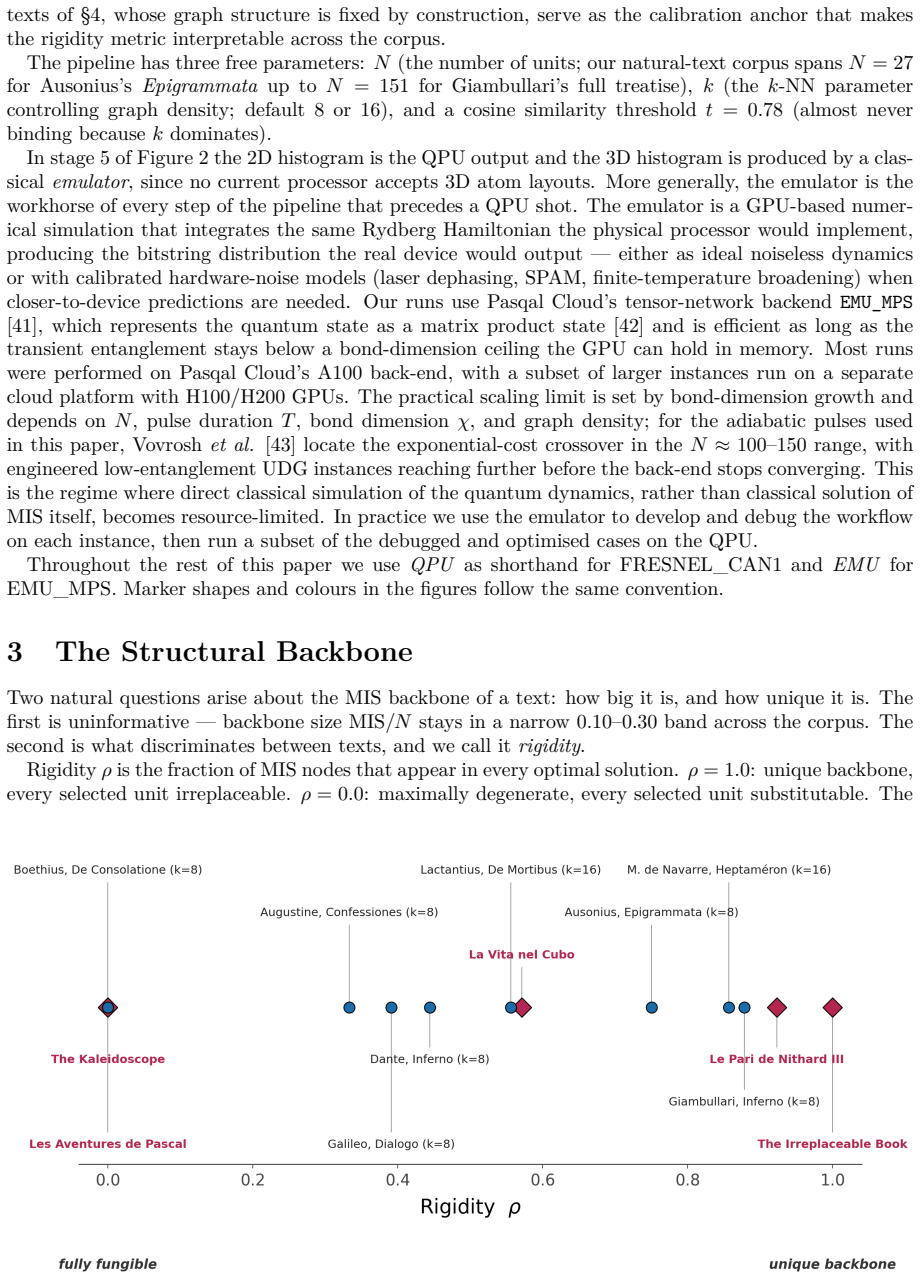
Representing a book as a graph with textual units as atoms and edges as blockade constraints or 2D semantic approximations allows a neutral-atom processor to extract the structural backbone; rigidity rho quantifies the uniqueness of that backbone, distinguishing rigid texts such as the Heptameron from fully fungible ones such as Boethius, while texts engineered to match hardware-native graphs achieve exact recovery on current devices.
What carries the argument
Graph encoding of texts where units become atoms and relations become blockade constraints, together with the rigidity rho metric that measures how uniquely determined the backbone is.
If this is right
- The QOuLiPo corpus supplies a growing benchmark distribution for measuring neutral-atom hardware performance as atom counts increase.
- Graph-topological constraints extend the OuLiPo tradition into a form directly executable on quantum processors.
- Digital Humanities obtains an operational interface for structural text analysis that runs on cloud-accessible quantum devices.
- Agentic coding environments allow a single user to generate, map, and solve new texts end-to-end on the hardware.
Where Pith is reading between the lines
- Quantum superposition over possible backbones could eventually surface alternative structural readings of a text that classical methods miss.
- The same graph-mapping technique could be applied to music scores or visual compositions to create constraint-based artworks native to quantum hardware.
- Hardware-native writing may impose new limits on what narrative structures can be expressed without loss under the processor's constraints.
- Early adoption by humanists today shapes the reference distribution against which future scaled processors will be evaluated.
Load-bearing premise
That mapping textual units to atoms under blockade constraints or 2D semantic approximations preserves the meaningful structural backbone of the original prose.
What would settle it
Running multiple engineered QOuLiPo texts on the processor and finding that the returned configurations do not recover the target backbone structures, or that natural texts show no correlation between rigidity rho and solution quality.
Figures






read the original abstract
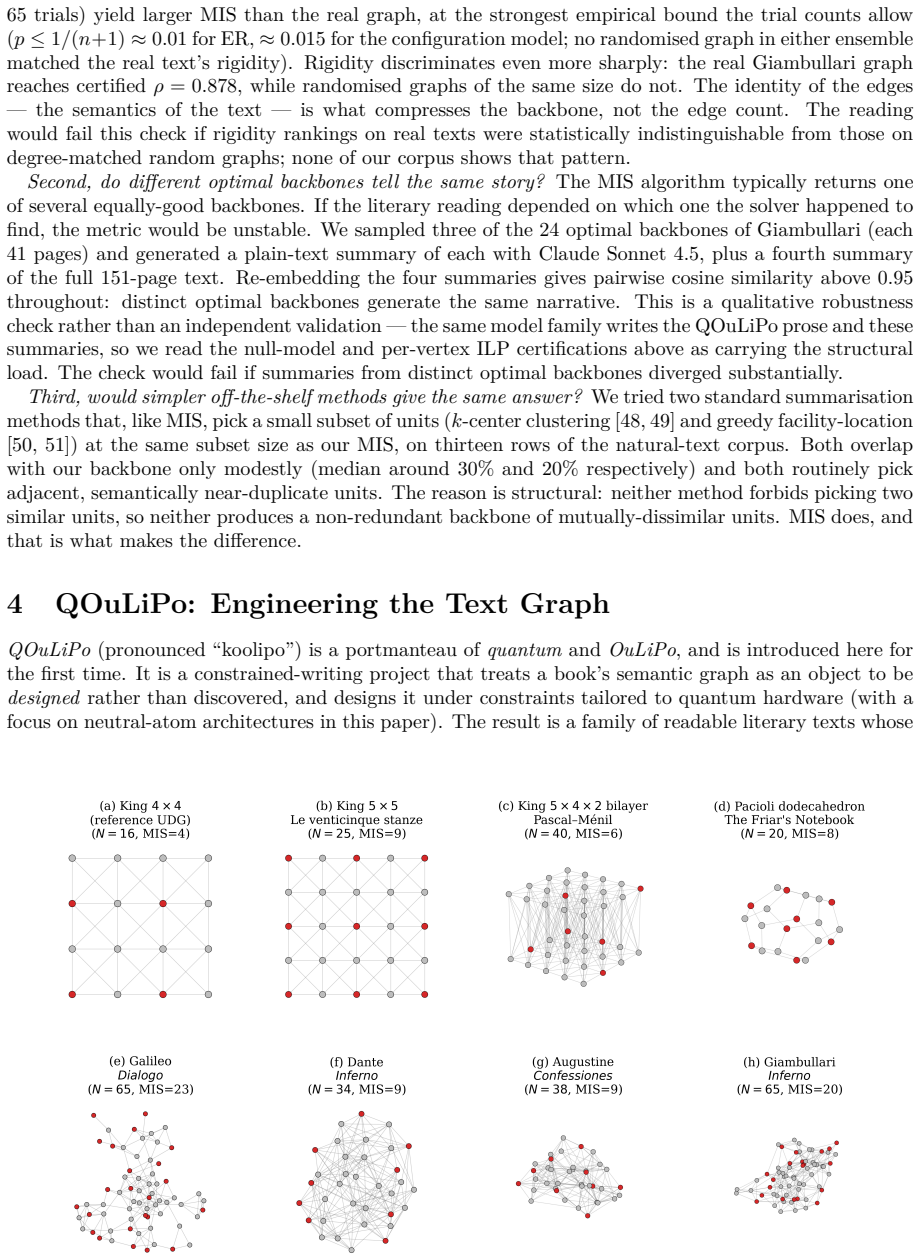
What does a book look like to a quantum computer? This paper takes eight classical works of the Renaissance and its late-antique inheritance -- from Augustine to Galileo -- and runs each through a neutral-atom quantum processor. The bridge is graphs: each textual unit becomes an atom, and graph edges are physical blockade constraints for engineered exact unit-disk designs, or a 2D approximation to the semantic graph for natural texts. Three contributions follow. First, we introduce rigidity rho, a metric for how unique a book's structural backbone is -- distinguishing Marguerite de Navarre's Heptameron (rigid, twelve-nouvelle hard core) from Boethius (fully fungible, every chapter substitutable). Second, we invert the pipeline: rather than extracting a graph from existing prose, we pick a target graph the hardware encodes natively, and write a book whose structure matches it. The twenty-nine texts written this way, collected under the name QOuLiPo, extend the OuLiPo tradition to graph-topological constraints and, together with the eight natural texts, form a benchmark distribution against which neutral-atom hardware can be tracked as it scales. Third, we run both natural and engineered texts on Pasqal's FRESNEL processor up to one hundred atoms; engineered texts reach high approximation ratios, the cleanest instances returning the exact backbone. A cloud-accessible quantum machine plus an agentic coding environment now lets a single investigator run this pipeline end-to-end. What is reported is an application layer, not a speedup -- humanistic instances ready to load onto neutral-atom processors as they scale, already complementing classical text analysis. The Digital Humanities community has a stake in building familiarity with this hardware now: the engineered-corpus design choices made today fix the benchmark distribution future hardware will be measured against.
Editorial analysis
A structured set of objections, weighed in public.
Referee Report
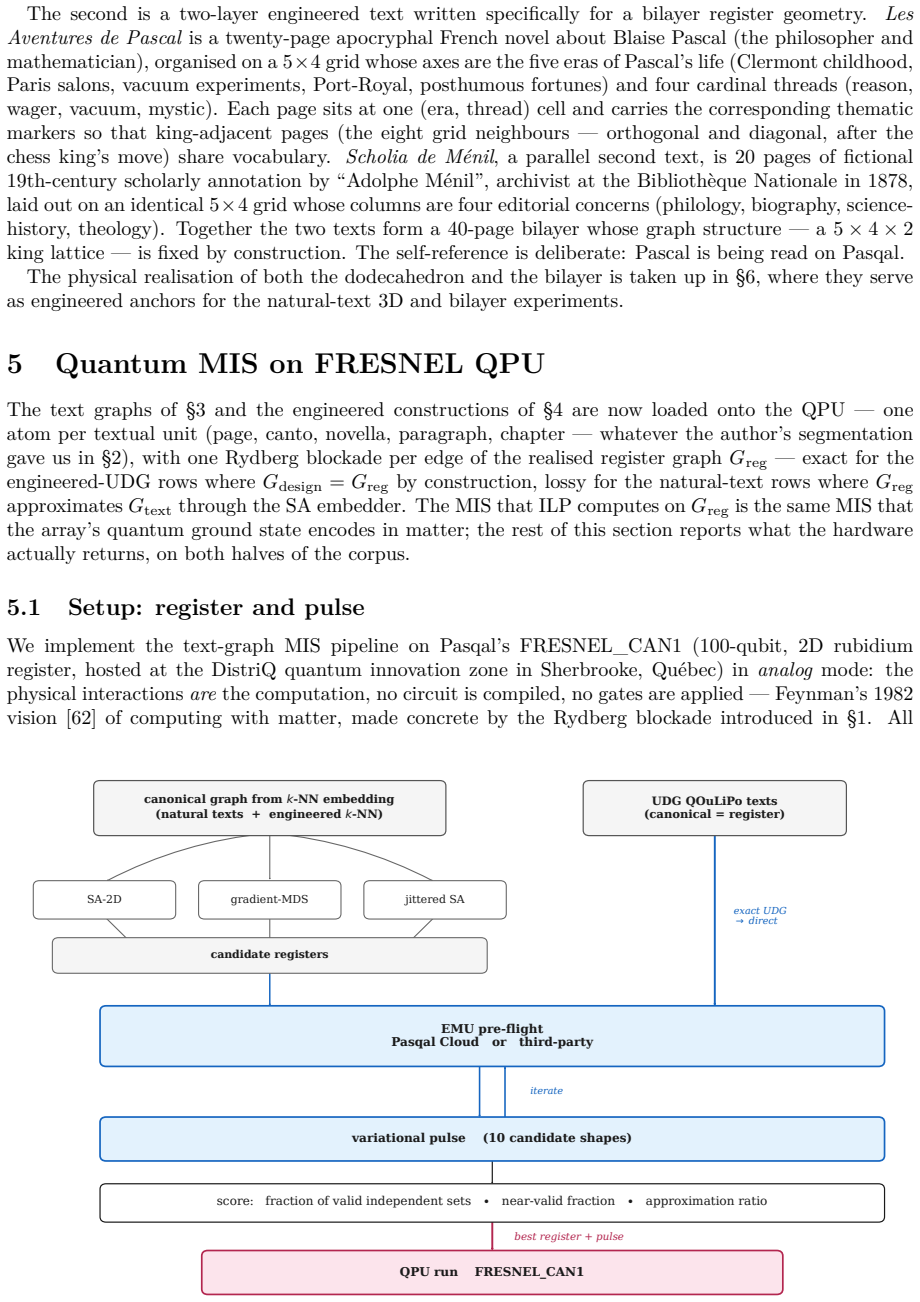
Summary. The paper maps eight Renaissance and late-antique texts to graphs for neutral-atom quantum processors (blockade constraints for engineered unit-disk graphs, 2D semantic approximations for natural texts), introduces rigidity rho as a metric of structural uniqueness, constructs 29 engineered QOuLiPo texts whose graphs match hardware-native constraints, and reports runs on Pasqal's FRESNEL processor up to 100 atoms where engineered instances achieve high approximation ratios and some return the exact backbone.
Significance. If the semantic-to-graph mapping is shown to preserve higher-order literary relations, the work supplies reproducible benchmark instances for neutral-atom hardware scaling and a new structural metric for digital humanities; the QOuLiPo corpus and end-to-end pipeline are concrete strengths for tracking hardware progress.
major comments (3)
- [Abstract] Abstract and § on natural-text pipeline: the claim that 2D semantic approximations yield meaningful backbones for the eight classical works rests on an unvalidated assumption that the embedding retains narrative or rhetorical relations recognized by literary analysis; without explicit validation or comparison to classical close reading, the quantum outputs solve a different graph than the one implied by the prose.
- [Abstract] Rigidity rho definition (abstract and § introducing the metric): rho is presented as distinguishing rigid structures (e.g., Heptameron) from fungible ones (Boethius) without a visible derivation, formula, or demonstration that it is independent of the chosen graph-construction rules; this leaves open whether the metric is circular with the embedding choices.
- [Abstract] Experimental results on FRESNEL (abstract and § reporting runs): the statements of 'high approximation ratios' and 'exact backbone' for engineered texts lack reported error bars, raw data, or explicit mapping rules, making it impossible to assess whether the solver performance is independent of the design-by-construction of the unit-disk instances.
minor comments (2)
- [Abstract] The abstract introduces 'rigidity rho' without an equation or explicit definition; add the formula and at least one worked example in the main text.
- [Methods] Clarify the precise graph-construction procedure for the 2D semantic approximation (e.g., how textual units are embedded and edges weighted) so that the pipeline can be reproduced from the manuscript alone.
Simulated Author's Rebuttal
We thank the referee for the careful and constructive review. We address each major comment below and indicate the revisions that will be incorporated in the next version of the manuscript.
read point-by-point responses
-
Referee: [Abstract] Abstract and § on natural-text pipeline: the claim that 2D semantic approximations yield meaningful backbones for the eight classical works rests on an unvalidated assumption that the embedding retains narrative or rhetorical relations recognized by literary analysis; without explicit validation or comparison to classical close reading, the quantum outputs solve a different graph than the one implied by the prose.
Authors: We agree that the manuscript does not contain an explicit side-by-side comparison with classical close readings. The 2D semantic embedding is presented as a practical, hardware-compatible approximation rather than a claim of exhaustive preservation of all literary relations. In the revised manuscript we will add a short subsection that qualitatively compares the extracted backbones of the Heptameron and Boethius against established scholarly interpretations of those works. This addition will make the scope and limitations of the approximation explicit while preserving the paper’s primary focus on reproducible graph instances for neutral-atom hardware. revision: partial
-
Referee: [Abstract] Rigidity rho definition (abstract and § introducing the metric): rho is presented as distinguishing rigid structures (e.g., Heptameron) from fungible ones (Boethius) without a visible derivation, formula, or demonstration that it is independent of the chosen graph-construction rules; this leaves open whether the metric is circular with the embedding choices.
Authors: The definition and derivation of rho appear in Section 3.2 but are not restated in the abstract. We will insert the explicit formula rho(G) = |distinct maximal backbones under unit-disk constraints| / |permissible substitutions| together with a one-paragraph derivation showing invariance under graph isomorphism. This will remove any appearance of circularity and make the metric’s independence from specific embedding choices immediately visible. revision: yes
-
Referee: [Abstract] Experimental results on FRESNEL (abstract and § reporting runs): the statements of 'high approximation ratios' and 'exact backbone' for engineered texts lack reported error bars, raw data, or explicit mapping rules, making it impossible to assess whether the solver performance is independent of the design-by-construction of the unit-disk instances.
Authors: We accept that the experimental reporting requires greater transparency. The revised manuscript will state the number of independent runs and include standard-error bars in both the abstract and main text. Raw approximation-ratio tables and the precise pseudocode for constructing the 29 QOuLiPo unit-disk instances will be placed in a new supplementary information file. These additions will allow readers to verify that the reported performance follows directly from the hardware-native design. revision: yes
Circularity Check
Engineered texts' exact backbone recovery reduces to input construction by design
specific steps
-
fitted input called prediction
[Abstract, third contribution]
"we pick a target graph the hardware encodes natively, and write a book whose structure matches it. The twenty-nine texts written this way, collected under the name QOuLiPo, ... Third, we run both natural and engineered texts on Pasqal's FRESNEL processor up to one hundred atoms; engineered texts reach high approximation ratios, the cleanest instances returning the exact backbone."
The structural backbone is defined by matching the chosen target graph that the hardware solves natively; therefore the processor returning that same backbone is recovering the deliberately embedded input rather than independently validating the textual-to-graph mapping or the quantum solution.
full rationale
The paper's central demonstration for engineered texts constructs books whose structure is defined to match hardware-native unit-disk graphs, then reports that the processor returns the exact backbone. This recovery is forced by the construction rather than an independent test of the mapping or solver. Natural-text results use a separate 2D semantic approximation whose fidelity to literary backbone is not shown to be independent of the same graph choices. No self-citations, uniqueness theorems, or ansatzes appear in the provided text, so the circularity is limited to the engineered pipeline. Rigidity rho is introduced without a quoted definition that would allow further reduction check.
Axiom & Free-Parameter Ledger
axioms (1)
- domain assumption Textual units can be mapped to atoms such that blockade constraints or 2D approximations preserve the structural backbone
invented entities (1)
-
rigidity rho
no independent evidence
Lean theorems connected to this paper
-
IndisputableMonolith/Cost/FunctionalEquation.leanwashburn_uniqueness_aczel unclear?
unclearRelation between the paper passage and the cited Recognition theorem.
Each textual unit becomes an atom; graph edges are physical blockade constraints for engineered exact unit-disk designs, or a 2D approximation to the semantic graph for natural texts... engineered texts reach high approximation ratios, the cleanest instances returning the exact backbone.
-
IndisputableMonolith/Foundation/AlexanderDuality.leanalexander_duality_circle_linking unclear?
unclearRelation between the paper passage and the cited Recognition theorem.
We introduce rigidity ρ, a metric for how unique a book's structural backbone is
What do these tags mean?
- matches
- The paper's claim is directly supported by a theorem in the formal canon.
- supports
- The theorem supports part of the paper's argument, but the paper may add assumptions or extra steps.
- extends
- The paper goes beyond the formal theorem; the theorem is a base layer rather than the whole result.
- uses
- The paper appears to rely on the theorem as machinery.
- contradicts
- The paper's claim conflicts with a theorem or certificate in the canon.
- unclear
- Pith found a possible connection, but the passage is too broad, indirect, or ambiguous to say the theorem truly supports the claim.
Reference graph
Works this paper leans on
-
[1]
Quantum computing with neutral atoms,
L. Henriet, L. Beguin, A. Signoles, T. Lahaye, A. Browaeys, G.-O. Reymond, and C. Jurczak, “Quantum computing with neutral atoms,”Quantum, vol. 4, p. 327, 2020
work page 2020
-
[2]
Many-body physics with individually controlled Rydberg atoms,
A. Browaeys and T. Lahaye, “Many-body physics with individually controlled Rydberg atoms,” Nature Physics, vol. 16, pp. 132–142, 2020
work page 2020
-
[3]
Quantum Optimization for Maximum Independent Set Using Rydberg Atom Arrays
H. Pichler, S.-T. Wang, L. Zhou, S. Choi, and M. D. Lukin, “Quantum optimization for maximum independent set using Rydberg atom arrays,”arXiv preprint arXiv:1808.10816, 2018
work page internal anchor Pith review Pith/arXiv arXiv 2018
-
[4]
Quantum optimization of maximum independent set using Rydberg atom arrays,
S. Ebadi, A. Keesling, M. Cain, T. T. Wang, H. Levine, D. Bluvstein, G. Semeghini, A. Omran, J.-G. Liu, R. Samajdar, X.-Z. Luo, B. Nash, X. Gao, B. Barak, E. Farhi, S. Sachdev, N. Gemelke, L. Zhou, S. Choi, H. Pichler, S.-T. Wang, M. Greiner, V. Vuletić, and M. D. Lukin, “Quantum optimization of maximum independent set using Rydberg atom arrays,”Science, ...
work page 2022
-
[5]
P. Cazals, A. François, L. Henriet, L. Leclerc, M. Marin, Y. Naghmouchi, W. da Silva Coelho, F. Sikora, V. Vitale, R. Watrigant, M. Witt Garzillo, and C. Dalyac, “Identifying hard native instances for the maximum-independent-set problem on neutral-atom quantum processors,”Physical Review Applied, vol. 25, no. 3, 2026
work page 2026
-
[6]
Fast quantum gates for neutral atoms,
D. Jaksch, J. I. Cirac, P. Zoller, S. L. Rolston, R. Côté, and M. D. Lukin, “Fast quantum gates for neutral atoms,”Phys. Rev. Lett., vol. 85, no. 10, pp. 2208–2211, 2000
work page 2000
-
[7]
Observation of Rydberg blockade between two atoms,
E. Urban, T. A. Johnson, T. Henage, L. Isenhower, D. D. Yavuz, T. G. Walker, and M. Saffman, “Observation of Rydberg blockade between two atoms,”Nature Physics, vol. 5, pp. 110–114, 2009
work page 2009
-
[8]
G. Rockwell and S. Sinclair,Hermeneutica: Digital Humanities, Interpretation and Technology. MIT Press, 2016
work page 2016
-
[9]
D. M. Blei, A. Y. Ng, and M. I. Jordan, “Latent Dirichlet allocation,”Journal of Machine Learning Research, vol. 3, pp. 993–1022, 2003
work page 2003
-
[10]
Queneau,Cent Mille Milliards de Poèmes
R. Queneau,Cent Mille Milliards de Poèmes. Gallimard, 1961
work page 1961
- [11]
- [12]
-
[13]
Berkman,OuLiPo and the Mathematics of Literature
N. Berkman,OuLiPo and the Mathematics of Literature. Peter Lang, 2022
work page 2022
-
[14]
A Model Context Protocol Server for Quantum Execution in Hybrid Quantum-HPC Environments
M. Shiraishi, I. Hamamura, T. Ishigaki, and T. Kadowaki, “A model context protocol server for quantum execution in hybrid quantum-hpc environments,”arXiv preprint arXiv:2604.08318, 2026
work page internal anchor Pith review Pith/arXiv arXiv 2026
-
[15]
H. Silvério, S. Grijalva, C. Dalyac, L. Leclerc, P. J. Karalekas, N. Shammah, M. Beji, L.-P. Henry, and L. Henriet, “Pulser: An open-source package for the design of pulse sequences in programmable neutral-atom arrays,”Quantum, vol. 6, p. 629, 2022
work page 2022
- [16]
-
[17]
M. L. Jockers,Macroanalysis: Digital Methods and Literary History. University of Illinois Press, 2013
work page 2013
-
[18]
Underwood,Distant Horizons: Digital Evidence and Literary Change
T. Underwood,Distant Horizons: Digital Evidence and Literary Change. University of Chicago Press, 2019
work page 2019
-
[19]
Extractive multi-document text summarization based on graph independent sets,
T. Uçkan and A. Karcı, “Extractive multi-document text summarization based on graph independent sets,”Egyptian Informatics Journal, vol. 21, no. 3, pp. 145–157, 2020
work page 2020
-
[20]
C. Hark, “Using graph-based maximum independent sets with large language models for extractive text summarization,”Applied Sciences, vol. 15, no. 12, p. 6395, 2025
work page 2025
-
[21]
Strong correlations between text quality and complex networks features,
L. Antiqueira, M. d. G. V. Nunes, O. N. Oliveira Jr., and L. d. F. Costa, “Strong correlations between text quality and complex networks features,”Physica A: Statistical Mechanics and its Applications, vol. 388, no. 12, pp. 2603–2611, 2009
work page 2009
-
[22]
Identification of literary movements using complex networks to represent texts,
D. R. Amancio, O. N. Oliveira Jr., and L. d. F. Costa, “Identification of literary movements using complex networks to represent texts,”New Journal of Physics, vol. 15, p. 043048, 2013
work page 2013
-
[23]
Probing the topological properties of complex networks modeling short written texts,
D. R. Amancio, “Probing the topological properties of complex networks modeling short written texts,”PLoS ONE, vol. 10, no. 2, p. e0118394, 2015
work page 2015
-
[24]
Extracting social networks from literary fiction,
D. K. Elson, N. Dames, and K. R. McKeown, “Extracting social networks from literary fiction,” in Proceedings of the 48th Annual Meeting of the ACL, pp. 138–147, 2010
work page 2010
-
[25]
Network theory, plot analysis,
F. Moretti, “Network theory, plot analysis,”New Left Review, vol. 68, pp. 80–102, 2011
work page 2011
-
[26]
Extraction and analysis of fictional character networks: a survey,
V. Labatut and X. Bost, “Extraction and analysis of fictional character networks: a survey,”ACM Computing Surveys, vol. 52, no. 5, p. 89, 2019
work page 2019
-
[27]
Grammar-aware sentence classification on quantum computers,
K. Meichanetzidis, A. Toumi, G. de Felice, and B. Coecke, “Grammar-aware sentence classification on quantum computers,”Quantum Machine Intelligence, vol. 5, no. 1, p. 16, 2023. arXiv:2012.03756
-
[28]
Quantum humanities: a vision for quantum computing in digital humanities,
J. Barzen and F. Leymann, “Quantum humanities: a vision for quantum computing in digital humanities,”SICS Software-Intensive Cyber-Physical Systems, vol. 35, pp. 153–158, 2019
work page 2019
-
[29]
From digital humanities to quantum humanities: Potentials and applications,
J. Barzen, “From digital humanities to quantum humanities: Potentials and applications,” inQuan- tum Computing in the Arts and Humanities(E. R. Miranda, ed.), Springer, 2022. arXiv:2103.11825
-
[30]
E. R. Miranda, ed.,Quantum Computing in the Arts and Humanities: An Introduction to Core Concepts, Theory and Applications. Springer, 2022
work page 2022
-
[31]
QNLP in practice: Run- ning compositional models of meaning on a quantum computer,
R. Lorenz, A. Pearson, K. Meichanetzidis, D. Kartsaklis, and B. Coecke, “QNLP in practice: Run- ning compositional models of meaning on a quantum computer,”Journal of Artificial Intelligence Research, vol. 76, pp. 1305–1342, 2023. arXiv:2102.12846
-
[32]
Large-scale structure-aware pronoun resolution using quantum natural language processing,
H. Wazni, K. I. Lo, L. McPheat, and M. Sadrzadeh, “Large-scale structure-aware pronoun resolution using quantum natural language processing,”Quantum Machine Intelligence, vol. 6, no. 2, p. 60, 2024
work page 2024
-
[33]
A 2.48% CER VLM-OCR pipeline for a heavily accented 1544 Florentine treatise,
C. Jurczak, “A 2.48% CER VLM-OCR pipeline for a heavily accented 1544 Florentine treatise,” Apr. 2026. Preprint.https://zenodo.org/records/19503091. 20
-
[34]
Harvard University Press, “Loeb classical library.”https://www.loebclassics.com/. Subscription bilingual Greek/Latin–English series; founded 1911
work page 1911
-
[35]
The latin library: A free resource for latin texts
The Latin Library, “The latin library: A free resource for latin texts.”https://www. thelatinlibrary.com/. Open-access Latin transcriptions, classical and post-classical
-
[36]
DigiLiBLT: Biblioteca digitale di testi latini tardoantichi
DigiLiBLT, “DigiLiBLT: Biblioteca digitale di testi latini tardoantichi.”https://digiliblt. uniupo.it/. Università degli Studi del Piemonte Orientale; open-access digital library of Late Antique Latin texts
-
[37]
A mathematical physicist in hell: Galileo on the geometry of Dante’s Inferno,
J.-M. Lévy-Leblond, “A mathematical physicist in hell: Galileo on the geometry of Dante’s Inferno,” inImagine Math 8: Dreaming Venice(M. Emmer and M. Abate, eds.), Springer, 2022
work page 2022
-
[38]
M. A. Peterson,Galileo’s Muse: Renaissance Mathematics and the Arts. Harvard University Press, 2011
work page 2011
-
[39]
Multilingual E5 Text Embeddings: A Technical Report
L. Wang, N. Yang, X. Huang, L. Yang, R. Majumder, and F. Wei, “Multilingual E5 text embeddings: A technical report,”arXiv preprint arXiv:2402.05672, 2024
work page internal anchor Pith review Pith/arXiv arXiv 2024
-
[40]
MMTEB: Massive multilingual text embedding benchmark,
K. Enevoldsenet al., “MMTEB: Massive multilingual text embedding benchmark,” inInternational Conference on Learning Representations (ICLR), 2025
work page 2025
-
[41]
emu-mps: A matrix-product-state emulator for neutral-atom quantum processors
Pasqal, “emu-mps: A matrix-product-state emulator for neutral-atom quantum processors.”https: //github.com/pasqal-io/emulators, 2024. Open-sourcetensor-networkbackendforPasqalCloud
work page 2024
-
[42]
The density-matrix renormalization group in the age of matrix product states,
U. Schollwöck, “The density-matrix renormalization group in the age of matrix product states,” Annals of Physics, vol. 326, no. 1, pp. 96–192, 2011
work page 2011
-
[43]
J. Vovrosh, T. Mendes-Santos, A. Mamann, K. Bidzhiev, M. Hayes, B. Ximenez, L. Béguin, C. Dalyac, and A. Dauphin, “Resource assessment of classical and quantum hardware for post- quench dynamics,”arXiv preprint arXiv:2511.20388, 2025
-
[44]
Vertex packings: Structural properties and algorithms,
G. L. Nemhauser and J. Trotter, Leslie E., “Vertex packings: Structural properties and algorithms,” Mathematical Programming, vol. 8, no. 1, pp. 232–248, 1975
work page 1975
-
[45]
Roof duality, complementation and persistency in quadratic 0–1 optimization,
P. L. Hammer, P. Hansen, and B. Simeone, “Roof duality, complementation and persistency in quadratic 0–1 optimization,”Mathematical Programming, vol. 28, no. 2, pp. 121–155, 1984
work page 1984
-
[46]
E. Boros and P. L. Hammer, “Pseudo-Boolean optimization,”Discrete Applied Mathematics, vol. 123, no. 1–3, pp. 155–225, 2002
work page 2002
-
[47]
Computational hermeneutics: Eval- uating generative AI as a cultural technology,
C. Kommers, R. Ahnert, M. Antoniak, E. Benetos, S. Benford, M. Bunz, B. Caramiaux, S. Concan- non, M. Disley, J. Dobson, Y. Du, E. Duéñez Guzmán, K. Francksen, E. Gius, J. Gray, R. Heuser, S. Immel, R. J. So, S. Leigh, D. Livingston, H. Long, M. Martin, G. Meyer, D. Mihai, A. Noel-Hirst, K. Ostherr, D. Parker, Y. Qin, J. Ratcliff, E. Robinson, K. Rodrigue...
work page 2025
-
[48]
Clustering to minimize the maximum intercluster distance,
T. F. Gonzalez, “Clustering to minimize the maximum intercluster distance,”Theoretical Computer Science, vol. 38, pp. 293–306, 1985
work page 1985
-
[49]
Abestpossibleheuristicforthek-centerproblem,
D.S.HochbaumandD.B.Shmoys, “Abestpossibleheuristicforthek-centerproblem,”Mathematics of Operations Research, vol. 10, no. 2, pp. 180–184, 1985
work page 1985
-
[50]
An analysis of approximations for maximizing submodular set functions – I,
G. L. Nemhauser, L. A. Wolsey, and M. L. Fisher, “An analysis of approximations for maximizing submodular set functions – I,”Mathematical Programming, vol. 14, pp. 265–294, 1978
work page 1978
-
[51]
Submodular function maximization,
A. Krause and D. Golovin, “Submodular function maximization,”Tractability: Practical Approaches to Hard Problems, pp. 71–104, 2014
work page 2014
-
[52]
OuLiPo,Atlas de littérature potentielle. Paris: Gallimard, 1981
work page 1981
- [53]
-
[54]
R. Netz and W. Noel,The Archimedes Codex: Revealing the Secrets of the World’s Greatest Palimpsest. Da Capo Press, 2011
work page 2011
-
[55]
Praefatio ad Centonem Nuptialem,
D. M. Ausonius, “Praefatio ad Centonem Nuptialem,” ca. 370. Modern critical edition: R. P. H. Green (ed.),The Works of Ausonius, Oxford: Clarendon Press, 1991, pp. 132–134; Loeb edition: H. G. Evelyn-White (trans.),Ausonius, vol. 1, Cambridge MA: Harvard University Press, 1919/1985, pp. 370–373. Photographed in this work from the Aldineeditio princeps, Ve...
work page 1991
-
[56]
A. Blossier-Jacquemot,Les Oulipiens antiques: pour une anthropologie des pratiques d’écriture à contraintes dans l’antiquité. PhD thesis, Université Paris VII Diderot, 2009
work page 2009
-
[57]
Calvino,Il castello dei destini incrociati
I. Calvino,Il castello dei destini incrociati. Torino: Einaudi, 1973
work page 1973
-
[58]
Calvino,Se una notte d’inverno un viaggiatore
I. Calvino,Se una notte d’inverno un viaggiatore. Torino: Einaudi, 1979
work page 1979
-
[59]
Calvino,Lezioni americane: sei proposte per il prossimo millennio
I. Calvino,Lezioni americane: sei proposte per il prossimo millennio. Milano: Garzanti, 1988
work page 1988
-
[60]
J. L. Borges,El jardín de senderos que se bifurcan. Buenos Aires: Editorial Sur, 1941. Collection containingLa biblioteca de Babeland the title storyEl jardín de senderos que se bifurcan; both later included inFicciones(1944)
work page 1941
-
[61]
QOuLiPo corpus — canonical text-graph data,
C. Jurczak, “QOuLiPo corpus — canonical text-graph data,” 2026. Dataset.https://doi.org/10. 5281/zenodo.20074378
work page 2026
-
[62]
Simulating physics with computers,
R. P. Feynman, “Simulating physics with computers,”International Journal of Theoretical Physics, vol. 21, no. 6–7, pp. 467–488, 1982
work page 1982
-
[63]
Embedding the MIS problem for non-local graphs with bounded degree using 3D arrays of atoms,
C. Dalyac and L. Henriet, “Embedding the MIS problem for non-local graphs with bounded degree using 3D arrays of atoms,”arXiv preprint arXiv:2209.05164, 2022
-
[64]
P. Cazals, A. Sorondo, V. Onofre, C. Dalyac, W. Coelho, and V. Vitale, “Quantum optimization on rydberg atom arrays with arbitrary connectivity: Gadgets limitations and a heuristic approach,” Physical Review A, vol. 112, p. 062416, 2025
work page 2025
-
[65]
One-to-one quantum simulation of a frustrated magnet with 256 qubits
L. Leclerc, S. Julià-Farré, G. Silva Freitas, G. Villaret, B. Albrecht, L. Béguin,et al., “One-to- one quantum simulation of the low-dimensional frustrated quantum magnet TmMgGaO4 with 256 qubits,”arXiv preprint arXiv:2603.20372, 2026
work page internal anchor Pith review Pith/arXiv arXiv 2026
-
[66]
Synthetic three-dimensional atomic structures assembled atom by atom,
D. Barredo, V. Lienhard, S. de Léséleuc, T. Lahaye, and A. Browaeys, “Synthetic three-dimensional atomic structures assembled atom by atom,”Nature, vol. 561, no. 7721, pp. 79–82, 2018
work page 2018
-
[67]
Quantumoptimization with arbitrary connectivity using Rydberg atom arrays,
M.-T.Nguyen, J.-G.Liu, J.Wurtz, M.D.Lukin, S.-T.Wang, andH.Pichler, “Quantumoptimization with arbitrary connectivity using Rydberg atom arrays,”PRX Quantum, vol. 4, no. 1, p. 010316, 2023
work page 2023
-
[68]
ICON: An ontology for com- prehensive artistic interpretations,
B. Sartini, S. Baroncini, M. van Erp, F. Tomasi, and A. Gangemi, “ICON: An ontology for com- prehensive artistic interpretations,”Journal on Computing and Cultural Heritage, vol. 16, no. 3, pp. 59–76, 2023. ICON ontology v2.0 athttps://w3id.org/icon/ontology; formalises Panofsky’s tripartite pre-iconographic / iconographic / iconological framework
work page 2023
-
[69]
IICONGRAPH: improved iconographic and iconological statements in knowledge graphs,
B. Sartini, “IICONGRAPH: improved iconographic and iconological statements in knowledge graphs,” inThe Semantic Web — 21st European Semantic Web Conference, ESWC 2024, Her- sonissos, Crete, Greece, May 26–30, 2024, Proceedings, Springer, 2024. arXiv:2402.00048; dataset Zenodo DOI 10.5281/zenodo.10294589, CC-BY 4.0
-
[70]
Describing monastic iconography using semantic data: A preliminary investigation,
S. Baroncini and F. Mele, “Describing monastic iconography using semantic data: A preliminary investigation,” inAIUCD 2025: Conference of the Italian Association for Digital Humanities, 2025
work page 2025
-
[71]
Defect-free arrays at the thousand-atom scale in a 4-K cryogenic environment
D. Lim, H. Mamann, G. Pichard,et al., “Defect-free arrays at the thousand-atom scale in a 4-K cryogenic environment,”arXiv preprint arXiv:2604.07205, 2026
work page internal anchor Pith review Pith/arXiv arXiv 2026
-
[72]
A tweezer array with 6,100 highly coherent atomic qubits,
H. J. Manetsch, G. Nomura, E. Bataille, K. H. Leung, X. Lv, and M. Endres, “A tweezer array with 6,100 highly coherent atomic qubits,”Nature, vol. 647, pp. 60–67, 2025. 22
work page 2025
-
[73]
J. Chen, S. Xiao, P. Zhang, K. Luo, D. Lian, and Z. Liu, “BGE M3-Embedding: Multi-lingual, multi-functionality, multi-granularity text embeddings through self-knowledge distillation,”arXiv preprint arXiv:2402.03216, 2024
work page internal anchor Pith review Pith/arXiv arXiv 2024
-
[74]
Arctic-Embed 2.0: Multilingual retrieval without compromise,
P. Yu, L. Merrick, G. Nuti, and D. Campos, “Arctic-Embed 2.0: Multilingual retrieval without compromise,” 2024
work page 2024
-
[75]
C. D. Manning, P. Raghavan, and H. Schütze,Introduction to Information Retrieval. Cambridge: Cambridge University Press, 2008
work page 2008
-
[76]
Graph algorithms with neutral atom quantum processors,
C. Dalyac, L. Leclerc, L. Vignoli, M. Djellabi, W. da Silva Coelho, B. Ximenez, A. Dareau, D. Dreon, V. E. Elfving, A. Signoles, L.-P. Henry, and L. Henriet, “Graph algorithms with neutral atom quantum processors,”European Physical Journal A, vol. 60, p. 177, 2024. 23 Supporting Information The supporting information collects the corpus and methodology re...
work page 2024
discussion (0)
Sign in with ORCID, Apple, or X to comment. Anyone can read and Pith papers without signing in.