Recognition: no theorem link
Metacat: a categorical framework for formal systems
Pith reviewed 2026-05-10 17:18 UTC · model grok-4.3
The pith
Formal systems are represented so that their proofs form a symmetric monoidal category encoding hypothesis reuse through substitution.
A machine-rendered reading of the paper's core claim, the machinery that carries it, and where it could break.
Core claim
Inference rules with m metavariables over a category of syntax S, taken to be a cartesian PROP, are represented by operations of arity k to n equipped with spans k leftarrow m rightarrow n in S, encoding the hypotheses and conclusions in a common metavariable context. Composition is by substitution of metavariables, which is the sole primitive operation. Proofs in this setting form a symmetric monoidal category whose monoidal structure encodes the combination and reuse of hypotheses. This structure admits a proof-checking algorithm.
What carries the argument
Operations of arity k to n equipped with spans k leftarrow m rightarrow n in the cartesian PROP of syntax, using substitution as composition to build the symmetric monoidal category of proofs.
If this is right
- The framework admits a proof-checking algorithm based on the monoidal structure.
- First-order logic can be encoded with its formulae, inference rules, axioms, and representative derivations.
- An open-source implementation with a surface syntax for defining formal systems is available.
- Proofs can be checked by verifying the compositions in the symmetric monoidal category.
Where Pith is reading between the lines
- This monoidal structure could facilitate modular proof construction across different formal systems.
- The approach may extend to interactive proof development by leveraging the categorical compositions.
- It provides a bridge between abstract categorical semantics and concrete proof assistants like Metamath.
Load-bearing premise
The category of syntax can be taken to be a cartesian PROP and inference rules with metavariables are faithfully represented by operations of arity k to n equipped with spans k leftarrow m rightarrow n, with substitution as the sole primitive operation.
What would settle it
Demonstrating a valid derivation in first-order logic that cannot be checked correctly by the algorithm derived from the symmetric monoidal structure, or an invalid one that is accepted, would falsify the admissibility of the proof-checking algorithm.
Figures

read the original abstract
We present a categorical framework for formal systems in which inference rules with $m$ metavariables over a category of syntax $\mathscr{S}$, taken to be a cartesian PROP, are represented by operations of arity $k \to n$ equipped with spans $k \leftarrow m \to n$ in $\mathscr{S}$, encoding the hypotheses and conclusions in a common metavariable context. Composition is by substitution of metavariables, which is the sole primitive operation, as in Metamath. Proofs in this setting form a symmetric monoidal category whose monoidal structure encodes the combination and reuse of hypotheses. This structure admits a proof-checking algorithm; we provide an open-source implementation together with a surface syntax for defining formal systems. As a demonstration, we encode the formulae and inference rules of first-order logic in Metacat, and give axioms and representative derivations as examples.
Editorial analysis
A structured set of objections, weighed in public.
Referee Report
Summary. The paper introduces Metacat, a categorical framework for formal systems. Syntax is modeled as a cartesian PROP, and inference rules with m metavariables are represented as operations of arity k to n equipped with spans k ← m → n that encode hypotheses and conclusions in a shared metavariable context. Composition proceeds solely by substitution of metavariables, following the Metamath style. Proofs are organized into a symmetric monoidal category whose tensor product encodes the combination and reuse of hypotheses; this structure is asserted to admit a proof-checking algorithm. The contribution includes an open-source implementation, a surface syntax for defining systems, and a concrete encoding of first-order logic with sample axioms and derivations.
Significance. If the monoidal construction and algorithm are verified, the framework would supply a rigorous categorical semantics for substitution-based proof systems, potentially enabling new compositional analyses of proofs and bridges between category theory and proof assistants. The open-source implementation and FOL demonstration provide concrete reproducibility and a test case, which are positive features for a framework paper.
major comments (2)
- [abstract and sections on monoidal structure and proof-checking algorithm] The central claim that proofs form a symmetric monoidal category whose monoidal structure encodes hypothesis combination and reuse, and that this admits a proof-checking algorithm, is load-bearing but unsupported by any explicit construction, verification of the monoidal axioms (associativity, unitors, braiding), or description of the algorithm in the manuscript. The abstract and the sections on the monoidal category of proofs and the proof-checking algorithm reference the implementation but supply no derivations or correctness arguments.
- [section introducing the representation of inference rules] The weakest assumption—that the category of syntax can be taken to be a cartesian PROP and that inference rules with metavariables are faithfully represented by operations of arity k to n equipped with spans k ← m → n, with substitution as the sole primitive—is stated without discussion of its scope or potential counterexamples in formal systems that require additional structure beyond substitution.
minor comments (2)
- [section on syntax and inference rules] Notation for the spans and arities (e.g., k ← m → n) should be introduced with a diagram or explicit definition on first use to improve readability for readers unfamiliar with PROPs.
- [introduction or related work] The manuscript would benefit from a brief comparison table or paragraph contrasting Metacat with related categorical approaches to logic (e.g., those based on operads or polycategories) to clarify novelty.
Simulated Author's Rebuttal
We thank the referee for their thoughtful review and valuable comments on our paper. We address each major comment below and indicate the revisions we plan to make to strengthen the presentation of our framework.
read point-by-point responses
-
Referee: [abstract and sections on monoidal structure and proof-checking algorithm] The central claim that proofs form a symmetric monoidal category whose monoidal structure encodes hypothesis combination and reuse, and that this admits a proof-checking algorithm, is load-bearing but unsupported by any explicit construction, verification of the monoidal axioms (associativity, unitors, braiding), or description of the algorithm in the manuscript. The abstract and the sections on the monoidal category of proofs and the proof-checking algorithm reference the implementation but supply no derivations or correctness arguments.
Authors: We agree that the manuscript does not provide an explicit construction or verification of the symmetric monoidal category structure on proofs within the text itself, instead referencing the implementation for these details. This is a valid point, and we will revise the sections on the monoidal category of proofs and the proof-checking algorithm to include an explicit definition of the category, verification of the monoidal axioms (associativity, unitors, and braiding), and a high-level description of the proof-checking algorithm along with a sketch of its correctness. These additions will make the central claims self-contained and supported directly in the manuscript. revision: yes
-
Referee: [section introducing the representation of inference rules] The weakest assumption—that the category of syntax can be taken to be a cartesian PROP and that inference rules with metavariables are faithfully represented by operations of arity k to n equipped with spans k ← m → n, with substitution as the sole primitive—is stated without discussion of its scope or potential counterexamples in formal systems that require additional structure beyond substitution.
Authors: The referee correctly identifies that the modeling assumptions are presented without extensive discussion of their applicability or limitations. We will expand the section introducing the representation of inference rules to include a discussion of the scope of using cartesian PROPs for syntax and spans for metavariable contexts. This will cover why substitution is taken as the sole primitive (following Metamath) and note potential counterexamples or systems where additional structure might be needed, such as those with binding or dependent types, while arguing that the framework targets substitution-based systems. revision: yes
Circularity Check
No significant circularity detected
full rationale
The paper constructs a categorical framework directly from standard primitives: a cartesian PROP for syntax, inference rules as operations equipped with spans encoding hypotheses and conclusions, and substitution as the sole composition operation. Proofs are then organized into a symmetric monoidal category whose tensor encodes hypothesis combination and reuse, with the structure admitting a proof-checking algorithm by construction. No step reduces a claimed result to a fitted parameter, self-definition, or load-bearing self-citation; the central claims follow from the explicit representation and are demonstrated via an open-source implementation and FOL encoding. The derivation is self-contained against external benchmarks of PROPs and Metamath-style substitution.
Axiom & Free-Parameter Ledger
axioms (1)
- domain assumption The category of syntax is a cartesian PROP
Reference graph
Works this paper leans on
- [1]
- [2]
-
[3]
Filippo Bonchi, Fabio Gadducci, Aleks Kissinger, Paweł Soboci´nski & Fabio Zanasi (2022):String Diagram Rewrite Theory III: Confluence and Termination.arXiv preprint arXiv:2201.XXXX
2022
-
[4]
Filippo Bonchi, Alessandro Di Giorgio, Nathan Haydon & Pawel Sobocinski (2024):Diagrammatic Algebra of First Order Logic. arXiv:2401.07055
-
[5]
Mario Carneiro (2022):Metamath Zero: From Logic to Proof Assistant to Verified Compilation. Ph.D. thesis, Carnegie Mellon University. Available athttps://digama0.github.io/mm0/thesis.pdf
2022
- [6]
-
[7]
URL https://doi.org/10.1080/00927877608822127
Thomas Fox (1976):Coalgebras and Cartesian Categories.Communications in Algebra4(7), pp. 665–667, doi:10.1080/00927877608822127
-
[8]
Jean-Yves Girard (1987):Linear Logic.Theoretical Computer Science50, pp. 1–101. Available athttps: //girard.perso.math.cnrs.fr/linear.pdf
1987
-
[9]
com/akissinger/chyp
Aleks Kissinger (2023):Chyp: An Interactive Theorem Prover for String Diagrams.https://github. com/akissinger/chyp. Version 0.5.2, Apache-2.0 License
2023
-
[10]
Wheeler (2019):Metamath: A Computer Language for Mathematical Proofs
Norman Megill & David A. Wheeler (2019):Metamath: A Computer Language for Mathematical Proofs. Lulu Press. Available athttps://us.metamath.org/downloads/metamath.pdf
2019
-
[11]
Lecture notes
Paul-André Melliès (2009):Categorical Semantics of Linear Logic. Lecture notes
2009
-
[12]
arXiv preprint arXiv:2104.XXXXX
Leonardo de Moura & Sebastian Ullrich (2021):Lean 4: A Programming Language and Theorem Prover. arXiv preprint arXiv:2104.XXXXX
2021
-
[13]
In: International Conference on Types for Proofs and Programs (TYPES 2006), Springer, pp
Ulf Norell (2007):Towards a Practical Programming Language Based on Dependent Type Theory. In: International Conference on Types for Proofs and Programs (TYPES 2006), Springer, pp. 175–189
2007
-
[14]
Data-parallel algorithms for string diagrams.arXiv preprint arXiv:2305.01041,
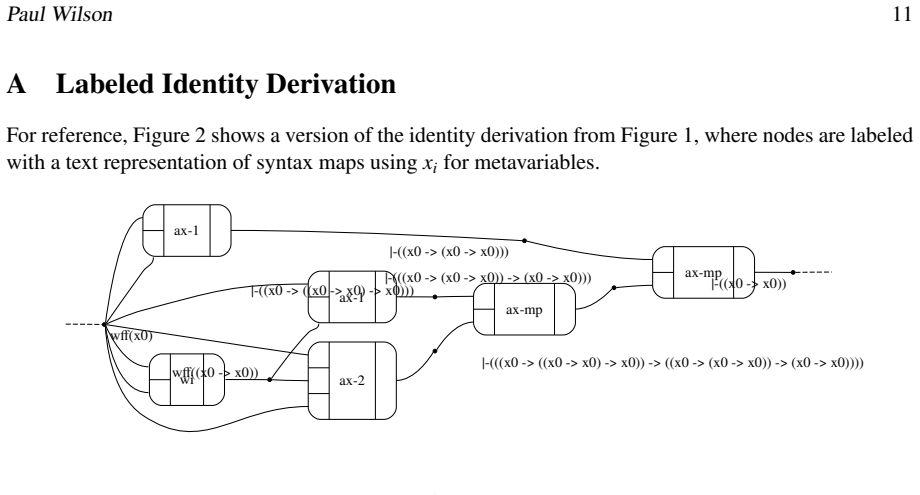
Paul Wilson & Fabio Zanasi (2023):Data-Parallel Algorithms for String Diagrams. arXiv:2305.01041. Paul Wilson 11 A Labeled Identity Derivation For reference, Figure 2 shows a version of the identity derivation from Figure 1, where nodes are labeled with a text representation of syntax maps usingx i for metavariables. wff(x0) ax-1 wi ax-1 ax-2 |-((x0 -> (x0...
discussion (0)
Sign in with ORCID, Apple, or X to comment. Anyone can read and Pith papers without signing in.