Recognition: 2 theorem links
· Lean TheoremA parametric study of plasma instability cooling and its impact on intergalactic magnetic field constraints in GeV cascades
Pith reviewed 2026-05-10 18:01 UTC · model grok-4.3
The pith
Plasma instabilities with a characteristic length scale of order 100 kpc cool electron-positron pairs enough to reproduce observed GeV spectra from blazars while implying intergalactic magnetic fields of order 10^{-17} G.
A machine-rendered reading of the paper's core claim, the machinery that carries it, and where it could break.
Core claim
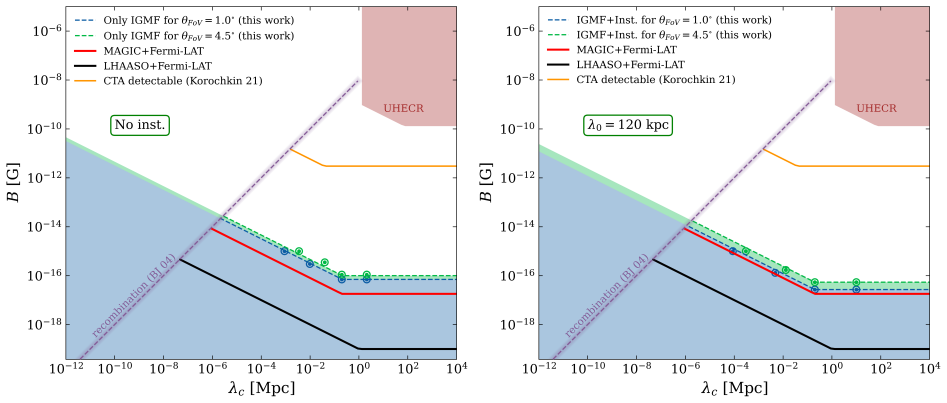
The paper claims that a parameterized model for plasma instability cooling, when included in cascade development, reproduces the observed GeV photon spectrum of 1ES 0229+200 for instability length scales of order 100 kpc. Under these conditions the best-fit intergalactic magnetic field strength consistent with extended-emission observations at different field-of-view angles is of order 10^{-17} G.
What carries the argument
Parameterized cooling term that reduces the energy of electron-positron pairs before they inverse-Compton scatter background photons to GeV energies.
If this is right
- The observed spectrum is reproduced when the instability length scale is of order 100 kpc.
- The implied IGMF strength drops to order 10^{-17} G once cooling is included.
- Constraints on the field strength vary with the observer's field-of-view angle.
- Extended-emission data within the field of view tighten the joint bounds on instability scale and magnetic field.
Where Pith is reading between the lines
- Applying the same parameterization to other blazars would test whether a single instability scale works across sources.
- Weaker IGMF limits would follow for any cascade study that previously omitted instability cooling.
- High-resolution spectra could distinguish the 100 kpc scale from other possible cooling lengths.
Load-bearing premise
The ad-hoc parameterized cooling term accurately captures the physical effect of plasma instabilities on pair energy loss before inverse-Compton scattering.
What would settle it
A GeV spectrum from another blazar at comparable redshift that cannot be reproduced for any instability length scale near 100 kpc and any IGMF near 10^{-17} G would falsify the reproduction claim.
Figures




read the original abstract
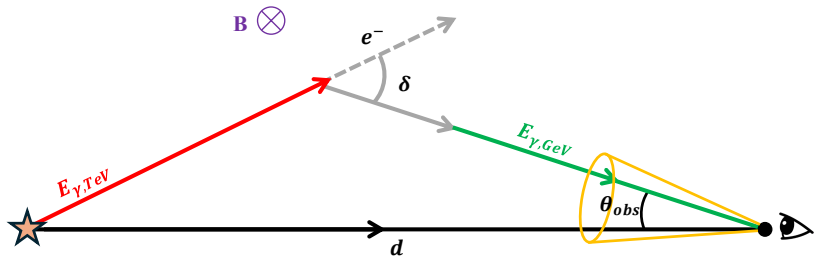
Electromagnetic cascades are initiated by TeV gamma rays propagating through the intergalactic medium (IGM), and they can be used to constrain the weak intergalactic magnetic field (IGMF) in cosmic voids. Primary TeV photons produce electrons and positrons through electromagnetic pair production, which can be deflected out of the line-of-sight to the observer by IGMF. In addition, electron-positron pairs can perturb the IGM, triggering plasma instabilities that can cool down the pairs before they upscatter cosmic background photons to GeV energies via inverse Compton (IC) scattering. We investigate the influence of plasma instabilities on the cascade spectrum by introducing a parameterized model for the instability using a publicly available Monte Carlo framework CRPropa. We use extended-emission observations within the field of view of the observer to constrain the IGMF in the presence of plasma instability cooling. Based on spectral observations of the blazar 1ES 0229+200 from Fermi-LAT, we find the best-fit photon spectrum including the plasma instability and IGMF parameters that reproduces the observational data for different observer field-of-view angles and obtain the IGMF constraint in cosmic voids. We find that plasma instabilities with a characteristic length scale of order $10^{2}~\text{kpc}$ reproduce the observed photon spectrum and imply an IGMF strength of order $10^{-17}~\text{G}$.
Editorial analysis
A structured set of objections, weighed in public.
Referee Report
Summary. The paper introduces a parameterized cooling term in CRPropa to model the effect of plasma instabilities on electron-positron pairs in electromagnetic cascades from TeV blazars. Using spectral data from 1ES 0229+200 observed by Fermi-LAT, it fits the instability characteristic length scale (order 100 kpc) jointly with IGMF strength and observer field-of-view to reproduce the GeV cascade spectrum, yielding an IGMF constraint of order 10^{-17} G in cosmic voids.
Significance. If the parameterization accurately captures plasma instability physics, the result would imply that standard IGMF bounds from cascade deflection are incomplete and that plasma cooling can dominate pair energy loss on ~100 kpc scales, altering interpretations of blazar spectra and void magnetic fields. The work demonstrates the sensitivity of cascade modeling to additional loss channels beyond inverse-Compton and magnetic deflection.
major comments (3)
- [Abstract and methods] Abstract and methods section: the cooling term is introduced as a free-parameterized loss rate with characteristic length ~10^2 kpc, but no derivation from the growth rate, saturation amplitude, or wave-particle interactions of the oblique two-stream or filamentation instability is provided; the term is inserted by hand into CRPropa rather than computed from plasma kinetics.
- [Results] Results section: the reported IGMF strength of ~10^{-17} G is obtained by simultaneously varying the instability scale, B-field amplitude, and observer FOV to fit the same 1ES 0229+200 Fermi spectrum; this creates a degeneracy in which any mismatch between the ad-hoc cooling and actual instability physics can be absorbed into the IGMF value, so the constraint is not an independent prediction.
- [Results and discussion] No validation or robustness tests: the manuscript provides neither comparison of the parameterized cooling rate against dedicated plasma simulations nor error bars/uncertainty quantification on the best-fit parameters, nor tests of sensitivity to the functional form of the cooling term.
minor comments (2)
- [Introduction] The abstract and introduction would benefit from explicit citation of prior analytic and simulation work on IGM plasma instabilities (e.g., growth rates and saturation scales) to clarify how the chosen parameterization relates to existing literature.
- [Figures] Figure captions and axis labels should specify the exact functional form of the added cooling term and the precise definition of the characteristic length scale used in the Monte Carlo runs.
Simulated Author's Rebuttal
We thank the referee for their thorough review and valuable feedback on our manuscript. We have carefully considered each comment and made revisions to improve the clarity and robustness of our parametric study. Below, we provide point-by-point responses to the major comments.
read point-by-point responses
-
Referee: [Abstract and methods] Abstract and methods section: the cooling term is introduced as a free-parameterized loss rate with characteristic length ~10^2 kpc, but no derivation from the growth rate, saturation amplitude, or wave-particle interactions of the oblique two-stream or filamentation instability is provided; the term is inserted by hand into CRPropa rather than computed from plasma kinetics.
Authors: Our study is explicitly framed as a parametric exploration of the effects of plasma instability cooling, as stated in the title. The parameterization is motivated by order-of-magnitude estimates from the literature on the growth and saturation of instabilities such as the oblique two-stream instability in the context of blazar-induced cascades. We have expanded the methods section to include a brief derivation sketch based on the expected cooling timescale from linear growth rates and saturation amplitudes reported in prior works. The term is implemented in CRPropa to allow Monte Carlo propagation studies, which is the focus of this work rather than a full plasma kinetic simulation. revision: partial
-
Referee: [Results] Results section: the reported IGMF strength of ~10^{-17} G is obtained by simultaneously varying the instability scale, B-field amplitude, and observer FOV to fit the same 1ES 0229+200 Fermi spectrum; this creates a degeneracy in which any mismatch between the ad-hoc cooling and actual instability physics can be absorbed into the IGMF value, so the constraint is not an independent prediction.
Authors: We agree that there is a degeneracy between the instability cooling scale, IGMF strength, and observer field-of-view in fitting the observed spectrum. We have revised the results section to highlight this and present the IGMF constraint as conditional on the instability scale being of order 100 kpc. To address this, we have included a new figure showing the parameter correlations and chi-squared values, demonstrating that the data prefer lower IGMF when cooling is included. The value of 10^{-17} G represents the best-fit under these assumptions, and we discuss its implications for void magnetic fields. revision: yes
-
Referee: [Results and discussion] No validation or robustness tests: the manuscript provides neither comparison of the parameterized cooling rate against dedicated plasma simulations nor error bars/uncertainty quantification on the best-fit parameters, nor tests of sensitivity to the functional form of the cooling term.
Authors: We have added uncertainty quantification by reporting error bars on the best-fit parameters derived from the spectral fitting procedure. Additionally, we performed sensitivity tests to variations in the functional form of the cooling term and include these results in the revised discussion. However, a direct comparison to dedicated plasma simulations (such as particle-in-cell codes) is not feasible within the scope of this work, as it would require a separate computational study. revision: partial
- Direct validation of the parameterized cooling rate through comparison with dedicated plasma kinetic simulations
Circularity Check
IGMF constraint obtained by joint fit of ad-hoc instability scale and B-field to same spectral data
specific steps
-
fitted input called prediction
[Abstract]
"We find that plasma instabilities with a characteristic length scale of order 10^{2} kpc reproduce the observed photon spectrum and imply an IGMF strength of order 10^{-17} G."
The instability length scale is a free parameter in the ad-hoc cooling model; both it and the IGMF strength are varied together to match the identical 1ES 0229+200 spectrum. The 'implied' IGMF value is therefore the fitted parameter itself, not an independent constraint.
full rationale
The paper introduces a parameterized cooling term for plasma instabilities inside CRPropa and performs a fit to the Fermi-LAT spectrum of 1ES 0229+200, simultaneously varying the instability characteristic length and IGMF strength (plus observer FOV). The reported IGMF value of order 10^{-17} G is therefore the direct numerical output of that optimization rather than an independent prediction derived from plasma kinetics or cascade physics. This constitutes partial circularity of the 'fitted input called prediction' type; the central claim reduces to the fit result by construction. No self-citation chains, uniqueness theorems, or ansatz smuggling are present in the text, so the score remains moderate rather than maximal.
Axiom & Free-Parameter Ledger
free parameters (2)
- characteristic length scale of plasma instability
- IGMF strength
axioms (1)
- domain assumption Plasma instabilities cool electron-positron pairs on a characteristic length scale before they undergo inverse Compton scattering
Lean theorems connected to this paper
-
Cost/FunctionalEquation.leanwashburn_uniqueness_aczel unclear?
unclearRelation between the paper passage and the cited Recognition theorem.
We define a two-parameter energy-loss term ... E^{-1}_e dE_e/dt = c λ_0^{-1} (E_e / Ẽ_e)^{-α} sec^{-1}. We perform a parametric analysis using two parameters, the instability length scale, λ_0, and the power-law index, α
-
Foundation/RealityFromDistinction.leanreality_from_one_distinction unclear?
unclearRelation between the paper passage and the cited Recognition theorem.
plasma instabilities with a characteristic length scale of order 10^2 kpc reproduce the observed photon spectrum and imply an IGMF strength of order 10^{-17} G
What do these tags mean?
- matches
- The paper's claim is directly supported by a theorem in the formal canon.
- supports
- The theorem supports part of the paper's argument, but the paper may add assumptions or extra steps.
- extends
- The paper goes beyond the formal theorem; the theorem is a base layer rather than the whole result.
- uses
- The paper appears to rely on the theorem as machinery.
- contradicts
- The paper's claim conflicts with a theorem or certificate in the canon.
- unclear
- Pith found a possible connection, but the passage is too broad, indirect, or ambiguous to say the theorem truly supports the claim.
Reference graph
Works this paper leans on
-
[1]
M. G. Hauser, E. Dwek, The cosmic infrared background: measurements and implications, Ann. Rev. Astron. Astro- phys. 39 (2001) 249–307.doi:10.1146/annurev.as tro.39.1.249
-
[3]
R. J. Gould, G. P. Schréder, Opacity of the universe to high-energy photons, Phys. Rev. 155 (5) (1967) 1408.do i:10.1103/PhysRev.155.1408
-
[4]
G. R. Blumenthal, R. J. Gould, Bremsstrahlung, syn- chrotron radiation, and compton scattering of high-energy electrons traversing dilute gases, Rev. Mod. Phys. 42 (2) (1970) 237.doi:10.1103/RevModPhys.42.237
-
[5]
F. A. Aharonian, P. S. Coppi, H. J. V oelk, Very high- energy gamma-rays from AGN: Cascading on the cos- mic background radiation fields and the formation of pair halos, Astrophys. J. Lett. 423 (1994) L5–L8.arXiv: astro-ph/9312045,doi:10.1086/187222
-
[6]
V . Berezinsky, O. Kalashev, High energy electromagnetic cascades in extragalactic space: physics and features, Phys. Rev. D 94 (2) (2016) 023007.arXiv:1603.03989, doi:10.1103/PhysRevD.94.023007. 15
-
[7]
C. Heiter, D. Kuempel, D. Walz, M. Erdmann, Produc- tion and propagation of ultra-high energy photons using CRPropa 3, Astropart. Phys. 102 (2018) 39–50.arXiv: 1710.11406,doi:10.1016/j.astropartphys.2018 .05.003
-
[9]
Hofmann, The High Energy Stereoscopic System (HESS) project, AIP Conf
W. Hofmann, The High Energy Stereoscopic System (HESS) project, AIP Conf. Proc. 515 (1) (2000) 500. doi:10.1063/1.1291416
-
[10]
Rico, Review of fundamental physics results with the MAGIC telescopes, AIP Conf
J. Rico, Review of fundamental physics results with the MAGIC telescopes, AIP Conf. Proc. 1792 (1) (2017) 060001.doi:10.1063/1.4968984
-
[11]
T. C. Weekes, et al., VERITAS: The Very energetic ra- diation imaging telescope array system, Astropart. Phys. 17 (2002) 221–243.arXiv:astro- ph/0108478, doi:10.1016/S0927-6505(01)00152-9
-
[12]
F. A. Aharonian, TeV blazars and cosmic infrared back- ground radiation, in: 27th International Cosmic Ray Con- ference, 2001, pp. 250–261.doi:10.48550/arXiv.ast ro-ph/0112314
-
[13]
A. Neronov, D. V . Semikoz, A method of measurement of extragalactic magnetic fields by TeV gamma ray tele- scopes, JETP Lett. 85 (2007) 473–477.arXiv:astro-p h/0604607,doi:10.1134/S0021364007100013
-
[14]
A. Neronov, D. V . Semikoz, Sensitivity of gamma-ray telescopes for detection of magnetic fields in intergalac- tic medium, Phys. Rev. D 80 (2009) 123012.arXiv: 0910.1920,doi:10.1103/PhysRevD.80.123012
-
[15]
A. Neronov, I. V ovk, Evidence for strong extragalactic magnetic fields from Fermi observations of TeV blazars, Science 328 (2010) 73–75.arXiv:1006.3504,doi: 10.1126/science.1184192
-
[16]
A. M. Taylor, I. V ovk, A. Neronov, Extragalactic magnetic fields constraints from simultaneous GeV-TeV observa- tions of blazars, Astron. Astrophys. 529 (2011) A144. arXiv:1101.0932,doi:10.1051/0004- 6361/20 1116441
-
[17]
I. V ovk, A. M. Taylor, D. Semikoz, A. Neronov, Fermi/LAT observations of 1ES 0229+200: implications for extragalactic magnetic fields and background light, Astrophys. J. Lett. 747 (2012) L14.arXiv:1112.2534, doi:10.1088/2041-8205/747/1/L14
-
[18]
M. Ackermann, et al., The Search for Spatial Extension in High-latitude Sources Detected by theFermiLarge Area Telescope, Astrophys. J. Suppl. 237 (2) (2018) 32.arXi v:1804.08035,doi:10.3847/1538-4365/aacdf7
- [19]
-
[20]
Aharonian, et al., Constraints on the Intergalactic Mag- netic Field Using Fermi-LAT and H.E.S.S
F. Aharonian, et al., Constraints on the Intergalactic Mag- netic Field Using Fermi-LAT and H.E.S.S. Blazar Obser- vations, Astrophys. J. Lett. 950 (2) (2023) L16.arXiv: 2306.05132,doi:10.3847/2041-8213/acd777
-
[21]
I. V ovk, A. Korochkin, A. Neronov, D. Semikoz, Constraints on the intergalactic magnetic field from Fermi/LAT observations of the ‘pair echo’ of GRB 221009A, Astron. Astrophys. 683 (2024) A25.arXiv: 2306.07672,doi:10.1051/0004-6361/202347310
-
[22]
J. Blunier, A. Neronov, D. Semikoz, Revision of conser- vative lower bound on intergalactic magnetic field from Fermi and Cherenkov telescope observations of extreme blazars (6 2025).arXiv:2506.22285
-
[23]
V ovk, Intergalactic magnetic field lower limits up to the redshiftz≈3 (12 2025).arXiv:2512.11397
I. V ovk, Intergalactic magnetic field lower limits up to the redshiftz≈3 (12 2025).arXiv:2512.11397
-
[24]
A. E. Broderick, P. Chang, C. Pfrommer, The Cosmolog- ical Impact of Luminous TeV Blazars I: Implications of Plasma Instabilities for the Intergalactic Magnetic Field and Extragalactic Gamma-Ray Background, Astrophys. J. 752 (2012) 22.arXiv:1106.5494,doi:10.1088/0004 -637X/752/1/22
-
[25]
F. Miniati, A. Elyiv, Relaxation of Blazar Induced Pair Beams in Cosmic V oids: Measurement of Magnetic Field in V oids and Thermal History of the IGM, Astrophys. J. 770 (2013) 54.doi:10.1088/0004-637X/770/1/54
-
[26]
R. Schlickeiser, D. Ibscher, M. Supsar, Plasma effects on fast pair beams in cosmic voids, Astrophys. J. 758 (2) (2012) 102.doi:10.1088/0004-637X/758/2/102
-
[27]
R. Schlickeiser, S. Krakau, M. Supsar, Plasma effects on fast pair beams. ii. reactive versus kinetic instability of parallel electrostatic waves, Astrophys. J. 777 (1) (2013) 49.doi:10.1088/0004-637X/777/1/49
-
[28]
L. Sironi, D. Giannios, Relativistic Pair Beams from TeV Blazars: A Source of Reprocessed GeV Emission rather than Intergalactic Heating, Astrophys. J. 787 (2014) 49. doi:10.1088/0004-637X/787/1/49
-
[29]
S. Vafin, I. Rafighi, M. Pohl, J. Niemiec, The electrostatic instability for realistic pair distributions in blazar/EBL cascades, Astrophys. J. 857 (1) (2018) 43.arXiv: 1803.02990,doi:10.3847/1538-4357/aab552
-
[30]
R. Alves Batista, A. Saveliev, E. M. de Gouveia Dal Pino, The Impact of Plasma Instabilities on the Spectra of TeV Blazars, Mon. Not. Roy. Astron. Soc. 489 (3) (2019) 3836–3849.arXiv:1904.13345,doi:10.1093/mn ras/stz2389. 16
work page doi:10.1093/mn 2019
-
[31]
M. Alawashra, M. Pohl, Nonlinear Feedback of the Elec- trostatic Instability on the Blazar-induced Pair Beam and GeV Cascade, Astrophys. J. 964 (1) (2024) 82.arXiv: 2402.03127,doi:10.3847/1538-4357/ad24ea
-
[32]
A. Saveliev, C. Evoli, G. Sigl, The Role of Plasma Insta- bilities in the Propagation of Gamma-Rays from Distant Blazars (11 2013).arXiv:1311.6752
-
[33]
S. Dey, G. Sigl, Simulations of astrophysically relevant pair beam instabilities in a laboratory context, Astropart. Phys. 173 (2025) 103153.arXiv:2501.14518,doi: 10.1016/j.astropartphys.2025.103153
-
[34]
, archivePrefix = "arXiv", eprint =
F. Tavecchio, G. Ghisellini, G. Bonnoli, L. Foschini, Ex- treme TeV blazars and the intergalactic magnetic field, Mon. Not. Roy. Astron. Soc. 414 (2011) 3566.arXiv: 1009.1048,doi:10.1111/j.1365-2966.2011.186 57.x
-
[35]
C. D. Dermer, M. Cavadini, S. Razzaque, J. D. Finke, J. Chiang, B. Lott, Time Delay of Cascade Radiation for TeV Blazars and the Measurement of the Intergalactic Magnetic Field, Astrophys. J. Lett. 733 (2011) L21.arXi v:1011.6660,doi:10.1088/2041-8205/733/2/L21
-
[36]
W. Atwood, A. Abdo, M. Ackermann, et al., The large area telescope on the fermi gamma-ray space telescope mission, The Astrophysical Journal 697 (2) (2009) 1071. doi:10.1088/0004-637X/697/2/1071
-
[37]
J. Aleksic, et al., Search for an extended VHE gamma-ray emission from Mrk 421 and Mrk 501 with the MAGIC Telescope, Astron. Astrophys. 524 (2010) A77.arXiv: 1004.1093,doi:10.1051/0004-6361/201014747
-
[38]
Abramowski, et al., Search for Extended\gamma-ray Emission around AGN with H.E.S.S
A. Abramowski, et al., Search for Extended\gamma-ray Emission around AGN with H.E.S.S. and Fermi-LAT, As- tron. Astrophys. 562 (2014) A145.arXiv:1401.2915, doi:10.1051/0004-6361/201322510
-
[39]
L. Burmeister, P. Da Vela, F. Longo, G. Marti-Devesa, M. Meyer, F. G. Saturni, A. Stamerra, P. Veres, Con- straints on the intergalactic magnetic field from Fermi- LAT observations of GRB 221009A, Phys. Rev. D 113 (4) (2026) 043041.arXiv:2512.11128,doi:10.1103/g8 rr-g7p4
work page doi:10.1103/g8 2026
- [40]
-
[41]
R. Alves Batista, et al., CRPropa 3.2 — an advanced framework for high-energy particle propagation in extra- galactic and galactic spaces, JCAP 2022 (09) (2022) 035. doi:10.1088/1475-7516/2022/09/035
-
[42]
A. Bret, L. Gremillet, M. Dieckmann, Multidimen- sional electron beam-plasma instabilities in the relativis- tic regime, Physics of Plasmas 17 (12) (2010) 120501. doi:10.1063/1.3514586
-
[43]
Bret, Weibel, Two-Stream, Filamentation, Oblique, Bell, Buneman
A. Bret, Weibel, Two-Stream, Filamentation, Oblique, Bell, Buneman... which one grows faster ?, Astrophys. J. 699 (2009) 990–1003.arXiv:0903.2658,doi: 10.1088/0004-637X/699/2/990
-
[44]
A. A. Penzias, R. W. Wilson, A Measurement of ex- cess antenna temperature at 4080-Mc/s, Astrophys. J. 142 (1965) 419–421.doi:10.1086/148307
-
[45]
L. E. E. Castro, S. Rossoni, G. Sigl, Influence of plasma instabilities on the propagation of electromagnetic cas- cades from distant blazars (2024).arXiv:2405.15390, doi:10.48550/arXiv.2405.15390
-
[46]
M. Alawashra, M. Pohl, Suppression of the TeV Pair- beam–Plasma Instability by a Tangled Weak Intergalactic Magnetic Field, Astrophys. J. 929 (1) (2022) 67.arXiv: 2203.01022,doi:10.3847/1538-4357/ac5a4b
-
[47]
R. A. Fisher, Dispersion on a sphere, Proceedings of the Royal Society A: Mathematical, Physical and Engineering Sciences 217 (1130) (1953) 295–305.doi:10.1098/rs pa.1953.0064
work page doi:10.1098/rs 1953
-
[48]
J. Jasche, A. van Vliet, J. P. Rachen, Targeting Earth: CR- Propa learns to aim, PoS ICRC2019 (2020) 447.arXiv: 1911.05048,doi:10.22323/1.358.0447
-
[49]
A. Franceschini, G. Rodighiero, M. Vaccari, Extragalac- tic optical-infrared background radiation, its time evolu- tion and the cosmic photon-photon opacity, A&A 487 (3) (2008) 837–852.doi:10.1051/0004-6361:20080969 1
-
[50]
A. Dundovi ´c, G. Sigl, Anisotropies of Ultra-high Energy Cosmic Rays Dominated by a Single Source in the Pres- ence of Deflections, JCAP 2019 (01) (2019) 018.doi: 10.1088/1475-7516/2019/01/018
-
[51]
R. Schlickeiser, A. Elyiv, D. Ibscher, F. Miniati, The pair beam production spectrum from photon-photon an- nihilation in cosmic voids, Astrophys. J. 758 (2012) 101. doi:10.1088/0004-637X/758/2/101
-
[52]
R. Perry, Y . Lyubarsky, The role of resonant plasma in- stabilities in the evolution of blazar induced pair beams, Mon. Not. Roy. Astron. Soc. 503 (2) (2021) 2215–2228. doi:10.1093/mnras/stab324
-
[53]
T. M. Kneiske, T. Bretz, K. Mannheim, D. H. Hartmann, Implications of cosmological gamma-ray absorption. 2. Modification of gamma-ray spectra, Astron. Astrophys. 413 (2004) 807–815.arXiv:astro- ph/0309141, doi:10.1051/0004-6361:20031542
- [54]
-
[55]
R. Alves Batista, A. Saveliev, The Gamma-ray Window to Intergalactic Magnetism, Universe 7 (7) (2021) 223.doi: 10.3390/universe7070223. 17
-
[56]
F. Aharonian, et al., New constraints on the Mid-IR EBL from the HESS discovery of VHE gamma rays from 1ES 0229+200, Astron. Astrophys. 475 (2007) L9–L13.arXi v:0709.4584,doi:10.1051/0004-6361:20078462
-
[57]
E. Aliu, et al., A three-year multi-wavelength study of the very-high-energyγ-ray blazar 1ES 0229+200, Astrophys. J. 782 (1) (2014) 13.arXiv:1312.6592,doi:10.108 8/0004-637X/782/1/13
-
[58]
Spin-down Evolution and Radio Disappearance of the Magnetar PSR J1622-4950.apj2017,841, 126
A. Korochkin, O. Kalashev, A. Neronov, D. Semikoz, Sensitivity reach of gamma-ray measurements for strong cosmological magnetic fields, Astrophys. J. 906 (2) (2021) 116.arXiv:2007.14331,doi:10.3847/15 38-4357/abc697
work page doi:10.3847/15 2021
-
[59]
A. Neronov, D. Semikoz, O. Kalashev, Limit on the in- tergalactic magnetic field from the ultrahigh-energy cos- mic ray hotspot in the Perseus-Pisces region, Phys. Rev. D 108 (10) (2023) 103008.doi:10.1103/PhysRevD.1 08.103008
-
[60]
R. Banerjee, K. Jedamzik, The Evolution of cosmic mag- netic fields: From the very early universe, to recombi- nation, to the present, Phys. Rev. D 70 (2004) 123003. arXiv:astro-ph/0410032,doi:10.1103/PhysRevD .70.123003
-
[61]
A. A. Abdo, et al., Fermi observations of TeV-selected AGN, Astrophys. J. 707 (2009) 1310–1333.arXiv:0910 .4881,doi:10.1088/0004-637X/707/2/1310
-
[62]
Farrell, Veritas observations of the blazar h 1426+428, Ph.D
K. Farrell, Veritas observations of the blazar h 1426+428, Ph.D. thesis, University College Dublin (2022)
2022
-
[63]
D. Grasso, H. R. Rubinstein, Magnetic fields in the early universe, Phys. Rept. 348 (2001) 163–266.arXiv:astr o-ph/0009061,doi:10.1016/S0370-1573(00)001 10-1
-
[64]
R. Durrer, A. Neronov, Cosmological Magnetic Fields: Their Generation, Evolution and Observation, Astron. As- trophys. Rev. 21 (2013) 62.arXiv:1303.7121,doi: 10.1007/s00159-013-0062-7
-
[65]
M. Alawashra, Y . Yang, C. M. Hirata, H. Long, M. Pohl, MeV Cosmic-Ray Electrons Modify the TeV Pair-beam Plasma Instability, Astrophys. J. 989 (1) (2025) 37.arXi v:2507.02423,doi:10.3847/1538-4357/adec9e. 18
discussion (0)
Sign in with ORCID, Apple, or X to comment. Anyone can read and Pith papers without signing in.