Recognition: unknown
Searching for Ultracool Dwarfs in Early LSST Data Products
Pith reviewed 2026-05-10 17:04 UTC · model grok-4.3
The pith
Early LSST data yields 89 ultracool dwarf candidates, 17 of them new, with over 17,000 expected in the next preview release.
A machine-rendered reading of the paper's core claim, the machinery that carries it, and where it could break.
Core claim
Cross-matching the early data against known catalogs recovers thirty-five previously known ultracool dwarfs and low-mass stars. This process also identifies eighty-nine ultracool dwarf candidates, seventeen unique to this work. Photometric temperature estimates are derived for these candidates, and population synthesis forecasts indicate that over seventeen thousand ultracool dwarfs will be detectable in the upcoming Data Preview 2.
What carries the argument
Cross-matching with known catalogs and photometric color selection applied to the early survey data products.
If this is right
- The survey will enable rapid growth in the known population of ultracool dwarfs over its full ten-year duration.
- Data Preview 2 will contain several hundred already-known objects along with thousands of new detections.
- Photometric characterization of ultracool dwarfs is possible even with preliminary calibration of the survey's data.
- Experience with the initial data preview informs improved selection methods for later releases.
Where Pith is reading between the lines
- Confirmation of the seventeen new candidates through spectroscopy would strengthen the case for using early survey data to find rare cool objects.
- Comparable selection techniques could be extended to search for other classes of faint or unusual objects in the same dataset.
- Refining the understanding of how the survey's filters respond to very cool atmospheres will be essential for scaling up the sample size.
Load-bearing premise
Colors and brightnesses recorded in the initial, incompletely calibrated data products suffice to separate ultracool dwarfs from more common stars and galaxies.
What would settle it
Spectroscopic observations of the eighty-nine candidates that would either verify their low temperatures or show that many are actually contaminants.
Figures


read the original abstract
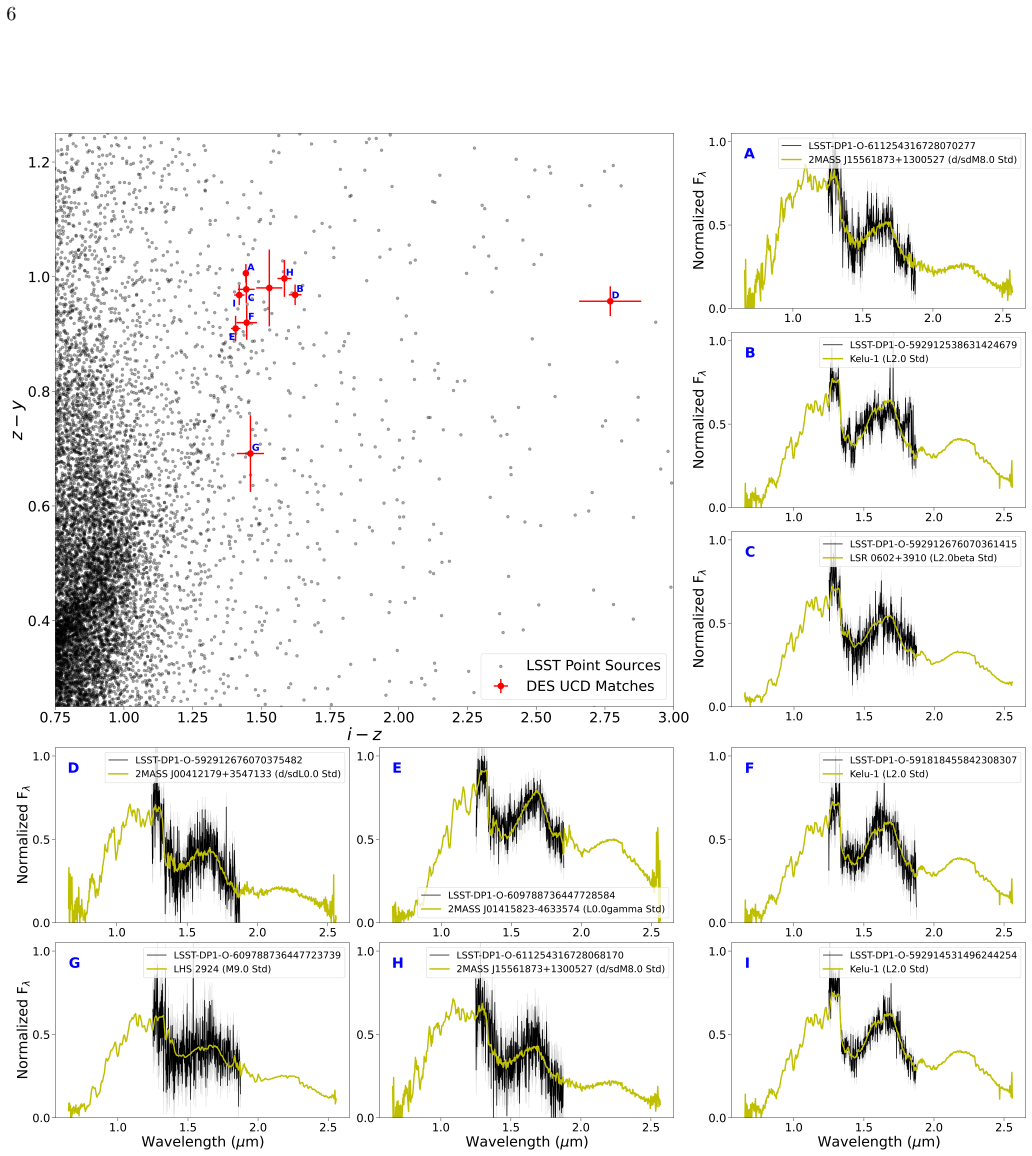
The Vera C. Rubin Observatory's Legacy Survey of Space and Time (LSST) promises to drastically accelerate the discovery of ultracool dwarfs (UCDs) over the course of its 10-year survey of the Southern Hemisphere. With the official start of LSST imminent, we showcase LSST's capabilities for discovering and characterizing UCDs using early commissioning data (Data Preview 1). The LSST photometric system at this stage remains poorly understood for faint UCDs. Thus, we begin by cross-matching Data Preview 1 against known UCD catalogs. We recover 1 known UCD from the Ultracool Sheet, 17 UCDs from the Dark Energy Survey, and 17 low mass stars from the Gaia Catalog of Nearby Stars. Using these known UCDs alongside recent spectroscopically-confirmed Euclid objects, we select 89 ultracool dwarf candidates in LSST fields, 17 of which are unique to this work. We present our candidates, a photometric temperature estimate, and discuss lessons learned from using early LSST data products. Finally, we turn to the future and predict potential UCD counts in upcoming LSST commissioning data (Data Preview 2), which is expected to be available to the Rubin community in 2026. Using synthetic populations of brown dwarfs, we forecast over 17,000 objects may be discovered and characterized in Data Preview 2. We predict that several hundred known objects and thousands of as-of-yet undiscovered UCDs may be detected in Data Preview 2 fields.
Editorial analysis
A structured set of objections, weighed in public.
Referee Report
Summary. The manuscript reports recovery of 35 known ultracool dwarfs and low-mass stars (1 from Ultracool Sheet, 17 from DES, 17 from Gaia) in early LSST Data Preview 1, followed by photometric selection of 89 UCD candidates (17 unique to this work) using color/magnitude criteria informed by those recoveries plus Euclid sources. Photometric temperature estimates are presented for the candidates, and a forecast of over 17,000 detectable UCDs (including thousands undiscovered) is made for Data Preview 2 based on synthetic brown dwarf populations.
Significance. If the selection criteria hold, the work provides a timely early demonstration of LSST's potential for UCD discovery in the Southern Hemisphere and supplies a concrete forecast for DP2 that could guide community planning. The explicit recovery of known objects supplies a basic validation check, and the use of external synthetic populations for the DP2 prediction follows standard practice in the field for population forecasting.
major comments (3)
- [Candidate selection section] Candidate selection (abstract and associated methods section): despite the explicit statement that the LSST photometric system remains poorly understood for faint UCDs, the color/magnitude cuts are applied to identify 89 candidates without any simulation of contaminant populations (e.g., reddened stars or galaxies) or quantified purity assessment. This assumption is load-bearing for both the headline count of 89 objects and the claim of 17 unique candidates.
- [DP2 forecast section] DP2 forecast (final section): the prediction of >17,000 objects relies on synthetic populations drawn from external models; no robustness tests are shown against the calibration uncertainties acknowledged for DP1 data, nor is there propagation of selection biases from the current sample into the forecast.
- [Results section] Temperature estimates (results section): the photometric temperature estimates for the 89 candidates lack sufficient detail on the fitting procedure, adopted models, or uncertainty quantification, making it impossible to assess whether they are reliable given the early-data calibration issues.
minor comments (3)
- [Abstract] The abstract and introduction would benefit from a brief statement of the exact color/magnitude criteria used for selection to improve reproducibility.
- [Figures] Figure showing the color-color or color-magnitude diagram of candidates should include the selection boundaries and the locations of the recovered known objects for direct visual assessment.
- [Results] A short table listing the 17 unique candidates with coordinates, magnitudes, and estimated temperatures would aid readers in following up the new objects.
Simulated Author's Rebuttal
We thank the referee for their constructive and detailed review. The comments highlight important areas for clarification and strengthening, particularly given the early and evolving nature of LSST data. We address each major comment below and indicate the revisions planned for the manuscript.
read point-by-point responses
-
Referee: [Candidate selection section] Candidate selection (abstract and associated methods section): despite the explicit statement that the LSST photometric system remains poorly understood for faint UCDs, the color/magnitude cuts are applied to identify 89 candidates without any simulation of contaminant populations (e.g., reddened stars or galaxies) or quantified purity assessment. This assumption is load-bearing for both the headline count of 89 objects and the claim of 17 unique candidates.
Authors: We agree that the absence of explicit contaminant simulations and a quantified purity estimate represents a limitation, especially since we note the photometric calibration uncertainties for faint UCDs. Our cuts were empirically derived from the 35 recovered known objects plus Euclid cross-matches to define a conservative locus in color-magnitude space. In the revised manuscript, we will add a dedicated paragraph in the methods section discussing potential contaminants (e.g., reddened M dwarfs and compact galaxies) based on selection studies from DES and other wide-field surveys, along with a qualitative estimate of contamination risk. We will also revise the abstract and results to note that the 17 unique candidates are new relative to the cross-matched catalogs but subject to the same unquantified purity caveats. revision: partial
-
Referee: [DP2 forecast section] DP2 forecast (final section): the prediction of >17,000 objects relies on synthetic populations drawn from external models; no robustness tests are shown against the calibration uncertainties acknowledged for DP1 data, nor is there propagation of selection biases from the current sample into the forecast.
Authors: The forecast follows standard practice by using published synthetic brown dwarf populations to estimate yields in DP2 fields. We acknowledge that the original text did not include robustness checks. In revision, we will insert a short sensitivity analysis that perturbs the photometric zero points by the calibration offsets reported for DP1 and reports the resulting range in predicted counts. We will also add a qualitative discussion of how selection biases from the small DP1 sample could affect the forecast, while noting that a full statistical propagation awaits larger datasets. revision: yes
-
Referee: [Results section] Temperature estimates (results section): the photometric temperature estimates for the 89 candidates lack sufficient detail on the fitting procedure, adopted models, or uncertainty quantification, making it impossible to assess whether they are reliable given the early-data calibration issues.
Authors: We appreciate this observation and agree the original description was insufficient. The temperatures were obtained via chi-squared minimization of the available LSST photometry against the BT-Settl model grid (Allard et al. 2012), with Teff as the free parameter, log g fixed at 5.0, and solar metallicity; uncertainties combined photometric errors with the fit covariance. In the revised manuscript, we will expand the methods and results sections to provide the full procedure, model references, grid boundaries, and per-candidate uncertainty values, together with an explicit caveat on calibration sensitivity. revision: yes
Circularity Check
No significant circularity in selection criteria or DP2 forecast.
full rationale
The paper recovers known UCDs via cross-matching with external catalogs (Ultracool Sheet, DES, Gaia, Euclid) and applies photometric criteria informed by those recoveries plus confirmed Euclid sources to identify 89 candidates in DP1. This is standard empirical selection, not a self-referential loop. The DP2 forecast of >17,000 objects explicitly relies on synthetic brown dwarf populations drawn from external models, independent of any parameters fitted to the present DP1 data. No equations, self-citations, or ansatzes are shown that reduce claims to inputs by construction. The derivation chain remains externally grounded and falsifiable.
Axiom & Free-Parameter Ledger
axioms (2)
- domain assumption Photometric colors can distinguish ultracool dwarfs from other stellar and galactic contaminants in early LSST data
- domain assumption Synthetic brown dwarf population models accurately represent the expected distribution in LSST fields
Reference graph
Works this paper leans on
-
[1]
Abbott, T. M. C., Adam´ ow, M., Aguena, M., et al. 2021, ApJS, 255, 20, doi: 10.3847/1538-4365/ac00b3
-
[2]
Aganze, C., Burgasser, A. J., Malkan, M., et al. 2022, ApJ, 934, 73, doi: 10.3847/1538-4357/ac7053
-
[3]
The Wide Field Infrared Survey Telescope: 100 Hubbles for the 2020s
Akeson, R., Armus, L., Bachelet, E., et al. 2019, arXiv e-prints, arXiv:1902.05569, doi: 10.48550/arXiv.1902.05569
-
[4]
Akins, H. B., Casey, C. M., Lambrides, E., et al. 2025, ApJ, 991, 37, doi: 10.3847/1538-4357/ade984
-
[5]
Allard, F., Allard, N. F., Homeier, D., et al. 2007, A&A, 474, L21, doi: 10.1051/0004-6361:20078362
-
[6]
Allard, F., Homeier, D., & Freytag, B. 2012, Philosophical Transactions of the Royal Society of London Series A, 370, 2765, doi: 10.1098/rsta.2011.0269
-
[7]
Allard, N. F., Allard, F., Hauschildt, P. H., Kielkopf, J. F., & Machin, L. 2003, A&A, 411, L473, doi: 10.1051/0004-6361:20031299
-
[8]
Allard, N. F., Allard, F., & Kielkopf, J. F. 2005, A&A, 440, 1195, doi: 10.1051/0004-6361:20053162
-
[9]
Allard, N. F., Kielkopf, J. F., Spiegelman, F., Tinetti, G., & Beaulieu, J. P. 2012, A&A, 543, A159, doi: 10.1051/0004-6361/201219037
-
[10]
Allers, K. N., & Liu, M. C. 2013, ApJ, 772, 79, doi: 10.1088/0004-637X/772/2/79
-
[11]
Alvarado, E., Gerasimov, R., Burgasser, A. J., et al. 2024, Research Notes of the American Astronomical Society, 8, 134, doi: 10.3847/2515-5172/ad4bd7 Astropy Collaboration, Robitaille, T. P., Tollerud, E. J., et al. 2013, A&A, 558, A33, doi: 10.1051/0004-6361/201322068 Astropy Collaboration, Price-Whelan, A. M., Sip˝ ocz, B. M., et al. 2018, AJ, 156, 123...
-
[12]
2015, A&A, 582, A83, doi: 10.1051/0004-6361/201526332 24
Baudino, J.-L., B´ ezard, B., Boccaletti, A., et al. 2015, A&A, 582, A83, doi: 10.1051/0004-6361/201526332 24
-
[13]
2025, An Interim Report on the On-Sky Commissioning Campaign with LSSTCam, Commissioning Technical Note SITCOMTN-170, NSF-DOE Vera C
Bechtol, K. 2025, An Interim Report on the On-Sky Commissioning Campaign with LSSTCam, Commissioning Technical Note SITCOMTN-170, NSF-DOE Vera C. Rubin Observatory. https://sitcomtn-170.lsst.io/
2025
-
[14]
Beiler, S. A., Cushing, M. C., Kirkpatrick, J. D., et al. 2023, ApJL, 951, L48, doi: 10.3847/2041-8213/ace32c
-
[15]
Bernstein, G. M., Armstrong, R., Plazas, A. A., et al. 2017, PASP, 129, 074503, doi: 10.1088/1538-3873/aa6c55
-
[16]
Best, W. M. J., Dupuy, T. J., Liu, M. C., et al. 2025, The UltracoolSheet: Photometry, Astrometry, Spectroscopy, and Multiplicity for 4000+ Ultracool Dwarfs and Imaged Exoplanets, 2.1.0 Zenodo, doi: 10.5281/zenodo.15802304
-
[17]
Best, W. M. J., Liu, M. C., Magnier, E. A., & Dupuy, T. J. 2021, AJ, 161, 42, doi: 10.3847/1538-3881/abc893
-
[18]
Dupuy, T. J. 2024, ApJ, 967, 115, doi: 10.3847/1538-4357/ad39ef
-
[20]
Best, W. M. J., Magnier, E. A., Liu, M. C., et al. 2018b, ApJS, 234, 1, doi: 10.3847/1538-4365/aa9982
-
[21]
Bianco, F. B., Ivezi´ c,ˇZ., Jones, R. L., et al. 2022, ApJS, 258, 1, doi: 10.3847/1538-4365/ac3e72
-
[22]
2021, A&A, 646, A15, doi: 10.1051/0004-6361/202039072
Blain, D., Charnay, B., & B´ ezard, B. 2021, A&A, 646, A15, doi: 10.1051/0004-6361/202039072
-
[23]
Bock, J. J., Aboobaker, A. M., Adamo, J., et al. 2026, ApJ, 999, 139, doi: 10.3847/1538-4357/ae2be2
-
[24]
Burgasser, A. J., & Splat Development Team. 2017, in Astronomical Society of India Conference Series, Vol. 14, Astronomical Society of India Conference Series, 7–12, doi: 10.48550/arXiv.1707.00062
-
[25]
J., Bezanson, R., Labbe, I., et al
Burgasser, A. J., Bezanson, R., Labbe, I., et al. 2024, ApJ, 962, 177, doi: 10.3847/1538-4357/ad206f
-
[26]
Reviews of Modern Physics , keywords =
Burrows, A., Hubbard, W. B., Lunine, J. I., & Liebert, J. 2001, Reviews of Modern Physics, 73, 719, doi: 10.1103/RevModPhys.73.719
-
[27]
2025, arXiv e-prints, arXiv:2501.02103, doi: 10.48550/arXiv.2501.02103
Caplar, N., Beebe, W., Branton, D., et al. 2025, arXiv e-prints, arXiv:2501.02103, doi: 10.48550/arXiv.2501.02103
-
[28]
Cardoso, C. V., Burningham, B., Smart, R. L., et al. 2015, MNRAS, 450, 2486, doi: 10.1093/mnras/stv380
-
[29]
2025, Research Notes of the American Astronomical Society, 9, 161, doi: 10.3847/2515-5172/adeab0
Malanchev, K. 2025, Research Notes of the American Astronomical Society, 9, 161, doi: 10.3847/2515-5172/adeab0
-
[30]
Chambers, K. C., Magnier, E. A., Metcalfe, N., et al. 2016, arXiv e-prints, arXiv:1612.05560, doi: 10.48550/arXiv.1612.05560
work page internal anchor Pith review Pith/arXiv arXiv doi:10.48550/arxiv.1612.05560 2016
-
[31]
NSF-DOE Vera C. Rubin Observatory Observations of Interstellar Comet 3I/ATLAS (C/2025 N1)
Chandler, C. O., Bernardinelli, P. H., Juri´ c, M., et al. 2025, arXiv e-prints, arXiv:2507.13409, doi: 10.48550/arXiv.2507.13409
work page internal anchor Pith review Pith/arXiv arXiv doi:10.48550/arxiv.2507.13409 2025
-
[32]
2018, ApJ, 854, 172, doi: 10.3847/1538-4357/aaac7d
Charnay, B., B´ ezard, B., Baudino, J.-L., et al. 2018, ApJ, 854, 172, doi: 10.3847/1538-4357/aaac7d
-
[33]
Choi, Y., Olsen, K. A. G., Carlin, J. L., et al. 2025, ApJ, 992, 47, doi: 10.3847/1538-4357/adfb70
-
[34]
Cordoni, G., Casagrande, L., & Jerjen, H. 2025, PASA, 42, e127, doi: 10.1017/pasa.2025.10089
-
[35]
2025, SIMPLE-AstroDB/SIMPLE-db: v4.3.2025.10, v4.3.2025.10 Zenodo, doi: 10.5281/zenodo.16640694
Cruz, K., Rodriguez, D., Alejandro, S., et al. 2025, SIMPLE-AstroDB/SIMPLE-db: v4.3.2025.10, v4.3.2025.10 Zenodo, doi: 10.5281/zenodo.16640694
-
[36]
Cushing, M. C., Kirkpatrick, J. D., Gelino, C. R., et al. 2011, ApJ, 743, 50, doi: 10.1088/0004-637X/743/1/50 dal Ponte, M., Santiago, B., Carnero Rosell, A., et al. 2023, MNRAS, 522, 1951, doi: 10.1093/mnras/stad955 Dal Tio, P., Mazzi, A., Girardi, L., et al. 2021, 506, 5681, doi: 10.1093/mnras/stab1964
-
[37]
Deacon, N. R., Liu, M. C., Magnier, E. A., et al. 2014, ApJ, 792, 119, doi: 10.1088/0004-637X/792/2/119
-
[38]
Dupuy, T. J., & Kraus, A. L. 2013, Science, 341, 1492, doi: 10.1126/science.1241917
-
[39]
Dupuy, T. J., & Liu, M. C. 2012, ApJS, 201, 19, doi: 10.1088/0067-0049/201/2/19
-
[40]
Dupuy, T. J., & Liu, M. C. 2017, ApJS, 231, 15, doi: 10.3847/1538-4365/aa5e4c Euclid Collaboration, Mellier, Y., Abdurro’uf, et al. 2025, A&A, 697, A1, doi: 10.1051/0004-6361/202450810
-
[41]
Faherty, J. K., Burgasser, A. J., Cruz, K. L., et al. 2009, AJ, 137, 1, doi: 10.1088/0004-6256/137/1/1
-
[42]
Faherty, J. K., Riedel, A. R., Cruz, K. L., et al. 2016, ApJS, 225, 10, doi: 10.3847/0067-0049/225/1/10 Gaia Collaboration, Smart, R. L., Sarro, L. M., et al. 2021, A&A, 649, A6, doi: 10.1051/0004-6361/202039498
-
[43]
Gardner, J. P., Mather, J. C., Clampin, M., et al. 2006, SSRv, 123, 485, doi: 10.1007/s11214-006-8315-7
-
[44]
Gerasimov, R., Bedin, L. R., Burgasser, A. J., et al. 2024, ApJ, 971, 65, doi: 10.3847/1538-4357/ad5551
-
[45]
Gizis, J. E., Burgasser, A. J., Berger, E., et al. 2013, The Astrophysical Journal, 779, 172, doi: 10.1088/0004-637X/779/2/172
-
[46]
Gizis, J. E., Monet, D. G., Reid, I. N., et al. 2000, AJ, 120, 1085, doi: 10.1086/301456
-
[47]
Greenstreet, S., Li, Z. C., Vavilov, D. E., et al. 2026, ApJL, 996, L33, doi: 10.3847/2041-8213/ae2a30
-
[48]
P., Bechtol, K., Bellm, E., et al
Guy, L. P., Bechtol, K., Bellm, E., et al. 2025, Rubin Observatory Plans for an Early Science Program, Technical Note RTN-011, NSF-DOE Vera C. Rubin Observatory, doi: 10.71929/rubin/2584021 25
-
[49]
Hainline, K. N., Helton, J. M., Johnson, B. D., et al. 2024, ApJ, 964, 66, doi: 10.3847/1538-4357/ad20d1
-
[50]
N., Maiolino, R., Juodˇzbalis, I., et al
Hainline, K. N., Maiolino, R., Juodˇ zbalis, I., et al. 2025, ApJ, 979, 138, doi: 10.3847/1538-4357/ad9920
-
[51]
Nature 585(7825), 357–362 (2020) https://doi.org/ 10.1038/s41586-020-2649-2
Harris, C. R., Millman, K. J., van der Walt, S. J., et al. 2020, Nature, 585, 357, doi: 10.1038/s41586-020-2649-2
-
[52]
Honaker, E. J., & Gizis, J. E. 2025, ApJ, 985, 48, doi: 10.3847/1538-4357/adc689
-
[53]
Hunter, J. D. 2007, Computing in Science & Engineering, 9, 90, doi: 10.1109/MCSE.2007.55 Ivezi´ c,ˇZ., Kahn, S. M., Tyson, J. A., et al. 2019, ApJ, 873, 111, doi: 10.3847/1538-4357/ab042c
-
[54]
Jones, H. R. A., & Tsuji, T. 1997, ApJL, 480, L39, doi: 10.1086/310619 Juri´ c, M., Ivezi´ c,ˇZ., Brooks, A., et al. 2008, ApJ, 673, 864, doi: 10.1086/523619
-
[55]
Kirkpatrick, J. D. 2005, ARA&A, 43, 195, doi: 10.1146/annurev.astro.42.053102.134017
-
[56]
Kirkpatrick, J. D., Reid, I. N., Liebert, J., et al. 1999, ApJ, 519, 802, doi: 10.1086/307414
-
[57]
Kirkpatrick, J. D., Looper, D. L., Burgasser, A. J., et al. 2010, ApJS, 190, 100, doi: 10.1088/0067-0049/190/1/100
-
[58]
Kirkpatrick, J. D., Cushing, M. C., Gelino, C. R., et al. 2011, ApJS, 197, 19, doi: 10.1088/0067-0049/197/2/19
-
[59]
Kirkpatrick, J. D., Gelino, C. R., Faherty, J. K., et al. 2021, ApJS, 253, 7, doi: 10.3847/1538-4365/abd107
-
[60]
Kirkpatrick, J. D., Marocco, F., Gelino, C. R., et al. 2024, ApJS, 271, 55, doi: 10.3847/1538-4365/ad24e2
-
[61]
Kumar, S. S. 1962, Astronomical Journal, 67, 579, doi: 10.1086/108658
-
[62]
J., Almaini, O., et al
Lawrence, A., Warren, S. J., Almaini, O., et al. 2012, VizieR Online Data Catalog: UKIDSS-DR8 LAS, GCS and DXS Surveys (Lawrence+ 2012),, VizieR On-line Data Catalog: II/314. Originally published in: 2007MNRAS.379.1599L; 2012yCat.2314....0U
2012
-
[63]
Liu, M. C., Dupuy, T. J., & Allers, K. N. 2016, ApJ, 833, 96, doi: 10.3847/1538-4357/833/1/96 LSST Science Collaboration, Abell, P. A., Allison, J., et al. 2009, arXiv e-prints, arXiv:0912.0201, doi: 10.48550/arXiv.0912.0201
-
[64]
L., Tremblin, P., Alves de Oliveira, C., et al
Luhman, K. L., Tremblin, P., Alves de Oliveira, C., et al. 2024, AJ, 167, 5, doi: 10.3847/1538-3881/ad0b72
-
[65]
Mackereth, J. T., Schiavon, R. P., Pfeffer, J., et al. 2019, MNRAS, 482, 3426, doi: 10.1093/mnras/sty2955
-
[66]
2025, arXiv e-prints, arXiv:2506.23955, doi: 10.48550/arXiv.2506.23955
Malanchev, K., DeLucchi, M., Caplar, N., et al. 2025, arXiv e-prints, arXiv:2506.23955, doi: 10.48550/arXiv.2506.23955
-
[67]
2024, AJ, 167, 168, doi: 10.3847/1538-3881/ad2938
Manjavacas, E., Tremblin, P., Birkmann, S., et al. 2024, AJ, 167, 168, doi: 10.3847/1538-3881/ad2938
-
[68]
Marocco, F., Eisenhardt, P. R. M., Fowler, J. W., et al. 2021, ApJS, 253, 8, doi: 10.3847/1538-4365/abd805 Mart´ ın, E. L., Delfosse, X., Basri, G., et al. 1999, AJ, 118, 2466, doi: 10.1086/301107 Mart´ ın, E. L., Lodieu, N., Pavlenko, Y., & B´ ejar, V. J. S. 2018, ApJ, 856, 40, doi: 10.3847/1538-4357/aaaeb8
-
[69]
2024, MNRAS, 527, 583, doi: 10.1093/mnras/stad2952
Mazzi, A., Girardi, L., Trabucchi, M., et al. 2024, MNRAS, 527, 583, doi: 10.1093/mnras/stad2952
-
[70]
Mohandasan, A., Smart, R. L., Reyl\’e, C., et al. 2025, arXiv e-prints, arXiv:2503.22559, doi: 10.48550/arXiv.2503.22559
-
[71]
Morley, C. V., Marley, M. S., Fortney, J. J., et al. 2014, ApJ, 787, 78, doi: 10.1088/0004-637X/787/1/78
-
[72]
Morley, C. V., Mukherjee, S., Marley, M. S., et al. 2024, ApJ, 975, 59, doi: 10.3847/1538-4357/ad71d5 NSF-DOE Vera C. Rubin Observatory. 2025a, Legacy Survey of Space and Time Data Preview 1: Source searchable catalog [Data set], NSF-DOE Vera C. Rubin Observatory, doi: 10.71929/RUBIN/2570323 NSF-DOE Vera C. Rubin Observatory. 2025b, Legacy Survey of Space...
-
[73]
Acero-Cuellar, T., Acosta, E., et al. 2025, RTN-095: The Vera C. Rubin Observatory Data Preview 1,, NSF-DOE Vera C. Rubin Observatory Technical Report doi: 10.71929/RUBIN/2570536
-
[74]
Patapis, P., Morales-Calder´ on, M., Arabhavi, A. M., et al. 2025, A&A, 704, A5, doi: 10.1051/0004-6361/202556296
-
[75]
Phillips, C. L., Faherty, J. K., Burningham, B., et al. 2024, ApJ, 972, 172, doi: 10.3847/1538-4357/ad5d57
-
[76]
Porter, M. N., Tucker, D. L., Smith, J. A., & Adair, C. L. 2025, Photometric Transformation Relations for the LSST Data Preview 1, Technical Note RTN-099, NSF-DOE Vera C. Rubin Observatory, doi: 10.71929/rubin/3006074
-
[77]
2020, in XIV.0 Scientific Meeting (virtual) of the Spanish Astronomical Society, 182
Rodrigo, C., & Solano, E. 2020, in XIV.0 Scientific Meeting (virtual) of the Spanish Astronomical Society, 182
2020
-
[78]
IVOA Working Draft 15 October 2012 , year = 2012, month = oct, pages =
Rodrigo, C., Solano, E., & Bayo, A. 2012, SVO Filter Profile Service Version 1.0,, IVOA Working Draft 15 October 2012 doi: 10.5479/ADS/bib/2012ivoa.rept.1015R
-
[79]
Rodrigo, C., Cruz, P., Aguilar, J. F., et al. 2024, A&A, 689, A93, doi: 10.1051/0004-6361/202449998
-
[80]
Rojas-Ayala, B., Covey, K. R., Muirhead, P. S., & Lloyd, J. P. 2012, ApJ, 748, 93, doi: 10.1088/0004-637X/748/2/93
-
[81]
Romanowsky, A. J., Tang, Y., & Bundy, K. A. 2025, Research Notes of the American Astronomical Society, 9, 181, doi: 10.3847/2515-5172/adee10 26 Rubin Observatory Science Pipelines Developers. 2025, The LSST Science Pipelines Software: Optical Survey Pipeline Reduction and Analysis Environment, Project Science Technical Note PSTN-019, NSF-DOE Vera C. Rubin...
discussion (0)
Sign in with ORCID, Apple, or X to comment. Anyone can read and Pith papers without signing in.