Recognition: unknown
Search for the lepton-flavour violating decays B^+ to π^+ μ^pm e^mp
Pith reviewed 2026-05-10 17:08 UTC · model grok-4.3
The pith
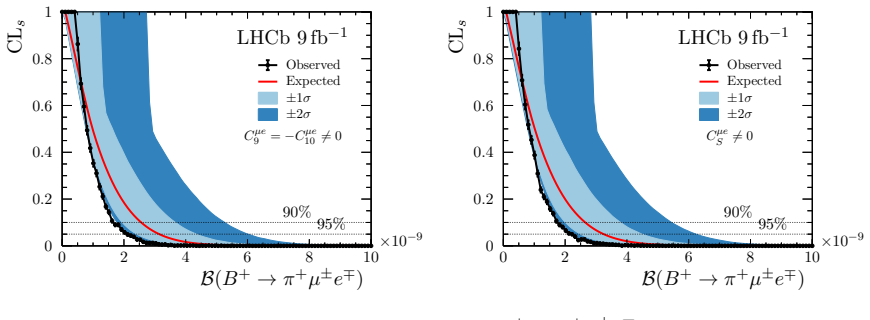
No significant signal is observed for the lepton-flavour violating decay B⁺ → π⁺ μ± e∓, setting an upper limit of 1.8 × 10^{-9} at 90% confidence level.
A machine-rendered reading of the paper's core claim, the machinery that carries it, and where it could break.
Core claim
Using 9 fb^{-1} of data collected between 2011 and 2018, B⁺ → π⁺ μ± e∓ candidates are reconstructed and an unbinned maximum-likelihood fit is performed on their invariant mass. With no significant signal observed, the branching fraction is limited to less than 1.8 × 10^{-9} at the 90% confidence level. This constitutes the first constraint on lepton-flavour violating b → d transitions at the LHC and the most stringent upper limits to date on b → d μ± e∓ processes. Limits are additionally derived for left-handed and scalar operators in beyond-Standard-Model scenarios.
What carries the argument
The central mechanism is the maximum-likelihood fit to the invariant-mass distribution of selected candidates, with signal efficiency determined from simulation and background shapes constrained by data control samples.
If this is right
- This supplies the first LHC constraint on lepton-flavour violating b to d quark transitions.
- It improves the previous world-average limit on the branching fraction by two orders of magnitude.
- Limits are placed on left-handed and scalar operators in specific beyond-Standard-Model scenarios.
- The result provides a reference point for future searches with larger data samples.
Where Pith is reading between the lines
- Additional data from later LHC runs could tighten the limit by a factor of several.
- Parallel searches in other B-meson decay modes could give complementary bounds on the same new-physics operators.
- The null result is consistent with Standard-Model expectations but leaves room for small effects that might appear in other channels or with higher statistics.
Load-bearing premise
Background modelling, detection efficiencies, and systematic uncertainties are correctly estimated from simulation and control samples, so that any real signal would appear as a distinct peak above background.
What would settle it
Observation of a statistically significant peak at the known B⁺ mass in the invariant-mass spectrum of a future dataset would falsify the null result and indicate a non-zero branching fraction.
Figures


read the original abstract
The first search for the lepton-flavour violating decays $B^+ \to \pi^+ \mu^{\pm} e^{\mp}$ in proton-proton collisions is presented, using data collected by the LHCb experiment between 2011 and 2018, corresponding to an integrated luminosity of 9 fb$^{-1}$. No significant signal is observed and an upper limit on the branching fraction is set at $\mathcal{B}(B^+ \to \pi^+ \mu^{\pm} e^{\mp}) < 1.8 \times 10^{-9}$ at the $90\%$ confidence level, two orders of magnitude more restrictive than the current world average. This is the first constraint on lepton-flavour violating $b \to d$ quark transitions at the LHC and also sets the most stringent upper limits to date on $b \to d \mu^{\pm} e^{\mp}$ transitions. Limits on left-handed and scalar scenarios beyond the Standard Model are also reported.
Editorial analysis
A structured set of objections, weighed in public.
Referee Report
Summary. The manuscript reports the first search for the lepton-flavour violating decay B⁺ → π⁺ μ± e∓ using 9 fb⁻¹ of LHCb proton-proton collision data collected between 2011 and 2018. No significant signal is observed in the B⁺ candidate invariant-mass distribution. An upper limit is set on the branching fraction of ℬ(B⁺ → π⁺ μ± e∓) < 1.8 × 10^{-9} at 90% confidence level, representing a two-order-of-magnitude improvement over the previous world average. The result also provides the first LHC constraint on lepton-flavour violating b → d transitions and the most stringent limits to date on b → d μ± e∓ processes, together with derived limits on left-handed and scalar beyond-Standard-Model scenarios.
Significance. If the analysis is sound, the result is significant for rare-decay phenomenology. It delivers the first direct LHC bound on LFV b → d transitions and tightens constraints on new-physics models that generate such processes. The reported sensitivity gain is consistent with the increase in integrated luminosity and the performance of the LHCb detector for this final state; the use of a standard unbinned maximum-likelihood fit with simulation-validated efficiencies and background modeling supports the reliability of the quoted limit.
minor comments (1)
- The abstract states that limits on left-handed and scalar BSM scenarios are reported but does not indicate the specific effective operators or the procedure used to translate the branching-fraction limit into those constraints; a short clarifying sentence would improve readability.
Simulated Author's Rebuttal
We thank the referee for their positive assessment of the manuscript, recognition of its significance as the first LHC search for lepton-flavour violating b → d transitions, and recommendation to accept. No major comments were raised.
Circularity Check
No significant circularity in experimental upper-limit result
full rationale
This is a standard LHCb experimental search paper reporting a null result for B+ → π+ μ± e∓. The central claim (upper limit < 1.8 × 10^{-9} at 90% CL) is obtained from an unbinned maximum-likelihood fit to the B candidate invariant-mass distribution in 9 fb^{-1} of data, with signal efficiency from Monte Carlo simulation and background shapes from simulation plus control samples. No theoretical derivation exists, no quantity is defined in terms of a fitted parameter that is then called a prediction, and no self-citation chain is load-bearing for the result. The analysis is self-contained against external benchmarks (prior world-average limits) and uses standard, externally falsifiable procedures.
Axiom & Free-Parameter Ledger
Forward citations
Cited by 1 Pith paper
-
Rare and very rare decays at the LHCb experiment
LHCb reports first searches and the most stringent limits to date on rare decays such as b to s tau+ tau- and tau to three muons.
Reference graph
Works this paper leans on
-
[1]
L. Calibbi and G. Signorelli,Charged lepton flavour violation: An experimental and theoretical introduction, Riv. Nuovo Cim.41(2018) 71,arXiv:1709.00294
-
[2]
Review of semileptonic B anomalies,
B. Capdevila, A. Crivellin, and J. Matias,Review of semileptonic B anomalies, Eur. Phys. J. ST1(2023) 20,arXiv:2309.01311
-
[3]
M. Duraisamy, S. Sahoo, and R. Mohanta,Rare semileptonic B→K (π)l− i l+ j decay in a vector leptoquark model, Phys. Rev.D95(2017) 035022,arXiv:1610.00902
-
[4]
Crivellinet al.,Lepton-flavour violating B decays in generic Z ′ models, Phys
A. Crivellinet al.,Lepton-flavour violating B decays in generic Z ′ models, Phys. Rev. D92(2015) 054013,arXiv:1504.07928
- [5]
-
[6]
Aaijet al.,Search for the lepton-flavour violating decays B+ →K +µ±e∓, Phys
LHCb collaboration, R. Aaijet al.,Search for the lepton-flavour violating decays B+ →K +µ±e∓, Phys. Rev. Lett.123(2019) 231802,arXiv:1909.01010
-
[7]
LHCb collaboration, R. Aaijet al.,Search for the lepton flavour violating decay B+ →K +µ−τ + usingB ∗0 s2 decays, JHEP06(2020) 129,arXiv:2003.04352
-
[8]
LHCb collaboration, R. Aaijet al.,Search for the lepton-flavour violating decays B0 →K ∗0µ±e∓ andB 0 s →ϕµ ±e∓, JHEP06(2023) 073,arXiv:2207.04005
-
[9]
LHCb collaboration, R. Aaijet al.,Search for the lepton flavour violating decay B0 →K ∗0τ ±µ∓ , JHEP06(2023) 143,arXiv:2209.09846
-
[10]
Aaijet al.,Search for the lepton-flavor violating decay B0 s →ϕµ ±τ ∓, Phys
LHCb collaboration, R. Aaijet al.,Search for the lepton-flavor violating decay B0 s →ϕµ ±τ ∓, Phys. Rev.D110(2024) 7,arXiv:2405.13103
-
[11]
LHCb collaboration, R. Aaijet al.,Search for the lepton-flavour-violating decays B0 →K ∗0τ ±e∓, JHEP11(2025) 172,arXiv:2506.15347
- [12]
-
[13]
Aubertet al.,Search for the rare decay B→πl +l−, Phys
BaBar collaboration, B. Aubertet al.,Search for the rare decay B→πl +l−, Phys. Rev. Lett.99(2007) 051801,arXiv:hep-ex/0703018
-
[14]
LHCb collaboration, A. A. Alves Jr.et al.,The LHCb detector at the LHC, JINST3 (2008) S08005
2008
-
[15]
Aaijet al.,LHCb detector performance, Int
LHCb collaboration, R. Aaijet al.,LHCb detector performance, Int. J. Mod. Phys. A30(2015) 1530022,arXiv:1412.6352
-
[16]
Aaijet al.,Performance of the LHCb Vertex Locator, JINST9(2014) P09007, arXiv:1405.7808
R. Aaijet al.,Performance of the LHCb Vertex Locator, JINST9(2014) P09007, arXiv:1405.7808
-
[17]
Arinket al.,Performance of the LHCb Outer Tracker, JINST9(2014) P01002, arXiv:1311.3893
R. Arinket al.,Performance of the LHCb Outer Tracker, JINST9(2014) P01002, arXiv:1311.3893. 10
-
[18]
P. d’Argentet al.,Improved performance of the LHCb Outer Tracker in LHC Run 2, JINST12(2017) P11016,arXiv:1708.00819
-
[19]
Adinolfi et al., Performance of the LHCb RICH detector at the LHC , Eur
M. Adinolfiet al.,Performance of the LHCb RICH detector at the LHC, Eur. Phys. J.C73(2013) 2431,arXiv:1211.6759
- [20]
-
[21]
Aaijet al.,The LHCb trigger and its performance in 2011, JINST8(2013) P04022, arXiv:1211.3055
R. Aaijet al.,The LHCb trigger and its performance in 2011, JINST8(2013) P04022, arXiv:1211.3055
-
[22]
Likhomanenkoet al.,LHCb topological trigger reoptimization, J
T. Likhomanenkoet al.,LHCb topological trigger reoptimization, J. Phys. Conf. Ser. 664(2015) 082025,arXiv:1510.00572
-
[23]
N. Grieseret al.,The LHCb stripping project: Sustainable legacy data processing for high-energy physics, Comput. Softw. Big. Sci.9(2025) 21,arXiv:2509.05294
-
[24]
A Brief Introduction to PYTHIA 8.1
T. Sj¨ ostrand, S. Mrenna, and P. Skands,A brief introduction to PYTHIA 8.1, Comput. Phys. Commun.178(2008) 852,arXiv:0710.3820
work page internal anchor Pith review arXiv 2008
-
[25]
Belyaevet al.,Handling of the generation of primary events in Gauss, the LHCb simulation framework, J
I. Belyaevet al.,Handling of the generation of primary events in Gauss, the LHCb simulation framework, J. Phys. Conf. Ser.331(2011) 032047
2011
-
[26]
D. J. Lange,The EvtGen particle decay simulation package, Nucl. Instrum. Meth. A462(2001) 152
2001
-
[27]
N. Davidson, T. Przedzinski, and Z. Was,PHOTOS interface in C++: Technical and physics documentation, Comput. Phys. Commun.199(2016) 86, arXiv:1011.0937
-
[28]
Allisonet al.,Geant4 developments and applications, IEEE Trans
Geant4 collaboration, J. Allisonet al.,Geant4 developments and applications, IEEE Trans. Nucl. Sci.53(2006) 270; Geant4 collaboration, S. Agostinelliet al.,Geant4: A simulation toolkit, Nucl. Instrum. Meth.A506(2003) 250
2006
-
[29]
Clemencicet al.,The LHCb simulation application, Gauss: Design, evolution and experience, J
M. Clemencicet al.,The LHCb simulation application, Gauss: Design, evolution and experience, J. Phys. Conf. Ser.331(2011) 032023
2011
-
[30]
Anderliniet al.,The PIDCalib package, LHCb-PUB-2016-021, 2016
L. Anderliniet al.,The PIDCalib package, LHCb-PUB-2016-021, 2016
2016
-
[31]
Breiman, J
L. Breiman, J. H. Friedman, R. A. Olshen, and C. J. Stone,Classification and regression trees, Wadsworth international group, Belmont, California, USA, 1984
1984
-
[32]
Freund and R
Y. Freund and R. E. Schapire,A decision-theoretic generalization of on-line learning and an application to boosting, J. Comput. Syst. Sci.55(1997) 119
1997
-
[33]
LHCb collaboration, R. Aaijet al.,Measurement of the B0 s →µ +µ− branching fraction and effective lifetime and search for B0 →µ +µ− decays, Phys. Rev. Lett.118(2017) 191801,arXiv:1703.05747
- [34]
- [35]
-
[36]
Sensitivity of searches for new signals and its optimization
G. Punzi,Sensitivity of searches for new signals and its optimization, eConfC030908 (2003) MODT002,arXiv:physics/0308063
work page Pith review arXiv 2003
-
[37]
Aaijet al.,Test of lepton universality in b→sℓ +ℓ− decays, Phys
LHCb collaboration, R. Aaijet al.,Test of lepton universality in b→sℓ +ℓ− decays, Phys. Rev. Lett.131(2023) 051803,arXiv:2212.09152
-
[38]
Cranmer,Kernel estimation in high-energy physics, Comput
K. Cranmer,Kernel estimation in high-energy physics, Comput. Phys. Commun.136 (2001) 198
2001
-
[39]
Navaset al.,Review of particle physics, Phys
Particle Data Group, S. Navaset al.,Review of particle physics, Phys. Rev.D110 (2024) 030001
2024
-
[40]
Skwarnicki,A study of the radiative cascade transitions between the Upsilon-prime and Upsilon resonances, PhD thesis, Institute of Nuclear Physics, Krakow, 1986, DESY-F31-86-02
T. Skwarnicki,A study of the radiative cascade transitions between the Upsilon-prime and Upsilon resonances, PhD thesis, Institute of Nuclear Physics, Krakow, 1986, DESY-F31-86-02
1986
-
[41]
LHCb collaboration,Search for the lepton-flavour violating decays B+ →π +µ±e∓, HEPData (collection), 2026. doi: 10.17182/hepdata.169831
-
[42]
A. L. Read,Presentation of search results: The CL s technique, J. Phys.G28(2002) 2693
2002
-
[43]
M. Kenzieet al.,GammaCombo: A statistical analysis framework for combining measurements, fitting datasets and producing confidence intervals, doi: 10.5281/zen- odo.3371421
-
[44]
D. Beˇ cirevi´ c, F. Jaffredo, J. P. Pinheiro, and O. Sumensari,Lepton flavor violation in exclusive b→d ℓiℓj and b→s ℓiℓj decay modes, Phys. Rev.D110(2024) 075004, arXiv:2407.19060. 12 LHCb collaboration R. Aaij38 , M. Abdelfatah 69, A.S.W. Abdelmotteleb 57 , C. Abellan Beteta 51 , F. Abudin´ en59 , T. Ackernley61 , A. A. Adefisoye 69 , B. Adeva47 , M. A...
discussion (0)
Sign in with ORCID, Apple, or X to comment. Anyone can read and Pith papers without signing in.