Recognition: no theorem link
A Machine Learning Framework for Turbofan Health Estimation via Inverse Problem Formulation
Pith reviewed 2026-05-10 18:22 UTC · model grok-4.3
The pith
Traditional Bayesian filters remain strong baselines for turbofan health estimation while self-supervised methods expose the problem's difficulty on a new realistic dataset.
A machine-rendered reading of the paper's core claim, the machinery that carries it, and where it could break.
Core claim
By generating a dataset that includes realistic degradation trajectories, maintenance interventions, and usage changes, the authors benchmark steady-state models, nonstationary models, Bayesian filters, and self-supervised learning methods that learn latent representations without health labels. The comparison demonstrates that traditional filters continue to serve as competitive baselines, whereas the self-supervised representations reveal the intrinsic complexity of the inverse problem and indicate the need for more advanced and interpretable inference strategies.
What carries the argument
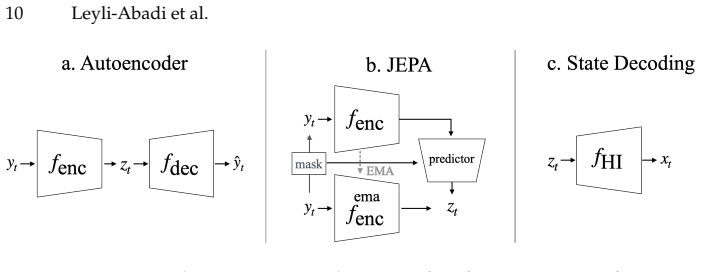
Self-supervised learning that extracts latent representations from unlabeled operational sensor data to set a practical lower bound on performance for the inverse health estimation task.
If this is right
- Bayesian filters can continue to be used as reliable reference methods in health monitoring pipelines.
- Self-supervised representations alone do not yet solve the inverse problem to a level that displaces established filters.
- The introduced dataset provides a standardized testbed for comparing future methods under realistic operational constraints.
- Improved inference strategies will be required to achieve high accuracy when true health labels are scarce.
- Hybrid approaches that combine filter dynamics with learned representations merit investigation for better temporal handling.
Where Pith is reading between the lines
- The benchmark could be extended by testing whether filter performance degrades when maintenance events are more frequent or more severe than those simulated.
- Similar inverse-problem setups in other mechanical systems might adopt the same dataset-generation strategy to create comparable lower bounds.
- If the dataset's realism holds under additional scrutiny, the work supplies a concrete target for new methods that must demonstrably beat the filter baseline on unlabeled data.
- Operational deployment would likely benefit from online adaptation mechanisms that update representations as new unlabeled flight data arrive.
Load-bearing premise
The generated dataset must accurately capture real-world degradation, maintenance events, and usage changes so that performance differences observed on it generalize to actual turbofan operations.
What would settle it
If self-supervised methods trained on the same dataset achieve markedly higher accuracy than Bayesian filters when both are evaluated on held-out real flight data from operating turbofans, the claim that filters remain strong baselines would be overturned.
Figures





read the original abstract
Estimating the health state of turbofan engines is a challenging ill-posed inverse problem, hindered by sparse sensing and complex nonlinear thermodynamics. Research in this area remains fragmented, with comparisons limited by the use of unrealistic datasets and insufficient exploration of the exploitation of temporal information. This work investigates how to recover component-level health indicators from operational sensor data under realistic degradation and maintenance patterns. To support this study, we introduce a new dataset that incorporates industry-oriented complexities such as maintenance events and usage changes. Using this dataset, we establish an initial benchmark that compares steady-state and nonstationary data-driven models, and Bayesian filters, classic families of methods used to solve this problem. In addition to this benchmark, we introduce self-supervised learning (SSL) approaches that learn latent representations without access to true health labels, a scenario reflective of real-world operational constraints. By comparing the downstream estimation performance of these unsupervised representations against the direct prediction baselines, we establish a practical lower bound on the difficulty of solving this inverse problem. Our results reveal that traditional filters remain strong baselines, while SSL methods reveal the intrinsic complexity of health estimation and highlight the need for more advanced and interpretable inference strategies. For reproducibility, both the generated dataset and the implementation used in this work are made accessible.
Editorial analysis
A structured set of objections, weighed in public.
Referee Report
Summary. The paper formulates turbofan health estimation as an ill-posed inverse problem and introduces a new synthetic dataset incorporating maintenance events and usage changes. It benchmarks steady-state/nonstationary data-driven models against Bayesian filters and adds self-supervised learning (SSL) methods that operate without health labels. The central empirical finding is that traditional filters remain strong baselines while SSL representations expose the intrinsic difficulty of the task, motivating more advanced inference strategies. Dataset and code are released for reproducibility.
Significance. If the synthetic dataset is shown to be a faithful proxy for real turbofan operations, the work supplies a needed benchmark that quantifies the performance gap between supervised filters and label-free SSL approaches on a temporally structured inverse problem. The open release of data and implementations is a concrete strength that supports follow-on research.
major comments (1)
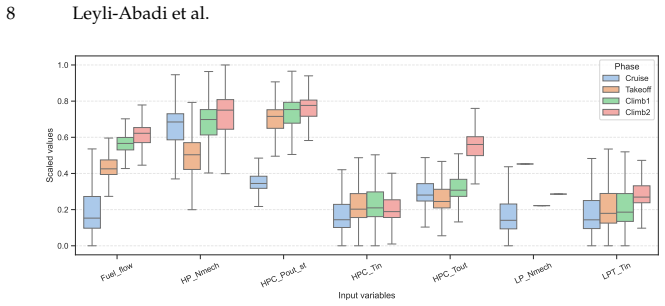
- The central claim—that filters are strong baselines and SSL reveals intrinsic complexity—depends on the generated dataset serving as a valid proxy. The abstract states that the dataset includes maintenance events and usage changes, yet no quantitative validation (e.g., Kolmogorov-Smirnov tests on sensor marginals, autocorrelation statistics of degradation paths, or maintenance-interval distributions) against C-MAPSS, N-CMAPSS, or engine logs is reported. Without this, observed performance gaps could be simulator artifacts rather than evidence about the inverse problem itself.
minor comments (1)
- The abstract refers to an 'initial benchmark' but does not specify the exact evaluation metrics, number of independent runs, or statistical tests used to compare method families.
Simulated Author's Rebuttal
We thank the referee for the constructive feedback emphasizing the need for dataset validation to support our central claims. We address the major comment below and will revise the manuscript accordingly.
read point-by-point responses
-
Referee: The central claim—that filters are strong baselines and SSL reveals intrinsic complexity—depends on the generated dataset serving as a valid proxy. The abstract states that the dataset includes maintenance events and usage changes, yet no quantitative validation (e.g., Kolmogorov-Smirnov tests on sensor marginals, autocorrelation statistics of degradation paths, or maintenance-interval distributions) against C-MAPSS, N-CMAPSS, or engine logs is reported. Without this, observed performance gaps could be simulator artifacts rather than evidence about the inverse problem itself.
Authors: We agree that explicit quantitative validation would strengthen the manuscript. In the revision we will add a dedicated subsection comparing our dataset to C-MAPSS and N-CMAPSS using Kolmogorov-Smirnov tests on sensor marginals, autocorrelation statistics of degradation trajectories, and reported maintenance-interval distributions drawn from the literature. These additions will be placed in Section 3 (Dataset) and will include tables and figures to allow readers to assess similarity in core dynamics. We note that our simulator was deliberately extended to incorporate maintenance events and usage changes absent from the original C-MAPSS formulation; therefore exact distributional identity is neither expected nor required. The new analyses will nevertheless demonstrate that the observed performance gaps are not merely simulator artifacts but reflect the added temporal and maintenance complexities of the inverse problem. revision: yes
- Direct quantitative validation against proprietary real-world engine logs is not feasible, as such detailed operational and maintenance records are not publicly available.
Circularity Check
No circularity: empirical benchmarking on synthetic dataset with no derivational reductions
full rationale
The paper presents an empirical study that generates a new synthetic dataset incorporating maintenance and usage patterns, then benchmarks existing method families (steady-state/nonstationary models, Bayesian filters) plus newly introduced SSL representations against downstream health estimation performance. No equations, uniqueness theorems, or first-principles derivations are claimed; results consist of comparative metrics on held-out data splits. No fitted parameters are renamed as predictions, no self-definitional loops appear, and any self-citations (if present) are not load-bearing for the core claims. The derivation chain is therefore self-contained as a standard ML evaluation pipeline rather than a tautological reduction of outputs to inputs.
Axiom & Free-Parameter Ledger
Reference graph
Works this paper leans on
-
[1]
In: Proceedings of the 25th ACM SIGKDD international conference on knowledge discovery & data mining
Akiba, T., Sano, S., Yanase, T., Ohta, T., Koyama, M.: Optuna: A next-generation hyperparameter optimization framework. In: Proceedings of the 25th ACM SIGKDD international conference on knowledge discovery & data mining. pp. 2623–2631 (2019)
2019
-
[2]
Link will be replaced upon publication
Anonymous: Health indicator degradation dataset.https://sandbox.zenodo.org/ records/469530(2026), anonymous dataset provided for peer review. Link will be replaced upon publication
2026
-
[3]
Data6(1), 5 (2021)
Arias Chao, M., Kulkarni, C., Goebel, K., Fink, O.: Aircraft engine run-to-failure dataset under real flight conditions for prognostics and diagnostics. Data6(1), 5 (2021)
2021
-
[4]
Assel, H.V ., Ibrahim, M., Biancalani, T., Regev, A., Balestriero, R.: Joint embedding vs reconstruction: Provable benefits of latent space prediction for self supervised learning (arXiv:2505.12477) (Oct 2025).https://doi.org/10.48550/arXiv.2505. 12477,http://arxiv.org/abs/2505.12477, arXiv:2505.12477 [cs]
-
[5]
Assran, M., Bardes, A., Fan, D., al.: V-jepa 2: Self-supervised video mod- els enable understanding, prediction and planning (arXiv:2506.09985) (june 2025).https://doi.org/10.48550/arXiv.2506.09985,http://arxiv.org/abs/ 2506.09985, arXiv:2506.09985 [cs]
work page internal anchor Pith review doi:10.48550/arxiv.2506.09985 2025
-
[6]
Bardes, A., Garrido, Q., Ponce, J., Chen, X., Rabbat, M., LeCun, Y., Assran, M., Ballas, N.: V-jepa: Latent video prediction for visual representation learning
-
[7]
Bordes, F., Garrido, Q., Kao, J.T., Williams, A., Rabbat, M., Dupoux, E.: Intphys 2: Benchmarking intuitive physics understanding in complex synthetic environ- ments (arXiv:2506.09849) (june 2025).https://doi.org/10.48550/arXiv.2506. 09849,http://arxiv.org/abs/2506.09849, arXiv:2506.09849 [cs] 16 Leyli-Abadi et al
-
[8]
Machines9(12), 372 (2021)
Castillo, I.G., Loboda, I., Pérez Ruiz, J.L.: Data-driven models for gas turbine online diagnosis. Machines9(12), 372 (2021)
2021
-
[9]
Costa, N., Sánchez, L.: Variational encoding approach for interpretable assess- ment of remaining useful life estimation. Reliability Engineering & System Safety 222, 108353 (june 2022).https://doi.org/10.1016/j.ress.2022.108353,https: //linkinghub.elsevier.com/retrieve/pii/S0951832022000321
-
[10]
Aerospace9(3), 118 (2022)
De Giorgi, M.G., Strafella, L., Menga, N., Ficarella, A.: Intelligent combined neural network and kernel principal component analysis tool for engine health monitoring purposes. Aerospace9(3), 118 (2022)
2022
-
[11]
De Pater, I., Mitici, M.: Novel metrics to evaluate probabilistic remaining useful life prognostics with applications to turbofan engines. PHM Society European Confer- ence7(1), 96–109 (june 2022).https://doi.org/10.36001/phme.2022.v7i1.3320, https://papers.phmsociety.org/index.php/phme/article/view/3320
-
[12]
Lee, S., Park, T., Lee, K.: Soft contrastive learning for time series (arXiv:2312.16424) (mar 2024).https://doi.org/10.48550/arXiv.2312.16424, arXiv:2312.16424 [cs]
-
[13]
IEEE Transactions on Systems, Man, and Cybernetics: Systems45(6), 915–928 (2015)
Liu, D., Zhou, J., Liao, H., Peng, Y., Peng, X.: A health indicator extraction and opti- mization framework for lithium-ion battery degradation modeling and prognostics. IEEE Transactions on Systems, Man, and Cybernetics: Systems45(6), 915–928 (2015)
2015
-
[14]
ISA Transactions125, 528–538 (2022)
Liu, X., Zhu, J., Luo, C., Xiong, L., Pan, Q.: Aero-engine health degradation estimation based on an underdetermined extended kalman filter and convergence proof. ISA Transactions125, 528–538 (2022)
2022
-
[15]
Loboda, I., Feldshteyn, Y.: Polynomials and neural networks for gas turbine moni- toring: a comparative study (2011)
2011
-
[16]
Aerospace Science and Technology 58, 36–47 (2016)
Lu, F., Ju, H., Huang, J.: An improved extended kalman filter with inequality con- straints for gas turbine engine health monitoring. Aerospace Science and Technology 58, 36–47 (2016)
2016
-
[17]
PHM, Society: 2025 phm north america conference data chal- lenge is now live! (2025),https://data.phmsociety.org/ 2025-phm-north-america-conference-data-challenge-is-now-live/
2025
-
[18]
Expert Systems with Applications 171, 114569 (june 2021)
Pillai, S., Vadakkepat, P .: Two stage deep learning for prognostics using multi-loss encoder and convolutional composite features. Expert Systems with Applications 171, 114569 (june 2021)
2021
-
[19]
Psaropoulos, M., Gkoutzamanis, V ., Kalfas, A.I., Giannakakis, P ., Razakarivony, S., Thepaut, S., Vu, D.Q.: OpenDeckSMR (Nov 2025),https://github.com/ OpenDeckLab/OpenDeckSMR
2025
-
[20]
In: 2008 international conference on prog- nostics and health management
Saxena, A., Goebel, K., Simon, D., Eklund, N.: Damage propagation modeling for aircraft engine run-to-failure simulation. In: 2008 international conference on prog- nostics and health management. pp. 1–9. IEEE (2008)
2008
-
[21]
In: Turbo Expo
Schirru, R., Vu, D.Q., Razakarivony, S., Thépaut, S., Bauny, A.: Adaptive kalman filter by reinforcement learning for monitoring aircraft engines’ performance against abrupt events. In: Turbo Expo. vol. 88803, p. V004T05A007. American Society of Mechanical Engineers (2025)
2025
-
[22]
Aerospace Science and Technology12(4), 276–284 (2008)
Simon, D.: A comparison of filtering approaches for aircraft engine health estimation. Aerospace Science and Technology12(4), 276–284 (2008)
2008
-
[23]
Applied Energy401, 126801 (2025)
Soleimani, M., Irani, F.N., Yadegar, M., Meskin, N.: Comprehensive review of gas turbine fault diagnostic strategies. Applied Energy401, 126801 (2025)
2025
-
[24]
In: Machine Learning and Knowledge Discovery in Databases
Thil, L., Read, J., Kaddah, R., Doquet, G.: I-glide: Input groups for latent health indi- cators in degradation estimation. In: Machine Learning and Knowledge Discovery in Databases. Research Track. p. 395–411. Springer Nature Switzerland, Cham (2026) Turbofan Health Estimation using Machine Learning 17
2026
-
[25]
Mechanical Systems and Signal Processing165, 108284 (2022)
Tian, Y., Chao, M.A., Kulkarni, C., Goebel, K., Fink, O.: Real-time model calibration with deep reinforcement learning. Mechanical Systems and Signal Processing165, 108284 (2022)
2022
-
[26]
Hamilton Standard Division of United Aircraft Corporation (1969)
Urban, L.A.: Gas turbine engine parameter interrelationships. Hamilton Standard Division of United Aircraft Corporation (1969)
1969
-
[27]
In: 2001 IEEE international conference on acoustics, speech, and signal processing
Van Der Merwe, R., Wan, E.A.: The square-root unscented kalman filter for state and parameter-estimation. In: 2001 IEEE international conference on acoustics, speech, and signal processing. Proceedings. vol. 6, pp. 3461–3464. IEEE (2001)
2001
-
[28]
Journal of Engineering for Gas Turbines and Power147(5), 050801 (2025)
Vu, D.Q., Razakarivony, S., Marnissi, Y., Nocture, M.: A comprehensive literature review on the resolution of turbine engine performances’ inverse problems. Journal of Engineering for Gas Turbines and Power147(5), 050801 (2025)
2025
-
[29]
methods7, 8 (2024) 18 Leyli-Abadi et al
Vu, D.Q., Razakarivony, S., Thepaut, S., Doquet, G., Marnissi, Y., Nocture, M.: Aircraft engines performances estimation from multi-point and multi-time operational data via neural networks. methods7, 8 (2024) 18 Leyli-Abadi et al. Appendix A Notations Symbol Description g Transition Model h Observation Model v,w Gaussian Noise fproc,f enc,f dec Process, ...
2024
discussion (0)
Sign in with ORCID, Apple, or X to comment. Anyone can read and Pith papers without signing in.