Recognition: 1 theorem link
· Lean TheoremMultivariate Time Series Anomaly Detection via Dual-Branch Reconstruction and Autoregressive Flow-based Residual Density Estimation
Pith reviewed 2026-05-14 22:04 UTC · model grok-4.3
The pith
DBR-AF decouples cross-variable and intra-variable modeling then applies autoregressive flow density estimation on residuals to detect multivariate time series anomalies more reliably.
A machine-rendered reading of the paper's core claim, the machinery that carries it, and where it could break.
Core claim
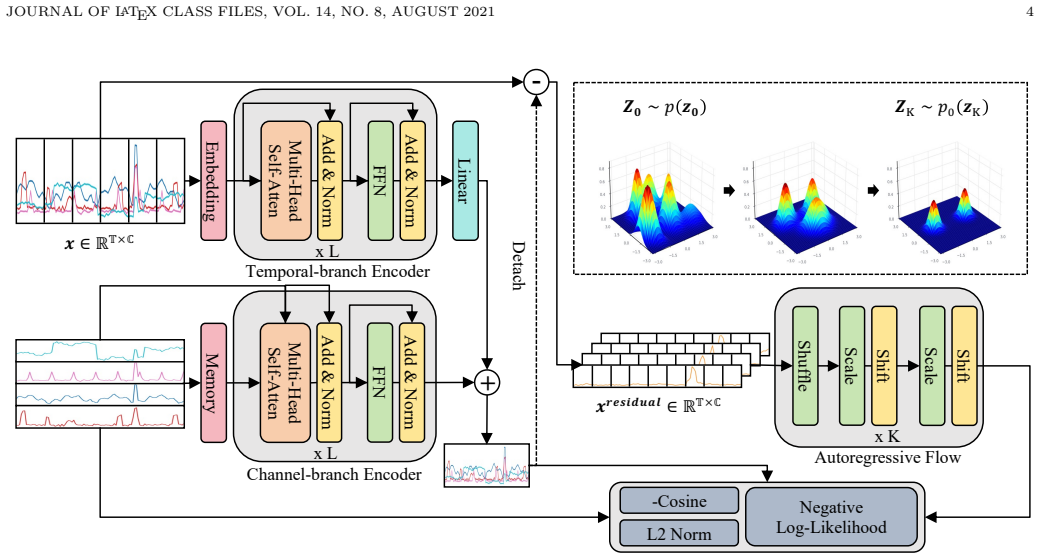
The DBR encoder decouples cross-variable correlation learning from intra-variable statistical property modeling to reduce overfitting to spurious correlations, while the AF module stacks reversible transformations to capture the complex multivariate residual distribution and applies density estimation to assign accurate anomaly scores even to normal samples with large reconstruction errors.
What carries the argument
Dual-branch reconstruction (DBR) encoder that splits cross-variable and intra-variable paths, combined with autoregressive flow (AF) module for residual density estimation via stacked reversible transformations.
If this is right
- Anomaly scores become more trustworthy because density estimation on residuals separates hard normal samples from actual anomalies.
- Overfitting to spurious correlations decreases when the encoder is forced to model intra-variable statistics independently.
- The framework scales to real monitoring tasks in industrial control and aerospace systems where summed error scores currently fail.
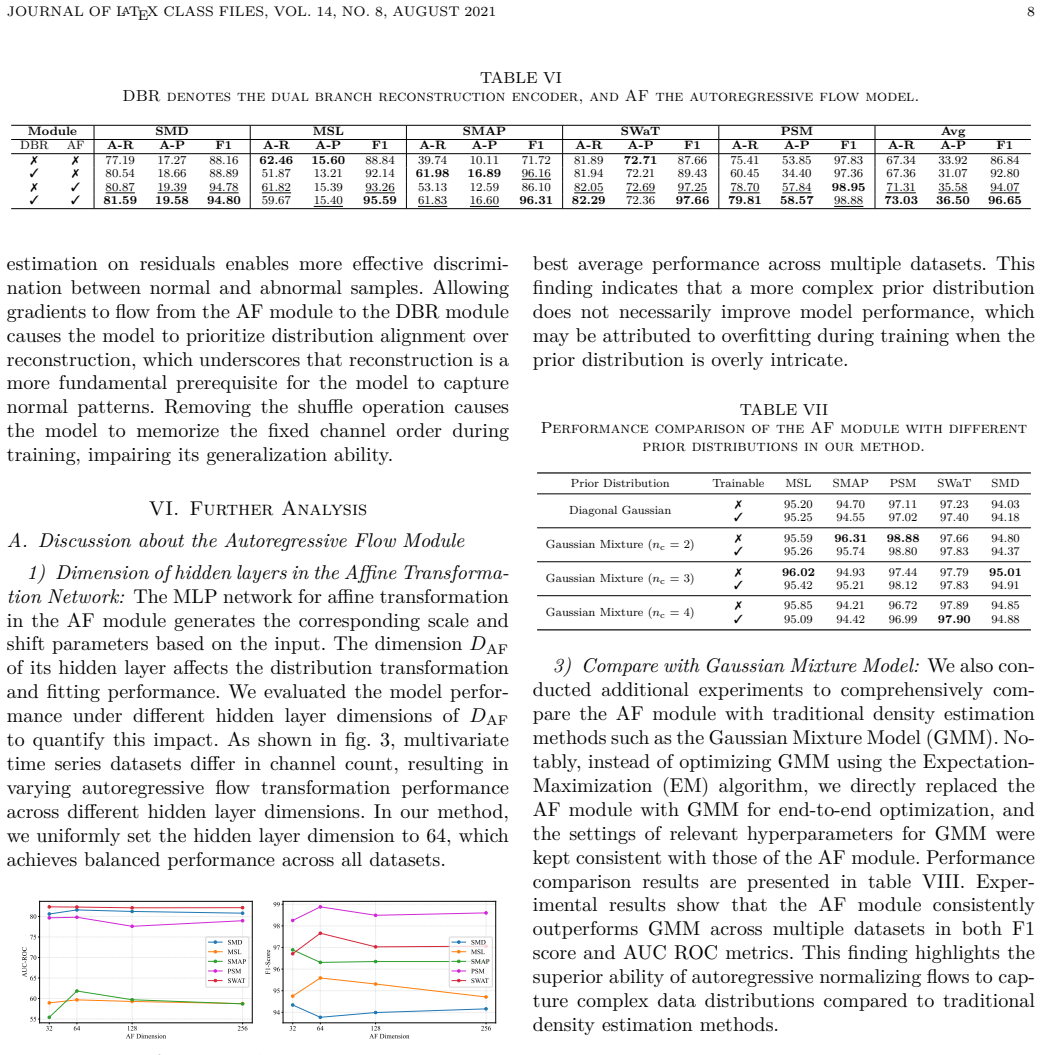
- Ablation results indicate that removing either the dual-branch structure or the flow module drops performance on the seven benchmarks.
Where Pith is reading between the lines
- The same decoupling strategy could be tested on other reconstruction-based detectors to check whether it reduces spurious fits in non-time-series domains.
- Density estimation on residuals might improve scoring in related tasks such as multivariate forecasting or imputation where reconstruction errors are also ambiguous.
- If the reversible transformations in the flow module prove stable under distribution shift, the approach could extend to online anomaly detection on streaming data.
Load-bearing premise
Separating cross-variable correlation learning from intra-variable modeling will reduce spurious correlations without discarding information needed to detect true anomalies.
What would settle it
A dataset in which strong causal cross-variable dependencies are the primary signal of anomalies, where the dual-branch model underperforms a joint-model baseline on held-out test data.
Figures



read the original abstract
Multivariate Time Series Anomaly Detection (MTSAD) is critical for real-world monitoring scenarios such as industrial control and aerospace systems. Mainstream reconstruction-based anomaly detection methods suffer from two key limitations: first, overfitting to spurious correlations induced by an overemphasis on cross-variable modeling; second, the generation of misleading anomaly scores by simply summing up multivariable reconstruction errors, which makes it difficult to distinguish between hard-to-reconstruct samples and genuine anomalies. To address these issues, we propose DBR-AF, a novel framework that integrates a dual-branch reconstruction (DBR) encoder and an autoregressive flow (AF) module. The DBR encoder decouples cross-variable correlation learning and intra-variable statistical property modeling to mitigate spurious correlations, while the AF module employs multiple stacked reversible transformations to model the complex multivariate residual distribution and further leverages density estimation to accurately identify normal samples with large reconstruction errors. Extensive experiments on seven benchmark datasets demonstrate that DBR-AF achieves state-of-the-art performance, with ablation studies validating the indispensability of its core components.
Editorial analysis
A structured set of objections, weighed in public.
Referee Report
Summary. The manuscript proposes DBR-AF for multivariate time series anomaly detection. It introduces a dual-branch reconstruction (DBR) encoder that decouples cross-variable correlation learning from intra-variable statistical property modeling to mitigate overfitting to spurious correlations. An autoregressive flow (AF) module is added to model the complex multivariate residual distribution via stacked reversible transformations and density estimation, replacing simple summation of reconstruction errors for more reliable anomaly scoring. The authors report state-of-the-art results on seven benchmark datasets and use ablation studies to demonstrate the indispensability of the DBR and AF components.
Significance. If the results hold with proper statistical support, the work provides a clear advance in reconstruction-based MTSAD by supplying a principled architectural response to two recurring limitations: over-reliance on cross-variable modeling and crude anomaly scoring. The decoupling strategy supplies a targeted inductive bias, while the AF density estimation offers a technically coherent improvement over summed-error heuristics. Ablation validation and multi-dataset evaluation are positive features that would strengthen the contribution if the quantitative evidence is robust.
minor comments (3)
- [Abstract] Abstract: the claim of SOTA performance and component indispensability is stated without any numerical metrics, error bars, or dataset-specific scores; adding at least the primary F1 or AUC values would make the central claim immediately verifiable.
- [Section 3.2] Section 3.2 (AF module): the description of how the stacked reversible transformations avoid post-hoc fitting issues on the same residuals is brief; a short derivation or explicit statement of the training objective would clarify the separation from the reconstruction loss.
- [Section 4] Section 4 (experiments): ablation tables would benefit from reporting standard deviations across runs or statistical significance tests to substantiate the claim that each component is indispensable.
Simulated Author's Rebuttal
We thank the referee for the positive assessment of DBR-AF and the recommendation for minor revision. The recognition that the dual-branch reconstruction provides a targeted inductive bias and that the autoregressive flow offers a coherent improvement over summed-error scoring is encouraging. We will incorporate minor revisions to strengthen statistical support for the reported results across the seven datasets.
Circularity Check
No significant circularity detected
full rationale
The paper introduces DBR-AF as an architectural combination of a dual-branch reconstruction encoder (decoupling cross- and intra-variable modeling) and an autoregressive flow module for residual density estimation. These are presented as independent inductive biases motivated by stated limitations of prior reconstruction-based methods. No equations, derivations, or self-citations in the provided abstract or description reduce the claimed performance gains or component indispensability to quantities defined solely by fits on the same data. Ablation studies and benchmark results serve as external validation rather than tautological re-derivations. The framework remains self-contained against external benchmarks.
Axiom & Free-Parameter Ledger
free parameters (1)
- number of stacked reversible transformations in AF
axioms (1)
- domain assumption Multivariate time series exhibit separable cross-variable correlations and intra-variable statistical properties that can be modeled independently without loss of essential information.
Lean theorems connected to this paper
-
IndisputableMonolith/Cost/FunctionalEquation.leanwashburn_uniqueness_aczel uncleardual-branch reconstruction (DBR) encoder ... autoregressive flow (AF) module ... residuals ... negative log-likelihood
Reference graph
Works this paper leans on
-
[1]
Detecting spacecraft anomalies using lstms and nonparametric dynamic thresholding,
K. Hundman, V. Constantinou, C. Laporte, I. Colwell, and T. Soderstrom, “Detecting spacecraft anomalies using lstms and nonparametric dynamic thresholding,” in Proceedings of the 24th ACM SIGKDD international conference on knowledge discovery & data mining , 2018, pp. 387–395
work page 2018
-
[2]
Gecco 2018 industrial chal- lenge: Monitoring of drinking-water quality,
F. Rehbach, S. Moritz, S. Chandrasekaran, M. Rebolledo, M. Friese, and T. Bartz-Beielstein, “Gecco 2018 industrial chal- lenge: Monitoring of drinking-water quality,” Accessed: Feb , vol. 19, p. 2019, 2018
work page 2018
-
[3]
Multivariate time series anomaly detection: Fancy algorithms and flawed evaluation methodology,
M. El Amine Sehili and Z. Zhang, “Multivariate time series anomaly detection: Fancy algorithms and flawed evaluation methodology,” in Technology Conference on Performance Eval- uation and Benchmarking . Springer, 2023, pp. 1–17
work page 2023
-
[4]
F. Wang, Y. Jiang, R. Zhang, A. Wei, J. Xie, and X. Pang, “A survey of deep anomaly detection in multivariate time se- ries: taxonomy, applications, and directions,” Sensors (Basel, Switzerland), vol. 25, no. 1, p. 190, 2025
work page 2025
-
[5]
Anomaly transformer: Time series anomaly detection with association discrepancy,
J. Xu, H. Wu, J. Wang, and M. Long, “Anomaly transformer: Time series anomaly detection with association discrepancy,” arXiv preprint arXiv:2110.02642 , 2021
-
[6]
Tfad: A decomposition time series anomaly detection architecture with time-frequency analysis,
C. Zhang, T. Zhou, Q. Wen, and L. Sun, “Tfad: A decomposition time series anomaly detection architecture with time-frequency analysis,” in Proceedings of the 31st ACM international confer- ence on information & knowledge management , 2022, pp. 2497– 2507
work page 2022
-
[7]
Dcde- tector: Dual attention contrastive representation learning for time series anomaly detection,
Y. Yang, C. Zhang, T. Zhou, Q. Wen, and L. Sun, “Dcde- tector: Dual attention contrastive representation learning for time series anomaly detection,” in Proceedings of the 29th ACM SIGKDD conference on knowledge discovery and data mining , 2023, pp. 3033–3045
work page 2023
-
[8]
Temporal-frequency masked autoencoders for time series anomaly detection,
Y. Fang, J. Xie, Y. Zhao, L. Chen, Y. Gao, and K. Zheng, “Temporal-frequency masked autoencoders for time series anomaly detection,” in 2024 IEEE 40th International Confer- ence on Data Engineering (ICDE) . IEEE, 2024, pp. 1228–1241
work page 2024
-
[9]
Learn hybrid prototypes for multivariate time series anomaly detection,
K.-Y. Shen, “Learn hybrid prototypes for multivariate time series anomaly detection,” in The Thirteenth International Con- ference on Learning Representations , 2025
work page 2025
-
[10]
Timesnet: Temporal 2d-variation modeling for general time series analysis,
H. Wu, T. Hu, Y. Liu, H. Zhou, J. Wang, and M. Long, “Timesnet: Temporal 2d-variation modeling for general time series analysis,” arXiv preprint arXiv:2210.02186 , 2022
-
[11]
Catch: Channel-aware multivariate time series anomaly detection via frequency patching,
X. Wu, X. Qiu, Z. Li, Y. Wang, J. Hu, C. Guo, H. Xiong, and B. Yang, “Catch: Channel-aware multivariate time series anomaly detection via frequency patching,” arXiv preprint arXiv:2410.12261, 2024
-
[12]
Y. Xie, H. Zhang, and M. A. Babar, “Multivariate time series anomaly detection by capturing coarse-grained intra-and inter- variate dependencies,” in Proceedings of the ACM on Web Conference 2025, 2025, pp. 697–705
work page 2025
-
[13]
Variational inference with nor- malizing flows,
D. Rezende and S. Mohamed, “Variational inference with nor- malizing flows,” in International conference on machine learn- ing. PMLR, 2015, pp. 1530–1538
work page 2015
-
[14]
On the uni- versality of volume-preserving and coupling-based normalizing flows,
F. Draxler, S. Wahl, C. Schnörr, and U. Köthe, “On the uni- versality of volume-preserving and coupling-based normalizing flows,” arXiv preprint arXiv:2402.06578 , 2024
-
[15]
D. M. Hawkins, Identification of outliers . Springer, 1980, vol. 11
work page 1980
-
[16]
Lof: identifying density-based local outliers,
M. M. Breunig, H.-P. Kriegel, R. T. Ng, and J. Sander, “Lof: identifying density-based local outliers,” in Proceedings of the 2000 ACM SIGMOD international conference on Management of data , 2000, pp. 93–104
work page 2000
-
[17]
Serial order: A parallel distributed processing approach,
M. I. Jordan, “Serial order: A parallel distributed processing approach,” in Advances in psychology. Elsevier, 1997, vol. 121, pp. 471–495
work page 1997
-
[18]
S. Hochreiter and J. Schmidhuber, “Long short-term memory,” Neural Computation, vol. 9, no. 8, pp. 1735–1780, 1997
work page 1997
-
[19]
Temporal convolutional networks for action segmentation and detection,
C. Lea, M. D. Flynn, R. Vidal, A. Reiter, and G. D. Hager, “Temporal convolutional networks for action segmentation and detection,” in proceedings of the IEEE Conference on Computer Vision and Pattern Recognition , 2017, pp. 156–165
work page 2017
-
[20]
D. E. Rumelhart, G. E. Hinton, and R. J. Williams, “(1986) de rumelhart, ge hinton, and rj williams, learning internal repre- sentations by error propagation, parallel distributed processing: Explorations in the microstructures of cognition, vol. i, de rumelhart and jl mcclelland (eds.) cambridge, ma: Mit press, pp. 318-362,” 1988
work page 1986
-
[21]
Auto-Encoding Variational Bayes
D. P. Kingma and M. Welling, “Auto-encoding variational bayes,” arXiv preprint arXiv:1312.6114 , 2013
work page internal anchor Pith review Pith/arXiv arXiv 2013
-
[22]
T. Yairi, N. Takeishi, T. Oda, Y. Nakajima, N. Nishimura, and N. Takata, “A data-driven health monitoring method for satellite housekeeping data based on probabilistic clustering and dimensionality reduction,” IEEE Transactions on Aerospace and Electronic Systems , vol. 53, no. 3, pp. 1384–1401, 2017
work page 2017
-
[23]
Deep autoencoding gaussian mixture model for unsupervised anomaly detection,
B. Zong, Q. Song, M. R. Min, W. Cheng, C. Lumezanu, D. Cho, and H. Chen, “Deep autoencoding gaussian mixture model for unsupervised anomaly detection,” in International conference on learning representations , 2018
work page 2018
-
[24]
Anomaly detection using autoen- coders with nonlinear dimensionality reduction,
M. Sakurada and T. Yairi, “Anomaly detection using autoen- coders with nonlinear dimensionality reduction,” in Proceedings of the MLSDA 2014 2nd workshop on machine learning for sensory data analysis , 2014, pp. 4–11
work page 2014
-
[25]
D. Park, Y. Hoshi, and C. C. Kemp, “A multimodal anomaly de- tector for robot-assisted feeding using an lstm-based variational autoencoder,” IEEE Robotics and Automation Letters , vol. 3, no. 3, pp. 1544–1551, 2018
work page 2018
-
[26]
Robust anomaly detection for multivariate time series through stochas- tic recurrent neural network,
Y. Su, Y. Zhao, C. Niu, R. Liu, W. Sun, and D. Pei, “Robust anomaly detection for multivariate time series through stochas- tic recurrent neural network,” in Proceedings of the 25th ACM SIGKDD international conference on knowledge discovery & data mining , 2019, pp. 2828–2837
work page 2019
-
[27]
Z. Li, Y. Zhao, J. Han, Y. Su, R. Jiao, X. Wen, and D. Pei, “Multivariate time series anomaly detection and interpretation using hierarchical inter-metric and temporal embedding,” in Proceedings of the 27th ACM SIGKDD conference on knowledge discovery & data mining , 2021, pp. 3220–3230
work page 2021
-
[28]
A. Vaswani, N. Shazeer, N. Parmar, J. Uszkoreit, L. Jones, A. N. Gomez, Ł. Kaiser, and I. Polosukhin, “Attention is all you need,” Advances in neural information processing systems , vol. 30, 2017
work page 2017
-
[29]
Breaking the time-frequency granularity discrepancy in time-series anomaly detection,
Y. Nam, S. Yoon, Y. Shin, M. Bae, H. Song, J.-G. Lee, and B. S. Lee, “Breaking the time-frequency granularity discrepancy in time-series anomaly detection,” in Proceedings of the ACM Web Conference 2024, 2024, pp. 4204–4215
work page 2024
-
[30]
Memto: Memory-guided transformer for multivariate time series anomaly detection,
J. Song, K. Kim, J. Oh, and S. Cho, “Memto: Memory-guided transformer for multivariate time series anomaly detection,” Advances in Neural Information Processing Systems , vol. 36, pp. 57 947–57 963, 2023. JOURNAL OF LATEX CLASS FILES, VOL. 14, NO. 8, AUGUST 2021 12
work page 2023
-
[31]
C. Wang, Z. Zhuang, Q. Qi, J. Wang, X. Wang, H. Sun, and J. Liao, “Drift doesn’t matter: Dynamic decomposition with diffusion reconstruction for unstable multivariate time series anomaly detection,” Advances in neural information processing systems, vol. 36, pp. 10 758–10 774, 2023
work page 2023
-
[32]
B. Zhang, T. Kieu, X. Qiu, C. Guo, J. Hu, A. Zhou, C. S. Jensen, and B. Yang, “An encode-then-decompose approach to unsu- pervised time series anomaly detection on contaminated train- ing data–extended version,” arXiv preprint arXiv:2510.18998 , 2025
-
[33]
NICE: Non-linear Independent Components Estimation
L. Dinh, D. Krueger, and Y. Bengio, “Nice: Non-linear indepen- dent components estimation,” arXiv preprint arXiv:1410.8516 , 2014
work page internal anchor Pith review Pith/arXiv arXiv 2014
-
[34]
Masked au- toregressive flow for density estimation,
G. Papamakarios, T. Pavlakou, and I. Murray, “Masked au- toregressive flow for density estimation,” Advances in neural information processing systems , vol. 30, 2017
work page 2017
-
[35]
Glow: Generative flow with invertible 1x1 convolutions,
D. P. Kingma and P. Dhariwal, “Glow: Generative flow with invertible 1x1 convolutions,” Advances in neural information processing systems, vol. 31, 2018
work page 2018
-
[36]
Neural ordinary differential equations,
R. T. Chen, Y. Rubanova, J. Bettencourt, and D. K. Duvenaud, “Neural ordinary differential equations,” Advances in neural information processing systems , vol. 31, 2018
work page 2018
-
[37]
C. Durkan, A. Bekasov, I. Murray, and G. Papamakarios, “Neu- ral spline flows,” Advances in neural information processing systems, vol. 32, 2019
work page 2019
-
[38]
Neural discrete repre- sentation learning,
A. Van Den Oord, O. Vinyals et al. , “Neural discrete repre- sentation learning,” Advances in neural information processing systems, vol. 30, 2017
work page 2017
-
[39]
Made: Masked autoencoder for distribution estimation,
M. Germain, K. Gregor, I. Murray, and H. Larochelle, “Made: Masked autoencoder for distribution estimation,” in Interna- tional conference on machine learning . PMLR, 2015, pp. 881– 889
work page 2015
-
[40]
F. T. Liu, K. M. Ting, and Z.-H. Zhou, “Isolation forest,” in 2008 eighth ieee international conference on data mining . IEEE, 2008, pp. 413–422
work page 2008
-
[41]
Joint selective state space model and detrending for robust time series anomaly detection,
J. Chen, X. Tan, S. Rahardja, J. Yang, and S. Rahardja, “Joint selective state space model and detrending for robust time series anomaly detection,” IEEE Signal Processing Letters , 2024
work page 2024
-
[42]
Swat: A water treatment testbed for research and training on ics security,
A. P. Mathur and N. O. Tippenhauer, “Swat: A water treatment testbed for research and training on ics security,” in 2016 inter- national workshop on cyber-physical systems for smart water networks (CySWater). IEEE, 2016, pp. 31–36
work page 2016
-
[43]
Practical approach to asynchronous multivariate time series anomaly detection and localization,
A. Abdulaal, Z. Liu, and T. Lancewicki, “Practical approach to asynchronous multivariate time series anomaly detection and localization,” in Proceedings of the 27th ACM SIGKDD conference on knowledge discovery & data mining , 2021, pp. 2485–2494
work page 2021
-
[44]
Swan-sf: Space weather analytics dataset-solar flares,
R. Angryk, P. Martens, B. Aydin, D. Kempton, S. Mahajan, S. Basodi, A. Ahmadzadeh, X. Cai, S. Filali Boubrahimi, S. M. Hamdi et al. , “Swan-sf: Space weather analytics dataset-solar flares,” Harvard Dataverse dataset , p. 102, 2020
work page 2020
-
[45]
Towards a rigorous evaluation of time-series anomaly detection,
S. Kim, K. Choi, H.-S. Choi, B. Lee, and S. Yoon, “Towards a rigorous evaluation of time-series anomaly detection,” in Proceedings of the AAAI conference on artificial intelligence , vol. 36, no. 7, 2022, pp. 7194–7201
work page 2022
-
[46]
Local evaluation of time series anomaly detection algorithms,
A. Huet, J. M. Navarro, and D. Rossi, “Local evaluation of time series anomaly detection algorithms,” in Proceedings of the 28th ACM SIGKDD Conference on Knowledge Discovery and Data Mining, 2022, pp. 635–645
work page 2022
-
[47]
Density estimation using Real NVP
L. Dinh, J. Sohl-Dickstein, and S. Bengio, “Density estimation using real nvp,” arXiv preprint arXiv:1605.08803 , 2016
work page internal anchor Pith review Pith/arXiv arXiv 2016
-
[48]
Tsb-uad: an end-to-end benchmark suite for univariate time-series anomaly detection,
J. Paparrizos, Y. Kang, P. Boniol, R. S. Tsay, T. Palpanas, and M. J. Franklin, “Tsb-uad: an end-to-end benchmark suite for univariate time-series anomaly detection,” Proceedings of the VLDB Endowment , vol. 15, no. 8, pp. 1697–1711, 2022
work page 2022
discussion (0)
Sign in with ORCID, Apple, or X to comment. Anyone can read and Pith papers without signing in.