Recognition: no theorem link
Reputational Spillovers
Pith reviewed 2026-05-10 18:01 UTC · model grok-4.3
The pith
Spillovers overturn the 'toughness pays' result in three-player bargaining precisely when one peripheral starts as uniquely most reputable.
A machine-rendered reading of the paper's core claim, the machinery that carries it, and where it could break.
Core claim
In a reputational bargaining game with a central player negotiating simultaneously with two peripheral players, each of whom may be rational or a commitment type, the central player's type is global across disputes. Concessions are publicly observed, so actions in one dispute update beliefs in the other and generate reputational spillovers. The game has a unique equilibrium that permits sharp comparison with the bilateral Abreu-Gul benchmark. Spillovers are payoff-relevant if and only if a peripheral is uniquely the most reputable player initially. In that case spillovers overturn the bilateral prediction that toughness pays: the central player is never strictly better off and can be worse,;
What carries the argument
The global (shared) type of the central player, which links the two disputes by making observed concessions in one update beliefs about the center's type in the other.
If this is right
- The game admits a unique equilibrium that allows direct comparison to the bilateral benchmark.
- When spillovers are active the central player is never strictly better off than in the absence of spillovers and can be strictly worse off.
- The strongest peripheral is strictly worse off when spillovers are active.
- The weakest peripheral can be strictly better off, particularly when the center's higher-stakes dispute is with the other peripheral.
- Spillovers have no payoff consequences if neither peripheral is uniquely most reputable at the start.
Where Pith is reading between the lines
- Parties facing multiple simultaneous negotiations may try to equalize initial reputations to neutralize spillovers.
- The model suggests that weak players can strategically benefit from being linked to a stronger peripheral through a shared central opponent.
- Extensions to chains of negotiations or to endogenous choice of which disputes to conduct simultaneously would test whether players actively manage spillover exposure.
- Empirical tests could compare concession rates in linked versus isolated disputes holding initial reputations fixed.
Load-bearing premise
The central player's type is the same in both disputes so that observed actions in one update beliefs in the other.
What would settle it
Compare equilibrium concession timing and payoffs in the three-player game against the corresponding bilateral games when one peripheral has strictly higher initial reputation than the center and the other peripheral; the payoffs must differ under the shared-type assumption and must coincide without it.
Figures


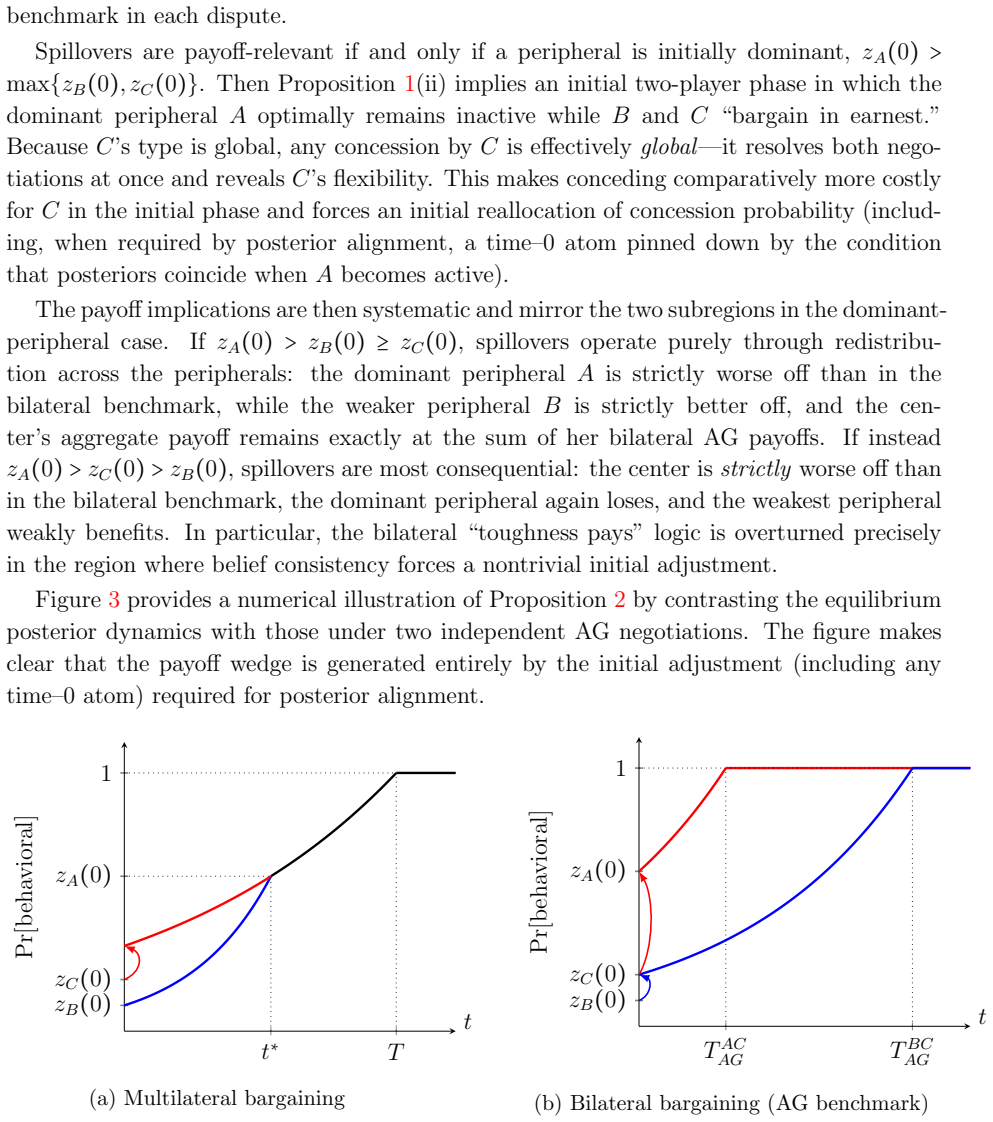

read the original abstract
We analyze a reputational bargaining game in which a central player negotiates simultaneously with two peripheral players. Each player is either rational or a commitment type who never concedes and insists on a fixed share, and concessions are publicly observed. The central player's type is global, so actions in one dispute update beliefs in the other and generate reputational spillovers. The game admits a unique equilibrium, enabling a sharp comparison with the bilateral benchmark of Abreu and Gul (2000). Spillovers are payoff-relevant if and only if a peripheral is uniquely the most reputable player initially. In that case, spillovers overturn the bilateral prediction that toughness pays: the central player is never strictly better off and can be strictly worse off; the strongest peripheral loses; and the weakest peripheral can benefit, especially when the center's higher-stakes dispute is with the other peripheral.
Editorial analysis
A structured set of objections, weighed in public.
Referee Report
Summary. The paper analyzes a reputational bargaining game in which a central player negotiates simultaneously with two peripheral players. Each player is rational or a commitment type who never concedes; concessions are public. The central player's type is global across disputes, so actions in one update beliefs in the other. The game admits a unique equilibrium. The authors compare this to the bilateral Abreu-Gul (2000) benchmark and show that reputational spillovers are payoff-relevant if and only if a peripheral player is uniquely the most reputable initially. In that case, the central player is never strictly better off (and can be strictly worse off), the strongest peripheral loses, and the weakest peripheral can benefit, particularly when the center's higher-stakes dispute is with the other peripheral.
Significance. If the equilibrium construction and payoff comparisons hold, the paper delivers a clean, sharp extension of the Abreu-Gul framework to a star-shaped multi-party setting. The explicit derivation of uniqueness and the if-and-only-if characterization of spillover relevance are strengths; they allow precise statements about when toughness pays or backfires due to cross-dispute belief updating. This advances the literature on reputation in bargaining networks and supplies falsifiable predictions about payoff reversals under global types.
minor comments (3)
- [§2] §2 (model setup): the timing of simultaneous offers and the exact definition of the common prior on the central player's type across the two disputes could be stated more formally to make the belief-updating map fully explicit before the equilibrium analysis begins.
- [§4] §4 (equilibrium characterization): while the uniqueness proof is referenced as following from the bilateral logic, a short self-contained sketch of why no other strategy profiles survive the simultaneous-move structure would help readers verify the 'unique equilibrium' claim without reconstructing the entire argument.
- [§5] The payoff-reversal statements in the abstract and §5 are qualitative; adding a brief numerical example (e.g., with specific initial reputation levels and stake sizes) would illustrate the 'can be strictly worse off' and 'weakest peripheral can benefit' claims without lengthening the paper.
Simulated Author's Rebuttal
We thank the referee for their careful summary of the paper and for recognizing its contribution as a sharp extension of the Abreu-Gul (2000) framework to a star-shaped reputational bargaining setting. The referee's assessment of the equilibrium uniqueness result and the if-and-only-if characterization of spillover relevance is accurate. We appreciate the recommendation for minor revision. Because the report lists no specific major comments, we have no point-by-point responses to offer at this stage and will incorporate any minor editorial suggestions in the revised version.
Circularity Check
No significant circularity
full rationale
The paper extends the Abreu-Gul (2000) bilateral reputational bargaining framework to a simultaneous two-dispute game with a global central-player type. The unique equilibrium, the 'if and only if' condition for payoff-relevant spillovers, and the resulting payoff comparisons are derived explicitly from the model's belief-updating rules and concession-timing logic. No step reduces a claimed prediction to a fitted parameter, a self-citation chain, or an input by construction; the shared-type assumption is stated upfront as the explicit coupling mechanism whose removal recovers the independent bilateral benchmark. The derivation is therefore self-contained against the external benchmark.
Axiom & Free-Parameter Ledger
axioms (3)
- domain assumption Central player's type is global across both negotiations
- domain assumption Commitment types never concede and insist on fixed share
- domain assumption Concessions are publicly observed
Reference graph
Works this paper leans on
-
[1]
If stage 1 ends at timeτbecauseCconcedes, thenCis revealed rational and concedes immediately to Bat the start of stage 2
(Stage 2) If stage 1 ends at timeτbecauseAconcedes, then stage 2 is the bilateral AG equilibrium betweenBandCwith initial posteriors(z B(0), zC(τ)). If stage 1 ends at timeτbecauseCconcedes, thenCis revealed rational and concedes immediately to Bat the start of stage 2
-
[2]
(Stage 1 hazards) Along the stage-1 no-concession history, there is a finite terminal timeT∈(0,∞)such thatz A(T)=z C(T)=1. On(0, T)both players concede with 2 positive density a.e., and their equilibrium hazards satisfy λC(t)=λ AG∶=r(1−α) 2α−1 , λ A(t)=λ AG⋅ πAC+1 πAC+g(z C(t);z B(0)) for a.e.t∈(0, T), (11) whereg(⋅;⋅)is defined in(8). Equivalently, ifz C...
-
[3]
reputational bonus
(Time-0 atom and terminal time) At most one player concedes with positive probability at time0in stage 1. Letz i(0+)∶=zi(0)/(1−Fi(0))denote the posteriors after any time-0atom in stage 1. The terminal time is T=− 1 λAG logz C(0+).(12) Define the threshold¯zA by ¯zA∶= ⎧⎪⎪⎪⎪⎪⎪⎪⎨⎪⎪⎪⎪⎪⎪⎪⎩ (πAC+1)z C(0)−zB(0) πAC+1−zB(0) ,ifz C(0)≥zB(0), πAC zB(0) πAC+1−zB(0)(...
discussion (0)
Sign in with ORCID, Apple, or X to comment. Anyone can read and Pith papers without signing in.