Recognition: unknown
Bypassed Core Formation in Milky Way-Mass SIDM Halos: Implications for the Local Group Past-Pericenter Scenario
Pith reviewed 2026-05-10 16:47 UTC · model grok-4.3
The pith
Baryonic potentials in Milky Way-mass halos cause SIDM to skip core formation and collapse immediately, raising central densities steadily.
A machine-rendered reading of the paper's core claim, the machinery that carries it, and where it could break.
Core claim
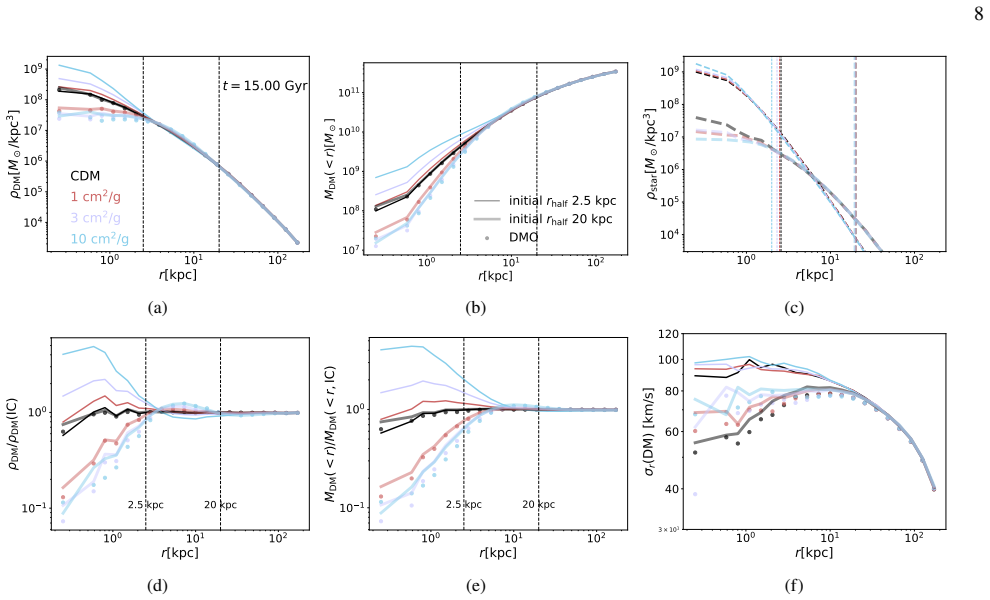
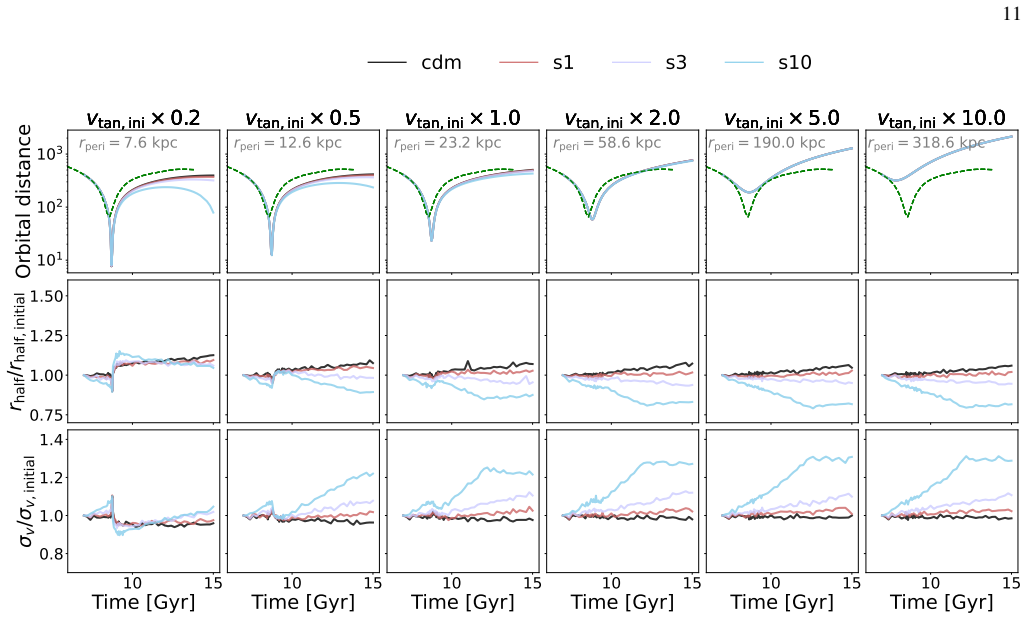
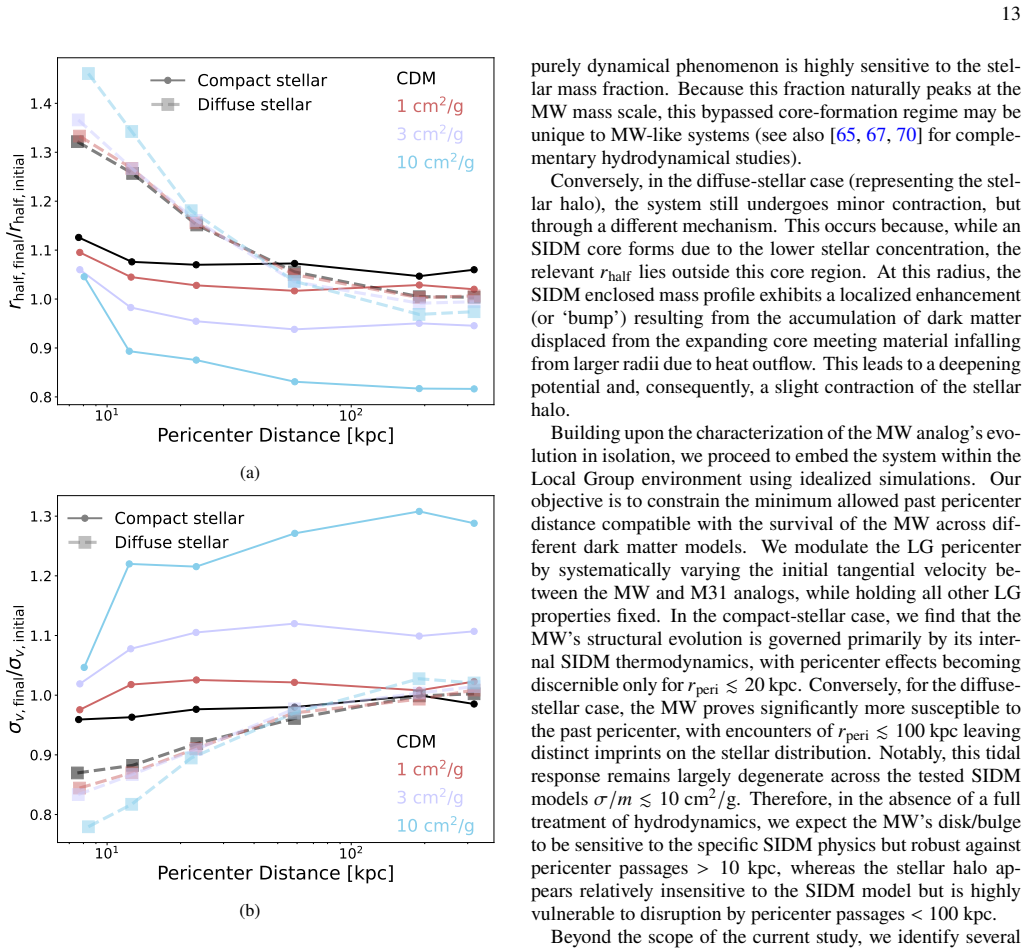
In simulations initialized from Local Group analogues, the deep baryonic potential establishes a negative temperature gradient that drives SIDM halos to bypass standard core formation and enter immediate core-collapse, resulting in monotonically increasing central densities. In full orbital simulations of the MW-M31 encounter, the compact stellar disk and bulge remain robust against tidal disruption for pericenter distances as close as 20 kpc at around 8 Gyr lookback time, while the diffuse stellar halo disrupts at larger separations around 100 kpc. This reveals a structural dichotomy where the inner components are sensitive to SIDM thermodynamics but resilient to the encounter, unlike the 0
What carries the argument
the negative temperature gradient in the dark matter halo preconditioned by the baryonic potential, which triggers immediate core-collapse instead of core formation
If this is right
- SIDM halos exhibit monotonically increasing central densities without passing through a core-formation phase.
- The stellar disk and bulge of the Milky Way analog survive pericentric passages as close as 20 kpc during an encounter at 8 Gyr lookback time.
- The diffuse stellar halo undergoes tidal disruption for pericenter distances below 100 kpc, largely independent of the SIDM cross-section.
- A clear separation emerges between the compact inner galaxy, which responds to SIDM thermodynamics, and the outer halo, which responds mainly to orbital tides.
Where Pith is reading between the lines
- The same baryonic preconditioning could alter SIDM evolution in other galaxies that host massive stellar components.
- Combining constraints on the Milky Way's orbital history with measurements of its central density profile offers a new route to bound the SIDM cross-section.
- This mechanism implies that SIDM predictions for halo structure depend on the presence and depth of the baryonic potential in ways that standard CDM does not.
- Extending the approach to include live baryonic disks or feedback could test whether the temperature gradient remains stable over cosmic time.
Load-bearing premise
The initial conditions drawn from Local Group analogues accurately reproduce the dark matter halo's thermal structure, including the negative temperature gradient set by the galaxy's stars and gas.
What would settle it
A direct measurement of the Milky Way's inner dark matter density profile that shows a flat core or declining density, rather than a steadily rising central density, would rule out the immediate core-collapse outcome.
Figures





read the original abstract
We consider a scenario in which the Milky Way (MW) and M31 have had a previous pericentric passage, and investigate its compatibility with self-interacting dark matter (SIDM). Using initial conditions sampled from Local Group (LG) analogues in the IllustrisTNG simulation, we perform controlled re-simulations of the MW-M31 orbit, evolving the system under both standard cold dark matter (CDM) and various SIDM cross-sections. We find that the deep baryonic potential of the MW preconditions the halo's thermal structure, establishing an initial negative temperature gradient. This drives SIDM halos to bypass the standard core-formation phase and enter immediate core-collapse, resulting in monotonically increasing central densities. In full orbital simulations, the compact stellar component (disk/bulge) of the MW analog remains robust against tidal disruption for pericenter distances as close as $r_{\rm peri}\lesssim20$ kpc during an encounter at cosmic time $\sim8$ Gyr. The diffuse stellar halo is comparatively more susceptible, facing disruption for $r_{\rm peri}\lesssim100$ kpc. Our results demonstrate a dichotomy in structural evolution: the compact disk/bulge is sensitive to intrinsic SIDM thermodynamics but dynamically robust against the pericenter encounter, whereas the diffuse stellar halo is largely independent of the specific SIDM model but more vulnerable to orbital tidal disruptions.
Editorial analysis
A structured set of objections, weighed in public.
Referee Report
Summary. The paper examines whether a past pericentric passage between Milky Way and M31 analogues is compatible with SIDM by performing controlled re-simulations initialized from IllustrisTNG Local Group analogues. It claims that the deep baryonic potential preconditions the dark-matter halo with a negative temperature (velocity-dispersion) gradient, causing SIDM models to bypass the usual gravothermal core-formation phase and proceed directly to core collapse, producing monotonically rising central densities. The compact stellar disk/bulge component remains dynamically robust even for pericenters as close as ~20 kpc at ~8 Gyr, while the diffuse stellar halo is more susceptible to tidal disruption; this establishes a dichotomy between SIDM thermodynamics (affecting the disk) and orbital tides (affecting the halo).
Significance. If the central mechanism is robust, the work would be significant for SIDM phenomenology in baryon-dominated environments and for assessing the viability of a Local Group past-encounter scenario. The controlled re-simulation approach from cosmologically sampled ICs is a methodological strength, enabling direct CDM–SIDM comparison under realistic orbital and baryonic conditions. It also supplies falsifiable predictions for central density evolution and differential vulnerability of stellar components that could be tested against observations.
major comments (2)
- [Initial conditions and thermal structure] The bypass-to-immediate-collapse claim rests on the initial negative temperature gradient (dσ/dr < 0) being both accurately inherited from the IllustrisTNG LG analogues and preserved once the live baryonic potential is removed in the SIDM runs. The manuscript should provide explicit measurements or figures of the velocity-dispersion profile at the start of the re-simulations (and its evolution) to demonstrate that the preconditioning is not erased by resampling or the absence of baryons; without this, the standard core-formation sequence could still occur before collapse.
- [Numerical methods and resolution] The abstract and methods provide no information on numerical resolution, particle number, softening length, time-stepping criteria, or convergence tests for the reported central-density evolution. Because the quantitative distinction between bypassed core formation and monotonic collapse is load-bearing for the SIDM-specific conclusions, these details are required to assess whether the results are numerically converged.
minor comments (1)
- [Abstract] The abstract refers to “various SIDM cross-sections” without quoting the specific values or range explored; adding these would improve immediate context for the claimed dichotomy.
Simulated Author's Rebuttal
We thank the referee for their positive assessment of the work's significance and for the constructive major comments. We have revised the manuscript to address both points by adding the requested explicit measurements, figures, and numerical details, which we believe strengthen the presentation of the bypass mechanism and ensure the results are reproducible and converged.
read point-by-point responses
-
Referee: [Initial conditions and thermal structure] The bypass-to-immediate-collapse claim rests on the initial negative temperature gradient (dσ/dr < 0) being both accurately inherited from the IllustrisTNG LG analogues and preserved once the live baryonic potential is removed in the SIDM runs. The manuscript should provide explicit measurements or figures of the velocity-dispersion profile at the start of the re-simulations (and its evolution) to demonstrate that the preconditioning is not erased by resampling or the absence of baryons; without this, the standard core-formation sequence could still occur before collapse.
Authors: We agree that explicit verification of the inherited thermal structure is essential to substantiate the bypass-to-collapse pathway. In the revised manuscript we have added a new figure (Figure 2) that shows the radial velocity-dispersion profiles σ(r) of the dark-matter halos at the exact start of the re-simulations, taken directly from the parent IllustrisTNG Local Group analogues. These profiles exhibit a clear negative gradient (dσ/dr < 0) within the inner ~10 kpc, preconditioned by the baryonic potential. We further display the early-time evolution of σ(r) in the SIDM runs (first ~1 Gyr), confirming that the gradient is preserved after baryons are removed and that the system proceeds directly to core collapse without an intervening core-formation phase. Direct comparison with the original TNG halos demonstrates that the resampling procedure does not erase the preconditioning. These additions directly address the referee’s concern. revision: yes
-
Referee: [Numerical methods and resolution] The abstract and methods provide no information on numerical resolution, particle number, softening length, time-stepping criteria, or convergence tests for the reported central-density evolution. Because the quantitative distinction between bypassed core formation and monotonic collapse is load-bearing for the SIDM-specific conclusions, these details are required to assess whether the results are numerically converged.
Authors: We thank the referee for highlighting this omission. The revised Methods section (Section 2.2) now provides full numerical specifications: each re-simulation uses ~1.2 × 10^6 dark-matter particles per halo (particle mass 1.5 × 10^5 M⊙), 2 × 10^5 baryonic particles, Plummer softening of 0.1 kpc for dark matter and 0.05 kpc for baryons, and adaptive time-stepping with a maximum Δt = 0.1 Myr. We have added a new appendix (Appendix A) containing convergence tests performed at three resolutions (particle number varied by factors of 4 and 8). These tests show that the central-density evolution, the absence of a core-formation phase, and the subsequent monotonic collapse remain unchanged to within 5 % in the inner 1 kpc, confirming that the reported SIDM-specific behavior is numerically converged. revision: yes
Circularity Check
No significant circularity; results from direct N-body simulations with external ICs
full rationale
The paper reports outcomes from controlled re-simulations of MW-M31 orbits using initial conditions sampled from IllustrisTNG Local Group analogues. The claimed bypass of core formation and immediate core-collapse in SIDM follows from evolving those ICs (which carry a baryon-preconditioned negative temperature gradient) under SIDM cross-sections; this gradient is an imported input from the external TNG run rather than a quantity defined in terms of the SIDM results themselves. No equations, fitted parameters, or self-citations are invoked to derive the structural dichotomy; the monotonic density increase and tidal robustness statements are direct numerical outputs. The analysis therefore contains no self-definitional steps, fitted-input predictions, or load-bearing self-citation chains.
Axiom & Free-Parameter Ledger
axioms (1)
- domain assumption Initial conditions sampled from Local Group analogues in the IllustrisTNG simulation accurately represent the thermal structure of Milky Way-mass halos including baryonic preconditioning.
Reference graph
Works this paper leans on
-
[1]
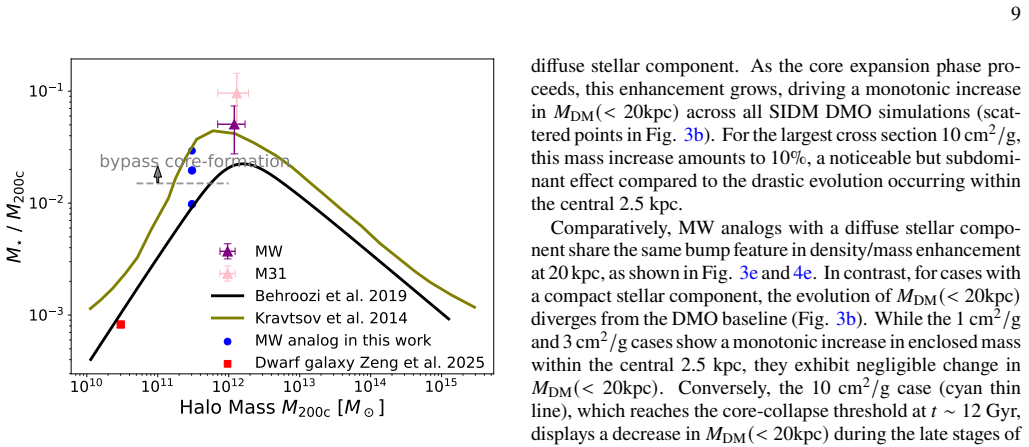
MW-sized systems have two characteristics relevant for this matter: a) the (central) stellar mass fraction peaks at a halo mass of∼10 12 𝑀⊙, as illustrated in Fig
Further testing the bypassed core-formation with varying stellar mass fraction We propose that this phenomenon of bypassing the core- formation process and having the central DM density nearly monotonically increasing over time, even at cross sections as low as 1cm 2/g, is likely unique to MW-sized systems. MW-sized systems have two characteristics releva...
2019
-
[2]
A dwarf system simulated with a very similar approach in [27] but displays a vastly different behavior is shown as the red square
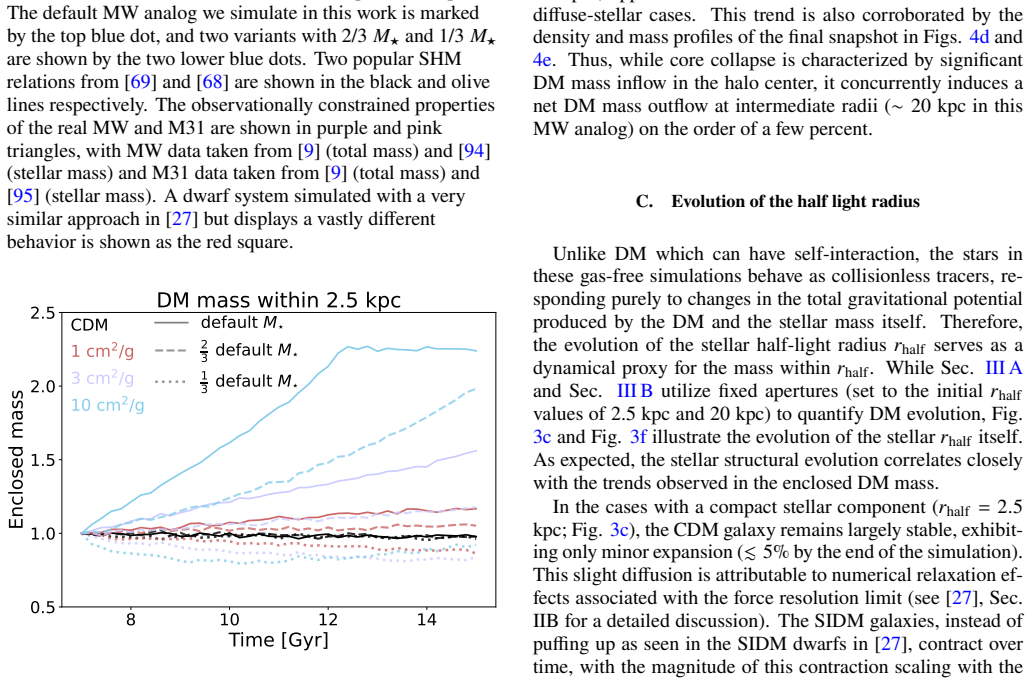
(stellar mass). A dwarf system simulated with a very similar approach in [27] but displays a vastly different behavior is shown as the red square. 8 10 12 14 Time [Gyr] 0.5 1.0 1.5 2.0 2.5Enclosed mass DM mass within 2.5 kpc CDM 1 cm2/g 3 cm2/g 10 cm2/g default M 2 3 default M 1 3 default M FIG. 6: The enclosed DM mass within 2.5 kpc for the compact-stell...
- [4]
- [5]
- [6]
- [7]
- [8]
-
[9]
J.872, 24 (2019), arXiv:1805.04079 [astro-ph.GA]
R.P.vanderMarel,M.A.Fardal,S.T.Sohn,E.Patel,G.Besla, A.delPino,J.Sahlmann,andL.L.Watkins,FirstGaiaDynam- ics of the Andromeda System: DR2 Proper Motions, Orbits, and Rotation of M31 and M33, Astrophys. J.872, 24 (2019), arXiv:1805.04079 [astro-ph.GA]
- [10]
- [11]
- [12]
- [13]
-
[14]
D. Benisty, Timing argument take on the Milky Way and An- dromedapastencounter,Astron.Astrophys.656,A129(2021), arXiv:1904.03153 [astro-ph.GA]
-
[15]
D. N. Spergel and P. J. Steinhardt, Observational Evidence for Self-Interacting Cold Dark Matter, Phys. Rev. Lett.84, 3760 (2000)
2000
-
[16]
F. Kahlhoefer, K. Schmidt-Hoberg, M. T. Frandsen, and S. Sarkar, Colliding clusters and dark matter self- interactions, Mon. Not. Roy. Astron. Soc.437, 2865 (2014), arXiv:1308.3419 [astro-ph.CO]
- [17]
- [18]
-
[19]
E. O. Nadler, A. Banerjee, S. Adhikari, Y.-Y. Mao, and R. H. Wechsler,SignaturesofVelocity-dependentDarkMatterSelf- interactions in Milky Way-mass Halos, Astrophys. J.896, 112 (2020), arXiv:2001.08754 [astro-ph.CO]. 16 7 8 9 10 11 12 13 14 15 Time [Gyr] 0.850 0.875 0.900 0.925 0.950 0.975 1.000 1.025 1.050Enclosed mass CDM 7 8 9 10 11 12 13 14 15 Time [Gy...
- [20]
-
[21]
Z.C.Zeng,A.H.G.Peter,X.Du,A.Benson,S.Kim,F.Jiang, F.-Y. Cyr-Racine, and M. Vogelsberger, Core-collapse, evapo- ration,andtidaleffects: thelifestoryofaself-interactingdark mattersubhalo,Mon.Not.Roy.Astron.Soc.513,4845(2022), arXiv:2110.00259 [astro-ph.CO]
-
[22]
D. Klemmer, M. S. Fischer, K. K. Boddy, M. Kaplinghat, and L. Sagunski, Survival of the most compact: the life and death of satellitehalos in self-interacting darkmatter, arXiv e-prints (2026), arXiv:2603.19362 [astro-ph.GA]
-
[23]
Selfinteracting dark matter halos and the gravothermal catastrophe,
S.Balberg,S.L.Shapiro,andS.Inagaki,Self-InteractingDark MatterHalosandtheGravothermalCatastrophe,Astrophys.J. 568, 475 (2002), arXiv:astro-ph/0110561 [astro-ph]
-
[24]
S. Balberg and S. L. Shapiro, Gravothermal Collapse of Self- Interacting Dark Matter Halos and the Origin of Massive Black Holes, Phys. Rev. Lett.88, 101301 (2002), arXiv:astro- ph/0111176 [astro-ph]
- [25]
-
[26]
O. Sameie, H.-B. Yu, L. V. Sales, M. Vogelsberger, and J. Zavala, Self-Interacting Dark Matter Subhalos in the Milky Way’s Tides, Phys. Rev. Lett.124, 141102 (2020), arXiv:1904.07872 [astro-ph.GA]
-
[27]
H. Nishikawa, K. K. Boddy, and M. Kaplinghat, Accelerated core collapse in tidally stripped self-interacting dark matter halos, Phys. Rev. D101, 063009 (2020), arXiv:1901.00499 [astro-ph.GA]
- [28]
- [29]
- [30]
- [31]
-
[32]
D. Yang, E. O. Nadler, H.-B. Yu, and Y.-M. Zhong, A Para- metric Model for Self-Interacting Dark Matter Halos, arXiv e-prints , arXiv:2305.16176 (2023), arXiv:2305.16176 [astro- 17 7 8 9 10 11 12 13 14 15 Time [Gyr] 0.90 0.92 0.94 0.96 0.98 1.00 1.02 1.04Enclosed mass CDM 7 8 9 10 11 12 13 14 15 Time [Gyr] 1.00 1.05 1.10 1.15 1.20Enclosed mass 1 cm2/g 7 8...
- [33]
-
[34]
M. Shirasaki, T. Okamoto, and S. Ando, Modelling self- interacting dark matter substructures - I. Calibration with N-body simulations of a Milky-Way-sized halo and its satellite, Mon. Not. Roy. Astron. Soc.516, 4594 (2022), arXiv:2205.09920 [astro-ph.CO]
-
[35]
K. A. Oman, J. F. Navarro, A. Fattahi, C. S. Frenk, T. Sawala, S. D. M. White, R. Bower, R. A. Crain, M. Furlong, M. Schaller, J. Schaye, and T. Theuns, The unexpected diver- sity of dwarf galaxy rotation curves, Mon. Not. Roy. Astron. Soc.452, 3650 (2015), arXiv:1504.01437 [astro-ph.GA]
- [36]
- [37]
- [38]
-
[39]
G. Despali, F. M. Heinze, C. D. Fassnacht, S. Vegetti, C. Sp- ingola, R. Klessen, and M. Tajalli, Detecting low-mass haloes with strong gravitational lensing - II. Constraints on the den- sityprofilesoftwodetectedsubhaloes,Astron.Astrophys.699, A222 (2025), arXiv:2407.12910 [astro-ph.CO]
- [40]
-
[41]
M. Tajalli, S. Vegetti, C. M. O’Riordan, S. D. M. White, C. D. Fassnacht, D. M. Powell, J. P. McKean, and G. Despali, SHARP-IX. The dense, low-mass perturbers in B1938+666 and J0946+1006: implications for cold and self-interacting dark matter, Mon. Not. R. Astron. Soc.543, 540 (2025), arXiv:2505.07944 [astro-ph.CO]
-
[42]
S. Li, R. Li, K. Wang, Z. Jia, X. Cao, C. S. Frenk, F. Jiang, A.Amvrosiadis,S.Cole,Q.He,S.C.Lange,R.Massey,J.W. Nightingale,A.Robertson,M.vonWietersheim-Kramsta,and X. Ma, The “Little Dark Dot”: Evidence for Self-interacting Dark Matter in the Strong Lens SDSS J0946+1006?, Astro- phys. J.994, 201 (2025), arXiv:2504.11800 [astro-ph.GA]
-
[43]
S.Vegetti,S.D.M.White,J.P.McKean,D.M.Powell,C.Sp- ingola, D. Massari, G. Despali, and C. D. Fassnacht, A possi- ble challenge for cold and warm dark matter, Nature Astron- 18 7 8 9 10 11 12 13 14 15 Time [Gyr] 0.94 0.96 0.98 1.00 1.02 1.04 1.06Enclosed mass CDM 7 8 9 10 11 12 13 14 15 Time [Gyr] 0.900 0.925 0.950 0.975 1.000 1.025 1.050 1.075Enclosed mass...
-
[44]
M.Meneghetti,G.Davoli,P.Bergamini,P.Rosati,P.Natarajan, C.Giocoli,G.B.Caminha,R.B.Metcalf,E.Rasia,S.Borgani, F. Calura, C. Grillo, A. Mercurio, and E. Vanzella, An excess ofsmall-scalegravitationallensesobservedingalaxyclusters, Science369, 1347 (2020), arXiv:2009.04471 [astro-ph.GA]
- [45]
-
[46]
M.Meneghetti,W.Cui,E.Rasia,G.Yepes,A.Acebron,G.An- gora, P. Bergamini, S. Borgani, F. Calura, G. Despali, C. Gio- 19 coli, G. Granata, C. Grillo, A. Knebe, A. Macciò, A. Mercu- rio, L. Moscardini, P. Natarajan, A. Ragagnin, P. Rosati, and E.Vanzella,Apersistentexcessofgalaxy-galaxystronglensing observedingalaxyclusters,arXive-prints,arXiv:2309.05799 (2023...
- [47]
-
[48]
X. Zhang, H.-B. Yu, D. Yang, and E. O. Nadler, The GD-1 Stellar Stream Perturber as a Core-collapsed Self-interacting Dark Matter Halo, Astrophys. J. Lett.978, L23 (2025), arXiv:2409.19493 [astro-ph.GA]
-
[49]
J. Nibauer, A. Bonaca, A. M. Price-Whelan, D. N. Spergel, and J. E. Greene, Measurement of Dark Matter Substructure fromtheKinematicsoftheGD-1StellarStream,arXive-prints (2025), arXiv:2510.02247 [astro-ph.GA]
-
[50]
Supermassive Black Holes from Ultra-Strongly Self-Interacting Dark Matter,
J. Pollack, D. N. Spergel, and P. J. Steinhardt, Supermassive Black Holes from Ultra-strongly Self-interacting Dark Mat- ter, Astrophys. J.804, 131 (2015), arXiv:1501.00017 [astro- ph.CO]
-
[51]
W.-X. Feng, H.-B. Yu, and Y.-M. Zhong, Seeding Supermas- siveBlackHoleswithSelf-interactingDarkMatter: AUnified Scenario with Baryons, Astrophys. J. Lett.914, L26 (2021), arXiv:2010.15132 [astro-ph.CO]
- [52]
- [53]
- [54]
-
[55]
M. Rocha, A. H. G. Peter, J. S. Bullock, M. Kaplinghat, S. Garrison-Kimmel, J. Oñorbe, and L. A. Moustakas, Cos- mological simulations with self-interacting dark matter - I. Constant-density cores and substructure, Mon. Not. Roy. As- tron. Soc.430, 81 (2013), arXiv:1208.3025 [astro-ph.CO]
-
[56]
O. D. Elbert, J. S. Bullock, M. Kaplinghat, S. Garrison- Kimmel, A. S. Graus, and M. Rocha, A Testable Conspiracy: Simulating Baryonic Effects on Self-interacting Dark Matter Halos, Astrophys. J.853, 109 (2018)
2018
- [57]
- [58]
-
[59]
Robertson, D
A. Robertson, D. Harvey, R. Massey, V. Eke, I. G. McCarthy, M. Jauzac, B. Li, and J. Schaye, Observable tests of self- interactingdarkmatteringalaxyclusters: cosmologicalsimu- lations with SIDM and baryons, Mon. Not. Roy. Astron. Soc. 488, 3646 (2019)
2019
-
[60]
McDaniel, T
A. McDaniel, T. Jeltema, and S. Profumo, X-ray shapes of elliptical galaxies and implications for self-interacting dark matter, JCAP2021(5), 020
-
[61]
J. Merten, D. Coe, R. Dupke, R. Massey, A. Zitrin, E. S. Cypriano, N. Okabe, B. Frye, F. G. Braglia, Y. Jiménez- Teja, N. Benítez, T. Broadhurst, J. Rhodes, M. Meneghetti, L. A. Moustakas, L. Sodré, Jr., J. Krick, and J. N. Bregman, Creation of cosmic structure in the complex galaxy cluster mergerAbell2744,Mon.Not.R.Astron.Soc.417,333(2011), arXiv:1103.27...
- [62]
-
[63]
Robertson, R
A. Robertson, R. Massey, and V. Eke, What does the Bullet Cluster tell us about self-interacting dark matter?, Mon. Not. Roy. Astron. Soc.465, 569 (2017)
2017
- [64]
-
[65]
Tulin and H.-B
S. Tulin and H.-B. Yu, Dark matter self-interactions and small scale structure, Phys. Rept.730, 1 (2018)
2018
- [66]
-
[67]
O.Sameie,M.Boylan-Kolchin,R.Sanderson,D.Vargya,P.F. Hopkins, A. Wetzel, J. Bullock, A. Graus, and V. H. Robles, The central densities of Milky Way-mass galaxies in cold and self-interacting dark matter models, Mon. Not. Roy. Astron. Soc.507, 720 (2021), arXiv:2102.12480 [astro-ph.GA]
- [68]
- [69]
-
[70]
A. Kravtsov, A. Vikhlinin, and A. Meshscheryakov, Stellar mass – halo mass relation and star formation efficiency in high-mass halos, Astron. Lett.44, 8 (2018), arXiv:1401.7329 [astro-ph.CO]
-
[71]
P.Behroozi,R.H.Wechsler,A.P.Hearin,andC.Conroy,UNI- VERSEMACHINE: The correlation between galaxy growth anddarkmatterhaloassemblyfromz=0-10,Mon.Not.R.As- tron.Soc.488,3143(2019),arXiv:1806.07893[astro-ph.GA]
work page Pith review arXiv 2019
- [72]
-
[73]
2018a, MNRAS, 475, 648, doi: 10.1093/mnras/stx3112
A. Pillepichet al., First results from the IllustrisTNG sim- ulations: the stellar mass content of groups and clusters of galaxies, Mon. Not. Roy. Astron. Soc.475, 648 (2018), arXiv:1707.03406 [astro-ph.GA]
work page Pith review arXiv 2018
-
[74]
First results from the IllustrisTNG simulations: matter and galaxy clustering
V. Springelet al., First results from the IllustrisTNG simula- tions: matter and galaxy clustering, Mon. Not. Roy. Astron. Soc.475, 676 (2018), arXiv:1707.03397 [astro-ph.GA]
work page Pith review arXiv 2018
- [75]
-
[76]
Springel, E pur si muove:galilean-invariant cosmological hydrodynamical simulations on a moving mesh, Monthly No- tices of the Royal Astronomical Society401, 791–851 (2010)
V. Springel, E pur si muove:galilean-invariant cosmological hydrodynamical simulations on a moving mesh, Monthly No- tices of the Royal Astronomical Society401, 791–851 (2010). 20
2010
-
[77]
M. Vogelsberger, J. Zavala, and A. Loeb, Subhaloes in self- interactinggalacticdarkmatterhaloes,Mon.Not.Roy.Astron. Soc.423, 3740 (2012), arXiv:1201.5892 [astro-ph.CO]
-
[78]
M.Vogelsberger,J.Zavala,C.Simpson,andA.Jenkins,Dwarf galaxies in cdm and sidm with baryons: observational probes of the nature of dark matter, Monthly Notices of the Royal Astronomical Society444, 3684–3698 (2014)
2014
-
[79]
B. Diemer and M. Joyce, An Accurate Physical Model for Halo Concentrations, Astrophys. J.871, 168 (2019), arXiv:1809.07326 [astro-ph.CO]
-
[80]
S. Garrison-Kimmel, M. Rocha, M. Boylan-Kolchin, J. S. Bullock, and J. Lally, Can feedback solve the too-big-to- fail problem?, Mon. Not. R. Astron. Soc.433, 3539 (2013), arXiv:1301.3137 [astro-ph.CO]
-
[81]
J.130, 705 (1959)
F.D.KahnandL.Woltjer,IntergalacticMatterandtheGalaxy., Astrophys. J.130, 705 (1959)
1959
discussion (0)
Sign in with ORCID, Apple, or X to comment. Anyone can read and Pith papers without signing in.