Recognition: unknown
Minimum mass, maximum charge and hyperbolicity in scalar Gauss-Bonnet gravity
Pith reviewed 2026-05-10 17:22 UTC · model grok-4.3
The pith
Black hole solutions in scalar Gauss-Bonnet gravity become unphysical below a minimum mass when perturbation equations turn elliptic, even though this minimum can be tuned arbitrarily small without increasing deviations from general reality
A machine-rendered reading of the paper's core claim, the machinery that carries it, and where it could break.
Core claim
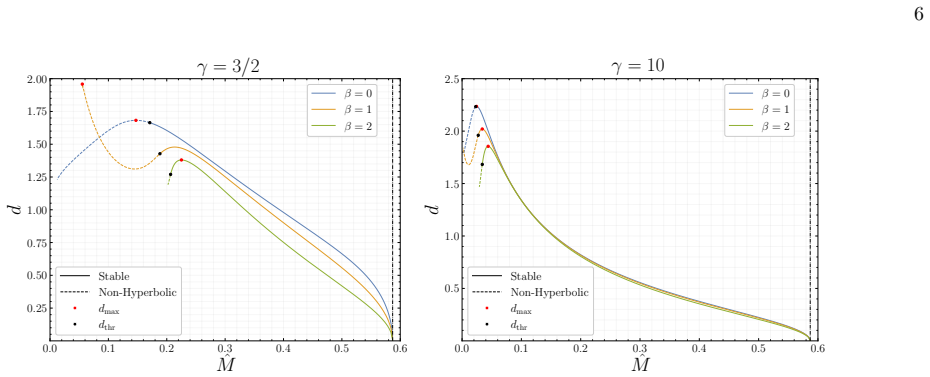
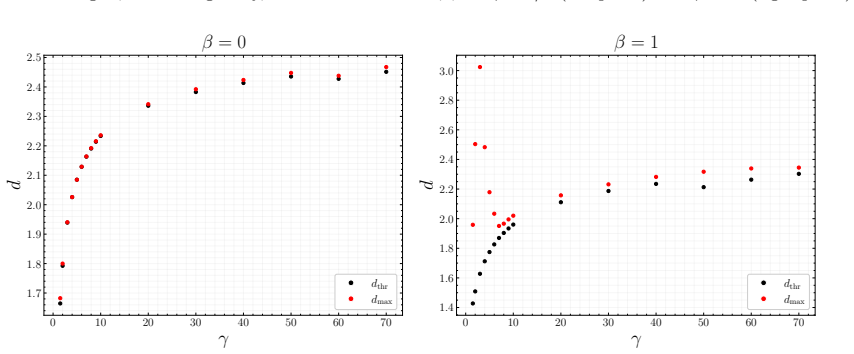
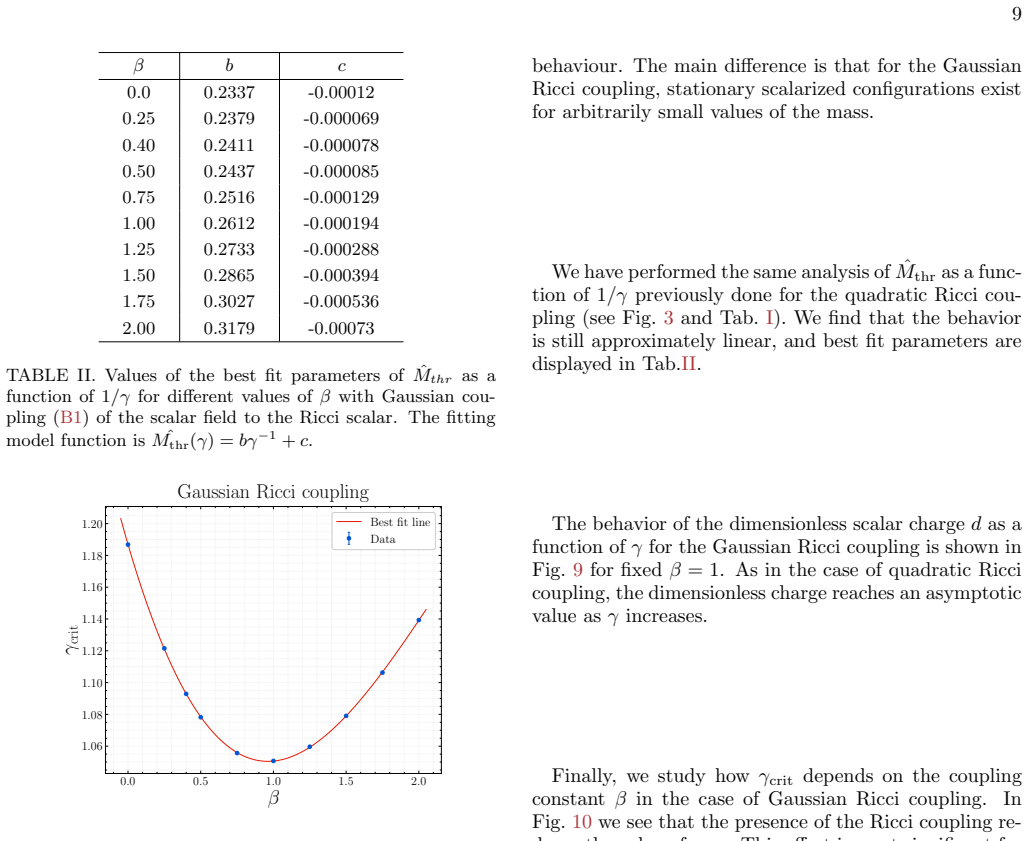
In scalar Gauss-Bonnet gravity with a suitable class of coupling functions, static black hole solutions exist for arbitrarily small masses, but the equations governing linear perturbations around these solutions become elliptic below a minimum mass; this renders the solutions unphysical and marks the loss of validity of the effective field theory. The minimum mass depends on the coupling parameters and can be driven arbitrarily close to zero, yet the black-hole scalar charge stays bounded above, limiting how far the solutions can depart from general relativity.
What carries the argument
The switch in character of the perturbation equations from hyperbolic to elliptic, which occurs at a critical mass determined by the coupling function and sets the boundary of physicality for the black hole solutions.
If this is right
- Black hole solutions below the minimum mass are excluded as unphysical because their perturbation equations are elliptic.
- The minimum mass can be made arbitrarily small by appropriate choice of the coupling function.
- Observable quantities such as the black hole scalar charge remain bounded from above even when the minimum mass approaches zero.
- Deviations from general relativity in these solutions cannot be made arbitrarily large by pushing the minimum mass lower.
Where Pith is reading between the lines
- Effective field theory descriptions of black holes in higher-curvature gravity may carry an intrinsic lower mass cutoff even when parameters appear to allow arbitrarily small objects.
- The bounded scalar charge implies that any observational signatures of these black holes in gravitational waves or electromagnetic observations are capped independently of how small the minimum mass is made.
- Similar hyperbolicity breakdowns could appear in other scalar-tensor theories with higher-order curvature couplings when small-mass solutions are considered.
Load-bearing premise
The assumption that a change from hyperbolic to elliptic type in the perturbation equations directly means the background solutions are unphysical and that the effective field theory has lost validity.
What would settle it
An explicit computation of the characteristic speeds or principal symbol of the perturbation equations for a chosen coupling function that remains hyperbolic for all masses down to zero, or a numerical construction of a stable small-mass black hole whose perturbations propagate without imaginary speeds.
Figures




read the original abstract
We study the loss of hyperbolicity of perturbation equations for black hole solutions of scalar Gauss-Bonnet gravity. We consider a class of coupling functions allowing for static black hole solutions with arbitrary small masses. For masses below a minimum value, such solutions become unphysical, because the perturbation equations become elliptic; this arguably corresponds to the loss of validity of the effective field theory. We analyse the dependence of this minimum mass on the parameters of the theory, finding that with an appropriate choice of the coupling function, such mass can be chosen arbitrarily small. However, this does not correspond to larger deviations from general relativity, since observable quantities like the black hole scalar charge are bounded by above.
Editorial analysis
A structured set of objections, weighed in public.
Referee Report
Summary. The paper studies static black hole solutions in scalar Gauss-Bonnet gravity for a class of coupling functions f(φ) that permit solutions with arbitrarily small masses. It shows that below a minimum mass the linear perturbation equations around these backgrounds change from hyperbolic to elliptic character; the authors interpret this as rendering the solutions unphysical and marking the breakdown of the effective field theory. The minimum mass can be made arbitrarily small by suitable choice of f(φ), yet the black-hole scalar charge remains bounded from above, so that deviations from general relativity stay limited.
Significance. If the central claims are substantiated, the work supplies a concrete diagnostic (loss of hyperbolicity) for the regime of validity of scalar-Gauss-Bonnet black holes inside the EFT truncation. It demonstrates that even when the minimum mass can be pushed arbitrarily low, observable quantities such as the scalar charge cannot be made arbitrarily large, thereby tightening the link between mathematical well-posedness and phenomenological constraints in higher-curvature gravity.
major comments (1)
- The interpretation that the change from hyperbolic to elliptic character directly signals the loss of EFT validity (abstract and the discussion after the perturbation analysis) rests on the mathematical property alone. No explicit estimate is given of the magnitude of the next-order curvature or derivative operators evaluated on the background at the hyperbolicity boundary, leaving the physical claim as an argument rather than a derived result.
minor comments (2)
- The dependence of the minimum mass on the parameters of f(φ) is presented clearly, but a short table or plot summarizing the scaling for the representative families would improve readability.
- Notation for the scalar charge and the coupling-function parameters is introduced without a consolidated list; adding a short nomenclature paragraph would help readers.
Simulated Author's Rebuttal
We thank the referee for their careful reading of the manuscript and for the constructive comment. We address the point below and have revised the text to strengthen the discussion of the EFT interpretation.
read point-by-point responses
-
Referee: The interpretation that the change from hyperbolic to elliptic character directly signals the loss of EFT validity (abstract and the discussion after the perturbation analysis) rests on the mathematical property alone. No explicit estimate is given of the magnitude of the next-order curvature or derivative operators evaluated on the background at the hyperbolicity boundary, leaving the physical claim as an argument rather than a derived result.
Authors: We agree that an explicit computation of the size of higher-order operators at the boundary would make the claim more quantitative. However, such an estimate necessarily depends on the details of the unknown UV completion and is therefore not uniquely determined within the EFT framework itself. The loss of hyperbolicity is a standard and robust diagnostic in the EFT literature because it renders the initial-value problem ill-posed, which is unphysical for a classical theory truncated at a given order. We have revised the relevant paragraph in Section IV and the abstract to make this reasoning more explicit, to cite additional references on well-posedness in higher-curvature gravity, and to emphasize that the hyperbolicity criterion serves as a practical indicator of the EFT regime rather than a direct calculation of omitted terms. We believe this addresses the referee's concern while remaining within the scope of the present analysis. revision: yes
Circularity Check
No circularity: minimum mass derived from direct hyperbolicity analysis of perturbation equations
full rationale
The paper's central result follows from solving the scalar-Gauss-Bonnet field equations for a chosen class of coupling functions f(φ), obtaining static black hole backgrounds, and then linearizing the perturbation equations around those backgrounds to determine the parameter values at which the equations change character from hyperbolic to elliptic. This character change directly supplies the minimum mass threshold. The subsequent observation that the threshold can be made arbitrarily small while keeping the scalar charge bounded is obtained by varying the parameters of f(φ) within the same framework. No equation or claim reduces to a prior result by algebraic identity, by renaming a fitted quantity as a prediction, or by a load-bearing self-citation whose own justification is internal to the present work. The interpretation that ellipticity signals EFT breakdown is explicitly flagged as an argument ('arguably') rather than a derived equality, leaving the mathematical finding independent of that interpretation.
Axiom & Free-Parameter Ledger
Reference graph
Works this paper leans on
-
[1]
This also affects the normalization ofγ. 4 perturbation of the scalar field,φ 1(t, r): g2(r) ∂2φ1(t, r) ∂t2 − ∂2φ1(t, r) ∂r2 + +k(r) ∂φ1(t, r) ∂r +u(r)φ 1(t, r) = 0, (14) whereu(r), g(r) andk(r) depend on the background met- ric and scalar field. Full expressions of the coefficients can be found in [38] for sGB gravity, while for sGBR gravity they are sho...
2023
-
[2]
Berti, E
E. Berti, E. Barausse, V. Cardoso, L. Gualtieri, P. Pani, U. Sperhake, L. C. Stein, N. Wex, K. Yagi, T. Baker, et al., Testing general relativity with present and future astrophysical observations, Classical and Quantum Grav- ity32, 243001 (2015)
2015
- [3]
-
[4]
T. P. Sotiriou and S.-Y. Zhou, Black hole hair in general- ized scalar-tensor gravity, Phys. Rev. Lett.112, 251102 (2014), arXiv:1312.3622 [gr-qc]
work page Pith review arXiv 2014
-
[5]
T. P. Sotiriou and S.-Y. Zhou, Black hole hair in gener- alized scalar-tensor gravity: An explicit example, Phys. Rev. D90, 124063 (2014), arXiv:1408.1698 [gr-qc]
work page Pith review arXiv 2014
-
[6]
D. J. Gross and J. H. Sloan, The Quartic Effective Action for the Heterotic String, Nucl. Phys. B291, 41 (1987)
1987
-
[7]
Effective Field Theory for Inflation
S. Weinberg, Effective Field Theory for Inflation, Phys. Rev. D77, 123541 (2008), arXiv:0804.4291 [hep-th]
work page Pith review arXiv 2008
-
[8]
K. Yagi, L. C. Stein, N. Yunes, and T. Tanaka, Post- Newtonian, Quasi-Circular Binary Inspirals in Quadratic Modified Gravity, Phys. Rev. D85, 064022 (2012), [Er- ratum: Phys.Rev.D 93, 029902 (2016)], arXiv:1110.5950 [gr-qc]
work page Pith review arXiv 2012
-
[9]
F.-L. Juli´ e and E. Berti, Post-Newtonian dynamics and black hole thermodynamics in Einstein-scalar-Gauss- Bonnet gravity, Phys. Rev. D100, 104061 (2019), arXiv:1909.05258 [gr-qc]
-
[10]
B. Shiralilou, T. Hinderer, S. M. Nissanke, N. Ortiz, and H. Witek, Post-Newtonian gravitational and scalar waves in scalar-Gauss–Bonnet gravity, Class. Quant. Grav.39, 035002 (2022), arXiv:2105.13972 [gr-qc]
-
[11]
F.-L. Juli´ e, L. Pompili, and A. Buonanno, Inspiral- merger-ringdown waveforms in Einstein-scalar-Gauss- 10 Bonnet gravity within the effective-one-body formalism, Phys. Rev. D111, 024016 (2025), arXiv:2406.13654 [gr- qc]
- [12]
- [13]
-
[14]
L. Arest´ e Sal´ o, K. Clough, and P. Figueras, Well- Posedness of the Four-Derivative Scalar-Tensor Theory of Gravity in Singularity Avoiding Coordinates, Phys. Rev. Lett.129, 261104 (2022), arXiv:2208.14470 [gr-qc]
- [15]
- [16]
- [17]
- [18]
-
[19]
L. Pierini and L. Gualtieri, Quasinormal modes of rotat- ing black holes in Einstein-dilaton Gauss-Bonnet gravity: The second order in rotation, Phys. Rev. D106, 104009 (2022), arXiv:2207.11267 [gr-qc]
- [20]
- [21]
- [22]
- [23]
-
[24]
H. O. Silva, J. Sakstein, L. Gualtieri, T. P. Sotiriou, and E. Berti, Spontaneous scalarization of black holes and compact stars from a Gauss-Bonnet coupling, Phys. Rev. Lett.120, 131104 (2018), arXiv:1711.02080 [gr-qc]
work page Pith review arXiv 2018
-
[25]
D. D. Doneva and S. S. Yazadjiev, New Gauss-Bonnet Black Holes with Curvature-Induced Scalarization in Ex- tended Scalar-Tensor Theories, Phys. Rev. Lett.120, 131103 (2018), arXiv:1711.01187 [gr-qc]
work page Pith review arXiv 2018
- [26]
- [27]
- [28]
- [29]
- [30]
-
[31]
Causality constraints on black holes beyond GR,
F. Serra, J. Serra, E. Trincherini, and L. G. Trombetta, Causality constraints on black holes beyond GR, JHEP 08, 157, arXiv:2205.08551 [hep-th]
- [32]
-
[33]
F. Thaalba, M. Bezares, N. Franchini, and T. P. Sotiriou, Spherical collapse in scalar-Gauss-Bonnet gravity: Tam- ing ill-posedness with a Ricci coupling, Phys. Rev. D109, L041503 (2024), arXiv:2306.01695 [gr-qc]
-
[34]
F. Thaalba, N. Franchini, M. Bezares, and T. P. Sotiriou, Dynamics of spherically symmetric black holes in scalar- Gauss-Bonnet gravity with a Ricci coupling, Phys. Rev. D111, 064054 (2025), arXiv:2409.11398 [gr-qc]
-
[35]
F. Thaalba, N. Franchini, M. Bezares, and T. P. Sotiriou, Hyperbolicity in scalar-Gauss-Bonnet gravity: A gauge invariant study for spherical evolution, Phys. Rev. D111, 024053 (2025), arXiv:2410.16264 [gr-qc]
-
[36]
B. Kleihaus, J. Kunz, and E. Radu, Rotating Black Holes in Dilatonic Einstein-Gauss-Bonnet Theory, Phys. Rev. Lett.106, 151104 (2011), arXiv:1101.2868 [gr-qc]
-
[37]
F. Thaalba, G. Antoniou, and T. P. Sotiriou, Black hole minimum size and scalar charge in shift-symmetric theories, Class. Quant. Grav.40, 155002 (2023), arXiv:2211.05099 [gr-qc]
-
[38]
F. Thaalba, L. Gualtieri, T. P. Sotiriou, and E. Trincherini, Screening of dipolar emission in two-scale Gauss-Bonnet gravity, (2025), arXiv:2512.04083 [gr-qc]
- [39]
- [40]
- [41]
-
[42]
G. Antoniou, L. Bordin, and T. P. Sotiriou, Com- pact object scalarization with general relativity as a cosmic attractor, Phys. Rev. D103, 024012 (2021), arXiv:2004.14985 [gr-qc]
-
[43]
G. Antoniou, A. Leh´ ebel, G. Ventagli, and T. P. Sotiriou, Black hole scalarization with Gauss-Bonnet and Ricci 11 scalar couplings, Phys. Rev. D104, 044002 (2021), arXiv:2105.04479 [gr-qc]
-
[44]
G. Antoniou, C. F. B. Macedo, R. McManus, and T. P. Sotiriou, Stable spontaneously-scalarized black holes in generalized scalar-tensor theories, Phys. Rev. D106, 024029 (2022), arXiv:2204.01684 [gr-qc]
-
[45]
P. Pani and V. Cardoso, Are black holes in alternative theories serious astrophysical candidates? The Case for Einstein-Dilaton-Gauss-Bonnet black holes, Phys. Rev. D79, 084031 (2009), arXiv:0902.1569 [gr-qc]
work page Pith review arXiv 2009
-
[46]
A. Maselli, P. Pani, L. Gualtieri, and V. Ferrari, Rotat- ing black holes in Einstein-Dilaton-Gauss-Bonnet grav- ity with finite coupling, Phys. Rev. D92, 083014 (2015), arXiv:1507.00680 [gr-qc]
-
[47]
J. L. Bl´ azquez-Salcedo, C. F. B. Macedo, V. Cardoso, V. Ferrari, L. Gualtieri, F. S. Khoo, J. Kunz, and P. Pani, Perturbed black holes in Einstein-dilaton-Gauss- Bonnet gravity: Stability, ringdown, and gravitational- wave emission, Phys. Rev. D94, 104024 (2016), arXiv:1609.01286 [gr-qc]
-
[48]
Evasion of No-Hair Theorems and Novel Black-Hole Solutions in Gauss-Bonnet Theories
G. Antoniou, A. Bakopoulos, and P. Kanti, Evasion of No-Hair Theorems and Novel Black-Hole Solutions in Gauss-Bonnet Theories, Phys. Rev. Lett.120, 131102 (2018), arXiv:1711.03390 [hep-th]
work page Pith review arXiv 2018
- [49]
- [50]
- [51]
-
[52]
S¨ anger, Elise M. and others, Tests of General Relativity with GW230529: a neutron star merging with a lower mass-gap compact object, (2024), arXiv:2406.03568 [gr- qc]
work page internal anchor Pith review arXiv 2024
-
[53]
Dilatonic Black Holes in Higher-Curvature String Gravity II: Linear Stability
P. Kanti, N. E. Mavromatos, J. Rizos, K. Tamvakis, and E. Winstanley, Dilatonic black holes in higher curvature string gravity. 2: Linear stability, Phys. Rev. D57, 6255 (1998), arXiv:hep-th/9703192
work page Pith review arXiv 1998
discussion (0)
Sign in with ORCID, Apple, or X to comment. Anyone can read and Pith papers without signing in.