Recognition: unknown
Ghosts of eruptions past: Searching for historical Galactic supernovae using variable thermal dust echoes and machine learning
Pith reviewed 2026-05-10 17:05 UTC · model grok-4.3
The pith
Only Cassiopeia A produces detectable variable thermal dust echoes among recent Galactic supernovae in WISE observations.
A machine-rendered reading of the paper's core claim, the machinery that carries it, and where it could break.
Core claim
The search identifies no spatial over-densities of variable thermal dust echoes except around Cas A, at the W2 surface brightness threshold of approximately 20 Vega mag arcsec^{-2}. This uniqueness arises from Cas A's combination of young age and luminous shock breakout, which produces bright, time-variable mid-infrared echoes distinguishable from other sources.
What carries the argument
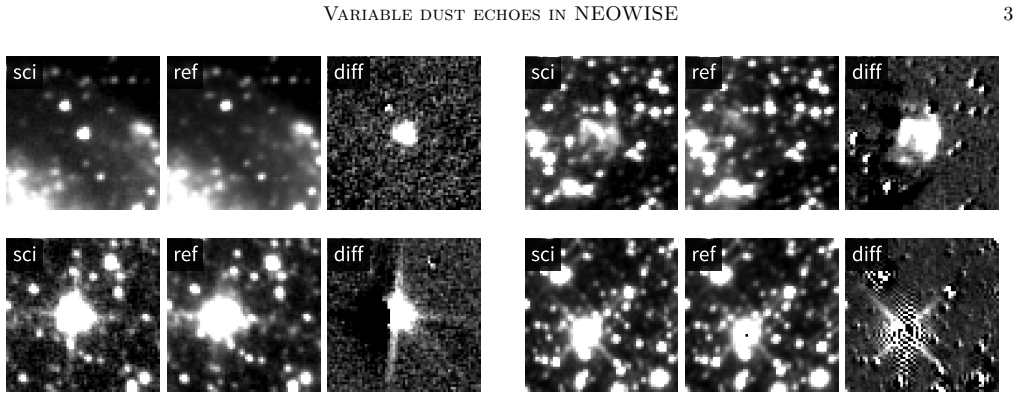
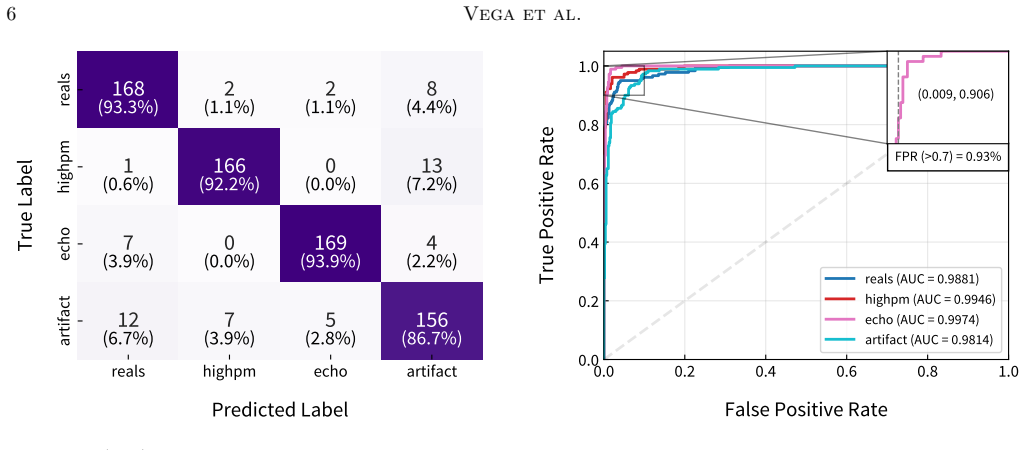
A convolutional neural network classifier trained on echo features from Cas A to identify dust echoes among transient candidates in difference images.
If this is right
- Cas A is the only region with echoes reaching the WISE sensitivity threshold of about 20 Vega mag arcsec^{-2}.
- A catalog of 20477 time-resolved echo positions around Cas A is delivered for studies of the interstellar medium.
- The search method and results provide the foundation for future surveys with the Roman Space Telescope at 100 times higher sensitivity.
- No other historical supernovae produce detectable echoes, consistent with their estimated rate but limited by current survey depth.
Where Pith is reading between the lines
- The CNN trained solely on Cas A features may overlook echoes with different shapes or timescales from other supernovae.
- A 100-fold sensitivity gain in upcoming surveys could uncover echoes from additional past events if they exist.
- Combining the difference-imaging approach with multi-wavelength or archival optical data might increase detection completeness.
- The lack of detections could indicate that bright, long-lived dust echoes are rare rather than simply below threshold.
Load-bearing premise
That any dust echoes from other historical supernovae would share the same morphological and variability features as those around Cas A and thus be correctly classified by a model trained exclusively on Cas A data.
What would settle it
Finding a cluster of variable extended sources classified as dust echoes by the CNN in a region away from Cas A at similar surface brightness levels, or failing to recover known Cas A echoes in a controlled test of the pipeline.
Figures



read the original abstract
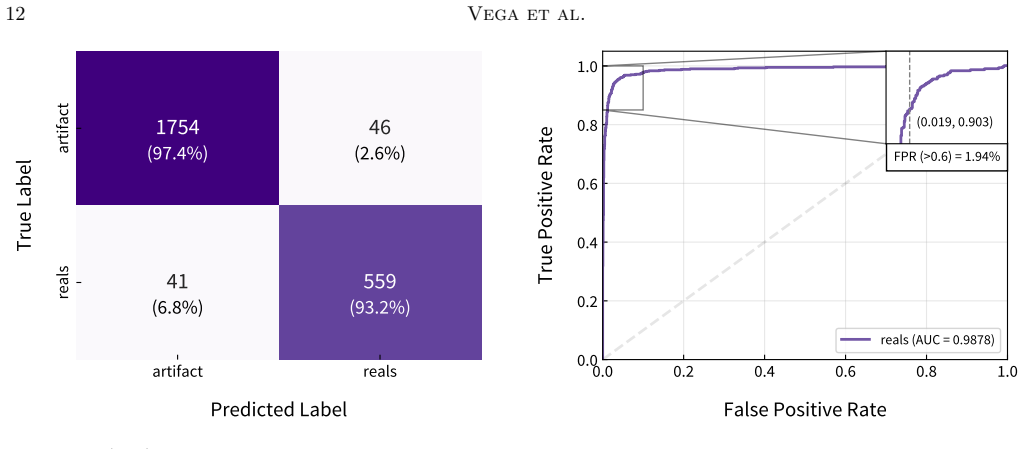
The Galactic core-collapse supernova (SN) rate is estimated at $\approx 1-3$ per century; however, no optically visible SN has been discovered in the past 400 years. Although records of the last optically detected SN (Cassiopeia A) are debated, it is revealed today via its bright, variable mid-infrared (MIR) dust echoes -- offering the possibility of identifying dust-obscured, missed events via their dust echoes. We present the first all-sky, untargeted search for thermal dust echoes of luminous Galactic transients using difference imaging on 12 years of time-resolved NEOWISE co-adds (spanning $2009-2022$) followed by statistical detection of variable extended sources. We use echo features around Cas A, together with archival catalogs to train a convolutional neural network to classify transient candidates as dust echoes, point sources, artifacts, and high proper motion stars. Our model achieves $\approx 94$% accuracy in distinguishing echoes from other variable sources. Applying the classifier to $\approx 11$ million transient candidates, we search for spatial over-densities of echoes across the Galactic plane. We find that Cas A is the only region exhibiting echoes at the WISE sensitivity threshold of $W2$ surface brightness of $\approx 20$ Vega mag arcsec$^{-2}$ -- reflecting its unique combination of young age and luminous shock breakout. We present the largest catalog of time-resolved echo positions of Cas A (20477 within 10$^\circ$) that are being used for studies of the surrounding interstellar medium with the James Webb Space Telescope. Our results lay the groundwork for the imminent Roman space telescope surveys -- which will achieve $\approx 100\times$ higher sensitivity and $\approx 30\times$ better spatial resolution at wavelengths of $\lesssim 2.5\,\mu$m.
Editorial analysis
A structured set of objections, weighed in public.
Referee Report
Summary. The paper presents the first all-sky untargeted search for thermal dust echoes from historical Galactic core-collapse supernovae in 12 years of NEOWISE co-adds (2009-2022). Difference imaging identifies ~11 million variable transient candidates, which are classified by a CNN trained on Cas A echo features plus archival negative examples (point sources, artifacts, high proper-motion stars) at ~94% accuracy. The search for spatial over-densities yields a null result outside Cas A at the W2 surface-brightness threshold of ~20 Vega mag arcsec^{-2}, which the authors attribute to Cas A's unique young age and luminous shock breakout. A catalog of 20,477 Cas A echo positions is released for JWST ISM studies, with the pipeline positioned as groundwork for Roman Space Telescope surveys.
Significance. If the result holds, the work is significant as the first systematic observational demonstration that MIR variable dust echoes can be used to recover dust-obscured Galactic SNe on an all-sky basis. The direct null result outside Cas A provides empirical support for the rarity of detectable echoes and the special status of Cas A. The released catalog of time-resolved echo positions is a concrete resource for follow-up, and the methodology directly informs the design of higher-sensitivity, higher-resolution surveys with Roman. The combination of difference imaging with CNN classification is a methodological strength for handling large candidate volumes.
major comments (2)
- [CNN classifier description (abstract and methods)] The central claim that Cas A is the only region exhibiting echoes above the WISE threshold depends on the CNN generalizing beyond its training set. The classifier is trained exclusively on echo features extracted around Cas A together with archival negatives; no quantitative false-negative rate, no tests on simulated echoes with different spatial scales, variability timescales, surface-brightness profiles, or MIR colors, and no cross-validation on held-out regions are described. This directly affects the interpretability of the null result for other historical SNe.
- [Search pipeline and results] No error budget or completeness assessment is provided for the surface-brightness threshold of ≈20 Vega mag arcsec^{-2} or for the generation and filtering of the ~11 million transient candidates. Without these, it is not possible to distinguish a true absence of other echoes from a limitation of the search pipeline or detection threshold.
minor comments (2)
- [Abstract] The reported 94% accuracy would benefit from explicit statement of the validation-set size, class balance, and whether it includes any non-Cas A echo examples.
- [Catalog presentation] The catalog of 20,477 positions is a valuable deliverable; specifying its format, column definitions, and public access method would improve usability.
Simulated Author's Rebuttal
We thank the referee for their constructive review and for recognizing the significance of the first all-sky untargeted search for Galactic supernova dust echoes. We address each major comment point by point below, with revisions indicated where the manuscript will be updated.
read point-by-point responses
-
Referee: [CNN classifier description (abstract and methods)] The central claim that Cas A is the only region exhibiting echoes above the WISE threshold depends on the CNN generalizing beyond its training set. The classifier is trained exclusively on echo features extracted around Cas A together with archival negatives; no quantitative false-negative rate, no tests on simulated echoes with different spatial scales, variability timescales, surface-brightness profiles, or MIR colors, and no cross-validation on held-out regions are described. This directly affects the interpretability of the null result for other historical SNe.
Authors: We agree that the CNN's generalization is central to interpreting the null result outside Cas A. The training set was deliberately built around the only confirmed strong echo source (Cas A) for positives and a broad set of archival negatives to capture common contaminants such as point sources, artifacts, and high proper-motion stars. The reported ~94% accuracy reflects performance on a held-out test split drawn from this distribution. We did not conduct simulations of alternative echo morphologies or explicit cross-validation on independent sky regions, as the work focused on applying the method to existing NEOWISE data. In the revised manuscript we expand the methods section with additional details on the training procedure, the composition of the negative class, and a discussion of the assumptions and limitations regarding generalization to other potential supernova echoes. We also include the false-negative rate implied by the test-set performance. revision: partial
-
Referee: [Search pipeline and results] No error budget or completeness assessment is provided for the surface-brightness threshold of ≈20 Vega mag arcsec^{-2} or for the generation and filtering of the ~11 million transient candidates. Without these, it is not possible to distinguish a true absence of other echoes from a limitation of the search pipeline or detection threshold.
Authors: We acknowledge that a quantitative error budget and completeness assessment would allow a more rigorous distinction between a true null result and pipeline limitations. The ~20 Vega mag arcsec^{-2} threshold corresponds to the WISE sensitivity at which Cas A echoes are readily detected, and the ~11 million candidates are the output of the difference-imaging pipeline after initial filtering. In the revised manuscript we add explicit descriptions of the candidate-generation steps, the filtering criteria applied to reach the final sample, and a qualitative completeness discussion based on the successful recovery of the known Cas A echoes together with the lack of other spatial over-densities. A full Monte-Carlo completeness simulation across varied echo properties is beyond the scope of the present study but is noted as a natural extension for future higher-sensitivity surveys. revision: partial
Circularity Check
No circularity: direct observational null result from all-sky search
full rationale
The paper conducts difference imaging on NEOWISE data to generate ~11 million transient candidates, trains a CNN on Cas A echo features plus archival negatives, and applies the classifier to identify spatial over-densities. The central claim (Cas A is the sole detection above the W2 ~20 mag arcsec^{-2} threshold) is a direct count of over-densities in the output catalog, not a fitted parameter or self-referential derivation. No equations, ansatzes, or self-citations reduce the uniqueness statement to the training inputs by construction; the null result for other regions is an independent measurement even if classifier generalization is imperfect. The work is self-contained as an empirical search against external WISE data.
Axiom & Free-Parameter Ledger
free parameters (1)
- W2 surface-brightness detection threshold
axioms (2)
- domain assumption Variable mid-infrared dust echoes are produced by luminous Galactic transients and remain detectable for centuries at NEOWISE sensitivity
- domain assumption A CNN trained exclusively on Cas A echo morphology can reliably separate true echoes from point sources, artifacts, and high-proper-motion stars across the entire Galactic plane
Reference graph
Works this paper leans on
-
[1]
2015, https://www.tensorflow.org/
Abadi, M., Agarwal, A., Barham, P., et al. 2015, https://www.tensorflow.org/
2015
-
[2]
Adams, S. M., Kochanek, C. S., Beacom, J. F., Vagins, M. R., & Stanek, K. Z. 2013, ApJ, 778, 164, doi: 10.1088/0004-637X/778/2/164
-
[3]
Ashworth, W. B. 1980, Journal for the History of Astronomy, 11, 1, doi: 10.1177/002182868001100102
-
[4]
J., Stern, D., Noirot, G., et al
Assef, R. J., Stern, D., Noirot, G., et al. 2018, ApJS, 234, 23, doi: 10.3847/1538-4365/aaa00a Astropy Collaboration, Robitaille, T. P., Tollerud, E. J., et al. 2013, A&A, 558, A33, doi: 10.1051/0004-6361/201322068 Astropy Collaboration, Price-Whelan, A. M., Sip˝ ocz, B. M., et al. 2018, AJ, 156, 123, doi: 10.3847/1538-3881/aabc4f Astropy Collaboration, P...
-
[5]
Besel, M. A., & Krause, O. 2012, A&A, 541, L3, doi: 10.1051/0004-6361/201219082
-
[6]
2015,, https://keras.io da Costa-Luis, C
Chollet, F., et al. 2015,, https://keras.io da Costa-Luis, C. 2019, The Journal of Open Source Software, 4, 1277, doi: 10.21105/joss.01277
-
[7]
De, K., Hankins, M. J., Kasliwal, M. M., et al. 2020, PASP, 132, 025001, doi: 10.1088/1538-3873/ab6069
-
[8]
2025, PASP, 137, 125003, doi: 10.1088/1538-3873/ae215c
Dong, Z., Ma, B., Zhang, H., et al. 2025, PASP, 137, 125003, doi: 10.1088/1538-3873/ae215c
-
[9]
Duev, D. A., Mahabal, A., Masci, F. J., et al. 2019, Monthly Notices of the Royal Astronomical Society, 489, 3582, doi: 10.1093/mnras/stz2357
-
[10]
Dwek, E., & Arendt, R. G. 2008, ApJ, 685, 976, doi: 10.1086/589988 Gaia Collaboration, Vallenari, A., Brown, A. G. A., et al. 2023, A&A, 674, A1, doi: 10.1051/0004-6361/202243940 Galactic Plane Survey Definition Committee, R. 2025, arXiv e-prints, arXiv:2511.07494, doi: 10.48550/arXiv.2511.07494
-
[11]
Green, D. A. 2025, Journal of Astrophysics and Astronomy, 46, 14, doi: 10.1007/s12036-024-10038-4 V ariable dust echoes in NEOWISE13
-
[12]
Green, D. A., Reynolds, S. P., Borkowski, K. J., et al. 2008, Monthly Notices of the Royal Astronomical Society: Letters, 387, L54–L58, doi: 10.1111/j.1745-3933.2008.00484.x
-
[13]
R., Millman, K
Harris, C. R., Millman, K. J., van der Walt, S. J., et al. 2020, Nature, 585, 357
2020
-
[14]
Hughes, D. W. 1980, Nature, 285, 132, doi: 10.1038/285132a0
-
[15]
Hunter, J. D. 2007, Computing in science & engineering, 9, 90
2007
-
[16]
G., et al
Jencson, J., Angulo, R., Arendt, R. G., et al. 2024,, JWST Proposal. Cycle 3, ID. #5451
2024
-
[17]
M., Earley, N., Smith, R., et al
Kasliwal, M. M., Earley, N., Smith, R., et al. 2025, PASP, 137, 065001, doi: 10.1088/1538-3873/adc629
-
[18]
Kim, Y., Rieke, G. H., Krause, O., et al. 2008, ApJ, 678, 287, doi: 10.1086/533426
-
[19]
Adam: A Method for Stochastic Optimization
Kingma, D. P., & Ba, J. 2017, https://arxiv.org/abs/1412.6980
work page internal anchor Pith review Pith/arXiv arXiv 2017
-
[20]
2019,, Astrophysics Source Code Library, record ascl:1905.008 http://ascl.net/1905.008
Koposov, S., & Bartunov, O. 2019,, Astrophysics Source Code Library, record ascl:1905.008 http://ascl.net/1905.008
2019
-
[21]
Krause, O., Birkmann, S. M., Usuda, T., et al. 2008a, Science, 320, 1195, doi: 10.1126/science.1155788
-
[22]
2008b, Nature, 456, 617, doi: 10.1038/nature07608
Krause, O., Tanaka, M., Usuda, T., et al. 2008b, Nature, 456, 617, doi: 10.1038/nature07608
-
[23]
Krause, O., Rieke, G. H., Birkmann, S. M., et al. 2005, Science, 308, 1604, doi: 10.1126/science.1112035
-
[25]
2014, AJ, 147, 108, doi: 10.1088/0004-6256/147/5/108
Lang, D. 2014, AJ, 147, 108, doi: 10.1088/0004-6256/147/5/108
-
[26]
Luken, K. J., Filipovi´ c, M. D., Maxted, N. I., et al. 2020, MNRAS, 492, 2606, doi: 10.1093/mnras/stz3439
-
[27]
Mainzer, A., Bauer, J., Cutri, R. M., et al. 2014, Astrophys. J., 792, 30, doi: 10.1088/0004-637X/792/1/30
-
[28]
Marocco, F., Eisenhardt, P. R. M., Fowler, J. W., et al. 2021, ApJS, 253, 8, doi: 10.3847/1538-4365/abd805
-
[29]
2024a, ApJ, 961, 211, doi: 10.3847/1538-4357/ad18bb —
Masterson, M., De, K., Panagiotou, C., et al. 2024, The Astrophysical Journal, 961, 211, doi: 10.3847/1538-4357/ad18bb
-
[30]
Meisner, A. M., Caselden, D., Schlafly, E. F., & Kiwy, F. 2023, AJ, 165, 36, doi: 10.3847/1538-3881/aca2ab
-
[31]
Meisner, A. M., Lang, D., & Schlegel, D. J. 2017, The Astronomical Journal, 153, 38, doi: 10.3847/1538-3881/153/1/38
-
[32]
Milisavljevic, D., Temim, T., De Looze, I., et al. 2024, The Astrophysical Journal Letters, 965, L27, doi: 10.3847/2041-8213/ad324b
-
[33]
Murphey, C. T., Hogan, J. W., Fields, B. D., & Narayan, G. 2021, MNRAS, 507, 927, doi: 10.1093/mnras/stab2182
-
[34]
2024, ApJ, 976, 230, doi: 10.3847/1538-4357/ad8922
Myers, C., De, K., Yan, L., et al. 2024, ApJ, 976, 230, doi: 10.3847/1538-4357/ad8922
-
[35]
Neumann, K. D., Tucker, M. A., Kochanek, C. S., Shappee, B. J., & Stanek, K. Z. 2024, The Open Journal of Astrophysics, 7, 98, doi: 10.33232/001c.125246
-
[36]
Oliphant, T. E. 2006, A guide to NumPy, Vol. 1 (Trelgol Publishing USA)
2006
-
[37]
2025,, JWST Proposal
Peek, J., Clark, C., Clark, S., et al. 2025,, JWST Proposal. Cycle 4, ID. #8527
2025
-
[38]
Rehemtulla, N., Miller, A. A., Jegou Du Laz, T., et al. 2024, ApJ, 972, 7, doi: 10.3847/1538-4357/ad5666
-
[39]
Rest, A., Suntzeff, N. B., Olsen, K., et al. 2005, Nature, 438, 1132, doi: 10.1038/nature04365
-
[40]
Rest, A., Welch, D. L., Suntzeff, N. B., et al. 2008, ApJL, 681, L81, doi: 10.1086/590427
-
[41]
Rest, A., Foley, R. J., Sinnott, B., et al. 2011, ApJ, 732, 3, doi: 10.1088/0004-637X/732/1/3
-
[42]
Rest, A., Prieto, J. L., Walborn, N. R., et al. 2012, Nature, 482, 375, doi: 10.1038/nature10775
-
[43]
2021, NewA, 83, 101498, doi: 10.1016/j.newast.2020.101498
Rozwadowska, K., Vissani, F., & Cappellaro, E. 2021, NewA, 83, 101498, doi: 10.1016/j.newast.2020.101498
-
[44]
Sanderson, R. E., McKinnon, K. A., Thob, A. C. R., et al. 2026, arXiv e-prints, arXiv:2603.12981, doi: 10.48550/arXiv.2603.12981
-
[45]
Very Deep Convolutional Networks for Large-Scale Image Recognition
Simonyan, K., & Zisserman, A. 2014, arXiv e-prints, arXiv:1409.1556, doi: 10.48550/arXiv.1409.1556
work page internal anchor Pith review Pith/arXiv arXiv doi:10.48550/arxiv.1409.1556 2014
-
[46]
Virtanen, P., Gommers, R., Oliphant, T. E., et al. 2020, Nature Medicine, 17, 261, doi: 10.1038/s41592-019-0686-2
-
[47]
Vogt, F. P. A., Besel, M.-A., Krause, O., & Dullemond, C. P. 2012, ApJ, 750, 155, doi: 10.1088/0004-637X/750/2/155
-
[48]
Walt, S. v. d., Colbert, S. C., & Varoquaux, G. 2011, Computing in Science & Engineering, 13, 22
2011
-
[49]
Wright, E. L. 1980, ApJL, 242, L23, doi: 10.1086/183393
-
[50]
Wright, E. L., Eisenhardt, P. R. M., Mainzer, A. K., et al. 2010, Astron. J., 140, 1868, doi: 10.1088/0004-6256/140/6/1868
work page internal anchor Pith review doi:10.1088/0004-6256/140/6/1868 2010
-
[51]
Zackay, B., Ofek, E. O., & Gal-Yam, A. 2016, The Astrophysical Journal, 830, 27, doi: 10.3847/0004-637X/830/1/27
-
[52]
2023, MNRAS, 523, 3555, doi: 10.1093/mnras/stad1625
Panagiotou, C. 2023, MNRAS, 523, 3555, doi: 10.1093/mnras/stad1625
discussion (0)
Sign in with ORCID, Apple, or X to comment. Anyone can read and Pith papers without signing in.