Recognition: 1 theorem link
· Lean TheoremChasing Gamma-Ray Signals from Binary Neutron Star Coalescences with the Cherenkov Telescope Array: Prospects and Observing Strategies
Pith reviewed 2026-05-10 16:52 UTC · model grok-4.3
The pith
An optimized follow-up strategy lets the Cherenkov Telescope Array detect GeV-TeV emission from about 5 percent of simulated gravitational-wave short gamma-ray bursts from binary neutron star mergers.
A machine-rendered reading of the paper's core claim, the machinery that carries it, and where it could break.
Core claim
Through a multi-step simulation pipeline that models binary neutron star systems with gravitational wave detections and applies phenomenological prescriptions for short gamma-ray burst emission including off-axis jets, an optimized CTAO follow-up strategy yields detectable GeV-TeV radiation from approximately 5 percent of simulated events, with detectability strongly influenced by jet opening angle and viewing angle.
What carries the argument
The multi-step simulation pipeline combining simulated BNS mergers with GW detections, phenomenological gamma-ray emission models from the short GRB population including off-axis scenarios, and CTAO observation simulations that incorporate instrument response, sky tiling, integration times, and observing conditions.
If this is right
- Variable and constant integration time strategies both contribute to improved detection prospects.
- Rough estimates of viewing angle from GW alerts could significantly enhance the efficiency of targeting observations.
- The framework extends naturally to follow-ups of neutron star-black hole mergers.
- Advanced strategies incorporating galaxy distributions and synergies with detectors like the Einstein Telescope are supported.
Where Pith is reading between the lines
- Prioritizing events with smaller estimated viewing angles from GW data could boost the actual detection fraction beyond the average 5 percent.
- Similar simulation approaches might be applied to predict detectability with other high-energy instruments for lower energies.
- Real-world application during the O5 run would provide data to refine the phenomenological emission models.
Load-bearing premise
The gamma-ray emission is modeled using phenomenological prescriptions based on the observed population of short GRBs, including off-axis cases, and the simulated BNS systems are assumed representative of actual future detections.
What would settle it
A clear discrepancy between the predicted 5 percent detection rate and the actual number of GeV-TeV detections in a sample of GW-triggered short GRB follow-ups during the O5 observing run would falsify the central prediction.
Figures





read the original abstract
The detection of gravitational waves (GWs) from a binary neutron star (BNS) merger by Advanced LIGO and Advanced Virgo (GW170817), together with its electromagnetic counterpart, the short gamma-ray burst GRB~170817A, heralded the birth of multi-messenger astronomy. The detection of TeV emission from GRBs motivates follow-up observations with the Cherenkov Telescope Array Observatory (CTAO), ideal for detecting such signals due to its unprecedented sensitivity, rapid response, and wide-field survey capabilities. The aim of this work is to evaluate GeV--TeV GW follow-up strategies for CTAO using a multi-step simulation pipeline and to estimate the expected rate of joint GW-GRB detections during observing run O5. Using a simulated sample of BNS systems with corresponding GW detections, gamma-ray emission is simulated through phenomenological prescriptions based on the observed population of short GRBs, including off-axis jet scenarios. CTAO observations are simulated to account for instrument response, sky tiling strategies, integration times, and varying observing conditions. Strategies with variable and constant integration times are investigated. We find that, via an optimized follow-up strategy, about 5% of simulated GW-associated short GRBs produce GeV--TeV radiation detectable by CTAO. Detectability is strongly influenced by the jet opening angle and viewing angle, suggesting that even rough estimates of the viewing angle in GW alerts could enhance targeting. This framework motivates future follow-ups of GW-detectable events, including neutron star-black hole mergers, and further supports the development of advanced strategies incorporating galaxy distributions and synergies with future detectors such as the Einstein Telescope.
Editorial analysis
A structured set of objections, weighed in public.
Referee Report
Summary. The manuscript presents a simulation-based study evaluating GeV-TeV follow-up strategies for short gamma-ray bursts associated with binary neutron star mergers using the Cherenkov Telescope Array Observatory (CTAO). A pipeline generates a population of BNS systems with GW detections, models their gamma-ray emission via phenomenological prescriptions calibrated on the observed short-GRB population (including off-axis jet scenarios), and simulates CTAO observations under different tiling and integration-time strategies. The central result is that an optimized follow-up strategy yields detectable GeV-TeV emission in approximately 5% of simulated events, with strong dependence on jet opening angle and viewing angle.
Significance. If the simulation pipeline and model assumptions hold, the work supplies quantitative guidance for multi-messenger observing campaigns during O5, underscoring the value of even approximate viewing-angle information in GW alerts and motivating synergies with future detectors. The forward-modeling approach and explicit treatment of off-axis geometries constitute a concrete planning tool rather than an abstract rate estimate.
major comments (3)
- [Results] Results section (around the 5% claim): the quoted detection fraction is obtained from forward simulation but is presented without statistical uncertainties, the total number of simulated events, or bootstrap/error estimates on the percentage itself. This makes it impossible to judge whether the 5% is robust or dominated by small-number statistics.
- [Methods] Methods section describing the gamma-ray emission model: the phenomenological prescriptions for off-axis GeV-TeV spectra and light curves are extrapolated from the single anchor GRB 170817A and the on-axis short-GRB population. No dedicated sensitivity study is shown that varies the jet-structure parameters, spectral index, or luminosity function within observationally allowed ranges and reports the resulting range in the detectable fraction.
- [Simulation pipeline] Simulation pipeline description: the text does not quantify how the assumed distributions of jet opening angles and viewing angles (listed as free parameters) propagate into the final 5% figure, nor does it test alternative population models (e.g., different BNS merger rate densities or GW selection biases).
minor comments (2)
- [Figures] Figure captions and axis labels should explicitly state the number of simulated events and the exact definition of 'detectable' (e.g., significance threshold and energy range).
- [Abstract and Conclusions] The abstract and conclusion should clarify that the 5% applies only to the specific phenomenological model set adopted and is not a model-independent prediction.
Simulated Author's Rebuttal
We thank the referee for their constructive and detailed comments, which have helped clarify several aspects of our analysis. We address each major comment point by point below and have revised the manuscript accordingly.
read point-by-point responses
-
Referee: [Results] Results section (around the 5% claim): the quoted detection fraction is obtained from forward simulation but is presented without statistical uncertainties, the total number of simulated events, or bootstrap/error estimates on the percentage itself. This makes it impossible to judge whether the 5% is robust or dominated by small-number statistics.
Authors: We agree that statistical uncertainties are essential for assessing robustness. The original manuscript omitted the total number of simulated events and error estimates. In the revised version, we now report the total number of simulated BNS events and provide bootstrap-derived uncertainties on the detection fraction, confirming that the ~5% result is not dominated by small-number statistics. revision: yes
-
Referee: [Methods] Methods section describing the gamma-ray emission model: the phenomenological prescriptions for off-axis GeV-TeV spectra and light curves are extrapolated from the single anchor GRB 170817A and the on-axis short-GRB population. No dedicated sensitivity study is shown that varies the jet-structure parameters, spectral index, or luminosity function within observationally allowed ranges and reports the resulting range in the detectable fraction.
Authors: We recognize the value of exploring parameter variations. We have conducted additional simulations varying jet-structure parameters, spectral index, and luminosity function within observationally allowed ranges. The resulting range in the detectable fraction is now reported in a new subsection of the revised Methods section. revision: yes
-
Referee: [Simulation pipeline] Simulation pipeline description: the text does not quantify how the assumed distributions of jet opening angles and viewing angles (listed as free parameters) propagate into the final 5% figure, nor does it test alternative population models (e.g., different BNS merger rate densities or GW selection biases).
Authors: We agree that propagation of parameter uncertainties should be quantified. The revised manuscript includes additional text and analysis showing how the assumed jet opening angle and viewing angle distributions affect the 5% figure. A complete exploration of alternative population models (e.g., varying merger rate densities or GW selection biases) lies beyond the scope of this work due to computational demands; we have added a discussion of this limitation and its implications for future studies. revision: partial
Circularity Check
Forward simulation pipeline yields detectability fraction without circular reduction to inputs
full rationale
The paper's central result (~5% of simulated GW-associated short GRBs detectable by CTAO under optimized strategy) is obtained by a multi-step forward-modeling chain: (1) draw BNS systems and GW detections from a simulated population, (2) assign gamma-ray emission via phenomenological prescriptions calibrated on the observed short-GRB sample (including off-axis jets), and (3) simulate CTAO instrument response, tiling, and observing conditions to count detectable events. This fraction is an emergent output of the simulation, not a fitted parameter, a self-defined quantity, or a prediction that reduces by construction to the input models. No load-bearing self-citations, uniqueness theorems, or ansatz smuggling are described; the derivation remains self-contained against external benchmarks once the (explicitly stated) phenomenological inputs are accepted.
Axiom & Free-Parameter Ledger
free parameters (2)
- jet opening angle distribution
- viewing angle sampling
axioms (2)
- domain assumption Phenomenological prescriptions based on the observed short-GRB population accurately represent GeV-TeV emission including off-axis cases
- domain assumption The simulated sample of BNS systems reproduces realistic GW detection properties
Lean theorems connected to this paper
-
IndisputableMonolith/Cost/FunctionalEquation.leanwashburn_uniqueness_aczel unclear?
unclearRelation between the paper passage and the cited Recognition theorem.
gamma-ray emission is simulated through phenomenological prescriptions based on the observed population of short GRBs, including off-axis jet scenarios
What do these tags mean?
- matches
- The paper's claim is directly supported by a theorem in the formal canon.
- supports
- The theorem supports part of the paper's argument, but the paper may add assumptions or extra steps.
- extends
- The paper goes beyond the formal theorem; the theorem is a base layer rather than the whole result.
- uses
- The paper appears to rely on the theorem as machinery.
- contradicts
- The paper's claim conflicts with a theorem or certificate in the canon.
- unclear
- Pith found a possible connection, but the passage is too broad, indirect, or ambiguous to say the theorem truly supports the claim.
Reference graph
Works this paper leans on
-
[1]
2017, PhRvL, 119, 161101, doi: 10.1103/PhysRevLett.119.161101
Abbott, B. P., Abbott, R., Abbott, T. D., et al. 2017a, PhRvL, 119, 161101, doi: 10.1103/PhysRevLett.119.161101
-
[2]
Abbott, B. P., Abbott, R., Abbott, T. D., et al. 2017b, ApJL, 848, L12, doi: 10.3847/2041-8213/aa91c9
-
[3]
Living Reviews in Relativity , keywords =
Abbott, B. P., Abbott, R., Abbott, T. D., et al. 2020, Living Reviews in Relativity, 23, 3, doi: 10.1007/s41114-020-00026-9
-
[4]
Abbott, R., et al. 2023, Phys. Rev. X, 13, 011048, doi: 10.1103/PhysRevX.13.011048
-
[5]
2017, ApJL, 850, L22, doi: 10.3847/2041-8213/aa97d2
Abdalla, H., Abramowski, A., Aharonian, F., et al. 2017, ApJL, 850, L22, doi: 10.3847/2041-8213/aa97d2
-
[6]
2019, Nature, 575, 464, doi: 10.1038/s41586-019-1743-9
Abdalla, H., Adam, R., Aharonian, F., et al. 2019, Nature, 575, 464, doi: 10.1038/s41586-019-1743-9
-
[7]
Abdalla, H., Adam, R., Aharonian, F., et al. 2020, ApJL, 894, L16, doi: 10.3847/2041-8213/ab8b59 28 Figure 13.Distribution of the temporal decay indicesβ 2 (F∝t −β2) of the X-ray afterglow of short GRBs. The temporal decay is obtained from a (multiple broken) power-law fit to the Swift/XRT unabsorbed light curve in the energy range 0.3-10keV (observer frame)
-
[8]
Abe, H., Abe, S., Acciari, V. A., et al. 2024, MNRAS, 527, 5856, doi: 10.1093/mnras/stad2958
-
[9]
2025, The Astrophysical Journal Letters, 988, L42
Abe, K., Abe, S., Abhishek, A., et al. 2025, The Astrophysical Journal Letters, 988, L42
2025
-
[10]
2025, arXiv e-prints, arXiv:2507.05215, doi: 10.48550/arXiv.2507.05215
Abe, S., Abhir, J., Abhishek, A., et al. 2025, arXiv e-prints, arXiv:2507.05215, doi: 10.48550/arXiv.2507.05215
-
[11]
Acciari, V. A., Ansoldi, S., Antonelli, L. A., et al. 2021, ApJ, 908, 90, doi: 10.3847/1538-4357/abd249
-
[12]
2015, Classical and Quantum Gravity, 32, 024001, doi: 10.1088/0264-9381/32/2/024001
Acernese, F., Agathos, M., Agatsuma, K., et al. 2015, Classical and Quantum Gravity, 32, 024001, doi: 10.1088/0264-9381/32/2/024001
-
[13]
S., Actis, M., Aghajani, T., et al
Acharya, B. S., Actis, M., Aghajani, T., et al. 2013, Astroparticle Physics, 43, 3, doi: 10.1016/j.astropartphys.2013.01.007
-
[14]
2016, Classical and Quantum Gravity, 33, 175012, doi: 10.1088/0264-9381/33/17/175012
Adams, T., Buskulic, D., Germain, V., et al. 2016, Classical and Quantum Gravity, 33, 175012, doi: 10.1088/0264-9381/33/17/175012
-
[15]
G., Barres de Almeida, U., et al
Aharonian, F., Akhperjanian, A. G., Barres de Almeida, U., et al. 2009, A&A, 495, 505, doi: 10.1051/0004-6361:200811072
-
[16]
2019, Classical and Quantum Gravity, 36, 165008, doi: 10.1088/1361-6382/ab28a9
Akutsu, T., Ando, M., Arai, K., et al. 2019, Classical and Quantum Gravity, 36, 165008, doi: 10.1088/1361-6382/ab28a9
-
[17]
2022, ApJ, 936, 126, doi: 10.3847/1538-4357/ac880e
Albert, A., Alfaro, R., Alvarez, C., et al. 2022, ApJ, 936, 126, doi: 10.3847/1538-4357/ac880e
-
[18]
2021, Journal of Cosmology and Astroparticle Physics, 2021, 045, doi: 10.1088/1475-7516/2021/03/045
Ashkar, H., Brun, F., Füßling, M., et al. 2021, Journal of Cosmology and Astroparticle Physics, 2021, 045, doi: 10.1088/1475-7516/2021/03/045
-
[19]
2023, Astronomy & Astrophysics, 678, A126
Banerjee, B., Oganesyan, G., Branchesi, M., et al. 2023, Astronomy & Astrophysics, 678, A126
2023
-
[20]
R., Gupte, N., et al
Bartos, I., Corley, K. R., Gupte, N., et al. 2019, Monthly Notices of the Royal Astronomical Society, 490, 3476
2019
-
[21]
2014, MNRAS, 443, 738, doi: 10.1093/mnras/stu1205
Bartos, I., Veres, P., Nieto, D., et al. 2014, MNRAS, 443, 738, doi: 10.1093/mnras/stu1205
-
[22]
R., et al
Bartos, I., Di Girolamo, T., Gair, J. R., et al. 2018, Monthly Notices of the Royal Astronomical Society, 477, 639
2018
-
[24]
2014b, ARA&A, 52, 43, doi: 10.1146/annurev-astro-081913-035926
Berger, E. 2014b, ARA&A, 52, 43, doi: 10.1146/annurev-astro-081913-035926
-
[25]
2020, GRB Coordinates Network, 28659, 1
Blanch, O., Gaug, M., Noda, K., et al. 2020, GRB Coordinates Network, 28659, 1
2020
-
[26]
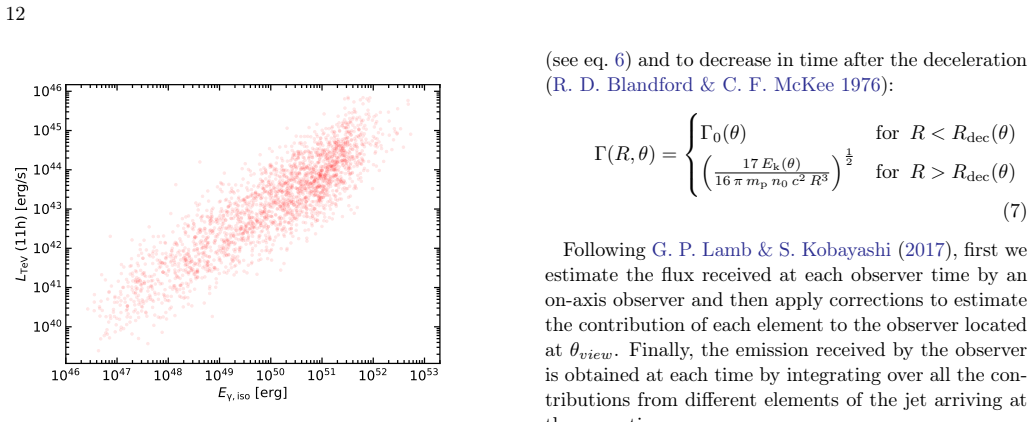
Blandford, R. D., & McKee, C. F. 1976, Physics of Fluids, 19, 1130, doi: 10.1063/1.861619 Bošnjak, Ž., Zhang, B. T., Murase, K., & Ioka, K. 2024, MNRAS, doi: 10.1093/mnras/stae093 29 40 42 44 46 Log10(LX, 11h/ [erg/s]) 39 40 41 42 43 44 45 46Log10(LTeV, 11h/ [erg/s]) Figure 14.X-ray (0.3-10keV) and VHE (0.3-1TeV) simulated luminosities at 11h
-
[27]
2022, in 37th International Cosmic Ray Conference, 937, doi: 10.22323/1.395.0937
Bulgarelli, A., Caroff, S., Addis, A., et al. 2022, in 37th International Cosmic Ray Conference, 937, doi: 10.22323/1.395.0937
-
[28]
2003, Nature, 426, 531, doi: 10.1038/nature02124
Burgay, M., D’Amico, N., Possenti, A., et al. 2003, Nature, 426, 531, doi: 10.1038/nature02124
-
[29]
2012, ApJ, 748, 136, doi: 10.1088/0004-637X/748/2/136
Cannon, K., Cariou, R., Chapman, A., et al. 2012, ApJ, 748, 136, doi: 10.1088/0004-637X/748/2/136
-
[30]
Cao, Z., Aharonian, F., An, Q., et al. 2023, Science Advances, 9, eadj2778, doi: 10.1126/sciadv.adj2778 Cherenkov Telescope Array Consortium, Acharya, B. S.,
-
[31]
Agudo, I., et al. 2019, Science with the Cherenkov Telescope Array, doi: 10.1142/10986 coll. (in prep.), M. 2025,
-
[32]
Colombo, A., Salafia, O. S., Gabrielli, F., et al. 2022, ApJ, 937, 79, doi: 10.3847/1538-4357/ac8d00
-
[33]
Colombo, A., Sharan Salafia, O., Ghirlanda, G., et al. 2025, Multi-messenger observations in the Einstein Telescope era: binary neutron star and black hole - neutron star mergers, arXiv, doi: 10.48550/arXiv.2503.00116 Dal Canton, T., Nitz, A. H., Lundgren, A. P., et al. 2014, PhRvD, 90, 082004, doi: 10.1103/PhysRevD.90.082004 Dálya, G., Díaz, R., Bouchet,...
-
[34]
Dey, A., Schlegel, D. J., Lang, D., et al. 2019, AJ, 157, 168, doi: 10.3847/1538-3881/ab089d
-
[35]
2023, A&A, 678, A157, doi: 10.1051/0004-6361/202346488 30
Donath, A., Terrier, R., Remy, Q., et al. 2023, A&A, 678, A157, doi: 10.1051/0004-6361/202346488 30
-
[36]
2022, in Society of Photo-Optical Instrumentation Engineers (SPIE) Conference Series, Vol
Egberts, K., Hoischen, C., Steppa, C., et al. 2022, in Society of Photo-Optical Instrumentation Engineers (SPIE) Conference Series, Vol. 12186, Observatory Operations: Strategies, Processes, and Systems IX, ed. D. S. Adler, R. L. Seaman, & C. R. Benn, 121860L, doi: 10.1117/12.2629372
-
[38]
Fong, W., Berger, E., Margutti, R., & Zauderer, B. A. 2015b, ApJ, 815, 102, doi: 10.1088/0004-637X/815/2/102
-
[39]
2017, Astronomy & Astrophysics, 603, A34, doi: 10.1051/0004-6361/201629684
Franceschini, A., & Rodighiero, G. 2017, A&A, 603, A34, doi: 10.1051/0004-6361/201629684
-
[40]
doi:10.1016/j.astropartphys.2012.05.018 , eprint =
Funk, S., Hinton, J. A., & CTA Consortium. 2013, Astroparticle Physics, 43, 348, doi: 10.1016/j.astropartphys.2012.05.018
-
[41]
2011, Monthly Notices of the Royal Astronomical Society: Letters, 418, L109
Ghirlanda, G., Ghisellini, G., & Nava, L. 2011, Monthly Notices of the Royal Astronomical Society: Letters, 418, L109
2011
-
[42]
Ghirlanda, G., Salafia, O. S., Pescalli, A., et al. 2016, A&A, 594, A84, doi: 10.1051/0004-6361/201628993
-
[43]
S., Paragi, Z., et al
Ghirlanda, G., Salafia, O. S., Paragi, Z., et al. 2019, Science, 363, 968
2019
-
[44]
2017, ApJL, 848, L14, doi: 10.3847/2041-8213/aa8f41
Goldstein, A., Veres, P., Burns, E., et al. 2017, ApJL, 848, L14, doi: 10.3847/2041-8213/aa8f41
-
[45]
G., Patricelli, B., Stamerra, A., & Seglar-Arroyo, M
Green, J. G., Patricelli, B., Stamerra, A., & Seglar-Arroyo, M. 2026, Sensipy: simulate gamma-ray observations of transient astrophysical sources, arXiv, doi: 10.48550/arXiv.2602.06783 H. E. S. S. Collaboration, Abdalla, H., Aharonian, F., et al. 2021, Science, 372, 1081, doi: 10.1126/science.abe8560
-
[46]
P., van Eerten, H
Hope, J. P., van Eerten, H. J., Kundu, S., & Schady, P. 2025, Monthly Notices of the Royal Astronomical Society, 538, 281
2025
-
[48]
2007b, ApJ, 654, 385, doi: 10.1086/508324
Kaneko, Y., Ramirez-Ruiz, E., Granot, J., et al. 2007b, ApJ, 654, 385, doi: 10.1086/508324
-
[49]
2018, MNRAS, 473, L121, doi: 10.1093/mnrasl/slx175
Kathirgamaraju, A., Barniol Duran, R., & Giannios, D. 2018, MNRAS, 473, L121, doi: 10.1093/mnrasl/slx175
-
[50]
W., Farah, A
Kiendrebeogo, R. W., Farah, A. M., Foley, E. M., et al. 2023, The Astrophysical Journal, 958, 158
2023
-
[51]
2003, ApJ, 591, 1075, doi: 10.1086/375186
Kumar, P., & Granot, J. 2003, ApJ, 591, 1075, doi: 10.1086/375186
-
[52]
Kuralkar, H. J., Sah, M. R., & Mukherjee, S. 2025, arXiv preprint arXiv:2507.18955
-
[53]
Lamb, G. P., & Kobayashi, S. 2017, MNRAS, 472, 4953, doi: 10.1093/mnras/stx2345
-
[54]
Levan, A. J., Gompertz, B. P., Salafia, O. S., et al. 2024, Nature, 626, 737, doi: 10.1038/s41586-023-06759-1 LHAASO Collaboration, Cao, Z., Aharonian, F., et al. 2023, Science, 380, 1390, doi: 10.1126/science.adg9328 Ligo Scientific Collaboration, VIRGO Collaboration, & Kagra Collaboration. 2025a, GRB Coordinates Network, 38991, 1 Ligo Scientific Collabo...
-
[55]
Margutti, R., Zaninoni, E., Bernardini, M. G., et al. 2013, MNRAS, 428, 729, doi: 10.1093/mnras/sts066
-
[56]
2017, PhRvD, 95, 042001, doi: 10.1103/PhysRevD.95.042001
Messick, C., Blackburn, K., Brady, P., et al. 2017, PhRvD, 95, 042001, doi: 10.1103/PhysRevD.95.042001
-
[57]
2022, Galaxies, 10, 66, doi: 10.3390/galaxies10030066
Miceli, D., & Nava, L. 2022, Galaxies, 10, 66, doi: 10.3390/galaxies10030066
-
[58]
2025, The Astrophysical Journal, 983, 35
Mondal, T., Chakraborty, S., Resmi, L., & Bose, D. 2025, The Astrophysical Journal, 983, 35
2025
-
[59]
2021, Universe, 7, 503, doi: 10.3390/universe7120503
Nava, L. 2021, Universe, 7, 503, doi: 10.3390/universe7120503
-
[60]
Brown, D. A. 2017, ApJ, 849, 118, doi: 10.3847/1538-4357/aa8f50 O’Reilly, B., Branchesi, M., Haino, S., & Gemme, G. 2020, LIGO-T2000012-v1 https://dcc.ligo.org/LIGO-T2000012/public
-
[61]
2024, in Software and Cyberinfrastructure for Astronomy VIII, Vol
Oya, I., Aubert, P., Baroncelli, L., et al. 2024, in Software and Cyberinfrastructure for Astronomy VIII, Vol. 13101, SPIE, 537–548 Özel, F., & Freire, P. 2016, ARA&A, 54, 401, doi: 10.1146/annurev-astro-081915-023322
-
[62]
2024, GRB Coordinates Network, 38443, 1
Paneque, D., Teshima, M., Seglar Arroyo, M., et al. 2024, GRB Coordinates Network, 38443, 1
2024
-
[63]
2018, JCAP, 2018, 056, doi: 10.1088/1475-7516/2018/05/056
Patricelli, B., Stamerra, A., Razzano, M., Pian, E., & Cella, G. 2018, JCAP, 2018, 056, doi: 10.1088/1475-7516/2018/05/056
-
[64]
2024, Astronomy & Astrophysics, 690, A281
Pellouin, C., & Daigne, F. 2024, Astronomy & Astrophysics, 690, A281
2024
-
[65]
2024, A&A, 690, A281, doi: 10.1051/0004-6361/202347516
Pellouin, C., & Daigne, F. 2024, A&A, 690, A281, doi: 10.1051/0004-6361/202347516
-
[66]
Petrov, P., Singer, L. P., Coughlin, M. W., et al. 2022, ApJ, 924, 54, doi: 10.3847/1538-4357/ac366d Planck Collaboration, Ade, P. A. R., Aghanim, N., et al. 2016, A&A, 594, A13, doi: 10.1051/0004-6361/201525830 31
-
[67]
C., Gompertz, B
Rastinejad, J. C., Gompertz, B. P., Levan, A. J., et al. 2022, Nature, 612, 223
2022
-
[68]
Rastinejad, J. C., Gompertz, B. P., Levan, A. J., et al. 2022, Nature, 612, 223, doi: 10.1038/s41586-022-05390-w Rouco Escorial, A., Fong, W., Berger, E., et al. 2023, ApJ, 959, 13, doi: 10.3847/1538-4357/acf830
-
[69]
2020, ApJ, 896, 166, doi: 10.3847/1538-4357/ab93cf
Ryan, G., van Eerten, H., Piro, L., & Troja, E. 2020, ApJ, 896, 166, doi: 10.3847/1538-4357/ab93cf
-
[70]
Salafia, O. S. 2025, A&A, 702, A54, doi: 10.1051/0004-6361/202555997
-
[71]
S., Colombo, A., Gabrielli, F., & Mandel, I
Salafia, O. S., Colombo, A., Gabrielli, F., & Mandel, I. 2022a, A&A, 666, A174, doi: 10.1051/0004-6361/202243260
-
[72]
S., & Ghirlanda, G
Salafia, O. S., & Ghirlanda, G. 2022, Galaxies, 10, 93
2022
-
[73]
S., Ghirlanda, G., Ascenzi, S., & Ghisellini, G
Salafia, O. S., Ghirlanda, G., Ascenzi, S., & Ghisellini, G. 2019, A&A, 628, A18, doi: 10.1051/0004-6361/201935831
-
[74]
Salafia, O. S., & Giacomazzo, B. 2021, A&A, 645, A93, doi: 10.1051/0004-6361/202038590
-
[75]
S., Berti, A., Covino, S., et al
Salafia, O. S., Berti, A., Covino, S., et al. 2022b, in 37th International Cosmic Ray Conference, 944, doi: 10.22323/1.395.0944
-
[76]
Sarin, N., Lasky, P. D., Vivanco, F. H., et al. 2022, PhRvD, 105, 083004, doi: 10.1103/PhysRevD.105.083004
-
[77]
Savchenko, V., Ferrigno, C., Kuulkers, E., et al. 2017, ApJL, 848, L15, doi: 10.3847/2041-8213/aa8f94
-
[78]
Seglar-Arroyo, M., Ashkar, H., de Lavergne, M. d. B., & Schüssler, F. 2024, The Astrophysical Journal Supplement Series, 274, 1
2024
-
[79]
Singer, L. 2021, Data-driven expectations for electromagnetic counterpart searches based on LIGO/Virgo public alerts: O5 Simulations, v1, Zenodo Zenodo, doi: 10.5281/zenodo.4765752
-
[80]
Singer, L. P., Price, L. R., Farr, B., et al. 2014, ApJ, 795, 105, doi: 10.1088/0004-637X/795/2/105
-
[81]
GWTC-4.0: Population Properties of Merging Compact Binaries
Singer, L. P., Criswell, A. W., Leggio, S. C., et al. 2025, arXiv preprint arXiv:2502.17560 The LIGO Scientific Collaboration, the Virgo Collaboration, the KAGRA Collaboration, et al. 2025, arXiv e-prints, arXiv:2508.18083, doi: 10.48550/arXiv.2508.18083
work page internal anchor Pith review doi:10.48550/arxiv.2508.18083 2025
-
[82]
Usman, S. A., Nitz, A. H., Harry, I. W., et al. 2016, Classical and Quantum Gravity, 33, 215004, doi: 10.1088/0264-9381/33/21/215004
-
[83]
2015, PhRvD, 91, 042003, doi: 10.1103/PhysRevD.91.042003
Veitch, J., Raymond, V., Farr, B., et al. 2015, PhRvD, 91, 042003, doi: 10.1103/PhysRevD.91.042003
discussion (0)
Sign in with ORCID, Apple, or X to comment. Anyone can read and Pith papers without signing in.