Recognition: unknown
Choose, Don't Label: Multiple-Choice Query Synthesis for Program Disambiguation
Pith reviewed 2026-05-10 16:38 UTC · model grok-4.3
The pith
Multiple-choice queries based on program clusters disambiguate user intent more reliably than labeled examples.
A machine-rendered reading of the paper's core claim, the machinery that carries it, and where it could break.
Core claim
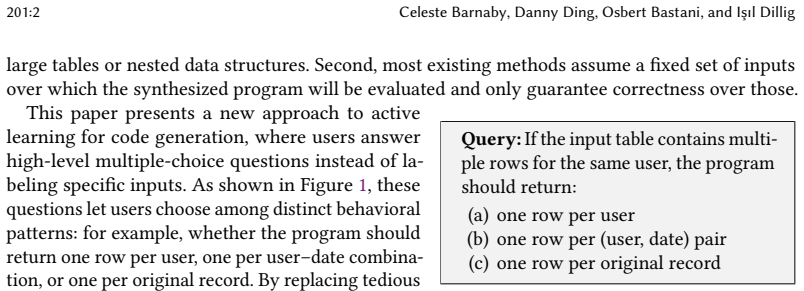
The paper establishes that program disambiguation can be reframed as the synthesis of multiple-choice queries in which each answer choice corresponds to a Hoare triple that groups semantically similar candidate programs; this formalization supports systematic construction of optimal queries that let users convey intent by selection rather than by writing examples, yielding more reliable convergence to the target program.
What carries the argument
Hoare-triple clustering of candidate programs into multiple-choice options that enables formal reasoning about query informativeness and supports systematic optimal query construction.
If this is right
- Disambiguation can proceed with fewer user errors because selection replaces the need to write potentially incorrect examples.
- The system can automatically choose queries that balance informativeness with interpretability for the user.
- The same formal machinery applies across both purely symbolic and neurosymbolic program synthesis settings.
- Convergence to the intended program occurs efficiently while runtime cost remains competitive with existing interactive techniques.
Where Pith is reading between the lines
- The method could lower the barrier for non-programmers to use synthesis tools by replacing formal labeling with simple selection.
- Similar clustering and query-generation ideas might transfer to other tasks where high-level intent is ambiguous, such as natural-language-to-code generation.
- Empirical validation with actual end users would be needed to confirm that the generated choices feel natural in real workflows.
Load-bearing premise
Users will accurately and consistently select the option that matches their true intended behavior, and the Hoare-triple clusters will group programs in ways that reflect meaningful semantic similarity to those users.
What would settle it
A controlled user study or simulation in which participants receive multiple-choice queries generated by the method and the system converges to an incorrect program more frequently than when the same users supply labeled examples.
Figures




read the original abstract
High-level specifications of code are inherently ambiguous, and prior systems have explored interactive techniques to help users clarify their intent and resolve such ambiguities. However, most existing approaches elicit supervision through labeled examples, which are often error-prone and may fail to capture user intent. This paper introduces a new active learning paradigm for program disambiguation based on multiple-choice queries. In this paradigm, the system presents a small set of high-level behaviors as multiple-choice options, and the user simply selects the intended one. Technically, each answer option corresponds to a Hoare triple that characterizes a cluster of semantically similar candidate programs. This formulation enables formal reasoning about the informativeness and interpretability of queries, and supports systematic construction of optimal queries. Building on this insight, we develop a new active learning algorithm and implement it in a tool called Socrates, which automatically synthesizes informative multiple-choice queries for program disambiguation. We evaluate Socrates across four domains spanning both symbolic and neurosymbolic settings and show that it produces intuitive, easy-to-answer queries and achieves efficient convergence. Most importantly, Socrates identifies the intended program more reliably than existing methods, while maintaining competitive runtime performance.
Editorial analysis
A structured set of objections, weighed in public.
Referee Report
Summary. The paper introduces a new active learning paradigm for resolving ambiguity in high-level program specifications via multiple-choice queries. Each query option is formalized as a Hoare triple that clusters semantically similar candidate programs; Socrates synthesizes informative queries under this model and is evaluated across four domains (symbolic and neurosymbolic), claiming more reliable identification of the intended program than prior methods while retaining competitive runtime.
Significance. If the empirical claims hold, the work offers a practical improvement over example-labeling approaches in interactive program synthesis by reducing user error and enabling formal analysis of query quality. The use of Hoare logic for clustering and query construction, together with the implementation in both symbolic and neurosymbolic settings, provides a reusable foundation that could influence future active-learning tools for verification and synthesis.
major comments (2)
- Evaluation section: the central claim that Socrates 'identifies the intended program more reliably' is load-bearing, yet the manuscript provides no explicit description of the baselines, reliability metric (e.g., success rate after k queries), statistical tests, or controls for confounds such as query length or domain-specific user expertise; without these, the superiority result cannot be assessed.
- §3 (Query Synthesis) and Evaluation: the approach rests on the assumption that Hoare-triple clustering captures semantic similarity in a way that users can consistently select the intended behavior; the paper should supply either a user study or quantitative evidence that this assumption holds in practice, as violation would directly undermine the reliability advantage.
minor comments (2)
- Abstract: the four domains are mentioned but never named; adding their identities would improve readability without altering technical content.
- Notation: the mapping from Hoare triples to 'clusters of semantically similar programs' is introduced without a formal definition of the similarity relation; a short clarifying sentence or equation would help.
Simulated Author's Rebuttal
We thank the referee for the thoughtful and constructive comments on our paper. We address each major comment below and indicate the revisions we will make to strengthen the manuscript.
read point-by-point responses
-
Referee: Evaluation section: the central claim that Socrates 'identifies the intended program more reliably' is load-bearing, yet the manuscript provides no explicit description of the baselines, reliability metric (e.g., success rate after k queries), statistical tests, or controls for confounds such as query length or domain-specific user expertise; without these, the superiority result cannot be assessed.
Authors: We agree that the evaluation section can be improved by providing more explicit details. In the revised manuscript, we will add a new subsection detailing the baselines (including the labeled-example active learning methods from prior work), the reliability metric defined as the success rate in identifying the target program within a bounded number of queries, the statistical tests used (e.g., paired t-tests across domains), and controls for confounds such as normalizing for query length and using standardized domains without assuming user expertise. This will make the superiority claims fully assessable. revision: yes
-
Referee: §3 (Query Synthesis) and Evaluation: the approach rests on the assumption that Hoare-triple clustering captures semantic similarity in a way that users can consistently select the intended behavior; the paper should supply either a user study or quantitative evidence that this assumption holds in practice, as violation would directly undermine the reliability advantage.
Authors: The assumption is central, and we provide quantitative evidence through the evaluation results: Socrates achieves higher reliability in identifying the intended program compared to baselines in simulated interactions where the 'user' selects based on the semantic clusters. This indirectly validates that the Hoare triple clusters allow consistent selection leading to correct disambiguation. However, to directly address the concern, we will add a discussion in §3 explaining how the Hoare logic ensures semantic similarity (e.g., via equivalence of postconditions), and include quantitative metrics such as cluster purity or inter-option distinguishability in the evaluation. A full user study is beyond the current scope but could be future work; the current evidence supports the practical utility. revision: partial
Circularity Check
No significant circularity detected
full rationale
The abstract and high-level description present a new active learning paradigm for program disambiguation via multiple-choice queries grounded in Hoare triples and clustering of candidate programs. This builds on established concepts from Hoare logic and active learning without any evident self-definitional reductions, fitted inputs renamed as predictions, or load-bearing self-citations. The central claims (reliable identification of intended programs, intuitive queries, efficient convergence) are framed as outcomes of a new algorithm and empirical evaluation across domains, not as derivations that collapse to the inputs by construction. No equations or steps in the provided material reduce the result to a tautology or prior self-referential assumption, making the derivation self-contained.
Axiom & Free-Parameter Ledger
Reference graph
Works this paper leans on
-
[1]
Anastasios N. Angelopoulos and Stephen Bates. 2023. Conformal Prediction: A Gentle Introduction.Found. Trends Mach. Learn.16, 4 (March 2023), 494–591. doi:10.1561/2200000101
-
[2]
Jacob Austin, Augustus Odena, Maxwell Nye, Maarten Bosma, Henryk Michalewski, David Dohan, Ellen Jiang, Carrie Cai, Michael Terry, Quoc Le, et al. 2021. Program synthesis with large language models.arXiv preprint arXiv:2108.07732 (2021)
work page internal anchor Pith review Pith/arXiv arXiv 2021
-
[3]
Thomas Ball, Rupak Majumdar, Todd Millstein, and Sriram K. Rajamani. 2001. Automatic predicate abstraction of C programs. InProceedings of the ACM SIGPLAN 2001 Conference on Programming Language Design and Implementation (Snowbird, Utah, USA)(PLDI ’01). Association for Computing Machinery, New York, NY, USA, 203–213. doi:10.1145/ 378795.378846
-
[4]
Celeste Barnaby, Qiaochu Chen, Ramya Ramalingam, Osbert Bastani, and Isil Dillig. 2025. Active Learning for Neurosymbolic Program Synthesis.arXiv preprint arXiv:2508.15750(2025). Proc. ACM Program. Lang., Vol. 10, No. PLDI, Article 201. Publication date: June 2026. Choose, Don’t Label: Multiple-Choice Query Synthesis for Program Disambiguation 201:23
-
[5]
Celeste Barnaby, Qiaochu Chen, Roopsha Samanta, and Işıl Dillig. 2023. ImageEye: Batch Image Processing Using Program Synthesis.Proc. ACM Program. Lang.7, PLDI, Article 134 (jun 2023), 26 pages. doi:10.1145/3591248
- [6]
-
[7]
Choose, Don’t Label: Multiple-Choice Query Synthesis for Program Disambiguation
Celeste Barnaby and Danny Ding. 2026.Artifact for "Choose, Don’t Label: Multiple-Choice Query Synthesis for Program Disambiguation". doi:10.5281/zenodo.19052770
-
[8]
Tom Brown, Benjamin Mann, Nick Ryder, Melanie Subbiah, Jared D Kaplan, Prafulla Dhariwal, Arvind Neelakantan, Pranav Shyam, Girish Sastry, Amanda Askell, et al. 2020. Language models are few-shot learners.Advances in neural information processing systems33 (2020), 1877–1901
2020
-
[9]
Nader H Bshouty. 1995. Exact learning boolean functions via the monotone theory.Information and Computation123, 1 (1995), 146–153
1995
-
[10]
Nader H Bshouty, Richard Cleve, Sampath Kannan, and Christino Tamon. 1994. Oracles and queries that are sufficient for exact learning. InProceedings of the seventh annual conference on Computational learning theory. 130–139
1994
-
[11]
Varun Chandrasekaran, Kamalika Chaudhuri, Irene Giacomelli, Somesh Jha, and Songbai Yan. 2020. Exploring connections between active learning and model extraction. In29th USENIX Security Symposium (USENIX Security 20). 1309–1326
2020
-
[12]
Mark Chen, Jerry Tworek, Heewoo Jun, Qiming Yuan, Henrique Ponde De Oliveira Pinto, Jared Kaplan, Harri Edwards, Yuri Burda, Nicholas Joseph, Greg Brockman, et al. 2021. Evaluating large language models trained on code.arXiv preprint arXiv:2107.03374(2021)
work page internal anchor Pith review Pith/arXiv arXiv 2021
-
[13]
Qiaochu Chen, Xinyu Wang, Xi Ye, Greg Durrett, and Isil Dillig. 2020. Multi-modal synthesis of regular expressions. In Proceedings of the 41st ACM SIGPLAN conference on programming language design and implementation. 487–502
2020
-
[14]
Yanju Chen, Chenglong Wang, Xinyu Wang, Osbert Bastani, and Yu Feng. 2024. Fast and Reliable Program Synthesis via User Interaction. InProceedings of the 38th IEEE/ACM International Conference on Automated Software Engineering (Echternach, Luxembourg)(ASE ’23). IEEE Press, 963–975. doi:10.1109/ASE56229.2023.00129
- [15]
-
[16]
Edmund Clarke, Orna Grumberg, Somesh Jha, Yuan Lu, and Helmut Veith. 2003. Counterexample-guided abstraction refinement for symbolic model checking.J. ACM50, 5 (Sept. 2003), 752–794. doi:10.1145/876638.876643
-
[17]
Sanjoy Dasgupta. 2004. Analysis of a greedy active learning strategy.Advances in neural information processing systems 17 (2004)
2004
-
[18]
Leonardo De Moura and Nikolaj Bjørner. 2008. Z3: An efficient SMT solver. InInternational conference on Tools and Algorithms for the Construction and Analysis of Systems. Springer, 337–340
2008
-
[19]
Isil Dillig, Thomas Dillig, and Alex Aiken. 2010. Small formulas for large programs: on-line constraint simplification in scalable static analysis. InProceedings of the 17th International Conference on Static Analysis(Perpignan, France) (SAS’10). Springer-Verlag, Berlin, Heidelberg, 236–252
2010
-
[20]
Dana Drachsler-Cohen, Sharon Shoham, and Eran Yahav. 2017. Synthesis with Abstract Examples. 254–278. doi:10. 1007/978-3-319-63387-9_13
2017
-
[21]
Yu Feng, Ruben Martins, Osbert Bastani, and Isil Dillig. 2018. Program synthesis using conflict-driven learning.ACM SIGPLAN Notices53, 4 (2018), 420–435
2018
-
[22]
Yu Feng, Ruben Martins, Jacob Van Geffen, Isil Dillig, and Swarat Chaudhuri. 2017. Component-based synthesis of table consolidation and transformation tasks from examples. InProceedings of the 38th ACM SIGPLAN Conference on Programming Language Design and Implementation(Barcelona, Spain)(PLDI 2017). Association for Computing Machinery, New York, NY, USA, ...
-
[23]
Margarida Ferreira, Miguel Terra-Neves, Miguel Ventura, Inês Lynce, and Ruben Martins. 2021. FOREST: An Interactive Multi-tree Synthesizer for Regular Expressions. InTools and Algorithms for the Construction and Analysis of Systems: 27th International Conference, TACAS 2021, Held as Part of the European Joint Conferences on Theory and Practice of Software...
-
[24]
Cormac Flanagan and Shaz Qadeer. 2002. Predicate abstraction for software verification. InProceedings of the 29th ACM SIGPLAN-SIGACT symposium on Principles of programming languages. 191–202
2002
-
[25]
Ivan Gavran, Eva Darulova, and Rupak Majumdar. 2020. Interactive synthesis of temporal specifications from examples and natural language.Proceedings of the ACM on Programming Languages4, OOPSLA (2020), 1–26
2020
-
[26]
Susanne Graf and Hassen Saïdi. 1997. Construction of Abstract State Graphs with PVS. InProceedings of the 9th International Conference on Computer Aided Verification (CA V ’97). Springer-Verlag, Berlin, Heidelberg, 72–83
1997
-
[27]
Zheng Guo, Michael James, David Justo, Jiaxiao Zhou, Ziteng Wang, Ranjit Jhala, and Nadia Polikarpova. 2019. Program synthesis by type-guided abstraction refinement.Proceedings of the ACM on Programming Languages4, POPL (2019), Proc. ACM Program. Lang., Vol. 10, No. PLDI, Article 201. Publication date: June 2026. 201:24 Celeste Barnaby, Danny Ding, Osbert...
2019
-
[28]
Xinyi Hou, Yanjie Zhao, Yue Liu, Zhou Yang, Kailong Wang, Li Li, Xiapu Luo, David Lo, John Grundy, and Haoyu Wang. 2024. Large language models for software engineering: A systematic literature review.ACM Transactions on Software Engineering and Methodology33, 8 (2024), 1–79
2024
- [29]
-
[30]
Naman Jain, Skanda Vaidyanath, Arun Iyer, Nagarajan Natarajan, Suresh Parthasarathy, Sriram Rajamani, and Rahul Sharma. 2022. Jigsaw: Large language models meet program synthesis. InProceedings of the 44th International Conference on Software Engineering. 1219–1231
2022
-
[31]
Susmit Jha, Sumit Gulwani, Sanjit A. Seshia, and Ashish Tiwari. 2010. Oracle-guided component-based program synthesis. InProceedings of the 32nd ACM/IEEE International Conference on Software Engineering - Volume 1(Cape Town, South Africa)(ICSE ’10). Association for Computing Machinery, New York, NY, USA, 215–224. doi:10.1145/ 1806799.1806833
-
[32]
Ruyi Ji, Chaozhe Kong, Yingfei Xiong, and Zhenjiang Hu. 2023. Improving Oracle-Guided Inductive Synthesis by Efficient Question Selection.Proc. ACM Program. Lang.7, OOPSLA1, Article 103 (apr 2023), 29 pages. doi:10.1145/3586055
-
[33]
Ruyi Ji, Jingjing Liang, Yingfei Xiong, Lu Zhang, and Zhenjiang Hu. 2020. Question selection for interactive program synthesis. InProceedings of the 41st ACM SIGPLAN Conference on Programming Language Design and Implementation (London, UK)(PLDI 2020). Association for Computing Machinery, New York, NY, USA, 1143–1158. doi:10.1145/3385412. 3386025
-
[34]
Tak Yeon Lee, Casey Dugan, and Benjamin B. Bederson. 2017. Towards Understanding Human Mistakes of Programming by Example: An Online User Study. InProceedings of the 22nd International Conference on Intelligent User Interfaces (Limassol, Cyprus)(IUI ’17). Association for Computing Machinery, New York, NY, USA, 257–261. doi:10.1145/3025171. 3025203
-
[35]
Toby Jia-Jun Li, Amos Azaria, and Brad A Myers. 2017. SUGILITE: creating multimodal smartphone automation by demonstration. InProceedings of the 2017 CHI conference on human factors in computing systems. 6038–6049
2017
-
[36]
Toby Jia-Jun Li, Marissa Radensky, Justin Jia, Kirielle Singarajah, Tom M Mitchell, and Brad A Myers. 2019. Pumice: A multi-modal agent that learns concepts and conditionals from natural language and demonstrations. InProceedings of the 32nd annual ACM symposium on user interface software and technology. 577–589
2019
-
[37]
Mikaël Mayer, Gustavo Soares, Maxim Grechkin, Vu Le, Mark Marron, Oleksandr Polozov, Rishabh Singh, Benjamin Zorn, and Sumit Gulwani. 2015. User interaction models for disambiguation in programming by example. InProceedings of the 28th Annual ACM Symposium on User Interface Software & Technology. 291–301
2015
-
[38]
Brad A. Myers and Richard McDaniel. 2001. Chapter 3 - Demonstrational Interfaces: Sometimes You Need a Little Intelligence, Sometimes You Need a Lot. InYour Wish is My Command, Henry Lieberman (Ed.). Morgan Kaufmann, San Francisco, 45–III. doi:10.1016/B978-155860688-3/50004-X
-
[39]
Jakob Nielsen. 1993. Response Times: The 3 Important Limits. https://www.nngroup.com/articles/response-times-3- important-limits/#:~:text=,not%20know%20what%20to%20expect
1993
-
[40]
Erik Nijkamp, Bo Pang, Hiroaki Hayashi, Lifu Tu, Huan Wang, Yingbo Zhou, Silvio Savarese, and Caiming Xiong. 2022. Codegen: An open large language model for code with multi-turn program synthesis.arXiv preprint arXiv:2203.13474 (2022)
work page internal anchor Pith review arXiv 2022
-
[41]
Saswat Padhi, Prateek Jain, Daniel Perelman, Oleksandr Polozov, Sumit Gulwani, and Todd Millstein. 2018. FlashProfile: a framework for synthesizing data profiles.Proc. ACM Program. Lang.2, OOPSLA, Article 150 (Oct. 2018), 28 pages. doi:10.1145/3276520
-
[42]
Hila Peleg, Shachar Itzhaky, Sharon Shoham, and Eran Yahav. 2020. Programming by predicates: a formal model for interactive synthesis.Acta Informatica57, 1 (2020), 165–193
2020
-
[43]
Hila Peleg, Sharon Shoham, and Eran Yahav. 2018. Programming not only by example. InProceedings of the 40th Inter- national Conference on Software Engineering(Gothenburg, Sweden)(ICSE ’18). Association for Computing Machinery, New York, NY, USA, 1114–1124. doi:10.1145/3180155.3180189
-
[44]
Willard V Quine. 1959. On cores and prime implicants of truth functions.The American Mathematical Monthly66, 9 (1959), 755–760
1959
-
[45]
Kia Rahmani, Mohammad Raza, Sumit Gulwani, Vu Le, Daniel Morris, Arjun Radhakrishna, Gustavo Soares, and Ashish Tiwari. 2021. Multi-modal program inference: a marriage of pre-trained language models and component-based synthesis.Proceedings of the ACM on Programming Languages5, OOPSLA (2021), 1–29
2021
-
[46]
Daniel Ramos, Ines Lynce, Vasco Manquinho, and Ruben Martins. 2020. Program disambiguation using MaxSAT. MaxSAT Evaluation 2020(2020), 58
2020
-
[47]
Pengzhen Ren, Yun Xiao, Xiaojun Chang, Po-Yao Huang, Zhihui Li, Brij B Gupta, Xiaojiang Chen, and Xin Wang. 2021. A survey of deep active learning.ACM computing surveys (CSUR)54, 9 (2021), 1–40. Proc. ACM Program. Lang., Vol. 10, No. PLDI, Article 201. Publication date: June 2026. Choose, Don’t Label: Multiple-Choice Query Synthesis for Program Disambigua...
2021
-
[48]
Greg Schohn and David Cohn. 2000. Less is more: Active learning with support vector machines. InICML, Vol. 2. Citeseer, 6
2000
-
[49]
Burr Settles. 2009. Active learning literature survey. (2009)
2009
-
[50]
Rishabh Singh and Armando Solar-Lezama. 2011. Synthesizing data structure manipulations from storyboards. InProceedings of the 19th ACM SIGSOFT Symposium and the 13th European Conference on Foundations of Software Engineering(Szeged, Hungary)(ESEC/FSE ’11). Association for Computing Machinery, New York, NY, USA, 289–299. doi:10.1145/2025113.2025153
-
[51]
Kota Sueyoshi and Takashi Matsubara. 2024. Predicated Diffusion: Predicate Logic-Based Attention Guidance for Text-to-Image Diffusion Models. In2024 IEEE/CVF Conference on Computer Vision and Pattern Recognition (CVPR). 8651–8660. doi:10.1109/CVPR52733.2024.00826
-
[52]
Dídac Surís, Sachit Menon, and Carl Vondrick. 2023. Vipergpt: Visual inference via python execution for reasoning. In Proceedings of the IEEE/CVF international conference on computer vision. 11888–11898
2023
-
[53]
Chenglong Wang, Alvin Cheung, and Rastislav Bodik. 2017. Interactive Query Synthesis from Input-Output Examples. InProceedings of the 2017 ACM International Conference on Management of Data(Chicago, Illinois, USA)(SIGMOD ’17). Association for Computing Machinery, New York, NY, USA, 1631–1634. doi:10.1145/3035918.3058738
-
[54]
Xinyu Wang, Greg Anderson, Isil Dillig, and Kenneth L McMillan. 2018. Learning abstractions for program synthesis. InInternational Conference on Computer Aided Verification. Springer, 407–426
2018
-
[55]
Xinyu Wang, Isil Dillig, and Rishabh Singh. 2017. Program synthesis using abstraction refinement.Proceedings of the ACM on Programming Languages2, POPL (2017), 1–30
2017
-
[56]
Tianyi Zhang, London Lowmanstone, Xinyu Wang, and Elena L. Glassman. 2020. Interactive Program Synthesis by Augmented Examples. InProceedings of the 33rd Annual ACM Symposium on User Interface Software and Technology (Virtual Event, USA)(UIST ’20). Association for Computing Machinery, New York, NY, USA, 627–648. doi:10.1145/ 3379337.3415900
-
[57]
A Survey on Efficient Inference for Large Language Models
Zixuan Zhou, Xuefei Ning, Ke Hong, Tianyu Fu, Jiaming Xu, Shiyao Li, Yuming Lou, Luning Wang, Zhihang Yuan, Xiuhong Li, et al. 2024. A survey on efficient inference for large language models.arXiv preprint arXiv:2404.14294 (2024). Proc. ACM Program. Lang., Vol. 10, No. PLDI, Article 201. Publication date: June 2026. 201:26 Celeste Barnaby, Danny Ding, Osb...
work page internal anchor Pith review arXiv 2024
discussion (0)
Sign in with ORCID, Apple, or X to comment. Anyone can read and Pith papers without signing in.