Recognition: unknown
Hierarchical Community Detection in Bipartite Networks
Pith reviewed 2026-05-10 16:37 UTC · model grok-4.3
The pith
A new modularity function called Qbg finds hierarchical communities in bipartite networks at multiple scales.
A machine-rendered reading of the paper's core claim, the machinery that carries it, and where it could break.
Core claim
The central claim is that the generalized bipartite modularity density Qbg, equipped with a tunable resolution parameter, recovers established mesoscale structure in bipartite networks while revealing additional hierarchical and fine-scale organization. It does so by exploiting resolution-limit behavior as a tool for multi-scale detection, without projecting the network or changing its intrinsic bipartite topology, and works for both weighted and unweighted cases.
What carries the argument
The generalized bipartite modularity density Qbg together with its resolution parameter, which is optimized at successive values to extract community partitions at different scales.
If this is right
- Qbg recovers planted multi-scale communities in hierarchical synthetic bipartite benchmarks.
- On empirical networks it detects fine-scale organization that conventional bipartite methods miss.
- The same framework applies directly to weighted bipartite networks while preserving interpretability.
- No network projection is required, so the original two-mode topology remains intact during analysis.
Where Pith is reading between the lines
- The resolution-tuning strategy could be tested on dynamic bipartite networks to track how hierarchy changes over time.
- Integration with other community quality functions might produce hybrid methods that combine strengths from multiple approaches.
- Automated selection of the resolution parameter would make the framework more practical for large unknown networks.
Load-bearing premise
That resolution-limit behavior in bipartite modularity optimization can be steered to expose genuine hierarchical organization rather than optimization artifacts.
What would settle it
Apply Qbg to a synthetic bipartite network whose communities are known to be flat and non-hierarchical; if the method still returns multiple nested partitions at different resolutions, the claim that it reliably uncovers hierarchy would be falsified.
Figures




read the original abstract
Many bipartite networks exhibit hierarchical community structure, but existing community detection methods are not well-suited for detecting hierarchy. They also do not effectively handle weighted bipartite networks. In this work, we introduce a novel modularity-based objective function, called the generalized bipartite modularity density, Qbg, specifically designed for hierarchical community detection in bipartite systems. The framework incorporates a tunable resolution parameter that enables systematic exploration of community structure across multiple scales. It leverages resolution-limit behavior in bipartite networks as a tool to uncover hierarchical organization without projecting the network or altering its intrinsic bipartite topology. We evaluate the method using a hierarchical synthetic bipartite benchmark and apply it to two empirical networks. In all cases, Qbg recovers established mesoscale structure while revealing additional hierarchical and fine-scale organization beyond that detected by conventional bipartite approaches. These results establish Qbg as a flexible, interpretable, and resolution-aware framework for hierarchical community detection in bipartite networks.
Editorial analysis
A structured set of objections, weighed in public.
Referee Report
Summary. The paper introduces a novel modularity-based objective function, the generalized bipartite modularity density Qbg, for hierarchical community detection in bipartite networks. It uses a tunable resolution parameter to explore multi-scale structure by leveraging resolution-limit behavior without network projection. The method is tested on a hierarchical synthetic bipartite benchmark and two empirical networks, with the claim that it recovers known mesoscale structure while revealing additional hierarchical and fine-scale organization beyond conventional bipartite methods.
Significance. If the central claims hold, the work would offer a useful resolution-aware framework for direct hierarchical analysis of bipartite networks, which is valuable given the prevalence of bipartite data and the limitations of projection-based or non-hierarchical methods. The approach of turning resolution limits into a feature for hierarchy detection is conceptually interesting and could enable interpretable multi-scale insights if nesting and quantitative validation are demonstrated.
major comments (3)
- [Method and Evaluation] The claim that Qbg uncovers hierarchical organization (abstract and §3) requires that multi-resolution partitions are nested, i.e., each finer-scale community lies entirely inside one coarser-scale community. The method description and evaluation sections provide no algorithm step, post-processing check, or empirical verification of nesting on the synthetic benchmark or empirical networks; without this, the output is multi-scale partitions rather than a hierarchy.
- [§4] §4 (synthetic benchmark results): The abstract states that Qbg recovers established mesoscale structure, but no quantitative metrics (e.g., normalized mutual information, adjusted Rand index against ground-truth hierarchy levels), tables of performance, or direct comparisons to existing bipartite modularity methods are referenced, undermining the ability to assess improvement over conventional approaches.
- [§2] The derivation and explicit functional form of Qbg (mentioned in abstract and §2) are not shown in sufficient detail to verify how the generalization of bipartite modularity density incorporates the resolution parameter or independently leverages resolution-limit behavior; the current presentation leaves the mathematical grounding of the central innovation unclear.
minor comments (2)
- [Abstract] The abstract refers to 'two empirical networks' without naming them or providing basic statistics (size, density, domain); adding this information would improve clarity.
- [§2] Notation for the resolution parameter and the precise definition of Qbg should be introduced with an equation in the first methods subsection rather than deferred.
Simulated Author's Rebuttal
We thank the referee for the thoughtful and constructive report. The comments highlight important aspects of clarity, evaluation, and presentation that will improve the manuscript. We address each major comment below and outline the corresponding revisions.
read point-by-point responses
-
Referee: [Method and Evaluation] The claim that Qbg uncovers hierarchical organization (abstract and §3) requires that multi-resolution partitions are nested, i.e., each finer-scale community lies entirely inside one coarser-scale community. The method description and evaluation sections provide no algorithm step, post-processing check, or empirical verification of nesting on the synthetic benchmark or empirical networks; without this, the output is multi-scale partitions rather than a hierarchy.
Authors: We agree that explicit nesting is essential to substantiate the hierarchical claim. In the current framework, varying the resolution parameter produces partitions that refine in a nested fashion by construction, as finer communities emerge from subdivisions of coarser ones through the generalized modularity density. To address the concern directly, we will add an explicit post-processing verification step in the method section that checks and reports the nesting property. We will also include empirical verification on the synthetic benchmark (showing that detected finer-scale communities are contained within coarser ones) and clarify the algorithmic procedure for generating the hierarchy. revision: yes
-
Referee: [§4] §4 (synthetic benchmark results): The abstract states that Qbg recovers established mesoscale structure, but no quantitative metrics (e.g., normalized mutual information, adjusted Rand index against ground-truth hierarchy levels), tables of performance, or direct comparisons to existing bipartite modularity methods are referenced, undermining the ability to assess improvement over conventional approaches.
Authors: We acknowledge that quantitative metrics would strengthen the evaluation. The manuscript currently emphasizes qualitative recovery of known structures on the benchmark and empirical networks. We will revise §4 to include normalized mutual information (NMI) and adjusted Rand index (ARI) scores against the ground-truth hierarchy levels, present these in a new performance table, and add direct comparisons to established bipartite modularity methods (e.g., Barber's modularity and related approaches). These additions will allow readers to quantitatively evaluate the method's performance. revision: yes
-
Referee: [§2] The derivation and explicit functional form of Qbg (mentioned in abstract and §2) are not shown in sufficient detail to verify how the generalization of bipartite modularity density incorporates the resolution parameter or independently leverages resolution-limit behavior; the current presentation leaves the mathematical grounding of the central innovation unclear.
Authors: We appreciate this observation on mathematical clarity. Section §2 currently provides a conceptual overview of the generalization. We will expand this section with the full step-by-step derivation of Qbg from standard bipartite modularity density, explicitly presenting the functional form, the incorporation of the tunable resolution parameter, and the mechanism by which resolution-limit behavior is leveraged to detect multi-scale hierarchy without projection. All key equations and optimization details will be included. revision: yes
Circularity Check
No significant circularity; derivation of Qbg is self-contained
full rationale
The paper introduces a novel objective function Qbg as an extension of bipartite modularity with an explicit tunable resolution parameter, then evaluates its output on a hierarchical synthetic benchmark and two empirical networks. No step reduces a claimed prediction or first-principles result to its own inputs by construction; the multi-scale exploration is achieved by direct variation of the stated parameter rather than by fitting a derived quantity and relabeling it. The nesting property required for true hierarchy is not enforced algorithmically in the given description, but this is a limitation of validation rather than a definitional or self-citation circularity. The central claim therefore rests on independent empirical recovery of known structure plus additional fine-scale partitions, not on tautological reduction.
Axiom & Free-Parameter Ledger
free parameters (1)
- resolution parameter
Reference graph
Works this paper leans on
-
[1]
Inspired by hierarchical network models [14, 22], the construction consists of four nested levels, each corresponding to a distinct structural scale
Artificial hierarchical bipartite network To examine how the proposed generalized bipartite modu- larity densityQ bg captures multiscale community structure, we construct an artificial hierarchical bipartite network de- signed to exhibit clear organization across multiple resolution levels. Inspired by hierarchical network models [14, 22], the constructio...
2000
-
[2]
town during the 1930s [23]
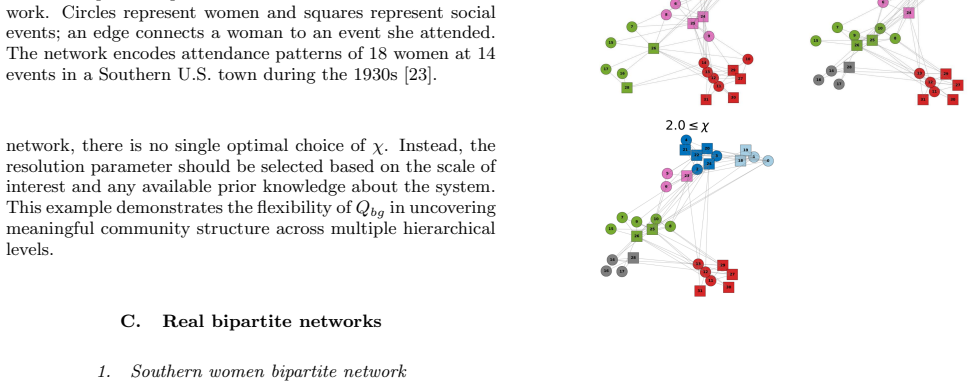
Southern women bipartite network We apply the bipartite modularity density metricQ bg to the well-known Southern Women bipartite network, which records attendance patterns of 18 women at 14 social events in a Southern U.S. town during the 1930s [23]. Figure 7 shows the bipartite representation of this network, where nodes cor- respond to women and social ...
-
[3]
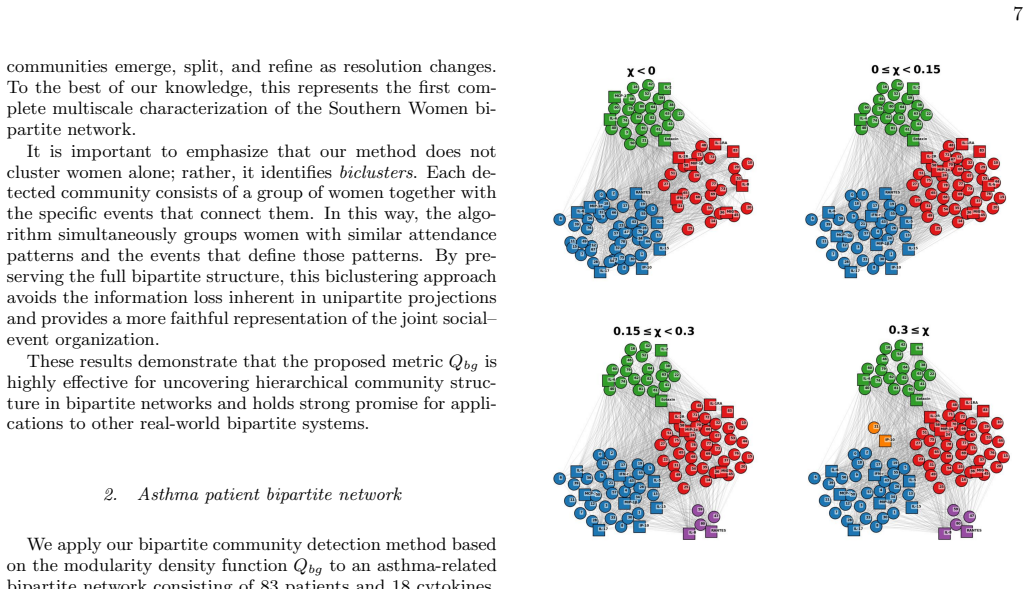
Asthma patient bipartite network We apply our bipartite community detection method based on the modularity density functionQ bg to an asthma-related bipartite network consisting of 83 patients and 18 cytokines, where edges represent significant cytokine activity levels mea- sured in patients [24]. The original biological study identified three major patie...
-
[4]
Forn= 4 andk= 2, Qb(M) = 0.4 andQ b(S) = 0.55, soQ b(S)> Q b(M) and the network is resolution-limit- free
-
[5]
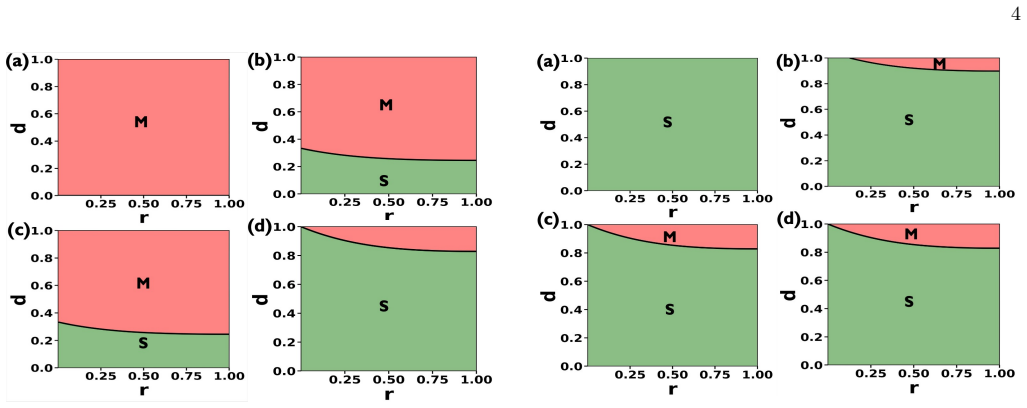
Forn= 12 andk= 2, Qb(M) = 0.733 andQ b(S) = 0.716, givingQ b(S)< Q b(M) and demonstrating the resolu- tion limit. Appendix B: Phase diagrams illustrating clique splitting behavior under modularityQ b in Benchmark Network The respective values ofQb resulting from splitting or merg- ing the two cliques in the benchmark network are Qsplit b =Q b1 +Q b2 +Q b(...
-
[6]
M. E. J. Newman, The structure and function of complex networks, SIAM Review45, 167 (2003), https://doi.org/10.1137/S003614450342480
-
[7]
Fortunato, Community detection in graphs, Physics Reports486, 75 (2010)
S. Fortunato, Community detection in graphs, Physics Reports486, 75 (2010)
2010
-
[8]
Reichardt and S
J. Reichardt and S. Bornholdt, Statistical mechanics of community detection, Phys. Rev. E74, 016110 (2006)
2006
-
[9]
X. Lu, B. Cross, and B. K. Szymanski, Asymptotic resolution bounds of generalized modularity and multi- scale community detection, Information Sciences525, 54 (2020)
2020
-
[10]
M. J. Barber, M. Faria, L. Streit, O. Strogan, C. C. Bernido, and M. V. Carpio-Bernido, Searching for com- munities in bipartite networks, inAIP Conference Pro- ceedings, Vol. 1021 (AIP, 2008) p. 171–182
2008
-
[11]
Latapy, C
M. Latapy, C. Magnien, and N. Del Vecchio, Basic no- tions for the analysis of large two-mode networks, Social Networks30, 31 (2008)
2008
-
[12]
M. E. J. Newman, The structure of scientific collaboration networks, Proceedings of the Na- 9 tional Academy of Sciences98, 404 (2001), https://www.pnas.org/doi/pdf/10.1073/pnas.98.2.404
-
[13]
Matsuo and H
Y. Matsuo and H. Yamamoto, Community gravity: mea- suring bidirectional effects by trust and rating on online social networks, inProceedings of the 18th International Conference on World Wide Web, WWW ’09 (Association for Computing Machinery, New York, NY, USA, 2009) p. 751–760
2009
-
[14]
K. I. Goh, M. E. Cusick, D. Valle, B. Childs, M. Vi- dal, and A. L. Barab´ asi, The human disease network, Proceedings of the National Academy of Sciences of the United States of America104, 8685 (2007), epub 2007 May 14
2007
-
[15]
Barab´ asi, N
A.-L. Barab´ asi, N. Gulbahce, and J. Loscalzo, Network medicine: A network-based approach to human disease, Nature Reviews Genetics12, 56 (2011)
2011
-
[16]
Z. Bu, J. Cao, H.-J. Li, G. Gao, and H. Tao, Gleam: a graph clustering framework based on potential game optimization for large-scale social networks, Knowl. Inf. Syst.55, 741–770 (2018)
2018
-
[17]
M. Chen, K. Kuzmin, and B. K. Szymanski, Community detection via maximization of modularity and its vari- ants, IEEE Transactions on Computational Social Sys- tems1, 46–65 (2014)
2014
-
[18]
Rezapoor Mirsaleh and M
M. Rezapoor Mirsaleh and M. Reza Meybodi, A michigan memetic algorithm for solving the community detection problem in complex network, Neurocomputing214, 535 (2016)
2016
-
[19]
Guoet al., Resolution limit revisited: community de- tection using generalized modularity density, Journal of Physics: Complexity4, 025001 (2023)
J. Guoet al., Resolution limit revisited: community de- tection using generalized modularity density, Journal of Physics: Complexity4, 025001 (2023)
2023
-
[20]
J. Kim, K. Feng, G. Cong, D. Zhu, W. Yu, and C. Miao, Abc: attributed bipartite co-clustering, Proc. VLDB En- dow.15, 2134–2147 (2022)
2022
-
[21]
M. J. Barber, Modularity and community detection in bipartite networks, Phys. Rev. E76, 066102 (2007)
2007
-
[22]
M. E. J. Newman, Analysis of weighted networks, Phys. Rev. E70, 056131 (2004)
2004
-
[23]
E. A. Leicht and M. E. J. Newman, Community struc- ture in directed networks, Phys. Rev. Lett.100, 118703 (2008)
2008
- [24]
-
[25]
M. E. J. Newman,Networks: an introduction(Oxford University Press, Oxford; New York, 2010)
2010
-
[26]
Lancichinetti and S
A. Lancichinetti and S. Fortunato, Limits of modularity maximization in community detection, Phys. Rev. E84, 066122 (2011)
2011
-
[27]
Arenas, A
A. Arenas, A. Fern´ andez, and S. G´ omez, Analysis of the structure of complex networks at different resolution lev- els, New Journal of Physics10, 053039 (2008)
2008
-
[28]
Davis, B
A. Davis, B. B. Gardner, and M. R. Gardner,Deep South: A Social Anthropological Study of Caste and Class(Uni- versity of Chicago Press, 1941)
1941
-
[29]
S. K. Bhavnani, G. Bellala, S. Victor, K. E. Bassler, and S. Visweswaran, The role of complementary bipartite vi- sual analytical representations in the analysis of snps: a case study in ancestral informative markers, Journal of the American Medical Informatics Association19, e5 (2012)
2012
-
[30]
B¨ orner, J
K. B¨ orner, J. T. Maru, and R. L. Goldstone, The simulta- neous evolution of author and paper networks, Proceed- ings of the National Academy of Sciences101, 5266–5273 (2004)
2004
-
[31]
Doreian, V
P. Doreian, V. Batagelj, and A. Ferligoj, Generalized blockmodeling of two-mode network data, Social Net- works26, 29 (2004)
2004
-
[32]
Guimer` a, B
R. Guimer` a, B. Uzzi, J. Spiro, and L. A. N. Amaral, Team assembly mechanisms determine collaboration net- work structure and team performance, Science308, 697 (2005)
2005
-
[33]
Arthur, Modularity and projection of bipartite net- works, Physica A: Statistical Mechanics and its Applica- tions549, 124341 (2020)
R. Arthur, Modularity and projection of bipartite net- works, Physica A: Statistical Mechanics and its Applica- tions549, 124341 (2020)
2020
-
[34]
Guimer` a, M
R. Guimer` a, M. Sales-Pardo, and L. A. N. Amaral, Module identification in bipartite and directed networks, Phys. Rev. E76, 036102 (2007)
2007
-
[35]
Cheng and G
Y. Cheng and G. Church, Biclustering of expression data, Proceedings / ... International Conference on Intelligent Systems for Molecular Biology ; ISMB. International Conference on Intelligent Systems for Molecular Biology 8, 93 (2000)
2000
-
[36]
I. S. Dhillon, Co-clustering documents and words using bipartite spectral graph partitioning, inProceedings of the Seventh ACM SIGKDD International Conference on Knowledge Discovery and Data Mining, KDD ’01 (Asso- ciation for Computing Machinery, New York, NY, USA,
-
[37]
I. S. Dhillon, S. Mallela, and D. S. Modha, Information- theoretic co-clustering, inProceedings of the Ninth ACM SIGKDD International Conference on Knowledge Dis- covery and Data Mining, KDD ’03 (Association for Com- puting Machinery, New York, NY, USA, 2003) p. 89–98
2003
-
[38]
C. Zhou, L. Feng, and Q. Zhao, A novel community detec- tion method in bipartite networks, Physica A: Statistical Mechanics and its Applications492, 1679 (2018)
2018
-
[39]
X. Yang, W. Yu, R. Wang, G. Zhang, and F. Nie, Fast spectral clustering learning with hierarchical bipartite graph for large-scale data, Pattern Recognition Letters 130, 345 (2020), image/Video Understanding and Anal- ysis (IUVA)
2020
-
[40]
Nassar, Hierarchical bipartite graph convolution net- works (2018), arXiv:1812.03813 [cs.LG]
M. Nassar, Hierarchical bipartite graph convolution net- works (2018), arXiv:1812.03813 [cs.LG]
-
[41]
K. Wang, W. Zhang, X. Lin, Y. Zhang, and S. Li, Dis- covering hierarchy of bipartite graphs with cohesive sub- graphs, in2022 IEEE 38th International Conference on Data Engineering (ICDE)(2022) pp. 2291–2305
2022
-
[42]
J. Guo, P. Singh, and K. E. Bassler, Reduced network extremal ensemble learning scheme for community de- tection in complex networks, Scientific Reports9, 14234 (2019)
2019
-
[43]
M. E. J. Newman, Fast algorithm for detecting commu- nity structure in networks, Physical Review E69, 066133 (2004)
2004
discussion (0)
Sign in with ORCID, Apple, or X to comment. Anyone can read and Pith papers without signing in.