Stringology-Based Cryptanalysis for EChaCha20 Stream Cipher
Pith reviewed 2026-05-10 18:04 UTC · model grok-4.3
The pith
EChaCha20 keystreams exhibit strong pseudorandomness at 16- and 32-bit levels with no significant rotational collisions under string pattern analysis.
A machine-rendered reading of the paper's core claim, the machinery that carries it, and where it could break.
Core claim
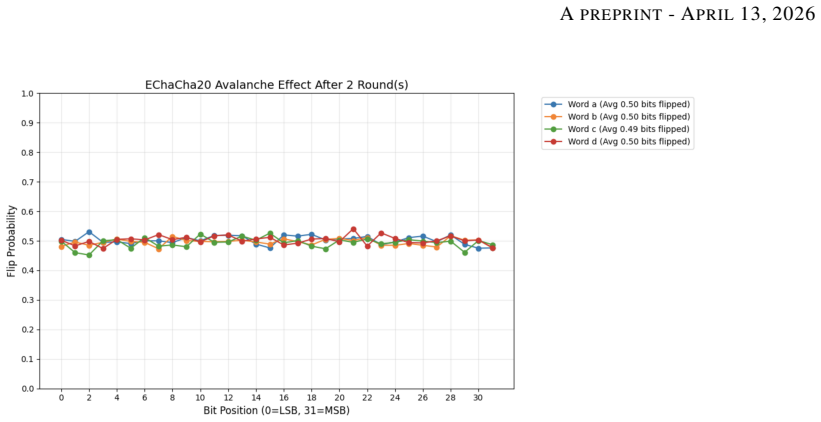
Leveraging optimized KMP and BM adaptations for 32-bit word-level pattern frequency analysis on large-scale datasets shows that EChaCha20 maintains strong pseudorandomness at 16-bit and 32-bit levels, with only minor irregularities in the 8-bit domain. Differential testing reveals an avalanche effect after two QR-F rounds and no statistically significant rotational collisions within the evaluated bounds, matching expected ARX diffusion behavior beyond three rounds. The paper concludes that these outcomes affirm the cipher's security properties and position stringology-based cryptanalysis as a complementary tool for ARX cipher assessment.
What carries the argument
Adapted Knuth-Morris-Pratt (KMP) and Boyer-Moore (BM) algorithms for 32-bit word-level m-bit pattern frequency analysis to detect rotational biases or partial collisions in keystreams.
If this is right
- EChaCha20 resists rotational-differential attacks within the tested sample bounds and bit widths.
- The 6x6 state matrix and enhanced QR-F deliver rapid diffusion without introducing detectable keystream weaknesses.
- Stringology methods can serve as a routine complement to statistical tests when evaluating ARX stream ciphers.
- Minor 8-bit irregularities do not propagate to compromise higher-bit pseudorandomness in the examined data.
Where Pith is reading between the lines
- Similar stringology scans on the original ChaCha20 could quantify whether the 6x6 expansion improves or merely preserves diffusion properties.
- Extending the tests to multi-gigabyte keystream volumes or varying pattern lengths might expose rare events missed by the current sample size.
- The approach could be automated into open cryptanalysis libraries for ongoing monitoring of ARX variants during design iterations.
Load-bearing premise
The KMP and BM adaptations for word-level analysis are sensitive enough to detect any real subtle patterns, biases, or collisions if they exist in EChaCha20.
What would settle it
A new set of one million keystream samples showing statistically significant non-uniform m-bit pattern distributions or rotational collisions at the 32-bit level would falsify the central claim.
Figures




read the original abstract
Stringology-Based Cryptanalysis (SBC) offers a suitable and a structurally aligned approach for uncovering structural patterns in stream ciphers that traditional statistical tests may often fail to detect. Despite \texttt{EChaCha20}'s design enhancements, no systematic investigation has been performed to determine whether its expanded 6$\times$6 state matrix and modified Quarter-Round Function (\texttt{QR-F}) introduce subtle keystream patterns, rotational biases, or partial collisions that could serve as statistical distinguishers. As such, addressing this gap is critical to ensure that the cipher's modifications do not unintentionally reduce its security margin. Therefore, this paper leverages Knuth-Morris-Pratt (\texttt{KMP}) and Boyer-Moore (\texttt{BM}) algorithms to analyze \texttt{EChaCha20}, which is a variant of ChaCha20 that features an expanded 6$\times$6 state matrix and an enhanced \texttt{QR-F}. The author has developed and optimized adaptations of the \texttt{KMP} and \texttt{BM} algorithms for 32-bit word level pattern analysis and employed them to investigate $m$-bit pattern frequency distributions to assess the \texttt{EChaCha20}'s resistance of rotational-differential attacks. Our experimental results on large-scale one million keystream datasets have confirmed that \texttt{EChaCha20} is able to maintain strong pseudorandomness at 16-bit and 32-bit levels with minor irregularities observed in the 8-bit domain. In addition to these, the differential tests have indicated a rapid diffusion, exhibiting an avalanche effect after two \texttt{QR-F} rounds and no statistically significant rotational collisions were observed within the evaluated bounds, consistent with expected ARX diffusion behavior beyond 3 rounds. This work puts forward SBC as a complementary tool for ARX cipher evaluation and provide new thoughts on the security properties of \texttt{EChaCha20}.
Editorial analysis
A structured set of objections, weighed in public.
Referee Report
Summary. The paper proposes Stringology-Based Cryptanalysis (SBC) as a method to detect subtle patterns in the EChaCha20 stream cipher (a 6x6-state variant of ChaCha20 with modified QR-F) by adapting the KMP and BM string-matching algorithms for 32-bit word-level m-bit pattern frequency analysis. Experiments on one million keystreams are reported to confirm strong pseudorandomness at 16-bit and 32-bit levels (with minor irregularities at 8 bits), rapid diffusion with avalanche effect after two QR-F rounds, and no statistically significant rotational collisions.
Significance. If the adapted algorithms are shown to be sensitive to known ARX biases and the statistical methodology is fully documented, the work could provide a useful complementary tool to traditional randomness tests for ARX cipher evaluation. The scale of the one-million-keystream experiments is a strength, but the current lack of validation and detail limits the significance of the security claims.
major comments (3)
- [Abstract] Abstract: The central claim that EChaCha20 exhibits 'strong pseudorandomness' and 'no statistically significant rotational collisions' rests on experimental observations, yet no details are supplied on keystream lengths, sampling procedure (random keys vs. fixed-key nonces), exact definitions of 'minor irregularities,' statistical tests applied, error bars, or exclusion criteria. This directly undermines the ability to evaluate the evidence for the pseudorandomness and diffusion claims.
- [Abstract] Abstract (experimental results): No baseline experiments are described on reduced-round ChaCha20 or other ARX designs known to exhibit biases or collisions. Without such controls, it is impossible to confirm that the adapted KMP and BM algorithms are sensitive enough to detect weaknesses when present, which is load-bearing for interpreting the negative results (absence of collisions) as support for security.
- [Abstract] Abstract (methods description): The adaptations of KMP and BM for 32-bit word-level pattern analysis, including how m-bit pattern frequencies and rotational collisions are defined, computed, and tested for significance, receive no technical description. This prevents assessment of whether the stringology approach offers any advantage over standard statistical batteries for ARX analysis.
minor comments (2)
- [Abstract] Abstract: Minor grammatical issues include 'provide new thoughts' (should be 'provides') and 'resistance of rotational-differential attacks' (should be 'resistance to').
- [Abstract] Abstract: The abbreviation 'QR-F' is introduced without expansion on first use, although 'Quarter-Round Function' appears later in the same paragraph.
Simulated Author's Rebuttal
We thank the referee for the constructive and detailed comments, which highlight important areas for improving the clarity and rigor of our work. We will make substantial revisions to address the concerns about experimental documentation, validation baselines, and methodological transparency. Our point-by-point responses follow.
read point-by-point responses
-
Referee: [Abstract] Abstract: The central claim that EChaCha20 exhibits 'strong pseudorandomness' and 'no statistically significant rotational collisions' rests on experimental observations, yet no details are supplied on keystream lengths, sampling procedure (random keys vs. fixed-key nonces), exact definitions of 'minor irregularities,' statistical tests applied, error bars, or exclusion criteria. This directly undermines the ability to evaluate the evidence for the pseudorandomness and diffusion claims.
Authors: We agree that the abstract requires more precise experimental details to support the claims. In the revised manuscript we will expand the abstract and add a dedicated Methods subsection specifying: keystream length of 2^20 bytes per sample; generation using uniformly random 256-bit keys and 96-bit nonces; definition of 'minor irregularities' as 8-bit frequency deviations exceeding two standard deviations from uniformity in under 5% of streams; application of chi-square goodness-of-fit tests with p-value reporting; and error bars derived from the one-million-sample ensemble. Exclusion criteria (streams failing basic length or format checks) will also be stated. revision: yes
-
Referee: [Abstract] Abstract (experimental results): No baseline experiments are described on reduced-round ChaCha20 or other ARX designs known to exhibit biases or collisions. Without such controls, it is impossible to confirm that the adapted KMP and BM algorithms are sensitive enough to detect weaknesses when present, which is load-bearing for interpreting the negative results (absence of collisions) as support for security.
Authors: The referee correctly notes the absence of positive controls. We will add a new subsection in the revised paper presenting baseline results: the same KMP/BM pipeline applied to 4-round and 8-round ChaCha20 (known to retain detectable rotational biases) and to a deliberately weakened ARX variant. These controls will show that the stringology method identifies the expected pattern deviations and collisions, thereby confirming its sensitivity and strengthening the interpretation of the EChaCha20 negative results. revision: yes
-
Referee: [Abstract] Abstract (methods description): The adaptations of KMP and BM for 32-bit word-level pattern analysis, including how m-bit pattern frequencies and rotational collisions are defined, computed, and tested for significance, receive no technical description. This prevents assessment of whether the stringology approach offers any advantage over standard statistical batteries for ARX analysis.
Authors: While the full manuscript contains a technical description of the adaptations in Section 4, we acknowledge that the abstract and early sections are insufficiently explicit. In the revision we will insert a concise methods summary into the abstract and ensure Section 3 provides explicit definitions: m-bit patterns as contiguous substrings extracted from the 32-bit word stream; frequency counting via optimized KMP/BM automata for linear-time matching; and significance testing via chi-square statistics supplemented by Monte Carlo estimation of rotational-collision probabilities under the null hypothesis of uniformity. revision: yes
Circularity Check
No circularity: claims rest on direct empirical observations
full rationale
The paper reports experimental results obtained by running adapted KMP and BM string-matching algorithms on one million generated keystreams. The conclusions (strong pseudorandomness at 16/32-bit levels, avalanche after two QR-F rounds, absence of significant rotational collisions) are stated as direct observations from those runs. No equations, fitted parameters presented as predictions, self-definitional loops, or load-bearing self-citations appear in the supplied text. The method is an empirical test whose outcome is not forced by construction from its own inputs.
Axiom & Free-Parameter Ledger
axioms (1)
- domain assumption Adaptations of KMP and BM algorithms can be used for m-bit pattern frequency analysis in 32-bit word keystreams to detect rotational-differential biases.
Lean theorems connected to this paper
-
IndisputableMonolith/Foundation/RealityFromDistinction.lean; Cost/FunctionalEquation.leanreality_from_one_distinction; washburn_uniqueness_aczel unclear?
unclearRelation between the paper passage and the cited Recognition theorem.
Our experimental results on large-scale one million keystream datasets have confirmed that EChaCha20 is able to maintain strong pseudorandomness at 16-bit and 32-bit levels with minor irregularities observed in the 8-bit domain... avalanche effect after two QR-F rounds
What do these tags mean?
- matches
- The paper's claim is directly supported by a theorem in the formal canon.
- supports
- The theorem supports part of the paper's argument, but the paper may add assumptions or extra steps.
- extends
- The paper goes beyond the formal theorem; the theorem is a base layer rather than the whole result.
- uses
- The paper appears to rely on the theorem as machinery.
- contradicts
- The paper's claim conflicts with a theorem or certificate in the canon.
- unclear
- Pith found a possible connection, but the passage is too broad, indirect, or ambiguous to say the theorem truly supports the claim.
Forward citations
Cited by 3 Pith papers
-
Structural Analysis of Cryptographic Sequences using Stringology-Based Fingerprinting
Introduces SBF framework that extracts structural string patterns from cryptographic sequences to produce measurable fingerprints distinguishing different generators.
-
Stringology Based Cryptology
Stringology-Based Cryptology applies substring recurrence and pattern-frequency metrics to cryptographic sequences to reveal structural properties beyond statistical randomness tests.
-
Neural Stringology Based Cryptanalysis of EChaCha20
A new framework using stringology features and neural learning detects distinguishable structural patterns in EChaCha20 keystreams under reduced-round conditions.
Reference graph
Works this paper leans on
-
[1]
Hidden stream ciphers and tmto attacks on tls 1.3, dtls 1.3, quic, and signal
John Preuß Mattsson. Hidden stream ciphers and tmto attacks on tls 1.3, dtls 1.3, quic, and signal. InInternational Conference on Cryptology and Network Security, pages 251–267. Springer, 2023
work page 2023
-
[2]
A survey on stream ciphers for constrained environments
Sameeh A Jassim and Alaa K Farhan. A survey on stream ciphers for constrained environments. In2021 1st Babylon International Conference on Information Technology and Science (BICITS), pages 228–233. IEEE, 2021
work page 2021
-
[3]
Dongyu Chen, Hua Chen, Limin Fan, and Kai Luo. Error analysis of nist sp 800-22 test suite.IEEE Transactions on Information Forensics and Security, 18:3745–3759, 2023
work page 2023
-
[4]
An overview on cryptanalysis of arx ciphers.DE CIFRIS KOINE, page 10, 2024
Stefano Barbero. An overview on cryptanalysis of arx ciphers.DE CIFRIS KOINE, page 10, 2024
work page 2024
-
[5]
Lama Sleem and Raphaël Couturier. Testu01 and practrand: Tools for a randomness evaluation for famous multimedia ciphers.Multimedia Tools and Applications, 79(33):24075–24088, 2020
work page 2020
-
[6]
Victor R Kebande. Extended-chacha20 stream cipher with enhanced quarter round function.IEEE Access, 11:114220–114237, 2023
work page 2023
-
[7]
Taj Saleh, Fatma Corut Ergin, Malek Malkawi, and Reda Alhajj. Performance and implementation comparison of knuth-morris-pratt and boyer-moore string search algorithms. In2025 2nd International Conference on Advanced Innovations in Smart Cities (ICAISC), pages 1–7. IEEE, 2025
work page 2025
-
[8]
Cryptanalysis of arx-based white-box implementations
Alex Biryukov, Baptiste Lambin, and Aleksei Udovenko. Cryptanalysis of arx-based white-box implementations. IACR Transactions on Cryptographic Hardware and Embedded Systems, 2023(3):97–135, 2023
work page 2023
-
[9]
Elena Almaraz Luengo, Bittor Alaña Olivares, Luis Javier García Villalba, and Julio Hernandez-Castro. Further analysis of the statistical independence of the nist sp 800-22 randomness tests.Applied Mathematics and Computation, 459:128222, 2023
work page 2023
-
[10]
Daniel J Bernstein et al. Chacha, a variant of salsa20. InWorkshop record of SASC, volume 8, pages 3–5. Lausanne, Switzerland, 2008
work page 2008
-
[11]
Design, diffusion, and cryptanalysis of symmetric primitive.repositorio.unb.br, 2023
Murilo Coutinho Silva. Design, diffusion, and cryptanalysis of symmetric primitive.repositorio.unb.br, 2023
work page 2023
-
[12]
Higher-order differential-linear cryptanalysis of chacha stream cipher
Nasratullah Ghafoori and Atsuko Miyaji. Higher-order differential-linear cryptanalysis of chacha stream cipher. IEEE Access, 12:13386–13399, 2024
work page 2024
-
[13]
Nasratullah Ghafoori.A Study on Differential Cryptanalysis of Salsa. PhD thesis, PhD thesis, 2024
work page 2024
-
[14]
Saqib Iqbal Hakak, Amirrudin Kamsin, Palaiahnakote Shivakumara, Gulshan Amin Gilkar, Wazir Zada Khan, and Muhammad Imran. Exact string matching algorithms: survey, issues, and future research directions.IEEE access, 7:69614–69637, 2019
work page 2019
-
[15]
Alfred V Aho. Pattern matching in strings. InFormal Language Theory, pages 325–347. Elsevier, 1980
work page 1980
-
[16]
Correctness-by-construction in stringology
Bruce W Watson. Correctness-by-construction in stringology. InStringology, pages 1–2, 2012
work page 2012
-
[17]
Dana Shapira and Ajay Daptardar. Adapting the knuth–morris–pratt algorithm for pattern matching in huffman encoded texts.Information processing & management, 42(2):429–439, 2006
work page 2006
-
[18]
On compile time knuth-morris-pratt precomputation
Justin Kourie, LGWA Cleophas, and BW Watson. On compile time knuth-morris-pratt precomputation. In Proceedings of the Prague Stringology Conference 2011 (PSC’11, Prague, Czech Republic, August 29-31, 2011), pages 15–29. Czech Technical University in Prague, 2011
work page 2011
-
[19]
Maxime Crochemore and Wojciech Rytter.Jewels of stringology: text algorithms. World Scientific, 2002
work page 2002
-
[20]
Optimal packed string matching
Oren Ben-Kiki, Philip Bille, Dany Breslauer, Leszek Gasieniec, Roberto Grossi, and Oren Weimann. Optimal packed string matching. InIARCS annual conference on foundations of software technology and theoretical computer science (FSTTCS 2011), pages 423–432. Schloss Dagstuhl–Leibniz-Zentrum für Informatik, 2011
work page 2011
-
[21]
Victor Cornejo-Aparicio, Cesar Cuarite-Silva, Antoni Benavente-Mayta, and Karim Guevara. A hybrid length- based pattern matching algorithm for text searching.International Journal of Advanced Computer Science & Applications, 16(4), 2025
work page 2025
-
[22]
A boyer–moore-style algorithm for regular expression pattern matching
Bruce W Watson and Richard E Watson. A boyer–moore-style algorithm for regular expression pattern matching. Science of Computer Programming, 48(2-3):99–117, 2003. 27 APREPRINT- APRIL13, 2026
work page 2003
-
[23]
Michael T Goodrich, Roberto Tamassia, and Michael H Goldwasser.Data structures and algorithms in Java. John wiley & sons, 2014
work page 2014
-
[24]
Heikki Hyyrö. On boyer-moore preprocessing.Department of Computer Sciences, University of Tampere, Series of Publications, D-NET Publications, D-2004-1, 2004
work page 2004
-
[25]
Fast detection algorithm for equal length frame signals based on pattern matching
Zhongyong Wang, Shufeng Zhang, Hong Sun, Kexian Gong, Honghua Liu, and Wei Wang. Fast detection algorithm for equal length frame signals based on pattern matching. InProceedings of the 2nd International Conference on Signal Processing, Computer Networks and Communications, pages 402–407, 2023
work page 2023
-
[26]
Authenticated key exchange secure against dictionary attacks
Mihir Bellare, David Pointcheval, and Phillip Rogaway. Authenticated key exchange secure against dictionary attacks. InInternational conference on the theory and applications of cryptographic techniques, pages 139–155. Springer, 2000
work page 2000
-
[27]
George Nagy, Sharad Seth, and Kent Einspahr. Decoding substitution ciphers by means of word matching with application to ocr.IEEE Transactions on Pattern Analysis and Machine Intelligence, 5:710–715, 1987
work page 1987
-
[28]
Rotational cryptanalysis of arx
Dmitry Khovratovich and Ivica Nikoli ´c. Rotational cryptanalysis of arx. InInternational Workshop on Fast Software Encryption, pages 333–346. Springer, 2010
work page 2010
-
[29]
Rotational cryptanalysis on chacha stream cipher
Stefano Barbero, Danilo Bazzanella, and Emanuele Bellini. Rotational cryptanalysis on chacha stream cipher. Symmetry, 14(6):1087, 2022
work page 2022
-
[30]
PhD thesis, King’s College London, 2021
Oluwole Ajala.Efficient String Algorithms for Data Security and Privacy. PhD thesis, King’s College London, 2021
work page 2021
-
[31]
PhD thesis, University of Haifa (Israel), 2024
Samah Idrees Ghazawi.Algorithms and Combinatorics in 1D and 2D Strings. PhD thesis, University of Haifa (Israel), 2024
work page 2024
-
[32]
Subhrajyoti Deb and Bubu Bhuyan. Performance analysis of current lightweight stream ciphers for constrained environments.S ¯adhan¯a, 45(1):256, 2020
work page 2020
-
[33]
Subhrajyoti Deb, Bubu Bhuyan, Nirmalya Kar, and K Sudheer Reddy. Colour image encryption using an improved version of stream cipher and chaos.International Journal of Ad Hoc and Ubiquitous Computing, 41(2):118–133, 2022
work page 2022
-
[34]
A quantum circuit for the cyclic string matching problem
Arianna Pavone and Caterina Viola. A quantum circuit for the cyclic string matching problem. InProceedings of the Prague Stringology Conference, 2024
work page 2024
-
[35]
Javad Darivandpour and Mikhail J Atallah. Efficient and secure pattern matching with wildcards using lightweight cryptography.Computers & Security, 77:666–674, 2018
work page 2018
-
[36]
Harish Kumar Sahu, Indivar Gupta, N Rajesh Pillai, and Rajendra Kumar Sharma. Bdd-based cryptanalysis of stream cipher: a practical approach.IET Information Security, 11(3):159–167, 2017
work page 2017
-
[37]
Janusz Rajski, Maciej Trawka, Jerzy Tyszer, and Bartosz Włodarczak. A nonlinear stream cipher for encryption of test patterns in streaming scan networks.IEEE Transactions on Circuits and Systems I: Regular Papers, 2024
work page 2024
-
[38]
Test data encryption with a new stream cipher
Janusz Rajski, Maciej Trawka, Jerzy Tyszer, and Bartosz Włodarczak. Test data encryption with a new stream cipher. In2024 IEEE International Test Conference (ITC), pages 313–322. IEEE, 2024
work page 2024
-
[39]
Randomness evaluation of stream cipher for secure mobile communication
Musheer Ahmad et al. Randomness evaluation of stream cipher for secure mobile communication. In2010 First International Conference On Parallel, Distributed and Grid Computing (PDGC 2010), pages 180–183. IEEE, 2010
work page 2010
-
[40]
rfc7539: Chacha20 and poly1305 for ietf protocols, 2021
Adam Langley and Yael Nir. rfc7539: Chacha20 and poly1305 for ietf protocols, 2021
work page 2021
-
[41]
Ind-cpa-d of relaxed functional bootstrapping: A new attack, a general fix, and a stronger model
Zeyu Liu, Yunhao Wang, and Ben Fisch. Ind-cpa-d of relaxed functional bootstrapping: A new attack, a general fix, and a stronger model. InProceedings of the 2025 ACM SIGSAC Conference on Computer and Communications Security, pages 2907–2921, 2025
work page 2025
-
[42]
The bonferroni adjustment.Statistics, 12(1):23–27, 2008
James Dean Brown. The bonferroni adjustment.Statistics, 12(1):23–27, 2008
work page 2008
-
[43]
The salsa20 family of stream ciphers
Daniel J Bernstein. The salsa20 family of stream ciphers. InNew stream cipher designs, pages 84–97. Springer, 2008
work page 2008
-
[44]
Scott Arciszewski. Xchacha: extended-nonce chacha and aead xchacha20 poly1305.Internet Engineering Task Force, Internet-Draft draft-irtf-cfrg-xchacha-03, 2020
work page 2020
-
[45]
Xing Wang and Derek Pao. Memory-based architecture for multicharacter aho–corasick string matching.IEEE transactions on very large scale integration (VLSI) systems, 26(1):143–154, 2017
work page 2017
-
[46]
Chien-Chi Chen and Sheng-De Wang. An efficient multicharacter transition string-matching engine based on the aho-corasick algorithm.ACM Transactions on Architecture and Code Optimization (TACO), 10(4):1–22, 2013. 28 APREPRINT- APRIL13, 2026
work page 2013
-
[47]
Kuznetsov Andrey Vladimirovich and Myasnikov Vladislav Valerievich. A fast plain copy-move detection algorithm based on structural pattern and 2d rabin-karp rolling hash. InInternational Conference Image Analysis and Recognition, pages 461–468. Springer, 2014
work page 2014
-
[48]
Adil Waheed and Fazli Subhan. S-box design based on logistic skewed chaotic map and modified rabin-karp algorithm: applications to multimedia security.Physica Scripta, 99(5):055236, 2024
work page 2024
-
[49]
Mayank Kabra, Rakesh Nadig, Harshita Gupta, Rahul Bera, Manos Frouzakis, Vamanan Arulchelvan, Yu Liang, Haiyu Mao, Mohammad Sadrosadati, and Onur Mutlu. Ciphermatch: Accelerating homomorphic encryption- based string matching via memory-efficient data packing and in-flash processing. InProceedings of the 30th ACM International Conference on Architectural S...
work page 2025
-
[50]
Full-text and keyword indexes for string searching.arXiv preprint arXiv:1508.06610, 2015
Aleksander Cisłak. Full-text and keyword indexes for string searching.arXiv preprint arXiv:1508.06610, 2015
-
[51]
Elena Almaraz Luengo and Luis Javier García Villalba. Recommendations on statistical randomness test batteries for cryptographic purposes.ACM Computing Surveys (CSUR), 54(4):1–34, 2021
work page 2021
-
[52]
Statistical testing of cryptographic randomness
Haydar Demirhan and Nihan Bitirim. Statistical testing of cryptographic randomness. ˙Istatistikçiler Dergisi: ˙Istatistik ve Aktüerya, 9(1):1–11, 2016
work page 2016
-
[53]
Konstantinos Limniotis and Nicholas Kolokotronis. The error linear complexity spectrum as a cryptographic criterion of boolean functions.IEEE Transactions on Information Theory, 65(12):8345–8356, 2019
work page 2019
-
[54]
Asmita Poojari, HR Nagesh, et al. Fpga implementation of random number generator using lfsr and scrambling algorithm for lightweight cryptography.International Journal of Applied Science and Engineering, 18(6):1–9, 2021
work page 2021
-
[55]
Bae: Anomaly detection algorithm based on clustering and autoencoder.Mathematics, 11(15):3398, 2023
Dongqi Wang, Mingshuo Nie, and Dongming Chen. Bae: Anomaly detection algorithm based on clustering and autoencoder.Mathematics, 11(15):3398, 2023. 29
work page 2023
discussion (0)
Sign in with ORCID, Apple, or X to comment. Anyone can read and Pith papers without signing in.