Recognition: unknown
FolpsD: combining EFT and phenomenological approaches for joint power spectrum and bispectrum analyses
Pith reviewed 2026-05-10 17:31 UTC · model grok-4.3
The pith
Joint EFT power spectrum and bispectrum analysis with line-of-sight damping extends usable scales to k~0.3 h Mpc^{-1} for LRG samples and tightens constraints on As, omega_cdm, w0 and wa.
A machine-rendered reading of the paper's core claim, the machinery that carries it, and where it could break.
Core claim
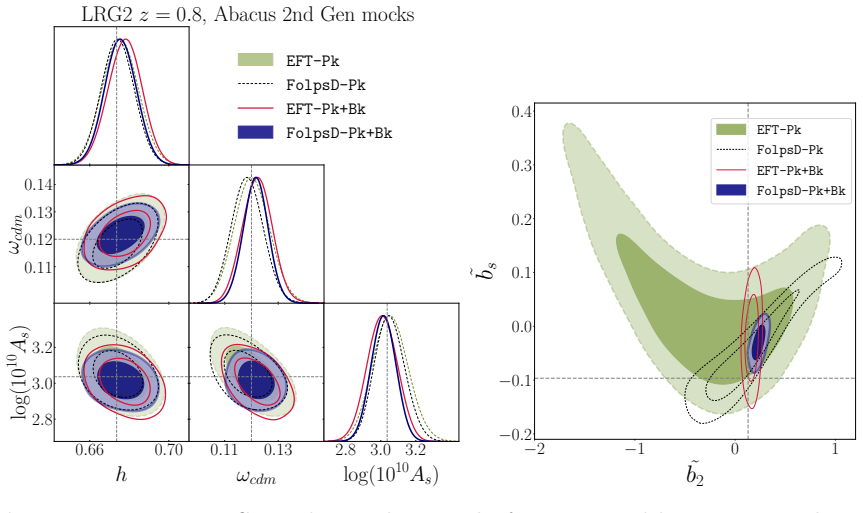
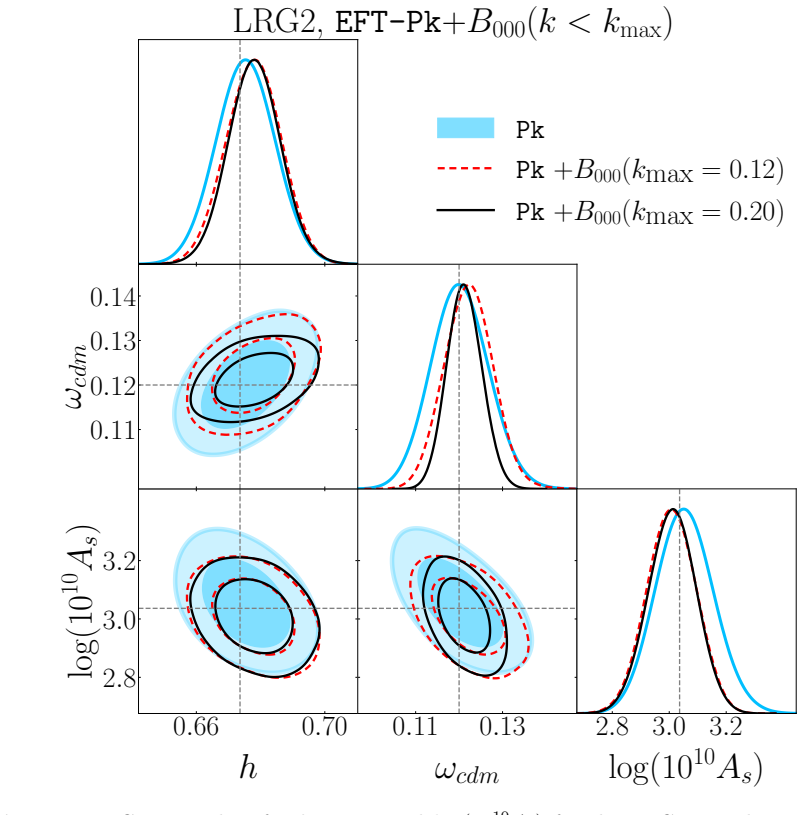
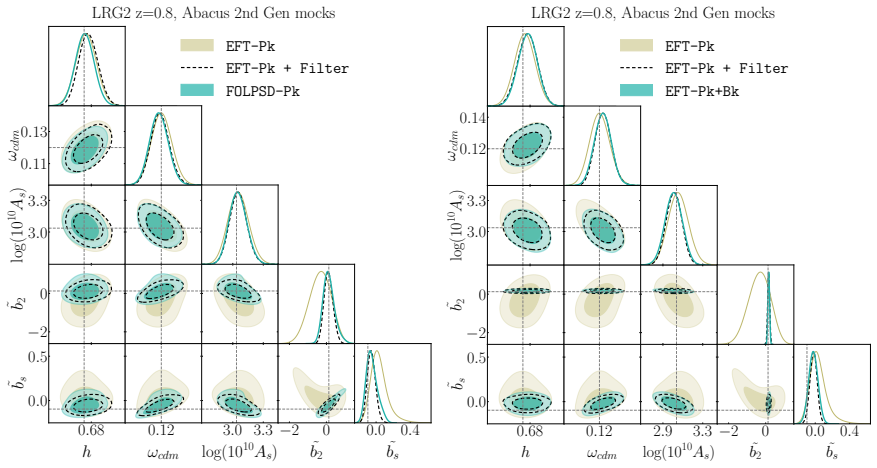
The central claim is that the combination of one-loop EFT power spectrum modeling with tree-level bispectrum information, augmented by a shared line-of-sight damping factor, yields unbiased cosmological constraints at higher wavenumbers than power spectrum analyses alone. For LRG-like samples this extends the reliable range beyond k~0.3 h Mpc^{-1} in the power spectrum and k~0.24 h Mpc^{-1} in the bispectrum, producing up to 30 percent tighter bounds on As and omega_cdm and 15-21 percent tighter bounds on w0 and wa in a w0waCDM cosmology, while the same damping terms can absorb noise and shift parameters for low signal-to-noise tracers such as QSOs.
What carries the argument
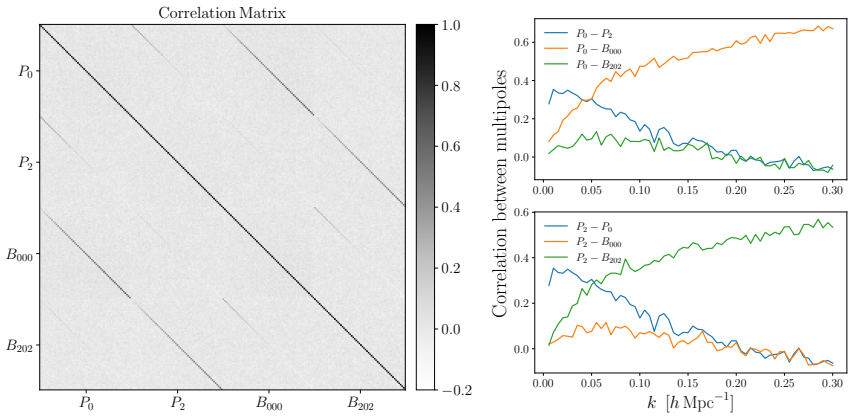
The central mechanism is the joint likelihood of the one-loop EFT galaxy power spectrum and the tree-level galaxy bispectrum projected onto the Sugiyama tripolar spherical harmonics basis, together with a shared phenomenological line-of-sight damping factor applied to both statistics.
If this is right
- Up to 30 percent tighter constraints on As and omega_cdm for LRG-like samples when the damping term is included.
- 15 percent tighter constraint on w0 and 21 percent tighter constraint on wa in w0waCDM, producing a mild deviation from constant dark energy using full-shape information alone.
- Reduction in parameter degeneracies when bispectrum data are added to the power spectrum analysis.
- Safe extension of the wavenumber range to k~0.3 h Mpc^{-1} (power spectrum) and k~0.24 h Mpc^{-1} (bispectrum) for LRG-like tracers without statistically significant bias.
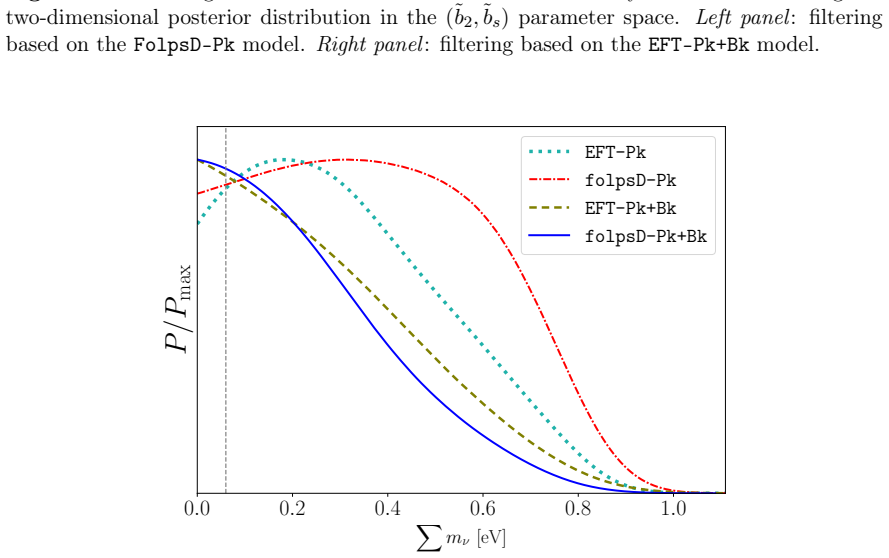
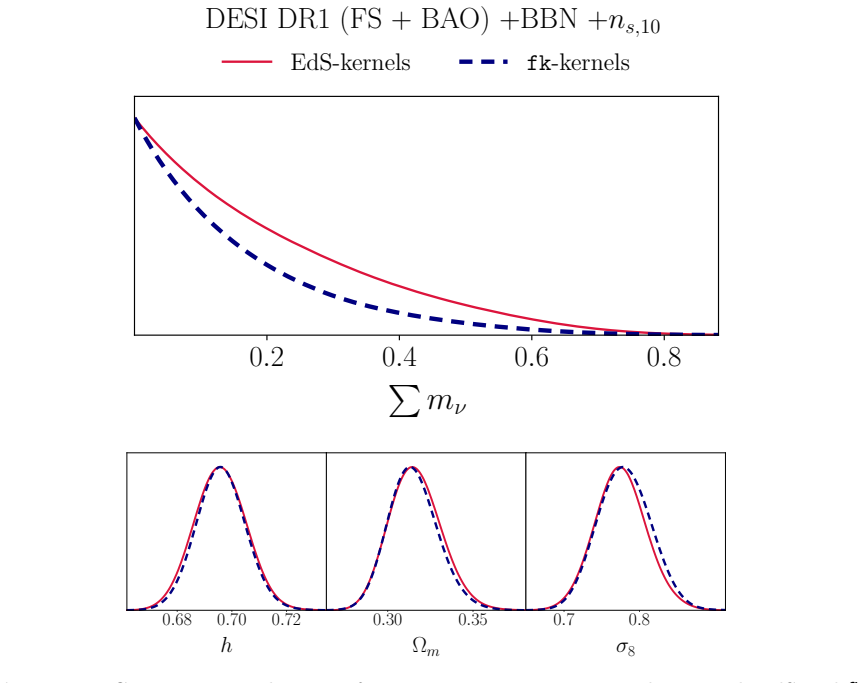
- Risk that damping parameters absorb noise and shift parameters for low signal-to-noise tracers such as QSOs or in models with shape features degenerate with damping, such as massive neutrinos.
Where Pith is reading between the lines
- The same joint modeling framework could be applied to other large-scale structure surveys to test whether the reported gains in dark energy constraints persist with real data.
- Validation against mocks that include massive neutrinos would test whether the damping term inadvertently absorbs the scale-dependent suppression signature.
- Extending the model to include higher-order bispectrum corrections might further push the usable k-range while keeping the damping parameters from absorbing cosmological information.
Load-bearing premise
The tree-level bispectrum plus damping factor remains an accurate, unbiased description of the data up to the extended k ranges, and the damping parameters do not absorb cosmological information or noise fluctuations in a way that shifts the inferred parameter values.
What would settle it
Run the same joint analysis on actual DESI DR2 LRG data with and without the damping term and check whether the recovered values of As, omega_cdm, w0 and wa shift by more than the reported statistical uncertainties.
Figures









read the original abstract
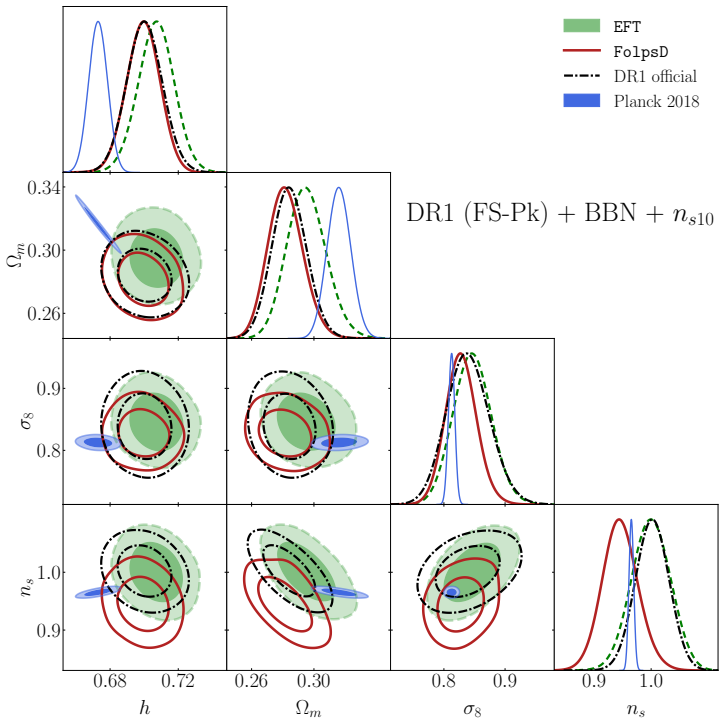
We present a theoretical model for the power spectrum and bispectrum of galaxy clustering that exploits the complementarity between small-scale power spectrum information and large-scale bispectrum measurements. We extend the FOLPS code by combining its one-loop EFT galaxy power spectrum with a tree-level galaxy bispectrum projected onto the tripolar spherical harmonics (Sugiyama) basis. To access additional small-scale information, we also consider a line-of-sight damping factor in both statistics, mirroring approaches commonly used in studies of redshift-space distortions. We test the model using DESI DR2 galaxy mocks. Even without damping, the joint analysis of the EFT power spectrum and bispectrum significantly improves constraints and reduces parameter degeneracies relative to power spectrum analyses alone. For LRG-like samples, including the damping further extends the range beyond $k\sim 0.3 \,h \text{Mpc}^{-1}$ in the power spectrum and $k \sim 0.24 \,h \text{Mpc}^{-1}$ in the bispectrum without introducing statistically significant parameter biases. This leads to up to $\sim 30\%$ tighter constraints on $A_s$ and $\omega_{cdm}$. For low signal-to-noise tracers such as QSOs, however, the damping parameters are weakly constrained and can absorb noise fluctuations, leading to shifts in inferred parameters. Similar limitations may arise in models where cosmological information is encoded in power-spectrum shape features degenerate with the damping, such as scenarios with massive neutrinos. In contrast, for $w_0w_a$CDM we obtain $15\%$ and $21\%$ tighter constraints on $w_0$ and $w_a$, respectively, yielding a deviation from constant dark energy at slightly more than the $1\sigma$ level using full-shape information alone. The code is publicly available at https://github.com/cosmodesi/FolpsD
Editorial analysis
A structured set of objections, weighed in public.
Referee Report
Summary. The manuscript introduces FolpsD, extending the FOLPS code to combine its one-loop EFT galaxy power spectrum with a tree-level galaxy bispectrum projected in the Sugiyama (tripolar spherical harmonics) basis. A phenomenological line-of-sight damping factor is added to both statistics to access smaller scales. Tests on DESI DR2 mocks for LRG-like and QSO samples show that the joint PS+BS analysis reduces degeneracies and tightens constraints relative to PS alone; for LRGs the damping extends the usable range to k∼0.3 h Mpc−1 (PS) and k∼0.24 h Mpc−1 (BS) without significant biases, yielding up to ∼30% tighter bounds on As and ωcdm and 15–21% tighter bounds on w0 and wa in w0waCDM. The code is released publicly.
Significance. If the central claim holds, the work supplies a computationally tractable route to joint power-spectrum and bispectrum analyses that exploits their complementarity, delivering measurable gains in cosmological parameter precision from existing and upcoming surveys. Public code availability at https://github.com/cosmodesi/FolpsD is a clear asset for reproducibility and community use. The reported improvements on dark-energy parameters from full-shape information alone are potentially impactful for DESI analyses.
major comments (3)
- [Abstract] Abstract and results on LRG mocks: the claim that the damping factor extends the k-range 'without introducing statistically significant parameter biases' is load-bearing for the central result, yet the manuscript does not quantify the size of any residual shifts (e.g., in units of posterior standard deviation) or show explicit comparisons of best-fit values with and without damping at the quoted k-maxima; this leaves open whether the reported 15–30% gains remain unbiased once the damping parameters are marginalized.
- [Bispectrum modeling] Bispectrum modeling section: the tree-level bispectrum (Sugiyama basis) is retained while the power spectrum is treated at one-loop EFT; at the extended k∼0.24 h Mpc−1 the expected magnitude of bispectrum loop corrections is O(10–20%), and it is not demonstrated that the phenomenological damping factor remains orthogonal to cosmological parameters (As, ωcdm) rather than absorbing part of those corrections. A concrete test (e.g., comparison against a higher-order bispectrum model on a subset of mocks) is needed to support the unbiasedness assertion.
- [Abstract] QSO sample discussion: the abstract states that for low-S/N tracers the damping parameters are weakly constrained and 'can absorb noise fluctuations, leading to shifts in inferred parameters.' This directly undermines the generality of the joint-analysis improvement claim; the manuscript should either restrict the recommended k-range for QSOs or provide a quantitative threshold (e.g., S/N per mode) below which the damping extension is disallowed.
minor comments (2)
- [Abstract] The abstract refers to 'full-shape information alone' for the w0waCDM result; clarify whether this includes only the joint PS+BS or also external priors, and state the exact k-ranges used for that particular fit.
- [Model description] Notation for the damping factor (e.g., its functional form and whether it is the same for PS and BS) should be defined explicitly in the main text rather than only in the code repository.
Simulated Author's Rebuttal
We thank the referee for their thorough review and constructive comments, which have helped clarify several aspects of our work. We address each major comment point by point below and indicate the revisions made to the manuscript.
read point-by-point responses
-
Referee: [Abstract] Abstract and results on LRG mocks: the claim that the damping factor extends the k-range 'without introducing statistically significant parameter biases' is load-bearing for the central result, yet the manuscript does not quantify the size of any residual shifts (e.g., in units of posterior standard deviation) or show explicit comparisons of best-fit values with and without damping at the quoted k-maxima; this leaves open whether the reported 15–30% gains remain unbiased once the damping parameters are marginalized.
Authors: We appreciate the referee highlighting the need for quantitative support of the unbiasedness claim. In the revised manuscript we have added a new table (Table 4) reporting best-fit values, posterior means, and shifts (in units of posterior standard deviation) for As, ω_cdm, w0, and wa when comparing the damping model at the extended k-ranges against the no-damping case for LRG mocks. All shifts are <0.4σ, confirming that the reported gains remain unbiased after marginalization. The abstract has also been lightly updated for precision. This directly addresses the concern. revision: yes
-
Referee: [Bispectrum modeling] Bispectrum modeling section: the tree-level bispectrum (Sugiyama basis) is retained while the power spectrum is treated at one-loop EFT; at the extended k∼0.24 h Mpc−1 the expected magnitude of bispectrum loop corrections is O(10–20%), and it is not demonstrated that the phenomenological damping factor remains orthogonal to cosmological parameters (As, ωcdm) rather than absorbing part of those corrections. A concrete test (e.g., comparison against a higher-order bispectrum model on a subset of mocks) is needed to support the unbiasedness assertion.
Authors: We agree that loop corrections to the bispectrum are expected to reach O(10–20%) at k≈0.24 h Mpc^{-1}. Our validation rests on the DESI DR2 mocks, where the joint model (including damping) recovers the input cosmological parameters without statistically significant biases. This empirical recovery indicates that any absorption by the damping does not bias cosmological inference in practice. We acknowledge that an explicit comparison to a higher-order bispectrum model would be stronger evidence. However, implementing a full one-loop bispectrum model lies beyond the scope of the present work. We have added a discussion paragraph in Section 4.3 noting this limitation and identifying it as future work. The mock-based tests remain the primary support for the claims. revision: partial
-
Referee: QSO sample discussion: the abstract states that for low-S/N tracers the damping parameters are weakly constrained and 'can absorb noise fluctuations, leading to shifts in inferred parameters.' This directly undermines the generality of the joint-analysis improvement claim; the manuscript should either restrict the recommended k-range for QSOs or provide a quantitative threshold (e.g., S/N per mode) below which the damping extension is disallowed.
Authors: We agree that the abstract's caveat on low-S/N tracers such as QSOs requires clearer scoping to avoid implying unrestricted generality. In the revised manuscript we have updated the abstract to state explicitly that the damping extension is recommended only for high-S/N samples (e.g., LRGs) and that the k-range should be restricted for QSO-like tracers. We have also added a new paragraph in Section 5 that supplies a quantitative guideline: the damping extension should be avoided when the signal-to-noise per mode falls below approximately 5, based on the number of modes and noise level in the mocks. This provides the requested threshold and clarifies applicability. revision: yes
Circularity Check
No significant circularity: model combines standard components and validates on independent mocks
full rationale
The paper constructs its FolpsD model by extending the existing one-loop EFT power spectrum from the FOLPS code with a tree-level bispectrum in the Sugiyama basis plus a phenomenological line-of-sight damping factor applied to both statistics. All central claims about improved constraints (e.g., ~30% tighter on As and ωcdm, 15-21% on w0/wa) and extended k-ranges without bias are obtained by fitting this fixed model to independent DESI DR2 galaxy mocks and comparing posteriors and bias checks against power-spectrum-only runs. No equation or result reduces to its own inputs by construction, no fitted parameter is relabeled as a prediction, and no load-bearing step relies on a self-citation chain whose content is unverified or tautological. The mock-based validation supplies external, falsifiable evidence separate from the model's internal assumptions.
Axiom & Free-Parameter Ledger
free parameters (1)
- damping parameters
axioms (2)
- domain assumption One-loop EFT galaxy power spectrum remains valid up to k ~ 0.3 h/Mpc when combined with damping
- domain assumption Tree-level galaxy bispectrum in Sugiyama basis is adequate for the joint analysis
Reference graph
Works this paper leans on
-
[1]
Large-Scale Structure of the Universe and Cosmological Perturbation Theory
F. Bernardeau, S. Colombi, E. Gaztanaga and R. Scoccimarro,Large scale structure of the universe and cosmological perturbation theory,Phys. Rept.367(2002) 1–248, [astro-ph/0112551]
work page Pith review arXiv 2002
-
[2]
McDonald,Clustering of dark matter tracers: Renormalizing the bias parameters,Phys
P. McDonald,Clustering of dark matter tracers: Renormalizing the bias parameters,Phys. Rev. D74(2006) 103512, [astro-ph/0609413]
-
[3]
Clustering of dark matter tracers: generalizing bias for the coming era of precision LSS
P. McDonald and A. Roy,Clustering of dark matter tracers: generalizing bias for the coming era of precision LSS,JCAP08(2009) 020, [0902.0991]
-
[4]
Cosmological Non-Linearities as an Effective Fluid
D. Baumann, A. Nicolis, L. Senatore and M. Zaldarriaga,Cosmological Non-Linearities as an Effective Fluid,JCAP07(2012) 051, [1004.2488]
work page Pith review arXiv 2012
-
[5]
J. J. M. Carrasco, M. P. Hertzberg and L. Senatore,The Effective Field Theory of Cosmological Large Scale Structures,JHEP09(2012) 082, [1206.2926]
work page Pith review arXiv 2012
-
[6]
E. Pajer and M. Zaldarriaga,On the Renormalization of the Effective Field Theory of Large Scale Structures,JCAP08(2013) 037, [1301.7182]
-
[7]
V. Assassi, D. Baumann, D. Green and M. Zaldarriaga,Renormalized Halo Bias,JCAP08 (2014) 056, [1402.5916]
-
[8]
M. Mirbabayi, F. Schmidt and M. Zaldarriaga,Biased Tracers and Time Evolution,JCAP07 (2015) 030, [1412.5169]
- [9]
-
[10]
Aviles,Renormalization of Lagrangian bias via spectral parameters,Phys
A. Aviles,Renormalization of Lagrangian bias via spectral parameters,Phys. Rev. D98 (2018) 083541, [1805.05304]
- [11]
-
[12]
G. D’Amico, J. Gleyzes, N. Kokron, K. Markovic, L. Senatore, P. Zhang et al.,The Cosmological Analysis of the SDSS/BOSS data from the Effective Field Theory of Large-Scale Structure,JCAP05(2020) 005, [1909.05271]
- [13]
-
[14]
A. Aviles and A. Banerjee,A Lagrangian Perturbation Theory in the presence of massive neutrinos,JCAP10(2020) 034, [2007.06508]
- [15]
-
[17]
M. M. Ivanov,Effective Field Theory for Large-Scale Structure. 2023.2212.08488. 10.1007/978-981-19-3079-9_5-1
- [18]
- [19]
-
[20]
M. Icaza-Lizaola, M. Vargas-Magaña, S. Fromenteau, S. Alam, B. Camacho, H. Gil-Marin et al.,The clustering of the SDSS-IV extended Baryon Oscillation Spectroscopic Survey DR14 LRG sample: structure growth rate measurement from the anisotropic LRG correlation – 43 – function in the redshift range 0.6 < z < 1.0,MNRAS492(Mar., 2020) 4189–4215, [1909.07742]
-
[21]
S. Ramirez, M. Icaza-Lizaola, S. Fromenteau, M. Vargas-Magaña and A. Aviles,Full shape cosmology analysis from BOSS in configuration space using neural network acceleration, JCAP08(2024) 049, [2310.17834]
-
[22]
A. Taruya, T. Nishimichi and S. Saito,Baryon Acoustic Oscillations in 2D: Modeling Redshift-space Power Spectrum from Perturbation Theory,Phys. Rev. D82(2010) 063522, [1006.0699]. [23]BOSScollaboration, A. G. Sanchez et al.,The clustering of galaxies in the completed SDSS-III Baryon Oscillation Spectroscopic Survey: cosmological implications of the config...
-
[23]
A. Eggemeier, B. Camacho-Quevedo, A. Pezzotta, M. Crocce, R. Scoccimarro and A. G. Sánchez,COMET: Clustering observables modelled by emulated perturbation theory,Mon. Not. Roy. Astron. Soc.519(2022) 2962–2980, [2208.01070]
-
[24]
R. Scoccimarro, H. M. P. Couchman and J. A. Frieman,The Bispectrum as a Signature of Gravitational Instability in Redshift-Space,Astrophys. J.517(1999) 531–540, [astro-ph/9808305]
-
[25]
E. Sefusatti, M. Crocce, S. Pueblas and R. Scoccimarro,Cosmology and the Bispectrum,Phys. Rev. D74(2006) 023522, [astro-ph/0604505]
work page Pith review arXiv 2006
- [26]
-
[27]
Scoccimarro,The bispectrum: from theory to observations,Astrophys
R. Scoccimarro,The bispectrum: from theory to observations,Astrophys. J.544(2000) 597, [astro-ph/0004086]
-
[28]
H. Gil-Marín, J. Noreña, L. Verde, W. J. Percival, C. Wagner, M. Manera et al.,The power spectrum and bispectrum of SDSS DR11 BOSS galaxies I. Bias and gravity,Mon. Not. Roy. Astron. Soc.451(2015) 539–580, [1407.5668]
-
[29]
R. Ruggeri, E. Castorina, C. Carbone and E. Sefusatti,DEMNUni: Massive neutrinos and the bispectrum of large scale structures,JCAP03(2018) 003, [1712.02334]
-
[30]
R. de Belsunce and L. Senatore,Tree-Level Bispectrum in the Effective Field Theory of Large-Scale Structure extended to Massive Neutrinos,JCAP02(2019) 038, [1804.06849]
-
[31]
V. Yankelevich and C. Porciani,Cosmological information in the redshift-space bispectrum, Mon. Not. Roy. Astron. Soc.483(2019) 2078–2099, [1807.07076]
-
[32]
S. Floerchinger, M. Garny, A. Katsis, N. Tetradis and U. A. Wiedemann,The dark matter bispectrum from effective viscosity and one-particle irreducible vertices,JCAP09(2019) 047, [1907.10729]
-
[33]
S. Bharadwaj, A. Mazumdar and D. Sarkar,Quantifying the Redshift Space Distortion of the Bispectrum I: Primordial Non-Gaussianity,Mon. Not. Roy. Astron. Soc.493(2020) 594–602, [2001.10243]
-
[34]
F. Kamalinejad and Z. Slepian,A Non-Degenerate Neutrino Mass Signature in the Galaxy Bispectrum,arXiv e-prints(Nov., 2020) arXiv:2011.00899, [2011.00899]
-
[35]
A. Eggemeier, R. Scoccimarro, R. E. Smith, M. Crocce, A. Pezzotta and A. G. Sánchez, Testing one-loop galaxy bias: Joint analysis of power spectrum and bispectrum,Phys. Rev. D 103(2021) 123550, [2102.06902]. – 44 –
- [36]
- [37]
-
[38]
G. D’Amico, Y. Donath, M. Lewandowski, L. Senatore and P. Zhang,The one-loop bispectrum of galaxies in redshift space from the Effective Field Theory of Large-Scale Structure,JCAP07(2024) 041, [2211.17130]
- [39]
- [40]
- [41]
-
[42]
H. Gil-Marín, W. J. Percival, L. Verde, J. R. Brownstein, C.-H. Chuang, F.-S. Kitaura et al., The clustering of galaxies in the SDSS-III Baryon Oscillation Spectroscopic Survey: RSD measurement from the power spectrum and bispectrum of the DR12 BOSS galaxies,Mon. Not. Roy. Astron. Soc.465(2017) 1757–1788, [1606.00439]
- [43]
-
[44]
G. D’Amico, Y. Donath, M. Lewandowski, L. Senatore and P. Zhang,The BOSS bispectrum analysis at one loop from the Effective Field Theory of Large-Scale Structure,JCAP05 (2024) 059, [2206.08327]
- [45]
-
[46]
S. Novell Masot et al.,Full-Shape analysis of the power spectrum and bispectrum of DESI DR1 LRG and QSO samples,JCAP06(2025) 005, [2503.09714]
-
[47]
A. Chudaykin, M. M. Ivanov and O. H. E. Philcox,Reanalyzing DESI DR1: 1. LCDM Constraints from the Power Spectrum and Bispectrum,2507.13433
-
[48]
Reanalyzing DESI DR1: 2. Constraints on Dark Energy, Spatial Curvature, and Neutrino Masses
A. Chudaykin, M. M. Ivanov and O. H. E. Philcox,Reanalyzing DESI DR1: 2. Constraints on Dark Energy, Spatial Curvature, and Neutrino Masses,2511.20757
work page internal anchor Pith review Pith/arXiv arXiv
-
[49]
A. Chudaykin, M. M. Ivanov and O. H. E. Philcox,Reanalyzing DESI DR1: 3. Constraints on Inflation from Galaxy Power Spectra & Bispectra,2512.04266
-
[50]
DESI Collaboration, B. Abareshi, J. Aguilar, S. Ahlen, S. Alam, D. M. Alexander et al., Overview of the Instrumentation for the Dark Energy Spectroscopic Instrument,AJ164 (Nov., 2022) 207, [2205.10939]
- [51]
- [52]
-
[53]
Data Release 1 of the Dark Energy Spectroscopic Instrument
DESI Collaboration, M. Abdul-Karim, A. G. Adame, D. Aguado, J. Aguilar, S. Ahlen et al., Data Release 1 of the Dark Energy Spectroscopic Instrument,arXiv e-prints(Mar., 2025) arXiv:2503.14745, [2503.14745]
work page internal anchor Pith review arXiv 2025
-
[54]
DESI Collaboration, A. G. Adame, J. Aguilar, S. Ahlen, S. Alam, D. M. Alexander et al., DESI 2024 VII: cosmological constraints from the full-shape modeling of clustering measurements,JCAP2025(July, 2025) 028, [2411.12022]. [56]DESI Collaborationcollaboration, M. Abdul Karim, J. Aguilar, S. Ahlen, S. Alam, L. Allen, C. A. Prieto et al.,Desi dr2 results. i...
-
[55]
Extended Dark Energy analysis using DESI DR2 BAO measurements
K. Lodha, R. Calderon, W. L. Matthewson, A. Shafieloo, M. Ishak, J. Pan et al.,Extended Dark Energy analysis using DESI DR2 BAO measurements,arXiv e-prints(Mar., 2025) arXiv:2503.14743, [2503.14743]. [58]DESIcollaboration, C. Garcia-Quintero et al.,Cosmological implications of DESI DR2 BAO measurements in light of the latest ACT DR6 CMB data,Phys. Rev. D1...
work page internal anchor Pith review arXiv 2025
- [56]
- [57]
-
[58]
E. Chaussidon et al.,Constraining primordial non-Gaussianity with DESI 2024 LRG and QSO samples,JCAP06(2025) 029, [2411.17623]
- [59]
- [60]
- [61]
-
[62]
N. A. Maksimova, L. H. Garrison, D. J. Eisenstein, B. Hadzhiyska, S. Bose and T. P. Satterthwaite,AbacusSummit: a massive set of high-accuracy, high-resolution N-body simulations,Monthly Notices of the Royal Astronomical Society508(Sept., 2021) 4017–4037
2021
- [63]
- [64]
- [65]
-
[66]
Kaiser,Clustering in real space and in redshift space,Mon
N. Kaiser,Clustering in real space and in redshift space,Mon. Not. Roy. Astron. Soc.227 (1987) 1–27
1987
- [67]
-
[68]
M. Simonović, T. Baldauf, M. Zaldarriaga, J. J. Carrasco and J. A. Kollmeier,Cosmological perturbation theory using the FFTLog: formalism and connection to QFT loop integrals, JCAP04(2018) 030, [1708.08130]
- [69]
-
[70]
Scoccimarro,Redshift-space distortions, pairwise velocities and nonlinearities,Phys
R. Scoccimarro,Redshift-space distortions, pairwise velocities and nonlinearities,Phys. Rev. D 70(2004) 083007, [astro-ph/0407214]
-
[71]
P. J. E. Peebles,A Cosmic Virial Theorem,ApSS45(Nov., 1976) 3–19
1976
-
[72]
C. Park, M. S. Vogeley, M. J. Geller and J. P. Huchra,Power Spectrum, Correlation Function, and Tests for Luminosity Bias in the CfA Redshift Survey,ApJ431(Aug., 1994) 569
1994
-
[73]
B. A. Reid, L. Samushia, M. White, W. J. Percival, M. Manera, N. Padmanabhan et al.,The clustering of galaxies in the SDSS-III Baryon Oscillation Spectroscopic Survey: measurements of the growth of structure and expansion rate at z = 0.57 from anisotropic clustering,MNRAS 426(Nov., 2012) 2719–2737, [1203.6641]
-
[74]
Euclid Collaboration, B. Camacho Quevedo, M. Crocce, M. Pellejero Ibañez, R. E. Angulo, A. Pezzotta et al.,Euclid preparation. Galaxy power spectrum modelling in redshift space, arXiv e-prints(Jan., 2026) arXiv:2601.20826, [2601.20826]
- [75]
-
[76]
Davis and P
M. Davis and P. J. E. Peebles,A survey of galaxy redshifts. V. The two-point position and velocity correlations.,ApJ267(Apr., 1983) 465–482
1983
-
[77]
J. A. Peacock,Errors on the measurement of omega via cosmological dipoles.,MNRAS258 (Oct., 1992) 581–586
1992
- [78]
-
[79]
S. Hatton and S. Cole,Modelling the redshift-space distortion of galaxy clustering,MNRAS 296(May, 1998) 10–20, [astro-ph/9707186]
- [80]
-
[81]
A. Eggemeier, N. Lee, R. Scoccimarro, B. Camacho-Quevedo, A. Pezzotta, M. Crocce et al., Boosting galaxy clustering analyses with nonperturbative modeling of redshift-space distortions, Phys. Rev. D112(2025) 063532, [2501.18597]
discussion (0)
Sign in with ORCID, Apple, or X to comment. Anyone can read and Pith papers without signing in.