Recognition: unknown
Dynamic Class-Aware Active Learning for Unbiased Satellite Image Segmentation
Pith reviewed 2026-05-10 16:51 UTC · model grok-4.3
The pith
A dynamic class-aware active learning method reduces bias in satellite image segmentation by tracking per-class performance in real time.
A machine-rendered reading of the paper's core claim, the machinery that carries it, and where it could break.
Core claim
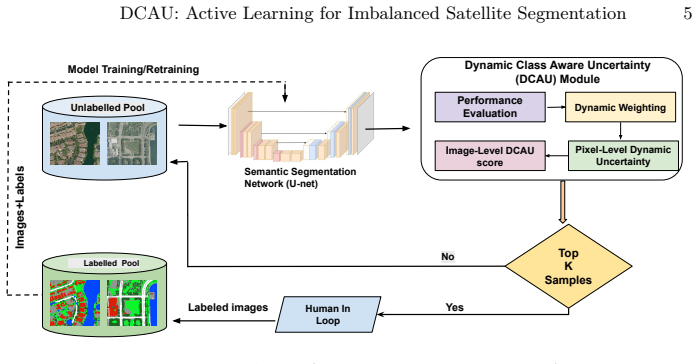
The authors claim that their Dynamic Class-Aware Uncertainty based Active Learning (DCAU-AL) overcomes limitations of standard active learning by continuously tracking segmentation performance per class and dynamically adjusting sampling weights to prioritize poorly performing or underrepresented classes. This adaptive mechanism leads to superior per-class IoU and improved annotation efficiency, as demonstrated on the OpenEarth land cover dataset under conditions of severe class imbalance.
What carries the argument
DCAU-AL acquisition function that uses real-time class-wise performance gaps to adjust sampling probabilities dynamically.
If this is right
- The proposed method outperforms existing active learning approaches in per-class accuracy on imbalanced satellite data.
- It achieves better overall segmentation quality with fewer annotated samples.
- Continuous adjustment prevents the model from ignoring rare classes as training progresses.
- Annotation efficiency improves particularly when class distributions are highly skewed.
Where Pith is reading between the lines
- Similar dynamic weighting could help in other domains with imbalanced data, such as medical image segmentation.
- Combining this with diversity-based selection might further reduce bias in very large datasets.
- Testing on datasets with different imbalance levels could reveal the method's robustness limits.
Load-bearing premise
That class-wise performance can be measured accurately enough in real time to guide sample selection without creating new biases or excessive computation.
What would settle it
Running the method on a held-out satellite dataset with known severe imbalance and finding no improvement in per-class IoU compared to standard uncertainty sampling would falsify the claim.
Figures


read the original abstract
Semantic segmentation of satellite imagery plays a vital role in land cover mapping and environmental monitoring. However, annotating large-scale, high-resolution satellite datasets is costly and time consuming, especially when covering vast geographic regions. Instead of randomly labeling data or exhaustively annotating entire datasets, Active Learning (AL) offers an efficient alternative by intelligently selecting the most informative samples for annotation with the help of Human-in-the-loop (HITL), thereby reducing labeling costs while maintaining high model performance. AL is particularly beneficial for large-scale or resource-constrained satellite applications, as it enables high segmentation accuracy with significantly fewer labeled samples. Despite these advantages, standard AL strategies typically rely on global uncertainty or diversity measures and lack the adaptability to target underperforming or rare classes as training progresses, leading to bias in the system. To overcome these limitations, we propose a novel adaptive acquisition function, Dynamic Class-Aware Uncertainty based Active learning (DCAU-AL) that prioritizes sample selection based on real-time class-wise performance gaps, thereby overcoming class-imbalance issue. The proposed DCAU-AL mechanism continuously tracks the performance of the segmentation per class and dynamically adjusts the sampling weights to focus on poorly performing or underrepresented classes throughout the active learning process. Extensive experiments on the OpenEarth land cover dataset show that DCAU-AL significantly outperforms existing AL methods, especially under severe class imbalance, delivering superior per-class IoU and improved annotation efficiency.
Editorial analysis
A structured set of objections, weighed in public.
Referee Report
Summary. The manuscript proposes Dynamic Class-Aware Uncertainty based Active Learning (DCAU-AL), a novel acquisition function for active learning in semantic segmentation of satellite imagery. It claims to address class imbalance by continuously tracking per-class segmentation performance and dynamically adjusting sampling weights to prioritize poorly performing or underrepresented classes. Experiments on the OpenEarth land cover dataset are asserted to show significant outperformance over existing AL methods, with improved per-class IoU and annotation efficiency.
Significance. If the empirical claims can be substantiated with detailed experiments, the method could provide a targeted improvement for active learning under severe class imbalance in remote sensing, potentially enhancing model fairness and reducing annotation costs in large-scale land cover mapping applications.
major comments (2)
- [Abstract] Abstract: The central empirical claim that DCAU-AL 'significantly outperforms existing AL methods, especially under severe class imbalance, delivering superior per-class IoU and improved annotation efficiency' is stated without any experimental details, baseline methods, evaluation metrics, result tables, or statistical tests, leaving the primary contribution unsupported.
- [Method description] Method: The DCAU-AL mechanism is described at a high level as tracking class-wise performance gaps and adjusting sampling weights, but no equations, formal definition of the acquisition function, algorithm, or pseudocode is supplied to specify how real-time class performance is measured or how weights are dynamically computed.
minor comments (1)
- [Abstract] Abstract: The expansion of the acronym DCAU-AL contains minor inconsistencies in wording ('Uncertainty based' vs. title phrasing) that could be clarified for precision.
Simulated Author's Rebuttal
We thank the referee for the detailed and constructive review. We address each major comment below and outline the revisions we will incorporate to strengthen the manuscript.
read point-by-point responses
-
Referee: [Abstract] Abstract: The central empirical claim that DCAU-AL 'significantly outperforms existing AL methods, especially under severe class imbalance, delivering superior per-class IoU and improved annotation efficiency' is stated without any experimental details, baseline methods, evaluation metrics, result tables, or statistical tests, leaving the primary contribution unsupported.
Authors: We agree that the abstract, as a concise summary, does not include the specific experimental details, baselines, metrics, or statistical tests. These are provided in full in the Experiments and Results sections of the manuscript, including comparisons against standard AL methods on the OpenEarth dataset with per-class IoU metrics and efficiency analysis. To better support the claim at the abstract level, we will revise the abstract to briefly reference the key baselines (e.g., uncertainty sampling, core-set selection) and primary metrics (per-class IoU, annotation budget). revision: partial
-
Referee: [Method description] Method: The DCAU-AL mechanism is described at a high level as tracking class-wise performance gaps and adjusting sampling weights, but no equations, formal definition of the acquisition function, algorithm, or pseudocode is supplied to specify how real-time class performance is measured or how weights are dynamically computed.
Authors: This observation is correct; the initial submission presented the DCAU-AL mechanism at a conceptual level without the required formalization. We will add the mathematical formulation of the class-wise performance gap (defined as the difference between current per-class IoU and a target threshold), the dynamic weighting function, the overall acquisition score, and a complete algorithm pseudocode in the revised Method section. revision: yes
Circularity Check
No significant circularity detected
full rationale
The paper introduces DCAU-AL as a novel adaptive acquisition function that tracks per-class performance gaps in real time and adjusts sampling weights accordingly. No equations, derivations, or self-citations are provided in the available text that reduce the proposed mechanism to fitted inputs, self-definitions, or prior author results by construction. The central claim rests on an empirical comparison on the OpenEarth dataset rather than any load-bearing mathematical reduction or renamed known pattern. The method is presented as a new heuristic without internal self-reference that would force the outcome.
Axiom & Free-Parameter Ledger
axioms (2)
- domain assumption Active learning reduces labeling costs while maintaining high model performance compared to random sampling.
- domain assumption Standard AL strategies lack adaptability to target underperforming or rare classes, leading to bias.
invented entities (1)
-
DCAU-AL acquisition function
no independent evidence
Reference graph
Works this paper leans on
-
[1]
In: Proceedings of the European Conference on Computer Vision (ECCV)
Agarwal, S., Arora, H., Anand, S., Arora, C.: Contextual diversity for active learn- ing. In: Proceedings of the European Conference on Computer Vision (ECCV). pp. 137–153. Springer (2020)
2020
-
[2]
In: Proceedings of the IEEE/CVF Winter Conference on Applications of Computer Vision (WACV)
Aggarwal, U., Popescu, A., Hudelot, C.: Active learning for imbalanced datasets. In: Proceedings of the IEEE/CVF Winter Conference on Applications of Computer Vision (WACV). pp. 1410–1419. IEEE (2020)
2020
-
[3]
In: Proceedings of the ACM International Con- ference on AI in Finance
Barata, R., Santana, A., Costa, H., Martins, P., Cardoso, J.: Active learning for imbalanced data under cold start. In: Proceedings of the ACM International Con- ference on AI in Finance. pp. 1–9. ACM (2021)
2021
-
[4]
In: Proceedings of the IEEE Conference on Computer Vision and Pattern Recognition (CVPR)
Cui, Y., Song, Y., Sun, C., Howard, A., Belongie, S.: Large scale fine-grained categorization and domain-specific transfer learning. In: Proceedings of the IEEE Conference on Computer Vision and Pattern Recognition (CVPR). pp. 4109–4118 (2018)
2018
-
[5]
In: Proceedings of the International Conference on Machine Learning (ICML)
Gal, Y., Islam, R., Ghahramani, Z.: Deep bayesian active learning with image data. In: Proceedings of the International Conference on Machine Learning (ICML). PMLR (2017)
2017
-
[6]
IEEE Transactions on Knowl- edge and Data Engineering21(9), 1263–1284 (2009)
He, H., Garcia, E.: Learning from imbalanced data. IEEE Transactions on Knowl- edge and Data Engineering21(9), 1263–1284 (2009)
2009
-
[7]
In: Proceedings of the IEEE Conference on Computer Vision and Pattern Recognition (CVPR)
Huang, C., Li, Y., Loy, C., Tang, X.: Learning deep representation for imbalanced classification. In: Proceedings of the IEEE Conference on Computer Vision and Pattern Recognition (CVPR). pp. 5375–5384 (2016)
2016
-
[8]
In: Pro- ceedings of the International Conference on Artificial Intelligence
Japkowicz, N.: The class imbalance problem: Significance and strategies. In: Pro- ceedings of the International Conference on Artificial Intelligence. vol. 56, pp. 111– 117 (2000)
2000
-
[9]
IEEE Journal of Selected Topics in Applied Earth Observations and Re- mote Sensing15, 3376–3389 (2022)
Lenczner, G., Lee, H., Rodriguez, A., Yao, A., Paheding, S., Zhu, Q., Kwon, H.: Dial: Deep interactive and active learning for semantic segmentation in remote sensing. IEEE Journal of Selected Topics in Applied Earth Observations and Re- mote Sensing15, 3376–3389 (2022)
2022
-
[10]
Medical Image Analysis88, 102862 (2023)
Li, X., Xia, M., Jiao, J., Zhou, S., Chang, C., Wang, Y., Guo, Y.: Hal-ia: A hybrid active learning framework using interactive annotation for medical image segmen- tation. Medical Image Analysis88, 102862 (2023)
2023
-
[11]
In: Proceedings of the International Confer- ence on Pattern Recognition (ICPR)
Mandalika, S., Nambiar, A.: Segxal: Explainable active learning for semantic seg- mentation in driving scene scenarios. In: Proceedings of the International Confer- ence on Pattern Recognition (ICPR). Springer (2024) DCAU: Active Learning for Imbalanced Satellite Segmentation 15
2024
-
[12]
International Journal of Computer Vision133(7), 4294– 4316 (2025)
Mittal, S.: Realistic evaluation of deep active learning for image classification and semantic segmentation. International Journal of Computer Vision133(7), 4294– 4316 (2025)
2025
-
[13]
In: Proceedings of the International Conference on Machine Learning (ICML)
Ren, M., Zeng, W., Yang, B., Urtasun, R.: Learning to reweight examples for robust deep learning. In: Proceedings of the International Conference on Machine Learning (ICML). pp. 4334–4343 (2018)
2018
-
[14]
ACM Computing Surveys54(9), 1–40 (2021)
Ren, Y., Xiao, X., Chang, X., Huang, P., Li, Z., Gupta, B., Chen, X., Wang, X.: A survey of deep active learning. ACM Computing Surveys54(9), 1–40 (2021)
2021
-
[15]
In: Medical Image Computing and Computer-Assisted Intervention (MICCAI)
Ronneberger, O., Fischer, P., Brox, T.: U-net: Convolutional networks for biomed- ical image segmentation. In: Medical Image Computing and Computer-Assisted Intervention (MICCAI). Lecture Notes in Computer Science, vol. 9351, pp. 234–
-
[16]
Computers & Geosciences192, 105704 (2024)
Scala, P., Manno, G., Ciraolo, G.: Semantic segmentation of coastal aerial/satellite images using deep learning techniques. Computers & Geosciences192, 105704 (2024)
2024
-
[17]
Active Learning for Convolutional Neural Networks: A Core-Set Approach
Sener, O., Savarese, S.: Active learning for convolutional neural networks: A coreset approach. In: arXiv preprint arXiv:1708.00489 (2017)
work page Pith review arXiv 2017
-
[18]
IEEE Transactions on Geoscience and Remote Sensing (2023)
Shan, L., Wang, W., Lv, K., Luo, B.: Boosting semantic segmentation of aerial im- ages via decoupled and multi-level compaction and dispersion. IEEE Transactions on Geoscience and Remote Sensing (2023)
2023
-
[19]
In: Proceedings of the 31st ACM International Conference on Multimedia (ACM MM)
Shan, L., Zhou, W., Zhao, G.: Incremental few-shot semantic segmentation via class-agnostic mask proposal and language-driven classifier. In: Proceedings of the 31st ACM International Conference on Multimedia (ACM MM). pp. 8561–8570. ACM (2023)
2023
-
[20]
arXiv preprint arXiv:2405.18078 (2024)
Shan, L., et al.: Edge-guided and class-balanced active learning for semantic seg- mentation of aerial images. arXiv preprint arXiv:2405.18078 (2024)
-
[21]
In: Proceedings of the IEEE/CVF Conference on Computer Vision and Pattern Recognition (CVPR)
Siddiqui, Y., Valentin, J., Nießner, M.: Viewal: Active learning with viewpoint entropy for semantic segmentation. In: Proceedings of the IEEE/CVF Conference on Computer Vision and Pattern Recognition (CVPR). pp. 9433–9443 (2020)
2020
-
[22]
In: Proceedings of the IEEE/CVF Winter Conference on Applications of Computer Vision (WACV) (2023)
Xia, J., et al.: Openearthmap: A benchmark dataset for global high-resolution land cover mapping. In: Proceedings of the IEEE/CVF Winter Conference on Applications of Computer Vision (WACV) (2023)
2023
-
[23]
In: Proceedings of the Asian Conference on Computer Vision (ACCV) (2020)
Xie, S., Feng, Z., Chen, Y., Sun, S., Ma, C., Song, M.: Deal: Difficulty-aware active learning for semantic segmentation. In: Proceedings of the Asian Conference on Computer Vision (ACCV) (2020)
2020
-
[24]
In: Proceedings of the IEEE/CVF Conference on Computer Vision and Pattern Recognition (CVPR)
Yang, F., He, Z., Zhang, Z., Xu, Y., Liang, X., Liang, Y.: Plug and play active learning for object detection. In: Proceedings of the IEEE/CVF Conference on Computer Vision and Pattern Recognition (CVPR). pp. 22954–22963 (2024)
2024
-
[25]
International Journal of Computer Vision113(2), 113–127 (2015)
Yang, Y., Ma, Z., Nie, F., Chang, X., Hauptmann, A.: Multi-class active learn- ing by uncertainty sampling with diversity maximization. International Journal of Computer Vision113(2), 113–127 (2015)
2015
discussion (0)
Sign in with ORCID, Apple, or X to comment. Anyone can read and Pith papers without signing in.