Recognition: 2 theorem links
· Lean TheoremTesting the Assumptions of Active Learning for Translation Tasks with Few Samples
Pith reviewed 2026-05-10 17:19 UTC · model grok-4.3
The pith
Active learning that selects informative or diverse samples does not improve translation performance with few annotations.
A machine-rendered reading of the paper's core claim, the machinery that carries it, and where it could break.
Core claim
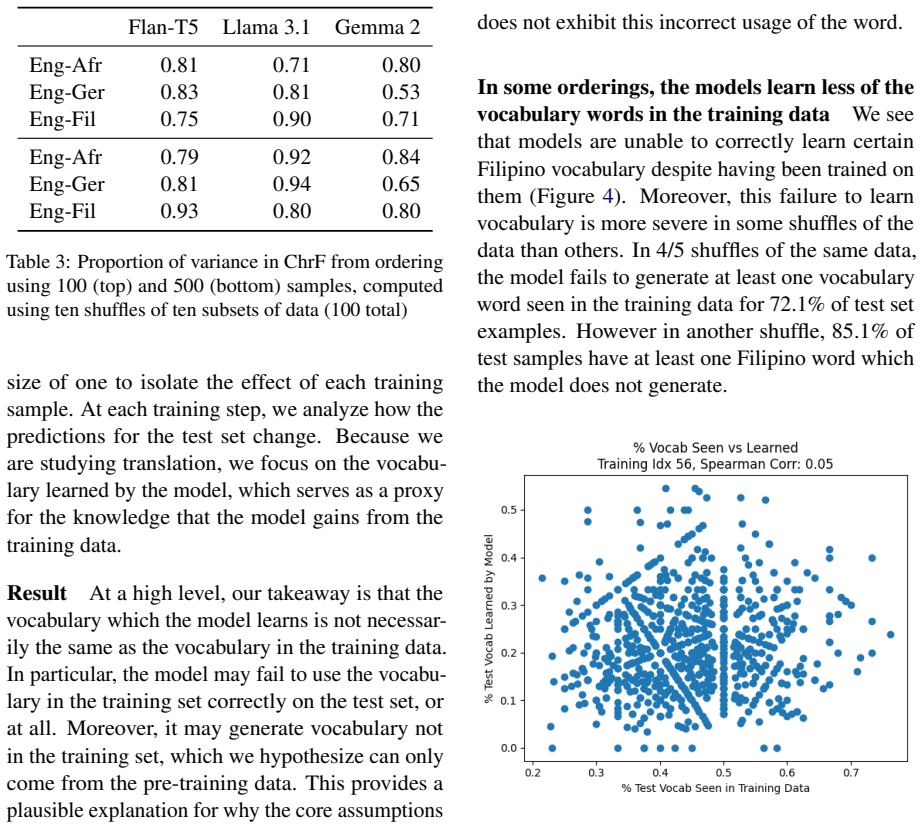
Neither the informativeness nor diversity of the training data, which AL strategies optimize for, are correlated with test set performance. Instead, factors like the ordering of the training samples and interactions with pre-training data have a larger impact on performance.
What carries the argument
Correlation analysis between active learning selection criteria (informativeness and diversity) and downstream model performance on translation tasks.
If this is right
- Active learning methods must incorporate considerations of sample ordering to be effective with few samples.
- Interactions between selected data and pre-trained model weights play a key role in final performance.
- Random sampling performs comparably to active learning strategies in this low-data regime.
- New active learning designs should target ordering and pre-training compatibility rather than only informativeness or diversity.
Where Pith is reading between the lines
- This finding may extend to other sequence generation tasks beyond translation where pre-trained models are used.
- Researchers could test whether reordering the same selected samples changes outcomes in controlled experiments.
- Future work might develop selection methods that explicitly model compatibility with pre-training data.
- Similar assumptions in active learning for other low-resource NLP tasks could be tested using the same correlation approach.
Load-bearing premise
That the chosen metrics for informativeness and diversity, together with the specific translation datasets and model sizes tested, are sufficient to detect the correlations that would exist if the active learning assumptions held.
What would settle it
A new experiment using alternative metrics for informativeness or diversity that finds a clear positive correlation with translation test-set performance would falsify the central claim.
Figures




read the original abstract
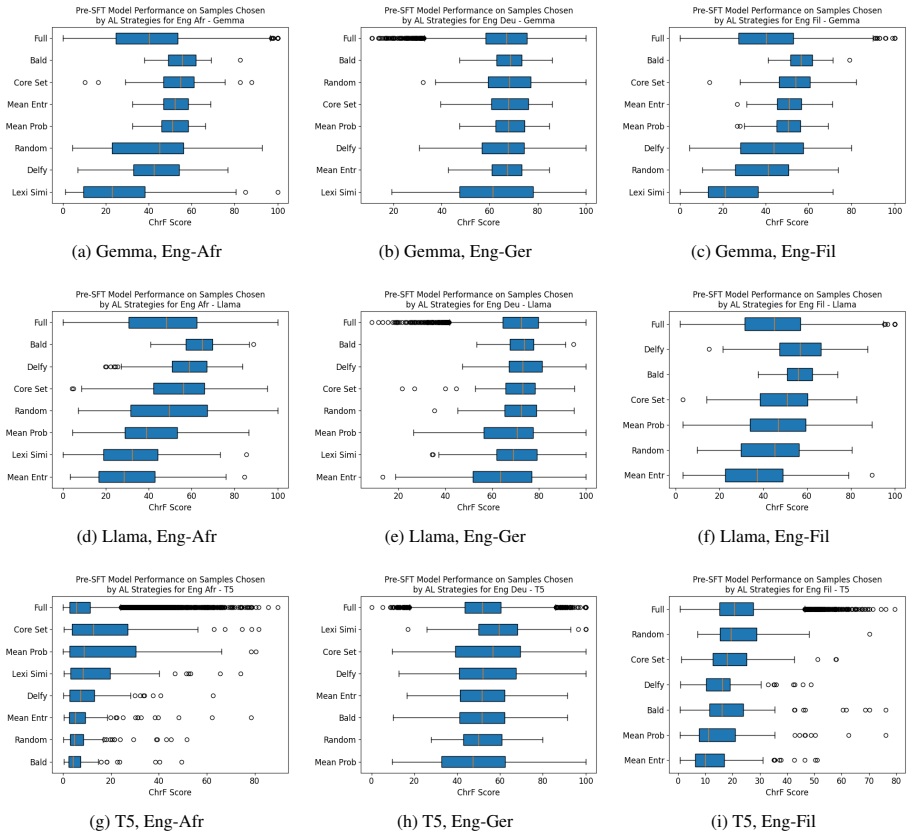
Active learning (AL) is a training paradigm for selecting unlabeled samples for annotation to improve model performance on a test set, which is useful when only a limited number of samples can be annotated. These algorithms often work by optimizing for the informativeness and diversity of the training data to be annotated. Recent work found that AL strategies fail to outperform random sampling on various language generation tasks when using 100-500 samples. To understand AL's poor performance when only using few samples, we investigate whether the core assumptions underlying AL strategies hold. We find that neither the informativeness nor diversity of the training data, which AL strategies optimize for, are correlated with test set performance. Instead, factors like the ordering of the training samples and interactions with pre-training data have a larger impact on performance. This suggests that future AL methods must take these factors into account in order to work with very few samples.
Editorial analysis
A structured set of objections, weighed in public.
Referee Report
Summary. The paper investigates why active learning (AL) strategies fail to outperform random sampling for neural machine translation when only 100-500 samples are available. It empirically tests the core AL assumptions by computing informativeness and diversity metrics on selected data and measuring their correlation with test-set performance, finding no such correlations. Instead, it reports that sample ordering and interactions with pre-training data exert larger effects on downstream performance, concluding that future AL methods must incorporate these factors to succeed in the few-sample regime.
Significance. If the no-correlation result holds under rigorous controls, the work provides a direct empirical challenge to the informativeness/diversity assumptions that underpin most AL algorithms in low-data MT settings. This could explain recent observations of AL underperforming random baselines and would motivate a shift toward ordering-aware or pre-training-aware selection criteria, with potential impact on efficient annotation pipelines for generation tasks.
major comments (2)
- [Results] The central no-correlation claim between informativeness/diversity and test performance is load-bearing for the paper's argument against standard AL assumptions, yet the abstract and described setup provide no correlation coefficients, p-values, or power analysis; with only 100-500 samples this risks underpowered tests that could mask weak but real relationships.
- [Discussion] The alternative claim that ordering and pre-training interactions have larger impact requires quantitative support (e.g., effect-size comparisons or ablation tables) to be proportionate to the null finding on informativeness/diversity; without these, the relative importance remains qualitative.
minor comments (2)
- [Methods] Clarify the exact definitions and implementations of the informativeness and diversity metrics used for translation (e.g., uncertainty estimation in seq2seq models) so readers can judge whether they faithfully test the AL assumptions.
- [Abstract] Report the number of random seeds, exact datasets, and model scales in the abstract or early methods paragraph to address reproducibility concerns for the correlation analyses.
Simulated Author's Rebuttal
We thank the referee for their constructive feedback on our manuscript. We address each major comment below and have revised the paper to incorporate additional statistical details and quantitative comparisons as requested.
read point-by-point responses
-
Referee: [Results] The central no-correlation claim between informativeness/diversity and test performance is load-bearing for the paper's argument against standard AL assumptions, yet the abstract and described setup provide no correlation coefficients, p-values, or power analysis; with only 100-500 samples this risks underpowered tests that could mask weak but real relationships.
Authors: We agree that explicit statistical measures strengthen the central claim. In the revised manuscript we now report Pearson and Spearman correlation coefficients with associated p-values for all informativeness and diversity metrics versus test performance. All correlations remain small and non-significant (|r| < 0.12, p > 0.15). We also added a power analysis (using the observed variances and n = 100–500) showing that the experiments have >80 % power to detect correlations of |r| ≥ 0.25 at α = 0.05. These additions confirm that the lack of correlation is not an artifact of underpowering. revision: yes
-
Referee: [Discussion] The alternative claim that ordering and pre-training interactions have larger impact requires quantitative support (e.g., effect-size comparisons or ablation tables) to be proportionate to the null finding on informativeness/diversity; without these, the relative importance remains qualitative.
Authors: We accept that the original discussion presented the relative importance of ordering and pre-training somewhat qualitatively. The revised version includes a new table (Table 4) that directly compares effect sizes (Cohen’s d and performance deltas in BLEU) across factors. Ordering and pre-training interactions produce deltas of 3–6 BLEU points, while informativeness/diversity variations produce <1 BLEU point under the same experimental controls. We also report the proportion of variance explained by each factor in a supplementary regression analysis. These quantitative results now allow a direct, proportionate comparison to the null findings on informativeness and diversity. revision: yes
Circularity Check
No significant circularity identified
full rationale
The paper performs an empirical investigation by selecting training samples via active learning strategies, computing informativeness and diversity metrics on those samples, and directly measuring correlations against observed test-set performance on translation tasks with 100-500 samples. No mathematical derivation, parameter fitting, or self-referential definition is present; the central claims rest on reported experimental correlations and comparisons to random sampling, which are externally falsifiable against the datasets and models used. The analysis is self-contained and does not reduce any result to the authors' own prior definitions or fitted quantities by construction.
Axiom & Free-Parameter Ledger
Lean theorems connected to this paper
-
IndisputableMonolith/Cost/FunctionalEquation.leanwashburn_uniqueness_aczel unclearneither the informativeness nor diversity of the training data, which AL strategies optimize for, are correlated with test set performance
-
IndisputableMonolith/Foundation/ArithmeticFromLogic.leanembed_strictMono_of_one_lt unclearordering of the training samples and interactions with pre-training data have a larger impact
Reference graph
Works this paper leans on
-
[1]
Satanjeev Banerjee and Alon Lavie. 2005. https://www.aclweb.org/anthology/W05-0909 METEOR : An automatic metric for MT evaluation with improved correlation with human judgments . In Proceedings of the ACL Workshop on Intrinsic and Extrinsic Evaluation Measures for Machine Translation and/or Summarization , pages 65--72, Ann Arbor, Michigan. Association fo...
2005
-
[2]
Everlyn Asiko Chimoto and Bruce A. Bassett. 2022. https://doi.org/10.18653/v1/2022.findings-emnlp.348 COMET - QE and active learning for low-resource machine translation . In Findings of the Association for Computational Linguistics: EMNLP 2022, pages 4735--4740, Abu Dhabi, United Arab Emirates. Association for Computational Linguistics
-
[3]
Scaling Instruction-Finetuned Language Models
Hyung Won Chung, Le Hou, Shayne Longpre, Barret Zoph, Yi Tay, William Fedus, Eric Li, Xuezhi Wang, Mostafa Dehghani, Siddhartha Brahma, Albert Webson, Shixiang Shane Gu, Zhuyun Dai, Mirac Suzgun, Xinyun Chen, Aakanksha Chowdhery, Sharan Narang, Gaurav Mishra, Adams Yu, Vincent Zhao, Yanping Huang, Andrew Dai, Hongkun Yu, Slav Petrov, Ed H. Chi, Jeff Dean,...
work page internal anchor Pith review doi:10.48550/arxiv.2210.11416 2022
- [4]
-
[5]
Liat Ein-Dor, Alon Halfon, Ariel Gera, Eyal Shnarch, Lena Dankin, Leshem Choshen, Marina Danilevsky, Ranit Aharonov, Yoav Katz, and Noam Slonim. 2020. https://doi.org/10.18653/v1/2020.emnlp-main.638 A ctive L earning for BERT : A n E mpirical S tudy . In Proceedings of the 2020 Conference on Empirical Methods in Natural Language Processing (EMNLP), pages ...
-
[6]
Lorenzo Jaime Yu Flores, Ori Ernst, and Jackie CK Cheung. 2025. https://doi.org/10.18653/v1/2025.acl-short.15 Improving the calibration of confidence scores in text generation using the output distribution ' s characteristics . In Proceedings of the 63rd Annual Meeting of the Association for Computational Linguistics (Volume 2: Short Papers), pages 172--1...
-
[7]
Yarin Gal and Zoubin Ghahramani. 2016. http://arxiv.org/abs/1506.02142 Dropout as a bayesian approximation: Representing model uncertainty in deep learning
work page Pith review arXiv 2016
- [8]
-
[9]
Aaron Grattafiori, Abhimanyu Dubey, Abhinav Jauhri, Abhinav Pandey, Abhishek Kadian, Ahmad Al-Dahle, Aiesha Letman, Akhil Mathur, Alan Schelten, Alex Vaughan, Amy Yang, Angela Fan, Anirudh Goyal, Anthony Hartshorn, Aobo Yang, Archi Mitra, Archie Sravankumar, Artem Korenev, Arthur Hinsvark, Arun Rao, Aston Zhang, Aurelien Rodriguez, Austen Gregerson, Ava S...
work page internal anchor Pith review Pith/arXiv arXiv 2024
- [10]
- [11]
-
[12]
Tyler LaBonte, Vidya Muthukumar, and Abhishek Kumar. 2022. https://openreview.net/forum?id=3OxII8ZB3A Dropout disagreement: A recipe for group robustness with fewer annotations . In NeurIPS 2022 Workshop on Distribution Shifts: Connecting Methods and Applications
2022
-
[13]
Elite Data Labs. 2025. A I D ata A nnotation C osts in 2025: P ricing, I nsights & V alue --- aidatalabelers.com. https://aidatalabelers.com/how-much-do-ai-data-annotation-services-cost-in-2025-the-complete-guide. [Accessed 17-05-2025]
2025
-
[14]
Balaji Lakshminarayanan, Alexander Pritzel, and Charles Blundell. 2017. http://arxiv.org/abs/1612.01474 Simple and scalable predictive uncertainty estimation using deep ensembles
work page Pith review arXiv 2017
-
[15]
Chuanming Liu and Jingqi Yu. 2023. https://doi.org/https://doi.org/10.1016/j.csl.2022.101444 Uncertainty-aware non-autoregressive neural machine translation . Computer Speech & Language, 78:101444
- [16]
-
[17]
Tasnim Mohiuddin, Philipp Koehn, Vishrav Chaudhary, James Cross, Shruti Bhosale, and Shafiq Joty. 2022. https://doi.org/10.18653/v1/2022.findings-emnlp.113 Data selection curriculum for neural machine translation . In Findings of the Association for Computational Linguistics: EMNLP 2022, pages 1569--1582, Abu Dhabi, United Arab Emirates. Association for C...
-
[18]
Jianmo Ni, Gustavo Hernandez Abrego, Noah Constant, Ji Ma, Keith Hall, Daniel Cer, and Yinfei Yang. 2022. https://doi.org/10.18653/v1/2022.findings-acl.146 Sentence-t5: Scalable sentence encoders from pre-trained text-to-text models . In Findings of the Association for Computational Linguistics: ACL 2022, pages 1864--1874, Dublin, Ireland. Association for...
-
[19]
NLLB Team , Marta R. Costa-juss \`a , James Cross, Onur C elebi, Maha Elbayad, Kenneth Heafield, Kevin Heffernan, Elahe Kalbassi, Janice Lam, Daniel Licht, Jean Maillard, Anna Sun, Skyler Wang, Guillaume Wenzek, Al Youngblood, Bapi Akula, Loic Barrault, Gabriel Mejia Gonzalez, Prangthip Hansanti, John Hoffman, Semarley Jarrett, Kaushik Ram Sadagopan, Dirk...
-
[20]
Yotam Perlitz, Ariel Gera, Michal Shmueli-Scheuer, Dafna Sheinwald, Noam Slonim, and Liat Ein-Dor. 2023. https://doi.org/10.18653/v1/2023.emnlp-main.611 Active learning for natural language generation . In Proceedings of the 2023 Conference on Empirical Methods in Natural Language Processing, pages 9862--9877, Singapore. Association for Computational Linguistics
-
[21]
arXiv preprint arXiv:1903.09848 , year=
Emmanouil Antonios Platanios, Otilia Stretcu, Graham Neubig, Barnabas Poczos, and Tom M. Mitchell. 2019. http://arxiv.org/abs/1903.09848 Competence-based curriculum learning for neural machine translation
-
[22]
Maja Popovi \'c . 2017. https://doi.org/10.18653/v1/W17-4770 chr F ++: words helping character n-grams . In Proceedings of the Second Conference on Machine Translation, pages 612--618, Copenhagen, Denmark. Association for Computational Linguistics
-
[23]
Ameya Prabhu, Charles Dognin, and Maneesh Singh. 2019. https://doi.org/10.18653/v1/D19-1417 Sampling bias in deep active classification: An empirical study . In Proceedings of the 2019 Conference on Empirical Methods in Natural Language Processing and the 9th International Joint Conference on Natural Language Processing (EMNLP-IJCNLP), pages 4058--4068, H...
-
[24]
Bartezzaghi, Jasmina Bogojeska, Adelmo Cristiano Innocenza Malossi, and Thang Vu
Maximilian Schmidt, A. Bartezzaghi, Jasmina Bogojeska, Adelmo Cristiano Innocenza Malossi, and Thang Vu. 2022. https://api.semanticscholar.org/CorpusID:254044648 Combining data generation and active learning for low-resource question answering . In International Conference on Artificial Neural Networks
2022
-
[25]
Ozan Sener and Silvio Savarese. 2018. https://openreview.net/forum?id=H1aIuk-RW Active learning for convolutional neural networks: A core-set approach . In International Conference on Learning Representations
2018
-
[26]
Aditya Siddhant and Zachary C. Lipton. 2018. https://doi.org/10.18653/v1/D18-1318 Deep B ayesian active learning for natural language processing: Results of a large-scale empirical study . In Proceedings of the 2018 Conference on Empirical Methods in Natural Language Processing, pages 2904--2909, Brussels, Belgium. Association for Computational Linguistics
-
[27]
Swabha Swayamdipta, Roy Schwartz, Nicholas Lourie, Yizhong Wang, Hannaneh Hajishirzi, Noah A. Smith, and Yejin Choi. 2020. http://arxiv.org/abs/2009.10795 Dataset cartography: Mapping and diagnosing datasets with training dynamics
-
[28]
Gemma Team, Morgane Riviere, Shreya Pathak, Pier Giuseppe Sessa, Cassidy Hardin, Surya Bhupatiraju, Léonard Hussenot, Thomas Mesnard, Bobak Shahriari, Alexandre Ramé, Johan Ferret, Peter Liu, Pouya Tafti, Abe Friesen, Michelle Casbon, Sabela Ramos, Ravin Kumar, Charline Le Lan, Sammy Jerome, Anton Tsitsulin, Nino Vieillard, Piotr Stanczyk, Sertan Girgin, ...
work page internal anchor Pith review Pith/arXiv arXiv 2024
-
[29]
NLLB Team, Marta R. Costa-jussà, James Cross, Onur Çelebi, Maha Elbayad, Kenneth Heafield, Kevin Heffernan, Elahe Kalbassi, Janice Lam, Daniel Licht, Jean Maillard, Anna Sun, Skyler Wang, Guillaume Wenzek, Al Youngblood, Bapi Akula, Loic Barrault, Gabriel Mejia Gonzalez, Prangthip Hansanti, John Hoffman, Semarley Jarrett, Kaushik Ram Sadagopan, Dirk Rowe,...
work page internal anchor Pith review arXiv 2022
-
[30]
Yu Wan, Baosong Yang, Derek F. Wong, Yikai Zhou, Lidia S. Chao, Haibo Zhang, and Boxing Chen. 2020. https://doi.org/10.18653/v1/2020.emnlp-main.80 Self-paced learning for neural machine translation . In Proceedings of the 2020 Conference on Empirical Methods in Natural Language Processing (EMNLP), pages 1074--1080, Online. Association for Computational Li...
-
[31]
Polina Zablotskaia, Du Phan, Joshua Maynez, Shashi Narayan, Jie Ren, and Jeremiah Liu. 2023. https://doi.org/10.18653/v1/2023.findings-emnlp.197 On uncertainty calibration and selective generation in probabilistic neural summarization: A benchmark study . In Findings of the Association for Computational Linguistics: EMNLP 2023, pages 2980--2992, Singapore...
-
[32]
Xiangkai Zeng, Sarthak Garg, Rajen Chatterjee, Udhyakumar Nallasamy, and Matthias Paulik. 2019. https://doi.org/10.18653/v1/D19-6110 Empirical evaluation of active learning techniques for neural MT . In Proceedings of the 2nd Workshop on Deep Learning Approaches for Low-Resource NLP (DeepLo 2019), pages 84--93, Hong Kong, China. Association for Computatio...
-
[33]
Ye Zhang, Matthew Lease, and Byron Wallace. 2017. https://doi.org/10.1609/aaai.v31i1.10962 Active discriminative text representation learning . Proceedings of the AAAI Conference on Artificial Intelligence, 31(1)
-
[34]
Zhisong Zhang, Emma Strubell, and Eduard Hovy. 2022. https://doi.org/10.18653/v1/2022.emnlp-main.414 A survey of active learning for natural language processing . In Proceedings of the 2022 Conference on Empirical Methods in Natural Language Processing, pages 6166--6190, Abu Dhabi, United Arab Emirates. Association for Computational Linguistics
-
[35]
Yuekai Zhao, Haoran Zhang, Shuchang Zhou, and Zhihua Zhang. 2020. https://doi.org/10.18653/v1/2020.findings-emnlp.162 Active learning approaches to enhancing neural machine translation . In Findings of the Association for Computational Linguistics: EMNLP 2020, pages 1796--1806, Online. Association for Computational Linguistics
-
[36]
URL: " 'urlintro :=
ENTRY address author booktitle chapter edition editor howpublished institution journal key month note number organization pages publisher school series title type volume year eprint doi pubmed url lastchecked label extra.label sort.label short.list INTEGERS output.state before.all mid.sentence after.sentence after.block STRINGS urlintro eprinturl eprintpr...
-
[37]
write newline
" write newline "" before.all 'output.state := FUNCTION n.dashify 't := "" t empty not t #1 #1 substring "-" = t #1 #2 substring "--" = not "--" * t #2 global.max substring 't := t #1 #1 substring "-" = "-" * t #2 global.max substring 't := while if t #1 #1 substring * t #2 global.max substring 't := if while FUNCTION word.in bbl.in capitalize " " * FUNCT...
discussion (0)
Sign in with ORCID, Apple, or X to comment. Anyone can read and Pith papers without signing in.