Recognition: 1 theorem link
· Lean TheoremV-CAGE: Vision-Closed-Loop Agentic Generation Engine for Robotic Manipulation
Pith reviewed 2026-05-10 18:06 UTC · model grok-4.3
The pith
V-CAGE automates scalable synthesis of robotic manipulation datasets through semantic planning and visual self-verification.
A machine-rendered reading of the paper's core claim, the machinery that carries it, and where it could break.
Core claim
V-CAGE operates as an embodied agentic system that leverages foundation models to bridge high-level semantic reasoning with low-level physical interaction. It employs Inpainting-Guided Scene Construction to arrange context-aware layouts ensuring semantic structure and kinematic reachability, integrates a Vision-Language Model based closed-loop verification mechanism as a visual critic to filter silent failures, and applies perceptually-driven compression for over 90 percent filesize reduction, thereby enabling the highly scalable synthesis of diverse, high-quality robotic manipulation datasets.
What carries the argument
The V-CAGE framework, which centralizes semantic layout planning via Inpainting-Guided Scene Construction and visual self-verification via VLM closed-loop mechanism to ensure reachable scenes and correct trajectories.
If this is right
- Generated scenes are semantically structured and kinematically reachable, avoiding unreachable targets that cause early task failures.
- The visual critic filters silent failures to break the error propagation chain during trajectory generation.
- Perceptually-driven compression reduces dataset filesize by over 90 percent without loss of downstream VLA training efficacy.
- The end-to-end pipeline is fully automated, supporting scalable synthesis of diverse high-quality datasets beyond traditional scripted methods.
Where Pith is reading between the lines
- Researchers could generate custom datasets tailored to specific robots or tasks with far less manual effort.
- The verification and compression techniques might transfer to data generation pipelines in other embodied AI domains such as navigation.
- Widespread use could shift VLA research focus from data collection challenges toward model improvements and real-world deployment.
Load-bearing premise
The vision-language model based closed-loop verification can act as a visual critic to rigorously filter out silent failures and sever the error propagation chain without introducing new biases or missing critical errors.
What would settle it
Train the same VLA model on V-CAGE generated data and on existing manually collected or scripted datasets, then measure and compare their success rates on physical robotic manipulation tasks.
Figures


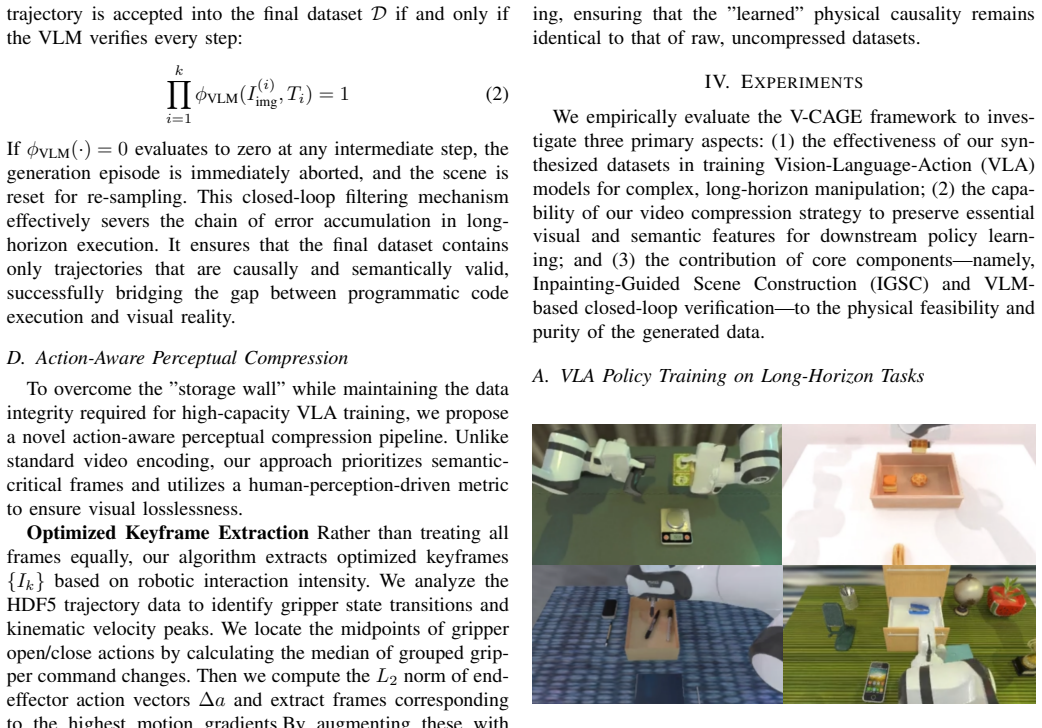
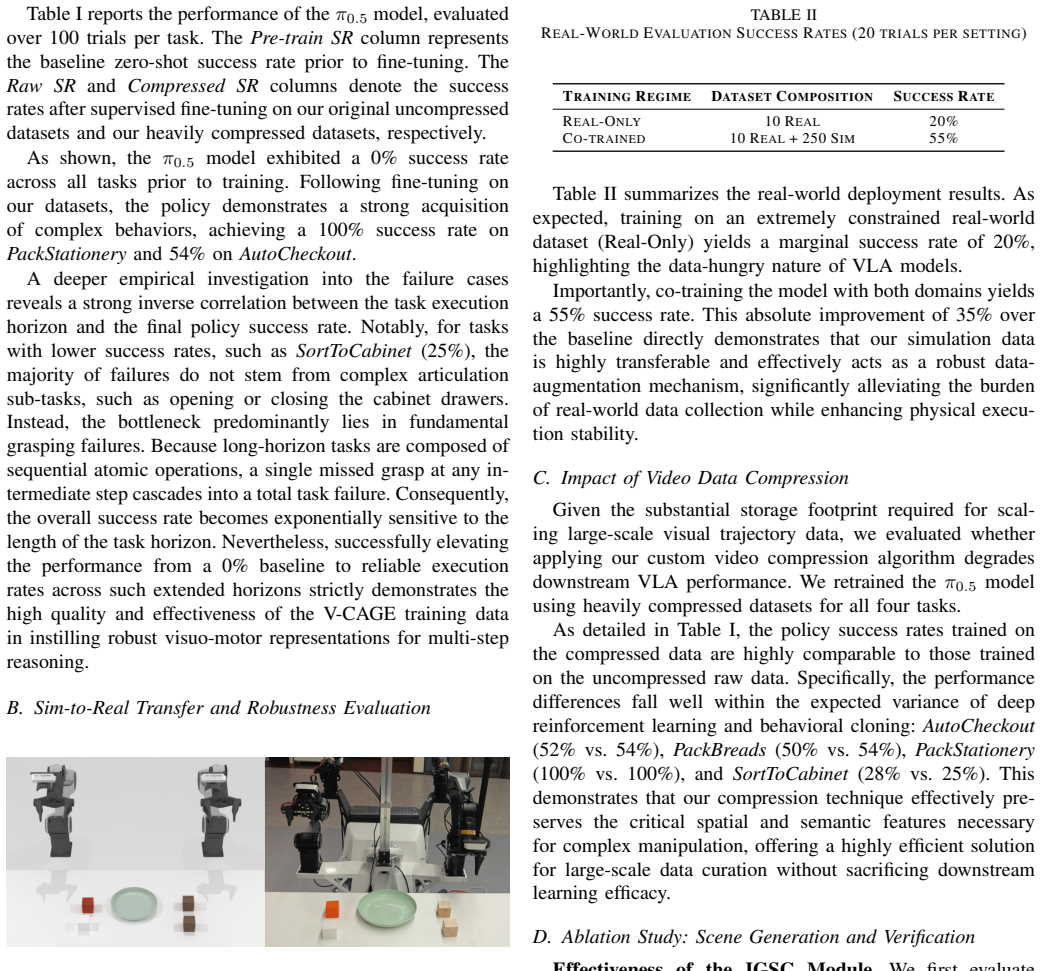
read the original abstract
Scaling Vision-Language-Action (VLA) models requires massive datasets that are both semantically coherent and physically feasible. However, existing scene generation methods often lack context-awareness, making it difficult to synthesize high-fidelity environments embedded with rich semantic information, frequently resulting in unreachable target positions that cause tasks to fail prematurely. We present V-CAGE (Vision-Closed-loop Agentic Generation Engine), an agentic framework for autonomous robotic data synthesis. Unlike traditional scripted pipelines, V-CAGE operates as an embodied agentic system, leveraging foundation models to bridge high-level semantic reasoning with low-level physical interaction. Specifically, we introduce Inpainting-Guided Scene Construction to systematically arrange context-aware layouts, ensuring that the generated scenes are both semantically structured and kinematically reachable. To ensure trajectory correctness, we integrate functional metadata with a Vision-Language Model based closed-loop verification mechanism, acting as a visual critic to rigorously filter out silent failures and sever the error propagation chain. Finally, to overcome the storage bottleneck of massive video datasets, we implement a perceptually-driven compression algorithm that achieves over 90\% filesize reduction without compromising downstream VLA training efficacy. By centralizing semantic layout planning and visual self-verification, V-CAGE automates the end-to-end pipeline, enabling the highly scalable synthesis of diverse, high-quality robotic manipulation datasets.
Editorial analysis
A structured set of objections, weighed in public.
Referee Report
Summary. The paper introduces V-CAGE, an agentic framework for autonomous synthesis of robotic manipulation datasets. It proposes Inpainting-Guided Scene Construction to create semantically coherent and kinematically reachable scenes, integrates functional metadata with a VLM-based closed-loop visual verification mechanism to detect and filter trajectory errors and silent failures, and applies a perceptually-driven compression algorithm claimed to achieve over 90% filesize reduction without loss of downstream VLA training efficacy. The central goal is to automate the end-to-end pipeline for scalable generation of high-quality data for Vision-Language-Action models.
Significance. If the verification and compression components can be shown to perform as described, V-CAGE would address a key bottleneck in scaling VLA models by providing an automated, context-aware alternative to manual or scripted dataset creation, potentially enabling larger and more diverse training corpora while reducing storage demands.
major comments (2)
- [Abstract] Abstract: The claim that the VLM-based closed-loop verification mechanism 'rigorously filter out silent failures and sever the error propagation chain' is load-bearing for the high-quality dataset claim, yet the manuscript provides no quantitative evaluation (precision/recall, failure-mode analysis, or comparison to oracle/human critics) to support it.
- [Abstract] Abstract: The assertion of 'over 90% filesize reduction without compromising downstream VLA training efficacy' is presented without any reported experiments, ablations, or metrics (e.g., pre/post-compression VLA performance on standard benchmarks), leaving the compression component unsupported.
minor comments (1)
- [Abstract] The abstract and description would benefit from explicit statements of the specific foundation models, robotic simulator/platform, and task distribution used in the pipeline to improve reproducibility.
Simulated Author's Rebuttal
We thank the referee for the constructive feedback on our manuscript. We address the two major comments below and will revise the paper to provide the requested quantitative evaluations.
read point-by-point responses
-
Referee: [Abstract] Abstract: The claim that the VLM-based closed-loop verification mechanism 'rigorously filter out silent failures and sever the error propagation chain' is load-bearing for the high-quality dataset claim, yet the manuscript provides no quantitative evaluation (precision/recall, failure-mode analysis, or comparison to oracle/human critics) to support it.
Authors: We agree that quantitative evidence is required to support this claim. In the revised manuscript we will add a new evaluation section reporting precision/recall for the VLM verifier, a failure-mode breakdown, and direct comparisons against both human annotators and oracle critics on held-out trajectories. revision: yes
-
Referee: [Abstract] Abstract: The assertion of 'over 90% filesize reduction without compromising downstream VLA training efficacy' is presented without any reported experiments, ablations, or metrics (e.g., pre/post-compression VLA performance on standard benchmarks), leaving the compression component unsupported.
Authors: We acknowledge the absence of supporting experiments for the compression claim. The revised version will include ablations and benchmark results (pre- and post-compression VLA performance on standard tasks) that quantify the >90% size reduction and confirm no degradation in downstream training efficacy. revision: yes
Circularity Check
No significant circularity; procedural framework with external models
full rationale
The paper describes an agentic system (Inpainting-Guided Scene Construction, VLM closed-loop verification as visual critic, perceptually-driven compression) that automates dataset synthesis. No mathematical derivations, equations, fitted parameters, or self-referential predictions appear in the provided text. Claims rely on external foundation models rather than internal definitions or self-citations that reduce to inputs by construction. The central automation claim is procedural and does not exhibit any of the enumerated circularity patterns. This is the expected non-finding for a system-description paper without load-bearing math.
Axiom & Free-Parameter Ledger
axioms (2)
- domain assumption Foundation models can bridge high-level semantic reasoning with low-level physical interaction for robotic scene planning and verification.
- domain assumption Inpainting can systematically produce kinematically reachable and semantically structured scenes.
Lean theorems connected to this paper
-
IndisputableMonolith/Foundation/Cost/FunctionalEquation.leanwashburn_uniqueness_aczel unclearintegrate functional metadata with a Vision-Language Model based closed-loop verification mechanism, acting as a visual critic to rigorously filter out silent failures
Reference graph
Works this paper leans on
-
[1]
Diffusion policy: Visuomotor policy learning via action diffusion,
C. Chi, Z. Xu, S. Feng, E. Cousineau, Y . Du, B. Burchfiel, R. Tedrake, and S. Song, “Diffusion policy: Visuomotor policy learning via action diffusion,”The International Journal of Robotics Research, vol. 44, no. 10-11, pp. 1684–1704, 2025
2025
-
[2]
Open x-embodiment: Robotic learning datasets and rt-x models,
A. O’Neill, A. Rehman, A. Maddukuri, A. Gupta, A. Padalkar, A. Lee, A. Pooley, A. Gupta, A. Mandlekar, A. Jainet al., “Open x-embodiment: Robotic learning datasets and rt-x models,” in2024 IEEE International Conference on Robotics and Automation (ICRA). IEEE, 2024, pp. 6892–6903
2024
-
[3]
DROID: A Large-Scale In-The-Wild Robot Manipulation Dataset
A. Khazatsky, K. Pertsch, S. Nair, A. Balakrishna, S. Dasari, S. Karam- cheti, S. Nasiriany, M. K. Srirama, L. Y . Chen, K. Elliset al., “Droid: A large-scale in-the-wild robot manipulation dataset,”arXiv preprint arXiv:2403.12945, 2024
work page internal anchor Pith review arXiv 2024
-
[4]
Gensim: Generating robotic simulation tasks via large language models,
L. Wang, Y . Ling, Z. Yuan, M. Shridhar, C. Bao, Y . Qin, B. Wang, H. Xu, and X. Wang, “Gensim: Generating robotic simulation tasks via large language models,” inProceedings of the International Conference on Learning Representations (ICLR), 2024, iCLR 2024
2024
-
[5]
Y . Wang, Z. Xian, F. Chen, T.-H. Wang, Y . Wang, K. Fragkiadaki, Z. Erickson, D. Held, and C. Gan, “Robogen: Towards unleashing infinite data for automated robot learning via generative simulation,” in Proceedings of the 41st International Conference on Machine Learning (ICML), 2024. [Online]. Available: https://arxiv.org/abs/2311.01455
-
[6]
T. Chen, Z. Chen, B. Chen, Z. Cai, Y . Liu, Z. Li, Q. Liang, X. Lin, Y . Ge, Z. Gu, Y . Guo, T. Nian, X. Xie, Q. Chen, K. Su, T. Xu, G. Liu, M. Hu, H. Gao, K. Wang, Z. Liang, Y . Qin, X. Yang, P. Luo, and Y . Mu, “RoboTwin 2.0: A scalable data generator and benchmark with strong domain randomization for robust bimanual robotic manipulation,”arXiv preprint...
work page internal anchor Pith review arXiv 2025
-
[7]
RoboTwin: Dual- arm robot benchmark with generative digital twins,
Y . Mu, T. Chen, Z. Chen, S. Peng, Z. Lan, Z. Gao, Z. Liang, Q. Yu, Y . Zou, M. Xu, L. Lin, Z. Xie, M. Ding, and P. Luo, “RoboTwin: Dual- arm robot benchmark with generative digital twins,” inProceedings of the Computer Vision and Pattern Recognition Conference (CVPR), June 2025, pp. 27 649–27 660
2025
-
[8]
Sage: Scalable agentic 3d scene generation for embodied ai, 2026
J. Xu, M.-Y . Liu, Y . Cui, S. Song, F. Wei, H. Xia, X. Li, Z. Li, Q. Ma, T.-Y . Lin, W.-C. Ma, and S. Wang, “Sage: Scalable agentic 3d scene generation for embodied ai,”arXiv preprint arXiv:2602.10116v2, 2026
-
[9]
Tabletopgen: Instance-level interactive 3d table- top scene generation from text or single image,
Z. Wang, Y . He, L. Yang, W. Zou, H. Ma, L. Liu, W. Sui, Y . Guo, and H. Su, “Tabletopgen: Instance-level interactive 3d tabletop scene generation from text or single image,”arXiv preprint arXiv:2512.01204, 2025
-
[10]
Openclaw: An open-source ai agent for autonomous execution backbone orchestration,
OpenClaw Team, “Openclaw: An open-source ai agent for autonomous execution backbone orchestration,” 2025. [Online]. Available: https://github.com/open-claw/openclaw
2025
-
[11]
Model context protocol (mcp): Open protocol that standardizes how applications provide context to llms,
MCP Authors, “Model context protocol (mcp): Open protocol that standardizes how applications provide context to llms,” https://modelcontextprotocol.io/introduction, 2025, accessed: 2025- 11-11
2025
-
[12]
Vila: On pre-training for visual language models,
J. Lin, H. Yin, W. Ping, Y . Lu, A. Molchanov, Pavlo andlob, S. Han, and J. M. Alvarez, “Vila: On pre-training for visual language models,” inProceedings of the IEEE/CVF Conference on Computer Vision and Pattern Recognition, 2024
2024
-
[13]
arXiv preprint arXiv:2403.03174
F. Liu, K. Lin, H. Yan, L. Yi, P. Abbeel, and Y . Gao, “Moka: Open- vocabulary robotic manipulation through mark-based visual prompting,” arXiv preprint arXiv:2403.03174, 2024
-
[14]
Gemini 3: Frontier multimodal intelligence,
Gemini Team, Google, “Gemini 3: Frontier multimodal intelligence,” arXiv preprint, 2025, technical Report. [Online]. Available: https://deepmind.google/technologies/gemini/
2025
-
[15]
SAPIEN: A simulated part-based intelligent EN- vironment,
F. Xiang, Y . Qin, K. Li, H. Wang, K. Yi, T.-L. Liu, L. Zhou, J. Gu, S. Sun, and H. Su, “SAPIEN: A simulated part-based intelligent EN- vironment,” inProceedings of the IEEE/CVF Conference on Computer Vision and Pattern Recognition (CVPR), 2020, pp. 11 097–11 107
2020
-
[16]
Grounding DINO: Marrying DINO with grounded pre- training for open-set object detection,
S. Liu, Z. Zeng, T. Ren, F. Li, H. Zhang, J. Yang, C. Li, J. Yang, H. Su, J. Zhuet al., “Grounding DINO: Marrying DINO with grounded pre- training for open-set object detection,” inProceedings of the IEEE/CVF Conference on Computer Vision and Pattern Recognition (CVPR), 2023, pp. 9350–9360
2023
-
[17]
DINOv2: Learning Robust Visual Features without Supervision
M. Oquab, T. Darcet, T. Moutakanni, I. V o, M. Szafraniec, V . Vasil- jevic, P. Seguin, P. Pietrini, S. Singh, A. El-Noubyet al., “DINOv2: Learning robust visual features without supervision,”arXiv preprint arXiv:2304.07193, 2023
work page internal anchor Pith review Pith/arXiv arXiv 2023
-
[18]
ColorVideoVDP: A color-sensitive video quality metric,
R. K. Mantiuket al., “ColorVideoVDP: A color-sensitive video quality metric,” inProceedings of the ACM SIGGRAPH Conference, 2023
2023
-
[19]
FovVideoVDP: A visible difference predictor for high dynamic range and ultra-high resolution video,
R. K. Mantiuk, P. Hanji, M. Z. Ashraf, R. Mantiuk, K. Myszkowski, and H.-P. Seidel, “FovVideoVDP: A visible difference predictor for high dynamic range and ultra-high resolution video,”ACM Transactions on Graphics (TOG), vol. 40, no. 4, pp. 1–19, 2021
2021
discussion (0)
Sign in with ORCID, Apple, or X to comment. Anyone can read and Pith papers without signing in.