Recognition: unknown
PDE-regularized Dynamics-informed Diffusion with Uncertainty-aware Filtering for Long-Horizon Dynamics
Pith reviewed 2026-05-10 17:39 UTC · model grok-4.3
The pith
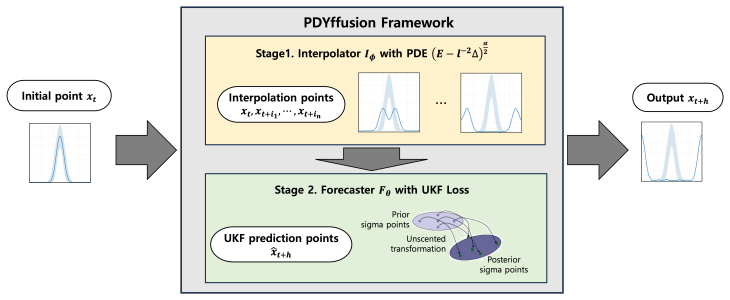
PDYffusion adds PDE regularization and UKF filtering to diffusion models to stabilize long-horizon dynamical predictions.
A machine-rendered reading of the paper's core claim, the machinery that carries it, and where it could break.
Core claim
PDYffusion, a dynamics-informed diffusion framework, integrates a PDE-regularized interpolator that satisfies PDE-constrained smoothness properties with a UKF-based forecaster that converges under the proposed loss, producing more accurate long-horizon predictions on multiple dynamical datasets while keeping uncertainty estimates stable.
What carries the argument
The PDE-regularized interpolator that enforces physical consistency through a differential operator, paired with the UKF-based forecaster that explicitly models uncertainty to limit error growth in iterative steps.
If this is right
- The interpolator satisfies PDE-constrained smoothness properties for generated states.
- The forecaster converges under the proposed loss formulation.
- Superior CRPS and MSE performance is achieved on multiple dynamical datasets.
- Uncertainty behavior remains stable as measured by SSR.
- A balanced trade-off between accuracy and uncertainty is provided for long-horizon tasks.
Where Pith is reading between the lines
- The approach may require known governing PDEs, limiting use on systems where equations are only partially observed.
- Testing on real sensor data with measurement noise would check whether the reported robustness holds outside simulated benchmarks.
- The explicit uncertainty modeling could support downstream tasks such as risk-aware control or ensemble planning.
Load-bearing premise
That PDE regularization in the interpolator and UKF integration in the forecaster will reliably enforce physical consistency and stop error accumulation during long iterative predictions across varied dynamical systems.
What would settle it
A new dynamical system dataset on which iterative PDYffusion forecasts accumulate larger errors or show growing PDE violations than standard diffusion baselines after many steps would falsify the stability claims.
Figures


read the original abstract
Long-horizon spatiotemporal prediction remains a challenging problem due to cumulative errors, noise amplification, and the lack of physical consistency in existing models. While diffusion models provide a probabilistic framework for modeling uncertainty, conventional approaches often rely on mean squared error objectives and fail to capture the underlying dynamics governed by physical laws. In this work, we propose PDYffusion, a dynamics-informed diffusion framework that integrates PDE-based regularization and uncertainty-aware forecasting for stable long-term prediction. The proposed method consists of two key components: a PDE-regularized interpolator and a UKF-based forecaster. The interpolator incorporates a differential operator to enforce physically consistent intermediate states, while the forecaster leverages the Unscented Kalman Filter to explicitly model uncertainty and mitigate error accumulation during iterative prediction. We provide theoretical analyses showing that the proposed interpolator satisfies PDE-constrained smoothness properties, and that the forecaster converges under the proposed loss formulation. Extensive experiments on multiple dynamical datasets demonstrate that PDYffusion achieves superior performance in terms of CRPS and MSE, while maintaining stable uncertainty behavior measured by SSR. We further analyze the inherent trade-off between prediction accuracy and uncertainty, showing that our method provides a balanced and robust solution for long-horizon forecasting.
Editorial analysis
A structured set of objections, weighed in public.
Referee Report
Summary. The manuscript introduces PDYffusion, a dynamics-informed diffusion framework consisting of a PDE-regularized interpolator that enforces physical consistency via a differential operator and a UKF-based forecaster that models uncertainty to reduce error accumulation in iterative long-horizon predictions. It claims theoretical results establishing PDE-constrained smoothness for the interpolator and convergence of the forecaster under the proposed loss, together with empirical superiority over baselines in CRPS, MSE, and SSR on multiple dynamical datasets.
Significance. If the theoretical smoothness and convergence properties hold and translate to controlled error growth, the work would be significant for physics-informed probabilistic forecasting, as it directly targets cumulative error and lack of physical consistency in diffusion-based long-horizon models. The PDE-UKF combination offers a concrete mechanism for enforcing consistency that could generalize to other spatiotemporal systems.
major comments (2)
- [Theoretical analyses] The theoretical analyses assert PDE-constrained smoothness and forecaster convergence under the proposed loss, yet supply no explicit contraction bound, stability estimate, or growth rate on iterative error propagation across many rollout steps. This is load-bearing for the central claim that the method prevents cumulative error in long-horizon prediction; without such a bound the reported CRPS/MSE gains could be artifacts of short effective horizons or specific initial conditions rather than a general consequence of the regularization.
- [Experiments] The experimental section reports superior performance on CRPS, MSE, and SSR across dynamical datasets but provides no dataset specifications, training protocols, ablation studies isolating the PDE term versus the UKF component, or quantitative validation that the theoretical smoothness properties actually reduce error accumulation in the tested rollouts.
minor comments (2)
- The loss formulation used for forecaster convergence is referenced but not written explicitly; including the precise expression (including any weighting between diffusion and PDE terms) would improve clarity.
- Figure captions and axis labels for the uncertainty (SSR) plots should explicitly state the number of rollout steps and the range of initial conditions to allow readers to judge the effective horizon length.
Simulated Author's Rebuttal
We thank the referee for the constructive review and for recognizing the potential significance of the PDE-UKF combination for physics-informed long-horizon forecasting. We address each major comment below and commit to revisions that directly strengthen the theoretical and empirical support for our central claims.
read point-by-point responses
-
Referee: [Theoretical analyses] The theoretical analyses assert PDE-constrained smoothness and forecaster convergence under the proposed loss, yet supply no explicit contraction bound, stability estimate, or growth rate on iterative error propagation across many rollout steps. This is load-bearing for the central claim that the method prevents cumulative error in long-horizon prediction; without such a bound the reported CRPS/MSE gains could be artifacts of short effective horizons or specific initial conditions rather than a general consequence of the regularization.
Authors: We agree that an explicit contraction or stability bound on iterative error would provide stronger theoretical grounding for the long-horizon claim. Our existing results establish PDE-constrained smoothness of the interpolator (via the differential operator) and convergence of the forecaster under the proposed loss; these properties together imply controlled error growth, but we did not derive a quantitative growth rate or contraction factor across rollout steps. In revision we will add a dedicated subsection deriving a stability estimate that bounds the propagated error using the Lipschitz properties of the PDE operator and the UKF covariance update, showing that the combined mechanism yields sub-linear error accumulation under standard assumptions on the dynamical system. revision: yes
-
Referee: [Experiments] The experimental section reports superior performance on CRPS, MSE, and SSR across dynamical datasets but provides no dataset specifications, training protocols, ablation studies isolating the PDE term versus the UKF component, or quantitative validation that the theoretical smoothness properties actually reduce error accumulation in the tested rollouts.
Authors: We will substantially expand the experimental section. Revisions will include: (i) complete dataset specifications (state dimensions, temporal discretization, noise characteristics, and train/test splits for each dynamical system); (ii) full training protocols (optimizer, learning-rate schedule, batch size, and regularization weights); (iii) ablation studies that separately disable the PDE term and the UKF component while keeping all other elements fixed; and (iv) quantitative validation plots of per-step and cumulative error versus rollout horizon, together with correlation analysis between the measured smoothness metric and observed error growth. These additions will directly demonstrate that the theoretical properties translate to reduced error accumulation on the evaluated rollouts. revision: yes
Circularity Check
No circularity; claims rest on independent theoretical analyses and external experiments
full rationale
The abstract and provided context describe a proposed PDYffusion method with two components (PDE-regularized interpolator and UKF forecaster), followed by separate theoretical analyses asserting PDE-constrained smoothness and forecaster convergence under a stated loss, plus empirical evaluation on multiple dynamical datasets using CRPS, MSE, and SSR metrics. No load-bearing step reduces by construction to fitted inputs, self-definitions, or self-citation chains; the performance claims are presented as outcomes of external testing rather than tautological renamings or predictions forced by the model definition itself. The derivation chain is therefore self-contained against the benchmarks given.
Axiom & Free-Parameter Ledger
Reference graph
Works this paper leans on
-
[1]
Arendt and R
W. Arendt and R. Mazzeo , Spectral properties of the dirichlet-to-neumann operator on lipschitz domains , Ulmer Seminare, 12 (2007), p. 33
2007
-
[2]
Aronszajn , Theory of reproducing kernels , Transactions of the American mathematical society, 68 (1950), pp
N. Aronszajn , Theory of reproducing kernels , Transactions of the American mathematical society, 68 (1950), pp. 337--404
1950
-
[3]
Bansal, E
A. Bansal, E. Borgnia, H.-M. Chu, J. Li, H. Kazemi, F. Huang, M. Goldblum, J. Geiping, and T. Goldstein , Cold diffusion: Inverting arbitrary image transforms without noise , Advances in Neural Information Processing Systems, 36 (2023), pp. 41259--41282
2023
-
[4]
Bartz, H
S. Bartz, H. H. Bauschke, and X. Wang , The resolvent order: a unification of the orders by zarantonello, by loewner, and by moreau , SIAM Journal on Optimization, 27 (2017), pp. 466--477
2017
-
[5]
Black and M
F. Black and M. Scholes , The pricing of options and corporate liabilities , Journal of political economy, 81 (1973), pp. 637--654
1973
-
[6]
M. W. Davis , Production of conditional simulations via the lu triangular decomposition of the covariance matrix , Mathematical geology, 19 (1987), pp. 91--98
1987
-
[7]
J. L. Elman , Finding structure in time , Cognitive science, 14 (1990), pp. 179--211
1990
-
[8]
L. C. Evans , Partial differential equations , vol. 19, American mathematical society, 2022
2022
-
[9]
G. Evensen , Sequential data assimilation with a nonlinear quasi-geostrophic model using monte carlo methods to forecast error statistics , Journal of Geophysical Research: Oceans, 99 (1994), pp. 10143--10162
1994
-
[10]
Fortin, M
V. Fortin, M. Abaza, F. Anctil, and R. Turcotte , Why should ensemble spread match the rmse of the ensemble mean? , Journal of Hydrometeorology, 15 (2014), pp. 1708--1713
2014
-
[11]
Gal and Z
Y. Gal and Z. Ghahramani , Dropout as a bayesian approximation: Representing model uncertainty in deep learning , in international conference on machine learning, PMLR, 2016, pp. 1050--1059
2016
-
[12]
I. J. Goodfellow, J. Pouget-Abadie, M. Mirza, B. Xu, D. Warde-Farley, S. Ozair, A. Courville, and Y. Bengio , Generative adversarial nets , Advances in neural information processing systems, 27 (2014)
2014
-
[13]
Gretton, K
A. Gretton, K. M. Borgwardt, M. J. Rasch, B. Sch \"o lkopf, and A. Smola , A kernel two-sample test , The journal of machine learning research, 13 (2012), pp. 723--773
2012
-
[14]
J. Ho, A. Jain, and P. Abbeel , Denoising diffusion probabilistic models , Advances in neural information processing systems, 33 (2020), pp. 6840--6851
2020
-
[15]
Hochreiter and J
S. Hochreiter and J. Schmidhuber , Long short-term memory , Neural computation, 9 (1997), pp. 1735--1780
1997
-
[16]
Jazwinski , Filtering for nonlinear dynamical systems , IEEE Transactions on Automatic Control, 11 (1966), pp
A. Jazwinski , Filtering for nonlinear dynamical systems , IEEE Transactions on Automatic Control, 11 (1966), pp. 765--766
1966
-
[17]
S. J. Julier and J. K. Uhlmann , Unscented filtering and nonlinear estimation , Proceedings of the IEEE, 92 (2004), pp. 401--422
2004
-
[18]
R. E. Kalman , A new approach to linear filtering and prediction problems , (1960)
1960
-
[19]
Khristenko, L
U. Khristenko, L. Scarabosio, P. Swierczynski, E. Ullmann, and B. Wohlmuth , Analysis of boundary effects on pde-based sampling of whittle Mat\'ern random fields , SIAM/ASA Journal on Uncertainty Quantification, 7 (2019), pp. 948--974
2019
-
[20]
D. P. Kingma and M. Welling , Auto-encoding variational bayes , CoRR, abs/1312.6114 (2013), https://api.semanticscholar.org/CorpusID:216078090
work page internal anchor Pith review Pith/arXiv arXiv 2013
-
[21]
L \'e vy , Calcul des probabilit \'e s , Gauthier-Villars, 1925
P. L \'e vy , Calcul des probabilit \'e s , Gauthier-Villars, 1925
1925
-
[22]
J. E. Matheson and R. L. Winkler , Scoring rules for continuous probability distributions , Management science, 22 (1976), pp. 1087--1096
1976
-
[23]
J. Pathak, S. Subramanian, P. Harrington, S. Raja, A. Chattopadhyay, M. Mardani, T. Kurth, D. Hall, Z. Li, K. Azizzadenesheli, et al. , Fourcastnet: A global data-driven high-resolution weather model using adaptive fourier neural operators , arXiv preprint arXiv:2202.11214, (2022)
work page internal anchor Pith review arXiv 2022
-
[24]
Rezende and S
D. Rezende and S. Mohamed , Variational inference with normalizing flows , in International conference on machine learning, PMLR, 2015, pp. 1530--1538
2015
-
[25]
R \"u hling Cachay, B
S. R \"u hling Cachay, B. Zhao, H. Joren, and R. Yu , Dyffusion: A dynamics-informed diffusion model for spatiotemporal forecasting , Advances in neural information processing systems, 36 (2023), pp. 45259--45287
2023
-
[26]
Schwab and R
C. Schwab and R. A. Todor , Karhunen--lo \`e ve approximation of random fields by generalized fast multipole methods , Journal of Computational Physics, 217 (2006), pp. 100--122
2006
-
[27]
Shen and J
L. Shen and J. Kwok , Non-autoregressive conditional diffusion models for time series prediction , in International Conference on Machine Learning, PMLR, 2023, pp. 31016--31029
2023
-
[28]
J. Song, C. Meng, and S. Ermon , Denoising diffusion implicit models , arXiv preprint arXiv:2010.02502, (2020)
work page internal anchor Pith review Pith/arXiv arXiv 2010
-
[29]
B. K. Sriperumbudur, A. Gretton, K. Fukumizu, B. Sch \"o lkopf, and G. R. Lanckriet , Hilbert space embeddings and metrics on probability measures , The Journal of Machine Learning Research, 11 (2010), pp. 1517--1561
2010
-
[30]
Voleti, A
V. Voleti, A. Jolicoeur-Martineau, and C. Pal , Mcvd-masked conditional video diffusion for prediction, generation, and interpolation , Advances in neural information processing systems, 35 (2022), pp. 23371--23385
2022
-
[31]
H. Weyl , Das asymptotische verteilungsgesetz der eigenwerte linearer partieller differentialgleichungen (mit einer anwendung auf die theorie der hohlraumstrahlung) , Mathematische Annalen, 71 (1912), pp. 441--479
1912
-
[32]
Whittle , On stationary processes in the plane , Biometrika, 41 (1954), pp
P. Whittle , On stationary processes in the plane , Biometrika, 41 (1954), pp. 434--449, http://www.jstor.org/stable/2332724 (accessed 2026-01-29)
-
[33]
Whittle , Stochastic-processes in several dimensions , Bulletin of the International Statistical Institute, 40 (1963), pp
P. Whittle , Stochastic-processes in several dimensions , Bulletin of the International Statistical Institute, 40 (1963), pp. 974--994
1963
discussion (0)
Sign in with ORCID, Apple, or X to comment. Anyone can read and Pith papers without signing in.