Recognition: unknown
Structural Distinction in ODE and PDE Chaos:Lorenz vs Kuramoto--Sivashinsky Equation
Pith reviewed 2026-05-10 17:17 UTC · model grok-4.3
The pith
The Kuramoto-Sivashinsky equation produces simultaneous spatial and temporal chaos that low-dimensional reductions like the Lorenz system fail to preserve.
A machine-rendered reading of the paper's core claim, the machinery that carries it, and where it could break.
Core claim
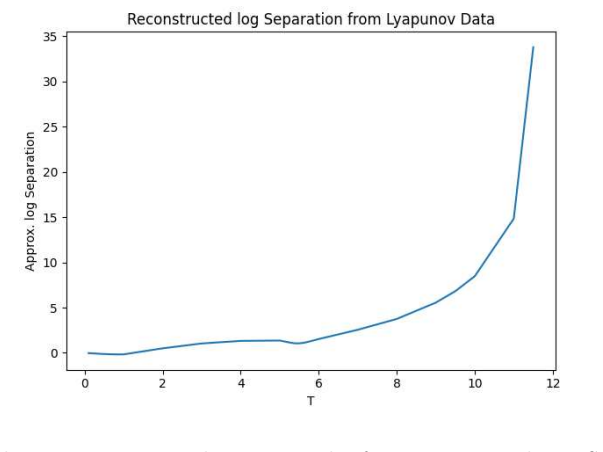
Numerical simulations of the Kuramoto-Sivashinsky equation reveal intrinsic spatio-temporal chaos with disorder evolving simultaneously in space and time. In contrast, the Lorenz system and the Wilczak reduction exhibit low-dimensional temporal chaos lacking spatial complexity. Lyapunov exponent analysis highlights the finite-dimensional convergence properties of the reduced systems and underscores that low-dimensional reductions may reproduce transient chaotic signatures but do not necessarily retain the structural properties of infinite-dimensional dissipative systems.
What carries the argument
Direct numerical comparison of spatio-temporal patterns and Lyapunov spectra between the full KS PDE and its low-dimensional Lorenz-type ODE reductions.
If this is right
- Low-dimensional reductions capture short-lived chaotic transients but lose the spatial degrees of freedom that define chaos in the full PDE.
- Lyapunov exponents in the reduced systems converge to finite values, while those of the KS equation reflect ongoing spatial complexity.
- Analysis tools calibrated on ODE chaos do not automatically transfer to dissipative PDEs that support extended spatial disorder.
- Models of extended systems such as fluid films or reaction-diffusion media require methods that track both temporal and spatial instability simultaneously.
Where Pith is reading between the lines
- The same mismatch between reduced and full-system structure may appear in other dissipative PDEs such as the Navier-Stokes equations at moderate Reynolds number.
- Control or prediction schemes based solely on low-dimensional projections could overlook spatial pattern formation that persists in the unreduced dynamics.
- Systematic tests with varying domain sizes or boundary conditions on the KS equation could quantify how spatial extent modulates the observed distinction.
Load-bearing premise
The chosen numerical discretization and time integration for the KS equation faithfully represents the infinite-dimensional dynamics without introducing artifacts that mimic or suppress spatial structure.
What would settle it
A simulation in which a finer spatial grid or alternative scheme for the KS equation produces only temporal chaos without persistent spatial disorder, or in which the Wilczak reduction develops sustained spatial patterns, would undermine the claimed structural distinction.
Figures




read the original abstract
We study the nature of chaos in finite and infinite dimensional systems through a comparison between the Kuramoto Sivashinsky (KS) equation, the Lorenz system, and a Lorenz type reduction of the KS equation proposed by Wilczak. Numerical simulations of the KS equation reveal intrinsic spatio temporal chaos, with disorder evolving simultaneously in space and time. In contrast, the Lorenz system and the Wilczak reduction exhibit low dimensional temporal chaos lacking spatial complexity. Lyapunov exponent analysis highlights the finite-dimensional convergence properties of the reduced systems and underscores the fundamentally different dynamical nature of chaos in the KS equation. In particular, we demonstrate that low-dimensional reductions may reproduce transient chaotic signatures but do not necessarily retain the structural properties of infinite-dimensional dissipative systems.
Editorial analysis
A structured set of objections, weighed in public.
Referee Report
Summary. The manuscript compares chaotic dynamics in the finite-dimensional Lorenz system, a low-dimensional Wilczak reduction of the Kuramoto-Sivashinsky (KS) equation, and direct numerical simulations of the KS PDE. It claims that KS exhibits intrinsic spatio-temporal chaos with disorder evolving simultaneously in space and time, while the reduced systems show only low-dimensional temporal chaos; Lyapunov exponent analysis is invoked to argue that low-dimensional reductions reproduce transient signatures but fail to retain the structural properties of infinite-dimensional dissipative systems.
Significance. If the numerical distinction is robust, the work would clarify limitations of finite-dimensional reductions for capturing PDE-specific features of dissipative chaos, with potential relevance to modeling in fluid dynamics and pattern formation. The emphasis on structural (rather than merely transient) differences is a useful framing, though the result is entirely numerical and its strength hinges on discretization fidelity.
major comments (3)
- [Numerical Methods] Numerical Methods section: the discretization of the KS equation (Fourier-Galerkin or equivalent) is described without stating the number of retained modes, time-stepping scheme, or any convergence tests with respect to spatial resolution. Because the central claim rests on the infinite-dimensional character of KS chaos, explicit demonstration that the reported spatio-temporal structure and Lyapunov spectrum remain unchanged under refinement is required.
- [Lyapunov analysis] Lyapunov analysis (presumably §4 or equivalent): the statement that the KS spectrum 'does not converge like the finite-dimensional cases' is not accompanied by spectra computed at multiple truncations or an estimate of the number of positive exponents versus resolution; without this, it is impossible to rule out that the reported non-convergence is a truncation artifact rather than an intrinsic PDE property.
- [Results] Results section, comparison with Wilczak reduction: the claim that the reduction reproduces only 'transient chaotic signatures' lacks quantitative metrics (e.g., duration of transients, spatial correlation lengths, or direct comparison of attractor dimensions) that would make the structural distinction falsifiable rather than visual.
minor comments (2)
- [Figures] Figure captions should specify the exact time intervals and spatial domains shown for the KS spatio-temporal plots to allow readers to assess the claimed simultaneity of disorder.
- [Introduction/References] The manuscript would benefit from citing standard references on KS attractor dimension and Lyapunov spectra (e.g., works by Nicolaenko, Hyman, or Manneville) to contextualize the new simulations.
Simulated Author's Rebuttal
We thank the referee for the careful reading and constructive suggestions. The comments correctly identify areas where additional numerical details and quantitative support will strengthen the manuscript. We will revise accordingly and address each point below.
read point-by-point responses
-
Referee: [Numerical Methods] Numerical Methods section: the discretization of the KS equation (Fourier-Galerkin or equivalent) is described without stating the number of retained modes, time-stepping scheme, or any convergence tests with respect to spatial resolution. Because the central claim rests on the infinite-dimensional character of KS chaos, explicit demonstration that the reported spatio-temporal structure and Lyapunov spectrum remain unchanged under refinement is required.
Authors: We agree that the numerical methods require explicit documentation to substantiate the claims. In the revised manuscript we will state the number of retained Fourier modes, the time-stepping scheme, and include convergence tests (both for the spatio-temporal fields and the Lyapunov spectrum) under successive grid refinement. These additions will demonstrate that the reported structures and non-convergent Lyapunov behavior persist at higher resolutions. revision: yes
-
Referee: [Lyapunov analysis] Lyapunov analysis (presumably §4 or equivalent): the statement that the KS spectrum 'does not converge like the finite-dimensional cases' is not accompanied by spectra computed at multiple truncations or an estimate of the number of positive exponents versus resolution; without this, it is impossible to rule out that the reported non-convergence is a truncation artifact rather than an intrinsic PDE property.
Authors: We accept this criticism and will expand the Lyapunov section with spectra computed at several spatial resolutions for the KS PDE. We will also plot the number of positive exponents versus retained modes, showing that the non-convergence remains while the finite-dimensional Lorenz and Wilczak systems converge. This will directly address the possibility of truncation artifacts. revision: yes
-
Referee: [Results] Results section, comparison with Wilczak reduction: the claim that the reduction reproduces only 'transient chaotic signatures' lacks quantitative metrics (e.g., duration of transients, spatial correlation lengths, or direct comparison of attractor dimensions) that would make the structural distinction falsifiable rather than visual.
Authors: The distinction is already supported quantitatively by the differing convergence properties of the Lyapunov spectra, but we agree that additional metrics would make the argument more falsifiable. In revision we will report estimates of transient durations, spatial correlation lengths, and attractor-dimension comparisons between the KS PDE and the Wilczak reduction. We view this as a partial revision because the existing Lyapunov evidence already provides a quantitative basis for the structural claim. revision: partial
Circularity Check
No circularity: direct numerical comparison of independent simulations
full rationale
The paper conducts separate numerical integrations of the KS PDE (via discretization), the Lorenz ODE, and the Wilczak reduction, then applies standard Lyapunov exponent calculations to the resulting trajectories. No parameters are fitted to a target outcome and then relabeled as a prediction; no derivation step equates an output to its input by construction; no uniqueness theorems or ansatzes are imported via self-citation to force the central distinction. The claimed structural difference follows from the observed spatio-temporal disorder in KS versus its absence in the low-dimensional cases, without any reduction that collapses the result to the simulation inputs themselves.
Axiom & Free-Parameter Ledger
axioms (2)
- domain assumption The Kuramoto-Sivashinsky PDE possesses well-defined solutions on the chosen spatial domain and boundary conditions.
- domain assumption Lyapunov exponents computed from finite-time trajectories reliably distinguish temporal from spatio-temporal chaos.
Reference graph
Works this paper leans on
-
[1]
E. N. Lorenz, Deterministic nonperiodic flow, J. Atmos. Sci. 20, 130–141 (1963)
1963
-
[2]
Guckenheimer and P
J. Guckenheimer and P. Holmes, Nonlinear Oscillations, Dynamical Systems, and Bifurcati ons of Vector Fields , Springer, New York (1983)
1983
-
[3]
Ott, Chaos in Dynamical Systems , Cambridge University Press (2002)
E. Ott, Chaos in Dynamical Systems , Cambridge University Press (2002)
2002
-
[4]
Ruelle and F
D. Ruelle and F. Takens, On the nature of turbulence, Commun. Math. Phys. 20, 167–192 (1971)
1971
-
[5]
M. C. Cross and P. C. Hohenberg, Pattern formation outsid e of equilibrium, Rev. Mod. Phys. 65, 851–1112 (1993)
1993
-
[6]
Kuramoto and T
Y. Kuramoto and T. Tsuzuki, Persistent propagation of co ncentration waves in dissipative media, Prog. Theor. Phys. 55, 356–369 (1976)
1976
-
[7]
G. I. Sivashinsky, Nonlinear analysis of hydrodynamic i nstability in laminar flames, Acta As- tronautica 4, 1177–1206 (1977)
1977
-
[8]
Temam, Infinite-Dimensional Dynamical Systems in Mechanics and Phy sics, Springer, New York (1988)
R. Temam, Infinite-Dimensional Dynamical Systems in Mechanics and Phy sics, Springer, New York (1988)
1988
-
[9]
Christiansen, P
F. Christiansen, P. Cvitanovi´ c, and V. Putkaradze, Spa tio–temporal chaos in the Kuramoto– Sivashinsky equation, Nonlinearity 10, 55–70 (1997)
1997
-
[10]
Manneville, Lyapunov exponents for the Kuramoto–Si vashinsky model, J
P. Manneville, Lyapunov exponents for the Kuramoto–Si vashinsky model, J. Phys. France 46, 1245–1259 (1985)
1985
-
[11]
Collet and J.-P
P. Collet and J.-P. Eckmann, Instabilities and Fronts in Extended Systems , Princeton Univer- sity Press (1990)
1990
-
[12]
Aubry, G
S. Aubry, G. Abramovici, and C. Baesens, Analytic study of the Kuramoto–Sivashinsky equa- tion, Physica D 32, 1–20 (1988)
1988
-
[13]
L. R. Keefe, Dynamics of perturbed wavetrains in the Kur amoto–Sivashinsky equation, Physica D 64, 247–268 (1992)
1992
-
[14]
Wilczak, Chaos in the Kuramoto–Sivashinsky equatio ns — a computer assisted proof, J
D. Wilczak, Chaos in the Kuramoto–Sivashinsky equatio ns — a computer assisted proof, J. Differential Equations 194, 433–459 (2003)
2003
-
[15]
Chaos in Partial Differential Equations , International Press (2004). 17
2004
discussion (0)
Sign in with ORCID, Apple, or X to comment. Anyone can read and Pith papers without signing in.