Recognition: unknown
Radio Monitoring Campaign of Active Repeater FRB 20220912A with CHIME
Pith reviewed 2026-05-10 17:36 UTC · model grok-4.3
The pith
FRB 20220912A exhibits a 2.3-sigma increase in dispersion measure of 1.4 pc cm^{-3} per year but stable rotation measure.
A machine-rendered reading of the paper's core claim, the machinery that carries it, and where it could break.
Core claim
From CHIME monitoring, FRB 20220912A shows a linear dispersion measure increase of 1.4 ± 0.6 pc cm^{-3} yr^{-1} at 2.3 sigma significance over 1.5 years with no significant rotation measure trend (3 sigma upper limit of 13.4 rad m^{-2} yr^{-1}). Analysis of 828 bursts indicates this differs from other repeaters, suggesting a unique local environment.
What carries the argument
Linear regression fits to the time evolution of dispersion measure and rotation measure values measured from the 828 CHIME-detected bursts.
If this is right
- The total energy emitted by the source is estimated at 2 × 10^{43} ergs assuming a radio efficiency of 10^{-4} and beaming angle of 0.1.
- The source remains highly active for approximately 10 weeks with a bimodal wait-time distribution peaking at about 160 ms and 306 s.
- Comparison with other active repeaters highlights different DM and RM evolution patterns.
- The lack of RM change combined with DM increase points to specific conditions in the surrounding plasma.
Where Pith is reading between the lines
- If the DM increase continues, it may indicate the FRB is moving away from or through a region of varying electron density.
- Longer term data could help determine whether this unique evolution is transient or persistent.
- Modeling the environment based on the observed rates could constrain possible progenitor scenarios for this FRB.
Load-bearing premise
Interpreting the 2.3 sigma DM trend as a genuine detection of linear increase rather than statistical noise.
What would settle it
Extended monitoring that either confirms the DM slope at higher significance or demonstrates that the DM has stopped increasing would validate or invalidate the reported trend.
Figures
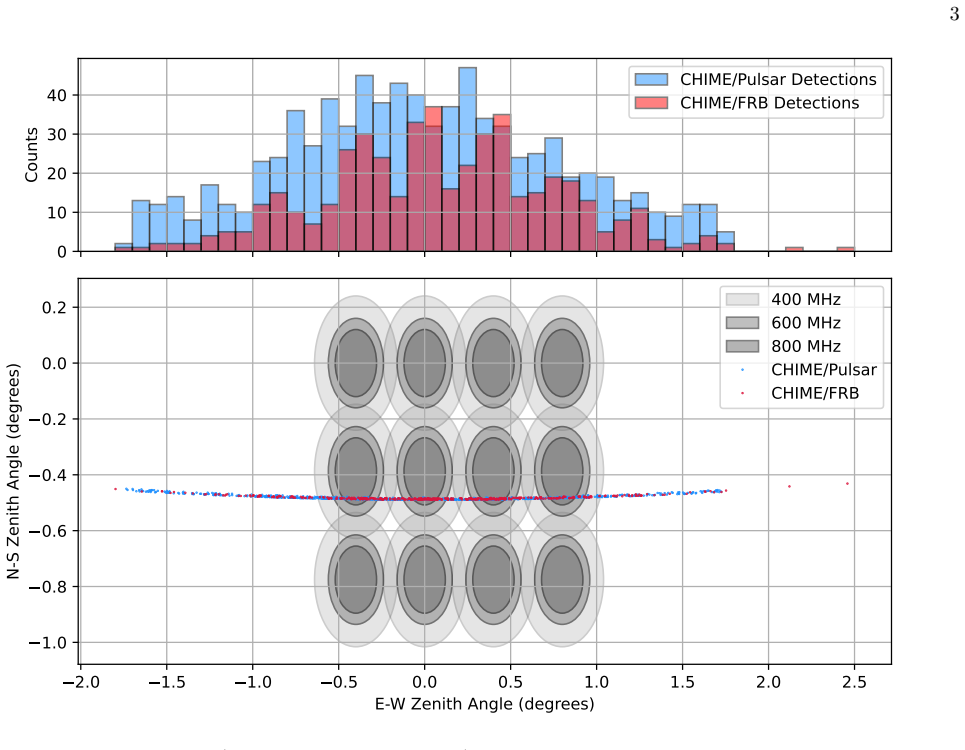


read the original abstract
FRB 20220912A is a highly active repeating fast radio burst (FRB) source, discovered by the Canadian Hydrogen Intensity Mapping Experiment (CHIME) using its real-time FRB detection system (CHIME/FRB). Here, we present results from a radio monitoring campaign of FRB 20220912A using CHIME, including ~200 hours of data collected by CHIME/Pulsar, spanning 1.5 years following the source's discovery. We present an analysis of a sample of 828 CHIME-detected bursts from FRB 20220912A, in the 400-800 MHz radio frequency band. The source remains highly active for ~10 weeks and has a bimodal wait-time distribution with peaks at $160^{+120}_{-70}$ ms and $306^{+14}_{-13}$ s. Assuming a radio efficiency factor of $10^{-4}$ and a beaming angle of 0.1, we estimate the total emitted energy from the source over the entire observing campaign to be $2 \times 10^{43}$ ergs. We report a 2.3$\sigma$ detection of a linear increase in the DM of $1.4 \pm 0.6$ pc cm$^{-3}$ yr$^{-1}$, with no significant trend in rotation measure (with a 3$\sigma$ upper limit of 13.4 rad m$^{-2}$ yr$^{-1}$). We contrast our findings with other active repeaters, which exhibit different DM and RM evolution to indicate that FRB 20220912A may reside in a unique local environment.
Editorial analysis
A structured set of objections, weighed in public.
Referee Report
Summary. The manuscript reports results from a 1.5-year radio monitoring campaign of the repeating FRB 20220912A using CHIME, analyzing 828 detected bursts in the 400-800 MHz band. Key findings include a bimodal wait-time distribution with peaks at ~160 ms and ~306 s, an estimated total emitted energy of 2 × 10^{43} ergs assuming a radio efficiency of 10^{-4} and beaming angle of 0.1, a 2.3σ linear DM increase of 1.4 ± 0.6 pc cm^{-3} yr^{-1}, no significant RM trend (3σ upper limit 13.4 rad m^{-2} yr^{-1}), and the inference that the source occupies a unique local environment based on contrasts with other active repeaters.
Significance. The large sample of 828 bursts and extended monitoring period provide a valuable observational dataset for characterizing the activity and burst statistics of a highly active repeater. If the reported DM trend proves robust under additional checks, it could help constrain models of evolving plasma environments around FRB sources. The work adds to the growing body of long-term repeater monitoring but is limited by the marginal significance of the primary trend and dependence on external assumptions.
major comments (3)
- [DM evolution analysis] DM trend section: The linear DM increase is reported at only 2.3σ with slope 1.4 ± 0.6 pc cm^{-3} yr^{-1}. The manuscript provides no details on the number of independent DM measurements, their individual uncertainties, the fitting procedure (e.g., weighted least-squares or MCMC), or tests for robustness against data-selection cuts and frequency-dependent systematics. This marginal detection is load-bearing for the unique-environment conclusion.
- [Energy calculation] Energy estimate paragraph: The total emitted energy of 2 × 10^{43} ergs is calculated using fixed external assumptions of radio efficiency factor 10^{-4} and beaming angle 0.1. No sensitivity analysis or justification from observations is given, and the downstream environmental interpretation depends on these unvaried parameters.
- [Discussion] Comparison with other repeaters: The claim that FRB 20220912A resides in a unique local environment rests on contrasts in DM and RM evolution. The manuscript does not specify the selection criteria for the comparison sample or list the exact sources and their measured trends, preventing evaluation of whether the differences are statistically significant or selection-biased.
minor comments (2)
- [Abstract] The abstract states '~200 hours of data' but does not specify the exact total integration time or the burst detection threshold and pipeline validation steps used to assemble the 828-burst sample.
- [Figures] Figure showing DM versus time should explicitly label the fitted slope, its uncertainty, and the number of points used; the wait-time histogram would benefit from a quantitative test for bimodality (e.g., BIC comparison).
Simulated Author's Rebuttal
We thank the referee for their constructive and detailed comments, which have helped us identify areas where the manuscript can be clarified and strengthened. We address each major comment below and will revise the manuscript to incorporate additional details and analysis as outlined.
read point-by-point responses
-
Referee: [DM evolution analysis] DM trend section: The linear DM increase is reported at only 2.3σ with slope 1.4 ± 0.6 pc cm^{-3} yr^{-1}. The manuscript provides no details on the number of independent DM measurements, their individual uncertainties, the fitting procedure (e.g., weighted least-squares or MCMC), or tests for robustness against data-selection cuts and frequency-dependent systematics. This marginal detection is load-bearing for the unique-environment conclusion.
Authors: We agree that the DM analysis requires more transparency to allow proper evaluation of the 2.3σ trend. In the revised manuscript we will report the number of independent DM measurements entering the fit, tabulate or describe their individual uncertainties, detail the fitting procedure employed, and present explicit robustness checks including variations in data-selection cuts and assessments of frequency-dependent systematics. While the significance remains marginal, the trend provides a useful contrast with other repeaters and we will emphasize the need for independent confirmation in future observations. revision: yes
-
Referee: [Energy calculation] Energy estimate paragraph: The total emitted energy of 2 × 10^{43} ergs is calculated using fixed external assumptions of radio efficiency factor 10^{-4} and beaming angle 0.1. No sensitivity analysis or justification from observations is given, and the downstream environmental interpretation depends on these unvaried parameters.
Authors: The adopted efficiency and beaming values follow standard assumptions in the FRB literature. We acknowledge the absence of a sensitivity study. The revised manuscript will include a short sensitivity analysis illustrating the range of total energies obtained by varying the efficiency (10^{-5} to 10^{-3}) and beaming angle (0.01 to 1 sr), with the quoted value retained as an illustrative benchmark. The primary environmental conclusions rest on the DM and RM trends rather than the absolute energy scale. revision: yes
-
Referee: [Discussion] Comparison with other repeaters: The claim that FRB 20220912A resides in a unique local environment rests on contrasts in DM and RM evolution. The manuscript does not specify the selection criteria for the comparison sample or list the exact sources and their measured trends, preventing evaluation of whether the differences are statistically significant or selection-biased.
Authors: We will expand the discussion to list the specific comparison sources (e.g., FRB 20121102A, FRB 20180916B and other well-monitored active repeaters), state the selection criteria (repeaters with published multi-year DM/RM monitoring and at least several hundred bursts), and provide a table or explicit citations of their reported DM and RM trends. This will enable readers to assess the statistical significance and potential selection effects of the contrasts. revision: yes
Circularity Check
No circularity; purely observational measurements and explicit assumptions
full rationale
The paper reports direct measurements from 828 bursts: bimodal wait times, a linear DM fit yielding 1.4 ± 0.6 pc cm^{-3} yr^{-1} at 2.3σ, an RM trend upper limit, and an energy estimate that explicitly states the assumed efficiency (10^{-4}) and beaming angle (0.1). No step derives a quantity from the paper's own fitted parameters or renames a result as a prediction. The DM slope is obtained by fitting observed data, not by construction from prior definitions within the work. Comparisons to other repeaters rely on external literature. All load-bearing claims are falsifiable against the raw burst sample and do not reduce to self-citation chains or self-definitional loops.
Axiom & Free-Parameter Ledger
free parameters (2)
- radio efficiency factor =
10^{-4}
- beaming angle =
0.1
axioms (1)
- standard math Standard cold-plasma dispersion and Faraday rotation formulas apply to the observed signals.
Reference graph
Works this paper leans on
-
[1]
2024, arXiv e-prints, arXiv:2408.00172, doi: 10.48550/arXiv.2408.00172
Amiri, M., Chakraborty, A., Foreman, S., et al. 2024, arXiv e-prints, arXiv:2408.00172, doi: 10.48550/arXiv.2408.00172
-
[2]
C., Hama, S., van Hook, S., & Foster, R
Backer, D. C., Hama, S., van Hook, S., & Foster, R. S. 1993, ApJ, 404, 636, doi: 10.1086/172317
-
[3]
Bannister, K. W., Deller, A. T., Phillips, C., et al. 2019, Science, 365, 565, doi: 10.1126/science.aaw5903
-
[4]
2024, arXiv e-prints, arXiv:2412.13121, doi: 10.48550/arXiv.2412.13121
Bhusare, Y., Maan, Y., & Kumar, A. 2024, arXiv e-prints, arXiv:2412.13121, doi: 10.48550/arXiv.2412.13121
-
[5]
Bochenek, C. D., Ravi, V., Belov, K. V., et al. 2020, Nature, 587, 59, doi: 10.1038/s41586-020-2872-x
-
[6]
Brentjens, M. A., & de Bruyn, A. G. 2005, A&A, 441, 1217, doi: 10.1051/0004-6361:20052990 CHIME Collaboration, Amiri, M., Bandura, K., et al. 2022, Astrophysical Journal Supplement Series, 261, 29, doi: 10.3847/1538-4365/ac6fd9 CHIME/FRB Collaboration, Amiri, M., Bandura, K., et al. 2018, ApJ, 863, 48, doi: 10.3847/1538-4357/aad188 CHIME/FRB Collaboration...
-
[7]
Collaboration, T. C., Abbott, T., Andersen, B. C., et al. 2026, The Astrophysical Journal Supplement Series, 283, 34, doi: 10.3847/1538-4365/ae3828
-
[8]
Cook, A. M., Scholz, P., Pearlman, A. B., et al. 2024, The Astrophysical Journal, 974, 170, doi: 10.3847/1538-4357/ad6a13
-
[9]
NE2001.I. A New Model for the Galactic Distribution of Free Electrons and its Fluctuations
Cordes, J. M., & Lazio, T. J. W. 2002, arXiv e-prints, astro, doi: 10.48550/arXiv.astro-ph/0207156
work page internal anchor Pith review Pith/arXiv arXiv doi:10.48550/arxiv.astro-ph/0207156 2002
-
[10]
2019, The Astronomer’s Telegram, 13064, 1
Di, L., Zhang, X., Qian, L., et al. 2019, The Astronomer’s Telegram, 13064, 1
2019
-
[11]
Fedorova, V. A., Rodin, A. E., Zhang, Z.-B., et al. 2023, Astronomy Reports, 67, 970, doi: 10.1134/S1063772923100050
-
[12]
2026, arXiv e-prints, arXiv:2604.01825, doi: 10.48550/arXiv.2604.01825
Feng, Y., Zhou, D., Zhang, Y.-K., et al. 2026, arXiv e-prints, arXiv:2604.01825, doi: 10.48550/arXiv.2604.01825
-
[13]
2024, The Astrophysical Journal, 974, 296, doi: 10.3847/1538-4357/ad7a64
Feng, Y., Li, D., Zhang, Y.-K., et al. 2024, The Astrophysical Journal, 974, 296, doi: 10.3847/1538-4357/ad7a64
-
[14]
2024, ApJS, 271, 49, doi: 10.3847/1538-4365/ad27d6
Fonseca, E., Pleunis, Z., Breitman, D., et al. 2024, ApJS, 271, 49, doi: 10.3847/1538-4365/ad27d6
-
[15]
Gajjar, V., Siemion, A. P. V., Price, D. C., et al. 2018, ApJ, 863, 2, doi: 10.3847/1538-4357/aad005
-
[17]
Hessels, J. W. T., Spitler, L. G., Seymour, A. D., et al. 2019, The Astrophysical Journal Letters, 876, L23, doi: 10.3847/2041-8213/ab13ae
-
[18]
Hewitt, D. M., Snelders, M. P., Hessels, J. W. T., et al. 2022, MNRAS, 515, 3577, doi: 10.1093/mnras/stac1960
-
[19]
Hewitt, D. M., Hessels, J. W. T., Ould-Boukattine, O. S., et al. 2023, MNRAS, 526, 2039, doi: 10.1093/mnras/stad2847
-
[20]
M., Bhandari, S., Marcote, B., et al
Hewitt, D. M., Bhandari, S., Marcote, B., et al. 2024, MNRAS, 529, 1814, doi: 10.1093/mnras/stae632
-
[21]
Hilmarsson, G. H., Michilli, D., Spitler, L. G., et al. 2021, ApJL, 908, L10, doi: 10.3847/2041-8213/abdec0
-
[22]
Hutschenreuter, S., Anderson, C. S., Betti, S., et al. 2022, Astronomy & Astrophysics, 657, A43, doi: 10.1051/0004-6361/202140486
-
[23]
Jahns, J. N., Spitler, L. G., Nimmo, K., et al. 2023, Monthly Notices of the Royal Astronomical Society, 519, 666, doi: 10.1093/mnras/stac3446
-
[24]
Konijn, D. C., Hewitt, D. M., Hessels, J. W. T., et al. 2024, MNRAS, 534, 3331, doi: 10.1093/mnras/stae2296
-
[25]
2025, arXiv e-prints, arXiv:2512.21889, doi: 10.48550/arXiv.2512.21889
Kumar, A., Maan, Y., Lal, B., et al. 2025, arXiv e-prints, arXiv:2512.21889, doi: 10.48550/arXiv.2512.21889
-
[26]
Kumar, P., Luo, R., Price, D. C., et al. 2023, Monthly Notices of the Royal Astronomical Society, 526, 3652, doi: 10.1093/mnras/stad2969
-
[27]
Lai, D., & Shapiro, S. L. 1991, ApJ, 383, 745, doi: 10.1086/170831
-
[28]
Lanman, A. E., Andersen, B. C., Chawla, P., et al. 2022, The Astrophysical Journal, 927, 59, doi: 10.3847/1538-4357/ac4bc7
-
[29]
Li, C. K., Lin, L., Xiong, S. L., et al. 2021, Nature Astronomy, 5, 378, doi: 10.1038/s41550-021-01302-6
-
[30]
2022, The Astronomer’s Telegram, 15679, 1
Mckinven, R., & CHIME/FRB Collaboration. 2022, The Astronomer’s Telegram, 15679, 1
2022
-
[31]
2021, The Astrophysical Journal, 920, 138, doi: 10.3847/1538-4357/ac126a
Mckinven, R., Michilli, D., Masui, K., et al. 2021, The Astrophysical Journal, 920, 138, doi: 10.3847/1538-4357/ac126a
-
[32]
Mckinven, R., Gaensler, B. M., Michilli, D., et al. 2023, The Astrophysical Journal, 951, 82, doi: 10.3847/1538-4357/acd188
-
[33]
2020, The Astrophysical Journal Letters, 898, L29, doi: 10.3847/2041-8213/aba2cf
Mereghetti, S., Savchenko, V., Ferrigno, C., et al. 2020, The Astrophysical Journal Letters, 898, L29, doi: 10.3847/2041-8213/aba2cf
-
[34]
, archivePrefix = "arXiv", eprint =
Bucciantini, N., & Quataert, E. 2011, MNRAS, 413, 2031, doi: 10.1111/j.1365-2966.2011.18280.x
-
[35]
Metzger, B. D., Margalit, B., & Sironi, L. 2019, Monthly Notices of the Royal Astronomical Society, 485, 4091, doi: 10.1093/mnras/stz700
-
[36]
Michilli, D., Seymour, A., Hessels, J. W. T., et al. 2018, Nature, 553, 182, doi: 10.1038/nature25149
-
[37]
Morello, V., Rajwade, K. M., & Stappers, B. W. 2022, MNRAS, 510, 1393, doi: 10.1093/mnras/stab3493
-
[38]
2011, International Journal of Modern Physics D, 20, 989, doi: 10.1142/S0218271811019335
Nan, R., Li, D., Jin, C., et al. 2011, International Journal of Modern Physics D, 20, 989, doi: 10.1142/S0218271811019335
-
[39]
Nimmo, K., Hessels, J. W. T., Snelders, M. P., et al. 2023, MNRAS, 520, 2281, doi: 10.1093/mnras/stad269
-
[40]
2026, Science Bulletin, 71, 76, doi: https://doi.org/10.1016/j.scib.2025.11.023
Niu, C.-H., Li, D., Yang, Y.-P., et al. 2026, Science Bulletin, 71, 76, doi: https://doi.org/10.1016/j.scib.2025.11.023
-
[41]
The McGill Magnetar Catalog.ApJ Suppl
Olausen, S. A., & Kaspi, V. M. 2014, Astrophysical Journal Supplement Series, 212, 6, doi: 10.1088/0067-0049/212/1/6
-
[42]
Ould-Boukattine, O. S., Chawla, P., Hessels, J. W. T., et al. 2026, MNRAS, 545, staf1937, doi: 10.1093/mnras/staf1937
-
[43]
2024, ApJ, 968, 50, doi: 10.3847/1538-4357/ad40aa
Pandhi, A., Pleunis, Z., Mckinven, R., et al. 2024, ApJ, 968, 50, doi: 10.3847/1538-4357/ad40aa
-
[44]
2026, arXiv e-prints, arXiv:2602.22309, doi: 10.48550/arXiv.2602.22309
Pandhi, A., Nimmo, K., Andrew, S., et al. 2026, arXiv e-prints, arXiv:2602.22309, doi: 10.48550/arXiv.2602.22309
-
[45]
Pastor-Marazuela, I., Gordon, A. C., Stappers, B., et al. 2025, Monthly Notices of the Royal Astronomical Society, 545, staf2144, doi: 10.1093/mnras/staf2144
-
[46]
B., Scholz, P., Bethapudi, S., et al
Pearlman, A. B., Scholz, P., Bethapudi, S., et al. 2025, Nature Astronomy, 9, 111, doi: 10.1038/s41550-024-02386-6
-
[47]
2024, A&A, 690, A219, doi: 10.1051/0004-6361/202450271
Pelliciari, D., Bernardi, G., Pilia, M., et al. 2024, A&A, 690, A219, doi: 10.1051/0004-6361/202450271
-
[48]
Petroff, E., Hessels, J. W. T., & Lorimer, D. R. 2019, A&A Rv, 27, 4, doi: 10.1007/s00159-019-0116-6
-
[49]
Shannon, R. M. 2013, Monthly Notices of the Royal Astronomical Society, 435, 1610, doi: 10.1093/mnras/stt1401
-
[50]
Piro, A. L., & Gaensler, B. M. 2018, ApJ, 861, 150, doi: 10.3847/1538-4357/aac9bc
-
[51]
2011, PRESTO: PulsaR Exploration and Search TOolkit, Astrophysics Source Code Library, record ascl:1107.017
Ransom, S. 2011, PRESTO: PulsaR Exploration and Search TOolkit, Astrophysics Source Code Library, record ascl:1107.017. http://ascl.net/1107.017
2011
-
[52]
2023, The Astrophysical Journal Letters, 949, L3, doi: 10.3847/2041-8213/acc4b6
Ravi, V., Catha, M., Chen, G., et al. 2023, The Astrophysical Journal Letters, 949, L3, doi: 10.3847/2041-8213/acc4b6
-
[53]
Rea, N., Esposito, P., Turolla, R., et al. 2010, Science, 330, 944, doi: 10.1126/science.1196088
-
[54]
Sheikh, S. Z., Farah, W., Pollak, A. W., et al. 2024, MNRAS, 527, 10425, doi: 10.1093/mnras/stad3630 16
-
[55]
2026, ApJ, 997, 334, doi: 10.3847/1538-4357/ae2fc4
Shin, K., Curtin, A., Fine, M., et al. 2026, The Astrophysical Journal, 997, 334, doi: 10.3847/1538-4357/ae2fc4
-
[56]
Snelders, M. P., Hessels, J. W. T., Huang, J., et al. 2025, arXiv e-prints, arXiv:2510.11352, doi: 10.48550/arXiv.2510.11352
-
[57]
Tian, J., Pastor-Marazuela, I., Rajwade, K. M., et al. 2025, Monthly Notices of the Royal Astronomical Society, 540, 1685, doi: 10.1093/mnras/staf793
-
[58]
2023, Monthly Notices of the Royal Astronomical Society, 526, 2795, doi: 10.1093/mnras/stad2532
Totani, T., & Tsuzuki, Y. 2023, Monthly Notices of the Royal Astronomical Society, 526, 2795, doi: 10.1093/mnras/stad2532
-
[59]
Xu, H., Niu, J. R., Chen, P., et al. 2022, Nature, 609, 685, doi: 10.1038/s41586-022-05071-8
-
[60]
2017, ApJ, 847, 22, doi: 10.3847/1538-4357/aa8721
Yang, Y.-P., & Zhang, B. 2017a, The Astrophysical Journal, 847, 22, doi: 10.3847/1538-4357/aa8721 —. 2017b, ApJ, 847, 22, doi: 10.3847/1538-4357/aa8721
-
[61]
2023, Reviews of Modern Physics, 95, 035005, doi: 10.1103/RevModPhys.95.035005
Zhang, B. 2023, Reviews of Modern Physics, 95, 035005, doi: 10.1103/RevModPhys.95.035005
-
[62]
2025, arXiv e-prints, arXiv:2507.14707, doi: 10.48550/arXiv.2507.14707
Zhang, J.-S., Wang, T.-C., Wang, P., et al. 2025, A prolific repeating fast radio burst source and a crisis of the magnetar model. https://arxiv.org/abs/2507.14707
-
[63]
Zhang, S. B., Wang, J. S., Yang, X., et al. 2024, Nature Communications, 15, 7454, doi: 10.1038/s41467-024-51711-0
-
[64]
2022, Research in Astronomy and Astrophysics, 22, 124002, doi: 10.1088/1674-4527/ac98f7
Zhang, Y.-K., Wang, P., Feng, Y., et al. 2022, Research in Astronomy and Astrophysics, 22, 124002, doi: 10.1088/1674-4527/ac98f7
-
[65]
2023, ApJ, 955, 142, doi: 10.3847/1538-4357/aced0b
Zhang, Y.-K., Li, D., Zhang, B., et al. 2023, The Astrophysical Journal, 955, 142, doi: 10.3847/1538-4357/aced0b
discussion (0)
Sign in with ORCID, Apple, or X to comment. Anyone can read and Pith papers without signing in.