Recognition: 2 theorem links
· Lean TheoremLattice Realizations of Flat Gauging and T-duality Defects at Any Radius
Pith reviewed 2026-05-10 18:01 UTC · model grok-4.3
The pith
Flat-gauged and T-duality defects in the compact boson survive modified Villain discretization at any radius, producing non-compact edge modes.
A machine-rendered reading of the paper's core claim, the machinery that carries it, and where it could break.
Core claim
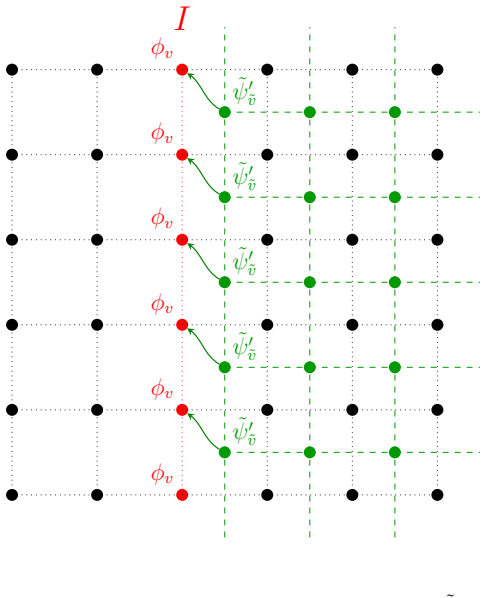
Using the modified Villain discretization on both a Euclidean two-dimensional square lattice and a quantum one-dimensional chain, the topological interfaces survive discretization and give rise to non-compact edge modes localized at the defect sites. Such non-compact edge modes imply a continuous defect spectrum and an infinite quantum dimension. In the special case of rational radii, the defect action or Hamiltonian can be modified in order to compactify the edge modes and produce more standard defects with finite quantum dimension.
What carries the argument
Modified Villain discretization of the compact boson, which implements flat-gauged defects and T-duality interfaces on the lattice while preserving their topological character through non-compact edge modes.
If this is right
- These lattice defects exhibit a continuous spectrum arising from the non-compact edge modes.
- The defects possess infinite quantum dimension at any radius.
- Interfaces between mutually irrational radii are realizable without lattice artifacts.
- For rational radii, a simple modification of the defect Hamiltonian or action compactifies the edge modes to finite quantum dimension.
- The same discretization works uniformly for both Euclidean 2D lattices and quantum 1D chains.
Where Pith is reading between the lines
- This regularization opens the door to tensor-network or Monte Carlo explorations of the dynamics of irrational-radius interfaces.
- The persistence of non-compact modes suggests that similar lattice constructions could capture non-invertible defects in other 2D theories with continuous symmetries.
- The method provides a controlled way to regularize theories where radius incommensurability would otherwise obstruct standard discretizations.
Load-bearing premise
The modified Villain discretization on the lattice and chain accurately reproduces the continuum topological properties of the flat-gauged defects and T-duality without introducing lattice artifacts, especially for mutually irrational radii.
What would settle it
A numerical diagonalization of the 1D quantum chain or Monte Carlo sampling on the 2D lattice that reveals a finite gap for the edge modes or a discrete spectrum when the radius ratio is irrational would show that the discretization fails to preserve the continuum defects.
Figures


read the original abstract
We analyze non-invertible topological interfaces and defects in the two-dimensional compact boson, focusing on the more exotic ones obtained by gauging continuous symmetries with flat connections on a half-space. These include interfaces between mutually irrational radii and T-duality symmetries at arbitrary boson radius. Using the modified Villain discretization on both a Euclidean two-dimensional square lattice and a quantum one-dimensional chain, we show that all these topological interfaces survive discretization and give rise to non-compact edge modes localized at the defect sites. Such non-compact edge modes imply a continuous defect spectrum and an infinite quantum dimension. In the special case of rational radii, we show how the defect action or Hamiltonian can be modified in order to compactify the edge modes and produce more standard defects with finite quantum dimension.
Editorial analysis
A structured set of objections, weighed in public.
Referee Report
Summary. The paper constructs explicit lattice realizations of non-invertible topological interfaces in the 2D compact boson CFT, including flat-gauged defects between mutually irrational radii and T-duality defects at arbitrary radius. Using the modified Villain discretization on a Euclidean 2D square lattice and a quantum 1D chain, it shows that these defects survive discretization, producing non-compact edge modes localized at defect sites that imply a continuous defect spectrum and infinite quantum dimension. For rational radii, the defect action/Hamiltonian is modified to compactify the edge modes and recover finite quantum dimension.
Significance. If the constructions are free of uncontrolled artifacts, the work supplies concrete, simulable lattice models for exotic non-invertible defects that are difficult to access numerically in the continuum. The explicit treatment at arbitrary (including irrational) radii and the demonstration of non-compact edge modes constitute a useful bridge between continuum CFT topology and lattice gauge theory/condensed-matter models.
major comments (2)
- [Lattice interface construction (2D Euclidean and 1D quantum cases)] The interface coupling in the modified Villain action (the term that enforces the flat connection across the defect cut) is the load-bearing step for the irrational-radius claim. The manuscript must show explicitly that this coupling does not induce an effective compactification or mass gap due to the discrete periodicity of the Villain variables when the two radii are mutually irrational; otherwise the asserted non-compact edge modes and continuous spectrum are not guaranteed.
- [Edge-mode analysis and spectrum] The statement that the edge modes remain non-compact for irrational radii relies on the absence of lattice-induced identifications. A concrete diagnostic—e.g., the form of the defect Hilbert space or the partition function on a cylinder with the defect inserted—should be provided to confirm that the spectrum stays continuous rather than acquiring a discrete tower from the lattice cutoff.
minor comments (2)
- [Notation and definitions] Notation for the Villain variables and the continuous gauge parameter on the cut should be unified between the 2D lattice and 1D chain sections to avoid reader confusion.
- [Rational-radius case] The rational-radius compactification procedure is presented as a modification; it would be helpful to state explicitly whether this modification preserves the topological character of the defect or alters its fusion rules.
Simulated Author's Rebuttal
We thank the referee for their careful reading, positive assessment of the significance, and constructive major comments. We address each point below and will revise the manuscript to incorporate explicit demonstrations as requested.
read point-by-point responses
-
Referee: [Lattice interface construction (2D Euclidean and 1D quantum cases)] The interface coupling in the modified Villain action (the term that enforces the flat connection across the defect cut) is the load-bearing step for the irrational-radius claim. The manuscript must show explicitly that this coupling does not induce an effective compactification or mass gap due to the discrete periodicity of the Villain variables when the two radii are mutually irrational; otherwise the asserted non-compact edge modes and continuous spectrum are not guaranteed.
Authors: We agree that an explicit verification of the interface term is essential to rule out lattice artifacts for mutually irrational radii. In the revised manuscript we will add a dedicated subsection expanding the interface coupling in both the 2D Euclidean and 1D quantum formulations. We will demonstrate that the Villain integer variables, combined with the incommensurability of the radii, prevent any effective periodic identification or mass gap; the flat-connection constraint remains non-compact because no integer combination can close under the irrational ratio. This will be shown by direct substitution into the action and by examining the resulting equations of motion for the edge degrees of freedom. revision: yes
-
Referee: [Edge-mode analysis and spectrum] The statement that the edge modes remain non-compact for irrational radii relies on the absence of lattice-induced identifications. A concrete diagnostic—e.g., the form of the defect Hilbert space or the partition function on a cylinder with the defect inserted—should be provided to confirm that the spectrum stays continuous rather than acquiring a discrete tower from the lattice cutoff.
Authors: We concur that a concrete diagnostic strengthens the claim. In the revision we will supply an explicit construction of the defect Hilbert space for the 1D quantum chain at irrational radius, showing that the edge-mode operators generate a continuous spectrum without lattice-induced discretization. We will also compute the leading contribution to the cylinder partition function with the defect inserted, confirming the absence of a discrete tower and the presence of a continuous density of states. The same analysis will be outlined for the 2D Euclidean case via the transfer-matrix formulation. revision: yes
Circularity Check
No circularity; explicit lattice constructions are self-contained
full rationale
The paper's central results follow from direct application of the modified Villain discretization to the 2d square lattice and 1d quantum chain, with explicit interface terms that preserve flat connections. These constructions yield the claimed non-compact edge modes for irrational radii as an output of the lattice model, without any fitted parameters, self-definitional loops, or load-bearing self-citations that reduce the claim to its own inputs. The special-case modification for rational radii is likewise an explicit adjustment of the defect action/Hamiltonian. The derivation chain is therefore independent of the target conclusions and does not collapse by construction.
Axiom & Free-Parameter Ledger
axioms (1)
- domain assumption The modified Villain discretization preserves the topological properties of the flat-gauged interfaces and T-duality defects.
Lean theorems connected to this paper
-
IndisputableMonolith/Cost/FunctionalEquation.leanwashburn_uniqueness_aczel unclear?
unclearRelation between the paper passage and the cited Recognition theorem.
Using the modified Villain discretization... non-compact edge modes... continuous defect spectrum and an infinite quantum dimension... special case of rational radii... compactify the edge modes
-
IndisputableMonolith/Foundation/AlexanderDuality.leanalexander_duality_circle_linking unclear?
unclearRelation between the paper passage and the cited Recognition theorem.
flat gauging of the U(1) winding symmetry... decompactification... gauging a Z subgroup of the R shift symmetry
What do these tags mean?
- matches
- The paper's claim is directly supported by a theorem in the formal canon.
- supports
- The theorem supports part of the paper's argument, but the paper may add assumptions or extra steps.
- extends
- The paper goes beyond the formal theorem; the theorem is a base layer rather than the whole result.
- uses
- The paper appears to rely on the theorem as machinery.
- contradicts
- The paper's claim conflicts with a theorem or certificate in the canon.
- unclear
- Pith found a possible connection, but the passage is too broad, indirect, or ambiguous to say the theorem truly supports the claim.
Forward citations
Cited by 1 Pith paper
-
A Twist on Scattering from Defect Anomalies
Defect 't Hooft anomalies trap charges at symmetry-line junctions and thereby drive categorical scattering into twist operators.
Reference graph
Works this paper leans on
-
[1]
D. Gaiotto, A. Kapustin, N. Seiberg, and B. Willett,Generalized Global Symmetries,JHEP 02(2015) 172, arXiv:1412.5148 [hep-th]
work page internal anchor Pith review arXiv 2015
-
[2]
O. Diatlyk, C. Luo, Y. Wang, and Q. Weller,Gauging non-invertible symmetries: topological interfaces and generalized orbifold groupoid in 2d QFT,JHEP03(2024) 127, arXiv:2311.17044 [hep-th]
-
[3]
J. McGreevy,Generalized Symmetries in Condensed Matter,Ann. Rev. Condensed Matter Phys.14(2023) 57–82, arXiv:2204.03045 [cond-mat.str-el]
-
[4]
What’s Done CannotBe Undone: TASILectures on Non-InvertibleSymmetries,
S.-H. Shao,What’s Done Cannot Be Undone: TASI Lectures on Non-Invertible Symmetries,inTheoretical Advanced Study Institute in Elementary Particle Physics 2023: Aspects of Symmetry. 8, 2023. arXiv:2308.00747 [hep-th]. 28
-
[5]
ICTP lectures on (non-)invertible generalized symmetries,
S. Schafer-Nameki,ICTP lectures on (non-)invertible generalized symmetries,Phys. Rept. 1063(2024) 1–55, arXiv:2305.18296 [hep-th]
- [6]
-
[7]
Anomalies and gauging of U(1) symmetries,
A. Antinucci and F. Benini,Anomalies and gauging of U(1) symmetries,Phys. Rev. B111 (2025) 024110, arXiv:2401.10165 [hep-th]
-
[8]
SymTFTs for Continuous non-Abelian Symmetries,
F. Bonetti, M. Del Zotto, and R. Minasian,SymTFTs for continuous non-Abelian symmetries,Phys. Lett. B871(2025) 140010, arXiv:2402.12347 [hep-th]
-
[9]
A. Arbalestrier, R. Argurio, and L. Tizzano,Noninvertible axial symmetry in QED comes full circle,Phys. Rev. D110(2024) 105012, arXiv:2405.06596 [hep-th]
-
[10]
R. Argurio, A. Collinucci, G. Galati, O. Hulik, and E. Paznokas,Non-Invertible T-duality at Any Radius via Non-Compact SymTFT,SciPost Phys.18(2025) 089, arXiv:2409.11822 [hep-th]
-
[11]
E. Paznokas,Non-invertible SO(2) symmetry of 4d Maxwell from continuous gaugings, JHEP06(2025) 014, arXiv:2501.14419 [hep-th]
-
[12]
A. Arbalestrier, R. Argurio, and L. Tizzano,U(1) gauging, continuous TQFTs, and higher symmetry structures,SciPost Phys.19(2025) 032, arXiv:2502.12997 [hep-th]
-
[13]
B. O˘ guz,Topological manipulations onRsymmetries of Abelian gauge theory,JHEP11 (2025) 135, arXiv:2505.03700 [hep-th]
-
[14]
Symmetry TFTs for Continuous Spacetime Symmetries,
F. Apruzzi, N. Dondi, I. Garc´ ıa Etxebarria, H. T. Lam, and S. Schafer-Nameki,Symmetry TFTs for Continuous Spacetime Symmetries,arXiv:2509.07965 [hep-th]
-
[15]
A. Arbalestrier, R. Argurio, G. Galati, and E. Paznokas,4d Maxwell on the edge: global aspects of boundary conditions and duality,JHEP03(2026) 010, arXiv:2510.19551 [hep-th]
- [16]
-
[17]
S. Fredenhagen and C. Restuccia,The geometry of the limit of N=2 minimal models,J. Phys. A46(2013) 045402, arXiv:1208.6136 [hep-th]
- [18]
-
[19]
R. Thorngren and Y. Wang,Fusion category symmetry. Part II. Categoriosities at c = 1 and beyond,JHEP07(2024) 051, arXiv:2106.12577 [hep-th]
-
[20]
Topological Defect Lines and Renormalization Group Flows in Two Dimensions
C.-M. Chang, Y.-H. Lin, S.-H. Shao, Y. Wang, and X. Yin,Topological Defect Lines and Renormalization Group Flows in Two Dimensions,JHEP01(2019) 026, arXiv:1802.04445 [hep-th]
work page Pith review arXiv 2019
-
[21]
Y. Nagoya and S. Shimamori,Non-invertible duality defect and non-commutative fusion algebra,JHEP12(2023) 062, arXiv:2309.05294 [hep-th]
- [22]
-
[23]
Y. Choi, D.-C. Lu, and Z. Sun,Self-duality under gauging a non-invertible symmetry, JHEP01(2024) 142, arXiv:2310.19867 [hep-th]
-
[24]
S. Bharadwaj, P. Niro, and K. Roumpedakis,Non-invertible defects on the worldsheet, JHEP03(2025) 164, arXiv:2408.14556 [hep-th]
-
[25]
Y. Furuta,On the classification of duality defects in c = 2 compact boson CFTs with a discrete group orbifold,JHEP06(2025) 219, arXiv:2412.01319 [hep-th]
-
[26]
G. Arias-Tamargo, C. Hull, and M. L. Vel´ asquez Cotini Hutt,Non-invertible symmetries of two-dimensional non-linear sigma models,SciPost Phys.19(2025) 126, arXiv:2503.20865 [hep-th]
-
[27]
Lieb-Schultz-Mattis, Luttinger, and ’t Hooft - anomaly matching in lattice systems,
M. Cheng and N. Seiberg,Lieb-Schultz-Mattis, Luttinger, and ’t Hooft - anomaly matching in lattice systems,SciPost Phys.15(2023) 051, arXiv:2211.12543 [cond-mat.str-el]
-
[28]
Lieb-Schultz-Mattis anomalies as obstructions to gauging (non-on-site) symmetries,
S. Seifnashri,Lieb-Schultz-Mattis anomalies as obstructions to gauging (non-on-site) symmetries,SciPost Phys.16(2024) 098, arXiv:2308.05151 [cond-mat.str-el]
-
[29]
Majorana chain and Ising model - (non-invertible) translations, anomalies, and emanant symmetries,
N. Seiberg and S.-H. Shao,Majorana chain and Ising model - (non-invertible) translations, anomalies, and emanant symmetries,SciPost Phys.16(2024) 064, arXiv:2307.02534 [cond-mat.str-el]
- [30]
-
[31]
Non-invertible symmetries and LSM-type constraints on a tensor product Hilbert space,
N. Seiberg, S. Seifnashri, and S.-H. Shao,Non-invertible symmetries and LSM-type constraints on a tensor product Hilbert space,SciPost Phys.16(2024) 154, arXiv:2401.12281 [cond-mat.str-el]
-
[32]
T. Sulejmanpasic and C. Gattringer,Abelian gauge theories on the lattice:θ-Terms and compact gauge theory with(out) monopoles,Nucl. Phys. B943(2019) 114616, arXiv:1901.02637 [hep-lat]
-
[33]
P. Gorantla, H. T. Lam, N. Seiberg, and S.-H. Shao,A modified Villain formulation of fractons and other exotic theories,J. Math. Phys.62(2021) 102301, arXiv:2103.01257 [cond-mat.str-el]
- [34]
-
[35]
L. Fazza and T. Sulejmanpasic,Lattice quantum Villain Hamiltonians: compact scalars, U(1) gauge theories, fracton models and quantum Ising model dualities,JHEP05(2023) 017, arXiv:2211.13047 [hep-th]
-
[36]
Topological defects for the free boson CFT
J. Fuchs, M. R. Gaberdiel, I. Runkel, and C. Schweigert,Topological defects for the free boson CFT,J. Phys. A40(2007) 11403, arXiv:0705.3129 [hep-th]
work page Pith review arXiv 2007
-
[37]
C. Bachas and I. Brunner,Fusion of conformal interfaces,JHEP02(2008) 085, arXiv:0712.0076 [hep-th]
-
[38]
S. Dubovsky, S. Negro, and M. Porrati,Topological gauging and double current deformations,JHEP05(2023) 240, arXiv:2302.01654 [hep-th]. 30
- [39]
-
[40]
Villain,Theory of one-dimensional and two-dimensional magnets with an easy magnetization plane
J. Villain,Theory of one-dimensional and two-dimensional magnets with an easy magnetization plane. 2. The Planar, classical, two-dimensional magnet,J. Phys. (France) 36(1975) 581–590
1975
-
[41]
V. L. Berezinskii,Destruction of Long-range Order in One-dimensional and Two-dimensional Systems having a Continuous Symmetry Group I. Classical Systems, Sov. Phys. JETP32(1971) 493–500
1971
-
[42]
J.-Y. Chen,Instanton density operator in lattice QCD from higher category theory, SciPost Phys.19(2025) 158, arXiv:2406.06673 [hep-lat]
-
[43]
Seifnashri,Exactly Solvable 1+1d Chiral Lattice Gauge Theories, arXiv:2601.14359 [hep-th]
S. Seifnashri,Exactly Solvable 1+1d Chiral Lattice Gauge Theories, arXiv:2601.14359 [hep-th]. 31
discussion (0)
Sign in with ORCID, Apple, or X to comment. Anyone can read and Pith papers without signing in.