Recognition: no theorem link
What's in a BIP? Exploring the Lived Experiences of Breaks In Presence
Pith reviewed 2026-05-10 17:59 UTC · model grok-4.3
The pith
Breaks in presence in VR unfold through four distinct temporal patterns that users actively manage.
A machine-rendered reading of the paper's core claim, the machinery that carries it, and where it could break.
Core claim
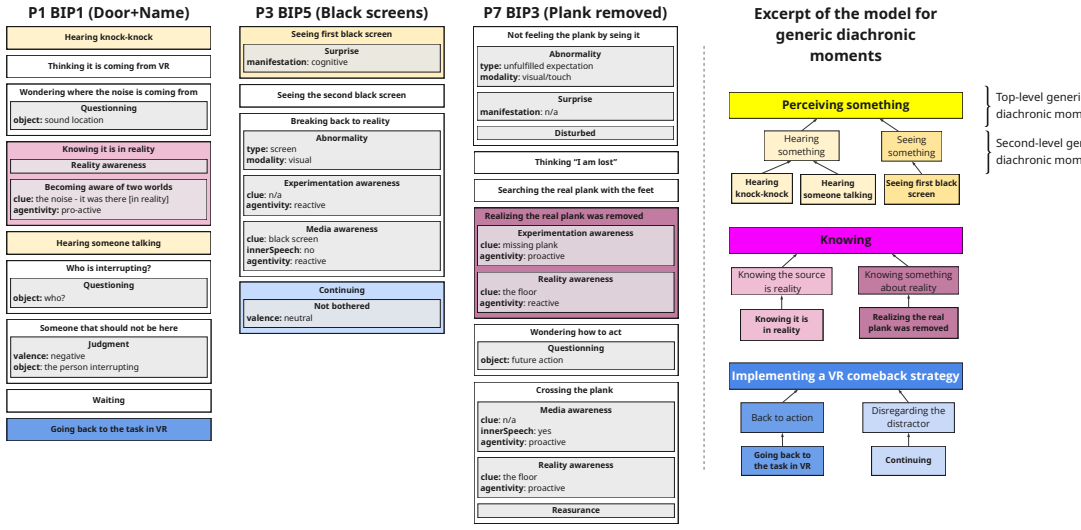
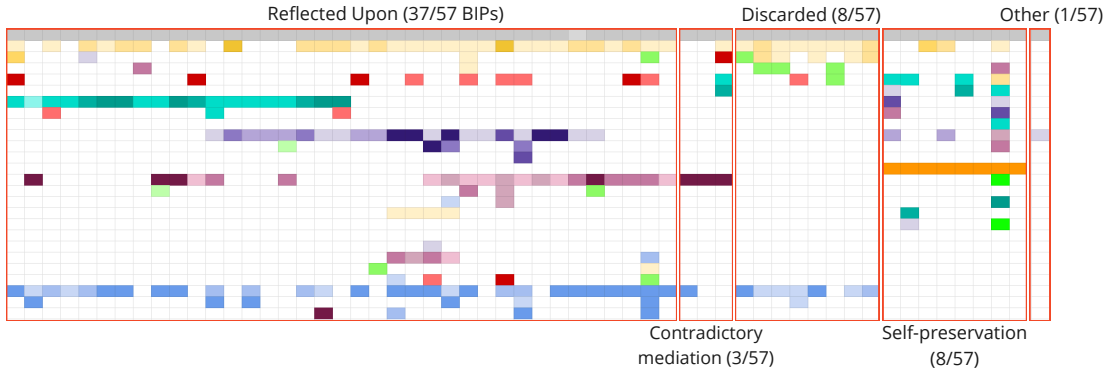
By applying micro-phenomenology to collect and model descriptions of breaks in presence from 14 users in a height-exposure VR application, the authors identified four generic diachronic patterns: reflected-upon BIPs, discarded BIPs, self-preservation BIPs, and contradictory mediation BIPs. These patterns are interpreted through the PI/Psi model of presence, which supports an awareness-based definition of BIPs and the proposal of three related design opportunities.
What carries the argument
Micro-phenomenological modeling of individual BIP episodes to extract four recurring diachronic patterns in user experience and response.
If this is right
- VR systems can anticipate and accommodate the specific ways users reflect on, discard, or use breaks for self-preservation rather than treating all disruptions the same.
- An awareness-based definition allows presence to be treated as a graded state instead of a binary condition.
- Designers gain three targeted opportunities to address the four identified BIP patterns in application development.
Where Pith is reading between the lines
- The same interview and modeling approach could be applied to augmented reality or mixed-reality settings to test whether similar temporal patterns appear.
- Combining these subjective patterns with physiological sensors might improve real-time systems that respond to user awareness shifts.
- Longitudinal studies could examine whether users develop preferred patterns over repeated VR sessions and whether those preferences affect continued use.
Load-bearing premise
Detailed accounts from fourteen users of one height-exposure application can reveal patterns that hold across other VR applications and broader user groups.
What would settle it
A follow-up micro-phenomenological study in a different VR context, such as a social interaction or navigation task, that identifies a substantially different set of temporal patterns or no consistent patterns at all.
Figures



read the original abstract
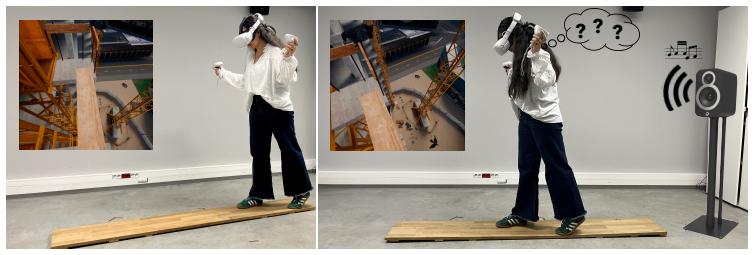
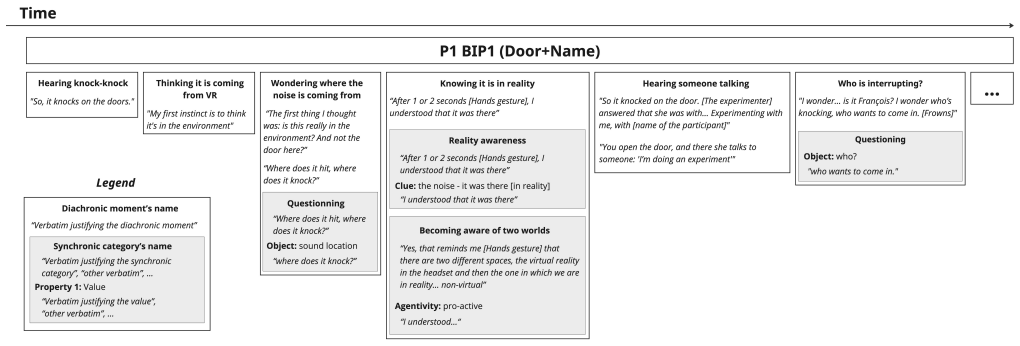
Occasionally, individuals immersed in a Virtual Reality (VR) environment may experience distractions that disrupt their sense of presence, a phenomenon referred to as a break in presence (BIP). Better understanding BIPs is crucial to designing VR applications that keep their users present. BIPs have been studied using a variety of methods, exploring their origins or trying to detect them from physiological or behavioral measurements. However, despite the importance of understanding how they are actually lived and managed by VR users, very few studies focused on their phenomenological characterization. We employed micro-phenomenology to collect the descriptions of BIPs experienced by users (n=14) of a height exposure VR application. We precisely modeled 57 BIP episodes, bringing to light a variety of experiences and behaviors. Four generic diachronic patterns of BIP episodes emerge: reflected-upon, discarded, self-preservation, and contradictory mediation BIPs. We discuss these in light of the PI/Psi model of presence, propose an awareness-based definition of BIPs, as well as three BIP-related design opportunities.
Editorial analysis
A structured set of objections, weighed in public.
Referee Report
Summary. The paper uses micro-phenomenological interviews with 14 users of a single height-exposure VR application to collect and model descriptions of 57 BIP episodes. From this data, four generic diachronic patterns of BIP experiences are identified (reflected-upon, discarded, self-preservation, and contradictory mediation). These patterns are discussed in relation to the PI/Psi model of presence, an awareness-based definition of BIPs is proposed, and three BIP-related design opportunities for VR are outlined.
Significance. If the patterns are shown to be robustly derived and not artifacts of the specific height-exposure context, the work would advance phenomenological understanding of BIPs beyond physiological detection or origin-focused studies. The micro-phenomenological method is well-suited for capturing lived experiences, and the resulting definition and design opportunities could usefully inform VR application development in human-computer interaction.
major comments (3)
- [Methods] Methods section: The abstract states that 57 episodes were precisely modeled from n=14 interviews, yet no information is given on inter-rater reliability, saturation criteria, or procedures for resolving contradictions in the data. These details are load-bearing for the reliability of the four emergent patterns.
- [Results/Discussion] Results and Discussion: The four patterns are presented as generic and diachronic, but the data come exclusively from a height-exposure application that strongly primes self-preservation and fear responses. No evidence of negative-case analysis, cross-context replication, or explicit saturation is indicated, weakening the claim that the patterns generalize beyond this scenario.
- [Abstract/Introduction] Abstract and Introduction: The leap from this small, homogeneous sample in one application to an awareness-based BIP definition and broader design implications requires stronger justification; without saturation or generalizability checks, the patterns risk being context-specific rather than generic.
minor comments (2)
- [Discussion] Clarify in the discussion how the PI/Psi model is applied to each of the four patterns, with explicit mappings to the interview excerpts.
- [Discussion] Add a limitations subsection that explicitly addresses the single-application sample and implications for broader VR contexts.
Simulated Author's Rebuttal
We thank the referee for their thoughtful and constructive comments on our manuscript. These points help us improve the clarity and transparency of our phenomenological analysis. Below, we address each major comment point by point, indicating where revisions will be made to the manuscript.
read point-by-point responses
-
Referee: [Methods] Methods section: The abstract states that 57 episodes were precisely modeled from n=14 interviews, yet no information is given on inter-rater reliability, saturation criteria, or procedures for resolving contradictions in the data. These details are load-bearing for the reliability of the four emergent patterns.
Authors: We appreciate this observation on methodological transparency. Micro-phenomenology, as a qualitative method, prioritizes the detailed, first-person description and the researcher's bracketing process over quantitative measures like inter-rater reliability. The modeling of the 57 episodes was conducted by the lead author with iterative review and discussion among the co-authors to resolve any interpretive differences through consensus. Saturation was assessed by monitoring when no new diachronic patterns emerged in subsequent interviews. In the revised version, we will include a more detailed description of these procedures in the Methods section to address this concern. revision: partial
-
Referee: [Results/Discussion] Results and Discussion: The four patterns are presented as generic and diachronic, but the data come exclusively from a height-exposure application that strongly primes self-preservation and fear responses. No evidence of negative-case analysis, cross-context replication, or explicit saturation is indicated, weakening the claim that the patterns generalize beyond this scenario.
Authors: The referee correctly notes the specific context of the height-exposure application, which may have emphasized self-preservation responses. The four patterns emerged from a comprehensive analysis of all 57 episodes, including consideration of cases that initially appeared contradictory or did not fit emerging categories (negative-case analysis was part of the iterative modeling process). However, we recognize that explicit reporting of this and the absence of cross-context data limit claims to generalizability. We will add a Limitations subsection in the Discussion to explicitly discuss the single-application context, the potential influence of the height-exposure scenario, and the need for future research to replicate these patterns in other VR environments. The patterns are presented as generic within the scope of this study but will be qualified accordingly. revision: partial
-
Referee: [Abstract/Introduction] Abstract and Introduction: The leap from this small, homogeneous sample in one application to an awareness-based BIP definition and broader design implications requires stronger justification; without saturation or generalizability checks, the patterns risk being context-specific rather than generic.
Authors: The sample of 14 participants is consistent with micro-phenomenological research, which values in-depth exploration of lived experiences over large-scale generalizability. The awareness-based definition is proposed based on the patterns observed in this dataset and is intended as a contribution to the ongoing discussion in the field, informed by the PI/Psi model. We will revise the Abstract and Introduction to better frame the study as an initial phenomenological investigation, provide stronger links to prior work, and temper the language around the definition and design opportunities to reflect their basis in this specific context. This will include explicit mention of the exploratory nature and calls for further validation. revision: yes
Circularity Check
No circularity: qualitative patterns emerge from interview data without self-referential derivation
full rationale
This is a descriptive qualitative study employing micro-phenomenological interviews with 14 participants to model 57 BIP episodes in one VR application. The four diachronic patterns (reflected-upon, discarded, self-preservation, contradictory mediation) are presented as emerging from the data analysis rather than being presupposed, fitted, or derived via equations or self-citations. No mathematical derivations, parameter fitting, uniqueness theorems, or ansatzes appear in the provided text. The discussion of the PI/Psi model and proposed BIP definition serves as interpretive framing, not a load-bearing self-referential step. The central claim remains independent of its inputs, consistent with standard qualitative phenomenology.
Axiom & Free-Parameter Ledger
axioms (1)
- domain assumption Micro-phenomenology interviews can accurately and reliably capture the diachronic structure of subjective BIP experiences.
Reference graph
Works this paper leans on
-
[1]
Witmer, B.G., Singer, M.J.: Measuring Presence in Virtual Environments: A Presence Questionnaire. Presence: Teleoperators and Virtual Environments7(3), 225–240 (1998) https://doi.org/10.1162/105474698565686
-
[2]
Slater, M.: Place illusion and plausibility can lead to realistic behaviour in immer- sive virtual environments. Philosophical Transactions of the Royal Society B: Biological Sciences364(1535), 3549–3557 (2009) https://doi.org/10.1098/rstb. 2009.0138
-
[3]
Presence: Teleopera- tors and Virtual Environments9(5), 413–434 (2000) https://doi.org/10.1162/ 105474600566925
Slater, M., Steed, A.: A Virtual Presence Counter. Presence: Teleopera- tors and Virtual Environments9(5), 413–434 (2000) https://doi.org/10.1162/ 105474600566925
2000
-
[4]
Brooks, F.P.: What’s real about virtual reality? IEEE Computer Graphics and Applications19(6), 16–27 (1999) https://doi.org/10.1109/38.799723
-
[5]
PRESENCE: Virtual and Augmented Reality31, 257–281 (2022) https: //doi.org/10.1162/pres a 00397
Pouke, M., Ylipulli, J., Uotila, E., Sitomaniemi, A.-K., Pouke, S., Ojala, T.: A qualitative case study on deconstructing presence for young adults and older adults. PRESENCE: Virtual and Augmented Reality31, 257–281 (2022) https: //doi.org/10.1162/pres a 00397
-
[6]
Chertoff, D., Schatz, S., Mcdaniel, R., Bowers, C.: Improving Presence Theory Through Experiential Design. Presence: Teleoperators and Virtual Environments 17, 405–413 (2008) https://doi.org/10.1162/pres.17.4.405
-
[7]
Annual Review of CyberTherapy and Telemedicine21, 28–32 (2023)
Gaspari, S.D., Sajno, E., Lernia, D.D., Brizzi, G., Sansoni, M., Riva, G.: Detection of Break in Presence in Full Body Illusion using Machine Learning. Annual Review of CyberTherapy and Telemedicine21, 28–32 (2023)
2023
-
[8]
Garau, M., Friedman, D., Widenfeld, H.R., Antley, A., Brogni, A., Slater, M.: Temporal and Spatial Variations in Presence: Qualitative Analysis of Interviews from an Experiment on Breaks in Presence. Presence: Teleoperators and Virtual Environments17(3), 293–309 (2008) https://doi.org/10.1162/pres.17.3.293
-
[9]
CyberPsychology & Behavior4(2), 203–213 (2001) https://doi.org/10.1089/109493101300117893
Waterworth, E.L., Waterworth, J.A.: Focus, Locus, and Sensus: The Three Dimensions of Virtual Experience. CyberPsychology & Behavior4(2), 203–213 (2001) https://doi.org/10.1089/109493101300117893
-
[10]
John Benjamins Publishing Company, Amsterdam, Netherlands (2003)
Depraz, N., Varela, F.J., Vermersch, P.: On Becoming Aware: A Pragmatics of Experiencing. John Benjamins Publishing Company, Amsterdam, Netherlands (2003)
2003
-
[11]
Encyclopaedia Britannica14, 699–702 (1927)
Husserl, E.: Phenomenology. Encyclopaedia Britannica14, 699–702 (1927)
1927
-
[12]
Current Psychology42(12), 10437–10453 (2021) https://doi.org/10.1007/s12144-021-02277-3
Lumma, A.-L., Weger, U.: Looking from within: Comparing first-person 38 approaches to studying experience. Current Psychology42(12), 10437–10453 (2021) https://doi.org/10.1007/s12144-021-02277-3
-
[13]
Høffding, S., Heimann, K., Martiny, K.: Editorial: Working with others’ expe- rience. Phenomenology and the Cognitive Sciences22(1), 1–24 (2022) https: //doi.org/10.1007/s11097-022-09873-z
-
[14]
In: Proceedings of the 4th Nordic Conference on Human-Computer Interaction: Changing Roles
Bødker, S.: When second wave hci meets third wave challenges. In: Proceedings of the 4th Nordic Conference on Human-Computer Interaction: Changing Roles. NordiCHI ’06, pp. 1–8, Oslo, Norway (2006). https://doi.org/10.1145/1182475. 1182476
-
[15]
In: Proceedings of the 2020 CHI Conference on Human Factors in Com- puting Systems
Prpa, M., Fdili-Alaoui, S., Schiphorst, T., Pasquier, P.: Articulating Experience: Reflections from Experts Applying Micro-Phenomenology to Design Research in HCI. In: Proceedings of the 2020 CHI Conference on Human Factors in Com- puting Systems. CHI ’20, pp. 1–14, Honolulu HI USA (2020). https://doi.org/10. 1145/3313831.3376664
-
[16]
Communication Theory14(1), 27–50 (2004) https://doi.org/10.1111/j.1468-2885.2004.tb00302.x
Lee, K.M.: Presence, Explicated. Communication Theory14(1), 27–50 (2004) https://doi.org/10.1111/j.1468-2885.2004.tb00302.x
-
[17]
Felton, W.M., Jackson, R.E.: Presence: A review. International Journal of Human–Computer Interaction38(1), 1–18 (2021) https://doi.org/10.1080/ 10447318.2021.1921368
-
[18]
Jr., Whitton, M.C.: A Survey of Presence and Related Concepts
Skarbez, R., Brooks, F.P. Jr., Whitton, M.C.: A Survey of Presence and Related Concepts. ACM Computing Survey50(6), 96–19639 (2017) https://doi.org/10. 1145/3134301
2017
-
[19]
Media Psychology9(3), 493–525 (2007) https://doi.org/10
Wirth, W., Hartmann, T., B¨ ocking, S., Vorderer, P., Klimmt, C., Schramm, H., Saari, T., Laarni, J., Ravaja, N., Gouveia, F.R., Biocca, F., Sacau, A., J¨ ancke, L., Baumgartner, T., J¨ ancke, P.: A process model of the formation of spatial presence experiences. Media Psychology9(3), 493–525 (2007) https://doi.org/10. 1080/15213260701283079
2007
-
[20]
Jour- nal of Communication42(4), 73–93 (1992) https://doi.org/10.1111/j.1460-2466
Steuer, J.: Defining Virtual Reality: Dimensions Determining Telepresence. Jour- nal of Communication42(4), 73–93 (1992) https://doi.org/10.1111/j.1460-2466. 1992.tb00812.x
-
[21]
Witmer, B.G., Jerome, C.J., Singer, M.J.: The Factor Structure of the Presence Questionnaire. Presence: Teleoperators and Virtual Environments14(3), 298–312 (2005) https://doi.org/10.1162/105474605323384654
-
[22]
Lombard, M., Ditton, T.: At the heart of it all: The concept of presence. Jour- nal of Computer-Mediated Communication3(2) (2006) https://doi.org/10.1111/ j.1083-6101.1997.tb00072.x 39
-
[23]
Presence
Murphy, D., Skarbez, R.: What Do We Mean When We Say “Presence”? PRES- ENCE: Virtual and Augmented Reality29, 171–190 (2020) https://doi.org/10. 1162/pres a 00360
2020
-
[24]
Frontiers in Virtual Reality3(2022) https://doi.org/10.3389/frvir.2022.914392
Slater, M., Banakou, D., Beacco, A., Gallego, J., Macia-Varela, F., Oliva, R.: A separate reality: An update on place illusion and plausibility in virtual reality. Frontiers in Virtual Reality3(2022) https://doi.org/10.3389/frvir.2022.914392
-
[25]
Presence Connect3(3), 1–5 (2003)
Slater, M.: A note on presence terminology. Presence Connect3(3), 1–5 (2003)
2003
-
[26]
In: Presence 2003: The 6th Annual International Workshop on Presence, Aalborg, Denmark, pp
Slater, M., Brogni, A., Steed, A.: Physiological responses to breaks in presence: A pilot study. In: Presence 2003: The 6th Annual International Workshop on Presence, Aalborg, Denmark, pp. 1–4 (2003)
2003
-
[27]
Presence: Teleop- erators and Virtual Environments7(1), 78–89 (1998) https://doi.org/10.1162/ 105474698565541
Zahorik, P., Jenison, R.L.: Presence as being-in-the-world. Presence: Teleop- erators and Virtual Environments7(1), 78–89 (1998) https://doi.org/10.1162/ 105474698565541
1998
-
[28]
In: 5th Annual International Workshop on Presence, Porto, Portugal, pp
Spagnolli, A., Gamberini, L.: Immersion/emersion: Presence in hybrid environ- ments. In: 5th Annual International Workshop on Presence, Porto, Portugal, pp. 1–14 (2002)
2002
-
[29]
In: EU Future and Emerging Technologies, Presence Initiative Meeting, vol
Biocca, F.: Can we resolve the book, the physical reality, and the dream state problems? from the two-pole to a three-pole model of shifts in presence. In: EU Future and Emerging Technologies, Presence Initiative Meeting, vol. 12, pp. 13–69 (2003)
2003
-
[30]
In: Lom- bard, M., Biocca, F., Freeman, J., IJsselsteijn, W., Schaevitz, R.J
Laarni, J., Ravaja, N., Saari, T., B¨ ocking, S., Hartmann, T., Schramm, H.: Ways to Measure Spatial Presence: Review and Future Directions. In: Lom- bard, M., Biocca, F., Freeman, J., IJsselsteijn, W., Schaevitz, R.J. (eds.) Immersed in Media, pp. 139–185. Springer, Cham (2015). https://doi.org/10. 1007/978-3-319-10190-3 8
2015
-
[31]
ACM Computing Survey54(8) (2021) https://doi.org/10
Souza, V., Maciel, A., Nedel, L., Kopper, R.: Measuring presence in virtual envi- ronments: A survey. ACM Computing Survey54(8) (2021) https://doi.org/10. 1145/3466817
2021
-
[32]
In: Proceedings of the 29th Annual Conference on Computer Graphics and Interactive Techniques
Meehan, M., Insko, B., Whitton, M., Brooks, F.P.: Physiological measures of presence in stressful virtual environments. In: Proceedings of the 29th Annual Conference on Computer Graphics and Interactive Techniques. SIGGRAPH ’02, pp. 645–652, San Antonio, Texas (2002). https://doi.org/10.1145/566570.566630
-
[33]
PLOS one13(7) (2018) https://doi.org/10.1371/journal.pone.0200306 40
Peterson, S.M., Furuichi, E., Ferris, D.P.: Effects of virtual reality high heights exposure during beam-walking on physiological stress and cognitive loading. PLOS one13(7) (2018) https://doi.org/10.1371/journal.pone.0200306 40
-
[34]
Media Psychology20(3), 477–501 (2017) https://doi.org/10.1080/15213269.2016
Liebold, B., Brill, M., Pietschmann, D., Schwab, F., Ohler, P.: Continuous Mea- surement of Breaks in Presence: Psychophysiology and Orienting Responses. Media Psychology20(3), 477–501 (2017) https://doi.org/10.1080/15213269.2016. 1206829
-
[35]
Computers in Human Behavior Reports18, 100637 (2025) https://doi.org/10.1016/j.chbr.2025.100637
Holl, E., Huber, K., Pietschmann, D., Liebold, B.: Being here, being there: Investigating cognitive and attentional mechanisms of breaks in presence using psychophysiological and reaction time measures. Computers in Human Behavior Reports18, 100637 (2025) https://doi.org/10.1016/j.chbr.2025.100637
-
[36]
Journal of Neural Engineering21(4), 046015 (2024) https://doi.org/10.1088/1741-2552/ad5cc2
Savalle, E., Pillette, L., Won, K., Argelaguet, F., L´ ecuyer, A., J-M Mac´ e, M.: Towards electrophysiological measurement of presence in virtual reality through auditory oddball stimuli. Journal of Neural Engineering21(4), 046015 (2024) https://doi.org/10.1088/1741-2552/ad5cc2
-
[37]
In: Proceedings of the 2019 CHI Conference on Human Factors in Computing Systems
Schwind, V., Knierim, P., Haas, N., Henze, N.: Using presence questionnaires in virtual reality. In: Proceedings of the 2019 CHI Conference on Human Factors in Computing Systems. CHI ’19, pp. 1–12, Glasgow, Scotland Uk (2019). https: //doi.org/10.1145/3290605.3300590
-
[38]
Slater, M.: How colorful was your day? why questionnaires cannot assess presence in virtual environments. Presence: Teleoperators and Virtual Environments13(4), 484–493 (2004) https://doi.org/10.1162/1054746041944849
-
[39]
Chung, J., Gardner, H.J.: Temporal presence variation in immersive computer games. International Journal of Human-Computer Interaction28(8), 511–529 (2012) https://doi.org/10.1080/10447318.2011.627298
-
[40]
Virtual Reality27(2), 651–675 (2023) https://doi.org/10.1007/s10055-022-00685-9
Slater, M., Cabriera, C., Senel, G., Banakou, D., Beacco, A., Oliva, R., Gallego, J.: The sentiment of a virtual rock concert. Virtual Reality27(2), 651–675 (2023) https://doi.org/10.1007/s10055-022-00685-9
-
[41]
Chung, J., Gardner, H.J.: Measuring temporal variation in presence during game playing. In: Proceedings of the 8th International Conference on Virtual Reality Continuum and Its Applications in Industry. VRCAI ’09, pp. 163–168, Yokohama, Japan (2009). https://doi.org/10.1145/1670252.1670287
-
[42]
Vermersch, P.: L’entretien D’explicitation. ESF, Paris, France (1994). English version: The Explicitation Interview (2007, independently published): https://www.researchgate.net/publication/324976173 The explicitation interview
-
[43]
Petitmengin, C., Remillieux, A., Valenzuela-Moguillansky, C.: Discovering the structures of lived experience. Phenomenology and the Cognitive Sciences18(4), 691–730 (2019) https://doi.org/10.1007/s11097-018-9597-4
-
[44]
Le 41 travail humain79(3), 259–284 (2016) https://doi.org/10.3917/th.793.0259
Cahour, B., Salembier, P., Zouinar, M.: Analyzing lived experience of activity. Le 41 travail humain79(3), 259–284 (2016) https://doi.org/10.3917/th.793.0259
-
[45]
Petitmengin, C.: L’´ enaction comme exp´ erience v´ ecue. Intellectica. Revue de l’Association pour la Recherche Cognitive43(1), 85–92 (2006) https://doi.org/ 10.3406/intel.2006.1333
-
[46]
Van Someren, M.W., Barnard, Y.F., Sandberg, J.A.: The Think Aloud Method: a Practical Approach to Modelling Cognitive Processes, pp. 1–208. Academic Press, London, England (1994)
1994
-
[47]
Phe- nomenology and the Cognitive Sciences5(3), 271–301 (2006) https://doi.org/10
Hurlburt, R.T., Akhter, S.A.: The Descriptive Experience Sampling method. Phe- nomenology and the Cognitive Sciences5(3), 271–301 (2006) https://doi.org/10. 1007/s11097-006-9024-0
2006
-
[48]
Theureau, J.: Le Cours D’action: M´ ethode D´ evelopp´ ee, pp. 1–384. Octares, Editions, Toulouse, France (2006)
2006
-
[49]
In: 2018 IEEE Games, Entertainment, Media Conference (GEM), Galway, pp
Quesnel, D., Stepanova, E.R., Aguilar, I.A., Pennefather, P., Riecke, B.E.: Creat- ing AWE: Artistic and Scientific Practices in Research-Based Design for Exploring a Profound Immersive Installation. In: 2018 IEEE Games, Entertainment, Media Conference (GEM), Galway, pp. 200–207 (2018). https://doi.org/10.1109/GEM. 2018.8516463
work page doi:10.1109/gem 2018
-
[50]
Frontiers in Robotics and AI , author =
Stepanova, E.R., Quesnel, D., Riecke, B.E.: Understanding awe: Can a virtual journey, inspired by the overview effect, lead to an increased sense of intercon- nectedness? Frontiers in Digital Humanities6, 1–21 (2019) https://doi.org/10. 3389/fdigh.2019.00009
-
[51]
Multi- modal Technologies and Interaction3(1), 1–17 (2019) https://doi.org/10.3390/ mti3010017
Montuwy, A., Cahour, B., Dommes, A.: Using sensory wearable devices to navigate the city: Effectiveness and user experience in older pedestrians. Multi- modal Technologies and Interaction3(1), 1–17 (2019) https://doi.org/10.3390/ mti3010017
2019
-
[52]
Rivi` ere, J.-P., Vinet, L., Pri´ e, Y.: Towards the use of virtual reality prototypes in architecture to collect user experiences: An assessment of the comparability of patient experiences in a virtual and a real ambulatory pathway. International Journal of Human-Computer Studies192, 1–21 (2024) https://doi.org/10.1016/ j.ijhcs.2024.103342
-
[53]
In: Proceed- ings of the 2018 Designing Interactive Systems Conference
Prpa, M., Tatar, K., Fran¸ coise, J., Riecke, B., Schiphorst, T., Pasquier, P.: Attend- ing to breath: Exploring how the cues in a virtual environment guide the attention to breath and shape the quality of experience to support mindfulness. In: Proceed- ings of the 2018 Designing Interactive Systems Conference. DIS ’18, pp. 71–84, Hong Kong, China (2018)....
-
[54]
Hu, X., Dalsgaard, T.-S., Hornbæk, K.: “A False Reality”? A Micro- phenomenology of Avatars in VR, pp. 77–96. Springer, Berlin, Heidelberg (2025). 42 https://doi.org/10.1007/978-3-031-93861-0 5
-
[55]
In: Proceedings of the 2018 CHI Conference on Human Factors in Computing Systems
Knibbe, J., Schjerlund, J., Petraeus, M., Hornbæk, K.: The dream is collapsing: The experience of exiting VR. In: Proceedings of the 2018 CHI Conference on Human Factors in Computing Systems. CHI ’18, pp. 1–13, Montreal QC, Canada (2018). https://doi.org/10.1145/3173574.3174057
-
[56]
SAGE Publishing, London, United Kingdom (2022)
Braun, V., Clarke, V.: Thematic Analysis: a Practical Guide. SAGE Publishing, London, United Kingdom (2022)
2022
-
[57]
Hogan, T., Hinrichs, U., Hornecker, E.: The elicitation interview technique: Capturing people’s experiences of data representations. IEEE Transactions on Visualization and Computer Graphics22(12), 2579–2593 (2016) https://doi.org/ 10.1109/tvcg.2015.2511718
-
[58]
Constructivist Foundations14(2), 123–145 (2019)
Valenzuela-Moguillansky, C., V´ asquez-Rosati, A.: An analysis procedure for the micro-phenomenological interview. Constructivist Foundations14(2), 123–145 (2019)
2019
-
[59]
Alcaraz-Sanchez, A.: Awareness in the void: a micro-phenomenological explo- ration of conscious dreamless sleep. Phenomenology and the Cognitive Sciences 22(4), 867–905 (2021) https://doi.org/10.1007/s11097-021-09743-0
-
[60]
In: Proceedings of the Human Factors and Ergonomics Society Annual Meeting, vol
Wilkinson, M., Brantley, S., Feng, J.: A mini review of presence and immersion in virtual reality. In: Proceedings of the Human Factors and Ergonomics Society Annual Meeting, vol. 65. Baltimore, USA, pp. 1099–1103 (2021). https://doi.org/ 10.1177/1071181321651148
-
[61]
Maymon, C.N., Crawford, M.T., Blackburne, K., Botes, A., Carnegie, K., Mehr, S.A., Meier, J., Murphy, J., Miles, N.L., Robinson, K., Tooley, M., Grimshaw, G.M.: The presence of fear: How subjective fear, not physiological changes, shapes the experience of presence. Journal of Experimental Psychology: General153(6), 1500–1516 (2024) https://doi.org/10.1037...
-
[62]
Journal of Clinical Medicine11(2), 345 (2022) https://doi.org/ 10.3390/jcm11020345
Bulteau, S., Laurin, A., Bach-Ngohou, K., P´ er´ e, M., Vibet, M.-A., Hardouin, J.- B., Sebille, V., Lagalice, L., Faurel-Paul, E., Acier, D., Rabeyron, T., Riche, V.-P., Sauvaget, A., Melki, F., Vigier, T., Perreira Da Silva, M., Charlet, O., Pri´ e, Y.: Feasibility of combining transcranial direct current stimulation and active fully embodied virtual re...
-
[63]
Frontiers in Neuroscience15(2021) https://doi.org/10.3389/fnins.2021
Holtze, B., Jaeger, M., Debener, S., Adilo˘ glu, K., Mirkovic, B.: Are they calling my name? attention capture is reflected in the neural tracking of attended and ignored speech. Frontiers in Neuroscience15(2021) https://doi.org/10.3389/fnins.2021. 643705 43
-
[64]
Frontiers in Neurology8(2017) https://doi.org/10.3389/fneur.2017.00211
Huppert, D., Grill, E., Brandt, T.: A new questionnaire for estimating the severity of visual height intolerance and acrophobia by a metric interval scale. Frontiers in Neurology8(2017) https://doi.org/10.3389/fneur.2017.00211
-
[65]
Behaviour Research and Therapy27(5), 561–567 (1989) https://doi.org/ 10.1016/0005-7967(89)90091-0
Abelson, J.L., Curtis, G.C.: Cardiac and neuroendocrine responses to exposure therapy in height phobics: Desynchrony within the ‘physiological response sys- tem’. Behaviour Research and Therapy27(5), 561–567 (1989) https://doi.org/ 10.1016/0005-7967(89)90091-0
-
[66]
Xiao, C., Yu, D., Hornbæk, K., Bergstr¨ om, J.: A concept at work: A review of motivations, operationalizations, and conclusions in VR research about presence. In: Proceedings of the 2025 CHI Conference on Human Factors in Computing Systems. CHI ’25, Yokohama, Japan (2025). https://doi.org/10.1145/3706598. 3714279
-
[67]
In: Bourdot, P., Interrante, V., Nedel, L., Magnenat-Thalmann, N., Zachmann, G
Khenak, N., V´ ezien, J.-M., Bourdot, P.: The Construction and Validation of the SP-IE Questionnaire: An Instrument for Measuring Spatial Presence in Immersive Environments. In: Bourdot, P., Interrante, V., Nedel, L., Magnenat-Thalmann, N., Zachmann, G. (eds.) Virtual Reality and Augmented Reality, pp. 201–225. Springer, Cham (2019). https://doi.org/10.10...
-
[68]
IEEE Transactions on Visualization and Computer Graphics26(12), 3467–3478 (2020) https://doi
Khenak, N., Vezien, J., Bourdot, P.: Spatial presence, performance, and behavior between real, remote, and virtual immersive environments. IEEE Transactions on Visualization and Computer Graphics26(12), 3467–3478 (2020) https://doi. org/10.1109/tvcg.2020.3023574
-
[69]
Journal of Consciousness Studies16(10-12), 363–404 (2009)
Petitmengin, C.: The validity of first-person descriptions as authenticity and coherence. Journal of Consciousness Studies16(10-12), 363–404 (2009)
2009
-
[70]
Lystbæk, Anna Maria Feit, Ken Pfeuffer, Peter Kán, Antti Oulasvirta, and Kaj Grønbæk
Tao, Y., Lopes, P.: Integrating real-world distractions into virtual reality. In: Proceedings of the 35th Annual ACM Symposium on User Interface Software and Technology. UIST ’22, Bend, OR, USA (2022). https://doi.org/10.1145/3526113. 3545682 .https://doi.org/10.1145/3526113.3545682
-
[71]
Ribeiro, N., Vigier, T., Han, J., Kwon, G.H., Choi, H., Bulteau, S., Pri´ e, Y.: Three virtual reality environments for the assessment of exec- utive functioning using performance scores and kinematics: An embodied and ecological approach to cognition. Cyberpsychology, Behavior, and Social Networking27(2), 127–134 (2024) https://doi.org/10.1089/cyber.2023...
-
[72]
Gibson, J.J.: The Ecological Approach to Visual Perception: Classic Edition, pp. 1–346. Psychology Press, New York, NY, USA (1979). https://doi.org/10.4324/ 9781315740218 .http://dx.doi.org/10.4324/9781315740218
-
[73]
Virtual Reality 44 27(2), 1173–1185 (2022) https://doi.org/10.1007/s10055-022-00719-2 45
Kelly, N.J., Hallam, J., Bignell, S.: Using interpretative phenomenological analysis to gain a qualitative understanding of presence in virtual reality. Virtual Reality 44 27(2), 1173–1185 (2022) https://doi.org/10.1007/s10055-022-00719-2 45
discussion (0)
Sign in with ORCID, Apple, or X to comment. Anyone can read and Pith papers without signing in.