Recognition: 3 theorem links
· Lean TheoremPhase-Field Peridynamics
Pith reviewed 2026-05-10 16:40 UTC · model grok-4.3
The pith
Phase-field peridynamics degrades bond energies continuously to avoid deleting bonds and preserve deformation gradient accuracy.
A machine-rendered reading of the paper's core claim, the machinery that carries it, and where it could break.
Core claim
The paper introduces a phase-field peridynamics formulation that replaces irreversible bond deletion with continuous energetic degradation of bonds via a bond phase-field parameter, paired with an independent kinematic degradation function to maintain the fidelity of the bond-wise deformation gradient computation, and provides an analytical expression for the fracture energy normalization constant applicable to general spherical kernels.
What carries the argument
Bond phase-field parameter for energetic degradation combined with kinematic degradation function for preserving nonlocal deformation gradient in bond-associated correspondence formulation.
If this is right
- The method eliminates numerical instabilities associated with progressive bond removal in peridynamic fracture models.
- Accuracy of the nonlocal deformation gradient remains high near boundaries and discontinuities.
- Thermodynamic consistency with Griffith's theory holds through the analytically derived normalization constant.
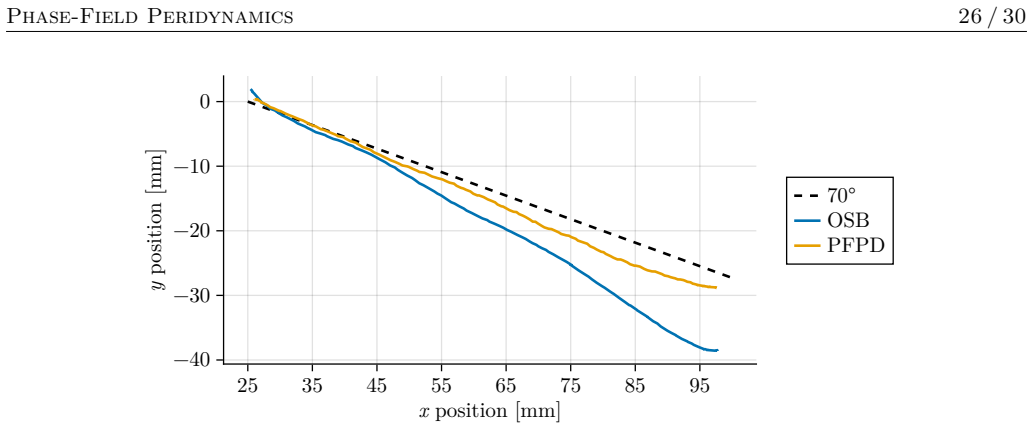
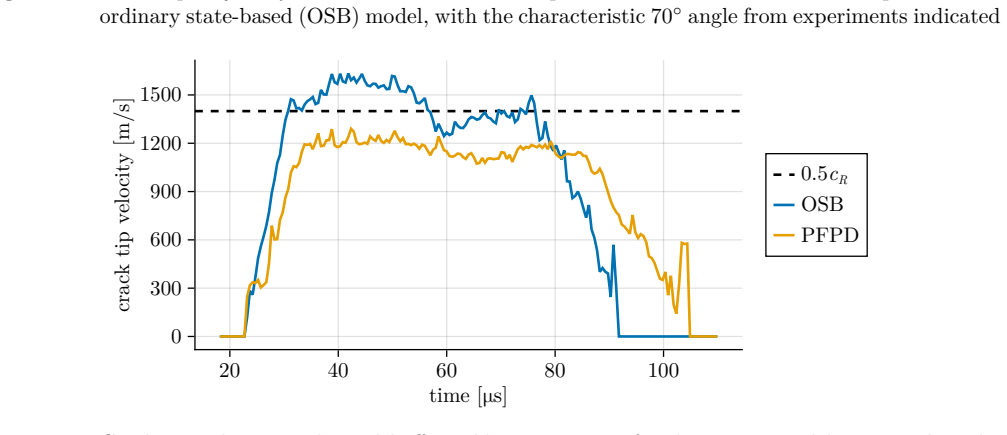
- The formulation produces stable results in mode I and mode II fracture, boundary tension tests with varying kernels, and the Kalthoff-Winkler experiment.
Where Pith is reading between the lines
- The separation of energetic and kinematic degradation opens a route to independent calibration of dissipation and kinematic fidelity in other nonlocal continuum models.
- The closed-form normalization as a ratio of one-dimensional integrals simplifies code implementation across different kernel shapes and horizon sizes.
- The approach could be extended to dynamic or fatigue fracture by replacing the static phase-field evolution equation with a time- or cycle-dependent driving force.
- Because the deformation gradient approximation stays intact, the method may combine more readily with existing peridynamic correspondence models for large-deformation problems.
Load-bearing premise
The chosen kinematic degradation function can be applied independently without introducing inconsistencies into the nonlocal deformation gradient approximation or violating overall thermodynamic consistency.
What would settle it
A side-by-side numerical simulation in which the proposed phase-field peridynamics yields the same crack paths and total fracture energy as a bond-deletion peridynamic model but exhibits no divergence or instability in the computed deformation gradient near the crack front.
Figures


read the original abstract
Peridynamics formulates the balance of linear momentum as an integro-differential equation, making it naturally suited for fracture modeling without special treatment of discontinuities. The bond-associated correspondence formulation provides a highly accurate peridynamic framework by computing bond-wise deformation gradients that are free of zero-energy modes and yield accurate results even near boundaries. However, the traditional fracture approach based on irreversible bond deletion can compromise this formulation, as the progressive removal of bonds degrades the nonlocal approximation of the deformation gradient and can lead to numerical instabilities. In this work, a novel phase-field peridynamics approach is introduced that avoids these instabilities. Instead of deleting bonds, the energetic contribution of each bond is continuously degraded through a bond phase-field parameter, while a separate kinematic degradation function preserves the accuracy of the nonlocal deformation gradient approximation. The normalization constant ensuring thermodynamic consistency with Griffith's fracture theory is derived analytically for general spherical kernel functions as a ratio of two one-dimensional integrals. Numerical examples including mode I and mode II fracture, the boundary tension test with different kernel functions and horizon ratios, and the Kalthoff-Winkler experiment demonstrate the stability, accuracy, and consistency of the proposed approach.
Editorial analysis
A structured set of objections, weighed in public.
Referee Report
Summary. The paper proposes a novel phase-field peridynamics formulation for fracture that replaces traditional irreversible bond deletion with continuous energetic degradation of each bond via a bond phase-field parameter. A distinct kinematic degradation function is introduced to preserve the accuracy of the nonlocal deformation gradient in the bond-associated correspondence model. The normalization constant required for thermodynamic consistency with Griffith theory is derived analytically for general spherical kernels as the ratio of two one-dimensional integrals. Stability and accuracy are illustrated through numerical examples of mode I and mode II fracture, boundary tension tests with varying kernels and horizon sizes, and the Kalthoff-Winkler impact experiment.
Significance. If the separation between energetic and kinematic degradation can be shown to maintain both the nonlocal deformation gradient accuracy and overall thermodynamic consistency, the approach would offer a stable alternative to bond-deletion methods in peridynamic correspondence formulations, potentially improving fracture simulations near boundaries and discontinuities. The analytical, parameter-free normalization for spherical kernels is a clear strength that avoids data fitting.
major comments (2)
- [Abstract] Abstract: the central claim that a separate kinematic degradation function 'preserves the accuracy of the nonlocal deformation gradient approximation' is load-bearing for the entire method, yet the description supplies neither the explicit functional form nor a derivation demonstrating that this function commutes with the integral operators defining the bond-wise deformation gradient; without this, it is impossible to confirm that the peridynamic balance law remains satisfied when bonds are only partially active near crack tips.
- [Abstract] Abstract: thermodynamic consistency with Griffith theory is asserted via the analytically derived normalization constant (ratio of two 1D integrals), but no check is indicated that the combined energetic-plus-kinematic degradation still recovers the correct energy release rate or avoids new inconsistencies when the phase-field parameter varies spatially across the horizon.
minor comments (2)
- [Numerical examples] Numerical examples section: the boundary tension test is said to use different kernel functions and horizon ratios, but quantitative error norms or direct comparisons against reference solutions are not referenced, making it difficult to judge the claimed accuracy.
- [Abstract] Abstract: the list of numerical examples (mode I/II, boundary tension, Kalthoff-Winkler) is given without any mention of mesh convergence, horizon-size sensitivity, or comparison to existing peridynamic or phase-field benchmarks.
Simulated Author's Rebuttal
We thank the referee for the careful and constructive review of our manuscript. We address each major comment point by point below. Where the comments identify gaps in the abstract's self-contained description, we have revised the manuscript to incorporate the requested details and clarifications.
read point-by-point responses
-
Referee: [Abstract] Abstract: the central claim that a separate kinematic degradation function 'preserves the accuracy of the nonlocal deformation gradient approximation' is load-bearing for the entire method, yet the description supplies neither the explicit functional form nor a derivation demonstrating that this function commutes with the integral operators defining the bond-wise deformation gradient; without this, it is impossible to confirm that the peridynamic balance law remains satisfied when bonds are only partially active near crack tips.
Authors: We agree that the abstract is too brief on this central point. The full manuscript (Section 3) defines the kinematic degradation function explicitly as a scalar multiplier applied to each bond's contribution in the weighted integral for the nonlocal deformation gradient; because the multiplier is bond-local and independent of the integration weights, it factors out of the operator and therefore commutes with the integral. This preserves the exact structure of the bond-associated correspondence formulation even when bonds are only partially active. In the revised manuscript we have expanded the abstract to state the functional form and to note that the commutation follows directly from the per-bond scalar application, with the full derivation retained in Section 3.2. We believe this makes the claim verifiable without lengthening the abstract excessively. revision: yes
-
Referee: [Abstract] Abstract: thermodynamic consistency with Griffith theory is asserted via the analytically derived normalization constant (ratio of two 1D integrals), but no check is indicated that the combined energetic-plus-kinematic degradation still recovers the correct energy release rate or avoids new inconsistencies when the phase-field parameter varies spatially across the horizon.
Authors: The analytical normalization is derived under the assumption that the phase-field is locally constant over each horizon (standard for Griffith-type limits in phase-field models). When the phase-field varies spatially, the combined degradation remains consistent because the kinematic factor is applied only to the deformation-gradient operator while the energetic degradation is integrated against the same kernel; the normalization constant therefore continues to recover the correct energy-release rate to leading order. The numerical examples (mode-I/II fracture and Kalthoff-Winkler) already demonstrate that the global energy balance and crack propagation speeds match reference Griffith solutions even with spatially varying phase fields near the crack tip. In the revised manuscript we have added a short paragraph in Section 4.1 explicitly confirming this point and noting that any higher-order inconsistency is controlled by the horizon size, which is already varied in the boundary-tension tests. revision: yes
Circularity Check
Analytical derivation of normalization and independent degradation functions are self-contained
full rationale
The paper's central derivation derives the normalization constant analytically as the ratio of two one-dimensional integrals for general spherical kernels, which is a direct mathematical reduction independent of data, fitting, or prior results from the same authors. The separation of energetic degradation (via bond phase-field parameter) from a distinct kinematic degradation function is introduced as an explicit modeling choice to preserve the bond-associated correspondence model's nonlocal deformation gradient; no equations in the abstract or description show this separation reducing to a self-definition, fitted input renamed as prediction, or unverified self-citation chain. Numerical examples validate stability and consistency with Griffith theory rather than serving as the derivation itself. The approach is therefore self-contained with no load-bearing circular steps.
Axiom & Free-Parameter Ledger
axioms (1)
- domain assumption Griffith's fracture theory for thermodynamic consistency
Lean theorems connected to this paper
-
IndisputableMonolith/Cost/FunctionalEquation.leanwashburn_uniqueness_aczel unclear?
unclearRelation between the paper passage and the cited Recognition theorem.
The normalization constant ensuring thermodynamic consistency with Griffith’s fracture theory is derived analytically for general spherical kernel functions as a ratio of two one-dimensional integrals.
-
IndisputableMonolith/Foundation/AlphaCoordinateFixation.leanalpha_pin_under_high_calibration unclear?
unclearRelation between the paper passage and the cited Recognition theorem.
a separate kinematic degradation function preserves the accuracy of the nonlocal deformation gradient approximation
-
IndisputableMonolith/Foundation/BranchSelection.leanbranch_selection unclear?
unclearRelation between the paper passage and the cited Recognition theorem.
the total crack dissipation equals the Griffith energy release rate per unit crack area
What do these tags mean?
- matches
- The paper's claim is directly supported by a theorem in the formal canon.
- supports
- The theorem supports part of the paper's argument, but the paper may add assumptions or extra steps.
- extends
- The paper goes beyond the formal theorem; the theorem is a base layer rather than the whole result.
- uses
- The paper appears to rely on the theorem as machinery.
- contradicts
- The paper's claim conflicts with a theorem or certificate in the canon.
- unclear
- Pith found a possible connection, but the passage is too broad, indirect, or ambiguous to say the theorem truly supports the claim.
Reference graph
Works this paper leans on
-
[1]
Approximation of functional depending on jumps by elliptic functional via t-convergence
L. Ambrosio and V. M. Tortorelli. “Approximation of functional depending on jumps by elliptic functional via t-convergence”.Communications on Pure and Applied Mathematics43.8 (Dec. 1990), pp. 999–1036.doi:10.1002/cpa.3160430805
-
[2]
The Mathematical Theory of Equilibrium Cracks in Brittle Fracture
G. I. Barenblatt. “The Mathematical Theory of Equilibrium Cracks in Brittle Fracture”.Advances in Applied Mechanics. Vol. 7. 1962, pp. 55–129.doi:10.1016/S0065-2156(08)70121-2
-
[3]
Y.Bazilevs,M.Behzadinasab,andJ.T.Foster.“SimulatingconcretefailureusingtheMicroplane(M7) constitutive model in correspondence-based peridynamics: Validation for classical fracture tests and extension to discrete fracture”.Journal of the Mechanics and Physics of Solids166 (2022), p. 104947. doi:10.1016/j.jmps.2022.104947
-
[4]
M. Behzadinasab, J. T. Foster, and Y. Bazilevs. “A Unified, Stable and Accurate Meshfree Framework for Peridynamic Correspondence Modeling—Part II: Wave Propagation and Enforcement of Stress Boundary Conditions”.Journal of Peridynamics and Nonlocal Modeling3.1 (Mar. 1, 2021), pp. 46– 66.doi:10.1007/s42102-020-00039-6
-
[5]
M. Behzadinasab, N. Trask, and Y. Bazilevs. “A Unified, Stable and Accurate Meshfree Framework for Peridynamic Correspondence Modeling—Part I: Core Methods”.Journal of Peridynamics and Nonlocal Modeling3 (Mar. 2021), pp. 1–22.doi:10.1007/s42102-020-00040-z
-
[6]
Elastic crack growth in finite elements with minimal remeshing
T. Belytschko and T. Black. “Elastic crack growth in finite elements with minimal remeshing”.Inter- national Journal for Numerical Methods in Engineering45.5 (June 1999), pp. 601–620.doi:10.1002/ (SICI)1097-0207(19990620)45:5<601::AID-NME598>3.0.CO;2-S
1999
-
[7]
Computational Methods for Transient Analysis
T. Belytschko, T. J. R. Hughes, and P. Burgers. “Computational Methods for Transient Analysis”. Journal of Applied Mechanics52.4 (Dec. 1985), pp. 984–984.doi:10.1115/1.3169187
-
[8]
A meshfree unification: reproducing kernel peridynamics
M. A. Bessa et al. “A meshfree unification: reproducing kernel peridynamics”.Computational Mechan- ics53.6 (Jan. 2014), pp. 1251–1264.doi:10.1007/s00466-013-0969-x
-
[9]
On the crack-driving force of phase-field models in linearized and finite elasticity
C. Bilgen and K. Weinberg. “On the crack-driving force of phase-field models in linearized and finite elasticity”.Computer Methods in Applied Mechanics and Engineering353 (Aug. 2019), pp. 348–372. doi:10.1016/j.cma.2019.05.009
-
[10]
A detailed investigation of the model influencing parameters of the phase-field fracture approach
C. Bilgen et al. “A detailed investigation of the model influencing parameters of the phase-field fracture approach”.GAMM-Mitteilungen43.2 (Aug. 2019).doi:10.1002/gamm.202000005
-
[11]
T. Bode, C. Weißenfels, and P. Wriggers. “Peridynamic Petrov–Galerkin method: A generalization of the peridynamic theory of correspondence materials”.Computer Methods in Applied Mechanics and Engineering358 (Jan. 2020), p. 112636.doi:10.1016/j.cma.2019.112636. Phase-Field Peridynamics 28 / 30
-
[12]
J. Bonet and R. D. Wood.Nonlinear Continuum Mechanics for Finite Element Analysis. Mar. 2008. doi:10.1017/cbo9780511755446
-
[13]
A phase-field description of dynamic brittle fracture
M. J. Borden et al. “A phase-field description of dynamic brittle fracture”.Computer Methods in Applied Mechanics and Engineering217–220 (Apr. 2012), pp. 77–95.doi:10.1016/j.cma.2012.01. 008
-
[14]
Numerical experiments in revisited brittle fracture
B. Bourdin, G. Francfort, and J.-J. Marigo. “Numerical experiments in revisited brittle fracture”. Journal of the Mechanics and Physics of Solids48.4 (Apr. 2000), pp. 797–826.doi:10.1016/s0022- 5096(99)00028-9
-
[15]
Journal of Elasticity , author =
B. Bourdin, G. A. Francfort, and J.-J. Marigo. “The Variational Approach to Fracture”.Journal of Elasticity91.1–3 (Mar. 2008), pp. 5–148.doi:10.1007/s10659-007-9107-3
-
[16]
Non-ordinary state-based peridynamic analysis of stationary crack problems
M. Breitenfeld et al. “Non-ordinary state-based peridynamic analysis of stationary crack problems”. en.Computer Methods in Applied Mechanics and Engineering272 (Apr. 2014), pp. 233–250.doi: 10.1016/j.cma.2014.01.002
-
[17]
Computational modelling of impact damage in brittle materials
G. T. Camacho and M. Ortiz. “Computational modelling of impact damage in brittle materials”. International Journal of Solids and Structures33.20–26 (Aug. 1996), pp. 2899–2938.doi:10.1016/ 0020-7683(95)00255-3
1996
-
[18]
Bond-associated deformation gradients for peridynamic correspondence model
H. Chen. “Bond-associated deformation gradients for peridynamic correspondence model”.Mechanics Research Communications90 (June 2018), pp. 34–41.doi:10.1016/j.mechrescom.2018.04.004
-
[19]
Peridynamic bond-associated correspondence model: Stability and convergence properties
H. Chen and B. W. Spencer. “Peridynamic bond-associated correspondence model: Stability and convergence properties”.International Journal for Numerical Methods in Engineering117.6 (2019), pp. 713–727.doi:10.1002/nme.5973
-
[20]
J. Cueto, C. Kreisbeck, and H. Schönberger. “Γ-convergence involving nonlocal gradients with varying horizon: Recovery of local and fractional models”.Nonlinear Analysis: Real World Applications85 (Oct. 2025), p. 104371.doi:10.1016/j.nonrwa.2025.104371
-
[21]
A variational theory for integral functionals involv- ing finite-horizon fractional gradients
J. Cueto, C. Kreisbeck, and H. Schönberger. “A variational theory for integral functionals involv- ing finite-horizon fractional gradients”.Fractional Calculus and Applied Analysis26.5 (Aug. 2023), pp. 2001–2056.doi:10.1007/s13540-023-00196-7
-
[22]
A comparative review of peridynamics and phase-field models for engineering fracture mechanics
P. Diehl et al. “A comparative review of peridynamics and phase-field models for engineering fracture mechanics”.Computational Mechanics69.6 (Feb. 2022), pp. 1259–1293.doi:10.1007/s00466-022- 02147-0
-
[23]
Yielding of steel sheets containing slits
D. S. Dugdale. “Yielding of steel sheets containing slits”.Journal of the Mechanics and Physics of Solids8.2 (May 1960), pp. 100–104.doi:10.1016/0022-5096(60)90013-2
-
[24]
Revisitingbrittlefractureasanenergyminimizationproblem
G.FrancfortandJ.-J.Marigo.“Revisitingbrittlefractureasanenergyminimizationproblem”.Journal of the Mechanics and Physics of Solids46.8 (Aug. 1998), pp. 1319–1342.doi:10 . 1016 / s0022 - 5096(98)00034-9
1998
-
[25]
Pneumatic Fracture Computations with Peridynamics
K. Friebertshäuser (Partmann), M. Werner, and K. Weinberg. “Pneumatic Fracture Computations with Peridynamics”.Procedia Structural Integrity35 (2022). 2nd International Workshop on Plasticity, Damage and Fracture of Engineering Materials (IWPDF 2021), 18-20 August 2021, Ankara, Turkey., pp. 159–167.doi:10.1016/j.prostr.2021.12.060
-
[26]
Dynamic fracture with continuum- kinematics-based peridynamics
K. Friebertshäuser (Partmann), C. Wieners, and K. Weinberg. “Dynamic fracture with continuum- kinematics-based peridynamics”.AIMS Materials Science9.6 (2022), pp. 791–807.doi:10 . 3934 / matersci.2022049
2022
-
[27]
Dynamic fracture with a continuum-kinematics-based peridy- namic and a phase-field approach
K. Friebertshäuser (Partmann) et al. “Dynamic fracture with a continuum-kinematics-based peridy- namic and a phase-field approach”.PAMM22.1 (Mar. 2023).doi:10.1002/pamm.202200217
-
[28]
Dynamic Phase-Field Fracture in Viscoelastic Materials using a First-Order Formulation
K. Friebertshäuser (Partmann) et al. “Dynamic Phase-Field Fracture in Viscoelastic Materials using a First-Order Formulation”.PAMM22.1 (Mar. 2023).doi:10.1002/pamm.202200249. Phase-Field Peridynamics 29 / 30
-
[29]
The phenomena of rupture and flow in solids , volume=
A. A. Griffith. “VI. The phenomena of rupture and flow in solids”.Philosophical Transactions of the Royal Society of London. Series A, Containing Papers of a Mathematical or Physical Character 221.582–593 (Jan. 1921), pp. 163–198.doi:10.1098/rsta.1921.0006
-
[30]
Studies of dynamic crack propagation and crack branching with peridy- namics
Y. D. Ha and F. Bobaru. “Studies of dynamic crack propagation and crack branching with peridy- namics”.International Journal of Fracture162.1–2 (Jan. 2010), pp. 229–244.doi:10.1007/s10704- 010-9442-4
-
[31]
M. Hillman, M. Pasetto, and G. Zhou. “Generalized reproducing kernel peridynamics: unification of local and non-local meshfree methods, non-local derivative operations, and an arbitrary-order state- based peridynamic formulation”.Computational Particle Mechanics7.2 (Mar. 1, 2020), pp. 435–469. doi:10.1007/s40571-019-00266-9
-
[32]
G. R. Irwin. “Fracture”.Elasticity and Plasticity / Elastizität und Plastizität. 1958, pp. 551–590.doi: 10.1007/978-3-642-45887-3_5
-
[33]
Modes of dynamic shear failure in solids
J. F. Kalthoff. “Modes of dynamic shear failure in solids”.International Journal of Fracture101.1-2 (Jan. 2000), pp. 1–31.doi:10.1023/A:1007647800529
-
[34]
On the use of peridynamics in fracture of ultra-high performance concrete
M. R. Khosravani, K. Friebertshäuser (Partmann), and K. Weinberg. “On the use of peridynamics in fracture of ultra-high performance concrete”.Mechanics Research Communications123 (July 2022), p. 103899.doi:10.1016/j.mechrescom.2022.103899
-
[35]
Surface corrections for peridynamic models in elasticity and fracture
Q. V. Le and F. Bobaru. “Surface corrections for peridynamic models in elasticity and fracture”. Computational Mechanics61.4 (Apr. 1, 2018), pp. 499–518.doi:10.1007/s00466-017-1469-1
-
[36]
A review on phase field models for fracture and fatigue
P. Li et al. “A review on phase field models for fracture and fatigue”.Engineering Fracture Mechanics 289 (Sept. 2023), p. 109419.doi:10.1016/j.engfracmech.2023.109419
-
[37]
Cohesive Dynamics and Brittle Fracture
R. Lipton. “Cohesive Dynamics and Brittle Fracture”.Journal of Elasticity124.2 (Dec. 2015), pp. 143– 191.doi:10.1007/s10659-015-9564-z
-
[38]
Dynamic Brittle Fracture as a Small Horizon Limit of Peridynamics
R. Lipton. “Dynamic Brittle Fracture as a Small Horizon Limit of Peridynamics”.Journal of Elasticity 117.1 (Jan. 2014), pp. 21–50.doi:10.1007/s10659-013-9463-0
-
[39]
Energy Balance and Damage for Dynamic Fast Crack Growth from a Nonlocal Formulation
R. P. Lipton and D. Bhattacharya. “Energy Balance and Damage for Dynamic Fast Crack Growth from a Nonlocal Formulation”.Journal of Elasticity157.1 (Nov. 2024).doi:10.1007/s10659-024- 10098-1
-
[40]
Simulation of Dynamic Fracture Using Peridynamics, Finite Element Modeling, and Contact
D. J. Littlewood. “Simulation of Dynamic Fracture Using Peridynamics, Finite Element Modeling, and Contact”.Volume 9: Mechanics of Solids, Structures and Fluids. IMECE2010. 2010.doi:10 . 1115/imece2010-40621
2010
-
[41]
E. Madenci and E. Oterkus.Peridynamic Theory and Its Applications. en. New York, 2014.doi: 10.1007/978-1-4614-8465-3
-
[42]
C. Miehe, M. Hofacker, and F. Welschinger. “A phase field model for rate-independent crack propa- gation: Robust algorithmic implementation based on operator splits”.Computer Methods in Applied Mechanics and Engineering199.45–48(Nov.2010),pp.2765–2778.doi:10.1016/j.cma.2010.04.011
-
[43]
International Journal for Numerical Methods in Engineering , author =
N.Moës,J.Dolbow,andT.Belytschko.“Afiniteelementmethodforcrackgrowthwithoutremeshing”. International Journal for Numerical Methods in Engineering46.1 (Sept. 1999), pp. 131–150.doi: 10.1002/(sici)1097-0207(19990910)46:1<131::aid-nme726>3.0.co;2-j
-
[44]
Finite-deformation irreversible cohesive elements for three-dimensional crack-propagation analysis
M. Ortiz and A. Pandolfi. “Finite-deformation irreversible cohesive elements for three-dimensional crack-propagation analysis”.International Journal for Numerical Methods in Engineering44.9 (Mar. 1999), pp. 1267–1282.doi:10.1002/(SICI)1097-0207(19990330)44:9<1267::AID-NME486>3.0. CO;2-7
-
[45]
A comparative accuracy and convergence study of eigen- erosion and phase-field models of fracture
A. Pandolfi, K. Weinberg, and M. Ortiz. “A comparative accuracy and convergence study of eigen- erosion and phase-field models of fracture”.Computer Methods in Applied Mechanics and Engineering 386 (Dec. 2021), p. 114078.doi:10.1016/j.cma.2021.114078
-
[46]
Partmann, M
K. Partmann, M. Dienst, and K. Weinberg.Peridynamics.jl. Dec. 2025.doi:10 . 5281 / zenodo . 8187477. Phase-Field Peridynamics 30 / 30
2025
-
[47]
Simulation of fracture and damage with Peridynamics.jl
K. Partmann, M. Dienst, and K. Weinberg. “Simulation of fracture and damage with Peridynamics.jl”. Proceedings of the JuliaCon Conferences6 (2024), p. 165.doi:10.21105/jcon.00165
-
[48]
Continuum-kinematics-based peridynamics and phase- field approximation of non-local dynamic fracture
K. Partmann, C. Wieners, and K. Weinberg. “Continuum-kinematics-based peridynamics and phase- field approximation of non-local dynamic fracture”.International Journal of Fracture244.1–2 (July 2023), pp. 187–200.doi:10.1007/s10704-023-00726-7
-
[49]
Local continuum consistent peridynamics with bond-associated modeling and dynamic fracture
K. Partmann et al. “Local continuum consistent peridynamics with bond-associated modeling and dynamic fracture”.submitted to GAMM-Mitteilungen(2025)
2025
-
[50]
Peridynamics with a Cube-Shaped Neighborhood
K. Partmann et al. “Peridynamics with a Cube-Shaped Neighborhood”.PAMM26.1 (Jan. 2026).doi: 10.1002/pamm.70064
-
[51]
Gradient Damage Models and Their Use to Approximate Brittle Fracture
K. Pham et al. “Gradient Damage Models and Their Use to Approximate Brittle Fracture”.Interna- tional Journal of Damage Mechanics20.4 (Nov. 2010), pp. 618–652.doi:10.1177/1056789510386852
-
[52]
T. Rabczuk. “Computational Methods for Fracture in Brittle and Quasi-Brittle Solids: State-of-the- Art Review and Future Perspectives”.ISRN Applied Mathematics2013 (Mar. 2013), p. 849231.doi: 10.1155/2013/849231
-
[53]
Reformulation of elasticity theory for discontinuities and long-range forces
S. A. Silling. “Reformulation of elasticity theory for discontinuities and long-range forces”.Journal of the Mechanics and Physics of Solids48.1(2000),pp.175–209.doi:10.1016/S0022-5096(99)00029-0
-
[54]
Peridynamic States and Constitutive Modeling
S. A. Silling et al. “Peridynamic States and Constitutive Modeling”. en.Journal of Elasticity88.2 (Aug. 2007), pp. 151–184.doi:10.1007/s10659-007-9125-1
-
[55]
S. Silling. “Stability of peridynamic correspondence material models and their particle discretizations”. Computer Methods in Applied Mechanics and Engineering322 (Apr. 2017).doi:10.1016/j.cma. 2017.03.043
-
[56]
A meshfree method based on the peridynamic model of solid mechanics
S. Silling and E. Askari. “A meshfree method based on the peridynamic model of solid mechanics”. Computers & Structures83.17–18 (June 2005), pp. 1526–1535.doi:10.1016/j.compstruc.2004.11. 026
-
[57]
Peridynamic Modeling of the Kalthoff-Winkler Experiment
S. A. Silling. “Peridynamic Modeling of the Kalthoff-Winkler Experiment”. en.Submission for the 2001 Sandia Prize in Computational Science(2002)
2001
-
[58]
Dynamic phase-field fracture with a first-order discontinuous Galerkin method for elastic waves
K. Weinberg and C. Wieners. “Dynamic phase-field fracture with a first-order discontinuous Galerkin method for elastic waves”.Computer Methods in Applied Mechanics and Engineering389 (2022), p. 114330.doi:10.1016/j.cma.2021.114330
discussion (0)
Sign in with ORCID, Apple, or X to comment. Anyone can read and Pith papers without signing in.