Recognition: 2 theorem links
· Lean TheoremGeRM: A Generative Rendering Model From Physically Realistic to Photorealistic
Pith reviewed 2026-05-10 17:49 UTC · model grok-4.3
The pith
GeRM models the shift from physically-based to photorealistic rendering as a learnable distribution transfer vector field.
A machine-rendered reading of the paper's core claim, the machinery that carries it, and where it could break.
Core claim
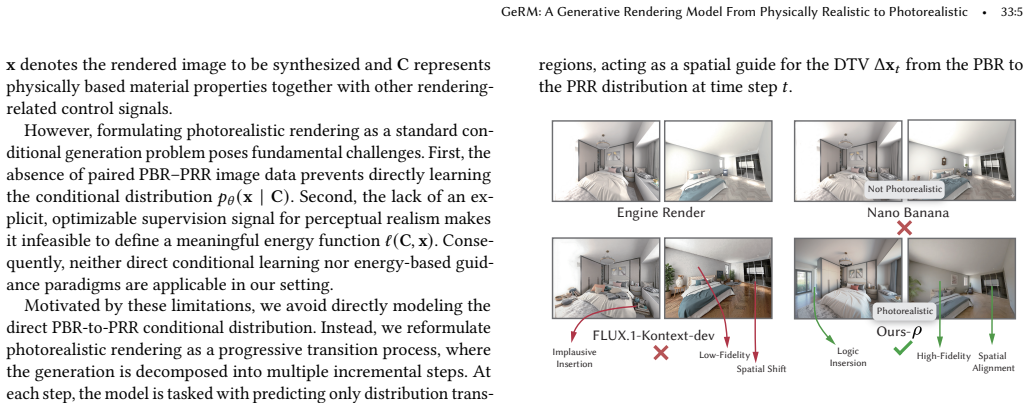
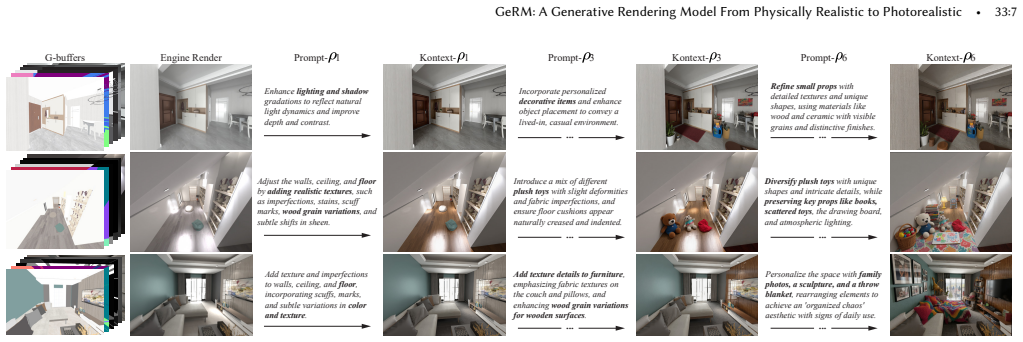
The transition between PBR and PRR images can be modeled as a distribution transfer problem. By constructing a pairwise dataset P2P-50K with a multi-agent VLM framework, the authors define transfer vectors. A multi-condition ControlNet then learns the distribution transfer vector field, taking G-buffers and text prompts as conditions to synthesize PBR images and progressively refine them into PRR images with enhanced regions.
What carries the argument
The distribution transfer vector field (DTV Field), which encodes the incremental shift from PBR to PRR and is learned by a multi-condition ControlNet guided by G-buffers and text.
If this is right
- Users gain continuous control to adjust images along the spectrum from strict physical simulation to visual appeal.
- Geometric consistency is enforced throughout by conditioning on G-buffers rather than regenerating from scratch.
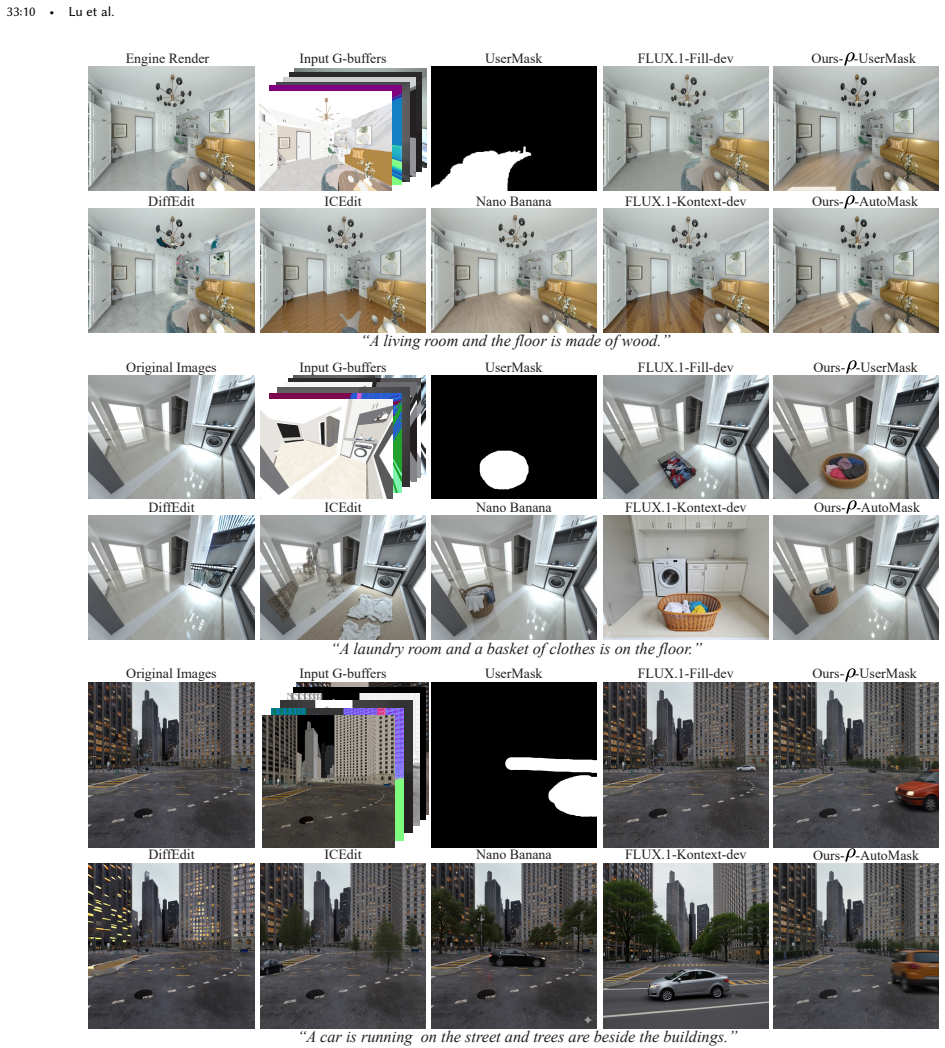
- Text prompts allow targeted enhancement of specific regions without altering the underlying physical attributes.
- The same trained field supports both pure PBR fidelity and full photorealistic output as endpoints of one process.
Where Pith is reading between the lines
- The vector-field framing could generalize to other image-to-image shifts where an explicit physical prior exists, such as from low-fidelity simulation to high-detail animation.
- Integration into existing rendering pipelines might reduce the need for manual texturing or post-processing steps by automating the perceptual lift.
- If the field proves invertible, it could also support diagnostic tasks like estimating physical parameters from a final photorealistic image.
Load-bearing premise
That a multi-agent vision-language model framework can build a dataset of image pairs whose differences accurately represent the intended move from physical accuracy to perceptual photorealism.
What would settle it
Generate outputs from the trained model on held-out PBR inputs and check whether human raters consistently rate them as more photorealistic than the originals while structure and geometry remain intact; failure on either criterion would undermine the claim.
Figures








read the original abstract
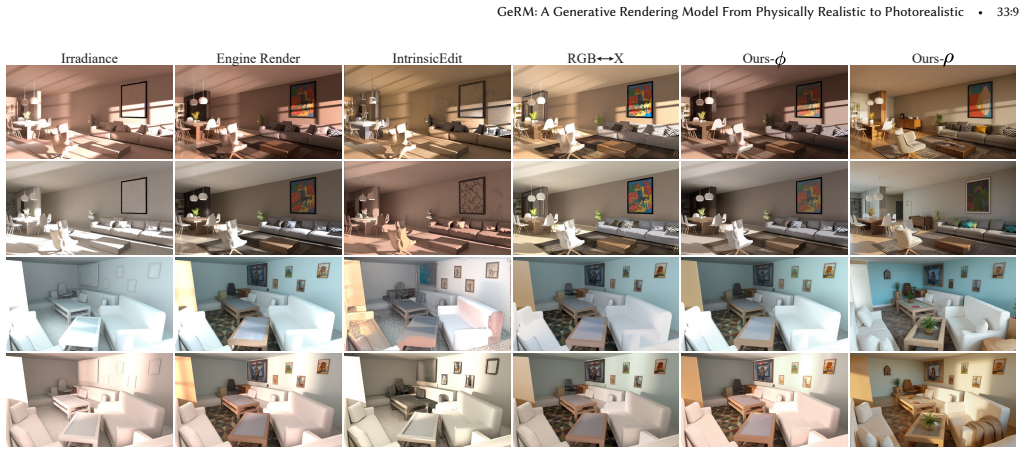
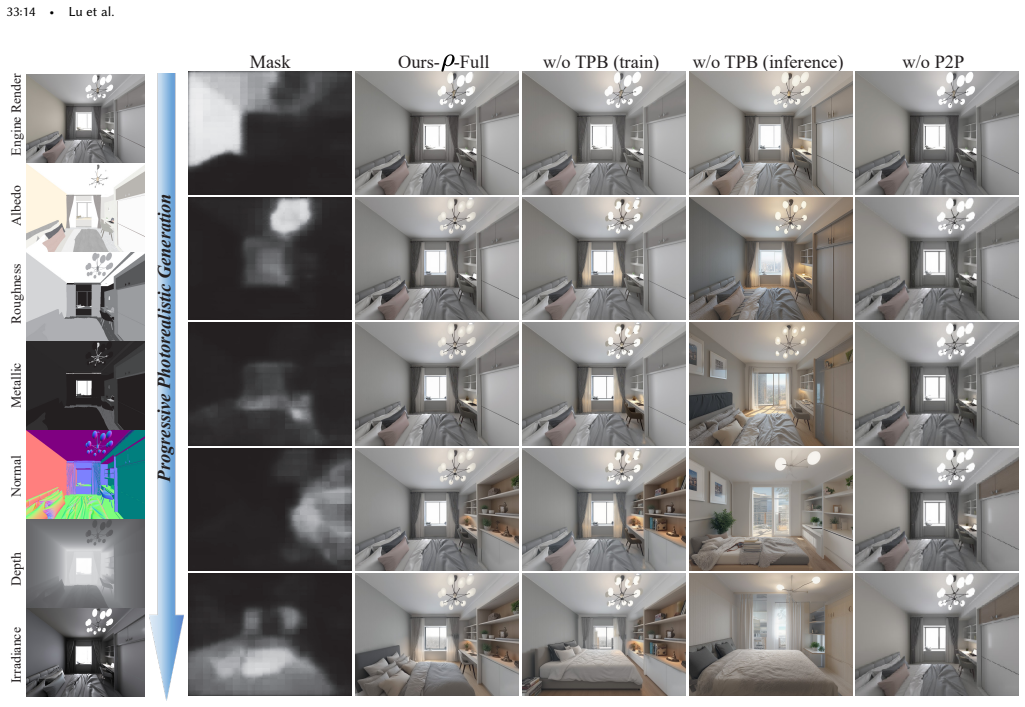
For decades, Physically-Based Rendering (PBR) is the fundation of synthesizing photorealisitic images, and therefore sometimes roughly referred as Photorealistic Rendering (PRR). While PBR is indeed a mathematical simulation of light transport that guarantees physical reality, photorealism has additional reliance on the realistic digital model of geometry and appearance of the real world, leaving a barely explored gap from PBR to PRR (P2P). Consequently, the path toward photorealism faces a critical dilemma: the explicit simulation of PRR encumbered by unreachable realistic digital models for real-world existence, while implicit generation models sacrifice controllability and geometric consistency. Based on this insight, this paper presents the problem, data, and approach of mitigating P2P gap, followed by the first multi-modal generative rendering model, dubbed GeRM, to unify PBR and PRR. GeRM integrates physical attributes like G-buffers with text prompts, and progressive incremental injection to generate controllable photorealistic images, allowing users to fluidly navigate the continuum between strict physical fidelity and perceptual photorealism. Technically, we model the transition between PBR and PRR images as a distribution transfer and aim to learn a distribution transfer vector field (DTV Field) to guide this process. To define the learning objective, we first leverage a multi-agent VLM framework to construct an expert-guided pairwise P2P transfer dataset, named P2P-50K, where each paired sample in the dataset corresponds to a transfer vector in the DTV Field. Subsequently, we propose a multi-condition ControlNet to learn the DTV Field, which synthesizes PBR images and progressively transitions them into PRR images, guided by G-buffers, text prompts, and cues for enhanced regions.
Editorial analysis
A structured set of objections, weighed in public.
Referee Report
Summary. The manuscript introduces GeRM, the first multi-modal generative rendering model to unify Physically-Based Rendering (PBR) and Photorealistic Rendering (PRR). It frames the PBR-to-PRR gap as a distribution transfer problem, constructs a P2P-50K pairwise dataset via a multi-agent VLM framework to extract transfer vectors, and trains a multi-condition ControlNet to learn a Distribution Transfer Vector (DTV) Field. The model integrates G-buffers, text prompts, and progressive incremental injection to enable controllable generation of images that navigate the continuum from strict physical fidelity to perceptual photorealism.
Significance. If the DTV Field is shown to accurately capture and apply the intended perceptual shifts, this approach could meaningfully advance controllable generative rendering by combining the geometric consistency of PBR with the perceptual enhancements of PRR. The P2P-50K dataset and the multi-condition ControlNet architecture offer a concrete mechanism for incremental, user-guided transitions, which may influence future work on hybrid simulation-perception pipelines in computer vision and graphics.
major comments (3)
- [Abstract] Abstract: The description of the method and P2P-50K dataset supplies no experimental results, ablation studies, quantitative metrics (e.g., FID, LPIPS, or human ratings), or consistency checks on G-buffers to demonstrate that the learned DTV Field achieves the claimed unification or controllability. This absence is load-bearing for the central claim that GeRM enables fluid navigation between PBR and PRR.
- [Dataset construction] Dataset construction (described in the abstract and likely §3): The multi-agent VLM framework used to generate the expert-guided pairwise P2P-50K transfer vectors receives no independent verification, such as expert human evaluations, artifact analysis, or geometric consistency metrics. Without this, it is unclear whether the extracted vectors faithfully encode the desired PBR-to-PRR distribution shift or instead embed VLM hallucinations and inconsistencies that the ControlNet would then optimize for.
- [Technical approach] Technical approach (abstract and likely §4): The multi-condition ControlNet is presented as learning the DTV Field via progressive injection, yet no derivation, loss formulation, or training details are supplied to show how the field remains stable or controllable across the continuum; the objective reduces directly to fitting the unverified VLM pairs.
minor comments (2)
- [Abstract] Abstract contains typographical errors including 'fundation' (should be 'foundation') and 'photorealisitic' (should be 'photorealistic').
- [Abstract] The acronym P2P is defined as the gap from PBR to PRR but could be introduced with a clearer sentence to avoid initial ambiguity with other uses of the abbreviation.
Simulated Author's Rebuttal
We thank the referee for the constructive and detailed feedback. We agree that the current manuscript version requires additional experimental validation, dataset verification, and technical exposition to fully support the central claims. We will prepare a major revision that incorporates these elements while preserving the core contribution of modeling the PBR-to-PRR transition via a learned DTV Field.
read point-by-point responses
-
Referee: [Abstract] Abstract: The description of the method and P2P-50K dataset supplies no experimental results, ablation studies, quantitative metrics (e.g., FID, LPIPS, or human ratings), or consistency checks on G-buffers to demonstrate that the learned DTV Field achieves the claimed unification or controllability. This absence is load-bearing for the central claim that GeRM enables fluid navigation between PBR and PRR.
Authors: We acknowledge that the abstract and early sections emphasize the problem formulation and architecture without foregrounding results. The full manuscript contains quantitative evaluations (FID, LPIPS, and user studies) and ablation studies on controllability in Section 5, but these were not summarized in the abstract. In the revision we will (1) expand the abstract with a concise report of the key metrics and (2) add explicit G-buffer consistency checks (e.g., edge and normal alignment scores) to demonstrate that the generated images remain geometrically faithful while moving along the DTV Field. revision: yes
-
Referee: [Dataset construction] Dataset construction (described in the abstract and likely §3): The multi-agent VLM framework used to generate the expert-guided pairwise P2P-50K transfer vectors receives no independent verification, such as expert human evaluations, artifact analysis, or geometric consistency metrics. Without this, it is unclear whether the extracted vectors faithfully encode the desired PBR-to-PRR distribution shift or instead embed VLM hallucinations and inconsistencies that the ControlNet would then optimize for.
Authors: We agree that independent verification of the P2P-50K construction pipeline is essential. The current manuscript describes the multi-agent VLM procedure but does not report human validation. In the revision we will add: (a) a human evaluation study on a 500-pair subset where experts rate transfer-vector quality and absence of hallucinations, (b) quantitative artifact analysis (e.g., perceptual hash distance and semantic segmentation consistency), and (c) geometric consistency metrics comparing G-buffers before and after transfer. These results will be presented in a new subsection of §3. revision: yes
-
Referee: [Technical approach] Technical approach (abstract and likely §4): The multi-condition ControlNet is presented as learning the DTV Field via progressive injection, yet no derivation, loss formulation, or training details are supplied to show how the field remains stable or controllable across the continuum; the objective reduces directly to fitting the unverified VLM pairs.
Authors: We accept that the loss derivation and training protocol must be made explicit. Section 4 currently sketches the multi-condition ControlNet and progressive injection but omits the full objective. In the revision we will insert: (i) the mathematical formulation of the DTV Field as a learned vector field in latent space, (ii) the composite loss (reconstruction + perceptual + consistency terms with progressive weighting), (iii) training hyperparameters and the incremental injection schedule, and (iv) an analysis showing that the field remains Lipschitz-stable across the continuum. These additions will clarify how controllability is achieved beyond simply fitting the VLM pairs. revision: yes
Circularity Check
No significant circularity in the derivation chain
full rationale
The paper's claimed chain proceeds by first using an external multi-agent VLM framework to construct the P2P-50K dataset of transfer vectors, then training a multi-condition ControlNet to learn the DTV Field from that dataset. This is a standard data-generation-then-supervised-training pipeline with no equations or claims that reduce the learned field or the unification of PBR/PRR back to the inputs by construction. No self-definitional loops, fitted inputs renamed as predictions, load-bearing self-citations, uniqueness theorems, or smuggled ansatzes appear in the abstract or described methodology. The central model is therefore self-contained against external benchmarks.
Axiom & Free-Parameter Ledger
Lean theorems connected to this paper
-
IndisputableMonolith/Cost/FunctionalEquation.leanwashburn_uniqueness_aczel unclearwe model the transition between PBR and PRR images as a distribution transfer and aim to learn a distribution transfer vector field (DTV Field) ... multi-condition ControlNet to learn the DTV Field ... progressive incremental injection
-
IndisputableMonolith/Foundation/ArithmeticFromLogic.leanLogicNat induction and 8-tick orbit unclearprogressive steps ... convergence ... Semantic Residual Monitoring ... I_t = M_t · ||x_{t+1} - x_t||_1
Reference graph
Works this paper leans on
-
[1]
PRISM: A Unified Framework for Photorealistic Reconstruction and Intrinsic Scene Modeling.arXiv preprint arXiv:2504.14219(2025). Epic Games. [n. d.]. Unreal Engine. https://www.unrealengine.com/. Accessed: Sep. 29, 2024. Andreas Geiger, Philip Lenz, and Raquel Urtasun. 2012. Are we ready for autonomous driving? The KITTI vision benchmark suite.2012 IEEE C...
-
[2]
Flow Straight and Fast: Learning to Generate and Transfer Data with Rectified Flow
Flow Matching for Generative Modeling. InThe Eleventh International Confer- ence on Learning Representations. https://openreview.net/forum?id=PqvMRDCJT9t Xingchao Liu, Chengyue Gong, and Qiang Liu. 2022. Flow straight and fast: Learning to generate and transfer data with rectified flow.arXiv preprint arXiv:2209.03003 (2022). Jiayuan Lu, Rengan Xie, Zixuan...
work page internal anchor Pith review Pith/arXiv arXiv 2022
-
[3]
High-resolution image synthesis with latent diffusion models. InProceedings of the IEEE/CVF conference on computer vision and pattern recognition. 10684–10695. Christoph Schuhmann, Romain Beaumont, Richard Vencu, Cade Gordon, Ross Wight- man, Mehdi Cherti, Theo Coombes, Aarush Katta, Clayton Mullis, Mitchell Worts- man, et al. 2022. Laion-5b: An open larg...
discussion (0)
Sign in with ORCID, Apple, or X to comment. Anyone can read and Pith papers without signing in.