Recognition: unknown
Improved Matlab code for Lyapunov exponents of fractional order systems
Pith reviewed 2026-05-10 16:44 UTC · model grok-4.3
The pith
An improved Matlab code computes Lyapunov exponents for fractional-order systems using QR reorthonormalization and a quadratic LIL integrator.
A machine-rendered reading of the paper's core claim, the machinery that carries it, and where it could break.
Core claim
Replacing the Gram-Schmidt procedure with QR reorthonormalization and switching to the quadratic LIL predictor-corrector scheme produces a single compact Matlab function that computes Lyapunov exponents for both commensurate and non-commensurate fractional-order systems while retaining the full-memory Caputo structure.
What carries the argument
The quadratic LIL predictor-corrector scheme together with QR reorthonormalization applied to the extended variational system in full-memory form.
If this is right
- The same code handles both commensurate and non-commensurate fractional orders without separate implementations.
- Higher-order integration from the quadratic LIL scheme improves accuracy relative to earlier predictor-corrector versions.
- Full-memory retention ensures consistency with the original Caputo model for long-time simulations.
- Benchmark comparisons confirm the method's performance against standard ABM-type integrators.
Where Pith is reading between the lines
- The supplied code could serve as a base for adding other fractional derivatives such as Riemann-Liouville.
- Efficiency gains may allow repeated computation of exponents inside parameter-optimization loops.
- The QR approach might reduce sensitivity to round-off in high-dimensional fractional systems.
Load-bearing premise
The quadratic LIL predictor-corrector scheme combined with QR reorthonormalization computes the Lyapunov exponents accurately without introducing large numerical errors or instabilities.
What would settle it
Running the code on a fractional system with independently known exact Lyapunov exponents and finding deviations larger than the method's expected truncation error would falsify the accuracy claim.
Figures

read the original abstract
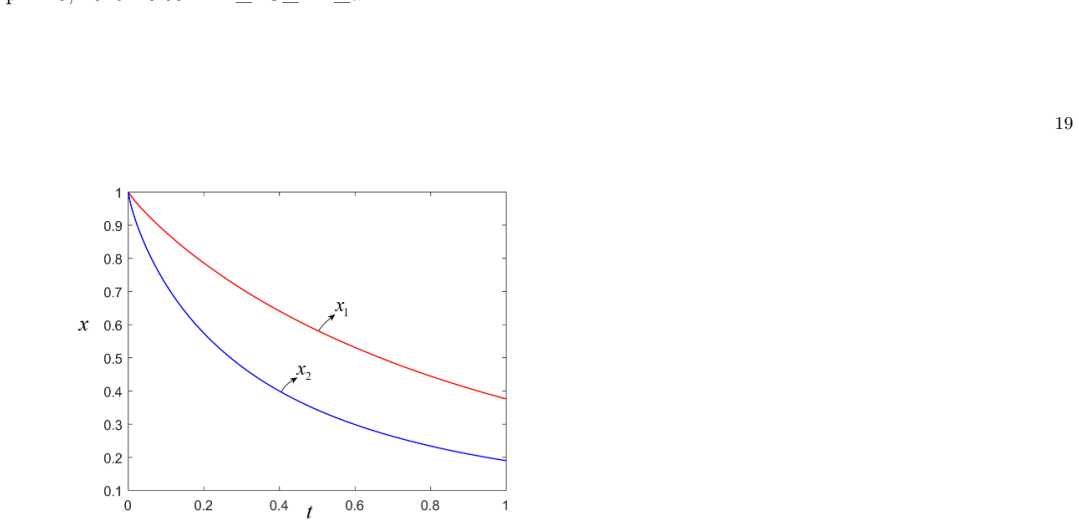
This paper presents an improved Matlab routine, FO_LE, for the numerical computation of Lyapunov exponents of fractional-order systems modeled by Caputo's derivative. It is conceived as an enhanced version of the former FO_Lyapunov and FO_NC_Lyapunov codes for commensurate and non-commensurate orders, respectively. The proposed approach replaces the Gram-Schmidt orthogonalization procedure with QR-based reorthonormalization and uses the new quadratic LIL predictor-corrector scheme for the integration of the extended variational system. Compared with the former implementations, the present routine benefits from the higher order of the fractional integrator LIL and applies to both commensurate and non-commensurate models. Like the previous code, FO_LE retains the full memory structure of the underlying Caputo model. The Matlab code for the LIL solver and for the computation of Lyapunov exponents with FO_LE are provided, while a fast implementation of LIL for commensurate and non-commensurate orders, LIL_nc, is available on MathWorks File Exchange. A benchmark problem with exact solution is used to compare the LIL-based solver with ABM-type methods, whereas the Rabinovich-Fabrikant system illustrates the computation of Lyapunov exponents in different dynamical regimes. The results indicate that the proposed implementation is a compact, robust, and efficient tool for the numerical study of stability and chaos in fractional-order systems.
Editorial analysis
A structured set of objections, weighed in public.
Referee Report
Summary. The manuscript presents an improved MATLAB routine FO_LE for computing Lyapunov exponents of fractional-order Caputo systems. It upgrades earlier codes (FO_Lyapunov and FO_NC_Lyapunov) by replacing Gram-Schmidt with QR reorthonormalization and adopting a quadratic LIL predictor-corrector integrator for the extended variational system. The implementation supports both commensurate and non-commensurate orders while preserving the full-memory structure, supplies the source code, and demonstrates the solver via a benchmark problem possessing an exact solution (comparing LIL against ABM-type methods) together with an illustrative computation on the Rabinovich-Fabrikant system across different dynamical regimes.
Significance. If the numerical accuracy of the combined LIL-QR procedure is confirmed, the work supplies a compact, higher-order, open-source tool that can facilitate reproducible studies of stability and chaos in fractional-order systems. The explicit provision of both the LIL solver and the FO_LE routine, plus the fast LIL_nc variant on MathWorks File Exchange, constitutes a concrete contribution to reproducibility in the field.
major comments (2)
- [Abstract] Abstract and benchmark description: the claim that FO_LE is 'robust' rests on the quadratic LIL predictor-corrector plus QR reorthonormalization producing accurate Lyapunov exponents, yet only the underlying LIL integrator is compared against ABM methods on a benchmark with exact solution; no error norms, step-size convergence rates, or direct LE-value comparisons for the full variational integration are reported.
- [Rabinovich-Fabrikant example] Rabinovich-Fabrikant illustration: the manuscript states that the code computes Lyapunov exponents 'in different dynamical regimes' but supplies no tabulated LE values, no comparison against literature results for the same parameter sets, and no discussion of possible instabilities arising from the full-memory implementation in non-commensurate cases.
minor comments (2)
- The manuscript should explicitly state the fractional orders and parameter values used in the Rabinovich-Fabrikant demonstration so that readers can reproduce the reported regimes.
- Clarify whether the supplied FO_LE code includes built-in options for varying the memory length or step-size adaptation, as these choices directly affect practical use.
Simulated Author's Rebuttal
We thank the referee for the constructive feedback on our manuscript. We address each major comment point by point below, indicating the revisions we intend to make to strengthen the presentation of our results and code.
read point-by-point responses
-
Referee: [Abstract] Abstract and benchmark description: the claim that FO_LE is 'robust' rests on the quadratic LIL predictor-corrector plus QR reorthonormalization producing accurate Lyapunov exponents, yet only the underlying LIL integrator is compared against ABM methods on a benchmark with exact solution; no error norms, step-size convergence rates, or direct LE-value comparisons for the full variational integration are reported.
Authors: We agree that the robustness claim would be better supported by explicit validation of the full LE computation. The benchmark validates the LIL integrator on the extended variational system (which incorporates the linearized equations), and QR reorthonormalization is a standard, numerically stable procedure whose accuracy properties are well-established in the integer-order LE literature. Nevertheless, we will revise the benchmark section to include error norms, step-size convergence rates for the computed Lyapunov exponents, and direct LE-value comparisons against the exact solution where feasible. We will also adjust the abstract wording to reflect these additions. revision: yes
-
Referee: [Rabinovich-Fabrikant example] Rabinovich-Fabrikant illustration: the manuscript states that the code computes Lyapunov exponents 'in different dynamical regimes' but supplies no tabulated LE values, no comparison against literature results for the same parameter sets, and no discussion of possible instabilities arising from the full-memory implementation in non-commensurate cases.
Authors: We acknowledge that tabulated values, literature comparisons, and discussion of non-commensurate full-memory effects are currently absent. We will add a table of computed LE values for the reported parameter sets in the Rabinovich-Fabrikant example, include comparisons to published results for commensurate cases where they exist, and insert a concise paragraph addressing the full-memory structure for non-commensurate orders, including any observed or potential numerical considerations. revision: yes
Circularity Check
No circularity: numerical code paper with external benchmarks
full rationale
The paper presents an improved numerical implementation (FO_LE) of Lyapunov exponent computation for Caputo fractional-order systems, replacing Gram-Schmidt with QR reorthonormalization and using a quadratic LIL predictor-corrector integrator. It supplies the Matlab code, a benchmark problem with exact solution for comparing LIL against ABM methods, and an illustrative example on the Rabinovich-Fabrikant system. No theoretical derivations, first-principles predictions, or fitted parameters are claimed; the central claim of being a compact, robust tool rests on provided code and numerical illustrations rather than any self-referential reduction. Prior self-citations to FO_Lyapunov/FO_NC_Lyapunov are contextual only and not load-bearing for validity of the new results.
Axiom & Free-Parameter Ledger
axioms (2)
- standard math The Caputo fractional derivative is used to model the systems.
- domain assumption The variational system can be integrated alongside the original system to compute Lyapunov exponents.
Reference graph
Works this paper leans on
-
[1]
https://www.mathworks.com/matlabcentral/fileexchange/122377-matlab-code-for-les-of-non-commensurate-fo
-
[2]
https://www.mathworks.com/matlabcentral/fileexchange/183396-lil
-
[3]
https://www.mathworks.com/matlabcentral/fileexchange/183478-lil_nc
-
[4]
https://www.mathworks.com/matlabcentral/fileexchange/my-file-exchange?s_tid=gn_mlc_fx_myfx
-
[5]
& Gollub, P.G.[1990)] Chaotic Dynamics - An Introduction Chaotic Dynamics- An Introduction, Cambridge University Press, New York
Baker, G.L. & Gollub, P.G.[1990)] Chaotic Dynamics - An Introduction Chaotic Dynamics- An Introduction, Cambridge University Press, New York
1990
-
[6]
& Strelcyn, J.-M
Benettin, G., Galgani, L., Giorgilli, A. & Strelcyn, J.-M. [1980].`` L yapunov characteristic exponents for smooth dynamical systems and for hamiltonian systems. A method for computing all of them. P art II : Numerical application,'' Meccanica , 15(1), 21--30
1980
-
[7]
[1967] ``Linear models of dissipation whose Q is almost frequency independent- II ,'' Geophys
Caputo, M. [1967] ``Linear models of dissipation whose Q is almost frequency independent- II ,'' Geophys. J. Roy. Astr. S. , 13(5), 529--539
1967
-
[8]
& Rugh, H
Christiansen, F . & Rugh, H. H. [1997] ``Computing Lyapunov spectra with continuous Gram - Schmidt orthonormalization,'', Nonlinearity, 10(5), 1063
1997
-
[9]
& Fe c kan, M
Danca, M.-F. & Fe c kan, M. [2024] ``Memory principle of the MATLAB code for Lyapunov exponents of fractional-order systems'', International Journal of Bifurcation and Chaos, 2450156
2024
-
[10]
[2026] ``A High Order Method for Caputo Fractional Differential Equations'', submitted
Danca, M.-F. [2026] ``A High Order Method for Caputo Fractional Differential Equations'', submitted
2026
-
[11]
& Kuznetsov, N
Danca, M.-F. & Kuznetsov, N. [2018] ''Matlab code for Lyapunov exponents of fractional-order systems'', International Journal of Bifurcation and Chaos, 28(5), 1850067
2018
-
[12]
[2021] ''Matlab code for Lyapunov exponents of fractional-order systems, Part II: The non-commensurate case,'' International Journal of Bifurcation and Chaos, 31(12), 2150187, 2021
Danca, M.-F. [2021] ''Matlab code for Lyapunov exponents of fractional-order systems, Part II: The non-commensurate case,'' International Journal of Bifurcation and Chaos, 31(12), 2150187, 2021
2021
-
[13]
& Kuznetsov, N
Danca, M.-F., Bourke, P. & Kuznetsov, N. [2019] ``Graphical structure of attraction basins of hidden attractors: the Rabinovich--Fabrikant system'', International Journal of Bifurcation and Chaos, 29(1), 1930001
2019
-
[14]
& Ford, N
Diethelm, K. & Ford, N. J. [2004] ``Multi-order fractional differential equations and their numerical solution'', Applied Mathematics and Computation, 154, 3, 621-640
2004
-
[15]
& Ford, N.J
Diethelm, K. & Ford, N.J. [2002] ``Analysis of fractional differential equations,'' J. Math. Anal. Appl. , 265(2),229--248
2002
-
[16]
& Freed, A.D
Diethelm, K., Ford, N.J. & Freed, A.D. [2002] ``A predictor-corrector approach for the numerical solution of fractional differential equations,'' Nonlinear Dynam. , 29(1), 3--22
2002
-
[17]
Eckmann, J.-P.& Ruelle D.[1985] ``Ergodic theory of chaos and strange attractors,'' Rev. Mod. Phys. , 57(3), 617--656
1985
-
[18]
[2018] ``Numerical Solution of Fractional Differential Equations: A Survey and a Software Tutorial'', Mathematics , 6(2), 16
Garrappa, R. [2018] ``Numerical Solution of Fractional Differential Equations: A Survey and a Software Tutorial'', Mathematics , 6(2), 16
2018
-
[19]
& Mainardi F.[1997] Fractional Calculus
Gorenflo R. & Mainardi F.[1997] Fractional Calculus. In: Carpinteri A., Mainardi F. (eds) Fractals and Fractional Calculus in Continuum Mechanics. International Centre for Mechanical Sciences (Courses and Lectures), vol 378. Springer, Vienna
1997
-
[20]
& Trujillo, J.J.[2001]`` Differential equations of fractional order
Kilbas, A.A. & Trujillo, J.J.[2001]`` Differential equations of fractional order. Methods, results and problems, I,'' Appl. Anal., 78(1-2): 153-192
2001
-
[21]
Spanier, J
Oldham, K.B. Spanier, J. [1974] The Fractional Calculus: Theory and Applications of Differentiation and Integration to Arbitrary Order . Academic Press, New York
1974
-
[22]
[2002] ``Geometric and physical interpretation of fractional integration and fractional differentiation,'' Frac
Podlubny, I. [2002] ``Geometric and physical interpretation of fractional integration and fractional differentiation,'' Frac. Calc. Appl. Anal. , 5(4):367--386
2002
-
[23]
Podlubny, I.[1999] Fractional Differential Equations: An Introduction to Fractional Derivatives, Fractional Differential Equations, to Methods of their Solution and some of their Applications, Academic Press, Dan Diego
1999
-
[24]
& Meador C
Sarra, S.A. & Meador C. [2011]. ``On the numerical solution of chaotic dynamical systems using extend precision floating point arithmetic and very high order numerical methods,'' Nonlinear Analysis: Modelling and Control , 16(3), 340--352
2011
-
[25]
& Nagashima, T
Shimada, I. & Nagashima, T. [1979], ``A Numerical Approach to Ergodic Problem of Dissipative Dynamical Systems,'' Prog. Theor. Phys. 61(6) 1605--1616
1979
-
[26]
& Haeri, M
Tavazoei, M.S. & Haeri, M. [2009] ``A proof for non existence of periodic solutions in time invariant fractional order systems,'' Automatica, 45(8), 1886--1890
2009
-
[27]
Wang, P., Li, J., & Li, Q [2012] ``Computational uncertainty and the application of a high-performance multiple precision scheme to obtaining the correct reference solution of L orenz equations,'' Numerical Algorithms , 59(1), 147--159
2012
discussion (0)
Sign in with ORCID, Apple, or X to comment. Anyone can read and Pith papers without signing in.