Recognition: unknown
Experimental Skills for Undergraduate Career Preparation in Quantum Information Science and Engineering
Pith reviewed 2026-05-10 16:30 UTC · model grok-4.3
The pith
Interviews with quantum industry professionals identify four core experimental skill categories for bachelor's-level QISE positions.
A machine-rendered reading of the paper's core claim, the machinery that carries it, and where it could break.
Core claim
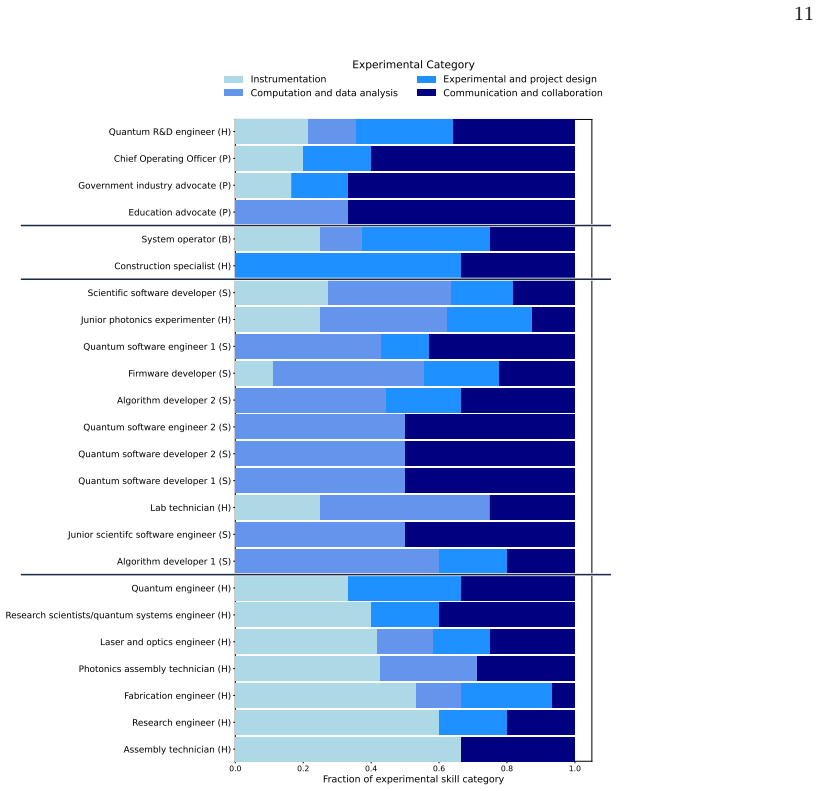
Through 44 semi-structured interviews with quantum industry professionals, the experimental skills tied to bachelor's-level positions are characterized and thematically synthesized into four categories—instrumentation, computation and data analysis, experimental and project design, and communication and collaboration—then examined for clustering by role type and articulated as concrete learning goals for undergraduate QISE education.
What carries the argument
Thematic synthesis of responses from 44 semi-structured interviews with quantum industry professionals, guided by American Association of Physics Teachers recommendations for undergraduate laboratory curricula, to derive and organize skill categories.
Load-bearing premise
The 44 interviews with quantum industry professionals capture a representative sample of the experimental skills actually required for bachelor's-level positions across the QISE industry.
What would settle it
A larger survey or additional interviews across more quantum companies that identify substantially different skills, additional categories, or different priorities for bachelor's hires would show the four-category framework is incomplete or unrepresentative.
Figures


read the original abstract
The growth of the Quantum Information Science and Engineering (QISE) industry has increased interest in how undergraduate programs prepare students for careers in this field. Prior research emphasizes the value of experiential learning as preparation for the quantum industry, but lacks specificity regarding the experimental skills needed for positions available to bachelor's degree graduates. In this study, we investigate the experimental skills associated with bachelor's-level quantum industry positions through 44 semi-structured interviews with quantum industry professionals. Guided by the American Association of Physics Teachers recommendations for the undergraduate physics laboratory curriculum, we characterize the experimental skills associated with positions described as requiring bachelor's-level preparation and thematically synthesize them into four categories: instrumentation, computation and data analysis, experimental and project design, and communication and collaboration. We further examine how these skills cluster across role types and articulate them as learning goals to provide guidance for educators interested in aligning undergraduate instruction with the needs of students wanting to pursue a career in the quantum industry. Our findings suggest the need to emphasize the discussion of hardware in QISE theory courses, expand experimental training through instructional laboratories, and intentionally integrate professional skills in undergraduate QISE education.
Editorial analysis
A structured set of objections, weighed in public.
Referee Report
Summary. The paper reports results from 44 semi-structured interviews with quantum industry professionals to identify experimental skills associated with bachelor's-level QISE positions. Guided by AAPT undergraduate laboratory recommendations, the authors thematically synthesize the skills into four categories—instrumentation, computation and data analysis, experimental and project design, and communication and collaboration—examine their clustering by role type, and articulate them as learning goals to guide undergraduate curriculum alignment, including calls to emphasize hardware in theory courses and expand lab and professional-skills training.
Significance. If the thematic categories prove robust, the work supplies a concrete, empirically grounded set of learning goals that directly addresses the lack of specificity in prior QISE education literature. It offers actionable guidance for aligning undergraduate programs with industry needs at the bachelor's level, potentially improving workforce preparation in a rapidly expanding field.
major comments (2)
- [Methods] The central claim that the four skill categories are stable and generalizable rests on the 44 interviews constituting a representative sample of bachelor's-level positions across QISE subfields and employers. The manuscript must supply explicit details on recruitment strategy, participant demographics, distribution across hardware/software/sensing roles, and verification that positions were described as requiring only a bachelor's degree; without these, the synthesis and curriculum recommendations inherit sampling uncertainty.
- [Analysis and Results] The thematic analysis process requires documentation of coding procedures, including whether multiple researchers coded the data, how disagreements were resolved, and any inter-rater reliability metrics. These details are necessary to establish that the four categories are not sensitive to analyst choices.
minor comments (3)
- [Results] A summary table listing representative skills or quotes under each of the four categories would improve readability and allow readers to assess the mapping from interview data to themes.
- [Introduction] The reference to AAPT recommendations should include a specific citation and a brief statement of which elements were adopted versus adapted for the QISE context.
- [Discussion] Clarify in the discussion whether the observed skill clusters differ significantly by role type or whether the four categories apply uniformly; quantitative or qualitative evidence for clustering would strengthen the claim.
Simulated Author's Rebuttal
We thank the referee for their constructive comments, which have helped us identify areas where the manuscript can be strengthened with greater methodological transparency. We address each major comment below and have prepared revisions to the Methods and Analysis sections accordingly.
read point-by-point responses
-
Referee: [Methods] The central claim that the four skill categories are stable and generalizable rests on the 44 interviews constituting a representative sample of bachelor's-level positions across QISE subfields and employers. The manuscript must supply explicit details on recruitment strategy, participant demographics, distribution across hardware/software/sensing roles, and verification that positions were described as requiring only a bachelor's degree; without these, the synthesis and curriculum recommendations inherit sampling uncertainty.
Authors: We agree that explicit details on sampling are essential for readers to evaluate the scope of our claims. The original manuscript summarized recruitment via professional networks and industry contacts but did not provide the requested granularity. In the revised version we will add: (1) a full description of the recruitment strategy (LinkedIn outreach, quantum industry conferences, and referrals from professional organizations); (2) the distribution of the 44 participants across role categories (hardware development, software/algorithm roles, sensing/metrology, and hybrid positions) as determined from job titles and self-reported responsibilities; (3) confirmation that every interviewee explicitly described their position as accessible with a bachelor's degree (verified both in the interview protocol and in post-interview notes); and (4) available demographic information (years of experience, educational background) while respecting IRB privacy constraints. These additions will be presented in a new subsection of Methods without changing the thematic results or curriculum recommendations. revision: yes
-
Referee: [Analysis and Results] The thematic analysis process requires documentation of coding procedures, including whether multiple researchers coded the data, how disagreements were resolved, and any inter-rater reliability metrics. These details are necessary to establish that the four categories are not sensitive to analyst choices.
Authors: We acknowledge that the original manuscript provided only a high-level description of the thematic synthesis. The analysis followed Braun and Clarke's reflexive thematic analysis framework and was led by the first author, with iterative category refinement through weekly team discussions involving all co-authors. Disagreements were resolved by returning to the raw interview transcripts and reaching consensus. Because the team is small and the analysis was primarily inductive, formal inter-rater reliability statistics were not computed. In the revision we will insert a dedicated paragraph in the Methods section that (a) cites the Braun and Clarke approach, (b) describes the six-phase process as applied here, (c) notes the team-based consensus procedure, and (d) explains why quantitative IRR metrics were not appropriate for this exploratory study. We believe these additions will adequately address concerns about analyst sensitivity while remaining faithful to the actual conduct of the research. revision: yes
Circularity Check
No circularity: claims rest on thematic synthesis of external interview data
full rationale
The paper performs no mathematical derivations, equations, or model fitting. Its central result—the four skill categories—is produced by thematic analysis of 44 semi-structured interviews with quantum industry professionals, guided by an external AAPT document. No self-definitional loops, fitted inputs renamed as predictions, or load-bearing self-citations exist; the synthesis is data-driven rather than presupposed by the authors' prior work or definitions. Sampling representativeness is a validity concern, not a circularity issue.
Axiom & Free-Parameter Ledger
axioms (2)
- domain assumption Semi-structured interviews with industry professionals can reliably surface the experimental skills required for bachelor's-level QISE positions.
- domain assumption Thematic synthesis guided by AAPT undergraduate lab recommendations produces a complete and unbiased categorization of relevant skills.
Reference graph
Works this paper leans on
-
[1]
Bachelor’s, Mas- ter’s, or PhD
by asking each interviewee to refer colleagues within their company to participate in our research interviews. Concurrently, we asked the Quantum Economic Devel- opment Consortium (QED-C) [53], which has more than 150 member companies, to solicit participation from pro- fessionals part of the consortium. Across these recruit- ment strategies, responses ra...
2024
-
[2]
Interviewees emphasize that bachelor’s level employees are often working directly with hard- ware, especially in tasks involving optics, electronics, and vacuum systems
Instrumentation Instrumentation refers to operating, maintaining, and troubleshooting scientific and engineering instruments and systems. Interviewees emphasize that bachelor’s level employees are often working directly with hard- ware, especially in tasks involving optics, electronics, and vacuum systems. For example, Alex, who works at a company develop...
-
[3]
Computation and data analysis Computation and data analysis refer to applying com- putational tools to acquire, process, and interpret data. Interviewees describe computation as tightly integrated with experimental work, particularly for controlling in- struments, interacting with hardware components, and data collection and analysis. Rather than being tr...
-
[4]
Experimental and project design Experimental and project design refers to planning, ex- ecuting, and managing experiments. Interviewees high- light how bachelor’s level employees contribute to design- ing and refining experiments by thinking through require- ments, constraints, and tradeoffs for technologies that are still emerging and procedures that are...
-
[5]
Communication and collaboration Communication and collaboration refer to sharing technical insights, coordinating work, and engaging with multiple stakeholders. Interviewees consistently high- light that experimental work in the quantum industry is highly collaborative, which requires bachelor’s-level em- ployees to work effectively with colleagues with v...
-
[6]
National Quantum Initiative, National quantum initia- tive,http://quantum.gov/(2018)
2018
-
[7]
Riedel, M
M. Riedel, M. Kovacs, P. Zoller, J. Mlynek, and T. Calarco, Europe’s quantum flagship initiative, Quan- tum Science and Technology4, 020501 (2019)
2019
-
[8]
Knight and I
P. Knight and I. Walmsley, UK national quantum tech- nology programme, Quantum Science and Technology4, 040502 (2019)
2019
-
[9]
National Science and Technology Council, Subcommittee on Quantum Information Science, Quantum information science and technology workforce development national strategic plan,https://www.quantum.gov/wp-content/ uploads/2022/02/QIST-Natl-Workforce-Plan.pdf (2022)
2022
-
[10]
UNESCO – United Nations Educational, Scientific and Cultural Organization, International year of quantum science and technology,https://www.unesco.org/en/ years/quantum-science-technology(2025)
2025
-
[11]
M. F. Fox, B. M. Zwickl, and H. J. Lewandowski, Prepar- ing for the quantum revolution: What is the role of higher education?, Physical Review Physics Education Research 16, 020131 (2020)
2020
-
[12]
Greinert, M
F. Greinert, M. S. Ubben, I. N. Dogan, D. Hilfert- R¨ uppell, and R. M¨ uller, Advancing quantum technology workforce: industry insights into qualification and train- ing needs, EPJ Quantum Technology11, 82 (2024)
2024
-
[13]
El-Adawy, A
S. El-Adawy, A. R. Pi˜ na, B. M. Zwickl, and H. J. Lewandowski, Industry perspectives on projected quan- tum workforce needs, 2025 Physics Education Research Conference Proceedings PERC Proceedings, 148 (2025)
2025
- [14]
-
[15]
Pi˜ na, S
A. Pi˜ na, S. El-Adawy, M. Verostek, B. T. Boyle, M. Cacheiro, M. Lawler, N. Pradeep, E. Watts, C. G. West, H. Lewandowski, et al., Landscape of quantum information science and engineering education: From physics foundations to interdisciplinary frontiers, Phys- ical Review Physics Education Research21, 020131 (2025)
2025
-
[16]
J. C. Meyer, G. Passante, S. J. Pollock, and B. R. Wilcox, Introductory quantum information science coursework at us institutions: content coverage, EPJ Quantum Tech- nology11, 16 (2024)
2024
-
[17]
C. D. Aiello, D. D. Awschalom, H. Bernien, T. Brower, K. R. Brown, T. A. Brun, J. R. Caram, E. Chitambar, R. Di Felice, K. M. Edmonds,et al., Achieving a quantum smart workforce, Quantum Science and Technology6, 030501 (2021)
2021
-
[18]
Asfaw, A
A. Asfaw, A. Blais, K. R. Brown, J. Candelaria, C. Cantwell, L. D. Carr, J. Combes, D. M. Debroy, J. M. Donohue, S. E. Economou, et al., Building a quantum engineering undergraduate program, IEEE Transactions on Education65, 220 (2022)
2022
-
[19]
Greinert, R
F. Greinert, R. M¨ uller, P. Bitzenbauer, M. S. Ubben, and K.-A. Weber, Future quantum workforce: Competences, requirements, and forecasts, Physical Review Physics Ed- ucation Research19, 010137 (2023). 14
2023
-
[20]
Quantum Economic Development Consortium (QED-C), Connecting the dots: Quantum learning through experi- ential activities and practice, SRI International (2025), report published by the Quantum Economic Develop- ment Consortium (QED-C)
2025
-
[21]
El-Adawy, A
S. El-Adawy, A. Pi˜ na, B. M. Zwickl, and H. Lewandowski, Insights from educators on build- ing a more cohesive quantum information science and engineering education ecosystem, Physical Review Physics Education Research21, 020144 (2025)
2025
-
[22]
B. M. Zwickl, D. Hu, N. Finkelstein, and H. Lewandowski, Model-based reasoning in the physics laboratory: Framework and initial results, Physical Review Special Topics—Physics Education Research11, 020113 (2015)
2015
-
[23]
D. R. Dounas-Frazer and H. Lewandowski, The mod- elling framework for experimental physics: Description, development, and applications, European Journal of Physics39, 064005 (2018)
2018
-
[24]
B. Cai, L. A. Mainhood, R. Groome, C. Laverty, and A. McLean, Student behavior in undergraduate physics laboratories: Designing experiments, Physical Review Physics Education Research17, 020109 (2021)
2021
-
[25]
D. R. Dounas-Frazer, K. L. Van De Bogart, M. R. Stet- zer, and H. Lewandowski, Investigating the role of model- based reasoning while troubleshooting an electric circuit, Physical Review Physics Education Research12, 010137 (2016)
2016
-
[26]
Kozminski, H
J. Kozminski, H. Lewandowski, N. Beverly, S. Lindaas, D. Deardorff, A. Reagan, R. Dietz, R. Tagg, M. EblenZa- yas, J. Williams, et al., AAPT recommendations for the undergraduate physics laboratory curriculum, American Association of Physics Teachers29(2014)
2014
-
[27]
J. R. Hoehn and H. Lewandowski, Investigating students’ views about the role of writing in physics lab classes, 2020 Physics Education Research Conference Proceed- ings (2020)
2020
-
[28]
B. L. Lewis, Surveying the state of writing education in physics and astronomy, Physical Review Physics Educa- tion Research21, 020146 (2025)
2025
-
[29]
Hughes, D
C. Hughes, D. Finke, D.-A. German, C. Merzbacher, P. M. Vora, and H. Lewandowski, Assessing the needs of the quantum industry, IEEE Transactions on Educa- tion65, 592 (2022)
2022
-
[30]
S. El-Adawy, A. R. Pi˜ na, B. M. Zwickl, and H. J. Lewandowski, Industry perspectives on projected quan- tum workforce needs, 2025 Physics Education Research Conference Proceedings 10.1119/perc.2025.pr.El-Adawy (2025), august 6–7, 2025
-
[31]
J. C. Meyer, G. Passante, S. J. Pollock, and B. R. Wilcox, Today’s interdisciplinary quantum information classroom: Themes from a survey of quantum informa- tion science instructors, Physical Review Physics Educa- tion Research18, 010150 (2022)
2022
-
[32]
K. A. Oliver, V. Borish, B. R. Wilcox, and H. Lewandowski, Education for expanding the quantum workforce: Students’ perceptions of the quantum indus- try in an upper-division physics capstone course, Physical Review Physics Education Research21, 010129 (2025)
2025
-
[33]
K. A. Oliver, V. Borish, B. R. Wilcox, and H. J. Lewandowski, Influence of an undergraduate quantum capstone course on students’ post-graduation careers, 2025 Physics Education Research Conference Proceed- ings 10.1119/perc.2025.pr.Oliver (2025)
-
[34]
Watts and B
E. Watts and B. Zwickl, Formation of students’ interests in quantum technology across stem majors, Proceedings of the Physics Education Research Conference 2025 , 441 (2025)
2025
-
[35]
J. C. Meyer, G. Passante, and B. Wilcox, Disparities in access to us quantum information education, Physical Review Physics Education Research20, 010131 (2024)
2024
-
[36]
Kruse, M
J. Kruse, M. Griston, and B. R. Wilcox, Characteri- zation of upper-level undergraduate quantum mechan- ics courses in the u.s., Phys. Rev. Phys. Educ. Res.21, 020162 (2025)
2025
-
[37]
Buzzell, T
A. Buzzell, T. J. Atherton, and R. Barthelemy, Quan- tum mechanics curriculum in the US: Quantifying the instructional time, content taught, and paradigms used, Physical Review Physics Education Research21, 010102 (2025)
2025
-
[38]
Borish and H
V. Borish and H. Lewandowski, Implementation and goals of quantum optics experiments in undergraduate instructional labs, Physical Review Physics Education Research19, 010117 (2023)
2023
-
[39]
Y. S. Sun, G. Shi, W. A. Scales, and P. Leigh-Mack, Ex- ploring minority undergraduate students’ hands-on and research experiences in a summer qise laboratory course, 2025 ASEE Annual Conference & Exposition (2025)
2025
-
[40]
Ivory, J
M. Ivory, J. Balewski, A. Bettale, J. Brewer, R. Boren, D. Camps, L. Hackett, M. Juarez, A. Kononov, K.-H. Lee, et al., Qcamp: A 4-week summer camp introduc- ing high school students to quantum information sci- ence and technology, 2025 IEEE International Conference on Quantum Computing and Engineering (QCE)3, 29 (2025)
2025
-
[41]
Etkina, A
E. Etkina, A. Karelina, M. Ruibal-Villasenor, D. Rosen- grant, R. Jordan, and C. E. Hmelo-Silver, Design and reflection help students develop scientific abilities: Learn- ing in introductory physics laboratories, The Journal of the Learning Sciences19, 54 (2010)
2010
-
[42]
B. R. Wilcox and H. J. Lewandowski, Developing skills versus reinforcing concepts in physics labs: Insight from a survey of students’ beliefs about experimental physics, Physical Review Physics Education Research13, 010108 (2017)
2017
-
[43]
Holmes, B
N. Holmes, B. Keep, and C. E. Wieman, Developing sci- entific decision making by structuring and supporting student agency, Physical Review Physics Education Re- search16, 010109 (2020)
2020
-
[44]
J. R. Hoehn and H. Lewandowski, Framework of goals for writing in physics lab classes, Physical Review Physics Education Research16, 010125 (2020)
2020
-
[45]
Walsh, H
C. Walsh, H. Lewandowski, and N. Holmes, Skills-focused lab instruction improves critical thinking skills and ex- perimentation views for all students, Physical Review Physics Education Research18, 010128 (2022)
2022
-
[46]
Borish, J
V. Borish, J. R. Hoehn, and H. Lewandowski, Student en- gagement with modeling in multiweek student-designed lab projects, Physical Review Physics Education Re- search18, 020135 (2022)
2022
-
[47]
B. R. Wilcox and H. J. Lewandowski, Students’ views about the nature of experimental physics, Physical Re- view Physics Education Research13, 020110 (2017)
2017
-
[48]
K. L. Van De Bogart, D. R. Dounas-Frazer, H. Lewandowski, and M. R. Stetzer, Investigating the role of socially mediated metacognition during col- laborative troubleshooting of electric circuits, Physical Review Physics Education Research13, 020116 (2017). 15
2017
-
[49]
Karelina and E
A. Karelina and E. Etkina, Acting like a physicist: Stu- dent approach study to experimental design, Physical Review Special Topics—Physics Education Research3, 020106 (2007)
2007
-
[50]
D. R. Dounas-Frazer, J. T. Stanley, and H. Lewandowski, Student ownership of projects in an upper-division optics laboratory course: A multiple case study of successful ex- periences, Physical Review Physics Education Research 13, 020136 (2017)
2017
-
[51]
Z. Y. Kalender, E. Stump, K. Hubenig, and N. Holmes, Restructuring physics labs to cultivate sense of student agency, Physical Review Physics Education Research17, 020128 (2021)
2021
-
[52]
B. R. Wilcox and H. Lewandowski, Open-ended versus guided laboratory activities: Impact on students’ beliefs about experimental physics, Physical Review Physics Ed- ucation Research12, 020132 (2016)
2016
-
[53]
Liu and H
Q. Liu and H. Lewandowski, Students’ views of exper- imental physics after participating in lab courses with open-ended activities, Physical Review Physics Educa- tion Research21, 020151 (2025)
2025
-
[54]
J. T. Stanley and H. Lewandowski, Recommendations for the use of notebooks in upper-division physics lab courses, American Journal of Physics86, 45 (2018)
2018
-
[55]
J. R. Hoehn and H. Lewandowski, Incorporating writing in advanced lab projects: A multiple case-study analysis, Physical Review Physics Education Research16, 020161 (2020)
2020
-
[56]
Etikan, S
I. Etikan, S. A. Musa, R. S. Alkassim, et al., Compar- ison of convenience sampling and purposive sampling, American journal of theoretical and applied statistics5, 1 (2016)
2016
-
[57]
Parker, S
C. Parker, S. Scott, and A. Geddes, Snowball sampling, SAGE research methods foundations (2019)
2019
-
[58]
Quantum Economic Development Consortium (QED- C), Quantum economic development consortium (qed- c) — enabling the quantum ecosystem,https:// quantumconsortium.org/
-
[59]
Gotranscript: 100% human transcription in 140+ lan- guages,https://gotranscript.com/
-
[60]
Braun and V
V. Braun and V. Clarke, Using thematic analysis in psy- chology, Qualitative research in psychology3, 77 (2006)
2006
-
[61]
A. R. Pi˜ na, S. El-Adawy, H. J. Lewandowski, and B. M. Zwickl, Industry insights into quantum knowl- edge needed for the quantum information science and engineering workforce, 2025 PERC Proceedings 10.1119/perc.2025.pr.Pina (2025)
-
[62]
N. G. Holmes and E. M. Smith, Operationalizing the AAPT learning goals for the lab, The Physics Teacher 57, 296 (2019)
2019
-
[63]
American Association of Colleges and Universities, The agility imperative: How employers view preparation for an uncertain future (2025)
2025
-
[64]
B. M. Zwickl, N. Finkelstein, and H. J. Lewandowski, The process of transforming an advanced lab course: Goals, curriculum, and assessments, American Journal of Physics81, 63 (2013)
2013
-
[65]
Holmes and H
N. Holmes and H. Lewandowski, Investigating the land- scape of physics laboratory instruction across North America, Physical Review Physics Education Research 16, 020162 (2020)
2020
-
[66]
Werth, C
A. Werth, C. G. West, and H. Lewandowski, Impacts on student learning, confidence, and affect in a remote, large-enrollment, course-based undergraduate research experience in physics, Physical Review Physics Educa- tion Research18, 010129 (2022)
2022
-
[67]
Werth, C
A. Werth, C. G. West, N. Sulaiman, and H. Lewandowski, Enhancing students’ views of experi- mental physics through a course-based undergraduate research experience, Physical Review Physics Education Research19, 020151 (2023)
2023
-
[68]
R. L. Merritt and H. J. Lewandowski, Physics instruc- tor views on course-based undergraduate research expe- riences (cures), Proceedings of the Physics Education Re- search Conference 2024 Physics Education Research Con- ference, 293 (2024)
2024
-
[69]
M. Kretchmer, R. L. Merritt, and H. J. Lewandowski, Ex- ploring student beliefs of traditional physics laboratory coursework in relation to authentic research, Proceed- ings of the 2024 Physics Education Research Conference 10.1119/perc.2024.pr.Kretchmer (2024)
-
[70]
R. L. Merritt, M. Kretchmer, and H. J. Lewandowski, Student perspectives on “successful science” in a physics cure and traditional lab course, 2025 PERC Proceedings 10.1119/perc.2025.pr.Merritt (2025)
-
[71]
J. R. Hoehn, M. F. Fox, A. Werth, V. Borish, and H. Lewandowski, Remote advanced lab course: A case study analysis of open-ended projects, Physical Review Physics Education Research17, 020111 (2021)
2021
-
[72]
Tufino, S
E. Tufino, S. Oss, and M. Alemani, Using jupyter note- books to foster computational skills and professional practice in an introductory physics lab course (2025)
2025
-
[73]
Lusignan, A
C. Lusignan, A. McGowan, and B. Zwickl, Instructional goals and decisions when integrating computation into physics labs, Integrating Computing into the Undergrad- uate Physics Curriculum , 6 (2025)
2025
-
[74]
Lusignan, A
C. Lusignan, A. McGowan, and B. Zwickl, Case stud- ies of integrating computation into physics lab courses, Integrating Computing into the Undergraduate Physics Curriculum , 7 (2025)
2025
-
[75]
Foote and S
K. Foote and S. Martino, Implementing investigative labs and writing intensive reports in large university physics courses, The Physics Teacher56, 466 (2018)
2018
-
[76]
E. M. Smith and N. Holmes, Evaluating instructional labs’ use of deliberate practice to teach critical think- ing skills, Physical Review Physics Education Research 16, 020150 (2020)
2020
-
[77]
Werth, K
A. Werth, K. Oliver, C. G. West, and H. Lewandowski, Assessing student engagement with teamwork in an on- line, large-enrollment course-based undergraduate re- search experience in physics, Physical Review Physics Education Research18, 020128 (2022)
2022
discussion (0)
Sign in with ORCID, Apple, or X to comment. Anyone can read and Pith papers without signing in.