Recognition: unknown
Quantum Randomized Subspace Iteration
Pith reviewed 2026-05-10 16:44 UTC · model grok-4.3
The pith
Conjugating a Hamiltonian with independent random unitaries across branches spans the full degenerate eigenspace almost surely.
A machine-rendered reading of the paper's core claim, the machinery that carries it, and where it could break.
Core claim
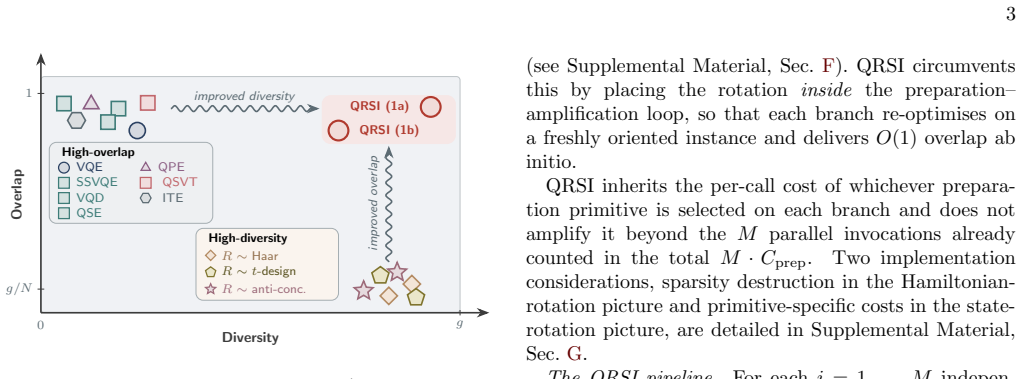
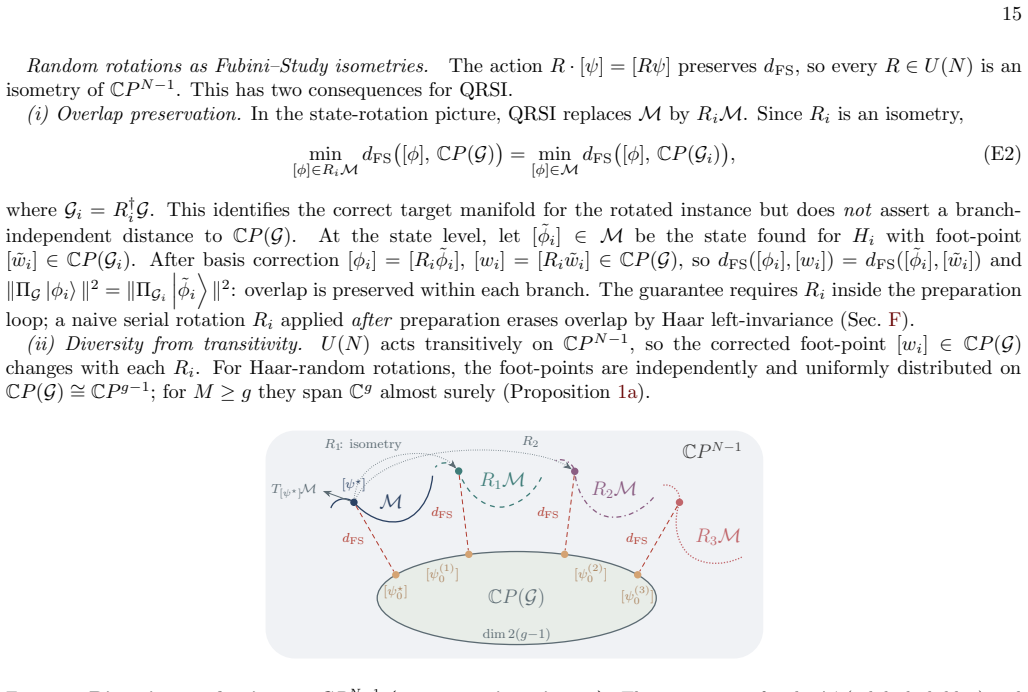
We introduce the quantum randomized subspace iteration (QRSI), a fully parallel construction that conjugates the Hamiltonian by independent random unitaries across as many branches as the degeneracy g, then invokes any chosen eigenstate-preparation primitive on each branch. The target subspace is identified from the resulting ensemble via standard subspace estimation. We prove that the construction spans the full eigenspace almost surely and preserves the spectral gap exactly on every branch. These guarantees hold whenever the random rotations satisfy an anti-concentration condition over the degenerate manifold, substantially weaker than full Haar randomness.
What carries the argument
QRSI construction: independent random unitaries applied in parallel across g branches, followed by eigenstate preparation on each and subspace estimation from the ensemble.
If this is right
- The full eigenspace is recovered from the parallel ensemble without sequential orthogonality constraints.
- The spectral gap remains exactly the same on every branch, so any existing eigenstate finder can be used unchanged.
- The guarantees apply to the toric code, recovering all four topological ground states.
- The anti-concentration requirement is weaker than Haar randomness, allowing simpler random circuits on hardware.
Where Pith is reading between the lines
- The same parallel structure could be paired with any variational primitive to handle degeneracy in frustrated magnets without extra penalty terms.
- Hardware Gram-matrix measurements would allow the entire subspace identification to stay quantum, reducing classical post-processing.
- If approximate random circuits satisfy anti-concentration on typical hardware noise models, QRSI could be tested on near-term devices for small degeneracies.
Load-bearing premise
The random unitaries must spread sufficiently across the degenerate manifold to meet an anti-concentration condition.
What would settle it
Run QRSI on the toric-code Hamiltonian, whose ground-state degeneracy is known to be four, and check whether the estimated subspace has exact dimension four and contains representatives from all topological sectors.
Figures



read the original abstract
Resolving degenerate quantum eigenspaces - including topologically ordered ground states and frustrated magnets - requires preparing high-fidelity states that span every direction of the target manifold. Existing variational and projective algorithms do not naturally cover a multi-dimensional degenerate subspace without sequential orthogonality constraints. We introduce the quantum randomized subspace iteration (QRSI), a fully parallel construction that conjugates the Hamiltonian by independent random unitaries across as many branches as the degeneracy g, then invokes any chosen eigenstate-preparation primitive on each branch. The target subspace is identified from the resulting ensemble via standard subspace estimation, either classically through the coefficient matrix or on hardware through Gram-matrix measurements. We prove that the construction spans the full eigenspace almost surely and preserves the spectral gap exactly on every branch. For practical use, we show that these guarantees hold whenever the random rotations satisfy an anti-concentration condition over the degenerate manifold, substantially weaker than full Haar randomness. We demonstrate QRSI on the toric code, recovering all four topological ground states, and on random Hamiltonians with planted degeneracies.
Editorial analysis
A structured set of objections, weighed in public.
Referee Report
Summary. The manuscript introduces Quantum Randomized Subspace Iteration (QRSI), a parallel algorithm for spanning degenerate eigenspaces. It conjugates the Hamiltonian by g independent random unitaries (g = degeneracy), applies an eigenstate-preparation primitive on each branch, and recovers the target subspace via classical coefficient-matrix or hardware Gram-matrix estimation. The central claims are that the construction spans the full eigenspace almost surely and exactly preserves the spectral gap on every branch whenever the random unitaries obey an anti-concentration condition over the degenerate manifold, a requirement strictly weaker than Haar randomness. The claims are supported by a proof and by numerical demonstrations on the toric code (recovering all four topological ground states) and on random Hamiltonians with planted degeneracies.
Significance. If the probabilistic guarantees hold, QRSI supplies a fully parallel route to degenerate-subspace preparation that avoids sequential orthogonality constraints, which is directly relevant to topological order and frustrated magnetism. The exact gap preservation follows immediately from unitary invariance of the spectrum, while the almost-sure spanning result under a mild anti-concentration assumption is a substantive theoretical advance. The demonstrations provide concrete, falsifiable evidence of practicality. Credit is due for the explicit statement of the anti-concentration hypothesis and for the reproducible numerical examples.
major comments (1)
- The proof that anti-concentration implies almost-sure spanning (central to both the theoretical guarantee and the practical claim of being weaker than Haar) is stated in the abstract and introduction but lacks an explicit quantitative bound on the failure probability in terms of degeneracy g and the anti-concentration parameter; without this, it is impossible to assess how much weaker the condition truly is or to verify tightness of the almost-sure claim.
minor comments (2)
- The abstract refers to 'standard subspace estimation' without citing the precise classical or quantum procedure used; a short reference or one-sentence description would improve clarity.
- Figure captions for the toric-code and planted-degeneracy demonstrations should explicitly state the number of random branches g and the anti-concentration parameter employed.
Simulated Author's Rebuttal
We thank the referee for their careful reading, positive assessment of QRSI, and constructive suggestion regarding quantitative bounds. We address the single major comment below and will revise the manuscript to incorporate the requested clarification.
read point-by-point responses
-
Referee: The proof that anti-concentration implies almost-sure spanning (central to both the theoretical guarantee and the practical claim of being weaker than Haar) is stated in the abstract and introduction but lacks an explicit quantitative bound on the failure probability in terms of degeneracy g and the anti-concentration parameter; without this, it is impossible to assess how much weaker the condition truly is or to verify tightness of the almost-sure claim.
Authors: We agree that an explicit quantitative bound on the failure probability would strengthen the result and allow a clearer comparison to Haar randomness. The existing proof (Section 3) shows that the anti-concentration condition (Definition 2) implies that the probability of failing to span the full degenerate subspace is zero, but it does not supply a finite-sample expression such as 1 - (1 - c(g,δ))^k or similar. We can derive such a bound by bounding the measure of the exceptional set of unitaries more precisely using the anti-concentration parameter δ and the dimension g; the revised manuscript will include this explicit dependence together with a short derivation. This change does not alter the almost-sure claim but makes the practical implications more transparent. revision: yes
Circularity Check
No significant circularity identified
full rationale
The paper's central claims consist of an algorithmic construction (QRSI) that applies independent random unitaries followed by an eigenstate-preparation primitive, plus probabilistic guarantees that the resulting ensemble spans the degenerate eigenspace almost surely under an external anti-concentration assumption on the unitaries. Spectrum preservation follows immediately from the standard fact that unitary conjugation leaves eigenvalues invariant, which is not derived from the target result. The anti-concentration condition is stated as a hypothesis on the chosen distribution rather than a quantity fitted or defined from the spanning guarantee itself. No self-citations are invoked as load-bearing uniqueness theorems, no parameters are fitted to data and then relabeled as predictions, and no ansatz is smuggled via prior work. The derivation chain is therefore self-contained against external benchmarks and does not reduce to its inputs by construction.
Axiom & Free-Parameter Ledger
axioms (2)
- standard math Standard postulates of quantum mechanics and linear algebra suffice to prove almost-sure spanning of the degenerate subspace under random unitary conjugation.
- domain assumption The chosen random unitaries satisfy an anti-concentration condition over the degenerate manifold.
Reference graph
Works this paper leans on
-
[1]
Leon Balents. Spin liquids in frustrated magnets.Na- ture, 464(7286):199–208, March 2010. ISSN 1476-4687. doi:10.1038/nature08917. URLhttp://dx.doi.org/10. 1038/nature08917
-
[2]
Reports on Progress in Physics, 55, 1855 (doi: 10.1088/0034- 4885/55/11/001)
Lucile Savary and Leon Balents. Quantum spin liquids: a review.Reports on Progress in Physics, 80(1):016502, November 2016. ISSN 1361-6633. doi:10.1088/0034- 4885/80/1/016502. URLhttp://dx.doi.org/10.1088/ 0034-4885/80/1/016502
-
[3]
Yi Zhang, Tarun Grover, Ari Turner, Masaki Oshikawa, and Ashvin Vishwanath. Quasiparticle statistics and braiding from ground-state entanglement.Physical Re- view B, 85(23), June 2012. ISSN 1550-235X. doi: 10.1103/physrevb.85.235151. URLhttp://dx.doi.org/ 10.1103/PhysRevB.85.235151
-
[4]
L. Cincio and G. Vidal. Characterizing topological or- der by studying the ground states on an infinite cylin- der.Physical Review Letters, 110(6), February 2013. ISSN 1079-7114. doi:10.1103/physrevlett.110.067208. URLhttp://dx.doi.org/10.1103/PhysRevLett.110. 067208
-
[5]
Molecular Electronic-Structure Theory
Trygve Helgaker, Poul Jørgensen, and Jeppe Olsen. Molecular Electronic-Structure Theory. Wiley, August
-
[6]
ISBN 9781119019572. doi:10.1002/9781119019572. URLhttp://dx.doi.org/10.1002/9781119019572
-
[7]
Quantum algorithms for topological and geometric anal- ysis of data.Nature Communications, 7(1), January
Seth Lloyd, Silvano Garnerone, and Paolo Zanardi. Quantum algorithms for topological and geometric anal- ysis of data.Nature Communications, 7(1), January
-
[8]
ISSN 2041-1723. doi:10.1038/ncomms10138. URL http://dx.doi.org/10.1038/ncomms10138
-
[9]
To- wards quantum advantage via topological data analysis
Casper Gyurik, Chris Cade, and Vedran Dunjko. To- wards quantum advantage via topological data analysis. Quantum, 6:855, November 2022. ISSN 2521-327X. doi: 10.22331/q-2022-11-10-855. URLhttp://dx.doi.org/ 10.22331/q-2022-11-10-855
-
[10]
The topology of data hides in quantum ther- mal states.APL Quantum, 1(3), July 2024
Stefano Scali, Chukwudubem Umeano, and Oleksandr Kyriienko. The topology of data hides in quantum ther- mal states.APL Quantum, 1(3), July 2024. ISSN 2835-
2024
-
[11]
URLhttp://dx.doi.org/ 10.1063/5.0209201
doi:10.1063/5.0209201. URLhttp://dx.doi.org/ 10.1063/5.0209201
-
[12]
Yin-Chen He, D. N. Sheng, and Yan Chen. Obtain- ing topological degenerate ground states by the den- sity matrix renormalization group.Physical Review B, 89(7):075110, February 2014. ISSN 1550-235X. doi: 10.1103/PhysRevB.89.075110. URLhttp://dx.doi. org/10.1103/PhysRevB.89.075110
-
[13]
E. M. Stoudenmire and Steven R. White. Study- ing two-dimensional systems with the density ma- trix renormalization group.Annual Review of Condensed Matter Physics, 3:111–128, March 2012. ISSN 1947-5462. doi:10.1146/annurev-conmatphys- 020911-125018. URLhttp://dx.doi.org/10.1146/ annurev-conmatphys-020911-125018
-
[14]
Nakanishi, Kosuke Mitarai, and Keisuke Fujii
Ken M. Nakanishi, Kosuke Mitarai, and Keisuke Fujii. Subspace-search variational quantum eigen- solver for excited states.Physical Review Re- search, 1(3), October 2019. ISSN 2643-1564. doi: 10.1103/physrevresearch.1.033062. URLhttp://dx. doi.org/10.1103/PhysRevResearch.1.033062
-
[15]
Variational quantum computation of excited states
Oscar Higgott, Daochen Wang, and Stephen Brier- ley. Variational quantum computation of excited states. Quantum, 3:156, July 2019. ISSN 2521-327X. doi: 10.22331/q-2019-07-01-156. URLhttp://dx.doi.org/ 10.22331/q-2019-07-01-156
-
[16]
Robert M. Parrish, Edward G. Hohenstein, Pe- ter L. McMahon, and Todd J. Mart´ ınez. Quan- tum computation of electronic transitions using a vari- ational quantum eigensolver.Physical Review Let- ters, 122(23), June 2019. ISSN 1079-7114. doi: 10.1103/physrevlett.122.230401. URLhttp://dx.doi. org/10.1103/PhysRevLett.122.230401
-
[17]
Jarrod R. McClean, Mollie E. Kimchi-Schwartz, Jonathan Carter, and Wibe A. de Jong. Hybrid quantum-classical hierarchy for mitigation of decoher- ence and determination of excited states.Physical Re- view A, 95(4), April 2017. ISSN 2469-9934. doi: 10.1103/physreva.95.042308. URLhttp://dx.doi.org/ 10.1103/PhysRevA.95.042308
-
[18]
A.Yu. Kitaev. Fault-tolerant quantum computation by anyons.Annals of Physics, 303(1):2–30, January
-
[19]
doi:10.1016/s0003-4916(02)00018-
ISSN 0003-4916. doi:10.1016/s0003-4916(02)00018-
-
[20]
URLhttp://dx.doi.org/10.1016/S0003-4916(02) 00018-0
-
[21]
N. Halko, P. G. Martinsson, and J. A. Tropp. Finding structure with randomness: Probabilistic algorithms for constructing approximate matrix decompositions.SIAM Review, 53(2):217–288, January 2011. ISSN 1095-7200. doi:10.1137/090771806. URLhttp://dx.doi.org/10. 1137/090771806
-
[22]
Randomized block krylov methods for stronger and faster approximate singular value decomposition, 2015
Cameron Musco and Christopher Musco. Randomized block krylov methods for stronger and faster approximate singular value decomposition, 2015
2015
-
[23]
Yousef Saad.Numerical Methods for Large Eigen- value Problems: Revised Edition. Society for Indus- trial and Applied Mathematics, January 2011. ISBN 9781611970739. doi:10.1137/1.9781611970739. URL http://dx.doi.org/10.1137/1.9781611970739
-
[24]
Yunkai Zhou and Yousef Saad. A chebyshev–davidson al- gorithm for large symmetric eigenproblems.SIAM Jour- nal on Matrix Analysis and Applications, 29(3):954–971, January 2007. ISSN 1095-7162. doi:10.1137/050630404. URLhttp://dx.doi.org/10.1137/050630404
-
[25]
A. Yu. Kitaev. Quantum measurements and the abelian stabilizer problem, 1995
1995
-
[26]
Daniel S. Abrams and Seth Lloyd. Quantum algorithm providing exponential speed increase for finding eigen- values and eigenvectors.Physical Review Letters, 83 (24):5162–5165, December 1999. ISSN 1079-7114. doi: 10.1103/physrevlett.83.5162. URLhttp://dx.doi.org/ 10.1103/PhysRevLett.83.5162
-
[27]
Preparing ground states of quantum many-body systems on a quantum computer
David Poulin and Pawel Wocjan. Preparing ground states of quantum many-body systems on a quantum computer. Physical Review Letters, 102(13), April 2009. ISSN 1079-
2009
-
[28]
URLhttp: //dx.doi.org/10.1103/PhysRevLett.102.130503
doi:10.1103/physrevlett.102.130503. URLhttp: //dx.doi.org/10.1103/PhysRevLett.102.130503
-
[29]
Guang Hao Low and Isaac L. Chuang. Optimal hamil- tonian simulation by quantum signal processing.Phys- ical Review Letters, 118(1), January 2017. ISSN 1079-
2017
-
[30]
URLhttp: //dx.doi.org/10.1103/PhysRevLett.118.010501
doi:10.1103/physrevlett.118.010501. URLhttp: //dx.doi.org/10.1103/PhysRevLett.118.010501
-
[31]
An Optimal Space Lower Bound for Approximating MAX-CUT
Andr´ as Gily´ en, Yuan Su, Guang Hao Low, and Nathan Wiebe. Quantum singular value transformation and beyond: exponential improvements for quantum ma- trix arithmetics. InProceedings of the 51st Annual 7 ACM SIGACT Symposium on Theory of Computing, STOC ’19, page 193–204. ACM, June 2019. doi: 10.1145/3313276.3316366. URLhttp://dx.doi.org/ 10.1145/3313276.3316366
-
[32]
Near-optimal ground state prepa- ration.Quantum, 4:372, December 2020
Lin Lin and Yu Tong. Near-optimal ground state prepa- ration.Quantum, 4:372, December 2020. ISSN 2521- 327X. doi:10.22331/q-2020-12-14-372. URLhttp://dx. doi.org/10.22331/q-2020-12-14-372
-
[33]
Yulong Dong, Lin Lin, and Yu Tong. Ground- state preparation and energy estimation on early fault- tolerant quantum computers via quantum eigenvalue transformation of unitary matrices.PRX Quan- tum, 3(4), October 2022. ISSN 2691-3399. doi: 10.1103/prxquantum.3.040305. URLhttp://dx.doi. org/10.1103/PRXQuantum.3.040305
-
[34]
Yimin Ge, Jordi Tura, and J. Ignacio Cirac. Faster ground state preparation and high-precision ground en- ergy estimation with fewer qubits.Journal of Mathemat- ical Physics, 60(2), February 2019. ISSN 1089-7658. doi: 10.1063/1.5027484. URLhttp://dx.doi.org/10.1063/ 1.5027484
-
[35]
J. P. Provost and G. Vallee. Riemannian structure on manifolds of quantum states.Communications in Mathematical Physics, 76(3):289–301, September 1980. ISSN 1432-0916. doi:10.1007/bf02193559. URLhttp: //dx.doi.org/10.1007/BF02193559
-
[36]
G.W. Gibbons. Typical states and density matrices. Journal of Geometry and Physics, 8(1–4):147–162, March
-
[37]
doi:10.1016/0393-0440(92)90046-
ISSN 0393-0440. doi:10.1016/0393-0440(92)90046-
-
[38]
URLhttp://dx.doi.org/10.1016/0393-0440(92) 90046-4
-
[39]
On the spinor representation of surfaces in Euclidean 3-space
Dorje C. Brody and Lane P. Hughston. Geometric quan- tum mechanics.Journal of Geometry and Physics, 38(1): 19–53, April 2001. ISSN 0393-0440. doi:10.1016/s0393- 0440(00)00052-8. URLhttp://dx.doi.org/10.1016/ S0393-0440(00)00052-8
-
[40]
Entanglement distance for arbitrary m-qudit hybrid systems.Physical Review A, 101(4), April 2020
Denise Cocchiarella, Stefano Scali, Salvatore Ribisi, Bianca Nardi, Ghofrane Bel-Hadj-Aissa, and Roberto Franzosi. Entanglement distance for arbitrary m-qudit hybrid systems.Physical Review A, 101(4), April 2020. ISSN 2469-9934. doi:10.1103/physreva.101.042129. URL http://dx.doi.org/10.1103/PhysRevA.101.042129
-
[41]
Quantum fingerprinting.Physical Review Letters, 87(16), September 2001
Harry Buhrman, Richard Cleve, John Watrous, and Ronald de Wolf. Quantum fingerprinting.Physical Review Letters, 87(16), September 2001. ISSN 1079-
2001
-
[42]
URLhttp: //dx.doi.org/10.1103/PhysRevLett.87.167902
doi:10.1103/physrevlett.87.167902. URLhttp: //dx.doi.org/10.1103/PhysRevLett.87.167902
-
[43]
Flammia, Hsin-Yuan Huang, Richard Kueng, John Preskill, Benoˆ ıt Vermersch, and Peter Zoller
Andreas Elben, Steven T. Flammia, Hsin-Yuan Huang, Richard Kueng, John Preskill, Benoˆ ıt Vermersch, and Peter Zoller. The randomized measurement toolbox.Na- ture Reviews Physics, 5(1):9–24, December 2022. ISSN 2522-5820. doi:10.1038/s42254-022-00535-2. URLhttp: //dx.doi.org/10.1038/s42254-022-00535-2
-
[44]
Yao Heng Su, Bing-Quan Hu, Sheng-Hao Li, and Sam Young Cho. Quantum fidelity for degenerate ground states in quantum phase transitions.Physical Review E, 88(3), September 2013. ISSN 1550-2376. doi: 10.1103/physreve.88.032110. URLhttp://dx.doi.org/ 10.1103/PhysRevE.88.032110
-
[45]
Quantum fidelity measures for mixed states
Yeong-Cherng Liang, Yu-Hao Yeh, Paulo E M F Men- don¸ ca, Run Yan Teh, Margaret D Reid, and Peter D Drummond. Quantum fidelity measures for mixed states. Reports on Progress in Physics, 82(7):076001, June 2019. ISSN 1361-6633. doi:10.1088/1361-6633/ab1ca4. URL http://dx.doi.org/10.1088/1361-6633/ab1ca4
-
[46]
Supervised Learning with Quantum-Enhanced Feature Spaces
Vojtˇ ech Havl´ ıˇ cek, Antonio D. C´ orcoles, Kristan Temme, Aram W. Harrow, Abhinav Kandala, Jerry M. Chow, and Jay M. Gambetta. Supervised learning with quantum-enhanced feature spaces.Nature, 567(7747): 209–212, March 2019. ISSN 1476-4687. doi: 10.1038/s41586-019-0980-2. URLhttp://dx.doi.org/ 10.1038/s41586-019-0980-2
-
[47]
Anyons in an exactly solved model and beyond
Alexei Kitaev. Anyons in an exactly solved model and beyond.Annals of Physics, 321(1):2–111, January 2006. ISSN 0003-4916. doi:10.1016/j.aop.2005.10.005. URL http://dx.doi.org/10.1016/j.aop.2005.10.005
-
[48]
New Journal of Physics , abstract =
C. Karrasch, J. H. Bardarson, and J. E. Moore. Re- ducing the numerical effort of finite-temperature den- sity matrix renormalization group calculations.New Journal of Physics, 15(8):083031, August 2013. ISSN 1367-2630. doi:10.1088/1367-2630/15/8/083031. URL http://dx.doi.org/10.1088/1367-2630/15/8/083031
-
[49]
Fernando G. S. L. Brand˜ ao, Aram W. Harrow, and Micha l Horodecki. Local random quantum circuits are approximate polynomial-designs.Communications in Mathematical Physics, 346(2):397–434, August 2016. ISSN 1432-0916. doi:10.1007/s00220-016-2706-8. URL http://dx.doi.org/10.1007/s00220-016-2706-8
-
[50]
Aram W. Harrow and Saeed Mehraban. Approximate unitary t-designs by short random quantum circuits using nearest-neighbor and long-range gates.Communications in Mathematical Physics, 401(2):1531–1626, May 2023. ISSN 1432-0916. doi:10.1007/s00220-023-04675-z. URL http://dx.doi.org/10.1007/s00220-023-04675-z
-
[51]
Bremner, Ashley Montanaro, and Dan J
Michael J. Bremner, Ashley Montanaro, and Dan J. Shepherd. Average-case complexity versus approximate simulation of commuting quantum computations.Phys- ical Review Letters, 117(8):080501, 2016
2016
-
[52]
Dalzell, Nicholas Hunter-Jones, and Fer- nando G
Alexander M. Dalzell, Nicholas Hunter-Jones, and Fer- nando G. S. L. Brandao. Random quantum circuits an- ticoncentrate in log depth.PRX Quantum, 3(1):010333, 2022
2022
-
[53]
Entanglement esti- mation in non-optimal qubit states.Annals of Physics, 411:167995, December 2019
Stefano Scali and Roberto Franzosi. Entanglement esti- mation in non-optimal qubit states.Annals of Physics, 411:167995, December 2019. ISSN 0003-4916. doi: 10.1016/j.aop.2019.167995. URLhttp://dx.doi.org/ 10.1016/j.aop.2019.167995
-
[54]
Nature Communications9(1) (2018) https:// doi.org/10.1038/s41467-018-07090-4
Jarrod R. McClean, Sergio Boixo, Vadim N. Smelyanskiy, Ryan Babbush, and Hartmut Neven. Barren plateaus in quantum neural network training landscapes.Nature Communications, 9(1), November 2018. ISSN 2041-1723. doi:10.1038/s41467-018-07090-4. URLhttp://dx.doi. org/10.1038/s41467-018-07090-4
-
[55]
Martin Larocca, Piotr Czarnik, Kunal Sharma, Gopikr- ishnan Muraleedharan, Patrick J. Coles, and M. Cerezo. Diagnosing barren plateaus with tools from quantum op- timal control.Quantum, 6:824, September 2022. ISSN 2521-327X. doi:10.22331/q-2022-09-29-824. URLhttp: //dx.doi.org/10.22331/q-2022-09-29-824
-
[56]
W. M. C. Foulkes, L. Mitas, R. J. Needs, and G. Ra- jagopal. Quantum monte carlo simulations of solids. Reviews of Modern Physics, 73(1):33–83, January 2001. ISSN 1539-0756. doi:10.1103/revmodphys.73.33. URL http://dx.doi.org/10.1103/RevModPhys.73.33
-
[57]
Sam McArdle, Tyson Jones, Suguru Endo, Ying Li, Si- mon C. Benjamin, and Xiao Yuan. Variational ansatz- based quantum simulation of imaginary time evolution. npj Quantum Information, 5(1), September 2019. ISSN 8 2056-6387. doi:10.1038/s41534-019-0187-2. URLhttp: //dx.doi.org/10.1038/s41534-019-0187-2
-
[58]
Mario Motta, Chong Sun, Adrian T. K. Tan, Matthew J. O’Rourke, Erika Ye, Austin J. Minnich, Fernando G. S. L. Brand˜ ao, and Garnet Kin-Lic Chan. Determin- ing eigenstates and thermal states on a quantum com- puter using quantum imaginary time evolution.Na- ture Physics, 16(2):205–210, November 2019. ISSN 1745-
2019
-
[59]
doi:10.1038/s41567-019-0704-4. URLhttp://dx. doi.org/10.1038/s41567-019-0704-4
-
[60]
George H. Booth, Alex J. W. Thom, and Ali Alavi. Fermion monte carlo without fixed nodes: A game of life, death, and annihilation in slater determinant space. The Journal of Chemical Physics, 131(5), August 2009. ISSN 1089-7690. doi:10.1063/1.3193710. URLhttp: //dx.doi.org/10.1063/1.3193710
-
[61]
Deidre Cleland, George H. Booth, and Ali Alavi. Com- munications: Survival of the fittest: Accelerating con- vergence in full configuration-interaction quantum monte carlo.The Journal of Chemical Physics, 132(4), Jan- uary 2010. ISSN 1089-7690. doi:10.1063/1.3302277. URL http://dx.doi.org/10.1063/1.3302277
-
[62]
William J. Huggins, Bryan A. O’Gorman, Nicholas C. Rubin, David R. Reichman, Ryan Babbush, and Joonho Lee. Unbiasing fermionic quantum monte carlo with a quantum computer.Nature, 603(7901): 416–420, March 2022. ISSN 1476-4687. doi: 10.1038/s41586-021-04351-z. URLhttp://dx.doi.org/ 10.1038/s41586-021-04351-z
-
[63]
Naka- gawa
Keita Kanno, Masaya Kohda, Ryosuke Imai, Sho Koh, Kosuke Mitarai, Wataru Mizukami, and Yuya O. Naka- gawa. Quantum-selected configuration interaction: clas- sical diagonalization of hamiltonians in subspaces se- lected by quantum computers, 2023
2023
-
[64]
Quantum computing quantum monte carlo algorithm.Physical Review A, 112(2), August 2025
Yukun Zhang, Yifei Huang, Jinzhao Sun, Dingshun Lv, and Xiao Yuan. Quantum computing quantum monte carlo algorithm.Physical Review A, 112(2), August 2025. ISSN 2469-9934. doi:10.1103/jt8s-hzhd. URLhttp:// dx.doi.org/10.1103/jt8s-hzhd
-
[65]
Paine, Vicente P
Giuseppe Buonaiuto, Antonio Marquez Romero, Brian Coyle, Annie E. Paine, Vicente P. Soloviev, Stefano Scali, and Michal Krompiec. A unified quantum comput- ing quantum monte carlo framework through structured state preparation, 2026
2026
-
[66]
Andrew M. Childs and Nathan Wiebe. Hamiltonian simulation using linear combinations of unitary opera- tions.Quantum Information and Computation, 12(11 & 12):901–924, November 2012. ISSN 1533-7146. doi: 10.26421/qic12.11-12-1. URLhttp://dx.doi.org/10. 26421/QIC12.11-12-1
-
[67]
Dominic W. Berry, Andrew M. Childs, and Robin Kothari. Hamiltonian simulation with nearly optimal de- pendence on all parameters. In2015 IEEE 56th Annual Symposium on Foundations of Computer Science, page 792–809. IEEE, October 2015. doi:10.1109/focs.2015.54. URLhttp://dx.doi.org/10.1109/FOCS.2015.54
-
[68]
Stair, Renke Huang, and Francesco A
Nicholas H. Stair, Renke Huang, and Francesco A. Evan- gelista. A multireference quantum krylov algorithm for strongly correlated electrons, 2019. URLhttps: //arxiv.org/abs/1911.05163
-
[69]
Cristian L. Cortes and Stephen K. Gray. Quantum krylov subspace algorithms for ground- and excited-state energy estimation.Physical Review A, 105(2), February 2022. ISSN 2469-9934. doi:10.1103/physreva.105.022417. URL http://dx.doi.org/10.1103/PhysRevA.105.022417
-
[70]
On approximation by trigono- metric sums and polynomials.Transactions of the American Mathematical Society, 13(4):491–515,
Dunham Jackson. On approximation by trigono- metric sums and polynomials.Transactions of the American Mathematical Society, 13(4):491–515,
-
[71]
ISSN 1088-6850. doi:10.1090/s0002-9947- 1912-1500930-2. URLhttp://dx.doi.org/10.1090/ S0002-9947-1912-1500930-2
-
[72]
Alexander Weiße, Gerhard Wellein, Andreas Alvermann, and Holger Fehske. The kernel polynomial method.Re- views of Modern Physics, 78(1):275–306, March 2006. ISSN 1539-0756. doi:10.1103/revmodphys.78.275. URL http://dx.doi.org/10.1103/RevModPhys.78.275
-
[73]
G. W. Stewart and Ji-guang Sun.Matrix Perturbation Theory. Academic Press, Boston, 1990
1990
-
[74]
Oxford University Press, 2012
J¨ org Liesen and Zdenˇ ek Strakoˇ s.Krylov Subspace Meth- ods: Principles and Analysis. Oxford University Press, 2012. 9 Appendix A: Padding to qubit dimension When the physical Hilbert-space dimensionNis not a power of two, the Hamiltonian must be embedded on n=⌈log 2 N⌉qubits. We extendHto a 2 n ×2 n matrix H (pad) = H0 0 Λ1 2n−N ,(A1) where Λ≫ ∥H∥is a...
2012
-
[75]
Under Haar measure, the equivariance ˆw(SR) =Sˆw(R) combined with left-invariance (SR∼Haar) givesSˆw d = ˆw for allS∈U(g), so ˆwis uniform onS 2g−1
Haar randomness satisfies anti-concentration We verify that Haar-random rotations satisfy (η, δ)-anti-concentration, recovering Proposition 1a as a special case of Proposition 1b. Under Haar measure, the equivariance ˆw(SR) =Sˆw(R) combined with left-invariance (SR∼Haar) givesSˆw d = ˆw for allS∈U(g), so ˆwis uniform onS 2g−1. For a uniform unit vector in...
-
[76]
The distributional symmetry acts after the preparation, so no assumptions on the preparation are needed
Hierarchy of assumptions and open questions The three approaches to diversity are distinguished by where isotropy is enforced: 1.Haar randomness(Proposition 1a): enforcesoutput isotropy(foot-points uniform onS 2g−1) via left-invariance of the measure. The distributional symmetry acts after the preparation, so no assumptions on the preparation are needed. ...
-
[77]
Bypasses the preparation entirely
(η, δ)-anti-concentration(Proposition 1b): directly assumesoutputanti-concentration of the foot-point dis- tribution. Bypasses the preparation entirely. The cost is thatηmust be verified or argued per implementation. The nesting is: Haar⇒anti-concentration (withηgiven by (C7))⇒diversity. At-design gives input isotropy but does not imply output anti-concen...
-
[78]
Hamiltonian-rotation picture: sparsity destruction While the Hamiltonian-rotation picture is mathematically clean, it faces an implementation obstacle. A Hamiltonian with a sparse or structured Pauli decompositionH= P α hαPα generically loses that structure under conjugation: R† i PαRi is a dense unitary, soH i hasO(4 n) nonzero Pauli coefficients even wh...
-
[79]
Picture” indicates the most natural rotation picture (Hamiltonian- rotation or state-rotation); “Either
State-rotation picture: per-primitive cost In the state-rotation picture the Hamiltonian is untouched, but the preparation primitive carries a per-branch cost. Variational methods (VQE)inherit any per-call cost of the chosen ansatz, including the exponential concentration phenomena (e.g. barren plateaus) characteristic of deep or highly expressive circuit...
discussion (0)
Sign in with ORCID, Apple, or X to comment. Anyone can read and Pith papers without signing in.