Recognition: unknown
On the Methodology for Assessing Vegetation Impacts on the Atmospheric Branch of the Hydrological Cycle
Pith reviewed 2026-05-10 15:51 UTC · model grok-4.3
The pith
Vegetation-induced atmospheric circulation changes control water yield more than local moisture recycling.
A machine-rendered reading of the paper's core claim, the machinery that carries it, and where it could break.
Core claim
The central claim is that water yield depends fundamentally on vegetation-induced changes in atmospheric circulation. Neglecting these dynamics, as moisture-recycling approaches do, biases the analysis toward finding negative effects of added vegetation on water yield. Streamflow reductions in dry regions are viewed as a transient early-succession phase, with the potential for reversal and positive vegetation-water feedbacks as ecosystems and regional moisture patterns evolve.
What carries the argument
The mechanism of vegetation-induced modifications to atmospheric circulation that govern the atmospheric branch of the hydrological cycle.
If this is right
- Moisture-recycling methods are structurally biased to predict reduced water yield from increased vegetation.
- Initial streamflow reductions in dry restored areas are transient and will reverse with ecosystem maturity.
- Longer-term positive feedbacks can develop between vegetation cover and water availability.
- Robust assessments require explicit coupling of vegetation change, atmospheric processes, and hydrological responses.
Where Pith is reading between the lines
- Climate models may underestimate water benefits from reforestation if they omit circulation feedbacks.
- Restoration in arid zones should account for time lags before water yield improves.
- Similar patterns could be tested in other large-scale vegetation projects worldwide.
Load-bearing premise
That any streamflow reduction from added vegetation in dry regions is a temporary effect of early ecological succession rather than a persistent outcome.
What would settle it
Observational data from mature restored ecosystems in dry regions showing no increase in precipitation or streamflow, or no evidence of altered atmospheric moisture convergence.
Figures

read the original abstract
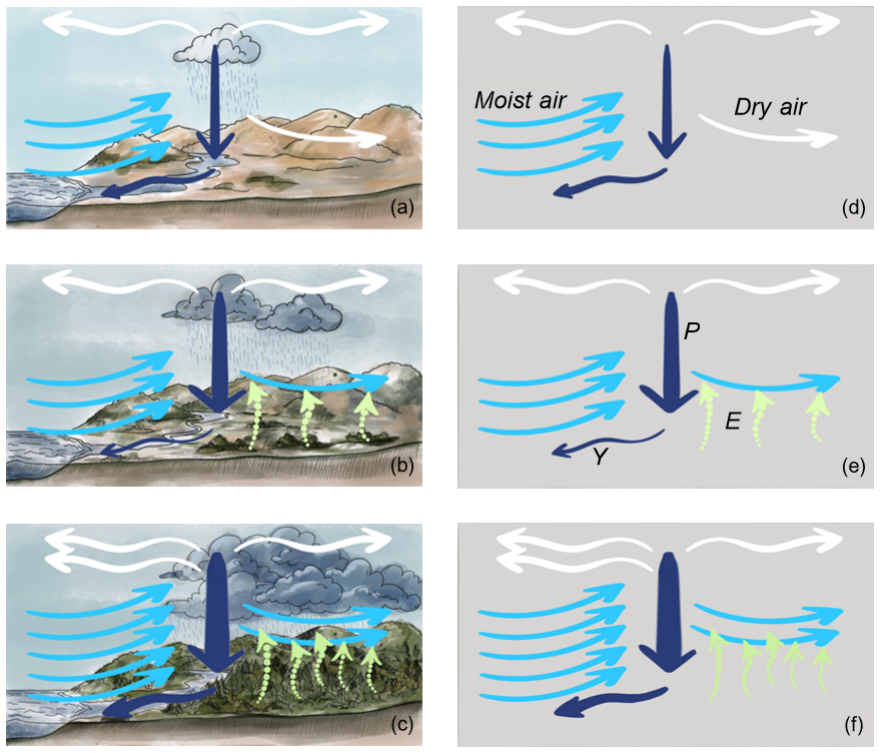
China has undertaken unprecedented, state-driven vegetation restoration on a continental scale. This large-scale land-surface intervention offers a rare opportunity to assess how deliberate biospheric change influences climate-relevant processes, especially the hydrological cycle. Of particular interest is how increased water use by additional vegetation affects terrestrial water availability, including streamflow that sustains both ecosystems and human society. Here we evaluate the methodological basis for addressing this question in light of recently available data on hydrological change in China. Revisiting the atmospheric branch of the hydrological cycle, we argue that water yield depends fundamentally on vegetation-induced changes in atmospheric circulation. When the effects of vegetation on atmospheric dynamics are neglected, as in moisture-recycling-based approaches, the analysis is predisposed by construction toward diagnosing a negative effect of additional vegetation on water yield. Given the nonlinear dependence of precipitation on atmospheric moisture, we further suggest that streamflow reductions associated with added vegetation in dry regions reflects a transient phase of early ecological succession rather than a long-term outcome. As ecosystems mature and regional moisture regimes evolve, this relationship may reverse, generating a positive feedback between vegetation cover and water availability. We briefly discuss recent observational evidence consistent with this interpretation. We conclude that robust assessment of vegetation impacts on water yield requires frameworks that explicitly couple vegetation change, atmospheric processes, and hydrological responses. Such an approach is essential for distinguishing short-term trade-offs from longer-term system trajectories and for informing sustainable land management under continued ecosystem restoration and conservation.
Editorial analysis
A structured set of objections, weighed in public.
Referee Report
Summary. The manuscript argues that moisture-recycling methods for assessing vegetation effects on the atmospheric branch of the hydrological cycle are biased by construction toward negative water-yield outcomes because they omit vegetation-driven changes in atmospheric circulation. In the context of China's continental-scale restoration, it posits that observed streamflow declines in dry regions represent a transient early-succession phase that may reverse with ecosystem maturity owing to nonlinear precipitation-moisture relationships, and concludes that robust evaluation requires explicitly coupled vegetation-atmosphere-hydrology frameworks.
Significance. If the methodological critique holds, the paper would encourage a shift away from static recycling ratios toward dynamic circulation-inclusive models when evaluating large-scale land-cover interventions, with direct relevance to policy assessments of afforestation impacts on regional water resources.
major comments (2)
- [Abstract] Abstract: the assertion that moisture-recycling approaches are 'predisposed by construction' toward negative diagnoses is presented as a logical consequence of neglecting circulation but is not accompanied by a formal derivation, counter-example, or quantitative illustration showing how the bias magnitude arises.
- [Abstract] Abstract: the claim that streamflow reductions in dry regions reflect a transient phase that 'may reverse' as ecosystems mature rests on the nonlinear precipitation response, yet no supporting time-series analysis, model output, or specific observational metrics from China are supplied to establish the reversal trajectory or its timescale.
minor comments (1)
- The reference to 'recent observational evidence consistent with this interpretation' is left unspecified; adding explicit citations or dataset identifiers would allow readers to evaluate the supporting observations directly.
Simulated Author's Rebuttal
We thank the referee for the constructive and insightful comments. We address each major point below, clarifying our reasoning and indicating planned revisions to strengthen the manuscript without altering its core methodological focus.
read point-by-point responses
-
Referee: [Abstract] Abstract: the assertion that moisture-recycling approaches are 'predisposed by construction' toward negative diagnoses is presented as a logical consequence of neglecting circulation but is not accompanied by a formal derivation, counter-example, or quantitative illustration showing how the bias magnitude arises.
Authors: We agree that the abstract would benefit from an explicit illustration of the bias. The manuscript's argument follows directly from the definition of moisture recycling ratios, which hold atmospheric circulation fixed and thus attribute all precipitation changes to local evapotranspiration without accounting for vegetation-driven modifications to convergence and moisture transport. In the revised version we will insert a concise conceptual counter-example (e.g., a two-region moisture budget showing that an increase in evapotranspiration can produce net positive water yield once circulation feedbacks are restored) to quantify the direction and approximate magnitude of the omitted term. revision: yes
-
Referee: [Abstract] Abstract: the claim that streamflow reductions in dry regions reflect a transient phase that 'may reverse' as ecosystems mature rests on the nonlinear precipitation response, yet no supporting time-series analysis, model output, or specific observational metrics from China are supplied to establish the reversal trajectory or its timescale.
Authors: The full manuscript already cites observational studies from China's restoration regions that are consistent with a transient negative phase followed by recovery, but we accept that the abstract itself is too terse. In revision we will expand the relevant paragraph to reference specific time-series metrics (e.g., post-2000 streamflow and precipitation records from the Loess Plateau) and succession timescales drawn from published ecosystem-hydrology studies, while making clear that the reversal remains a hypothesis grounded in the documented nonlinearity rather than a new empirical result of our own. revision: partial
Circularity Check
No significant circularity identified
full rationale
The manuscript is a methodological perspective paper that advances an interpretive argument about the need to couple vegetation, atmospheric dynamics, and hydrology. It contains no equations, derivations, fitted parameters, or quantitative predictions. The claim that moisture-recycling frameworks are 'predisposed by construction' toward negative vegetation effects is presented as a definitional consequence of their stated neglect of circulation changes, not as a result obtained from any internal reduction or self-referential loop. References to observations and prior literature are external to the present text and do not function as load-bearing self-citations that close the argument. The suggestion that streamflow reductions are transient is offered as an interpretive hypothesis consistent with data, not as a mathematical output forced by the paper's own inputs. The derivation chain is therefore self-contained and does not reduce to its own assumptions by construction.
Axiom & Free-Parameter Ledger
axioms (2)
- domain assumption Vegetation affects atmospheric circulation in ways that control precipitation and water yield beyond local moisture recycling.
- domain assumption Precipitation has a nonlinear dependence on atmospheric moisture that allows reversal of vegetation-water relationships as ecosystems mature.
Reference graph
Works this paper leans on
-
[1]
An, Q., Liu, L., Staal, A., Yang, K., Cheng, Y ., Liu, J., and Huang, G.: Land cover changes redistribute China’s water resources through atmospheric moisture recycling, Earth’s Future, 13, e2024EF005 565, https://doi.org/10.1029/2024EF005565,
-
[2]
Andrade, D., Pasini, F., and Scarano, F. R.: Syntropy and innovation in agriculture, Current Opinion in Environmental Sustainability, 45, 20–24, https://doi.org/10.1016/j.cosust.2020.08.003, Open Issue 2020 Part A: Technology innovations and environmental sustainability in the Anthropocene,
-
[3]
Barnes, M. L., Zhang, Q., Robeson, S. M., Young, L., Burakowski, E. A., Oishi, A. C., Stoy, P. C., Katul, G., and Novick, K. A.: A century of reforestation reduced anthropogenic warming in the eastern United States, Earth’s Future, 12, e2023EF003 663, https://doi.org/10.1029/2023EF003663,
-
[4]
Breil, M., Davin, E. L., and Rechid, D.: What determines the sign of the evapotranspiration response to afforestation in European summer?, Biogeosciences, 18, 1499–1510, https://doi.org/10.5194/bg-18-1499-2021,
-
[5]
Byrne, M. P., Hegerl, G. C., Scheff, J., Adam, O., Berg, A., Biasutti, M., Bordoni, S., Dai, A., Geen, R., Henry, M., Hill, S. A., Hohenegger, C., Humphrey, V ., Joshi, M., Konings, A. G., Laguë, M. M., Lambert, F. H., Lehner, F., Mankin, J. S., McColl, K. A., McKinnon, K. A., Pendergrass, A. G., Pietschnig, M., Schmidt, L., Schurer, A. P., Scott, E. M., ...
-
[6]
Chen, C., Park, T., Wang, X., Piao, S., Xu, B., Chaturvedi, R. K., Fuchs, R., Brovkin, V ., Ciais, P., Fensholt, R., et al.: China and India lead in greening of the world through land-use management, Nature Sustainability, 2, 122–129, https://doi.org/10.1038/s41893-019-0220-7,
-
[7]
Chikoore, H. and Jury, M. R.: Intraseasonal variability of satellite-derived rainfall and vegetation over Southern Africa, Earth Interactions, 14, 1–26, https://doi.org/10.1175/2010EI267.1,
-
[8]
Food and Agriculture Organization of the United Nations: Global Forest Resources Assessment 2020: Main Report, FAO, Rome, Italy, https://doi.org/10.4060/ca9825en,
-
[9]
Gudmundsson, L., Boulange, J., Do, H. X., Gosling, S. N., Grillakis, M. G., Koutroulis, A. G., Leonard, M., Liu, J., Müller Schmied, H., Papadimitriou, L., Pokhrel, Y ., Seneviratne, S. I., Satoh, Y ., Thiery, W., Westra, S., Zhang, X., and Zhao, F.: Globally observed trends in mean and extreme river flow attributed to climate change, Science, 371, 1159–1...
-
[10]
Hansen, M. C., Potapov, P. V ., Moore, R., Hancher, M., Turubanova, S. A., Tyukavina, A., Thau, D., Stehman, S. V ., Goetz, S. J., Loveland, T. R., Kommareddy, A., Egorov, A., Chini, L., Justice, C. O., and Townshend, J. R. G.: High-resolution global maps of 21st-century forest cover change, Science, 342, 850–853, https://doi.org/10.1126/science.1244693,
-
[11]
F., Bellon, S., Coquil, X., Doetterl, S., Esnarriaga, D
Jacobi, J., Andres, C., Assaad, F. F., Bellon, S., Coquil, X., Doetterl, S., Esnarriaga, D. N., Ortiz-Vallejo, D., Rigolot, C., Rüegg, J., Takerkart, S., Trouillard, M., Vilter, B., and Dierks, J.: Syntropic farming systems for reconciling productivity, ecosystem functions, and restoration, The Lancet Planetary Health, 9, e314–e325, https://doi.org/10.101...
-
[12]
Jiang, B. and Liang, S.: Improved vegetation greenness increases summer atmospheric water vapor over Northern China, Journal of Geophysical Research: Atmospheres, 118, 8129–8139, https://doi.org/10.1002/jgrd.50602,
-
[13]
Lindenmayer, D. B., Bowd, E. J., Taylor, C., and Likens, G. E.: The interactions among fire, logging, and climate change have sprung a landscape trap in Victoria’s montane ash forests, Plant Ecology, 223, 733–749, https://doi.org/10.1007/s11258-021-01217-2,
-
[14]
11 Liu, J., Costanza, R., Kubiszewski, I., Li, B.-L. L., Chen, F., Day, J. W., Gleick, P. H., Makarieva, A., McGlade, J. M., Pimm, S. L., Stoeckl, N., and Zhu, Y .: Zhengzhou 2024 Ecosummit declaration: Building eco-civilization for a sustainable and desirable future, Ecological Indicators, 171, 113 249, https://doi.org/10.1016/j.ecolind.2025.113249,
-
[15]
Luo, X., Ge, J., Guo, W., Fan, L., Chen, C., Liu, Y ., and Yang, L.: The biophysical impacts of deforestation on precipitation: results from the CMIP6 model intercomparison, Journal of Climate, 35, 3293–3311, https://doi.org/10.1175/JCLI-D-21-0689.1,
-
[16]
Lyons, T. J.: Clouds prefer native vegetation, Meteorology and Atmospheric Physics, 80, 131–140, https://doi.org/10.1007/s007030200020,
-
[17]
Makarieva, A. M. and Gorshkov, V . G.: Biotic pump of atmospheric moisture as driver of the hydrological cycle on land, Hydrology and Earth System Sciences, 11, 1013–1033, https://doi.org/10.5194/hess-11-1013-2007,
-
[18]
Makarieva, A. M., Nefiodov, A. V ., Nobre, A. D., Baudena, M., Bardi, U., Sheil, D., Saleska, S. R., Molina, R. D., and Rammig, A.: The role of ecosystem transpiration in creating alternate moisture regimes by influencing atmospheric moisture convergence, Global Change Biology, 29, 2536–2556, https://doi.org/10.1111/gcb.16644,
-
[19]
Makarieva, A. M., Nefiodov, A. V ., Cuartas, L. A., Nobre, A. D., Pasini, F., Andrade, D., and Nobre, P.: Assessing changes in atmospheric circulation due to ecohydrological restoration: how can global climate models help?, Frontiers in Environmental Science, 13, 1516 747, https://doi.org/10.3389/fenvs.2025.1516747,
-
[20]
G., Piles, M., Rodríguez-Fernández, N
Muñoz-Sabater, J., Dutra, E., Agustí-Panareda, A., Albergel, C., Arduini, G., Balsamo, G., Boussetta, S., Choulga, M., Harrigan, S., Hersbach, H., Martens, B., Miralles, D. G., Piles, M., Rodríguez-Fernández, N. J., Zsoter, E., Buontempo, C., and Thépaut, J.-N.: ERA5-Land: a state-of-the-art global reanalysis dataset for land applications, Earth System Sc...
-
[21]
Pasini, F. S., Andrade, D. V ., and Scarano, F. R.: Syntropic Agriculture, in: Recarbonizing global soils: A technical manual of recommended management practices. V olume 3: Cropland, Grassland, Integrated systems and farming approaches – Practices overview, pp. 511–522, FAO and ITPS, Rome, Italy, 1 edn., https://doi.org/10.4060/cb6595en,
-
[22]
Teuling, A. J.: A forest evapotranspiration paradox investigated using lysimeter data, Vadose Zone Journal, 17, 170 031, https://doi.org/10.2136/vzj2017.01.0031,
-
[23]
Tian, J., Zhang, Z., Zhao, T., Tao, H., and Zhu, B.: Warmer and wetter climate induced by the continual increase in atmospheric temperature and precipitable water vapor over the arid and semi-arid regions of Northwest China, Journal of Hydrology: Regional Studies, 42, 101 151, https://doi.org/10.1016/j.ejrh.2022.101151, 2022a. Tian, L., Zhang, B., Chen, S...
-
[24]
Vaupel, A., Küsters, M., Toups, J., Herwig, N., Bösel, B., and Beule, L.: Trees shape the soil microbiome of a temperate agrosilvopastoral and syntropic agroforestry system, Scientific Reports, 15, 1550, https://doi.org/10.1038/s41598-025-85556-4,
-
[25]
Wang, K., Liu, X., Cui, P., Zhang, Y ., Xie, J., Liu, C., and Gosling, S. N.: China’s nationwide streamflow decline driven by landscape changes and human interventions, Science Advances, 11, eadu8032, https://doi.org/10.1126/sciadv.adu8032,
-
[26]
12 Wolf, J., Asch, J., Tian, F., Georgiou, K., and Ahlström, A.: Canopy responses of Swedish primary and secondary forests to the 2018 drought, Environmental Research Letters, 18, 064 044, https://doi.org/10.1088/1748-9326/acd6a8,
-
[27]
Wright, J. S., Fu, R., Worden, J. R., Chakraborty, S., Clinton, N. E., Risi, C., Sun, Y ., and Yin, L.: Rainforest-initiated wet season onset over the southern Amazon, Proceedings of the National Academy of Sciences of the USA, 114, 8481–8486, https://doi.org/10.1073/pnas.1621516114,
-
[28]
Xiao, C., Zaehle, S., Yang, H., Wigneron, J.-P., Schmullius, C., and Bastos, A.: Land cover and management effects on ecosystem resistance to drought stress, Earth System Dynamics, 14, 1211–1237, https://doi.org/10.5194/esd-14-1211-2023,
-
[29]
Yang, Z. and Dominguez, F.: Investigating land surface effects on the moisture transport over South America with a Moisture Tagging Model, Journal of Climate, 32, 6627–6644, https://doi.org/10.1175/JCLI-D-18-0700.1,
-
[30]
Yu, Y ., Yu, P., Wang, Y ., Wan, Y ., Han, X., Tu, X., Li, J., Xu, L., Wang, X., and Liu, Z.: Natural revegetation has dominated annual runoff reduction since the Grain for Green Program began in the Jing River Basin, Northwest China, Journal of Hydrology, 625, 129 978, https://doi.org/10.1016/j.jhydrol.2023.129978,
-
[31]
Zhan, Y . J. and Ren, G. Y .: Change in mean and extreme precipitation in eastern China since 1901, Climate Research, 91, 1–19, https://doi.org/10.3354/cr01716,
-
[32]
Zhang, Q., Yang, J., Duan, X., Ma, P., Lu, G., Zhu, B., Liu, X., Yue, P., Wang, Y ., and Liu, W.: The eastward expansion of the climate humidification trend in northwest China and the synergistic influences on the circulation mechanism, Climate Dynamics, 59, 2481–2497, https://doi.org/10.1007/s00382-022-06221-4,
-
[33]
Zhang, Y ., Li, C., Chiew, F. H. S., Post, D. A., Zhang, X., Ma, N., Tian, J., Kong, D., Leung, L. R., Yu, Q., Shi, J., and Liu, C.: Southern Hemisphere dominates recent decline in global water availability, Science, 382, 579–584, https://doi.org/10.1126/science.adh0716,
discussion (0)
Sign in with ORCID, Apple, or X to comment. Anyone can read and Pith papers without signing in.