Recognition: unknown
Machine Learning Phase Field Reconstruction in a Bose-Einstein Condensate
Pith reviewed 2026-05-10 16:22 UTC · model grok-4.3
The pith
A deep neural network can reconstruct the full phase field including vortex charges of a Bose-Einstein condensate from its measured density distribution.
A machine-rendered reading of the paper's core claim, the machinery that carries it, and where it could break.
Core claim
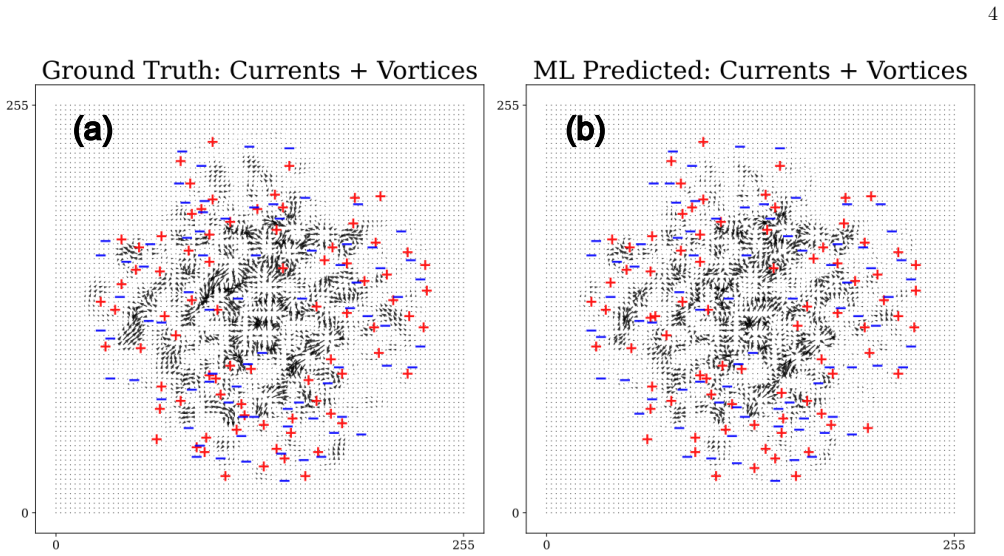
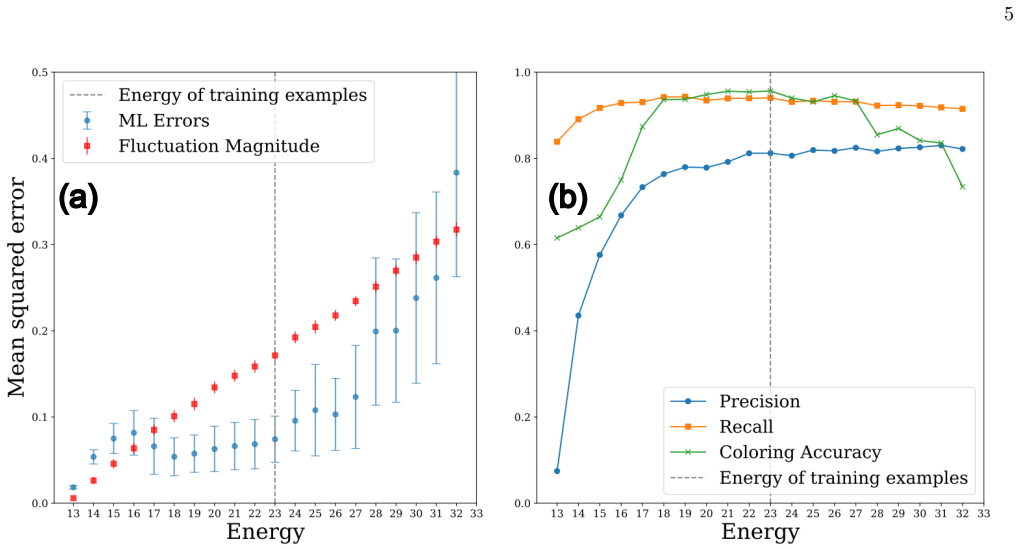
This work demonstrates that a combination of a deep machine learning model and classical computer vision post-processing steps can be used to infer the absolute values of the phase field gradients from an observed density field, locate the positions of the vortex cores, and determine with high accuracy the phase field, including the quantized charge of each vortex, when trained on realistic snapshots from projected Gross-Pitaevskii equation simulations of the thermal state in a harmonic trap.
What carries the argument
U-Net-based architecture (a convolutional neural network) that infers absolute values of phase field gradients from density, combined with a separate machine learning model to locate vortex cores and graphical post-processing to assemble the phase field and assign quantized charges.
If this is right
- Full reconstruction of the phase field becomes possible from standard in-situ density images of two-dimensional BECs.
- The quantized charge of each vortex can be identified automatically as part of the phase map.
- Phase-related quantities such as superfluid velocity and topological defects can be extracted without direct phase measurements.
- The approach works on thermal states in harmonic traps when models are trained on matching synthetic data.
Where Pith is reading between the lines
- Time series of density images could be processed to track the motion and interactions of vortices over time in experiments.
- Similar reconstruction pipelines might apply to other quantum fluids where density is measured but phase is hidden.
- Testing the model on real experimental images with controlled vortex configurations would directly test generalization beyond simulations.
Load-bearing premise
Synthetic data generated from projected Gross-Pitaevskii equation simulations of the thermal state in a harmonic trap sufficiently matches real experimental density images and noise characteristics for the trained model to generalize.
What would settle it
Apply the trained model to an experimental density image of a two-dimensional BEC whose phase field has been measured independently through interference or other means and check whether the reconstructed phase and vortex charges match the independent measurement.
Figures


read the original abstract
A basic challenge in experimental physics is the extraction of information related to variables that are not directly measured. The challenge is particularly severe in quantum systems where one may be interested in correlations of operators that are not diagonal in the measurement basis. In this paper we take a step towards addressing this issue in the context of Boson superfluids, where standard in-situ imaging yields only the spatially resolved density, leaving the phase field - crucial for identifying topological defects such as vortices and confirming superfluidity - indirectly encoded. Previous work has shown that the location of vortices in the phase field may be detected, but has not solved the problems of fully reconstructing the phase or identifying the charge (vortex vs. antivortex). This paper shows that a combination of a deep machine learning (ML) model and classical computer vision post-processing steps can address this gap. We use realistic snapshots of the thermal state of a two-dimensional BEC in a harmonic trap using synthetic data obtained from projected Gross-Pitaevskii equation simulations to train a U-Net-based architecture to infer the absolute values of the phase field gradients from an observed density field, and then employ a separate ML model to locate the positions of the vortex cores and a post-processing graphical analysis to determine with high accuracy the phase field, including the quantized charge of each vortex.
Editorial analysis
A structured set of objections, weighed in public.
Referee Report
Summary. The manuscript proposes a hybrid machine-learning and computer-vision pipeline to reconstruct the full phase field, including quantized vortex charges, of a two-dimensional Bose-Einstein condensate from its observed density distribution. A U-Net is trained on synthetic snapshots generated by projected Gross-Pitaevskii equation simulations of thermal states in a harmonic trap to predict the absolute value of the phase gradient; a second model locates vortex cores; and a post-processing graphical unwrapping step assigns charges and assembles the phase. The approach is presented as addressing the long-standing inability to extract phase information directly from standard in-situ density images.
Significance. If the reconstruction accuracy holds under realistic conditions, the method would provide a practical route to extract topological information (vortex positions and charges) from routine absorption images, thereby enabling quantitative studies of superfluidity and defect dynamics in experiments where direct phase imaging is unavailable. The combination of a gradient-inference network with classical unwrapping is a concrete technical contribution that could be adapted to other imaging modalities.
major comments (3)
- [Abstract and §4] Abstract and §4 (Results): the claim of reconstruction “with high accuracy” is not supported by any reported quantitative metrics (e.g., mean absolute error on |∇φ|, vortex-position RMSE, or charge-assignment success rate) on held-out synthetic realizations. Without these numbers or an error analysis, it is impossible to judge whether the pipeline meets the performance needed for the stated application.
- [§3 and §5] §3 (Methods) and §5 (Discussion): training and evaluation are performed exclusively on ideal, noise-free projected-GPE snapshots in a perfect harmonic trap. No ablation or transfer tests with added shot noise, finite imaging resolution, atom-number fluctuations, or trap anharmonicities are presented, yet the central claim concerns “observed density fields” in real experiments. This gap directly affects the practical utility asserted in the abstract.
- [§4] §4 (Results): the separation into an independent vortex-core detector and a subsequent graphical unwrapping step is described only at a high level; it is unclear how phase discontinuities are handled at the boundaries of the computational domain or how the method resolves ambiguities when multiple vortices are close together. These details are load-bearing for the charge-assignment accuracy.
minor comments (3)
- [Abstract] The abstract and introduction would benefit from a concise statement of the quantitative performance achieved on the synthetic test set (e.g., “MAE on |∇φ| of X rad/μm, 98 % charge-assignment accuracy”).
- [Figures] Figure captions should explicitly state the noise level (if any) and the precise simulation parameters used to generate each panel.
- [Introduction] A brief comparison with existing vortex-detection algorithms (e.g., those based on density minima or circulation integrals) would help situate the contribution.
Simulated Author's Rebuttal
We thank the referee for the constructive and detailed report. The comments highlight important aspects of quantitative validation, robustness, and methodological clarity that we address below. We have prepared revisions to strengthen the manuscript accordingly.
read point-by-point responses
-
Referee: [Abstract and §4] Abstract and §4 (Results): the claim of reconstruction “with high accuracy” is not supported by any reported quantitative metrics (e.g., mean absolute error on |∇φ|, vortex-position RMSE, or charge-assignment success rate) on held-out synthetic realizations. Without these numbers or an error analysis, it is impossible to judge whether the pipeline meets the performance needed for the stated application.
Authors: We agree that explicit quantitative metrics are necessary to support the accuracy claims. The original manuscript relied on qualitative visual comparisons in §4. In the revised version we will add a new error-analysis subsection reporting: (i) mean absolute error on the predicted |∇φ| field, (ii) root-mean-square error on vortex core positions, and (iii) charge-assignment success rate, all evaluated on a held-out test set of 1000 independent projected-GPE realizations. These numbers will also be referenced in the abstract. revision: yes
-
Referee: [§3 and §5] §3 (Methods) and §5 (Discussion): training and evaluation are performed exclusively on ideal, noise-free projected-GPE snapshots in a perfect harmonic trap. No ablation or transfer tests with added shot noise, finite imaging resolution, atom-number fluctuations, or trap anharmonicities are presented, yet the central claim concerns “observed density fields” in real experiments. This gap directly affects the practical utility asserted in the abstract.
Authors: This limitation is acknowledged. The present work establishes feasibility on ideal data. In the revision we will expand §5 with a dedicated robustness subsection that includes preliminary transfer tests in which Poisson shot noise (matched to typical experimental atom numbers) is added to both training and test images. We will also discuss the expected impact of finite resolution and trap anharmonicities. A complete multi-factor ablation study lies beyond the scope of this initial paper but will be noted as future work. revision: partial
-
Referee: [§4] §4 (Results): the separation into an independent vortex-core detector and a subsequent graphical unwrapping step is described only at a high level; it is unclear how phase discontinuities are handled at the boundaries of the computational domain or how the method resolves ambiguities when multiple vortices are close together. These details are load-bearing for the charge-assignment accuracy.
Authors: We will expand the description in §4. The graphical unwrapping employs a flood-fill algorithm initialized at a reference pixel with φ=0; Neumann (zero normal derivative) boundary conditions are imposed at the domain edges. Close vortices are disambiguated by the core detector via non-maximum suppression with a 2-pixel minimum-separation threshold, after which circulation integrals are computed on isolated 5-pixel-radius contours to assign charges. A short pseudocode block and an additional figure illustrating the boundary and proximity cases will be included. revision: yes
Circularity Check
No circularity in ML phase reconstruction pipeline
full rationale
The paper trains a U-Net to predict absolute phase gradients from density snapshots and a second model to locate vortex cores, then applies graphical post-processing to recover the full phase field and quantized charges. All training and evaluation occur on independent realizations drawn from the same projected Gross-Pitaevskii forward simulations; the reported accuracy therefore measures learned inversion performance rather than any tautological re-expression of the input data. No self-definitional steps, no fitted parameters renamed as predictions, and no load-bearing self-citations appear in the described derivation chain, rendering the pipeline self-contained against its synthetic benchmark.
Axiom & Free-Parameter Ledger
axioms (1)
- domain assumption Projected Gross-Pitaevskii equation simulations accurately capture the thermal state and density fluctuations of a 2D BEC in a harmonic trap.
Reference graph
Works this paper leans on
-
[1]
If one imagines coloring the image based on the sign of∂ xϕ, this corresponds to predicting the bor- ders between regions of positive and negative signs (and equivalently for∂ yϕ)
Prediction of the locations of the zeros of∂ xϕand ∂yϕ- that is, where the derivatives change signs. If one imagines coloring the image based on the sign of∂ xϕ, this corresponds to predicting the bor- ders between regions of positive and negative signs (and equivalently for∂ yϕ). We found that using two chained U-Nets, with the first U-Net perform- ing t...
-
[2]
This step uses a U- Net
Prediction of|∂ xϕ|and|∂ yϕ|. This step uses a U- Net
-
[3]
Prediction of the positions of vortices, without pre- dicting the signs of the vortices. The U-Net pre- dictions were returned as values between 0 and 1 for each pixel, and we follow the procedure in [41], with thresholding and non-maximum suppression, to produce binary predictions for vortex locations. B. Classical Post-Processing
-
[4]
Given ground truth borders, assigning the sign of∂ xϕto every pixel is a simple 2-coloring problem
Sign Prediction from Boundaries After the deep learning stage, we have the ML- predicted borders, predicting where the sign of∂ xϕ changes across the borders (and similarly for∂ yϕ). Given ground truth borders, assigning the sign of∂ xϕto every pixel is a simple 2-coloring problem. However, the ML- predicted borders are returned as probabilities, and are ...
-
[5]
Thresholding and distance transform. We apply a threshold to the ML-outputted probability map to create a binary boundary map, and compute dis- tances from the closest boundaries to create a dis- tance transformed image
-
[6]
over- segmented
Watershed Segmentation and Graph Construction. Starting from the local maxima in the distance transformed image, we imagine filling those re- gions with water in a watershed transform, with the probabilities of the ML output giving the heights of the landscape. This produces an initial “over- segmented” image, where each regionR i is pre- sumed to share t...
-
[7]
Color Assignment. We assign a sign ofs i =±1 to each node (region) in the constructed graph such that the assignment is maximally consistent with the boundary probabilities predicted by the neural network. First, we define (unnormalized) probabil- ities for regions sharing/not sharing signs based on the set of pixels∂Ω ij forming their boundary: P(s i =s ...
-
[8]
Final Gradient and Vortex Predictions Having predicted the sign of∂ xϕand the value of |∂xϕ|, the full∂ xϕand∂ yϕare each reconstructed up to a global sign. However, this does not fix the relative sign between∂ xϕand∂ yϕ; to obtain the relative sign, we try both∇ϕ= (∂ xϕ, ∂yϕ) and∇ϕ ′ = (∂ xϕ,−∂ yϕ), and numerically compute circulations around 2x2 loops (...
-
[9]
Projected Gross–Pitaevskii equation We consider a two-dimensional projected Gross– Pitaevskii equation (PGPE) describing the dynamics of a classical Bose field Ψ(r, t) confined in a harmonic trap. The dimensionful PGPE is iℏ ∂Ψ ∂t = − ℏ2 2m ∇2 +V trap(r) Ψ +P 4πℏ2a m |Ψ|2Ψ , (A1) where∇ 2 is the two-dimensional Laplacian,V trap(r) = 1 2 mω2(x2 +y 2) is th...
-
[10]
Dimensionless formulation We nondimensionalize Eq. (A1) using the harmonic trap frequencyωto set the characteristic scales x0 = r ℏ mω , t 0 =ω −1, E 0 =ℏω.(A3) Introducing dimensionless coordinates and time ˜r=r/x 0 and ˜t=t/t 0, and writing the classical field as ψ(r, t) = p Nc x−1 0 ˜ψ(˜r, ˜t),(A4) where ˜ψis normalized to unity, Z d2˜r| ˜ψ(˜r, ˜t)|2 =...
-
[11]
(A6), is evolved numer- ically using a spectral representation in the eigenbasis of the two-dimensional harmonic oscillator
Time evolution and equilibration protocol The dimensionless PGPE, Eq. (A6), is evolved numer- ically using a spectral representation in the eigenbasis of the two-dimensional harmonic oscillator. The field is expanded as ˜ψ(˜x,˜y,˜t) = X nx,ny∈C cnxny(˜t)ϕ nx(˜x)ϕny(˜y),(A8) whereϕ n(˜x) are the normalized eigenfunctions of the one- dimensional harmonic os...
-
[12]
The harmonic trap frequency isω= 200πHz, and the number of particles in the coherent region is fixed to Nc = 1.5×10 4
Simulation parameters All simulations reported here use parameters appropri- ate for 87Rb atoms, with massm= 86.9 amu ands-wave scattering lengtha= 106a 0, wherea 0 is the Bohr ra- dius. The harmonic trap frequency isω= 200πHz, and the number of particles in the coherent region is fixed to Nc = 1.5×10 4. For each target energy, the ground state was first ...
-
[13]
G¨ orlitz, J
A. G¨ orlitz, J. M. Vogels, A. E. Leanhardt, C. Raman, T. L. Gustavson, J. R. Abo-Shaeer, A. P. Chikkatur, S. Gupta, S. Inouye, T. Rosenband, and W. Ketterle, Realization of Bose-Einstein Condensates in Lower Di- mensions, Physical Review Letters87, 130402 (2001)
2001
-
[14]
J. R. Abo-Shaeer, C. Raman, J. M. Vogels, and W. Ket- terle, Observation of Vortex Lattices in Bose-Einstein Condensates, Science292, 476 (2001)
2001
-
[15]
Klaus, T
L. Klaus, T. Bland, E. Poli, C. Politi, G. Lamporesi, E. Casotti, R. N. Bisset, M. J. Mark, and F. Ferlaino, Observation of vortices and vortex stripes in a dipolar condensate, Nature Physics18, 1453 (2022)
2022
-
[16]
B¨ ottcher, J.-N
F. B¨ ottcher, J.-N. Schmidt, M. Wenzel, J. Hertkorn, M. Guo, T. Langen, and T. Pfau, Transient Supersolid Properties in an Array of Dipolar Quantum Droplets, Physical Review X9, 011051 (2019)
2019
-
[17]
Bigagli, W
N. Bigagli, W. Yuan, S. Zhang, B. Bulatovic, T. Karman, I. Stevenson, and S. Will, Observation of Bose–Einstein condensation of dipolar molecules, Nature631, 289 (2024)
2024
- [18]
-
[19]
Dalibard, Magnetic interactions between cold atoms: Quantum droplets and supersolid states, Lectures at the Coll` ege de France (2024)
J. Dalibard, Magnetic interactions between cold atoms: Quantum droplets and supersolid states, Lectures at the Coll` ege de France (2024)
2024
-
[20]
Chomaz, I
L. Chomaz, I. Ferrier-Barbut, F. Ferlaino, B. Laburthe- Tolra, B. L. Lev, and T. Pfau, Dipolar physics: a review of experiments with magnetic quantum gases, Reports on Progress in Physics86, 026401 (2022)
2022
-
[21]
A. Schindewolf, J. Hertkorn, I. Stevenson, M. Ciardi, P. Gross, D. Wang, T. Karman, G. Quemener, S. Will, T. Pohl, and T. Langen, From few- to many-body physics: Strongly dipolar molecular Bose-Einstein con- densates and quantum fluids (2025), arXiv:2512.14511 [cond-mat]. 11
-
[22]
D. N. Basov, R. D. Averitt, and D. Hsieh, Towards prop- erties on demand in quantum materials, Nature Materials 16, 1077 (2017)
2017
-
[23]
Bloch, A
J. Bloch, A. Cavalleri, V. Galitski, M. Hafezi, and A. Ru- bio, Strongly correlated electron–photon systems, Nature 606, 41 (2022)
2022
-
[24]
A. A. Khajetoorians, D. Wegner, A. F. Otte, and I. Swart, Creating designer quantum states of matter atom-by-atom, Nature Reviews Physics1, 703 (2019)
2019
-
[25]
Paschen and Q
S. Paschen and Q. Si, Quantum phases driven by strong correlations, Nature Reviews Physics3, 9 (2020)
2020
-
[26]
Defenu, A
N. Defenu, A. Lerose, and S. Pappalardi, Out-of- equilibrium dynamics of quantum many-body systems with long-range interactions, Physics Reports Out-of- equilibrium dynamics of quantum many-body systems with long-range interactions,1074, 1 (2024)
2024
-
[27]
R. B. A. Adamson and A. M. Steinberg, Improving Quan- tum State Estimation with Mutually Unbiased Bases, Physical Review Letters105, 030406 (2010)
2010
-
[28]
W. Ketterle, D. S. Durfee, and D. M. Stamper-Kurn, Making, probing and understanding Bose-Einstein con- densates (1999), arXiv:cond-mat/9904034
-
[29]
Kosaka, T
H. Kosaka, T. Inagaki, Y. Rikitake, H. Imamura, Y. Mit- sumori, and K. Edamatsu, Spin state tomography of op- tically injected electrons in a semiconductor, Nature457, 702 (2009)
2009
-
[30]
M. F. Parsons, A. Mazurenko, C. S. Chiu, G. Ji, D. Greif, and M. Greiner, Site-resolved measurement of the spin- correlation function in the Fermi-Hubbard model, Sci- ence353, 1253 (2016)
2016
-
[31]
Tucker, A
K. Tucker, A. K. Rege, C. Smith, C. Monteleoni, and T. Albash, Hamiltonian learning using machine-learning models trained with continuous measurements, Phys. Rev. Appl.22, 044080 (2024)
2024
-
[32]
Liu and X
J. Liu and X. Wang, Hamiltonian learning via inverse physics-informed neural networks, Phys. Rev. Res.7, 043137 (2025)
2025
-
[33]
S.-A. Guo, Y.-K. Wu, J. Ye, L. Zhang, Y. Wang, W.-Q. Lian, R. Yao, Y.-L. Xu, C. Zhang, Y.-Z. Xu, B.-X. Qi, P.-Y. Hou, L. He, Z.-C. Zhou, and L.-M. Duan, Hamil- tonian learning for 300 trapped ion qubits with long- range couplings, Science Advances11, eadt4713 (2025), https://www.science.org/doi/pdf/10.1126/sciadv.adt4713
-
[34]
Hohenberg and W
P. Hohenberg and W. Kohn, Inhomogeneous electron gas, Phys. Rev.136, B864 (1964)
1964
-
[35]
J. C. Snyder, M. Rupp, K. Hansen, K.-R. M¨ uller, and K. Burke, Finding density functionals with machine learning, Phys. Rev. Lett.108, 253002 (2012)
2012
-
[36]
Nelson, R
J. Nelson, R. Tiwari, and S. Sanvito, Machine learning density functional theory for the hubbard model, Phys. Rev. B99, 075132 (2019)
2019
-
[37]
J. R. Moreno, G. Carleo, and A. Georges, Deep learning the hohenberg-kohn maps of density functional theory, Phys. Rev. Lett.125, 076402 (2020)
2020
-
[38]
Y. Bai, L. Vogt-Maranto, M. Tuckerman, and W. J. Glover, Machine learning the hohenberg-kohn map for molecular excited states, Nature Communications13, 7044 (2022)
2022
-
[39]
Kumar, X
S. Kumar, X. Jing, J. E. Pask, A. J. Medford, and P. Suryanarayana, Kohn–sham accuracy from orbital- free density functional theory viaδ-machine learning, J. Chem. Phys.159, 244106 (2023)
2023
-
[40]
Cronin, R
E. Cronin, R. Tiwari, and S. Sanvito, Machine learning semilocal exchange-correlation functionals for kohn-sham density functional theory of the hubbard model, Phys. Rev. B112, 195103 (2025)
2025
-
[41]
Dalfovo, S
F. Dalfovo, S. Giorgini, L. P. Pitaevskii, and S. Stringari, Theory of Bose-Einstein condensation in trapped gases, Reviews of Modern Physics71, 463 (1999)
1999
-
[42]
Bloch, J
I. Bloch, J. Dalibard, and W. Zwerger, Many-body physics with ultracold gases, Reviews of Modern Physics 80, 885 (2008)
2008
-
[43]
E. W. Hagley, L. Deng, M. Kozuma, M. Trippenbach, Y. B. Band, M. Edwards, M. Doery, P. S. Julienne, K. Helmerson, S. L. Rolston, and W. D. Phillips, Mea- surement of the Coherence of a Bose-Einstein Conden- sate, Physical Review Letters83, 3112 (1999)
1999
-
[44]
M. E. Zawadzki, P. F. Griffin, E. Riis, and A. S. Arnold, Spatial interference from well-separated split conden- sates, Physical Review A81, 043608 (2010)
2010
- [45]
-
[46]
Sunami, V
S. Sunami, V. P. Singh, E. Rydow, A. Beregi, E. Chang, L. Mathey, and C. J. Foot, Detecting Phase Coherence of 2D Bose Gases via Noise Correlations, Physical Review Letters134, 183407 (2025)
2025
-
[47]
Meiser and P
D. Meiser and P. Meystre, Reconstruction of the phase of matter-wave fields using a momentum-resolved cross- correlation technique, Physical Review A72, 023605 (2005)
2005
-
[48]
Y.-R. E. Tan, D. M. Paganin, R. P. Yu, and M. J. Morgan, Wave-function reconstruction of complex fields obeying nonlinear parabolic equations, Physical Review E68, 066602 (2003)
2003
-
[49]
R. Ziv, A. Patsyk, Y. Lumer, Y. Sagi, Y. C. Eldar, and M. Segev, Phase retrieval of vortices in Bose-Einstein condensates, Physical Review A109, 043318 (2024)
2024
-
[50]
Kosior and K
A. Kosior and K. Sacha, Condensate Phase Microscopy, Physical Review Letters112, 045302 (2014)
2014
-
[51]
Berezinskii, Destruction of long-range order in one- dimensional and two-dimensional systems possessing a continuous symmetry group
V. Berezinskii, Destruction of long-range order in one- dimensional and two-dimensional systems possessing a continuous symmetry group. ii. quantum systems, Sov. Phys. JETP34, 610 (1972)
1972
-
[52]
J. M. Kosterlitz and D. J. Thouless, Ordering, metasta- bility and phase transitions in two-dimensional systems, Journal of Physics C: Solid State Physics6, 1181 (1973)
1973
-
[53]
J. Ye, Y. Huang, and K. Liu, U-net based vortex detec- tion in Bose–Einstein condensates with automatic cor- rection for manually mislabeled data, Scientific Reports 13, 21278 (2023)
2023
-
[54]
F. Metz, J. Polo, N. Weber, and T. Busch, Deep-learning- based quantum vortex detection in atomic Bose–Einstein condensates, Machine Learning: Science and Technology 2, 035019 (2021)
2021
-
[55]
M. J. Davis, S. A. Morgan, and K. Burnett, Simulations of Bose Fields at Finite Temperature, Physical Review Letters87, 160402 (2001)
2001
-
[56]
P. B. Blakie and M. J. Davis, Projected Gross-Pitaevskii equation for harmonically confined Bose gases at fi- nite temperature, Physical Review A72, 10.1103/phys- reva.72.063608 (2005)
-
[57]
T. P. Simula and P. B. Blakie, Thermal Activation of Vortex-Antivortex Pairs in Quasi-Two-Dimensional Bose-Einstein Condensates, Physical Review Letters96, 020404 (2006). 12
2006
-
[58]
C. J. Foster, P. B. Blakie, and M. J. Davis, Vortex pairing in two-dimensional Bose gases, Physical Review A81, 023623 (2010)
2010
-
[59]
P. B. Blakie, A. Bradley, M. Davis, R. Ballagh, and C. Gardiner, Dynamics and statistical mechanics of ultra- cold bose gases using c-field techniques, Advances in Physics57, 363 (2008)
2008
-
[60]
U-Net: Convolutional Networks for Biomedical Image Segmentation
O. Ronneberger, P. Fischer, and T. Brox, U-Net: Con- volutional Networks for Biomedical Image Segmentation (2015), arXiv:1505.04597 [cs]
work page internal anchor Pith review Pith/arXiv arXiv 2015
-
[61]
C. M. Dion and E. Canc` es, Spectral method for the time- dependent Gross-Pitaevskii equation with a harmonic trap, Physical Review E67, 046706 (2003)
2003
-
[62]
D. P. Kingma and J. Ba, Adam: A Method for Stochastic Optimization (2017), arXiv:1412.6980 [cs]
work page internal anchor Pith review Pith/arXiv arXiv 2017
discussion (0)
Sign in with ORCID, Apple, or X to comment. Anyone can read and Pith papers without signing in.