Recognition: 2 theorem links
· Lean TheoremBenchmarking Compound AI Applications for Hardware-Software Co-Design
Pith reviewed 2026-05-15 16:12 UTC · model grok-4.3
The pith
A benchmarking suite for compound AI applications enables cross-stack analysis to derive hardware-software co-design principles for higher resource efficiency.
A machine-rendered reading of the paper's core claim, the machinery that carries it, and where it could break.
Core claim
We present our benchmarking suite used for cross-stack analysis of Compound AI applications. Using this, we derive key takeaways and design principles spanning several layers of the stack for hardware-software co-design to unlock higher resource-efficiency.
What carries the argument
The benchmarking suite for compound AI applications that spans applications, serving software, and hardware to analyze configuration space effects on performance and resources.
If this is right
- Design principles guide optimizations at multiple stack layers to reduce resource consumption.
- Cross-stack insights support better decisions on application serving and hardware choices.
- Standardized evaluation helps navigate trade-offs in performance, deployment cost, and efficiency.
- The suite provides a foundation for analyzing diverse use cases of compound AI workloads.
Where Pith is reading between the lines
- Hardware architects could use the principles to prioritize features that align with common interactions in these applications.
- Extending the suite to new models or tools might reveal additional principles as workloads evolve.
- Adoption could lower overall datacenter energy and operational costs if the principles generalize beyond tested cases.
- Similar benchmarking approaches might apply to other emerging composite workloads beyond AI.
Load-bearing premise
The proposed suite adequately covers the large configuration space across applications, serving software, and hardware without missing critical interactions that would alter the derived design principles.
What would settle it
Testing the suite on additional compound AI applications and hardware configurations where measured resource efficiency and performance deviate from the expected design principles due to unaccounted layer interactions.
Figures
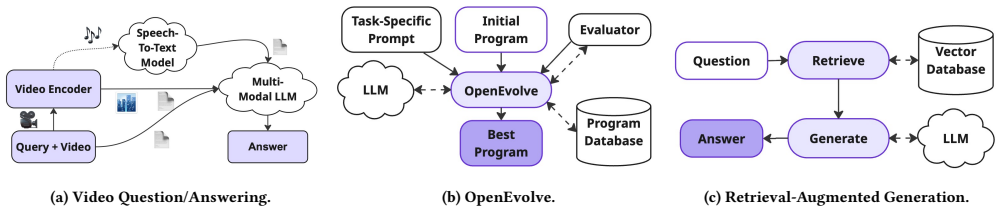





read the original abstract
Compound AI applications, composed from interactions between Large Language Models (LLMs), Machine Learning (ML) models, external tools and data sources are quickly becoming an integral workload in datacenters. Their diverse sub-components and use-cases present a large configuration-space across the deployment stack -- ranging from applications and serving software down to hardware -- each of which may influence the application performance, deployment cost, and/or resource consumption. Despite their rapid adoption, however, the systems community lacks a standardized benchmark for analyzing this complicated design-space and guiding in system design. In this work, we present our benchmarking suite used for cross-stack analysis of Compound AI applications. Using this, we derive key takeaways and design principles spanning several layers of the stack for hardware-software co-design to unlock higher resource-efficiency.
Editorial analysis
A structured set of objections, weighed in public.
Referee Report
Summary. The manuscript introduces a benchmarking suite for Compound AI applications composed of LLMs, ML models, external tools, and data sources. The suite supports cross-stack analysis across the application, serving software, and hardware layers in datacenters. The authors apply the suite to derive key takeaways and design principles for hardware-software co-design aimed at improving resource efficiency.
Significance. If the suite provides adequate coverage of the configuration space and the derived principles are supported by systematic evaluation, the work would address a clear gap in standardized benchmarks for these emerging workloads. Providing an open benchmarking suite is a concrete strength that enables future reproducible studies in hardware-software co-design.
major comments (2)
- [§4 (Evaluation)] §4 (Evaluation): the paper reports results from a modest number of configurations without explicit arguments for coverage of the large space or sensitivity analysis. This leaves open whether omitted interactions (e.g., specific LLM inference engine + accelerator pairings on memory bandwidth or tool-calling latency) would change the reported takeaways.
- [§5 (Design Principles)] §5 (Design Principles): the cross-stack design principles are presented as general but rest on the sampling performed in the evaluation; without quantitative justification of how the chosen points represent the full space, the load-bearing claim that the suite enables reliable derivation of principles is not yet demonstrated.
minor comments (1)
- [Figures] Figure captions and axis labels in the evaluation figures could be expanded to clarify which layers of the stack are being varied in each plot.
Simulated Author's Rebuttal
We thank the referee for the constructive comments on evaluation coverage and the generality of the derived design principles. We address each point below and will incorporate clarifications and additional analysis in the revised manuscript.
read point-by-point responses
-
Referee: §4 (Evaluation): the paper reports results from a modest number of configurations without explicit arguments for coverage of the large space or sensitivity analysis. This leaves open whether omitted interactions (e.g., specific LLM inference engine + accelerator pairings on memory bandwidth or tool-calling latency) would change the reported takeaways.
Authors: We selected the evaluated configurations to span representative dimensions of the space, including model scales (7B–70B), serving frameworks (vLLM and TensorRT-LLM), accelerators (A100/H100), and tool-call latencies drawn from production traces. To strengthen the section we will add an explicit sampling rationale together with a sensitivity study that varies batch size, memory bandwidth, and engine–accelerator pairings. The open-source suite is intentionally extensible so that omitted interactions can be explored by users; the reported results are therefore intended as illustrative demonstrations rather than exhaustive enumeration. revision: partial
-
Referee: §5 (Design Principles): the cross-stack design principles are presented as general but rest on the sampling performed in the evaluation; without quantitative justification of how the chosen points represent the full space, the load-bearing claim that the suite enables reliable derivation of principles is not yet demonstrated.
Authors: We will revise §5 to state the scope of the principles explicitly, include quantitative coverage metrics (ranges and distributions of model sizes, hardware specs, and latency budgets), and note that the principles reflect trends observed within the sampled subspace. This will ground the claims in the evaluation methodology while acknowledging that broader validation remains possible through the released benchmark. revision: yes
Circularity Check
No circularity: benchmarking suite and takeaways are empirically derived
full rationale
The paper introduces a benchmarking suite for Compound AI applications and uses it to perform cross-stack analysis, from which design principles are extracted. No equations, fitted parameters, self-citations, or ansatzes are described that would reduce any claimed prediction or principle back to the suite's own inputs by construction. The derivation chain consists of running the suite on selected workloads and reporting observed interactions, which is self-contained empirical work rather than a closed definitional loop. This matches the default expectation for a systems benchmarking paper.
Axiom & Free-Parameter Ledger
axioms (1)
- domain assumption Compound AI applications are quickly becoming an integral workload in datacenters with diverse sub-components that influence performance, cost, and resource consumption.
Lean theorems connected to this paper
-
IndisputableMonolith/Foundation/RealityFromDistinction.leanreality_from_one_distinction unclear?
unclearRelation between the paper passage and the cited Recognition theorem.
We present our benchmarking suite used for cross-stack analysis of Compound AI applications... derive key takeaways and design principles spanning several layers of the stack for hardware-software co-design
-
IndisputableMonolith/Cost/FunctionalEquation.leanwashburn_uniqueness_aczel unclear?
unclearRelation between the paper passage and the cited Recognition theorem.
Takeaway: Optimizing CPU execution is just as vital as optimizing GPU execution... dynamically adjusting GPU configurations and power management strategies
What do these tags mean?
- matches
- The paper's claim is directly supported by a theorem in the formal canon.
- supports
- The theorem supports part of the paper's argument, but the paper may add assumptions or extra steps.
- extends
- The paper goes beyond the formal theorem; the theorem is a base layer rather than the whole result.
- uses
- The paper appears to rely on the theorem as machinery.
- contradicts
- The paper's claim conflicts with a theorem or certificate in the canon.
- unclear
- Pith found a possible connection, but the passage is too broad, indirect, or ambiguous to say the theorem truly supports the claim.
Reference graph
Works this paper leans on
-
[1]
Features | Cursor – The AI Code Editor
2025. Features | Cursor – The AI Code Editor. https://cursor.com/ features. Accessed: 19 August 2025
work page 2025
-
[2]
Shubham Agrawal, Adeola Adesoba, Dhruv Nandakumar, Katherine Huang, and Vignesh Srinivasakumar. 2024. Build an Agentic Video Workflow with Video Search and Summarization. NVIDIA Developer Blog. Available at: https://developer.nvidia.com/blog/build-an-agentic- video-workflow-with-video-search-and-summarization/
work page 2024
-
[3]
Gohar Irfan Chaudhry, Esha Choukse, Íñigo Goiri, Rodrigo Fonseca, Adam Belay, and Ricardo Bianchini. 2025. Towards Resource-Efficient Compound AI Systems. InProceedings of the 2025 Workshop on Hot Topics in Operating Systems(Banff, AB, Canada)(HotOS ’25). Asso- ciation for Computing Machinery, New York, NY, USA, 218–224. https://doi.org/10.1145/3713082.3730377
- [4]
-
[5]
Esha Choukse, Brijesh Warrier, Scot Heath, Luz Belmont, April Zhao, Hassan Ali Khan, Brian Harry, Matthew Kappel, Russell J. Hewett, Kushal Datta, Yu Pei, Caroline Lichtenberger, John Siegler, David Lukofsky, Zaid Kahn, Gurpreet Sahota, Andy Sullivan, Charles Fred- erick, Hien Thai, Rebecca Naughton, Daniel Jurnove, Justin Harp, Reid Carper, Nithish Mahal...
-
[6]
The ml. energy benchmark: Toward automated inference energy measurement and optimization,
Jae-Won Chung, Jiachen Liu, Jeff J. Ma, Ruofan Wu, Oh Jun Kweon, Yux- uan Xia, Zhiyu Wu, and Mosharaf Chowdhury. 2025. The ML.ENERGY Benchmark: Toward Automated Inference Energy Measurement and Optimization. arXiv:2505.06371 [cs.LG] https://arxiv.org/abs/2505. 06371
-
[7]
NVIDIA Corporation. 2022. NVIDIA H100 Tensor Core GPU Datasheet. https://resources.nvidia.com/en-us-tensor-core/nvidia- tensor-core-gpu-datasheet
work page 2022
-
[8]
NVIDIA Corporation. 2024. NVIDIA Volta V100 GPU Datasheet. https://images.nvidia.com/content/technologies/volta/pdf/437317- Volta-V100-DS-NV-US-WEB.pdf
work page 2024
-
[9]
Ling Dai, Yuan-Hao Jiang, Yuanyuan Chen, Zinuo Guo, Tian-Yi Liu, and Xiaobao Shao. 2024. Agent4EDU: Advancing AI for Education with Agentic Workflows. InProceedings of the 2024 3rd International Conference on Artificial Intelligence and Education. 180–185
work page 2024
-
[10]
Yu Gan, Yanqi Zhang, Dailun Cheng, Ankitha Shetty, Priyal Rathi, Nayan Katarki, Ariana Bruno, Justin Hu, Brian Ritchken, Brendon Jack- son, Kelvin Hu, Meghna Pancholi, Yuan He, Brett Clancy, Chris Colen, Fukang Wen, Catherine Leung, Siyuan Wang, Leon Zaruvinsky, Mateo Espinosa, Rick Lin, Zhongling Liu, Jake Padilla, and Christina Delim- itrou. 2019. An Op...
- [11]
-
[12]
Sagar Goyal, Eti Rastogi, Sree Prasanna Rajagopal, Dong Yuan, Fen Zhao, Jai Chintagunta, Gautam Naik, and Jeff Ward. 2024. HealAI: A healthcare LLM for effective medical documentation. InProceedings of the 17th ACM International Conference on Web Search and Data Mining. 1167–1168
work page 2024
-
[13]
John L. Henning. 2006. SPEC CPU2006 benchmark descriptions. SIGARCH Comput. Archit. News34, 4 (Sept. 2006), 1–17. https: //doi.org/10.1145/1186736.1186737
-
[14]
DSPy: Compiling Declarative Language Model Calls into Self-Improving Pipelines
Omar Khattab, Arnav Singhvi, Paridhi Maheshwari, Zhiyuan Zhang, Keshav Santhanam, Sri Vardhamanan, Saiful Haq, Ashutosh Sharma, Thomas T. Joshi, Hanna Moazam, Heather Miller, Matei Zaharia, and Christopher Potts. 2023. DSPy: Compiling Declarative Language Model Calls into Self-Improving Pipelines. arXiv:2310.03714 [cs.CL] https: //arxiv.org/abs/2310.03714
work page internal anchor Pith review Pith/arXiv arXiv 2023
-
[15]
Efficient Memory Management for Large Language Model Serving with PagedAttention
Woosuk Kwon, Zhuohan Li, Siyuan Zhuang, Ying Sheng, Lianmin Zheng, Cody Hao Yu, Joseph E. Gonzalez, Hao Zhang, and Ion Sto- ica. 2023. Efficient Memory Management for Large Language Model Serving with PagedAttention. arXiv:2309.06180 [cs.LG] https: //arxiv.org/abs/2309.06180
work page internal anchor Pith review Pith/arXiv arXiv 2023
-
[16]
Gonzalez, Hao Zhang, and Ion Sto- ica
Woosuk Kwon, Zhuohan Li, Siyuan Zhuang, Ying Sheng, Lianmin Zheng, Cody Hao Yu, Joseph E. Gonzalez, Hao Zhang, and Ion Sto- ica. 2023. Efficient Memory Management for Large Language Model Serving with PagedAttention. InProceedings of the ACM SIGOPS 29th Symposium on Operating Systems Principles
work page 2023
-
[17]
Patrick Lewis, Ethan Perez, Aleksandra Piktus, Fabio Petroni, Vladimir Karpukhin, Naman Goyal, Heinrich Küttler, Mike Lewis, Wen-tau Yih, Tim Rocktäschel, Sebastian Riedel, and Douwe Kiela. 2020. Retrieval- Augmented Generation for Knowledge-Intensive NLP Tasks.CoRR abs/2005.11401 (2020). arXiv:2005.11401 https://arxiv.org/abs/2005. 11401
work page internal anchor Pith review Pith/arXiv arXiv 2020
-
[18]
Linux man-pages project. 2025. madvise(2) — give advice about use of memory. Linux manual page. https://man7.org/linux/man-pages/ man2/madvise.2.html Linux man-pages 6.16, accessed 2026-02-05
work page 2025
-
[19]
Peter Mattson, Christine Cheng, Cody Coleman, Greg Diamos, Paulius Micikevicius, David Patterson, Hanlin Tang, Gu-Yeon Wei, Peter Bailis, Victor Bittorf, David Brooks, Dehao Chen, Debojyoti Dutta, Udit Gupta, Kim Hazelwood, Andrew Hock, Xinyuan Huang, Atsushi Ike, Bill Jia, Daniel Kang, David Kanter, Naveen Kumar, Jeffery Liao, Guokai Ma, Deepak Narayanan...
-
[20]
Alexander Novikov, Ngân V˜u, Marvin Eisenberger, Emilien Dupont, Po-Sen Huang, Adam Zsolt Wagner, Sergey Shirobokov, Borislav Kozlovskii, Francisco J. R. Ruiz, Abbas Mehrabian, M. Pawan Ku- mar, Abigail See, Swarat Chaudhuri, George Holland, Alex Davies, Sebastian Nowozin, Pushmeet Kohli, and Matej Balog. 2025. Al- phaEvolve: A coding agent for scientific...
work page internal anchor Pith review Pith/arXiv arXiv 2025
-
[21]
NVIDIA. 2024. NVIDIA A100 Tensor Core GPU Datasheet. https://www.nvidia.com/content/dam/en-zz/Solutions/Data-Center/ a100/pdf/nvidia-a100-datasheet-us-nvidia-1758950-r4-web.pdf
work page 2024
-
[22]
KernelBench: Can LLMs Write Efficient GPU Kernels?
Anne Ouyang, Simon Guo, Simran Arora, Alex L. Zhang, William Hu, Christopher Ré, and Azalia Mirhoseini. 2025. KernelBench: Can LLMs Write Efficient GPU Kernels?. InInternational Conference on Machine Learning. https://doi.org/10.48550/arXiv.2502.10517
work page internal anchor Pith review doi:10.48550/arxiv.2502.10517 2025
- [23]
-
[24]
2026.Qwen3-Coder-Next Technical Report
Qwen Team. 2026.Qwen3-Coder-Next Technical Report. Technical Re- port. https://github.com/QwenLM/Qwen3-Coder/blob/main/qwen3_ coder_next_tech_report.pdf Accessed: 2026-02-04
work page 2026
-
[25]
Alec Radford, Jong Wook Kim, Tao Xu, Greg Brockman, Christine McLeavey, and Ilya Sutskever. 2022. Robust Speech Recognition via Large-Scale Weak Supervision. https://openai.com/research/whisper. OpenAI
work page 2022
-
[26]
Francisco Romero, Johann Hauswald, Aditi Partap, Daniel Kang, Matei Zaharia, and Christos Kozyrakis. 2022. Optimizing Video Analytics with Declarative Model Relationships.Proc. VLDB Endow.16, 3 (Nov. 2022), 447–460. https://doi.org/10.14778/3570690.3570695
-
[27]
2025.OpenEvolve: an open-source evolution- ary coding agent
Asankhaya Sharma. 2025.OpenEvolve: an open-source evolution- ary coding agent. https://github.com/algorithmicsuperintelligence/ openevolve
work page 2025
- [28]
-
[29]
Yunlong Tang, Jing Bi, Siting Xu, Luchuan Song, Susan Liang, Teng Wang, Daoan Zhang, Jie An, Jingyang Lin, Rongyi Zhu, Ali Vosoughi, Chao Huang, Zeliang Zhang, Pinxin Liu, Mingqian Feng, Feng Zheng, Jianguo Zhang, Ping Luo, Jiebo Luo, and Chenliang Xu
-
[30]
arXiv:2312.17432 [cs.CV] https://arxiv.org/abs/2312.17432
Video Understanding with Large Language Models: A Survey. arXiv:2312.17432 [cs.CV] https://arxiv.org/abs/2312.17432
-
[31]
Gemma Team, Aishwarya Kamath, Johan Ferret, Shreya Pathak, Nino Vieillard, Ramona Merhej, Sarah Perrin, Tatiana Matejovicova, Alexan- dre Ramé, Morgane Rivière, Louis Rouillard, Thomas Mesnard, Ge- offrey Cideron, Jean bastien Grill, Sabela Ramos, Edouard Yvinec, Michelle Casbon, Etienne Pot, Ivo Penchev, Gaël Liu, Francesco Visin, Kathleen Kenealy, Lucas...
work page internal anchor Pith review Pith/arXiv arXiv 2025
-
[32]
2026.Vast.ai GPU Rental Pricing
Vast.ai. 2026.Vast.ai GPU Rental Pricing. https://vast.ai/pricing
work page 2026
- [33]
-
[34]
Matei Zaharia, Omar Khattab, Lingjiao Chen, Jared Quincy Davis, Heather Miller, Chris Potts, James Zou, Michael Carbin, Jonathan Frankle, Naveen Rao, and Ali Ghodsi. 2024. The Shift from Models to Compound AI Systems. https://bair.berkeley.edu/blog/2024/02/18/ compound-ai-systems/
work page 2024
- [35]
- [36]
discussion (0)
Sign in with ORCID, Apple, or X to comment. Anyone can read and Pith papers without signing in.