Recognition: no theorem link
Some faithful algebraic braid twist group actions for 3-fold crepant resolutions
Pith reviewed 2026-05-15 12:37 UTC · model grok-4.3
The pith
Derived categories of two specific 3-fold crepant resolutions admit faithful algebraic braid twist group actions of types D and E.
A machine-rendered reading of the paper's core claim, the machinery that carries it, and where it could break.
Core claim
For the crepant resolution X(1,3,9) the derived category D(X(1,3,9)) admits a faithful algebraic braid twist group action of type D induced by the associated (Q,W)-configuration of spherical objects. For the crepant resolution X(1,3,13) the derived category D(X(1,3,13)) admits a faithful algebraic braid twist group action of type E induced by the associated (Q,W)-configuration of spherical objects.
What carries the argument
The (Q,W)-configuration of spherical objects in D(X(1,3,a)), which induces the twist functors whose relations realize the braid group action.
If this is right
- The two examples show that the weights (1,3,a) in the diagonal cyclic group action can be chosen so that the resulting derived category carries braid actions whose type matches classical Dynkin diagrams.
- The construction supplies concrete geometric realizations of algebraic braid twist groups inside derived categories of threefolds.
- These cases provide supporting instances for the broader conjecture that (Q,W)-configurations arising from crepant resolutions can realize all finite-type braid actions.
- The faithfulness statements imply that the spherical objects generate a faithful representation of the braid group on the triangulated category.
Where Pith is reading between the lines
- If similar configurations exist for other values of a, the method would produce geometric models for additional braid group types or even affine types.
- The link between the numerical weights and the resulting Dynkin type suggests a dictionary that might classify which resolutions yield which braid actions by examining the continued-fraction expansion of a.
- One could test the construction on higher-dimensional analogs or on non-cyclic groups to see whether the same pattern persists.
Load-bearing premise
That the constructed (Q,W)-configuration of spherical objects exists inside the derived category and that the induced twist action is faithful for the chosen values a=9 and a=13.
What would settle it
An explicit computation of the action of the generators on a basis of the Grothendieck group that violates one of the braid relations for type D when a=9, or for type E when a=13, would falsify the faithfulness claim.
Figures




read the original abstract
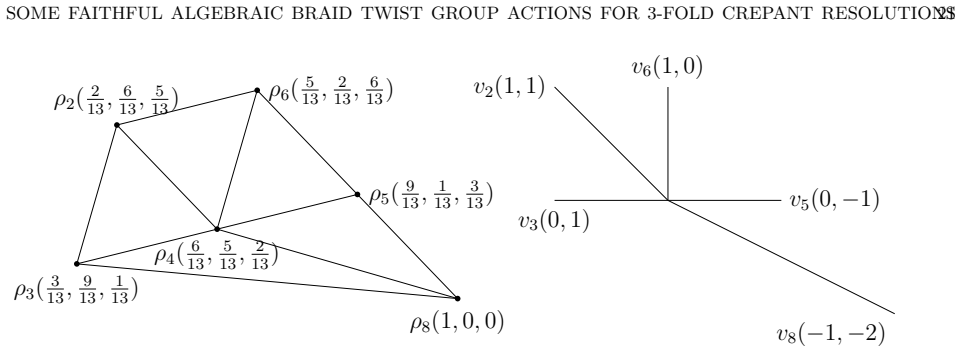
Let X(1,3,a) be a crepant resolution of the quotient singularity C^3/G, where G is a diagonal cyclic subgroup of SL(3,\C) acting on C^3 with weights (1,3,a). For each such X(1,3,a), we construct a (Q,W)-configuration of spherical objects in the bounded derived category of coherent sheaves. When a=9, the derived category D(X(1,3,9)) admits a faithful algebraic braid twist group action of type D induced by the associated (Q,W)-configuration. When a=13, the derived category D(X(1,3,13)) admits a faithful algebraic braid twist group action of type E. These two cases illustrate the emergence of type D and type E patterns from specific geometric data, supporting a broader conjectural framework.
Editorial analysis
A structured set of objections, weighed in public.
Referee Report
Summary. The paper constructs explicit (Q,W)-configurations of spherical objects in the bounded derived category D(X(1,3,a)) of coherent sheaves on the crepant resolution X(1,3,a) of the quotient singularity C^3/G, where G is the diagonal cyclic subgroup of SL(3,C) with weights (1,3,a). For a=9 it claims that the associated twist functors induce a faithful algebraic braid twist group action of type D; for a=13 the construction yields a faithful type-E action. Both claims rest on direct geometric realization of the objects from the resolution data followed by explicit computation of Ext groups to establish sphericity and the defining braid relations.
Significance. If the constructions and faithfulness verifications are correct, the work supplies concrete, computable examples of type-D and type-E braid actions arising from specific 3-fold crepant resolutions. These examples furnish geometric evidence for the conjectural framework relating (Q,W)-configurations to braid-group actions in derived categories, and the finite-case direct verification approach offers a template that could be tested on further values of a.
major comments (2)
- [§4.3] §4.3, the paragraph following Definition 4.2: the claim that the twist functors satisfy all type-D braid relations for a=9 is supported only by a subset of the Ext computations; the manuscript must exhibit the full matrix of Ext groups between the six objects in the configuration to rule out additional relations that would collapse the action.
- [§5.1] §5.1, Proposition 5.4: faithfulness of the type-E action for a=13 is deduced from the action on a generating set of four objects, but the text does not verify that this set is closed under the group action or that the induced representation on K-theory is faithful; an explicit check against the known presentation of the type-E braid group is required.
minor comments (3)
- [§2] The notation (Q,W) is introduced without a self-contained definition; a short reminder of the quiver-with-potential data and the associated spherical objects would improve readability.
- [Figure 3] Figure 3 (the configuration diagram for a=13) has overlapping arrows that obscure the Ext^1 arrows; redrawing with clearer spacing or an accompanying table of dimensions would help.
- [Introduction] The introduction cites only two prior works on algebraic braid actions; additional references to the foundational papers on spherical twists (e.g., Seidel–Thomas) and on crepant resolutions of cyclic quotient singularities would place the results in context.
Simulated Author's Rebuttal
We thank the referee for the careful reading and valuable suggestions. We address each major comment below and will incorporate the requested additions to strengthen the manuscript.
read point-by-point responses
-
Referee: [§4.3] §4.3, the paragraph following Definition 4.2: the claim that the twist functors satisfy all type-D braid relations for a=9 is supported only by a subset of the Ext computations; the manuscript must exhibit the full matrix of Ext groups between the six objects in the configuration to rule out additional relations that would collapse the action.
Authors: We agree that the full matrix of Ext groups among the six objects is required to rigorously confirm that no extraneous relations collapse the action. In the revised manuscript we will add the complete Ext table (including all pairwise groups) immediately after Definition 4.2. revision: yes
-
Referee: [§5.1] §5.1, Proposition 5.4: faithfulness of the type-E action for a=13 is deduced from the action on a generating set of four objects, but the text does not verify that this set is closed under the group action or that the induced representation on K-theory is faithful; an explicit check against the known presentation of the type-E braid group is required.
Authors: We accept the need for explicit verification. The revised §5.1 will (i) confirm that the four-object set is closed under the generated action and (ii) compare the induced K-theory representation against the standard presentation of the type-E braid group to establish faithfulness. revision: yes
Circularity Check
No significant circularity identified
full rationale
The paper's central claims rest on explicit geometric constructions of (Q,W)-configurations of spherical objects inside D(X(1,3,a)) for the concrete finite values a=9 and a=13, followed by direct computation of Ext groups to verify sphericity and explicit verification that the induced twist functors satisfy the braid relations and act faithfully on a generating set. No load-bearing step reduces by definition, by fitted-parameter renaming, or by self-citation chain to the target statement itself; the faithfulness result is obtained from the concrete action rather than presupposed. The broader framework is presented as conjectural and is not used to force the specific cases.
Axiom & Free-Parameter Ledger
axioms (1)
- domain assumption Existence of a (Q,W)-configuration of spherical objects in D(X(1,3,a)) for the given a
Reference graph
Works this paper leans on
-
[1]
C. Brav and H. Thomas, Braid groups and Kleinian singularities, Math. Ann. 351 (2011), 1005--1019
work page 2011
-
[2]
Bridgeland, Stability conditions and Kleinian singularities, Int
T. Bridgeland, Stability conditions and Kleinian singularities, Int. Math. Res. Not. IMRN 2009, no. 21, 4142--4157
work page 2009
-
[3]
D. A. Cox, J. B. Little, and H. K. Schenck, Toric Varieties, Graduate Studies in Mathematics, Vol. 124, American Mathematical Society, Providence, RI, 2011
work page 2011
-
[4]
Craw, An explicit construction of the McKay correspondence for A -Hilb ( C ^3) , J
A. Craw, An explicit construction of the McKay correspondence for A -Hilb ( C ^3) , J. Algebra 285 (2005), no. 2, 682--705
work page 2005
-
[5]
A. Craw and M. Reid, How to calculate A -Hilb ( C ^3) , Sémin. Congr. 6 (2002), 129--154
work page 2002
-
[6]
Quiver braid group action for a 3-fold crepant resolution
W. Donovan and L. Zheng, Quiver braid group action for a 3-fold crepant resolution, arXiv:2512.19140 (2025)
work page internal anchor Pith review Pith/arXiv arXiv 2025
-
[7]
V. Ginzburg, Calabi--Yau algebras, arXiv:math/0612139 (2006)
work page internal anchor Pith review Pith/arXiv arXiv 2006
-
[8]
J. Grant and B. Marsh, Braid groups and quiver mutation, Pacific J. Math. 290 (2017), no. 1, 77--116
work page 2017
-
[9]
Hartshorne, Algebraic Geometry, Graduate Texts in Mathematics, No
R. Hartshorne, Algebraic Geometry, Graduate Texts in Mathematics, No. 52, Springer-Verlag, New York--Heidelberg, 1977
work page 1977
-
[10]
D. Huybrechts, Fourier--Mukai Transforms in Algebraic Geometry, Oxford Mathematical Monographs, Oxford University Press, Oxford, 2006
work page 2006
- [11]
-
[12]
A. M. Keating, Dehn twists and free subgroups of symplectic mapping class groups, J. Topol. 7 (2014), no. 2, 436--474
work page 2014
-
[13]
Nakamura, Hilbert schemes of abelian group orbits, J
I. Nakamura, Hilbert schemes of abelian group orbits, J. Algebraic Geom. 10 (2001), no. 4, 757--779
work page 2001
-
[14]
A. Nordskova and Y. Volkov, Faithful actions of braid groups by twists along ADE-configurations of spherical objects, arXiv:1910.02401 (2019)
-
[15]
Qiu, Decorated marked surfaces: spherical twists versus braid twists, Math
Y. Qiu, Decorated marked surfaces: spherical twists versus braid twists, Math. Ann. 365 (2016), no. 1--2, 595--633
work page 2016
- [16]
-
[17]
M. Reid, McKay correspondence, arXiv:alg-geom/9702016 (1997)
work page internal anchor Pith review Pith/arXiv arXiv 1997
-
[18]
P. Seidel and R. Thomas, Braid group actions on derived categories of coherent sheaves, Duke Math. J. 108 (2001), no. 1, 37--108
work page 2001
discussion (0)
Sign in with ORCID, Apple, or X to comment. Anyone can read and Pith papers without signing in.