Recognition: 2 theorem links
· Lean TheoremGravitational Redshift of Light and the Heisenberg Uncertainty Principle
Pith reviewed 2026-05-14 21:28 UTC · model grok-4.3
The pith
Gravitational redshift may conflict with the Heisenberg uncertainty principle because the photon's interaction with spacetime lacks a clear quantum description.
A machine-rendered reading of the paper's core claim, the machinery that carries it, and where it could break.
Core claim
Empirical observations together with theoretical analyses indicate that gravitational redshift may be in tension with the Heisenberg uncertainty principle. In the Pound-Rebka setup the emitter-absorber pair exchanges a Mössbauer photon in a process fully describable by quantum mechanics, yet the photon's interaction with the spacetime metric stays unclear. Because the uncertainty principle rules out local realism, the authors propose studying continuous-variable photonic entanglement in the Einstein-Podolsky-Rosen framework in a weak gravitational field and outline a realizable thought experiment on the surface of the Earth to examine this boundary.
What carries the argument
Continuous-variable photonic entanglement within the Einstein-Podolsky-Rosen framework placed in a weak gravitational field, used to test the quantum description of photon-metric interaction.
If this is right
- Confirmation of the tension would require a refined quantum account of how photons propagate through curved spacetime.
- The thought experiment provides a concrete, low-energy test of the boundary between general relativity and quantum mechanics.
- Resolution in either direction would constrain how local realism and uncertainty coexist for light in static gravitational potentials.
- The setup could be extended to other weak-field redshift measurements without needing strong gravity.
Where Pith is reading between the lines
- If the experiment reveals no tension, it would support the view that semiclassical gravity already suffices for photon propagation at laboratory scales.
- Similar entanglement tests could be applied to other redshift phenomena, such as those near rotating bodies or in accelerating frames.
- A confirmed conflict might motivate new models in which the metric itself acquires quantum features at the level of single-photon exchange.
Load-bearing premise
The assumption that the photon's interaction with the spacetime metric cannot be fully specified inside a quantum-mechanical treatment of the emitter-absorber exchange.
What would settle it
Run the proposed Earth-surface experiment with entangled photons and check whether the measured entanglement correlations match or deviate from predictions that incorporate the gravitational redshift while respecting the uncertainty principle.
Figures


read the original abstract
Empirical observations together with theoretical analyses are being used to argue that the classical phenomenon of gravitational redshift -- namely, the redshift of light in a static gravitational potential -- may be in tension with the Heisenberg uncertainty principle. In particular, in the Pound-Rebka experiment, the emitter-absorber pair interact with each other by exchanging a Mossbauer photon, a process that is fully describable within quantum mechanics but how the photon interacts with the spacetime metric remains unclear. Since the uncertainty principle is incompatible with local realism, as per general relativity, we propose to study continuous-variable photonic entanglement within the Einstein-Podolsky-Rosen (EPR) framework in a weak gravitational field. We outline a thought experiment, realizable on the surface of the Earth, that could shed further light on this problematic seamline between general relativity and quantum mechanics in the weak-field regime.
Editorial analysis
A structured set of objections, weighed in public.
Referee Report
Summary. The manuscript argues that the classical gravitational redshift of light, as observed in the Pound-Rebka experiment with Mossbauer photons, may be in tension with the Heisenberg uncertainty principle. The claimed incompatibility arises because the photon's interaction with the spacetime metric is asserted to be unclear within a fully quantum-mechanical description of the emitter-absorber exchange. The authors propose investigating this seam between general relativity and quantum mechanics by studying continuous-variable photonic entanglement in the Einstein-Podolsky-Rosen framework in a weak gravitational field and outline a thought experiment realizable on Earth's surface.
Significance. If the asserted tension were rigorously demonstrated through explicit calculation, the work could highlight a potential foundational issue at the GR-QM interface in the weak-field regime and motivate new entanglement-based tests. However, the absence of any derivation or quantitative analysis in the current manuscript renders the significance speculative rather than substantive.
major comments (2)
- Abstract: The central claim that gravitational redshift conflicts with the Heisenberg uncertainty principle is asserted without derivation. No calculation is supplied showing how the redshift energy shift (from the Schwarzschild metric or equivalent) produces a violation of ΔE Δt ≥ ħ/2 when using the Mossbauer photon linewidth and transit time in the Pound-Rebka setup.
- Proposed thought experiment: The outline of the EPR-based photonic entanglement test does not specify the incorporation of the weak gravitational field into the continuous-variable mode analysis, the relevant operators, or the observable that would demonstrate incompatibility with the uncertainty principle or local realism.
minor comments (1)
- The manuscript would benefit from adding a dedicated section with explicit equations for the redshift formula and uncertainty relation to ground the claimed tension.
Simulated Author's Rebuttal
We thank the referee for their thoughtful review and for identifying areas where the manuscript could be strengthened. Our work is conceptual in nature, pointing to a potential foundational tension and outlining a possible test rather than delivering a complete quantitative resolution. We address the major comments below.
read point-by-point responses
-
Referee: Abstract: The central claim that gravitational redshift conflicts with the Heisenberg uncertainty principle is asserted without derivation. No calculation is supplied showing how the redshift energy shift (from the Schwarzschild metric or equivalent) produces a violation of ΔE Δt ≥ ħ/2 when using the Mossbauer photon linewidth and transit time in the Pound-Rebka setup.
Authors: We agree that an explicit derivation would strengthen the presentation. The manuscript highlights that the gravitational redshift imparts an energy shift ΔE = E (g h / c²) over height h in the Pound-Rebka geometry, while the Mössbauer linewidth sets a narrow energy uncertainty and the transit time sets Δt. In a fully quantum treatment the photon's energy is not a sharp eigenvalue during propagation through the metric, suggesting a possible incompatibility with the uncertainty relation. We will add a concise order-of-magnitude estimate and a short explanatory paragraph in the revised manuscript to make this reasoning explicit. revision: partial
-
Referee: Proposed thought experiment: The outline of the EPR-based photonic entanglement test does not specify the incorporation of the weak gravitational field into the continuous-variable mode analysis, the relevant operators, or the observable that would demonstrate incompatibility with the uncertainty principle or local realism.
Authors: The thought experiment is presented at a conceptual level to indicate a feasible direction for future work. In the weak-field limit the gravitational potential introduces a position-dependent phase shift on the quadrature operators of the continuous-variable modes, which modifies the covariance matrix of the entangled state. The relevant observable would be the violation of the EPR uncertainty relation (or a continuous-variable Bell inequality) after propagation. We will expand the description in the revision to include these schematic elements and the form of the modified operators. revision: yes
Circularity Check
No circularity: conceptual proposal asserts tension without any derivation chain or self-referential reduction
full rationale
The manuscript offers a high-level conceptual argument that gravitational redshift in the Pound-Rebka setup may conflict with the Heisenberg uncertainty principle because the photon's metric interaction is 'unclear' in a fully quantum treatment, then proposes an EPR-style thought experiment. No equations, fitted parameters, or derivations appear in the provided text. No self-citations, uniqueness theorems, or ansatzes are invoked. The incompatibility is stated as a premise rather than derived from operators or geodesic equations, so no step reduces to its own inputs by construction. The paper is therefore self-contained as a suggestion for future work and receives a zero circularity score.
Axiom & Free-Parameter Ledger
axioms (2)
- domain assumption Heisenberg uncertainty principle applies to photon energy and position in the emitter-absorber exchange
- standard math General relativity describes the metric interaction with the photon classically
Lean theorems connected to this paper
-
IndisputableMonolith/Foundation/RealityFromDistinction.leanreality_from_one_distinction contradictsthe uncertainty principle is incompatible with local realism, as per general relativity... how the photon interacts with the spacetime metric remains unclear... tension between GR and QM that manifests itself even within the weak-field regime
-
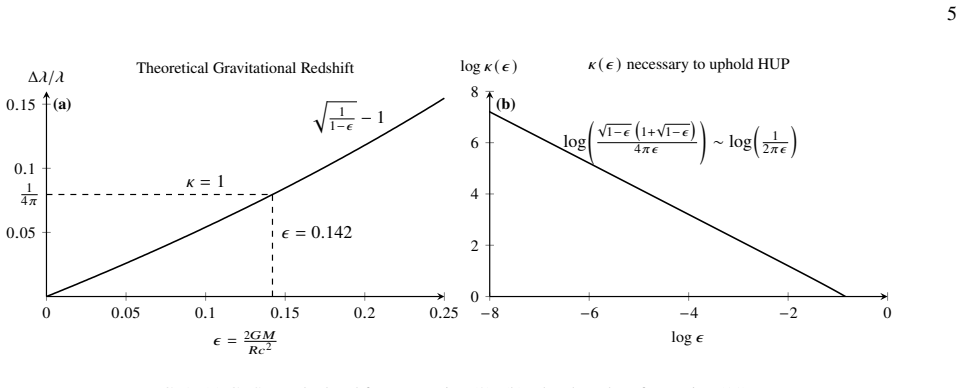
IndisputableMonolith/Foundation/Constants.leanℏ and G as φ-powers on the recognition ladder contradictsΔp_z Δz ≥ ℏ/2 ... Δλ/λ ≈ gz/c² ... κ(ε) ≥ 1/(2π ε) ... incompatibility... between GR and QM
Reference graph
Works this paper leans on
-
[1]
The interference pattern changes only after Bob performs his redshift measurement
-
[2]
Bob doesn’t measure redshift on his beam but the interference pattern changes on Alice’s end within the above estimated lifetime
-
[3]
The interreference pattern changes continuously from the onset of the experiment reaching a maximum around the time that it takes the beam to reach Bob’s location at𝑧, after𝑧/𝑐sec
-
[4]
The interference pattern doesn’t change whether Bob performs his measurement or not. While the first three outcomes indicate that entanglement influences spacetime and may therefore require incorporation into 9 general relativity, the fourth outcome instead suggests that the photon interaction with spacetime is fundamentally local and that GR does not req...
-
[5]
Über den Einfluss der Schwerkraft auf die Ausbreitung des Lichtes,
Einstein, A. (1911) On the Influence of Gravitation on the Propagation of Light.The Principle of Relativity, Dover Publication, Inc. (1952); translated from “Über den Einfluss der Schwerkraft auf die Ausbreitung des Lichtes,”Ann. Phys.35, 898–908
work page 1911
-
[6]
Walecka, J. D. (2007)Introduction to General Relativity, World Scientific Publishing, Singapore, Sec. 9.4, “A Cyclic Process.”
work page 2007
-
[7]
Misner, C. M., Thorne, K. S., Wheeler, J A. (1972)GRAVITATION, W. H. FREEMAN AND COMPANY San Francisco & 25.4 / Chapter 25 — GRAVITATIONAL REDSHIFT 11
work page 1972
-
[8]
Gravitational Red-Shift in Nuclear Resonance,
Pound, R. V. and Rebka, Jr., G. A. (1959) “Gravitational Red-Shift in Nuclear Resonance,”Phys. Rev. Lett.3(9), 439–441; Pound, R. V. and Rebka, Jr., G. A. (1960) “Apparent Weight of Photons,”Phys. Rev. Lett.4(7), 337–341; Pound, R. V. and Snider, J. L. (1964) “Effect of Gravity on Nuclear Resonance,”Phys. Rev. Lett.13(18), 539–540; Horowitz, P. (2021) “Te...
work page 1959
-
[9]
Landau, L. D. and Lifschitz, E. M. (1998)Course in Theoretical Physics, Vol. 2:Classical Theory of Fields. Butterworth Heinemann
work page 1998
-
[10]
Scully, M. O. and Zubairy, M. S. (1997)Quantum Optics. Cambridge University Press, Cambridge, Chapter 6: Atom–field interaction – quantum theory.http://dx.doi.org/10.1017/CBO9780511813993
-
[11]
Can Quantum-Mechanical Description of Physical Reality Be Considered Complete?
Einstein, A., Podolsky, B. and Rosen, N. (1935) “Can Quantum-Mechanical Description of Physical Reality Be Considered Complete?” Phys. Rev.47, 777
work page 1935
-
[12]
Searches for the role of spin and polarization in gravity: a five-year update,
Ni, Wei-Tou (2015) “Searches for the role of spin and polarization in gravity: a five-year update,”International Journal of Modern Physics: Conference Series1(1), 1–12; Duan, Xiao-Chunet al.(2016) “Test of the Universality of Free Fall with Atoms in Different Spin Orientations,”Phys. Rev. Lett.117
work page 2015
-
[13]
Experimental investigation of the information entropic Bell,
Cao, L. Z., Zhao, J. Q., Liu, X.et al.(2016) “Experimental investigation of the information entropic Bell,”Sci. Rep.6, 23758. https://doi.org/10.1038/srep23758
-
[14]
10.https://link.springer.com/book/10
Furusawa, A.Quantum States of Light, SpringerBriefs in Mathematical Physics, Vol. 10.https://link.springer.com/book/10. 1007/978-4-431-55960-3
-
[15]
Schlosshauer, M. (2019) “Quantum Decoherence,”Phys. Rep.831,1–57.https://doi.org/10.1016/j.physrep.2019.10.001
-
[16]
Observation of Gravitationally Induced Quantum Interference
Colella, R., Overhauser, A. W. and Werner, S. A. (1975) “Observation of Gravitationally Induced Quantum Interference",Phys. Rev. Lett., 34, 1472–1474https://link.aps.org/doi/10.1103/PhysRevLett.34.1472
-
[17]
The gravitational phase shift in quantum interference,
Stodolsky, L. (1979) “The gravitational phase shift in quantum interference,” General Relativity and Gravitation 11, 391–405
work page 1979
-
[18]
Remarks on the Mind-Body Question
Wigner, E. P. (1995) “Remarks on the Mind-Body Question.” In: Mehra, J. (ed.),Philosophical Reflections and Syntheses.The Collected Works of Eugene Paul Wigner, Vol. B/6. Springer, Berlin, Heidelberg.https://doi.org/10.1007/978-3-642-78374-6_20
discussion (0)
Sign in with ORCID, Apple, or X to comment. Anyone can read and Pith papers without signing in.