Recognition: no theorem link
Are We Recognizing the Jaguar or Its Background? A Diagnostic Framework for Jaguar Re-Identification
Pith reviewed 2026-05-10 19:51 UTC · model grok-4.3
The pith
Jaguar re-identification models often achieve high scores by matching backgrounds or silhouettes instead of coat patterns.
A machine-rendered reading of the paper's core claim, the machinery that carries it, and where it could break.
Core claim
Re-identification models for jaguars in natural images can achieve high performance by exploiting contextual information or non-unique shape features rather than the unique coat markings. The diagnostic framework quantifies this through a background-to-foreground context ratio derived from inpainted images and laterality metrics from cross-flank and mirror comparisons, tested on a new identity-balanced Pantanal jaguar dataset with segmentation masks. Case studies on fine-tuning, regularization, and hyperbolic embeddings illustrate how to evaluate what evidence the models actually use.
What carries the argument
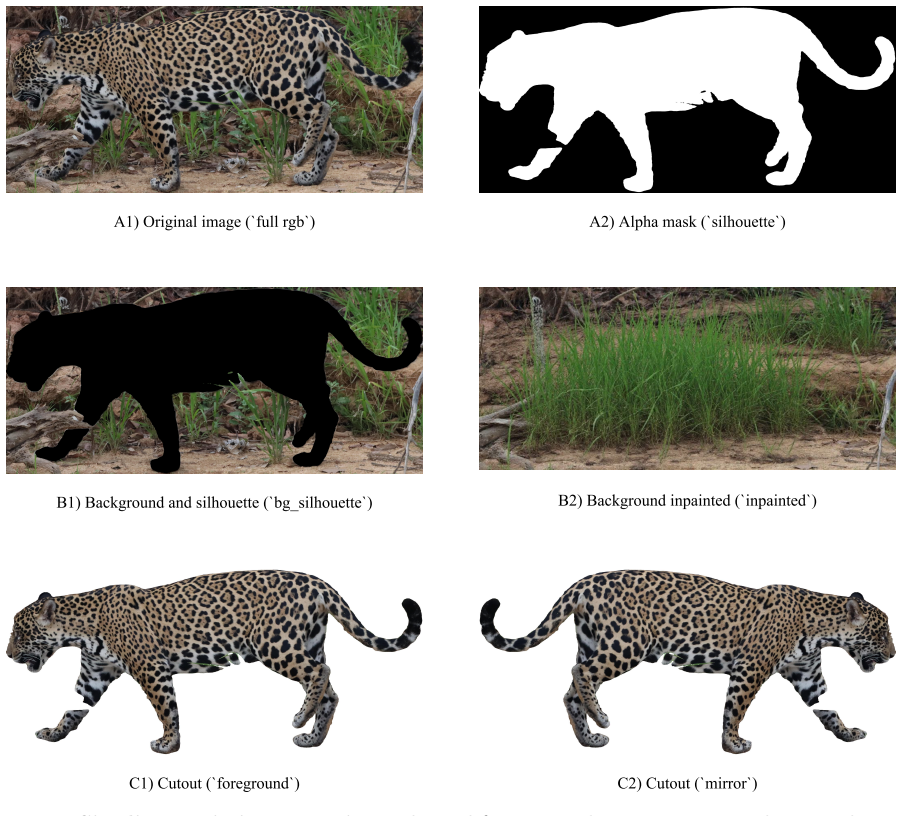
The leakage-controlled context ratio computed from retrieval performance on inpainted background-only versus foreground-only images, together with laterality diagnostics based on cross-flank retrieval and mirror self-similarity.
If this is right
- High context ratios indicate that models are matching based on background rather than the jaguar itself.
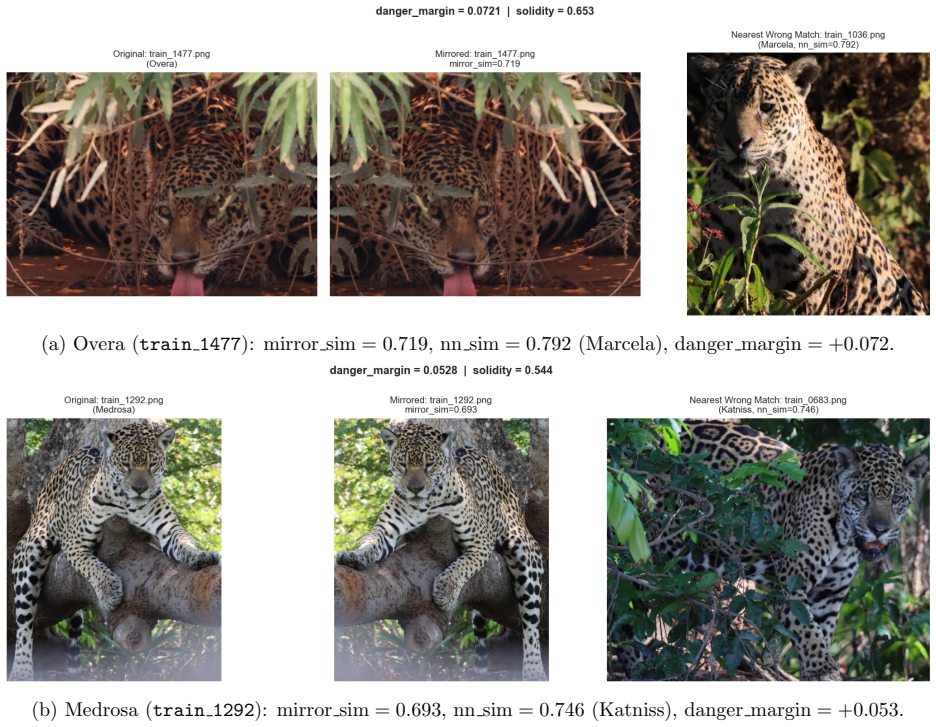
- The laterality diagnostic identifies models that fail to match left and right flanks of the same animal.
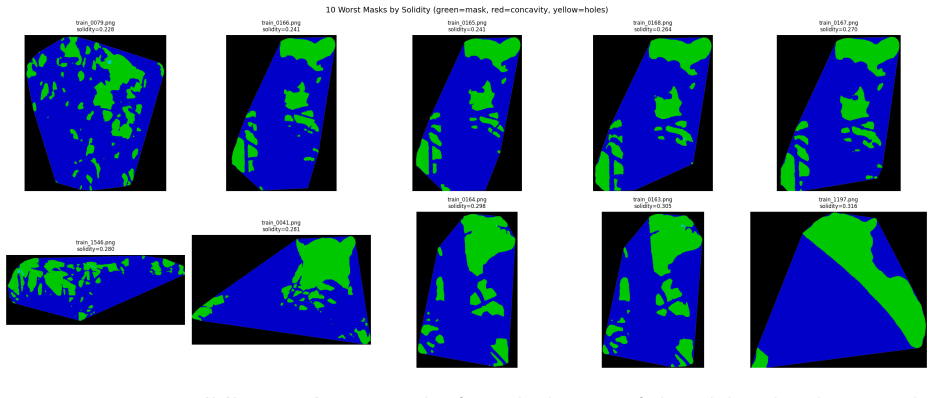
- The curated benchmark with segmentation masks supports controlled experiments on visual evidence.
- Mitigation methods like anti-symmetry regularization can be compared for their impact on these diagnostics.
- Evaluation protocols should incorporate these checks to ensure reliance on identity-defining features.
Where Pith is reading between the lines
- Similar diagnostics could be developed for re-identification of other wildlife species with distinctive markings.
- If background reliance is widespread, re-ID systems may not transfer well to new locations or camera setups.
- Incorporating inpainting-based tests during model development could encourage learning of more robust identity features.
Load-bearing premise
Inpainting the images to isolate background or foreground does not introduce artifacts that alter the retrieval behavior of the models being tested.
What would settle it
A model maintaining its ranking performance when tested on background-only inpainted images (with the jaguar removed) would show it is not using coat patterns for identification.
Figures




read the original abstract
Jaguar re-identification (re-ID) from citizen-science imagery can look strong on standard retrieval metrics while still relying on the wrong evidence, such as background context or silhouette shape, instead of the coat pattern that defines identity. We introduce a diagnostic framework for wildlife re-ID with two axes: a leakage-controlled context ratio, background/foreground, computed from inpainted background-only versus foreground-only images, and a laterality diagnostic based on cross-flank retrieval and mirror self-similarity. To make these diagnostics measurable, we curate a Pantanal jaguar benchmark with per-pixel segmentation masks and an identity-balanced evaluation protocol. We then use representative mitigation families, ArcFace fine-tuning, anti-symmetry regularization, and Lorentz hyperbolic embeddings, as case studies under the same evaluation lens. The goal is not only to ask which model ranks best, but also what visual evidence it uses to do so.
Editorial analysis
A structured set of objections, weighed in public.
Referee Report
Summary. The paper claims that standard retrieval metrics for jaguar re-identification from citizen-science images can be misleading because models may exploit background context or silhouette shape rather than the biologically defining coat patterns. It introduces a diagnostic framework consisting of a leakage-controlled context ratio (computed via inpainted background-only versus foreground-only images) and a laterality diagnostic (based on cross-flank retrieval and mirror self-similarity). To support this, the authors curate a Pantanal jaguar benchmark with per-pixel segmentation masks and an identity-balanced protocol, then apply the diagnostics as case studies to representative mitigation approaches including ArcFace fine-tuning, anti-symmetry regularization, and Lorentz hyperbolic embeddings.
Significance. If the diagnostics prove robust, the work would be significant for wildlife computer vision by providing concrete tools to detect and mitigate reliance on non-identity cues, improving the reliability of re-ID for conservation applications. The curated benchmark with masks and the dual-axis evaluation protocol represent useful contributions that could be adopted more broadly. The case-study application demonstrates practical utility, though the overall impact depends on addressing the core methodological assumptions.
major comments (1)
- [Diagnostic framework description] The leakage-controlled context ratio (introduced in the diagnostic framework and used to compute background/foreground performance) is load-bearing for the central claim that models rely on background leakage. However, the manuscript provides no validation, error analysis, or ablation of the inpainting step (e.g., no comparison of retrieval rankings on original vs. inpainted images or assessment of boundary artifacts in complex Pantanal scenes). This leaves open the possibility that observed context ratios reflect inpainter-specific statistical regularities rather than genuine scene context.
minor comments (2)
- [Evaluation and case studies] Ensure that all quantitative results, error bars, and statistical tests for the context ratio and laterality metrics are reported with full details in the evaluation section, as the abstract supplies none.
- [Benchmark curation] Clarify the exact identity-balanced evaluation protocol and how it prevents trivial splits; a small table summarizing dataset statistics (number of identities, images per flank, etc.) would improve readability.
Simulated Author's Rebuttal
We thank the referee for the detailed and constructive review. The feedback highlights an important aspect of our diagnostic framework that requires additional validation to strengthen the central claims. We address the major comment below and commit to revisions that will incorporate the suggested analyses without altering the core contributions of the Pantanal benchmark or the dual-axis evaluation protocol.
read point-by-point responses
-
Referee: The leakage-controlled context ratio (introduced in the diagnostic framework and used to compute background/foreground performance) is load-bearing for the central claim that models rely on background leakage. However, the manuscript provides no validation, error analysis, or ablation of the inpainting step (e.g., no comparison of retrieval rankings on original vs. inpainted images or assessment of boundary artifacts in complex Pantanal scenes). This leaves open the possibility that observed context ratios reflect inpainter-specific statistical regularities rather than genuine scene context.
Authors: We agree that explicit validation of the inpainting step is necessary to support the leakage-controlled context ratio as a reliable diagnostic. In the revised manuscript we will add a dedicated ablation subsection that (i) compares retrieval rankings and mAP on the original images versus the inpainted background-only and foreground-only versions for the same model checkpoints, (ii) quantifies boundary artifacts by measuring pixel-level consistency around mask edges in the complex Pantanal vegetation, and (iii) reports an error analysis using a small manually annotated subset of inpainted images to estimate the fraction of cases where inpainting introduces spurious textures. These additions will directly address whether the observed context ratios arise from genuine scene context or from inpainter-specific regularities. revision: yes
Circularity Check
No circularity: diagnostics built from external inpainting and segmentation on curated benchmark
full rationale
The paper introduces a diagnostic framework consisting of a leakage-controlled context ratio (computed from inpainted background-only vs. foreground-only images) and a laterality diagnostic (cross-flank retrieval and mirror self-similarity). These are applied to a newly curated Pantanal jaguar benchmark with per-pixel masks and an identity-balanced protocol. Mitigation methods (ArcFace fine-tuning, anti-symmetry regularization, Lorentz embeddings) are then evaluated under this lens. No load-bearing step reduces by construction to a fitted parameter renamed as prediction, a self-citation chain, or a self-definitional loop. The inpainting and segmentation steps are external techniques whose fidelity is an assumption (not a tautology), and the paper does not invoke uniqueness theorems or prior self-citations to justify its core choices. The derivation chain is therefore self-contained against external benchmarks.
Axiom & Free-Parameter Ledger
axioms (1)
- domain assumption Inpainting can produce background-only images that preserve model decision processes without introducing confounding artifacts
Reference graph
Works this paper leans on
-
[1]
Jaguar field guide.https://www.jaguaridproject.com/product-page/ jaguar-field-guide-digital, 2025
Jaguar ID Project. Jaguar field guide.https://www.jaguaridproject.com/product-page/ jaguar-field-guide-digital, 2025
2025
-
[2]
Wichmann
Robert Geirhos, J¨ orn-Henrik Jacobsen, Claudio Michaelis, Richard Zemel, Wieland Brendel, Matthias Bethge, and Felix A. Wichmann. Shortcut learning in deep neural networks.Nature Machine Intelli- gence, 2(11):665–673, 2020
2020
-
[3]
Recognition in terra incognita
Sara Beery, Grant Van Horn, and Pietro Perona. Recognition in terra incognita. InProceedings of the European Conference on Computer Vision (ECCV), pages 456–473, 2018
2018
-
[4]
Wildlifedatasets: An open-source toolkit for animal re-identification
Vojtˇ echˇCerm´ ak, Lukas Picek, Luk´ aˇ s Adam, and Kostas Papafitsoros. Wildlifedatasets: An open-source toolkit for animal re-identification. InProceedings of the IEEE/CVF Winter Conference on Applications of Computer Vision, pages 5953–5963, 2024
2024
-
[5]
Wildfusion: Individual animal identification with calibrated similarity fusion
Vojtˇ ech Cermak, Lukas Picek, Luk´ aˇ s Adam, Luk´ aˇ s Neumann, and Jiˇ r´ ı Matas. Wildfusion: Individual animal identification with calibrated similarity fusion. InEuropean Conference on Computer Vision, pages 18–36. Springer, 2024
2024
-
[6]
Lasha Otarashvili, Tamilselvan Subramanian, Jason Holmberg, JJ Levenson, and Charles V Stewart. Multispecies animal re-id using a large community-curated dataset.arXiv preprint arXiv:2412.05602, 2024
-
[7]
Rees, and Vojtˇ echˇCerm´ ak
Luk´ aˇ s Adam, Kostas Papafitsoros, Claire Jean, Alan F. Rees, and Vojtˇ echˇCerm´ ak. Exploiting facial side similarities to improve ai-driven sea turtle photo-identification systems.Ecological Informatics, 89:103158, 2025
2025
-
[8]
Hotspotter—patterned species instance recognition
Jonathan P Crall, Charles V Stewart, Tanya Y Berger-Wolf, Daniel I Rubenstein, and Siva R Sundare- san. Hotspotter—patterned species instance recognition. In2013 IEEE Workshop on Applications of Computer Vision (WACV), pages 230–237. IEEE, 2013
2013
-
[9]
Naturally occurring equivariance in neural networks.Distill, 2020.https://distill.pub/2020/circuits/equivariance
Chris Olah, Nick Cammarata, Chelsea Voss, Ludwig Schubert, and Gabriel Goh. Naturally occurring equivariance in neural networks.Distill, 2020.https://distill.pub/2020/circuits/equivariance
2020
-
[10]
Oriane Sim´ eoni, Huy V Vo, Maximilian Seitzer, Federico Baldassarre, Maxime Oquab, Cijo Jose, Vasil Khalidov, Marc Szafraniec, Seungeun Yi, Micha¨ el Ramamonjisoa, et al. Dinov3.arXiv preprint arXiv:2508.10104, 2025
work page internal anchor Pith review Pith/arXiv arXiv 2025
-
[11]
Eva-02: A visual representation for neon genesis.Image and Vision Computing, 149:105171, 2024
Yuxin Fang, Quan Sun, Xinggang Wang, Tiejun Huang, Xinlong Wang, and Yue Cao. Eva-02: A visual representation for neon genesis.Image and Vision Computing, 149:105171, 2024
2024
-
[12]
Efficientnetv2: Smaller models and faster training
Mingxing Tan and Quoc V Le. Efficientnetv2: Smaller models and faster training. InInternational Conference on Machine Learning, pages 10096–10106, 2021
2021
-
[13]
Self-supervised learning from images with a joint-embedding predictive architecture
Mahmoud Assran, Quentin Duval, Ishan Misra, Piotr Bojanowski, Pascal Vincent, Michael Rabbat, Yann LeCun, and Nicolas Ballas. Self-supervised learning from images with a joint-embedding predictive architecture. InProceedings of the IEEE/CVF Conference on Computer Vision and Pattern Recognition, pages 15619–15629, 2023
2023
-
[14]
Convnext v2: Co-designing and scaling convnets with masked autoencoders
Sanghyun Woo, Shoubhik Debnath, Ronghang Hu, Xinlei Chen, Zhuang Liu, In So Kweon, and Saining Xie. Convnext v2: Co-designing and scaling convnets with masked autoencoders. InProceedings of the IEEE/CVF Conference on Computer Vision and Pattern Recognition, pages 16133–16142, 2023
2023
-
[15]
arXiv preprint arXiv:2601.17237 (2026)
Mike Ranzinger, Greg Heinrich, Jan Kautz, and Pavlo Molchanov. C-radiov4.arXiv preprint arXiv:2601.17237, 2026
-
[16]
Deep residual learning for image recognition
Kaiming He, Xiangyu Zhang, Shaoqing Ren, and Jian Sun. Deep residual learning for image recognition. InProceedings of the IEEE Conference on Computer Vision and Pattern Recognition, pages 770–778, 2016. 32
2016
-
[17]
Distributionally robust neural networks for group shifts: On the importance of regularization for worst-case generalization
Shiori Sagawa, Pang Wei Koh, Tatsunori B Hashimoto, and Percy Liang. Distributionally robust neural networks for group shifts: On the importance of regularization for worst-case generalization. In International Conference on Learning Representations (ICLR), 2020
2020
-
[18]
Arcface: Additive angular margin loss for deep face recognition
Jiankang Deng, Jia Guo, Niannan Xue, and Stefanos Zafeiriou. Arcface: Additive angular margin loss for deep face recognition. InProceedings of the IEEE/CVF Conference on Computer Vision and Pattern Recognition, pages 4690–4699, 2019
2019
-
[19]
Sub-center arcface: Boosting face recognition by large-scale noisy web faces
Jiankang Deng, Jia Guo, Tongliang Liu, Mingming Gong, and Stefanos Zafeiriou. Sub-center arcface: Boosting face recognition by large-scale noisy web faces. InEuropean Conference on Computer Vision, pages 741–757. Springer, 2020
2020
-
[20]
Hyperbolic image embeddings
Valentin Khrulkov, Leyla Mirvakhabova, Evgeniya Ustinova, Ivan Oseledets, and Victor Lempitsky. Hyperbolic image embeddings. InProceedings of the IEEE/CVF Conference on Computer Vision and Pattern Recognition, pages 6418–6428, 2020
2020
-
[21]
Riemannian adaptive optimization methods
Gary B´ ecigneul and Octavian-Eugen Ganea. Riemannian adaptive optimization methods. InInterna- tional Conference on Learning Representations (ICLR), 2019
2019
-
[22]
Aggregating local descriptors into a compact image representation
Herv´ e J´ egou, Matthijs Douze, Cordelia Schmid, and Patrick P´ erez. Aggregating local descriptors into a compact image representation. InProceedings of the IEEE/CVF Conference on Computer Vision and Pattern Recognition, pages 3304–3311, 2010
2010
-
[23]
Aliked: A lighter keypoint and descriptor extraction network via deformable transformation.IEEE Transactions on Instrumentation and Measurement, 72:1–16, 2023
Xiaoming Zhao, Xingming Wu, Weihai Chen, Peter CY Chen, Qingsong Xu, and Zhengguo Li. Aliked: A lighter keypoint and descriptor extraction network via deformable transformation.IEEE Transactions on Instrumentation and Measurement, 72:1–16, 2023
2023
-
[24]
Loftr: Detector-free local feature matching with transformers
Jiaming Sun, Zehong Shen, Yuang Wang, Hujun Bao, and Xiaowei Zhou. Loftr: Detector-free local feature matching with transformers. InProceedings of the IEEE/CVF Conference on Computer Vision and Pattern Recognition, pages 8922–8931, 2021
2021
-
[25]
SAM 3: Segment Anything with Concepts
Nicolas Carion, Laura Gustafson, Yuan-Ting Hu, Shoubhik Debnath, Ronghang Hu, Didac Suris, Chai- tanya Ryali, Kalyan Vasudev Alwala, Haitham Khedr, Andrew Huang, et al. Sam 3: Segment anything with concepts.arXiv preprint arXiv:2511.16719, 2025
work page internal anchor Pith review Pith/arXiv arXiv 2025
-
[26]
Image enhancement by histogram transformation.Computer Graphics and Image Processing, 4(2):184–195, 1975
Robert Hummel. Image enhancement by histogram transformation.Computer Graphics and Image Processing, 4(2):184–195, 1975
1975
-
[27]
Hyperview: Open-source dataset cura- tion and model analysis, 2025
Matin Mahmood, Antonio Rueda-Toicen, and Daniil Morozov. Hyperview: Open-source dataset cura- tion and model analysis, 2025
2025
-
[28]
UMAP: Uniform Manifold Approximation and Projection for Dimension Reduction
Leland McInnes, John Healy, and James Melville. Umap: Uniform manifold approximation and projec- tion for dimension reduction.arXiv preprint arXiv:1802.03426, 2018
work page internal anchor Pith review Pith/arXiv arXiv 2018
-
[29]
A convnet for the 2020s
Zhuang Liu, Hanzi Mao, Chao-Yuan Wu, Christoph Feichtenhofer, Trevor Darrell, and Saining Xie. A convnet for the 2020s. InProceedings of the IEEE/CVF Conference on Computer Vision and Pattern Recognition, pages 11976–11986, 2022
2022
-
[30]
Swin transformer: Hierarchical vision transformer using shifted windows
Ze Liu, Yutong Lin, Yue Cao, Han Hu, Yixuan Wei, Zheng Zhang, Stephen Lin, and Baining Guo. Swin transformer: Hierarchical vision transformer using shifted windows. InProceedings of the IEEE/CVF International Conference on Computer Vision, pages 10012–10022, 2021
2021
-
[31]
Mefem: Medical face embedding model.arXiv preprint arXiv:2602.14672, 2026
Yury Borets and Stepan Botman. Mefem: Medical face embedding model.arXiv preprint arXiv:2602.14672, 2026
-
[32]
FLUX.1: Open source text-to-image model.https://github.com/ black-forest-labs/flux, 2024
Black Forest Labs. FLUX.1: Open source text-to-image model.https://github.com/ black-forest-labs/flux, 2024
2024
-
[33]
Supervised contrastive learning.Advances in neural infor- mation processing systems, 33:18661–18673, 2020
Prannay Khosla, Piotr Teterwak, Chen Wang, Aaron Sarna, Yonglong Tian, Phillip Isola, Aaron Maschinot, Ce Liu, and Dilip Krishnan. Supervised contrastive learning.Advances in neural infor- mation processing systems, 33:18661–18673, 2020. 33
2020
discussion (0)
Sign in with ORCID, Apple, or X to comment. Anyone can read and Pith papers without signing in.