Recognition: 2 theorem links
· Lean TheoremOptimising Quantum Error Correction Using Morphing Circuits
Pith reviewed 2026-05-10 17:52 UTC · model grok-4.3
The pith
Morphing circuits optimize quantum error correction codes and syndrome extraction directly for connectivity and gate choice.
A machine-rendered reading of the paper's core claim, the machinery that carries it, and where it could break.
Core claim
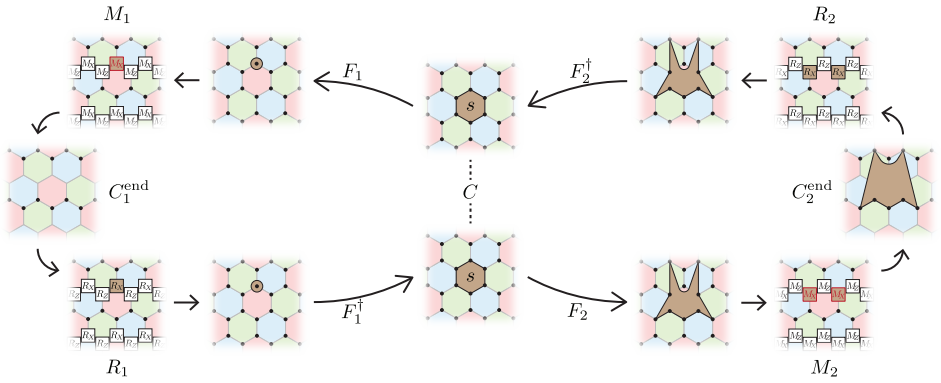
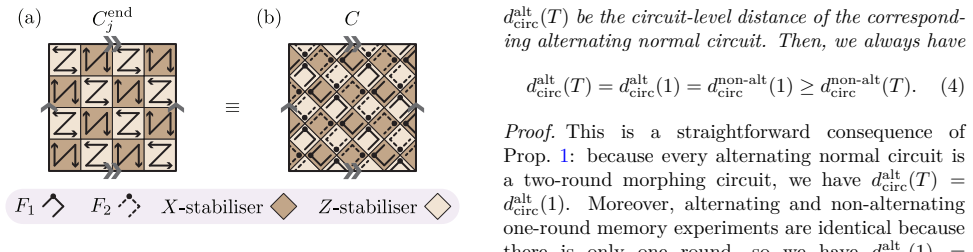
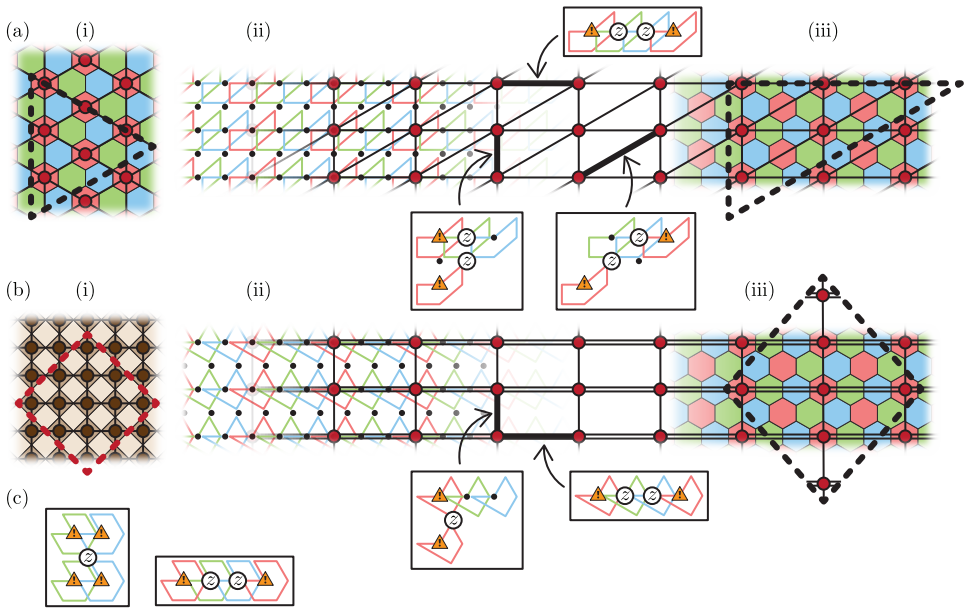
Morphing circuits provide a way of optimising syndrome extraction circuits and codes directly in terms of connectivity, choice of two-qubit gate and number of physical qubits. The methods find new codes and syndrome extraction circuits of practical interest, including Abelian 2BGA morphing circuits with better code parameters and connectivity than existing circuits. Alternating syndrome extraction circuits can be viewed as two-round morphing circuits whose fault-tolerant properties are computationally much easier to examine than non-alternating ones.
What carries the argument
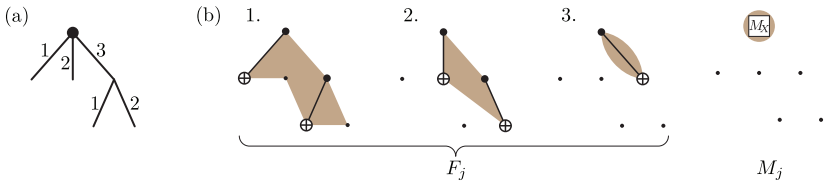
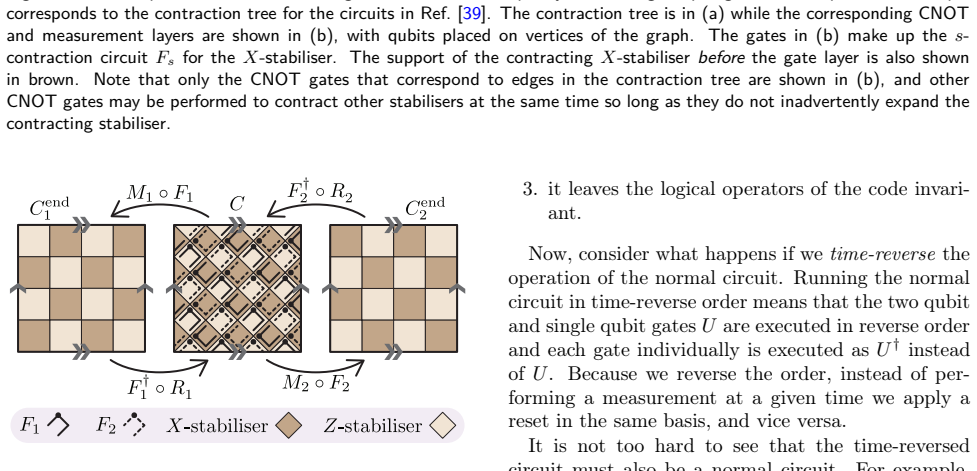
Morphing circuits: syndrome extraction procedures that incorporate alternating or time-reversed rounds to adjust effective connectivity and gate usage while preserving the logical code.
If this is right
- Abelian 2BGA morphing circuits achieve improved code parameters together with lower connectivity requirements.
- Stability experiments show better performance when measurement and reset errors are taken into account.
- Alternating syndrome extraction circuits become easier to verify for fault tolerance by reducing to two-round morphing analysis.
- Boundary conditions for two-dimensional codes and single-shot properties can be incorporated within the same morphing framework.
Where Pith is reading between the lines
- The same morphing technique could be applied to additional code families to discover further connectivity reductions.
- Hardware implementations of the new circuits would directly test whether the reported connectivity savings translate into measurable improvements in logical error rates.
- The computational simplification for alternating circuits may enable new decoder designs that exploit time-reversed round structure.
Load-bearing premise
Morphing circuits preserve the logical equivalence and fault-tolerant properties of Abelian 2BGA codes, their boundaries, and single-shot settings under realistic error models that include measurement and reset errors.
What would settle it
A simulation or hardware run in which an Abelian 2BGA morphing circuit exhibits equal or worse logical error rates, no reduction in connectivity, or loss of fault tolerance compared with a standard non-morphed circuit under the same noise model would falsify the optimization benefit.
Figures













read the original abstract
Quantum error correction (QEC) codes are traditionally defined and searched for without specifying the manner in which its syndrome extraction circuits are executed using elementary gates and measurements. We show how morphing circuits introduced in Refs. [1-3] provide a way of optimising syndrome extraction circuits and codes directly in terms of connectivity, choice of two-qubit gate (ISWAP versus CNOT) and number of physical qubits. We discuss morphing circuits in code optimisation among Abelian two-block group algebra (2BGA) codes, handling boundaries for 2D codes, codes with single-shot properties, and improving performance in stability experiments against measurement and reset errors. We show that alternating syndrome extraction circuits - executed with alternating time-reversed rounds - can be viewed as a two-round morphing circuit whose fault-tolerant properties are computationally much easier to examine than non-alternating syndrome extraction circuits. Our methods find new codes and syndrome extraction circuits of practical interest, including Abelian 2BGA morphing circuits with better code parameters and connectivity than existing circuits. [1] Matt McEwen, Dave Bacon, and Craig Gidney. Relaxing hardware requirements for surface code circuits using time-dynamics. Quantum, 7:1172, 2023. [2] Craig Gidney and Cody Jones. New circuits and an open source decoder for the color code, 2023. [3] Mackenzie H. Shaw and Barbara M. Terhal. Lowering connectivity requirements for bivariate bicycle codes using morphing circuits.
Editorial analysis
A structured set of objections, weighed in public.
Referee Report
Summary. The manuscript proposes using morphing circuits (from prior Refs. [1-3]) to optimize syndrome extraction circuits and codes for quantum error correction, focusing on Abelian two-block group algebra (2BGA) codes. It claims new optimized circuits with better code parameters and connectivity, easier fault-tolerance analysis via viewing alternating time-reversed rounds as two-round morphing circuits, handling of boundaries for 2D codes and single-shot properties, and improved performance against measurement/reset errors in stability experiments. The approach allows direct optimization in terms of connectivity, ISWAP vs CNOT gates, and qubit count.
Significance. If the preservation of logical equivalence and fault tolerance holds, the work provides a systematic method to tailor QEC codes and circuits to hardware constraints, which could aid practical fault-tolerant quantum computing implementations. The simplification of FT analysis for alternating circuits and identification of new 2BGA codes with improved parameters are potentially useful extensions. The paper credits the foundational morphing technique to prior work while adding applications to 2BGA codes, boundaries, and error models.
major comments (2)
- [Section on Abelian 2BGA morphing circuits and single-shot properties] The central claim that morphing circuits preserve logical equivalence and fault-tolerant properties (including code distance) when applied to Abelian 2BGA codes with boundaries and single-shot settings is load-bearing for all optimization results and new code claims, yet the manuscript supplies no explicit derivation, theorem, or circuit-level verification showing that error propagation remains controlled under realistic noise including measurement and reset errors (see the section discussing Abelian 2BGA morphing circuits and the skeptic note on preservation).
- [Paragraph on alternating time-reversed rounds] The assertion that alternating syndrome extraction circuits (time-reversed rounds) can be viewed as two-round morphing circuits whose FT properties are 'computationally much easier to examine' lacks a concrete comparison or example demonstrating reduced analysis complexity or improved thresholds relative to non-alternating circuits (see the paragraph on alternating circuits in the abstract and main text).
minor comments (2)
- Ensure all figures and tables explicitly compare new morphing circuits against baselines in terms of parameters, connectivity, and simulated performance under the claimed error models.
- Clarify notation for morphing operations when extending to boundaries to avoid ambiguity with prior definitions in Refs. [1-3].
Simulated Author's Rebuttal
We thank the referee for their careful reading of the manuscript and for highlighting these important points regarding the foundations of our claims. We address each major comment below and indicate the revisions we will make to strengthen the presentation.
read point-by-point responses
-
Referee: The central claim that morphing circuits preserve logical equivalence and fault-tolerant properties (including code distance) when applied to Abelian 2BGA codes with boundaries and single-shot settings is load-bearing for all optimization results and new code claims, yet the manuscript supplies no explicit derivation, theorem, or circuit-level verification showing that error propagation remains controlled under realistic noise including measurement and reset errors (see the section discussing Abelian 2BGA morphing circuits and the skeptic note on preservation).
Authors: The core preservation properties of morphing circuits are established in the cited foundational works [1-3]. Our section on Abelian 2BGA morphing circuits extends these by providing explicit circuit constructions for codes with boundaries and single-shot properties, together with stabilizer commutation arguments showing that the logical operators and code distance are unchanged. The stability experiments already incorporate measurement and reset errors and demonstrate improved performance under the morphing construction. We acknowledge that an explicit theorem statement would make the load-bearing claim clearer. We will therefore add a short formal subsection stating the preservation theorem for the 2BGA case with boundaries, including a sketch of the error-propagation argument under depolarizing and measurement noise. revision: yes
-
Referee: The assertion that alternating syndrome extraction circuits (time-reversed rounds) can be viewed as two-round morphing circuits whose FT properties are 'computationally much easier to examine' lacks a concrete comparison or example demonstrating reduced analysis complexity or improved thresholds relative to non-alternating circuits (see the paragraph on alternating circuits in the abstract and main text).
Authors: The computational simplification arises because the alternating (time-reversed) schedule reduces to a two-round morphing circuit, allowing direct application of the verification techniques already developed in Refs. [1-3] rather than tracking error propagation across an arbitrary number of rounds. The manuscript illustrates this view in the stability experiments, where the alternating construction yields visibly more stable logical observables under measurement noise. To make the advantage concrete, we will expand the relevant paragraph with a small explicit example using a minimal Abelian 2BGA code: we list the distinct error-propagation cases that must be checked in the non-alternating schedule versus the two-round morphing schedule, showing a reduction from O(n) independent checks to a constant number. This example also indicates how the simplified analysis facilitates threshold estimation against reset and measurement errors. revision: yes
Circularity Check
Morphing optimization technique originates in self-cited prior work but new 2BGA applications add independent content
specific steps
-
self citation load bearing
[Abstract]
"We show how morphing circuits introduced in Refs. [1-3] provide a way of optimising syndrome extraction circuits and codes directly in terms of connectivity, choice of two-qubit gate (ISWAP versus CNOT) and number of physical qubits. We discuss morphing circuits in code optimisation among Abelian two-block group algebra (2BGA) codes, handling boundaries for 2D codes, codes with single-shot properties, and improving performance in stability experiments against measurement and reset errors."
The optimization framework and its claimed preservation of logical equivalence/fault tolerance are taken from the authors' prior self-cited work [3] on morphing circuits; the present paper's new codes and performance claims for 2BGA codes with boundaries/single-shot properties inherit those properties without re-deriving them independently here.
full rationale
The paper's central method of optimizing syndrome extraction via morphing circuits is introduced and justified in the authors' own prior Ref. [3], with this work extending the technique to Abelian 2BGA codes, boundaries, and single-shot settings. While the applications to new code families and stability experiments provide non-trivial independent analysis, the load-bearing preservation of logical equivalence and fault tolerance under morphing reduces to properties defined in the self-citation. This yields moderate circularity without fully collapsing the derivation to tautology.
Axiom & Free-Parameter Ledger
axioms (1)
- domain assumption Morphing circuits preserve the logical equivalence and error correction properties of the original codes
Lean theorems connected to this paper
-
IndisputableMonolith/Cost/FunctionalEquation.leanwashburn_uniqueness_aczel unclear?
unclearRelation between the paper passage and the cited Recognition theorem.
We show how morphing circuits ... provide a way of optimising syndrome extraction circuits and codes directly in terms of connectivity, choice of two-qubit gate (ISWAP versus CNOT) and number of physical qubits.
-
IndisputableMonolith/Foundation/ArithmeticFromLogic.leanLogicNat induction and orbit embedding unclear?
unclearRelation between the paper passage and the cited Recognition theorem.
alternating syndrome extraction circuits ... can be viewed as a two-round morphing circuit whose fault-tolerant properties are computationally much easier to examine
What do these tags mean?
- matches
- The paper's claim is directly supported by a theorem in the formal canon.
- supports
- The theorem supports part of the paper's argument, but the paper may add assumptions or extra steps.
- extends
- The paper goes beyond the formal theorem; the theorem is a base layer rather than the whole result.
- uses
- The paper appears to rely on the theorem as machinery.
- contradicts
- The paper's claim conflicts with a theorem or certificate in the canon.
- unclear
- Pith found a possible connection, but the passage is too broad, indirect, or ambiguous to say the theorem truly supports the claim.
Reference graph
Works this paper leans on
-
[1]
Improved simulation of stabilizer circuits.Physical Review A, 70(5), 2004
Scott Aaronson and Daniel Gottesman. Im- proved simulation of stabilizer circuits.Phys- ical Review A, 70(5):052328, 2004. DOI: 10.1103/PhysRevA.70.052328
-
[2]
Hastings, Vadym Kli- uchnikov, Juan M
David Aasen, Matthew B. Hastings, Vadym Kli- uchnikov, Juan M. Bello-Rivas, Adam Paet- znick, Rui Chao, Ben W. Reichardt, Matt Zan- 52 10□4 10□3 10□2 Physical Error Rate 10□6 10□5 10□4 10□3 10□2 10□1 100 Logical Error Rate per d meas. rounds Original Extra Layer Extra Qubits dend 3 5 7 (a) Comparing triangular weight-6 morphing circuits 10□4 10□3 10□2 Phy...
- [3]
-
[5]
Neural network de- coder for topological color codes with circuit level noise.New Journal of Physics, 21(1):013003,
P Baireuther, M D Caio, B Criger, C W J Beenakker, and T E O’Brien. Neural network de- coder for topological color codes with circuit level noise.New Journal of Physics, 21(1):013003,
-
[6]
DOI: 10.1088/1367-2630/aaf29e
-
[7]
Michael E Beverland, Benjamin J Brown, Michael J Kastoryano, and Quentin Marolleau. The role of entropy in topological quantum er- ror correction.Journal of Statistical Mechan- ics: Theory and Experiment, 2019(7):073404, July 2019. ISSN 1742-5468. DOI: 10.1088/1742- 5468/ab25de. URLhttp://dx.doi.org/10. 1088/1742-5468/ab25de
-
[8]
A fault-tolerant neutral-atom architecture for universal quantum computation,
Dolev Bluvstein, Alexandra A. Geim, Sophie H. Li, Simon J. Evered, J. Pablo Bonilla Ataides, GefenBaranes, AndiGu, TomManovitz, Muqing Xu, Marcin Kalinowski, Shayan Majidy, Chris- tian Kokail, Nishad Maskara, Elias C. Trapp, Luke M. Stewart, Simon Hollerith, Hengyun Zhou, Michael J. Gullans, Susanne F. Yelin, Markus Greiner, Vladan Vuletić, Madelyn Cain, ...
-
[9]
Sergey Bravyi, Andrew W. Cross, Jay M. Gambetta, Dmitri Maslov, Patrick Rall, and Theodore J. Yoder. High-threshold and low-overhead fault-tolerant quantum mem- ory.Nature, 627(8005):778–782, 2024. DOI: 10.1038/s41586-024-07107-7
-
[10]
On colouring the nodes of a network
Rowland Leonard Brooks. On colouring the nodes of a network. InMathematical Proceed- ings of the Cambridge Philosophical Society, vol- ume 37, pages 194–197. Cambridge University Press, 1941
1941
-
[11]
Earl T Campbell. A theory of single-shot error correction for adversarial noise.Quantum Sci- ence and Technology, 4(2):025006, 2019. DOI: 10.1088/2058-9565/aafc8f
-
[12]
Cohen, Isaac H
Lawrence Z. Cohen, Isaac H. Kim, Stephen D. Bartlett, and Benjamin J. Brown. Low-overhead fault-tolerant quantum computing using long- range connectivity.Science Advances, 8(20),
-
[13]
DOI: 10.1126/sciadv.abn1717
- [14]
-
[15]
Debroy, Matt McEwen, Craig Gidney, Noah Shutty, and Adam Zalcman
Dripto M. Debroy, Matt McEwen, Craig Gidney, Noah Shutty, and Adam Zalcman. LUCI in the surface code with dropouts.Quantum, 9:1936,
1936
-
[16]
DOI: 10.22331/q-2025-12-11-1936
-
[17]
Spacetime codes of Clifford circuits, 2023
Nicolas Delfosse and Adam Paetznick. Spacetime codes of Clifford circuits, 2023. URLhttps:// arxiv.org/abs/2304.05943
-
[18]
To reset, or not to reset—that is the question.npj Quantum Information, 11(1):39, 2025
György P Gehér, Marcin Jastrzebski, Earl T Campbell, and Ophelia Crawford. To reset, or not to reset—that is the question.npj Quantum Information, 11(1):39, 2025. DOI: 10.1038/s41534-025-00998-y
-
[19]
Gehér, Ophelia Crawford, and Earl T
György P. Gehér, Ophelia Crawford, and Earl T. Campbell. Tangling schedules eases hardware connectivity requirements for quantum error cor- rection.PRX Quantum, 5(1), March 2024. DOI: 10.1103/prxquantum.5.010348
-
[20]
Gehér, David Byfield, and Archibald Ruban
György P. Gehér, David Byfield, and Archibald Ruban. Directional codes: a new family of quantum LDPC codes on hexagonal- and square- grid connectivity hardware, 2025. URLhttps: //arxiv.org/abs/2507.19430
-
[21]
doi:10.22331/q-2021-07-06-497 , title =
Craig Gidney. Stim: a fast stabilizer circuit sim- ulator.Quantum, 5:497, July 2021. ISSN 2521- 327X. DOI: 10.22331/q-2021-07-06-497
-
[22]
2022 , month = aug, publisher =
Craig Gidney. Stability experiments: the over- looked dual of memory experiments.Quantum, 6:786, 2022. DOI: 10.22331/q-2022-08-24-786
-
[23]
New circuits and an open source decoder for the color code , publisher =
Craig Gidney and Cody Jones. New circuits and an open source decoder for the color code, 2023. URLhttps://arxiv.org/abs/2312.08813
-
[24]
A fault- tolerant honeycomb memory,
Craig Gidney, Michael Newman, Austin Fowler, and Michael Broughton. A Fault-Tolerant Hon- eycomb Memory.Quantum, 5:605, 2021. DOI: 10.22331/q-2021-12-20-605
-
[25]
Demon- stration of dynamic surface codes.Na- ture Physics, 21(12):1994–2001, 2025
Google Quantum AI and Collaborators. Demon- stration of dynamic surface codes.Na- ture Physics, 21(12):1994–2001, 2025. DOI: 10.1038/s41567-025-03070-w
-
[26]
Gurobi Optimizer Reference Manual, 2024
Gurobi Optimization, LLC. Gurobi Optimizer Reference Manual, 2024. URLhttps://www. gurobi.com
2024
-
[27]
Dynamically Generated Logical Qubits,
Matthew B. Hastings and Jeongwan Haah. Dy- namically Generated Logical Qubits.Quantum, 5:564, 2021. DOI: 10.22331/q-2021-10-19-564
-
[28]
Trond Hjerpekjøn Haug, Timo Hillmann, An- ton Frisk Kockum, and Raphaël Van Laer. Lat- tice surgery with Bell measurements: Modular fault-tolerant quantum computation at low en- tanglement cost, 2025. URLhttps://arxiv. org/abs/2510.13541
-
[29]
Extractors: QLDPC Architectures for Efficient Pauli-Based Computation,
Zhiyang He, Alexander Cowtan, Dominic J. Williamson, and Theodore J. Yoder. Extrac- 54 tors: QLDPC architectures for efficient Pauli- based computation, 2025. URLhttps://arxiv. org/abs/2503.10390
-
[30]
Bohdanowicz, Alek- sander Kubica, Steven T
Oscar Higgott, Thomas C. Bohdanowicz, Alek- sander Kubica, Steven T. Flammia, and Earl T. Campbell. Improved decoding of circuit noise and fragile boundaries of tailored surface codes.Phys. Rev. X, 13:031007, 2023. DOI: 10.1103/PhysRevX.13.031007
-
[31]
Handling fabrication de- fects in hex-grid surface codes
Oscar Higgott, Benjamin Anker, Matt McEwen, and Dripto M Debroy. Handling fabrication de- fects in hex-grid surface codes. 2025. URL https://arxiv.org/abs/2508.08116
-
[32]
Kesselring, Fernando Pastawski, Jens Eisert, and Benjamin J
Markus S. Kesselring, Fernando Pastawski, Jens Eisert, and Benjamin J. Brown. The boundaries and twist defects of the color code and their ap- plications to topological quantum computation. Quantum, 2:101, 2018. ISSN 2521-327X. DOI: 10.22331/q-2018-10-19-101
-
[33]
Markus S. Kesselring, Julio C. Magdalena de la Fuente, Felix Thomsen, Jens Eisert, Stephen D. Bartlett, and Benjamin J. Brown. Anyon con- densation and the color code.PRX Quan- tum, 5:010342, 2024. DOI: 10.1103/PRXQuan- tum.5.010342
-
[34]
Alexey A. Kovalev and Leonid P. Pryadko. Improved quantum hypergraph-product LDPC codes. In2012 IEEE International Symposium on Information Theory Pro- ceedings, page 348–352. IEEE, 2012. DOI: 10.1109/isit.2012.6284206
-
[36]
Seok-Hyung Lee, Andrew Li, and Stephen D. Bartlett. Color code decoder with improved scal- ing for correcting circuit-level noise.Quantum, 9: 1609, 2025. DOI: 10.22331/q-2025-01-27-1609
-
[38]
Alphasyndrome: Tack- ling the syndrome measurement circuit schedul- ing problem for qec codes, 2026
Yuhao Liu, Shuohao Ping, Junyu Zhou, Ethan Decker, Justin Kalloor, Mathias Weiden, Kean Chen, Yunong Shi, Ali Javadi-Abhari, Costin Iancu, and Gushu Li. Alphasyndrome: Tack- ling the syndrome measurement circuit schedul- ing problem for qec codes, 2026. URLhttps: //arxiv.org/abs/2601.12509
-
[39]
Relaxing hardware requirements for surface code circuits using time-dynamics.Quantum, 7:1172,
Matt McEwen, Dave Bacon, and Craig Gidney. Relaxing hardware requirements for surface code circuits using time-dynamics.Quantum, 7:1172,
-
[40]
DOI: 10.22331/q-2023-11-07-1172
-
[41]
Degener- ate quantum LDPC codes with good finite length performance.Quantum, 5:585, November 2021
Pavel Panteleev and Gleb Kalachev. Degener- ate quantum LDPC codes with good finite length performance.Quantum, 5:585, November 2021. ISSN 2521-327X. DOI: 10.22331/q-2021-11-22- 585
-
[42]
Kaavya Sahay and Benjamin J. Brown. Decoder for the triangular color code by matching on a Möbius strip.PRX Quantum, 3:010310, 2022. DOI: 10.1103/PRXQuantum.3.010310
-
[43]
MackenzieH.ShawandBarbaraM.Terhal. Low- ering connectivity requirements for bivariate bi- cycle codes using morphing circuits.Phys. Rev. Lett., 134:090602, 2025. DOI: 10.1103/Phys- RevLett.134.090602
-
[44]
Armands Strikis, Dan E. Browne, and Michael E. Beverland. High-performance syndrome extrac- tion circuits for quantum codes, 2026. URL https://arxiv.org/abs/2603.05481
- [45]
-
[46]
Renyu Wang and Leonid P. Pryadko. Distance bounds for generalized bicycle codes.Symmetry, 14(7), 2022. DOI: 10.3390/sym14071348
-
[47]
Renyu Wang, Hsiang-Ku Lin, and Leonid P. Pryadko. Abelian and non-Abelian quantum two-blockcodes. In2023 12th International Sym- posium on Topics in Coding (ISTC), pages 1–5,
-
[48]
DOI: 10.1109/ISTC57237.2023.10273492
-
[49]
Distance-finding algorithms for quantum codes and circuits,
Mark Webster, Abraham Jacob, and Oscar Hig- gott. Distance-finding algorithms for quantum codes and circuits, 2026. URLhttps://arxiv. org/abs/2603.22532
-
[50]
Paul Webster, Lucas Berent, Omprakash Chan- dra, Evan T. Hockings, Nouédyn Baspin, Felix Thomsen, SamuelC.Smith, andLawrenceZ.Co- hen. The Pinnacle architecture: Reducing the cost of breaking RSA-2048 to 100 000 physical qubits using quantum LDPC codes, 2026. URL https://arxiv.org/abs/2602.11457
work page internal anchor Pith review Pith/arXiv arXiv 2048
-
[51]
Stasiu Wolanski. Automated compilation includ- ing dropouts: Tolerating defective components in stabiliser codes, 2025. URLhttps://arxiv. org/abs/2512.01943
-
[52]
Tour de gross: A modular quantum computer based on bivariate bicycle codes
Theodore J. Yoder, Eddie Schoute, Patrick Rall, Emily Pritchett, Jay M. Gambetta, Andrew W. Cross, Malcolm Carroll, and Michael E. Bev- erland. Tour de gross: A modular quantum computer based on bivariate bicycle codes, 2025. URLhttps://arxiv.org/abs/2506.03094
work page internal anchor Pith review arXiv 2025
-
[53]
Low depth color code cir- cuits with CXSWAP gate, 2025
Satoshi Yoshida, Craig Gidney, Matt McEwen, and Adam Zalcman. Low depth color code cir- cuits with CXSWAP gate, 2025. URLhttps: //arxiv.org/abs/2510.00370
-
[54]
Runshi Zhou, Fang Zhang, Hui-Hai Zhao, Feng Wu, Linghang Kong, and Jianxin Chen. Lou- vre: Relaxinghardwarerequirementsofquantum LDPC codes by routing with expanded quantum 55 instruction set, 2025. URLhttps://arxiv.org/ abs/2508.20858
-
[55]
Xinlan Zhou, Debbie W. Leung, and Isaac L. Chuang. Methodology for quantum logic gate construction.Physical Review A, 62(5), 2000. DOI: 10.1103/physreva.62.052316. 56
discussion (0)
Sign in with ORCID, Apple, or X to comment. Anyone can read and Pith papers without signing in.