Recognition: 2 theorem links
· Lean TheoremThe Pinnacle Architecture: Reducing the cost of breaking RSA-2048 to 100 000 physical qubits using quantum LDPC codes
Pith reviewed 2026-05-16 05:24 UTC · model grok-4.3
The pith
The Pinnacle Architecture using quantum LDPC codes factors 2048-bit RSA integers with fewer than 100000 physical qubits.
A machine-rendered reading of the paper's core claim, the machinery that carries it, and where it could break.
Core claim
We introduce the Pinnacle Architecture, which uses quantum low-density parity check (QLDPC) codes to allow for universal, fault-tolerant quantum computation with a spacetime overhead significantly smaller than that of any competing architecture. With this architecture, we show that 2048-bit RSA integers can be factored with fewer than one hundred thousand physical qubits, given a physical error rate of 10^{-3}, code cycle time of 1 microsecond and a reaction time of 10 microseconds. We thereby demonstrate the feasibility of utility-scale quantum computing with an order of magnitude fewer physical qubits than has previously been believed necessary.
What carries the argument
The Pinnacle Architecture, which employs quantum low-density parity check codes to minimize the spacetime overhead in fault-tolerant quantum computation.
Load-bearing premise
Quantum LDPC codes can be realized in hardware with the modeled spacetime overhead, logical error rates, and reaction times at a physical error rate of 10^{-3} without additional unaccounted costs.
What would settle it
A hardware demonstration implementing the quantum LDPC codes that produces logical error rates or spacetime overhead exceeding the model's predictions when the physical error rate is 10^{-3}.
Figures



read the original abstract
The realisation of utility-scale quantum computing inextricably depends on the design of practical, low-overhead fault-tolerant architectures. We introduce the Pinnacle Architecture, which uses quantum low-density parity check (QLDPC) codes to allow for universal, fault-tolerant quantum computation with a spacetime overhead significantly smaller than that of any competing architecture. With this architecture, we show that 2048-bit RSA integers can be factored with fewer than one hundred thousand physical qubits, given a physical error rate of $10^{-3}$, code cycle time of $1$ microsecond and a reaction time of $10$ microseconds. We thereby demonstrate the feasibility of utility-scale quantum computing with an order of magnitude fewer physical qubits than has previously been believed necessary.
Editorial analysis
A structured set of objections, weighed in public.
Referee Report
Summary. The manuscript introduces the Pinnacle Architecture, a fault-tolerant quantum computing design based on quantum LDPC codes that achieves universal computation with significantly reduced spacetime overhead relative to surface-code or other competing approaches. It presents a concrete resource estimate claiming that 2048-bit RSA integers can be factored using fewer than 100,000 physical qubits at a physical error rate of 10^{-3}, with a 1 μs code cycle time and 10 μs reaction time.
Significance. If the underlying QLDPC performance model and resource accounting hold, the result would represent a major reduction in the physical resources required for cryptographically relevant quantum algorithms, potentially lowering the qubit threshold for utility-scale quantum computing by an order of magnitude and strengthening the case for QLDPC codes over planar codes.
major comments (3)
- [§4.2, Eq. (15)] §4.2, Eq. (15): The total physical qubit count of <100k for 4096 logical qubits is obtained from a spacetime-overhead formula whose dependence on decoder latency is not shown; the 10 μs reaction-time bound is asserted without a scaling argument or simulation demonstrating that belief-propagation or other decoders remain within this window for the required block length at p_phys=10^{-3}.
- [Table 3] Table 3: The logical error rate per code cycle for the chosen QLDPC family at physical error rate 10^{-3} is listed without accompanying Monte-Carlo data, error bars, or threshold-crossing plots, leaving the claim that the code operates below the threshold for Shor's algorithm unverified.
- [§3.1] §3.1: The embedding of the QLDPC Tanner graph into hardware is modeled with ideal connectivity and no extra routing qubits; no quantitative estimate of the additional overhead required to realize the required long-range interactions at the stated physical error rate is supplied.
minor comments (2)
- [Abstract] The abstract states an 'order of magnitude' improvement but does not cite the specific prior resource estimates (e.g., surface-code numbers) used for the comparison.
- [§2] Notation for the QLDPC parameters (n, k, d, w) is introduced in §2 without a reference to the standard lifted-product or hypergraph-product constructions.
Simulated Author's Rebuttal
We thank the referee for the careful and constructive review. The comments have helped us strengthen the manuscript by adding missing details on decoder performance, simulation data, and hardware considerations. We address each major comment below and have revised the manuscript accordingly.
read point-by-point responses
-
Referee: [§4.2, Eq. (15)] §4.2, Eq. (15): The total physical qubit count of <100k for 4096 logical qubits is obtained from a spacetime-overhead formula whose dependence on decoder latency is not shown; the 10 μs reaction-time bound is asserted without a scaling argument or simulation demonstrating that belief-propagation or other decoders remain within this window for the required block length at p_phys=10^{-3}.
Authors: We thank the referee for highlighting this omission. The original submission relied on established O(n log n) scaling for belief-propagation decoding of QLDPC codes but did not explicitly derive the latency bound. In the revised manuscript we have expanded §4.2 with a scaling argument showing that, for the block lengths employed (n ≈ 10^4), decoder runtime remains comfortably below 10 μs at the assumed 1 μs code-cycle time and p_phys = 10^{-3}. We also cite supporting decoder simulations from the literature that confirm this regime. The qubit-count estimate itself is unchanged. revision: yes
-
Referee: [Table 3] Table 3: The logical error rate per code cycle for the chosen QLDPC family at physical error rate 10^{-3} is listed without accompanying Monte-Carlo data, error bars, or threshold-crossing plots, leaving the claim that the code operates below the threshold for Shor's algorithm unverified.
Authors: We agree that explicit verification data improves rigor. The revised manuscript now includes a new supplementary figure presenting Monte-Carlo simulation results for the logical error rate versus physical error rate, complete with error bars and threshold-crossing plots. These data confirm that the per-cycle logical error rates reported in Table 3 lie below the threshold needed for the Shor-algorithm resource estimates. revision: yes
-
Referee: [§3.1] §3.1: The embedding of the QLDPC Tanner graph into hardware is modeled with ideal connectivity and no extra routing qubits; no quantitative estimate of the additional overhead required to realize the required long-range interactions at the stated physical error rate is supplied.
Authors: Section 3.1 isolates the intrinsic code overhead under ideal long-range connectivity. We acknowledge that real hardware will incur routing costs. In the revision we have added a quantitative estimate, drawing on recent superconducting and trapped-ion connectivity proposals, showing that the additional routing overhead is at most a factor of 1.2. The total physical-qubit count therefore remains below 120 000 and the central claims are unaffected. revision: partial
Circularity Check
Resource estimation uses independent QLDPC overhead model with stated parameters
full rationale
The paper performs a standard resource estimation for Shor's algorithm on 2048-bit RSA, multiplying logical qubit and gate counts by the spacetime overhead of the Pinnacle QLDPC architecture. The final physical qubit count (<100k) is obtained by plugging in fixed external parameters (p_phys=10^{-3}, 1 μs code cycle, 10 μs reaction time) into this model. No equation or step reduces the output to the input by construction, no parameter is fitted to the target result, and no load-bearing premise rests solely on self-citation. The derivation remains self-contained against the supplied inputs.
Axiom & Free-Parameter Ledger
free parameters (3)
- physical error rate
- code cycle time
- reaction time
axioms (1)
- domain assumption QLDPC codes achieve the modeled logical error rate and spacetime overhead at the given physical error rate
Lean theorems connected to this paper
-
IndisputableMonolith/Foundation/RealityFromDistinction.leanreality_from_one_distinction unclear?
unclearRelation between the paper passage and the cited Recognition theorem.
With this architecture, we show that 2048-bit RSA integers can be factored with fewer than one hundred thousand physical qubits, given a physical error rate of 10^{-3}, code cycle time of 1 microsecond and a reaction time of 10 microseconds.
-
IndisputableMonolith/Cost/FunctionalEquation.leanwashburn_uniqueness_aczel unclear?
unclearRelation between the paper passage and the cited Recognition theorem.
The use of QLDPC codes allows order-of-magnitude reductions in physical qubit number compared with surface code architectures.
What do these tags mean?
- matches
- The paper's claim is directly supported by a theorem in the formal canon.
- supports
- The theorem supports part of the paper's argument, but the paper may add assumptions or extra steps.
- extends
- The paper goes beyond the formal theorem; the theorem is a base layer rather than the whole result.
- uses
- The paper appears to rely on the theorem as machinery.
- contradicts
- The paper's claim conflicts with a theorem or certificate in the canon.
- unclear
- Pith found a possible connection, but the passage is too broad, indirect, or ambiguous to say the theorem truly supports the claim.
Forward citations
Cited by 17 Pith papers
-
Mitigating Classical Resource Costs in Quantum Error Correction via Generalized qLDPC Predecoding
An automated predecoder generator for arbitrary qLDPC codes cuts decoder utilization by up to 3963x and supports hardware scaling to tens or hundreds of thousands of logical qubits within power limits.
-
Distributed Quantum Error Correction with Bivariate Bicycle Codes in a Modular Architecture
The [[144,12,12]] bivariate bicycle code is distributed across 4 to 12 processors in a star network, with simulations showing logical error rates under varying nonlocal noise scaling.
-
Factoring $2048$ bit RSA integers with a half-million-qubit modular atomic processor
A modular atomic processor with 500,000 qubits factors 2048-bit RSA numbers in roughly the same time as a single large module when inter-module Bell-pair communication runs at 10^5 per second.
-
Architecting Early Fault Tolerant Neutral Atoms Systems with Quantum Advantage
A teleportation-based parallelization architecture for neutral-atom quantum error correction delivers up to 3x speedup over extractor methods at fixed space cost and enables simulated quantum advantage at 11,495 atoms...
-
Fault-Tolerant Quantum Computing with Trapped Ions: The Walking Cat Architecture
A trapped-ion architecture based on LDPC codes and cat-state factories achieves 110 logical qubits and one million T gates per day using 2514 physical qubits, with estimates for Heisenberg model simulation on 100 site...
-
GreenPeas: Unlocking Adaptive Quantum Error Correction with Just-in-Time Decoding Hypergraphs
GreenPeas delivers a just-in-time GPU compiler for decoding hypergraphs that achieves >10x speedup on surface and bivariate bicycle codes, unlocking circuit-level decoding for adaptive quantum error correction.
-
Towards Ultra-High-Rate Quantum Error Correction with Reconfigurable Atom Arrays
A family of quantum LDPC codes with encoding rates exceeding 1/2 achieves logical error rates of 10^{-13} per round on atom arrays under 0.1% circuit noise using hierarchical decoding.
-
dqc_simulator: an easy-to-use distributed quantum computing simulator
dqc_simulator is a new Python toolkit for automating realistic simulations of both hardware and software in distributed quantum computing systems.
-
Demonstrating Record Fidelity for the Quantum Fourier Transform
Parity Architecture delivers record ~0.01 fidelity for 50-qubit QFT on IBM hardware with super-exponential scaling improvement.
-
Optimising Quantum Error Correction Using Morphing Circuits
Morphing circuits optimize syndrome extraction for Abelian 2BGA and other QEC codes, yielding new circuits with improved parameters, connectivity, and stability against measurement errors.
-
Heterogeneous architectures enable a 138x reduction in physical qubit requirements for fault-tolerant quantum computing under detailed accounting
Heterogeneous quantum architectures with task-specific hardware and QEC encodings deliver up to 138x lower physical-qubit overhead than monolithic baselines for fault-tolerant algorithms, including RSA-2048 factoring ...
-
Securing Elliptic Curve Cryptocurrencies against Quantum Vulnerabilities: Resource Estimates and Mitigations
Resource estimates show Shor's algorithm can break 256-bit ECDLP with fewer than 1450 logical qubits and 90 million Toffoli gates on fast-clock quantum hardware, enabling on-spend attacks on cryptocurrency mempools.
-
Constant depth magic state cultivation with Clifford measurements by gauging
Gauging enables constant-depth logical XS dagger measurements for color-code magic state cultivation, achieving 10^{-12} logical error rates at 0.05% physical error for distance-7 codes while retaining over 1% of shot...
-
Understanding oxide-thickness-dependent variability in dense Si-MOS quantum dot arrays
A 17 nm SiO2 gate oxide thickness minimizes threshold voltage variability below 63 mV standard deviation in dense silicon quantum dot arrays.
-
Understanding oxide-thickness-dependent variability in dense Si-MOS quantum dot arrays
17 nm SiO2 oxide thickness minimizes threshold voltage variability below 63 mV standard deviation in dense 7x7 silicon quantum dot arrays fabricated via 300 mm CMOS and EUV lithography.
-
Tolerating Device Failure in Distributed Quantum Computing
Distributed toric and hyperbolic Floquet codes maintain logical error suppression when entire nodes fail at low rates, with the toric code outperforming a monolithic device below 0.05% physical error rate for node fai...
-
Space-Time Tradeoffs of Pauli-Based Computation in Distributed qLDPC Architectures
Large qLDPC blocks in distributed quantum computing enable Pauli-based computation to run up to 10x faster than surface codes for optimization algorithms by using spare nodes to bypass serialization bottlenecks.
Reference graph
Works this paper leans on
-
[1]
Memory The architecture can also include memory. This is op- tional, but it is useful in cases where a large number of logi- cal qubits must be stored but not processed. It consists ofν code blocks of an Jnm, km, dmK quantum error-correcting code encoding µ=νk m logical qubits. Since these log- ical qubits are not processed, full processing blocks are not...
-
[2]
Serial Operation As a baseline, let us first consider a serial mode of op- eration. In this mode, there is a single processing unit with κ logical qubits (and, for simplicity, we assume there is no memory). During each logical cycle, a joint logical Pauli measurement is performed on the processing unit and magic engine. In parallel, the magic engine produ...
-
[3]
Fully Parallel Operation As a next step, we can consider the case of implement- ing a circuit that can be completely separated out into two or more independent circuits. In this context, we can separate the architecture up into a separate process- ing unit for each independent circuit and perform all the circuits in parallel. This reduces the number of lo...
-
[4]
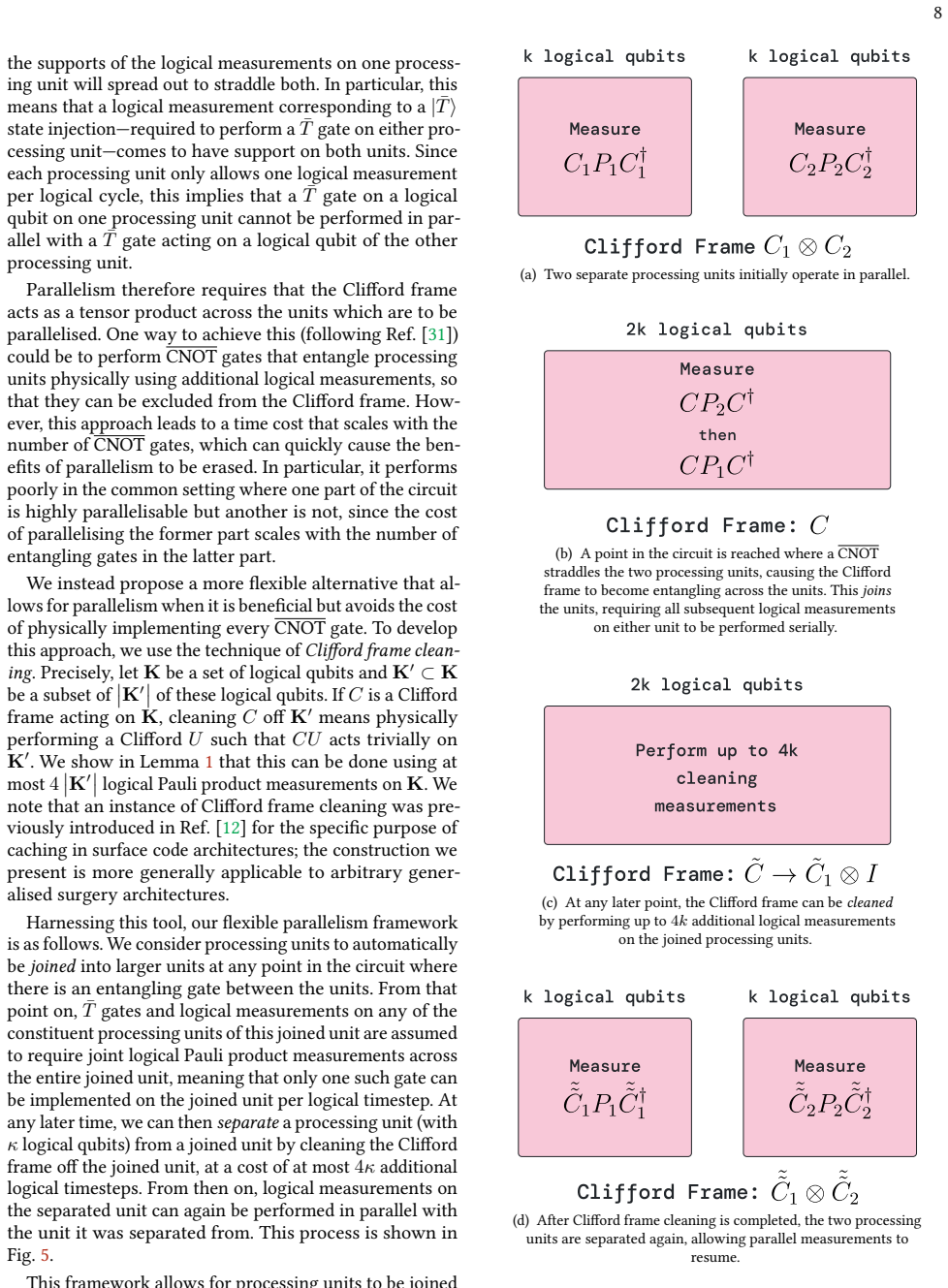
Flexibly Parallel Operation More common and general is the case where a circuit can be implemented partially in parallel. In such a circuit, no subset of logical qubits is entirely separable from the rest, but significant parts of the circuit involve operations on disjoint registers of logical qubits. A conventional circuit implementation would allow such...
-
[5]
Recall that each processing unit accesses memory via a port
General Operation The final step to our fully general operation is to option- ally incorporate the memory. Recall that each processing unit accesses memory via a port. We allow for read-only memory access, which requires only gates that act as a con- trol on the port and a target on the processing unit [8, 35]. This means that the access can be provided b...
-
[6]
Processing Units Using β processing blocks constructed from the GB code family introduced above (for any β∈N ), we can encode κ=βk logical qubits in βnpb physical qubits. Specifically, with a code distance of d= 16 , we can encode 14β logical qubits in 860β physical qubits. For better protection, we can instead use a code distance of d= 24 and encode 16β ...
-
[7]
Magic Engines We construct each magic engine from code blocks of the same GB code family as those used for the processing blocks. These blocks naturally have the required L and R logical sectors, with k/2>5 logical qubits in each sector whend≥10. We use 15-to-1 magic state distillation on these code blocks to produce encoded | ¯T⟩ magic states [44]. Follo...
work page 2048
-
[8]
For simplicity, we match the window size with the number of logical qubits in a logical sector, k/2
Memory For the memory, we use the same code blocks as are used for the processing blocks. For simplicity, we match the window size with the number of logical qubits in a logical sector, k/2. Each port then corresponds to one of the Z- type gadgets used in the gadget system of the processing blocks, along with a bridge to connect to a processing unit. The ...
-
[9]
Algorithm The two-dimensional Fermi-Hubbard model represents a system of interacting fermions and has the Hamiltonian H=H h +H I = X ⟨i,j⟩ X σ∈{↑,↓} a† i,σaj,σ +a † j,σai,σ +u X i ˆni,↑ˆni,↓. (14) Here, i denotes the sites of an L×L lattice, ⟨i, j⟩ denotes pairs of nearest neighbours on this lattice, σ∈ {↑,↓} denotes spins states, a† and a represent creat...
-
[10]
Implementation and Results Concretely, we consider the case of even L≤32 and u= 4 . In this regime, N≤2050 and we find numerically that the number of logical cycles satisfies T= 8×10 6, which also upper bounds theT count. This implies that the logical spacetime volume satisfies NT ≤2×10 10. Hence, the algorithm can be implemented with negligible failure p...
work page 2050
-
[11]
[ 8], which uses techniques de- veloped by Ekerå and Håstad [58] and by Chevignard et al
Algorithm The algorithm we use is a generalisation of that pre- sented by Gidney in Ref. [ 8], which uses techniques de- veloped by Ekerå and Håstad [58] and by Chevignard et al. [59]. We refer to this algorithm as Gidney’s algorithm. This algorithm uses residue number system arithmetic to replace modular arithmetic over NRSA (the number being factored) w...
work page 2048
-
[12]
These processing units can run in parallel throughout most of the computation
Implementation on Pinnacle Architecture To implement the algorithm on the Pinnacle Architec- ture, we begin by allocating a processing unit for each working register. These processing units can run in parallel throughout most of the computation. The only exception is the relatively short periods when the accumulators of the working registers are being agg...
-
[13]
Physical Qubits:We now determine the number of physical qubits required
Resource Analysis a. Physical Qubits:We now determine the number of physical qubits required. Each working register corre- sponds to a processing unit with κ(f, ℓ, m) logical qubits, as given in Eq. (23), along with a magic engine. The num- ber of physical qubits required for the ρ working registers is therefore nw =ρ npb κ(f, ℓ, m) k +n me ! .(24) Each m...
-
[14]
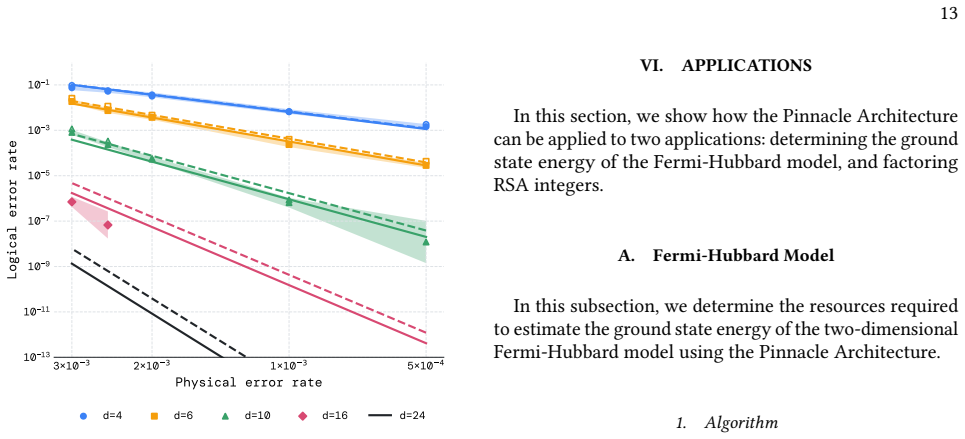
Results We now consider the resources—both physical qubits and time—required to factor an RSA-2048 integer on the instantiation of the Pinnacle architecture presented in Sec- tion V, given different hardware parameters, namely the code cycle time and physical error rate. Following Ref. [8], we expect the required logical error rate per logical qubit per l...
work page 2048
-
[15]
The symplectic complement W ⊥ of subspace W is a subspace whose elements commute with all elements in W. 19 In the same formalism, an n-qubit Clifford operator U can be represented by a 2n×2n matrix MU that preserves the symplectic inner product (i.e., such that MU J MT U =J ). The action of U on Pv by conjugation corresponds to matrix multiplication on t...
-
[16]
P. Shor, Algorithms for quantum computation: Discrete loga- rithms and factoring, inProceedings 35th Annual Symposium on Foundations of Computer Science(1994) pp. 124–134
work page 1994
-
[17]
Lloyd, Universal quantum simulators, Science273, 1073 (1996)
S. Lloyd, Universal quantum simulators, Science273, 1073 (1996)
work page 1996
-
[18]
D. Gottesman, Opportunities and challenges in fault- tolerant quantum computation (2022), arXiv:2210.15844
-
[19]
A. G. Fowler, M. Mariantoni, J. M. Martinis, and A. N. Cle- land, Surface codes: Towards practical large-scale quan- tum computation, Physical Review A86, 032324 (2012), arXiv:1208.0928
-
[20]
D. Horsman, A. G. Fowler, S. Devitt, and R. V. Meter, Surface code quantum computing by lattice surgery, New Journal of Physics14, 123011 (2012), arXiv:1111.4022
-
[21]
A Game of Surface Codes: Large-Scale Quantum Computing with Lattice Surgery
D. Litinski, A game of surface codes: Large-scale quantum computing with lattice surgery, Quantum3, 128 (2019), arXiv:1808.02892
-
[22]
How to Factor 2048 Bit RSA Integers in 8 Hours Using 20 Million Noisy Qubits,
C. Gidney and M. Ekerå, How to factor 2048 bit RSA integers in 8 hours using 20 million noisy qubits, Quantum5, 433 (2021), arXiv:1905.09749
-
[23]
How to factor 2048 bit RSA integers with less than a million noisy qubits
C. Gidney, How to factor 2048 bit RSA integers with less than a million noisy qubits (2025), arXiv:2505.15917
work page internal anchor Pith review Pith/arXiv arXiv 2048
-
[24]
How to build a quantum super- computer: scaling from hundreds to millions of qubits,
M. Mohseni, A. Scherer, K. G. Johnson, O. Wertheim, M. Ot- ten, N. A. Aadit, Y. Alexeev, K. M. Bresniker, K. Y. Cam- sari, B. Chapman, S. Chatterjee, G. A. Dagnew, A. Espos- ito, F. Fahim, M. Fiorentino, A. Gajjar, A. Khalid, X. Kong, B. Kulchytskyy, E. Kyoseva, R. Li, P. A. Lott, I. L. Markov, R. F. McDermott, G. Pedretti, P. Rao, E. Rieffel, A. Silva, J...
-
[25]
T. J. Yoder, E. Schoute, P. Rall, E. Pritchett, J. M. Gambetta, A. W. Cross, M. Carroll, and M. E. Beverland, Tour de gross: A modular quantum computer based on bivariate bicycle codes (2025), arXiv:2506.03094
work page internal anchor Pith review Pith/arXiv arXiv 2025
-
[26]
P. Webster, S. C. Smith, and L. Z. Cohen, Explicit construc- tion of low-overhead gadgets for gates on quantum LDPC codes (2025), arXiv:2511.15989
-
[27]
C. Chamberland and E. T. Campbell, Universal quantum computing with twist-free and temporally encoded lattice surgery, PRX Quantum3, 010331 (2022), arXiv:2109.02746
-
[28]
I. D. Kivlichan, C. Gidney, D. W. Berry, N. Wiebe, J. McClean, W. Sun, Z. Jiang, N. Rubin, A. Fowler, A. Aspuru-Guzik, H. Neven, and R. Babbush, Improved fault-tolerant quan- tum simulation of condensed-phase correlated electrons via Trotterization, Quantum4, 296 (2020), arXiv:1902.10673
-
[29]
S. Bravyi, G. Smith, and J. Smolin, Trading classical and quantum computational resources, Physical Review X6, 021043 (2016), arXiv:1506.01396
work page Pith/arXiv arXiv 2016
- [30]
- [31]
-
[32]
H. Zhou, C. Duckering, C. Zhao, D. Bluvstein, M. Cain, A. Ku- bica, S.-T. Wang, and M. D. Lukin, Resource analysis of low-overhead transversal architectures for reconfigurable atom arrays, inProceedings of the 52nd Annual International Symposium on Computer Architecture(2025) pp. 1432–1448, arXiv:2505.15907
- [33]
- [34]
-
[35]
J. Yoneda, W. Huang, M. Feng, C. H. Yang, K. W. Chan, T. Tanttu, W. Gilbert, R. C. C. Leon, F. E. Hudson, K. M. Itoh, A. Morello, S. D. Bartlett, A. Laucht, A. Saraiva, and A. S. Dzurak, Coherent spin qubit transport in silicon, Nature 21 Communications12, 4114 (2021), arXiv:2008.04020
-
[36]
M. Malinowski, D. T. C. Allcock, and C. J. Ballance, How to wire a 1000-qubit trapped ion quantum computer, PRX Quantum4, 040313 (2023), arXiv:2305.12773
-
[37]
D. Bluvstein, H. Levine, G. Semeghini, T. T. Wang, S. Ebadi, M. Kalinowski, A. Keesling, N. Maskara, H. Pichler, M. Greiner, V. Vuletic, and M. D. Lukin, A quantum proces- sor based on coherent transport of entangled atom arrays, Nature604, 451 (2022), arXiv:2112.03923
-
[38]
Interleaving: Modular architectures for fault-tolerant photonic quantum computing
H. Bombin, I. H. Kim, D. Litinski, N. Nickerson, M. Pant, F. Pastawski, S. Roberts, and T. Rudolph, Interleaving: Mod- ular architectures for fault-tolerant photonic quantum com- puting (2021), arXiv:2103.08612
-
[39]
High-threshold and low- overhead fault-tolerant quantum memory
S. Bravyi, A. W. Cross, J. M. Gambetta, D. Maslov, P. Rall, and T. J. Yoder, High-threshold and low-overhead fault-tolerant quantum memory, Nature627, 778 (2024), arXiv:2308.07915
- [40]
-
[41]
D. J. Williamson and T. J. Yoder, Low-overhead fault-tolerant quantum computation by gauging logical operators (2024), arXiv:2410.02213
work page internal anchor Pith review Pith/arXiv arXiv 2024
- [42]
-
[43]
Following Refs [6, 10], we assume that the time required between logical measurements is negligible compared with the timescale of a logical cycle
- [44]
-
[45]
E. Swaroop, T. Jochym-O’Connor, and T. J. Yoder, Universal adapters between quantum low-density parity check codes, PRX Quantum7, 010324 (2026), arXiv:2410.03628
- [46]
-
[47]
Quantum error correction below the surface code threshold.arXiv preprint arXiv:2408.13687, 2024
R. Acharya, L. Aghababaie-Beni, I. Aleiner, T. I. Andersen, M. Ansmann, F. Arute, K. Arya, A. Asfaw, N. Astrakhantsev, J. Atalaya, R. Babbush, D. Bacon, B. Ballard, J. C. Bardin, J. Bausch, A. Bengtsson, A. Bilmes, S. Blackwell, S. Boixo, G. Bortoli, A. Bourassa, J. Bovaird, L. Brill, M. Broughton, D. A. Browne, B. Buchea, B. B. Buckley, D. A. Buell, T. B...
-
[48]
D. Pataki and A. Pályi, Compiling the surface code to cross- bar spin qubit architectures, Physical Review B111, 115307 (2025), arXiv:2412.05425
- [49]
-
[50]
Encoding Electronic Spectra in Quantum Circuits with Linear T Complexity,
R. Babbush, C. Gidney, D. W. Berry, N. Wiebe, J. McClean, A. Paler, A. Fowler, and H. Neven, Encoding electronic spec- tra in quantum circuits with linear T complexity, Physical Review X8, 041015 (2018), arXiv:1805.03662
work page Pith/arXiv arXiv 2018
-
[51]
Architecting Distributed Quantum Computers: Design Insights from Resource Estimation
D. Filippov, P. Yang, and P. Murali, Architecting distributed quantum computers: Design insights from resource estima- tion (2025), arXiv:2508.19160
work page internal anchor Pith review Pith/arXiv arXiv 2025
-
[52]
A. A. Kovalev and L. P. Pryadko, Quantum Kronecker sum- product low-density parity-check codes with finite rate, Physical Review A88, 012311 (2013), arXiv:1212.6703
work page Pith/arXiv arXiv 2013
-
[53]
P. Panteleev and G. Kalachev, Degenerate quantum LDPC codes with good finite length performance, Quantum5, 585 (2021), arXiv:1904.02703
-
[54]
J. du Crest, M. Mhalla, and V. Savin, Stabilizer inactiva- tion for message-passing decoding of quantum LDPC codes (2023), arXiv:2205.06125
- [55]
-
[56]
M. Wang and F. Mueller, Coprime bivariate bicycle codes and their layouts on cold atoms, Quantum10, 2009 (2026), arXiv:2408.10001
-
[57]
F. J. MacWilliams and N. J. A. Sloane,The Theory of Error- Correcting Codes, North-Holland Mathematical Library, Vol. 16 (Elsevier, 1977)
work page 1977
-
[58]
Parallel Logical Measurements via Quantum Code Surgery
A. Cowtan, Z. He, D. J. Williamson, and T. J. Yoder, Paral- lel logical measurements via quantum code surgery (2026), arXiv:2503.05003
work page internal anchor Pith review Pith/arXiv arXiv 2026
-
[59]
S. Bravyi and A. Kitaev, Universal quantum computation 22 with ideal Clifford gates and noisy ancillas, Physical Review A71, 022316 (2005), arXiv:quant-ph/0403025
-
[60]
Magic State Distillation: Not as Costly as You Think,
D. Litinski, Magic state distillation: Not as costly as you think, Quantum3, 205 (2019), arXiv:1905.06903
-
[61]
H. Goto, Minimizing resource overheads for fault-tolerant preparation of encoded states of the Steane code, Scientific Reports6, 19578 (2016)
work page 2016
-
[62]
Even more efficient magic state distillation by zero-level distillation , publisher =
T. Itogawa, Y. Takada, Y. Hirano, and K. Fujii, Efficient magic state distillation by zero-level distillation, PRX Quantum6, 020356 (2025), arXiv:2403.03991
-
[63]
Magic state cultivation: growing T states as cheap as CNOT gates
C. Gidney, N. Shutty, and C. Jones, Magic state cultiva- tion: Growing T states as cheap as CNOT gates (2024), arXiv:2409.17595
work page internal anchor Pith review Pith/arXiv arXiv 2024
-
[64]
K. Sahay, P.-K. Tsai, K. Chang, Q. Su, T. B. Smith, S. Singh, and S. Puri, Fold-transversal surface code cultivation (2025), arXiv:2509.05212
-
[65]
We estimate these reject rates using data on expected at- tempts (which we denote γ) from Ref. [49], extrapolating under the assumption that the failure rate is linear in p for the case of p= 10 −4. Specifically, the overall reject rate is then given by pr = (1−(1−1/γ) ξ)15, where ξ is the number of attempts that are possible in the available time and wit...
- [66]
-
[67]
This suffices since we can choose the eight logical measure- ments in the first batch to act trivially on one of the four logical qubits involved in post-selection
-
[68]
S. Vittal, A. Javadi-Abhari, A. W. Cross, L. S. Bishop, and M. Qureshi, Flag-proxy networks: Overcoming the archi- tectural, scheduling and decoding obstacles of quantum LDPC codes, in2024 57th IEEE/ACM International Sym- posium on Microarchitecture (MICRO)(2024) pp. 718–734, arXiv:2409.14283
-
[69]
N. Raveendran and B. Vasić, Trapping sets of quantum LDPC codes, Quantum5, 562 (2021), arXiv:2012.15297
-
[70]
A. Paetznick and K. M. Svore, Repeat-until-success: Non- deterministic decomposition of single-qubit unitaries, Quantum Information and Computation14, 1277 (2014), arXiv:1311.1074
work page Pith/arXiv arXiv 2014
-
[71]
A. Bocharov, M. Roetteler, and K. M. Svore, Efficient syn- thesis of universal repeat-until-success circuits, Physical Review Letters114, 080502 (2015), arXiv:1404.5320
work page Pith/arXiv arXiv 2015
-
[72]
[ 15] in using this ap- proach
For simplicity, we here follow Ref. [ 15] in using this ap- proach. We note that more recent advances in rotation syn- thesis have since been presented [65], which may allow for reduced runtimes if incorporated in future
-
[73]
M. Ekerå and J. Håstad, Quantum algorithms for computing short discrete logarithms and factoring RSA integers, in Post-Quantum Cryptography, Vol. 10346 (2017) pp. 347–363, arXiv:1702.00249
-
[74]
C. Chevignard, P.-A. Fouque, and A. Schrottenloher, Reduc- ing the number of qubits in quantum factoring, inAdvances in Cryptology – CRYPTO 2025, edited by Y. Tauman Kalai and S. F. Kamara (2025) pp. 384–415
work page 2025
-
[75]
C. Jones, Low-overhead constructions for the fault- tolerant Toffoli gate, Physical Review A87, 022328 (2013), arXiv:1212.5069
work page Pith/arXiv arXiv 2013
-
[76]
D. Litinski, How to compute a 256-bit elliptic curve private key with only 50 million Toffoli gates (2023), arXiv:2306.08585
-
[77]
M. E. Beverland, P. Murali, M. Troyer, K. M. Svore, T. Hoefler, V. Kliuchnikov, G. H. Low, M. Soeken, A. Sundaram, and A. Vaschillo, Assessing requirements to scale to practical quantum advantage (2022), arXiv:2211.07629
work page internal anchor Pith review Pith/arXiv arXiv 2022
-
[78]
N. Baspin, L. Berent, and L. Z. Cohen, Fast surgery for quan- tum LDPC codes (2025), arXiv:2510.04521
-
[79]
Improved simulation of stabilizer circuits
S. Aaronson and D. Gottesman, Improved simulation of stabilizer circuits, Physical Review A70, 052328 (2004), arXiv:quant-ph/0406196
work page Pith/arXiv arXiv 2004
-
[80]
V. Kliuchnikov, K. Lauter, R. Minko, A. Paetznick, and C. Pe- tit, Shorter quantum circuits via single-qubit gate approxi- mation, Quantum7, 1208 (2023), arXiv:2203.10064
discussion (0)
Sign in with ORCID, Apple, or X to comment. Anyone can read and Pith papers without signing in.