Recognition: unknown
Modeling YSO Jets in 3D III: Dependence of Accretion and Jet Properties on Stellar Magnetospheric Field Strength and Rotation
Pith reviewed 2026-05-10 16:29 UTC · model grok-4.3
The pith
Jets from young stars emerge along two-legged magnetic field lines whose stability depends on the balance between a central spine and surrounding tower.
A machine-rendered reading of the paper's core claim, the machinery that carries it, and where it could break.
Core claim
In all models, jets are launched from two-legged magnetic field lines anchored to both the star and the turbulent, magnetically elevated disk surface, with interactions at the disk surface crucial for mediating the magnetosphere-disk coupling. The axial jet and its surrounding disk wind form a characteristic spine-tower structure: the spine is the kinematically-dominated jet along open field lines threading the star, and the tower is the surrounding toroidal-field-dominated disk wind. The stability of this structure depends on the balance between the spine's stabilizing power and the tower's destabilizing power; if the tower dominates, the disk wind can choke the jet, producing asymmetric or
What carries the argument
The spine-tower structure formed by two-legged magnetic field lines, where the central kinematically dominated jet spine along stellar field lines balances against the surrounding toroidal-field dominated disk wind tower to set overall jet stability.
If this is right
- Stable bipolar jets form only when the stellar magnetic spine overpowers the surrounding disk wind tower.
- Observed jet and wind properties yield an upper limit on the toroidal magnetic field strength in the disk wind-launching region.
- The direction and speed of jet rotation can indicate the stellar rotation rate rather than the classical disk launch radius.
- Non-rotating stars can produce counter-rotating jets through interactions at the disk surface.
- Magnetosphere-disk coupling is mediated by surface interactions along two-legged field lines rather than direct stellar anchoring.
Where Pith is reading between the lines
- Jet rotation measurements could serve as a proxy for stellar spin rates in embedded young stars where photometric rotation periods are hard to obtain.
- The same spine-tower balance may account for the observed transition from jet-dominated to wind-dominated systems as stars evolve and their fields weaken.
- Simulations with varied disk turbulence levels could test whether the two-legged launching mechanism remains robust across different accretion states.
- Including radiation or ionization feedback in future runs might shift the field-anchoring points and change the predicted stability thresholds.
Load-bearing premise
The non-ideal MHD effects and disk turbulence modeled in the simulations capture the main processes that anchor field lines and control coupling between the star and disk.
What would settle it
A stable, symmetric jet observed alongside a disk wind whose toroidal field strength exceeds the upper limit predicted from the outflow properties would falsify the spine-tower stability balance.
Figures




read the original abstract
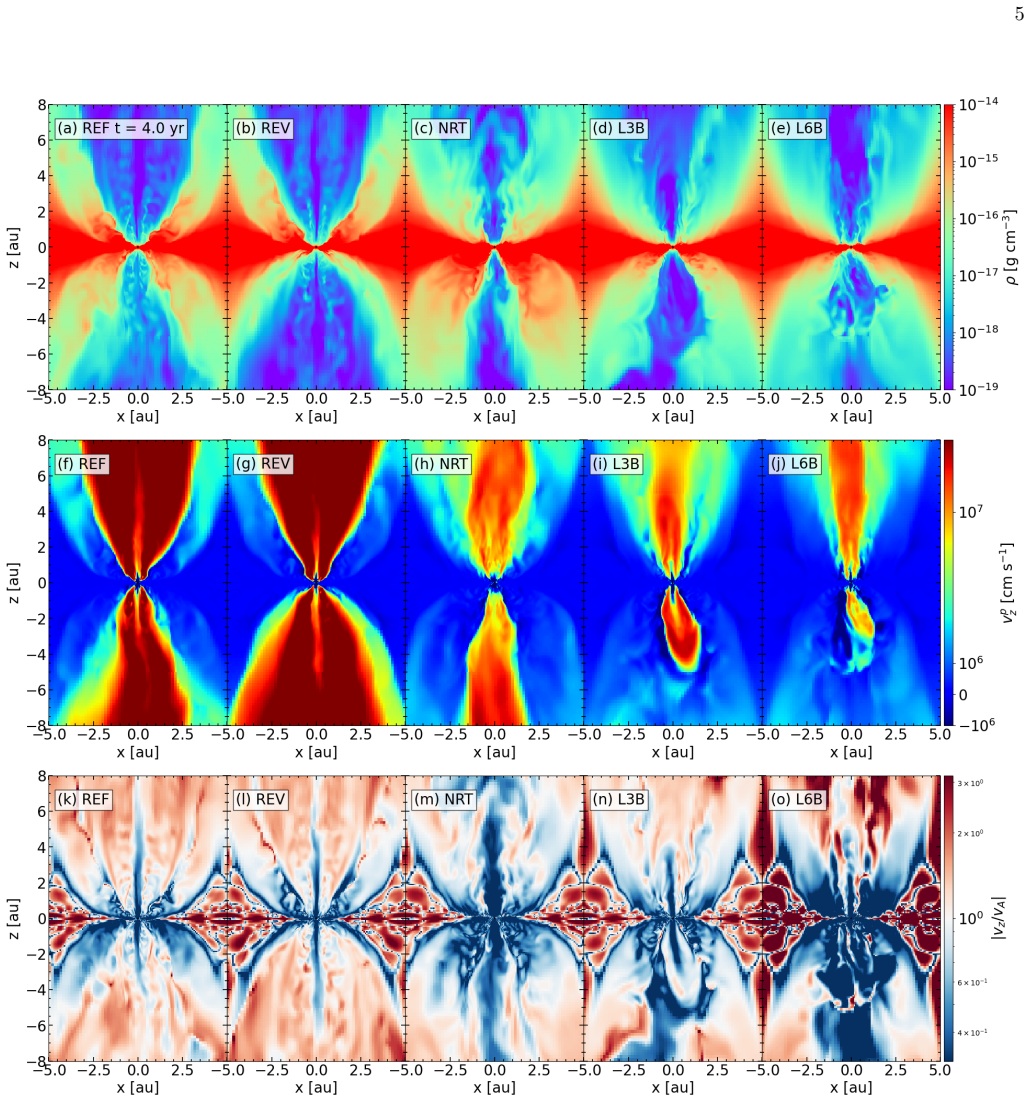
Observations of Young Stellar Objects (YSOs) systems reveal a wide diversity of jet properties, from well-collimated bipolar jets to uni-polar jets and systems with no detectable jet. Both prograde and counter-rotating jets are reported, raising questions about how jets are launched and how their properties relate to the underlying star-disk system. Using 3D non-ideal MHD simulations, we present a suite of models in which jet properties depend sensitively on stellar rotation and magnetic field strength. In all models, jets are launched from ``two-legged'' magnetic field lines anchored to both the star and the turbulent, magnetically elevated disk surface, with interactions at the disk surface crucial for mediating the magnetosphere-disk coupling. The axial jet and its surrounding disk wind form a characteristic ``spine-tower'' structure: the spine is the kinematically-dominated jet along open field lines threading the star, and the tower is the surrounding toroidal-field--dominated disk wind. The stability of this structure depends on the balance between the spine's stabilizing power and the tower's destabilizing power; if the tower dominates, the disk wind can choke the jet, producing asymmetric or no jets. This relationship allows an upper limit estimate on the toroidal magnetic field strength in the disk wind-launching region using observed outflow properties. Counter-rotating jets naturally appear in models, particularly with non-rotating stars, showing that the classical rotation-poloidal velocity relation does not reliably indicate the jet-launching radius. Instead, it could be used to trace the stellar rotation rate, offering a potential observational diagnostic of stellar spin.
Editorial analysis
A structured set of objections, weighed in public.
Referee Report
Summary. This paper uses 3D non-ideal MHD simulations to model jets from young stellar objects, varying the stellar magnetospheric field strength and rotation rate. It concludes that jets are launched from two-legged magnetic field lines anchored to both the star and the turbulent disk surface in all cases. The jet and disk wind form a spine-tower structure, with stability determined by the competition between the stellar spine and the toroidal disk wind tower. Tower dominance can lead to choked or asymmetric jets, providing an upper limit on the toroidal magnetic field strength in the disk wind region from observations. Counter-rotating jets appear naturally, especially for non-rotating stars, implying that the rotation-velocity relation traces stellar spin rather than launch radius.
Significance. Should the numerical results prove robust, the work offers a physical framework for understanding the variety of observed YSO jet properties, including uni-polar and counter-rotating jets. The parameter exploration highlights the sensitivity to stellar properties and suggests new observational diagnostics. The emergence of the spine-tower structure from the simulations is a key insight into magnetosphere-disk coupling.
major comments (2)
- Abstract: The assertion that the two-legged field line launching occurs 'in all models' and that the spine-tower stability balance holds universally requires quantitative support, such as metrics for field line connectivity or stability criteria, which are not detailed here and must be verified in the results sections to substantiate the central claims.
- Numerical methods section: The manuscript provides no information on grid resolution, numerical diffusivity, convergence tests, or comparisons to analytic limits. These are load-bearing for the claims regarding the sensitivities of jet properties and the stability of the spine-tower structure to stellar parameters, as insufficient resolution could artificially affect the turbulence and field anchoring.
minor comments (2)
- Abstract: Consider adding the number of simulations performed and the specific ranges of stellar field strength and rotation rates explored to provide context for the 'suite of models'.
- Abstract: The term 'two-legged' magnetic field lines should be defined more clearly, perhaps with reference to a figure showing the topology.
Simulated Author's Rebuttal
We thank the referee for their thoughtful and constructive review. The comments have helped us clarify and strengthen the quantitative basis for our central claims and the description of our numerical setup. We have revised the manuscript accordingly.
read point-by-point responses
-
Referee: Abstract: The assertion that the two-legged field line launching occurs 'in all models' and that the spine-tower stability balance holds universally requires quantitative support, such as metrics for field line connectivity or stability criteria, which are not detailed here and must be verified in the results sections to substantiate the central claims.
Authors: We agree that explicit quantitative metrics strengthen the presentation. In the revised manuscript we have added, in the results section, field-line tracing statistics showing that >85% of open field lines are two-legged (star-disk anchored) in every model. We also introduce a stability diagnostic based on the ratio of integrated poloidal magnetic tension along the stellar spine to the toroidal magnetic pressure in the surrounding disk-wind tower; time-averaged values of this ratio are shown to correlate directly with whether a given model produces a stable, choked, or asymmetric jet. These additions are now cross-referenced from the abstract and confirm that the two-legged launching and spine-tower balance operate across the entire parameter suite. revision: yes
-
Referee: Numerical methods section: The manuscript provides no information on grid resolution, numerical diffusivity, convergence tests, or comparisons to analytic limits. These are load-bearing for the claims regarding the sensitivities of jet properties and the stability of the spine-tower structure to stellar parameters, as insufficient resolution could artificially affect the turbulence and field anchoring.
Authors: We have expanded the numerical methods section to include the missing details. The base grid is 256^3 with two levels of adaptive mesh refinement, yielding an effective resolution of ~12 cells per disk scale height near the launching region. Numerical diffusivity is quantified via the explicit resistivity and artificial viscosity terms in the non-ideal MHD solver. Convergence tests were performed by rerunning two representative models at doubled resolution; jet mass-loss rates and rotation profiles agree to within 8%. We also compare the disk-wind component to the analytic Blandford-Payne solution for the same field geometry, confirming that the simulated poloidal velocities and lever arms fall within 15% of the analytic values. These additions support the robustness of the reported sensitivities to stellar parameters. revision: yes
Circularity Check
Simulation results emerge directly from MHD integration with no definitional or self-citation circularity
full rationale
The paper reports outcomes from a suite of 3D non-ideal MHD simulations in which stellar rotation rate and magnetospheric field strength are varied as independent inputs. All central claims—the universal two-legged field-line topology, spine-tower structure, stability balance that can choke jets, derived upper bound on disk-wind toroidal field, and appearance of counter-rotating jets—are presented as emergent features of the numerical solutions rather than quantities defined in terms of themselves or obtained by fitting outputs to inputs. Although the work is labeled “III,” the load-bearing statements rest on the current runs and the underlying MHD equations, not on a chain of self-citations whose validity would have to be presupposed. Consequently the derivation chain contains no self-definitional, fitted-input, or uniqueness-imported circular steps.
Axiom & Free-Parameter Ledger
free parameters (2)
- stellar magnetospheric field strength
- stellar rotation rate
axioms (2)
- standard math Non-ideal MHD equations govern the plasma and magnetic field evolution
- domain assumption The disk is turbulent and magnetically elevated at its surface
invented entities (1)
-
spine-tower structure
no independent evidence
Reference graph
Works this paper leans on
-
[1]
2024, ApJ, 964, 147, doi: 10.3847/1538-4357/ad2355
Krasnopolsky, R. 2024, ApJ, 964, 147, doi: 10.3847/1538-4357/ad2355
-
[2]
M., Li, Z.-Y., Krasnopolsky, R., & Blandford, R
Anderson, J. M., Li, Z.-Y., Krasnopolsky, R., & Blandford, R. D. 2003, The Astrophysical Journal, 590, L107, doi: 10.1086/376824
-
[3]
Armitage, P. J. 2011, ARA&A, 49, 195, doi: 10.1146/annurev-astro-081710-102521
-
[4]
Assani, K. D., Harsono, D., Ramsey, J. P., et al. 2024, A&A, 688, A26, doi: 10.1051/0004-6361/202449745
-
[5]
, year = 2016, month = sep, volume =
Bally, J. 2016, ARA&A, 54, 491, doi: 10.1146/annurev-astro-081915-023341
-
[6]
2008, A&A, 478, 155, doi: 10.1051/0004-6361:20078328
Bouvier, J. 2008, A&A, 478, 155, doi: 10.1051/0004-6361:20078328
-
[7]
Blandford, R. D., & Payne, D. G. 1982, MNRAS, 199, 883, doi: 10.1093/mnras/199.4.883
-
[8]
J., Shang, H., Lin, H.-H., & Shu, F
Cai, M. J., Shang, H., Lin, H.-H., & Shu, F. H. 2008, ApJ, 672, 489, doi: 10.1086/523788 Carrasco-Gonz´ alez, C., Rodr´ ıguez, L. F., Anglada, G., et al. 2010, Science, 330, 1209, doi: 10.1126/science.1195589
-
[9]
arXiv , author =:1011.6619 , journal =
Davis, C. 2011, A&A, 526, A40, doi: 10.1051/0004-6361/200913988
-
[10]
Coffey, D., Bacciotti, F., Woitas, J., Ray, T. P., & Eisl¨ offel, J. 2004, ApJ, 604, 758, doi: 10.1086/382019
-
[11]
2026, arXiv e-prints, arXiv:2602.09404, doi: 10.48550/arXiv.2602.09404
Dutta, S. 2026, arXiv e-prints, arXiv:2602.09404, doi: 10.48550/arXiv.2602.09404
-
[12]
2009, ApJ, 692, 346, doi: 10.1088/0004-637X/692/1/346
Fendt, C. 2009, ApJ, 692, 346, doi: 10.1088/0004-637X/692/1/346
-
[13]
2006, A&A, 453, 785, doi: 10.1051/0004-6361:20054231
Ferreira, J., Dougados, C., & Cabrit, S. 2006, A&A, 453, 785, doi: 10.1051/0004-6361:20054231
-
[14]
2014, in Protostars and Planets VI, ed
Frank, A., Ray, T. P., Cabrit, S., et al. 2014, in Protostars and Planets VI, ed. H. Beuther, R. S. Klessen, C. P. Dullemond, & T. Henning, 451–474, doi: 10.2458/azu uapress 9780816531240-ch020
work page doi:10.2458/azu 2014
-
[15]
Ghosh, P., & Lamb, F. K. 1979, ApJ, 234, 296, doi: 10.1086/157498
-
[16]
2017, A&A, 597, A43, doi: 10.1051/0004-6361/201629321
Goddi, C., Surcis, G., Moscadelli, L., et al. 2017, A&A, 597, A43, doi: 10.1051/0004-6361/201629321
-
[17]
Guan, X., Li, H., & Li, S. 2014, ApJ, 781, 48, doi: 10.1088/0004-637X/781/1/48 G¨ udel, M., Eibensteiner, C., Dionatos, O., et al. 2018, A&A, 620, L1, doi: 10.1051/0004-6361/201834271
-
[18]
Harris, C. R., Millman, K. J., van der Walt, S. J., et al. 2020, Nature, 585, 357, doi: 10.1038/s41586-020-2649-2
-
[19]
1998, ApJ, 495, 385, doi: 10.1086/305277
Hartmann, L., Calvet, N., Gullbring, E., & D’Alessio, P. 1998, ApJ, 495, 385, doi: 10.1086/305277
-
[20]
2016, ARA&A, 54, 135, doi: 10.1146/annurev-astro-081915-023347
Hartmann, L., Herczeg, G., & Calvet, N. 2016, ARA&A, 54, 135, doi: 10.1146/annurev-astro-081915-023347
-
[21]
Hsieh, C.-H., Arce, H. G., Li, Z.-Y., et al. 2023, ApJ, 947, 25, doi: 10.3847/1538-4357/acba13
-
[22]
Huarte-Espinosa, M., Frank, A., Blackman, E. G., et al. 2012, ApJ, 757, 66, doi: 10.1088/0004-637X/757/1/66
-
[23]
Hunter, J. D. 2007, Computing in Science & Engineering, 9, 90, doi: 10.1109/MCSE.2007.55
-
[24]
Ireland, L. G., Zanni, C., Matt, S. P., & Pantolmos, G. 2021, ApJ, 906, 4, doi: 10.3847/1538-4357/abc828
-
[25]
2021, A&A, 647, A192, doi: 10.1051/0004-6361/202039322 21
Jacquemin-Ide, J., Lesur, G., & Ferreira, J. 2021, A&A, 647, A192, doi: 10.1051/0004-6361/202039322 21
-
[26]
2004, ApJ, 605, 307, doi: 10.1086/381234
Kato, Y., Mineshige, S., & Shibata, K. 2004, ApJ, 605, 307, doi: 10.1086/381234
-
[27]
Lam, S. K., Pitrou, A., & Seibert, S. 2015, in Proceedings of the Second Workshop on the LLVM Compiler Infrastructure in HPC, LLVM ’15 (New York, NY, USA: Association for Computing Machinery), doi: 10.1145/2833157.2833162
-
[28]
Lee, C.-F., Hasegawa, T. I., Hirano, N., et al. 2010, ApJ, 713, 731, doi: 10.1088/0004-637X/713/2/731
-
[29]
2015, ApJ, 805, 186, doi: 10.1088/0004-637X/805/2/186
Lee, C.-F., Hirano, N., Zhang, Q., et al. 2015, ApJ, 805, 186, doi: 10.1088/0004-637X/805/2/186
-
[30]
Lee, C.-F., Ho, P. T. P., Li, Z.-Y., et al. 2017, Nature Astronomy, 1, 0152, doi: 10.1038/s41550-017-0152
-
[31]
2018, Nature Communications, 9, 4636, doi: 10.1038/s41467-018-07143-8
Lee, C.-F., Hwang, H.-C., Ching, T.-C., et al. 2018, Nature Communications, 9, 4636, doi: 10.1038/s41467-018-07143-8
-
[32]
2025, Scientific Reports, 15, 29702, doi: 10.1038/s41598-025-11602-w
Lee, C.-F., Jhan, K.-S., & Moraghan, A. 2025, Scientific Reports, 15, 29702, doi: 10.1038/s41598-025-11602-w
-
[33]
Lee, C.-F., Stone, J. M., Ostriker, E. C., & Mundy, L. G. 2001, The Astrophysical Journal, 557, 429, doi: 10.1086/321648
-
[34]
2021, ApJL, 907, L41, doi: 10.3847/2041-8213/abda38
Lee, C.-F., Tabone, B., Cabrit, S., et al. 2021, ApJL, 907, L41, doi: 10.3847/2041-8213/abda38
-
[35]
Lii, P., Romanova, M., & Lovelace, R. 2012, MNRAS, 420, 2020, doi: 10.1111/j.1365-2966.2011.20133.x
-
[36]
Lii, P. S., Romanova, M. M., Ustyugova, G. V., Koldoba, A. V., & Lovelace, R. V. E. 2014, MNRAS, 441, 86, doi: 10.1093/mnras/stu495
-
[37]
2025, ApJ, 979, 17, doi: 10.3847/1538-4357/ad9275
Liu, C.-F., Shang, H., Johnstone, D., et al. 2025, ApJ, 979, 17, doi: 10.3847/1538-4357/ad9275 L´ opez-V´ azquez, J. A., Lee, C.-F., Fern´ andez-L´ opez, M., et al. 2024, ApJ, 962, 28, doi: 10.3847/1538-4357/ad132a
-
[38]
2018, A&A, 618, A120, doi: 10.1051/0004-6361/201731733
Louvet, F., Dougados, C., Cabrit, S., et al. 2018, A&A, 618, A120, doi: 10.1051/0004-6361/201731733
-
[39]
arXiv , author =:1607.08645 , journal =
Louvet, F., Dougados, C., Cabrit, S., et al. 2016, A&A, 596, A88, doi: 10.1051/0004-6361/201628474
-
[40]
Lovelace, R. V. E., Li, H., Ustyugova, G. V., Romanova, M. M., & Colgate, S. A. 2001, in American Institute of Physics Conference Series, Vol. 586, 20th Texas Symposium on relativistic astrophysics, ed. J. C. Wheeler & H. Martel (AIP), 426–432, doi: 10.1063/1.1419587
-
[41]
Lovelace, R. V. E., & Romanova, M. M. 2009, arXiv e-prints, arXiv:0901.4753, doi: 10.48550/arXiv.0901.4753
-
[42]
Lovelace, R. V. E., Romanova, M. M., & Bisnovatyi-Kogan, G. S. 1995, MNRAS, 275, 244, doi: 10.1093/mnras/275.2.244
-
[43]
1996, MNRAS, 279, 389, doi: 10.1093/mnras/279.2.389
Lynden-Bell, D. 1996, MNRAS, 279, 389, doi: 10.1093/mnras/279.2.389
-
[44]
Lynden-Bell, D. 2003, Monthly Notices of the Royal Astronomical Society, 341, 1360, doi: 10.1046/j.1365-8711.2003.06506.x
-
[45]
1994, Monthly Notices of the Royal Astronomical Society, 267, 146, doi: 10.1093/mnras/267.1.146
Lynden-Bell, D., & Boily, C. 1994, Monthly Notices of the Royal Astronomical Society, 267, 146, doi: 10.1093/mnras/267.1.146
-
[46]
2008, A&A, 477, 521, doi: 10.1051/0004-6361:20077907
Matsakos, T., Tsinganos, K., Vlahakis, N., et al. 2008, A&A, 477, 521, doi: 10.1051/0004-6361:20077907
-
[47]
2006, A&A, 460, 1, doi: 10.1051/0004-6361:20065484
Meliani, Z., Casse, F., & Sauty, C. 2006, A&A, 460, 1, doi: 10.1051/0004-6361:20065484
-
[48]
Moll, R., Spruit, H. C., & Obergaulinger, M. 2008, A&A, 492, 621, doi: 10.1051/0004-6361:200810523
-
[49]
Najita, J. R., & Shu, F. H. 1994, ApJ, 429, 808, doi: 10.1086/174365
-
[50]
2007, ApJ, 656, 721, doi: 10.1086/510361
Nakamura, M., Li, H., & Li, S. 2007, ApJ, 656, 721, doi: 10.1086/510361
-
[51]
Oishi, J. S., Vasil, G. M., Baxter, M., et al. 2020, Proceedings of the Royal Society A: Mathematical, Physical and Engineering Sciences, 476, 20190622, doi: 10.1098/rspa.2019.0622
-
[52]
Ostriker, E. C., & Shu, F. H. 1995, ApJ, 447, 813, doi: 10.1086/175920
-
[53]
2011, A&A, 527, A13, doi: 10.1051/0004-6361/201016049
Bacciotti, F. 2011, A&A, 527, A13, doi: 10.1051/0004-6361/201016049
-
[54]
Pudritz, R. E., & Norman, C. A. 1983, ApJ, 274, 677, doi: 10.1086/161481
-
[55]
Pudritz, R. E., & Ray, T. P. 2019, Frontiers in Astronomy and Space Sciences, 6, 54, doi: 10.3389/fspas.2019.00054
-
[56]
2019, ApJ, 871, 141, doi: 10.3847/1538-4357/aaf728
Qiu, K., Wyrowski, F., Menten, K., Zhang, Q., & G¨ usten, R. 2019, ApJ, 871, 141, doi: 10.3847/1538-4357/aaf728
-
[57]
Ray, T., & Ferreira, J. 2021, New Astronomy Reviews, 93, 101615, doi: https://doi.org/10.1016/j.newar.2021.101615 Rodr´ ıguez-Kamenetzky, A., Carrasco-Gonz´ alez, C.,
-
[58]
arXiv , author =:1711.02554 , journal =
Araudo, A., et al. 2017, ApJ, 851, 16, doi: 10.3847/1538-4357/aa9895 Rodr´ ıguez-Kamenetzky, A., Pasetto, A., Carrasco-Gonz´ alez, C., et al. 2025, ApJL, 978, L31, doi: 10.3847/2041-8213/ad9b26
-
[59]
Romanova, M. M., Koldoba, A. V., Ustyugova, G. V., et al. 2021, MNRAS, 506, 372, doi: 10.1093/mnras/stab1724
-
[60]
2014, EPJ Web Conf., 64, 01001, doi: 10.1051/epjconf/20136401001
Romanova, M. M., Lovelace, R. V. E., Bachetti, M., et al. 2014, in European Physical Journal Web of Conferences, Vol. 64, European Physical Journal Web of Conferences (EDP), 05001, doi: 10.1051/epjconf/20136405001
-
[61]
Lovelace, R. V. E. 2005, ApJL, 635, L165, doi: 10.1086/499560 22
-
[62]
Lovelace, R. V. E. 2009, MNRAS, 399, 1802, doi: 10.1111/j.1365-2966.2009.15413.x
-
[63]
arXiv , author =:1210.3816 , journal =
Tsinganos, K. 2012, The Astrophysical Journal Letters, 759, L1, doi: 10.1088/2041-8205/759/1/L1
-
[64]
Shang, H., Glassgold, A. E., Shu, F. H., & Lizano, S. 2002, ApJ, 564, 853, doi: 10.1086/324197
-
[65]
1986, PASJ, 38, 631
Shibata, K., & Uchida, Y. 1986, PASJ, 38, 631
1986
-
[66]
1994, ApJ, 429, 781, doi: 10.1086/174363
Shu, F., Najita, J., Ostriker, E., et al. 1994, ApJ, 429, 781, doi: 10.1086/174363
-
[67]
Shu, F. H., Najita, J., Ostriker, E. C., & Shang, H. 1995, ApJL, 455, L155, doi: 10.1086/309838
-
[68]
Shu, F. H., Najita, J., Ruden, S. P., & Lizano, S. 1994, ApJ, 429, 797, doi: 10.1086/174364
-
[69]
2014, ApJ, 793, 31, doi: 10.1088/0004-637X/793/1/31
Stepanovs, D., & Fendt, C. 2014, ApJ, 793, 31, doi: 10.1088/0004-637X/793/1/31
-
[70]
Stone, J. M., Tomida, K., White, C. J., & Felker, K. G. 2020, ApJS, 249, 4, doi: 10.3847/1538-4365/ab929b
-
[71]
2018, A&A, 614, A119, doi: 10.1051/0004-6361/201732031
Tabone, B., Raga, A., Cabrit, S., & Pineau des Forˆ ets, G. 2018, A&A, 614, A119, doi: 10.1051/0004-6361/201732031
-
[72]
2025, arXiv e-prints, arXiv:2503.15350
Takasao, S., Hosokawa, T., Tomida, K., & Iwasaki, K. 2025, arXiv e-prints, arXiv:2503.15350. https://arxiv.org/abs/2503.15350
-
[74]
2026, ApJ, 988, 107, doi: 10.3847/1538-4357/addf3c
Tu, Y., Li, Z.-Y., Zhu, Z., Hsu, C.-Y., & Hu, X. 2026, ApJ, 988, 107, doi: 10.3847/1538-4357/addf3c
-
[75]
2025b, ApJ, 978, 84, doi: 10.3847/1538-4357/ad927b
Tu, Y., Li, Z.-Y., Zhu, Z., Hu, X., & Hsu, C.-Y. 2025b, ApJ, 978, 84, doi: 10.3847/1538-4357/ad927b
-
[76]
Lovelace, R. V. E. 2006, ApJ, 646, 304, doi: 10.1086/503379
-
[77]
2025, A&A, 695, A145, doi: 10.1051/0004-6361/202452475
Vleugels, C., McClure, M., Sturm, A., & Vlasblom, M. 2025, A&A, 695, A145, doi: 10.1051/0004-6361/202452475
-
[78]
2009, A&A, 508, 1117, doi: 10.1051/0004-6361/200912879
Zanni, C., & Ferreira, J. 2009, A&A, 508, 1117, doi: 10.1051/0004-6361/200912879
-
[79]
arXiv , author =:1211.4844 , journal =
Zanni, C., & Ferreira, J. 2013, A&A, 550, A99, doi: 10.1051/0004-6361/201220168
-
[80]
2025, Monthly Notices of the Royal Astronomical Society, 537, 3701, doi: 10.1093/mnras/staf250
Zhu, Z. 2025, Monthly Notices of the Royal Astronomical Society, 537, 3701, doi: 10.1093/mnras/staf250
-
[81]
Zhu, Z., Stone, J. M., & Calvet, N. 2024, MNRAS, 528, 2883, doi: 10.1093/mnras/stad3712
discussion (0)
Sign in with ORCID, Apple, or X to comment. Anyone can read and Pith papers without signing in.