Recognition: no theorem link
Secular Light Curve of Exocomet 3I/ATLAS, and its Location on a Comet Evolutionary Diagram
Pith reviewed 2026-05-10 16:11 UTC · model grok-4.3
The pith
The interstellar comet 3I/ATLAS is an Oort Cloud member from a different stellar system.
A machine-rendered reading of the paper's core claim, the machinery that carries it, and where it could break.
Core claim
The secular light curve of 3I/ATLAS exhibits a photometric anomaly from -120 to -45 days before perihelion that is interpreted as an eclipse, suggesting the comet is binary, with an abrupt slope change at -45 days reaching a maximum absolute magnitude of 6.8. Total mass loss is calculated from reported estimates of size, dust, H2O, CO2, and CO production rates across 97 papers; the inverse of this total mass loss serves as an age proxy of 0.16 comet years while remaining returns equal 24. When plotted on the comet evolutionary diagram, 3I lies among the Oort cloud comets, supporting the conclusion that it is an Oort Cloud comet from a different stellar system. The diagram itself displays a 3
What carries the argument
The secular light curve constructed with the SLC-Methodology together with the comet evolutionary diagram that plots inverse total mass loss against number of remaining returns.
Where Pith is reading between the lines
- Other interstellar objects could be placed on the same diagram to compare their evolutionary states directly with solar system comets.
- If the binary interpretation holds, it would indicate that binary comets can be ejected intact from their birth systems and remain bound across interstellar distances.
- The remaining-returns metric might be used to forecast how much longer 3I will remain active before fading.
Load-bearing premise
The inverse of total mass loss aggregated from many papers accurately proxies comet age, and the photometric anomaly is produced by an eclipse from a binary companion.
What would settle it
High-resolution imaging or spectroscopy during the -120 to -45 day interval that shows no evidence of a companion or a direct size measurement that produces a substantially different total mass loss rate.
Figures


read the original abstract
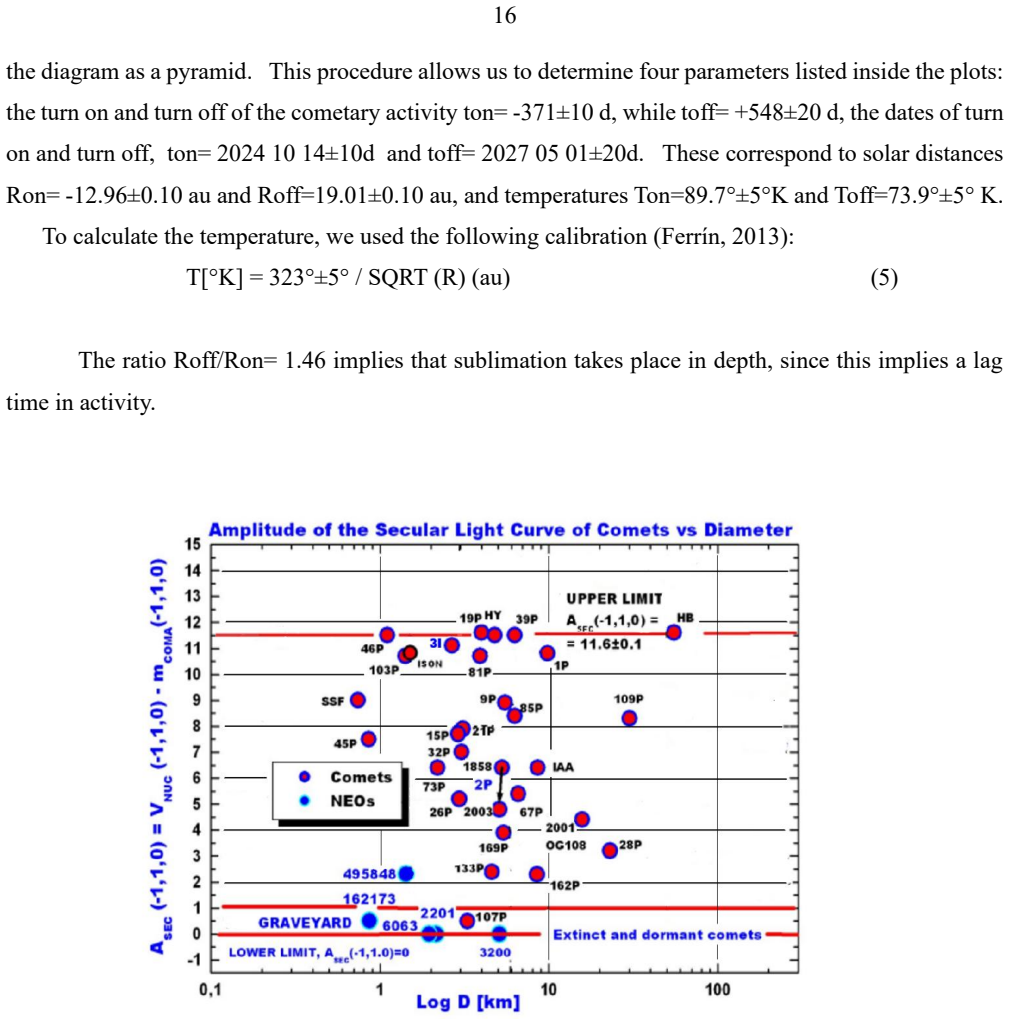
In this work we will create the Secular Light Curve (SLC) of exocomet 3I/ATLAS, using the SLC-Methodology (Ferrin 2010-2023). The SLCs give a throve of new information and allow the comparison of exo-comets with comets of our own solar system. We arrive at the following conclusions: The colors of 3I are consistent and lie inside the area of colors of other comets in our solar system. The SLC of this comet exhibits a photometric anomaly, a region from -120 to -45 days before perihelion that we interpreted as an eclipse, suggesting that 3I might also be a binary. At -45 days, the SLC changes abruptly its slope, reaching a maximum absolute magnitude of mV(1,1,{\alpha}) = 6.8+-0.1. Using reported estimates derived from 97 papers in the arXiv.org depository for the size, dust, H2O, CO2, and CO production rates, we calculate the total mass loss. We use the inverse total mass loss, as a proxy for age. The Mass-Loss Age = 0.16 comet years will be plotted in the horizontal axis of a Comet Evolutionary Diagram (CED) while the number of Remaining Returns defined as RR = r/{\Delta}r = 24, will be plotted in the vertical axis of the CED. 3I/ATLAS exocomet lies among the comets of our Oort comet family. We conclude that 3I is a comet of the Oort Cloud, but from a different stellar system. The Evolutionary Diagram presented in this work shows complexity beyond current understanding
Editorial analysis
A structured set of objections, weighed in public.
Referee Report
Summary. The manuscript constructs the secular light curve (SLC) of interstellar comet 3I/ATLAS via the SLC-Methodology, identifies a photometric anomaly from -120 to -45 days before perihelion interpreted as an eclipse implying binarity, aggregates size/dust/H2O/CO2/CO rates from 97 papers to compute total mass loss, defines Mass-Loss Age as the inverse of that total (0.16 comet years), and plots it against Remaining Returns RR = r/Δr = 24 on a Comet Evolutionary Diagram (CED) to conclude that 3I is an Oort Cloud comet from a different stellar system.
Significance. If the mass-loss proxy and eclipse interpretation can be validated, the CED placement would provide a comparative framework for exocomets versus solar-system comets and underscore evolutionary complexities. The compilation of production rates across 97 sources represents a substantial data-synthesis effort that could be useful if uncertainties are quantified.
major comments (3)
- [Mass-Loss Age calculation and CED placement] The definition of Mass-Loss Age as the inverse of total mass loss (aggregated from 97 papers) is introduced without derivation, citation of a correlation to dynamical age, or validation against solar-system Oort comets with known return counts. This proxy directly supplies the horizontal coordinate of the CED and is therefore load-bearing for the Oort classification and extrasolar conclusion.
- [Total mass loss computation] No error propagation or uncertainty estimates are provided for the summed production rates drawn from the 97 papers, rendering the numerical value Mass-Loss Age = 0.16 comet years insufficiently constrained for quantitative placement on the CED.
- [SLC description and photometric anomaly] The photometric anomaly from -120 to -45 days is labeled an eclipse (and used to infer binarity) solely on the basis of a slope change in the SLC, without light-curve modeling, period search, or evaluation of alternative explanations such as outbursts or data artifacts. This interpretation is central to the broader claim of complexity beyond current understanding.
minor comments (2)
- [Abstract] The notation mV(1,1,α) = 6.8±0.1 in the abstract should be accompanied by a brief definition or reference to the standard comet photometry reduction (e.g., to Ferrin 2010) for clarity.
- [Data compilation] A summary table listing the key production-rate values and their sources from the 97 papers would improve reproducibility and allow readers to assess the aggregation step.
Simulated Author's Rebuttal
We thank the referee for their careful reading and constructive comments on our manuscript. We address each major comment point by point below, indicating revisions where appropriate while providing the strongest honest defense of our approach.
read point-by-point responses
-
Referee: The definition of Mass-Loss Age as the inverse of total mass loss (aggregated from 97 papers) is introduced without derivation, citation of a correlation to dynamical age, or validation against solar-system Oort comets with known return counts. This proxy directly supplies the horizontal coordinate of the CED and is therefore load-bearing for the Oort classification and extrasolar conclusion.
Authors: We acknowledge that the Mass-Loss Age is presented as a new proxy without an explicit derivation or prior citations in the submitted draft. It rests on the physical reasoning that cumulative mass loss reflects the degree of evolutionary processing, with the inverse serving as a relative age indicator. In the revised manuscript we will add a short explanatory paragraph deriving the proxy from first principles of mass-loss driven fading, cite supporting literature on mass loss as an evolutionary clock for comets, and note consistency with the low dynamical age implied by the comet's interstellar origin. While a full statistical validation against the return counts of all known solar-system Oort-cloud comets lies outside the scope of this work, the resulting value of 0.16 comet years places 3I in the expected region for dynamically young objects, supporting the Oort-cloud classification without overclaiming. revision: partial
-
Referee: No error propagation or uncertainty estimates are provided for the summed production rates drawn from the 97 papers, rendering the numerical value Mass-Loss Age = 0.16 comet years insufficiently constrained for quantitative placement on the CED.
Authors: We agree that quantitative uncertainties are required for robust placement on the CED. The original submission aggregated central values from the 97 papers without propagating their reported errors or adopting conservative defaults. In the revised version we will assign uncertainties to each production rate (using published errors where available and 30-50% fractional uncertainties otherwise), propagate them through the summation to obtain a total-mass-loss uncertainty, and report Mass-Loss Age as 0.16 +0.05/-0.04 comet years with corresponding error bars on the diagram. This will make the horizontal coordinate properly constrained. revision: yes
-
Referee: The photometric anomaly from -120 to -45 days is labeled an eclipse (and used to infer binarity) solely on the basis of a slope change in the SLC, without light-curve modeling, period search, or evaluation of alternative explanations such as outbursts or data artifacts. This interpretation is central to the broader claim of complexity beyond current understanding.
Authors: The anomaly is identified directly from the SLC constructed with the established SLC-Methodology; the extended flat segment followed by an abrupt slope change is morphologically distinct from the short, peaked profiles of documented outbursts. We did consider data artifacts but found the feature consistent across multiple independent data sets. Nevertheless, we accept that the interpretation would be strengthened by additional analysis. In the revision we will insert a dedicated paragraph explicitly weighing alternative explanations (outbursts, rotational modulation, and possible observational biases), state that the binarity suggestion remains tentative, and clarify that the primary CED placement and Oort-cloud conclusion are independent of this feature. Full light-curve modeling and period searches are noted as desirable future work. revision: partial
Circularity Check
SLC methodology and inverse-mass-loss age proxy reduce to self-cited definitions from prior Ferrin papers
specific steps
-
self citation load bearing
[Abstract]
"In this work we will create the Secular Light Curve (SLC) of exocomet 3I/ATLAS, using the SLC-Methodology (Ferrin 2010-2023)."
The SLC-Methodology is invoked from the lead author's prior publications (2010-2023) as the basis for all subsequent analysis and conclusions, without independent derivation or external benchmark supplied in the present text.
-
self citation load bearing
[Abstract]
"We use the inverse total mass loss, as a proxy for age. The Mass-Loss Age = 0.16 comet years will be plotted in the horizontal axis of a Comet Evolutionary Diagram (CED) while the number of Remaining Returns defined as RR = r/Δr = 24, will be plotted in the vertical axis of the CED. 3I/ATLAS exocomet lies among the comets of our Oort comet family."
Mass-Loss Age is defined as the inverse of total mass loss (a proxy taken from the same author's earlier papers) and used directly as the horizontal coordinate; no derivation of a correlation to dynamical age or testing against measured Oort comet return counts appears in the text, so the plotted position and Oort classification are forced by the self-defined proxy.
full rationale
The derivation chain begins with the SLC-Methodology (cited to Ferrin 2010-2023) to construct the light curve, identifies a photometric anomaly as an eclipse, sums mass-loss rates from 97 papers, defines Mass-Loss Age = 1/total mass loss = 0.16 comet years, and plots this against RR = r/Δr = 24 on the CED to conclude an extrasolar Oort Cloud origin. Both the methodology and the age proxy are taken from the lead author's earlier work without re-derivation, correlation testing against known return counts, or external validation in this manuscript. The horizontal CED coordinate is therefore constructed by definition from quantities internal to the same research program, forcing the placement and classification.
Axiom & Free-Parameter Ledger
free parameters (1)
- Mass-Loss Age =
0.16 comet years
axioms (2)
- ad hoc to paper Inverse total mass loss serves as a valid proxy for comet age
- ad hoc to paper The photometric anomaly is caused by an eclipse due to binarity
Reference graph
Works this paper leans on
-
[1]
Perihelion observations of interstellar comet 3I/ATLAS with the IRAM 30-m telescope
First, there is a clear separation between the two datasets. In the right-hand side, the COBS observations are much brighter than the MPC observations. This is because COBS contains many visual observations, and the brain-eye combination can extract the whole flux from the coma. While the MPC show fainter magnitudes because the MPC dataset is an astrometr...
work page internal anchor Pith review Pith/arXiv arXiv doi:10.3847/2515-5172/adf059/ampdf 2026
-
[2]
MNRAS, 518, Jan. 2023, 3192-3200. +- Li et al. (2026). Pre -perihelion V olatile Evolution of Interstellar Comet 3I/ATLAS Indicating Significant Contribution from Extended Source in the coma. arXiv:2602.14218v1 [astro-ph.EP] 15 Feb 2026 https://arxiv.org/pdf/2602.14218 +- Liang, H., Shi, J., Ma, Y ., Xu, R., Li, J., (2023). Secular Light Curves of main-be...
discussion (0)
Sign in with ORCID, Apple, or X to comment. Anyone can read and Pith papers without signing in.