Recognition: 2 theorem links
· Lean TheoremAging Aware Adaptive Voltage Scaling for Reliable and Efficient AI Accelerators
Pith reviewed 2026-05-10 16:25 UTC · model grok-4.3
The pith
Aging prediction with DNN-resilient voltage scaling reduces threshold voltage shifts by 19% and cuts aging degradation up to 46% in AI accelerators.
A machine-rendered reading of the paper's core claim, the machinery that carries it, and where it could break.
Core claim
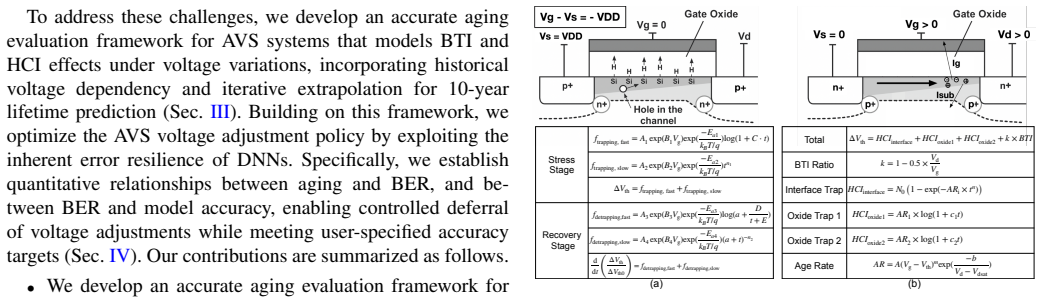
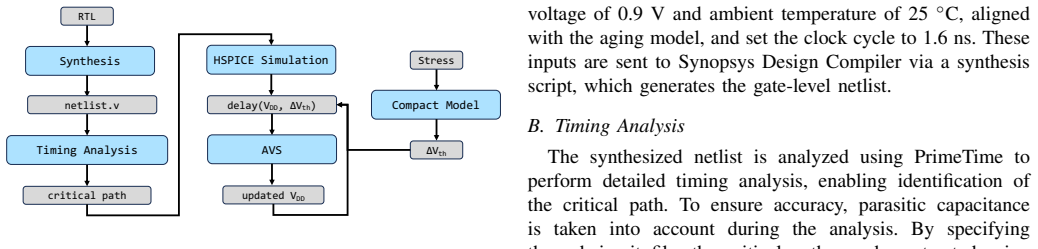
The authors develop an accurate aging prediction framework that incorporates historical effects and iterative extrapolation for full-lifetime modeling. Building on this framework, they propose a fault-tolerant voltage scaling policy that exploits DNN resilience and defers voltage increases accordingly. Experiments show that the framework mitigates the pessimism of maximum-voltage baselines, reducing predicted threshold voltage shift by 19.4% for PMOS and 19.1% for NMOS. Evaluation on representative DNN workloads demonstrates that the optimization reduces aging degradation by up to 45.8% for NMOS and 30.6% for PMOS while achieving 14.0% average lifetime power savings compared to resilience-gn
What carries the argument
The aging prediction framework that incorporates historical effects and iterative extrapolation for full-lifetime modeling, paired with the fault-tolerant voltage scaling policy that defers supply-voltage increases by exploiting DNN resilience.
If this is right
- Predicted threshold voltage shifts over device lifetime are lowered by roughly 19 percent for both PMOS and NMOS transistors.
- Aging degradation is reduced by up to 45.8 percent for NMOS and 30.6 percent for PMOS transistors under typical DNN workloads.
- Average lifetime power consumption drops by 14 percent relative to methods that ignore DNN resilience.
- Reliable AI inference becomes possible at lower supply voltages for longer periods without redesigning the accelerator fabric.
Where Pith is reading between the lines
- The same prediction-plus-resilience approach could be applied to other approximate or error-tolerant workloads such as certain signal-processing or graphics tasks.
- On-chip aging sensors could be combined with the iterative extrapolation step to create closed-loop controllers that adapt faster than open-loop models.
- Future technology nodes might be able to ship with smaller built-in guardbands if software-level resilience is systematically folded into hardware voltage policies.
- The power savings could compound with existing techniques such as dynamic body biasing or workload-aware clock gating.
Load-bearing premise
The aging prediction framework accurately models full-lifetime threshold voltage shifts using historical effects and iterative extrapolation, and the fault-tolerant voltage scaling policy can safely defer voltage increases without causing unacceptable accuracy loss or reliability failures in DNN inference.
What would settle it
Long-term stress-test measurements on fabricated AI accelerator chips that compare actual threshold-voltage drift and sustained inference accuracy when running the proposed fault-tolerant policy versus conventional maximum-voltage guardbanding.
Figures


read the original abstract
Deep neural networks (DNNs) have showcased remarkable performance across various tasks and are widely deployed on AI accelerators fabricated in advanced technology nodes for efficiency. As aging effects become more pronounced, timing and voltage guardbands are increasingly applied. Aging-aware adaptive voltage scaling (AVS), which adjusts supply voltage based on on-chip aging scenarios, has emerged as a promising solution to avoid excessive guardbanding. However, conventional AVS techniques overlook the inherent resilience of DNNs and frequently raise the supply voltage unnecessarily, thereby exacerbating aging and increasing power consumption. To enable reliable and efficient AI inference with AVS, in this paper, we develop an accurate aging prediction framework that incorporates historical effects and iterative extrapolation for full-lifetime modeling. Building on this framework, we propose a fault-tolerant voltage scaling policy that exploits DNN resilience and defers voltage increases accordingly. Experiments show that our framework mitigates the pessimism of maximum-voltage baselines, reducing predicted threshold voltage shift ({\Delta}Vth) by 19.4% for PMOS and 19.1% for NMOS, respectively. Furthermore, evaluation on representative DNN workloads demonstrates that our optimization reduces aging degradation by up to 45.8% (NMOS) and 30.6% (PMOS) while achieving 14.0% average lifetime power savings compared to resilience-agnostic methods.
Editorial analysis
A structured set of objections, weighed in public.
Referee Report
Summary. The manuscript proposes an aging prediction framework that incorporates historical effects and iterative extrapolation to model full-lifetime threshold voltage shifts (ΔVth) in AI accelerators fabricated in advanced nodes. Building on this, it introduces a fault-tolerant voltage scaling policy that exploits the inherent resilience of DNNs to defer voltage increases, claiming to mitigate pessimism in maximum-voltage baselines (reducing predicted ΔVth by 19.4% for PMOS and 19.1% for NMOS), reduce aging degradation by up to 45.8% (NMOS) and 30.6% (PMOS), and achieve 14.0% average lifetime power savings versus resilience-agnostic methods, as demonstrated on representative DNN workloads.
Significance. If the modeling accuracy and policy safety claims hold, the work is significant for addressing aging-induced guardbanding in AI hardware, potentially enabling more efficient and reliable DNN inference by combining physical aging models with workload-specific resilience. The empirical evaluation on DNN workloads and focus on both PMOS/NMOS shifts provide a practical contribution to hardware-software co-design for longevity in advanced technology nodes.
major comments (3)
- [Aging Prediction Framework and Experiments] The iterative extrapolation in the aging prediction framework for full-lifetime ΔVth lacks validation against measured silicon data over extended periods. The 19.4%/19.1% ΔVth reductions and subsequent aging-degradation improvements are computed directly from this extrapolated model versus maximum-voltage baselines; without silicon correlation or error bounds on extrapolation (particularly given process variation, temperature dependence, and recovery effects), the quantitative claims cannot be substantiated (see abstract and Experiments section).
- [Fault-Tolerant Voltage Scaling Policy and Experiments] The fault-tolerant voltage scaling policy assumes DNNs can tolerate deferred voltage increases without unacceptable accuracy loss or timing violations, yet no quantitative bounds on inference accuracy degradation or reliability failure rates under the proposed schedules are provided. This assumption is load-bearing for the safety and power-saving claims (up to 45.8%/30.6% degradation reduction and 14% power savings), as the abstract only mentions evaluation on representative workloads without detailing error metrics or violation rates.
- [Experimental Evaluation] The definitions and implementations of the 'maximum-voltage baselines' and 'resilience-agnostic methods' require clarification to ensure fair comparison. It is unclear how these baselines apply guardbands or scale voltage over lifetime, which directly affects whether the reported 14.0% power savings and ΔVth mitigations are attributable to the proposed framework rather than baseline pessimism.
minor comments (2)
- Clarify notation consistency for ΔVth, PMOS/NMOS shifts, and aging degradation metrics across text, figures, and tables.
- [Introduction] Add references to prior AVS techniques and DNN resilience studies to better position the novelty of the historical-effects + iterative-extrapolation approach.
Simulated Author's Rebuttal
We thank the referee for the constructive and detailed comments. We address each major point below with explanations and proposed revisions where feasible.
read point-by-point responses
-
Referee: [Aging Prediction Framework and Experiments] The iterative extrapolation in the aging prediction framework for full-lifetime ΔVth lacks validation against measured silicon data over extended periods. The 19.4%/19.1% ΔVth reductions and subsequent aging-degradation improvements are computed directly from this extrapolated model versus maximum-voltage baselines; without silicon correlation or error bounds on extrapolation (particularly given process variation, temperature dependence, and recovery effects), the quantitative claims cannot be substantiated (see abstract and Experiments section).
Authors: We acknowledge that full-lifetime silicon measurements are not available, as they would require multi-year experiments impractical for this study. The framework builds on established physical aging models from the literature, calibrated with short-term data and iterative extrapolation for long-term projection. In revision, we will add a limitations subsection with error bounds, sensitivity analysis to process variation/temperature/recovery, and references to supporting model validations to better substantiate the reported ΔVth reductions. revision: partial
-
Referee: [Fault-Tolerant Voltage Scaling Policy and Experiments] The fault-tolerant voltage scaling policy assumes DNNs can tolerate deferred voltage increases without unacceptable accuracy loss or timing violations, yet no quantitative bounds on inference accuracy degradation or reliability failure rates under the proposed schedules are provided. This assumption is load-bearing for the safety and power-saving claims (up to 45.8%/30.6% degradation reduction and 14% power savings), as the abstract only mentions evaluation on representative workloads without detailing error metrics or violation rates.
Authors: The policy incorporates conservative margins derived from the aging model to avoid timing violations, and evaluations were performed on representative workloads while preserving functional correctness. To provide the requested quantitative bounds, we will include additional tabulated results on inference accuracy degradation (e.g., top-1/top-5 loss) and estimated reliability failure rates under the schedules in the revised Experiments section. revision: yes
-
Referee: [Experimental Evaluation] The definitions and implementations of the 'maximum-voltage baselines' and 'resilience-agnostic methods' require clarification to ensure fair comparison. It is unclear how these baselines apply guardbands or scale voltage over lifetime, which directly affects whether the reported 14.0% power savings and ΔVth mitigations are attributable to the proposed framework rather than baseline pessimism.
Authors: We will clarify these in the revised manuscript. The maximum-voltage baseline applies the worst-case predicted voltage (with full guardband) statically over the entire lifetime. Resilience-agnostic methods perform adaptive scaling but without DNN-specific tolerance, using standard guardbanding independent of workload resilience. Additional details on guardband calculation and per-baseline voltage trajectories over time will be added to confirm the comparisons fairly attribute benefits to the proposed approach. revision: yes
Circularity Check
No circularity in derivation; results from empirical modeling and evaluation
full rationale
The paper develops an aging prediction framework via historical effects and iterative extrapolation, then applies a fault-tolerant voltage scaling policy exploiting DNN resilience. No equations, self-definitions, or fitted parameters renamed as predictions appear in the provided text. Claims rest on experimental comparisons to baselines (e.g., maximum-voltage and resilience-agnostic methods), with reported reductions in ΔVth and power savings derived from those evaluations rather than reducing to inputs by construction. No self-citation chains or uniqueness theorems are invoked as load-bearing. The approach is self-contained through physical modeling and workload-specific testing.
Axiom & Free-Parameter Ledger
Lean theorems connected to this paper
-
IndisputableMonolith/Cost/FunctionalEquation.leanwashburn_uniqueness_aczel unclear?
unclearRelation between the paper passage and the cited Recognition theorem.
develop an accurate aging prediction framework that incorporates historical effects and iterative extrapolation for full-lifetime modeling... fault-tolerant voltage scaling policy that exploits DNN resilience
-
IndisputableMonolith/Foundation/DimensionForcing.leanalexander_duality_circle_linking unclear?
unclearRelation between the paper passage and the cited Recognition theorem.
iterative extrapolation to enable full-lifetime aging prediction... VDD increased by Vstep whenever delay exceeds timing constraints
What do these tags mean?
- matches
- The paper's claim is directly supported by a theorem in the formal canon.
- supports
- The theorem supports part of the paper's argument, but the paper may add assumptions or extra steps.
- extends
- The paper goes beyond the formal theorem; the theorem is a base layer rather than the whole result.
- uses
- The paper appears to rely on the theorem as machinery.
- contradicts
- The paper's claim conflicts with a theorem or certificate in the canon.
- unclear
- Pith found a possible connection, but the passage is too broad, indirect, or ambiguous to say the theorem truly supports the claim.
Reference graph
Works this paper leans on
-
[1]
A Survey of Large Language Models
W. X. Zhaoet al., “A survey of large language models,”arXiv preprint arXiv:2303.18223, 2023
work page internal anchor Pith review arXiv 2023
-
[2]
In-datacenter performance analysis of a tensor processing unit,
N. P. Jouppiet al., “In-datacenter performance analysis of a tensor processing unit,” inProc. ISCA, pp. 1–12, 2017
2017
-
[3]
Towards reliability-aware circuit design in nanoscale finfet technology:—new-generation aging model and circuit reliability simulator,
S. Guoet al., “Towards reliability-aware circuit design in nanoscale finfet technology:—new-generation aging model and circuit reliability simulator,” inProc. ICCAD, pp. 780–785, IEEE, 2017
2017
-
[4]
Negative bias temperature instability: What do we understand?,
D. K. Schroder, “Negative bias temperature instability: What do we understand?,”Microelectronics Reliability, vol. 47, no. 6, pp. 841–852, 2007
2007
-
[5]
A two-stage model for negative bias temperature instability,
T. Grasseret al., “A two-stage model for negative bias temperature instability,” inProc. IRPS, pp. 33–44, IEEE, 2009
2009
-
[6]
Parameter variation tolerance and error resiliency: New design paradigm for the nanoscale era,
S. Ghosh and K. Roy, “Parameter variation tolerance and error resiliency: New design paradigm for the nanoscale era,”Proceedings of the IEEE, vol. 98, no. 10, pp. 1718–1751, 2010
2010
-
[7]
New insights into the hot carrier degradation (hcd) in finfet: New observations, unified compact model, and impacts on circuit reliability,
Z. Yuet al., “New insights into the hot carrier degradation (hcd) in finfet: New observations, unified compact model, and impacts on circuit reliability,” inProc. IEDM, pp. 7–2, IEEE, 2017
2017
-
[8]
An empirical model for device degradation due to hot-carrier injection,
E. Takeda and N. Suzuki, “An empirical model for device degradation due to hot-carrier injection,”IEEE EDL, vol. 4, no. 4, pp. 111–113, 2005
2005
-
[9]
Transient self-heating effects on mixed-mode hot carrier and bias temperature instability in finfets: Experiments and modeling,
Z. Sunet al., “Transient self-heating effects on mixed-mode hot carrier and bias temperature instability in finfets: Experiments and modeling,” IEEE TED, vol. 70, no. 11, pp. 5528–5534, 2023
2023
-
[10]
Silent data corruptions at scale
H. D. Dixitet al., “Silent data corruptions at scale,”arXiv preprint arXiv:2102.11245, 2021
-
[11]
Dependable dnn accelerator for safety-critical systems: A review on the aging perspective,
I. Moghaddasiet al., “Dependable dnn accelerator for safety-critical systems: A review on the aging perspective,”IEEE Access, 2023
2023
-
[12]
Clim: A cross-level workload-aware timing error pre- diction model for functional units,
X. Jiaoet al., “Clim: A cross-level workload-aware timing error pre- diction model for functional units,”IEEE Transactions on Computers, vol. 67, no. 6, pp. 771–783, 2017
2017
-
[13]
Variability-and reliability-aware design for 16/14nm and beyond technology,
R. Huanget al., “Variability-and reliability-aware design for 16/14nm and beyond technology,” inProc. IEDM, pp. 12–4, IEEE, 2017
2017
-
[14]
Realm: Reliable and efficient large language model inference with statistical algorithm-based fault tolerance,
T. Xieet al., “Realm: Reliable and efficient large language model inference with statistical algorithm-based fault tolerance,” inProc. DAC, pp. 703–709, 2025
2025
-
[15]
Avatar: an aging-and variation-aware dynamic timing analyzer for application-based dvafs,
Z. Zhanget al., “Avatar: an aging-and variation-aware dynamic timing analyzer for application-based dvafs,” inProc. DAC, pp. 841–846, 2022
2022
-
[16]
Variability mitigation in nanometer cmos integrated systems: A survey of techniques from circuits to software,
A. Rahimiet al., “Variability mitigation in nanometer cmos integrated systems: A survey of techniques from circuits to software,”Proceedings of the IEEE, vol. 104, no. 7, pp. 1410–1448, 2016
2016
-
[17]
Read: Reliability-enhanced accelerator dataflow opti- mization using critical input pattern reduction,
Z. Zhanget al., “Read: Reliability-enhanced accelerator dataflow opti- mization using critical input pattern reduction,” inProc. ICCAD, pp. 1–9, IEEE, 2023
2023
-
[18]
Self-tuning for maximized lifetime energy-efficiency in the presence of circuit aging,
E. Mintarnoet al., “Self-tuning for maximized lifetime energy-efficiency in the presence of circuit aging,”IEEE TCAD, vol. 30, no. 5, pp. 760– 773, 2011
2011
-
[19]
Aging-aware adaptive voltage scaling in 22nm high- k/metal-gate tri-gate cmos,
M. Choet al., “Aging-aware adaptive voltage scaling in 22nm high- k/metal-gate tri-gate cmos,” inProc. CICC, pp. 1–4, IEEE, 2015
2015
-
[20]
Aging-aware adaptive voltage scaling of product blocks in 28nm nodes,
V . Huardet al., “Aging-aware adaptive voltage scaling of product blocks in 28nm nodes,” inProc. IRPS, pp. 7C–2, IEEE, 2016
2016
-
[21]
Postsilicon voltage guard-band reduction in a 22 nm graphics execution core using adaptive voltage scaling and dynamic power gating,
M. Choet al., “Postsilicon voltage guard-band reduction in a 22 nm graphics execution core using adaptive voltage scaling and dynamic power gating,”IEEE Journal Solid-State Circuits, vol. 52, no. 1, pp. 50– 63, 2016
2016
-
[22]
On aging-aware signoff for circuits with adaptive voltage scaling,
T.-B. Chanet al., “On aging-aware signoff for circuits with adaptive voltage scaling,”IEEE TCAS I, vol. 61, no. 10, pp. 2920–2930, 2014
2014
-
[23]
Ares: A framework for quantifying the resilience of deep neural networks,
B. Reagenet al., “Ares: A framework for quantifying the resilience of deep neural networks,” inProc. DAC, pp. 1–6, 2018
2018
-
[24]
Optimizing selective protection for cnn resilience.,
A. Mahmoudet al., “Optimizing selective protection for cnn resilience.,” pp. 127–138, 2021
2021
-
[25]
A. Grattafioriet al., “The llama 3 herd of models,”arXiv preprint arXiv:2407.21783, 2024
work page internal anchor Pith review Pith/arXiv arXiv 2024
-
[26]
The LAMBADA dataset: Word prediction requiring a broad discourse context
D. Papernoet al., “The lambada dataset: Word prediction requiring a broad discourse context,”arXiv preprint arXiv:1606.06031, 2016
work page Pith review arXiv 2016
discussion (0)
Sign in with ORCID, Apple, or X to comment. Anyone can read and Pith papers without signing in.