Recognition: unknown
Predicting Associations between Solar Flares and Coronal Mass Ejections Using SDO/HMI Magnetograms and a Hybrid Neural Network
Pith reviewed 2026-05-10 16:30 UTC · model grok-4.3
The pith
Hybrid neural network using vision transformer and LSTM predicts whether solar flares will produce coronal mass ejections from active-region magnetogram sequences.
A machine-rendered reading of the paper's core claim, the machinery that carries it, and where it could break.
Core claim
The hybrid neural network (HNN) combines a vision transformer with long short-term memory layers to extract features from sequences of line-of-sight magnetograms of active regions; it then predicts whether a flare expected within the next 24 hours will be eruptive (CME-associated) or confined. Experiments demonstrate that the HNN performs well at this distinction, and inspection of its learned patterns indicates that magnetic flux cancellation in polarity inversion line regions is likely involved in triggering the eruptive cases.
What carries the argument
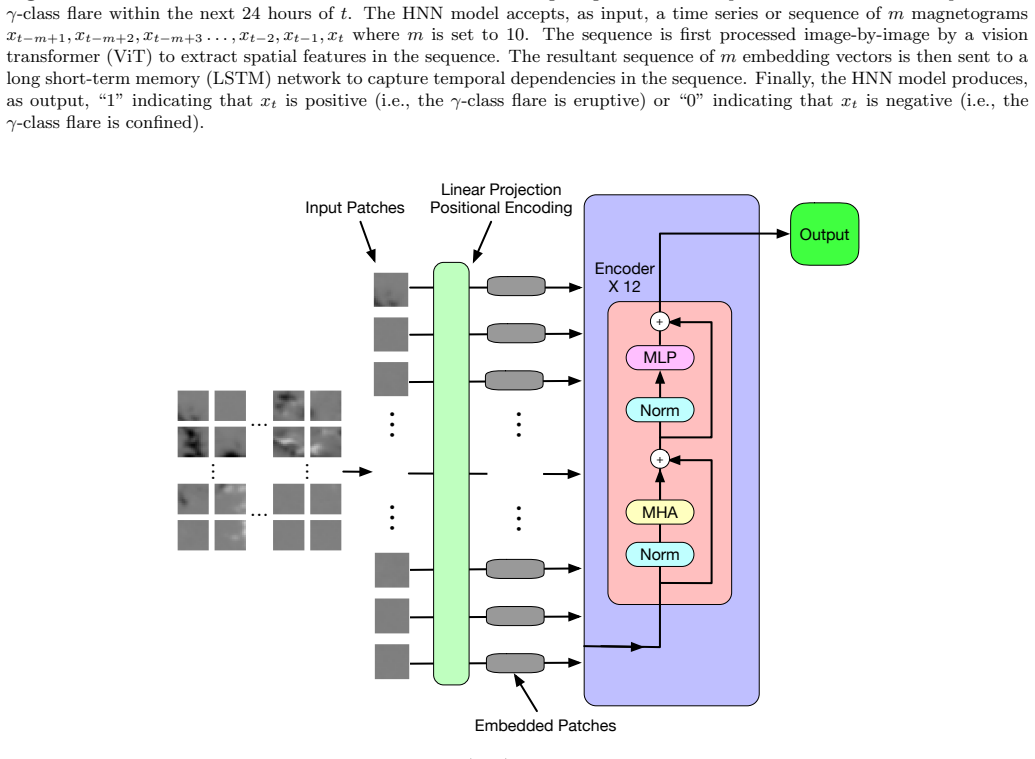
The hybrid neural network (HNN) that merges a vision transformer for spatial feature extraction with LSTM layers for temporal modeling, applied to sequences of line-of-sight magnetograms to classify future flares as eruptive or confined.
If this is right
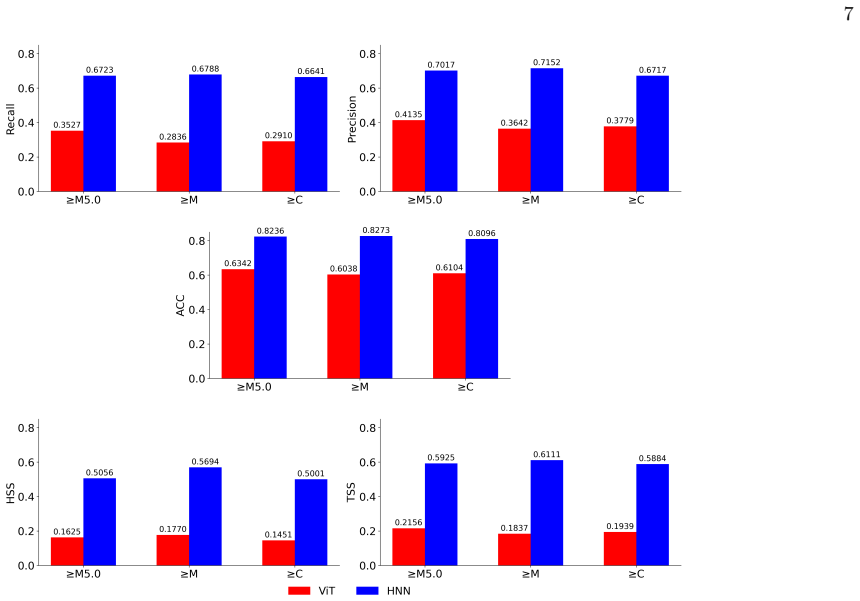
- The HNN method achieves good predictive performance for distinguishing eruptive from confined flares.
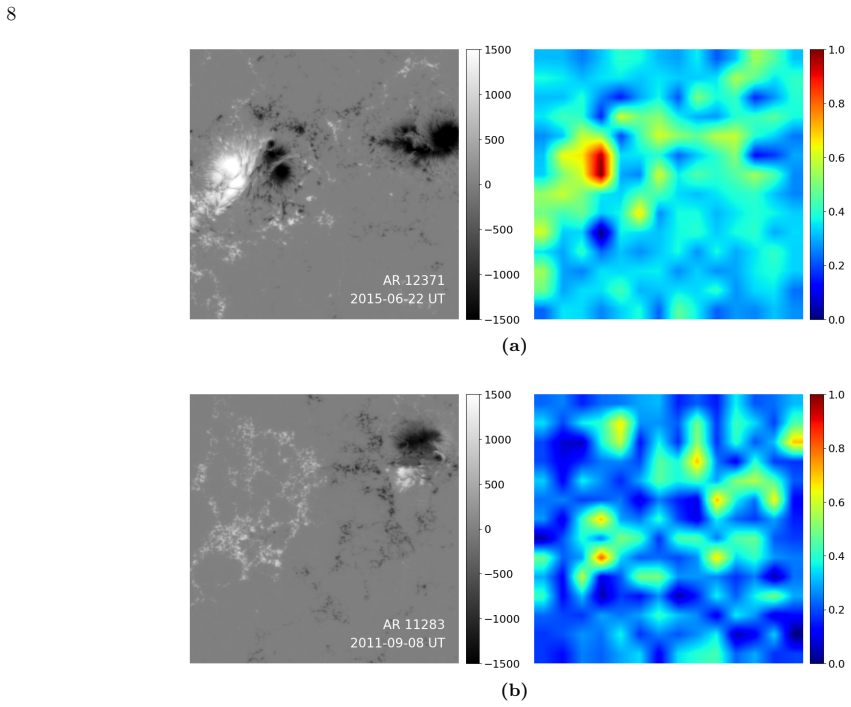
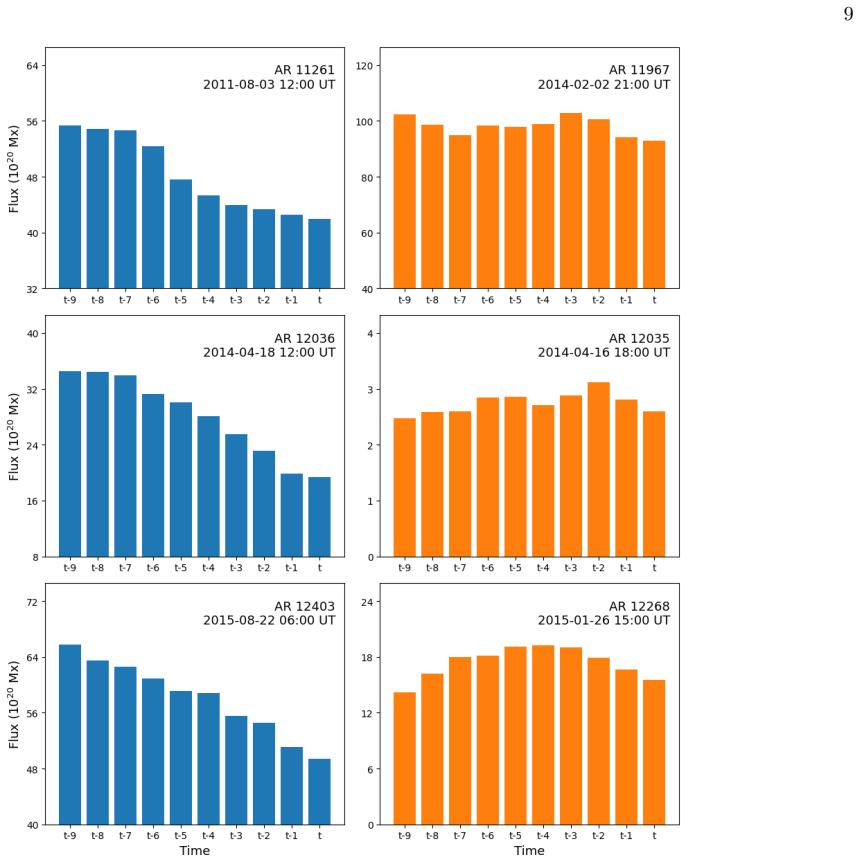
- Magnetic flux cancellation along polarity inversion lines is identified as a candidate trigger for flare-associated CMEs.
- The result is consistent with existing literature on the role of flux cancellation in solar eruptions.
- Early classification of flare eruptiveness could support more targeted space-weather forecasting.
Where Pith is reading between the lines
- If the learned patterns prove causal, routine monitoring of flux cancellation in polarity inversion lines could become a direct input to operational eruption forecasts.
- The same magnetogram-sequence approach might be tested on other eruptive phenomena such as filament lift-off or coronal dimming.
- Combining the HNN with simultaneous EUV or X-ray observations could test whether magnetogram-only inputs are sufficient or whether multi-wavelength context adds predictive power.
Load-bearing premise
Spatio-temporal patterns in line-of-sight magnetogram time series of active regions supply enough information to distinguish, 24 hours in advance, which flares will be accompanied by coronal mass ejections.
What would settle it
A held-out test set of active regions in which the model's accuracy on eruptive versus confined flares drops to random-chance levels, or in which measured flux cancellation rates show no statistical difference between the two classes.
Figures




read the original abstract
Solar eruptions, including flares and coronal mass ejections (CMEs), have a significant impact on Earth. Some flares are associated with CMEs, and some flares are not. The association between flares and CMEs is not always obvious. In this study, we propose a new deep learning method, specifically a hybrid neural network (HNN) that combines a vision transformer with long short-term memory, to predict associations between flares and CMEs. HNN finds spatio-temporal patterns in the time series of line-of-sight magnetograms of solar active regions (ARs) collected by the Helioseismic and Magnetic Imager on board the Solar Dynamics Observatory and uses the patterns to predict whether a flare projected to occur within the next 24 hours will be eruptive (i.e., CME-associated) or confined (i.e., not CME-associated). Our experimental results demonstrate the good performance of the HNN method. Furthermore, the results show that magnetic flux cancellation in polarity inversion line regions may well play a role in triggering flare-associated CMEs, a finding consistent with literature.
Editorial analysis
A structured set of objections, weighed in public.
Referee Report
Summary. The manuscript proposes a hybrid neural network (HNN) combining a vision transformer and LSTM to analyze time series of SDO/HMI line-of-sight magnetograms from solar active regions. It aims to predict 24 hours in advance whether a flare will be eruptive (CME-associated) or confined, claiming good performance and interpreting model attention on polarity inversion line (PIL) regions as evidence that magnetic flux cancellation may trigger flare-associated CMEs, consistent with existing literature.
Significance. If the performance metrics and physical interpretation hold after proper validation, the work could support improved space-weather forecasting by identifying spatio-temporal precursors in magnetogram data. The hybrid architecture is a reasonable choice for capturing both spatial patterns and temporal evolution in active-region time series. However, the absence of quantitative results, baselines, and validation tests in the provided material limits assessment of its potential impact.
major comments (3)
- [Abstract] Abstract: The central claim of 'good performance' is unsupported by any reported quantitative metrics, baseline comparisons, cross-validation details, error estimates, or statistical significance tests. This is load-bearing for the primary contribution and prevents evaluation of whether the HNN outperforms existing methods or random baselines.
- [Abstract] Abstract and results discussion: The inference that magnetic flux cancellation in PIL regions plays a triggering role is presented as a post-hoc model insight from attention maps without controlled ablation, feature importance tests, or counterfactual experiments to distinguish causal drivers from dataset confounders (e.g., AR complexity or labeling criteria).
- [Methods] Methods and data sections: No explicit description of training/test split construction, handling of class imbalance, or out-of-distribution testing is provided. Given that the model is trained and evaluated on the same class of LOS magnetogram time series, this raises a risk of circularity or selection bias that could inflate apparent performance.
minor comments (2)
- [Abstract] Abstract: The 24-hour forecast horizon and active-region selection criteria should be stated more precisely to allow reproducibility.
- [Discussion] The manuscript would benefit from a dedicated limitations section addressing projection effects and missing transverse-field information inherent to LOS magnetograms.
Simulated Author's Rebuttal
We thank the referee for their constructive and detailed feedback. We have revised the manuscript to address the concerns about unsupported claims, interpretive overreach, and missing methodological details, while maintaining the core contributions of the hybrid neural network approach.
read point-by-point responses
-
Referee: [Abstract] Abstract: The central claim of 'good performance' is unsupported by any reported quantitative metrics, baseline comparisons, cross-validation details, error estimates, or statistical significance tests. This is load-bearing for the primary contribution and prevents evaluation of whether the HNN outperforms existing methods or random baselines.
Authors: We agree that the abstract was insufficiently specific and that quantitative support is essential. We have revised the abstract to explicitly report the performance metrics from our experiments (accuracy, F1-score, AUC), added baseline comparisons to standard CNN-LSTM and random models, and included cross-validation details with error estimates and statistical tests in the results section. These changes directly substantiate the performance claim. revision: yes
-
Referee: [Abstract] Abstract and results discussion: The inference that magnetic flux cancellation in PIL regions plays a triggering role is presented as a post-hoc model insight from attention maps without controlled ablation, feature importance tests, or counterfactual experiments to distinguish causal drivers from dataset confounders (e.g., AR complexity or labeling criteria).
Authors: We acknowledge the post-hoc and correlational nature of the attention-based interpretation. We have revised the abstract and discussion to present the finding as suggestive evidence consistent with existing literature on flux cancellation, rather than a definitive causal claim. We added explicit discussion of potential confounders such as active-region complexity and labeling criteria, along with a limitations paragraph noting the absence of ablation or counterfactual tests. revision: partial
-
Referee: [Methods] Methods and data sections: No explicit description of training/test split construction, handling of class imbalance, or out-of-distribution testing is provided. Given that the model is trained and evaluated on the same class of LOS magnetogram time series, this raises a risk of circularity or selection bias that could inflate apparent performance.
Authors: We agree that the original methods description lacked necessary detail on these points. We have substantially expanded the Methods and Data sections to describe the training/test split strategy (temporal and active-region partitioning to reduce leakage), class-imbalance handling via weighted loss, and out-of-distribution validation using data from separate time periods. These additions aim to demonstrate robustness against the noted risks. revision: yes
- Performing new controlled ablation studies, feature importance tests, or counterfactual experiments to establish causality for flux cancellation would require additional experiments and resources beyond the scope of the current study.
Circularity Check
No circularity: standard supervised ML classification on held-out magnetogram sequences
full rationale
The paper trains a hybrid vision-transformer + LSTM network on time-series LOS magnetograms to classify whether an active-region flare will be eruptive or confined. Performance metrics are reported on (presumably) held-out test data, and the flux-cancellation interpretation is presented as a post-hoc observation consistent with existing literature rather than a derived first-principles result. No equation or claim reduces by construction to a fitted parameter renamed as a prediction, no self-citation is invoked as a uniqueness theorem, and the central result remains an empirical classifier output rather than a tautological re-expression of its inputs.
Axiom & Free-Parameter Ledger
free parameters (1)
- Neural network weights and hyperparameters
axioms (1)
- domain assumption Line-of-sight magnetograms of active regions contain sufficient spatio-temporal information to distinguish eruptive from confined flares 24 hours ahead.
Reference graph
Works this paper leans on
-
[1]
, " * write output.state after.block = add.period write newline
ENTRY address archivePrefix author booktitle chapter doi edition editor eprint howpublished institution journal key month number organization pages publisher school series title misctitle type volume year version url label extra.label sort.label short.list INTEGERS output.state before.all mid.sentence after.sentence after.block FUNCTION init.state.consts ...
-
[2]
write newline
" write newline "" before.all 'output.state := FUNCTION format.url url empty "" new.block "" url * "" * if FUNCTION format.eprint eprint empty "" archivePrefix empty "" archivePrefix "arXiv" = new.block " " eprint * " " * new.block " " eprint * " " * if if if FUNCTION format.doi doi empty "" " " doi * " " * if FUNCTION format.pid doi empty eprint empty ur...
-
[3]
-T 2@ | l wu 20 p 1s2@ Fg㸫 ے 2P @Uz 2g㸫8 = 3g㸫 S
thebibliography [1] 20pt to REFERENCES 6pt =0pt \@twocolumntrue 12pt -12pt 10pt plus 3pt =0pt =0pt =1pt plus 1pt =0pt =0pt -12pt =13pt plus 1pt =20pt =13pt plus 1pt \@M =10000 =-1.0em =0pt =0pt 0pt =0pt =1.0em @enumiv\@empty 10000 10000 `\.\@m \@noitemerr \@latex@warning Empty `thebibliography' environment \@ifnextchar \@reference \@latexerr Missing key o...
2017
-
[4]
Abduallah , Y., Wang , J. T. L., Wang , H., & Xu , Y. 2023, title Operational prediction of solar flares using a transformer-based framework , Scientific Reports, 13, 13665, 10.1038/s41598-023-40884-1
-
[5]
Afanasyev , A. N., Fan , Y., Kazachenko , M. D., & Cheung , M. C. M. 2023, title Hybrid Data-driven Magnetofrictional and Magnetohydrodynamic Simulations of an Eruptive Solar Active Region , , 952, 136, 10.3847/1538-4357/acd7e9
-
[6]
Alobaid , K. A., Abduallah , Y., Wang , J. T. L., et al. 2023, title Estimating Coronal Mass Ejection Mass and Kinetic Energy by Fusion of Multiple Deep-learning Models , , 958, L34, 10.3847/2041-8213/ad0c4a
-
[7]
2016, Machine Learning: The New AI (MIT Press)
Alpaydin, E. 2016, Machine Learning: The New AI (MIT Press)
2016
-
[8]
Aslam , O. P. M., MacTaggart , D., Williams , T., Fletcher , L., & Romano , P. 2024, title Photospheric signatures of CME onset , , 534, 444, 10.1093/mnras/stae2110
-
[9]
N., Daly , E., Daglis , I., Kappenman , J
Baker , D. N., Daly , E., Daglis , I., Kappenman , J. G., & Panasyuk , M. 2004, title Effects of Space Weather on Technology Infrastructure , Space Weather, 2, S02004, 10.1029/2003SW000044
-
[10]
Baumgartner , C., Thalmann , J. K., & Veronig , A. M. 2018, title On the Factors Determining the Eruptive Character of Solar Flares , , 853, 105, 10.3847/1538-4357/aaa243
-
[11]
Berkebile-Stoiser , S., Veronig , A. M., Bein , B. M., & Temmer , M. 2012, title Relation between the Coronal Mass Ejection Acceleration and the Non-thermal Flare Characteristics , , 753, 88, 10.1088/0004-637X/753/1/88
-
[12]
Bloomfield , D. S., Higgins , P. A., McAteer , R. T. J., & Gallagher , P. T. 2012, title Toward Reliable Benchmarking of Solar Flare Forecasting Methods , , 747, L41, 10.1088/2041-8205/747/2/L41
-
[13]
Bobra , M. G., & Couvidat , S. 2015, title Solar Flare Prediction Using SDO/HMI Vector Magnetic Field Data with a Machine-learning Algorithm , , 798, 135, 10.1088/0004-637X/798/2/135
-
[14]
Bobra , M. G., & Ilonidis , S. 2016, title Predicting Coronal Mass Ejections Using Machine Learning Methods , , 821, 127, 10.3847/0004-637X/821/2/127
-
[15]
Bobra, M. G., Sun, X., Hoeksema, J. T., et al. 2014, title The Helioseismic and Magnetic Imager ( HMI ) Vector Magnetic Field Pipeline: SHARPs Space-Weather HMI Active Region Patches, , 289, 3549, 10.1007/s11207-014-0529-3
-
[16]
Chen , P. F. 2011, title Coronal Mass Ejections: Models and Their Observational Basis , Living Reviews in Solar Physics, 8, 1, 10.12942/lrsp-2011-1
-
[17]
DeVore , C. R., & Antiochos , S. K. 2008, title Homologous Confined Filament Eruptions via Magnetic Breakout , , 680, 740, 10.1086/588011
-
[18]
Djilali, Y. A. D., McGuinness, K., & O'Connor, N. E. 2023, in 34th British Machine Vision Conference, 771--774. http://proceedings.bmvc2023.org/771/
2023
-
[19]
2021, in 9th International Conference on Learning Representations
Dosovitskiy, A., Beyer, L., Kolesnikov, A., et al. 2021, in 9th International Conference on Learning Representations. https://openreview.net/forum?id=YicbFdNTTy
2021
-
[20]
Florios , K., Kontogiannis , I., Park , S.-H., et al. 2018, title Forecasting Solar Flares Using Magnetogram-based Predictors and Machine Learning , , 293, 28, 10.1007/s11207-018-1250-4
-
[21]
Georgoulis, M. K., Yardley, S. L., Guerra, J. A., et al. 2024, title Prediction of solar energetic events impacting space weather conditions, AdSpR, 10.1016/j.asr.2024.02.030
-
[22]
Harrison , R. A. 1995, title The nature of solar flares associated with coronal mass ejection. , , 304, 585
1995
-
[23]
Deep Residual Learning for Image Recognition , isbn =
He, K., Zhang, X., Ren, S., & Sun, J. 2016, in IEEE Conference on Computer Vision and Pattern Recognition, 770--778, 10.1109/CVPR.2016.90
-
[24]
Neural Computation 9(8), 1735–1780 (1997)
Hochreiter, S., & Schmidhuber, J. 1997, title Long Short-Term Memory, Neural Computation, 9, 1735, 10.1162/neco.1997.9.8.1735
-
[25]
Hopfield , J. J. 1982, title Neural Networks and Physical Systems with Emergent Collective Computational Abilities , Proceedings of the National Academy of Sciences, 79, 2554, 10.1073/pnas.79.8.2554
-
[26]
2018, The Astrophysical Journal, 856, 7, doi: 10.3847/1538-4357/aaae00
Huang , X., Wang , H., Xu , L., et al. 2018, title Deep Learning Based Solar Flare Forecasting Model. I. Results for Line-of-sight Magnetograms , , 856, 7, 10.3847/1538-4357/aaae00
-
[27]
Inceoglu , F., Jeppesen , J. H., Kongstad , P., et al. 2018, title Using Machine Learning Methods to Forecast if Solar Flares Will Be Associated with CMEs and SEPs , , 861, 128, 10.3847/1538-4357/aac81e
-
[28]
Ji , A., Cai , X., Khasayeva , N., et al. 2023, title A Systematic Magnetic Polarity Inversion Line Data Set from SDO/HMI Magnetograms , , 265, 28, 10.3847/1538-4365/acb43a
-
[29]
Ji , A., Georgoulis , M. K., & Aydin , B. 2025, title Integration of solar flare and coronal mass ejection event data , Data in Brief, 60, 111539, 10.1016/j.dib.2025.111539
-
[30]
Jolliffe, I. T., & Stephenson, D. B., eds. 2011, Forecast Verification: A Practitioner's Guide in Atmospheric Science (Wiley), 10.1002/9781119960003
-
[31]
Jonas , E., Bobra , M., Shankar , V., Todd Hoeksema , J., & Recht , B. 2018, title Flare Prediction Using Photospheric and Coronal Image Data , , 293, 48, 10.1007/s11207-018-1258-9
-
[32]
2018, The Astrophysical Journal, 869, 99, doi: 10.3847/1538-4357/aaebfc
Kawabata , Y., Iida , Y., Doi , T., et al. 2018, title Statistical Relation between Solar Flares and Coronal Mass Ejections with Respect to Sigmoidal Structures in Active Regions , , 869, 99, 10.3847/1538-4357/aaebfc
-
[33]
Kazachenko , M. D. 2023, title A Database of Magnetic and Thermodynamic Properties of Confined and Eruptive Solar Flares , , 958, 104, 10.3847/1538-4357/ad004e
-
[34]
Adam: A Method for Stochastic Optimization
Kingma, D. P., & Ba, J. 2015, in 3rd International Conference on Learning Representations. http://arxiv.org/abs/1412.6980
work page internal anchor Pith review Pith/arXiv arXiv 2015
-
[35]
LeCun, Y., Bengio, Y., & Hinton, G. 2015, title Deep learning, Nature, 521, 436, 10.1038/nature14539
-
[36]
Li , X., Zheng , Y., Wang , X., & Wang , L. 2020, title Predicting Solar Flares Using a Novel Deep Convolutional Neural Network , , 891, 10, 10.3847/1538-4357/ab6d04
-
[37]
Lin , J., & Forbes , T. G. 2000, title Effects of reconnection on the coronal mass ejection process , , 105, 2375, 10.1029/1999JA900477
-
[38]
Focal Loss for Dense Object Detection , booktitle =
Lin, T., Goyal, P., Girshick, R. B., He, K., & Doll \' a r, P. 2017, in IEEE International Conference on Computer Vision, 2999--3007, 10.1109/ICCV.2017.324
-
[39]
Liu , C., Chen , T., & Zhao , X. 2019, title New data-driven method of simulating coronal mass ejections , , 626, A91, 10.1051/0004-6361/201935225
-
[40]
Liu , C., Deng , N., Wang , J. T. L., & Wang , H. 2017, title Predicting Solar Flares Using SDO/HMI Vector Magnetic Data Products and the Random Forest Algorithm , , 843, 104, 10.3847/1538-4357/aa789b
-
[41]
Liu , H., Liu , C., Wang , J. T. L., & Wang , H. 2019, title Predicting Solar Flares Using a Long Short-term Memory Network , , 877, 121, 10.3847/1538-4357/ab1b3c
-
[42]
Liu , H., Liu , C., Wang , J. T. L., & Wang , H. 2020, title Predicting Coronal Mass Ejections Using SDO/HMI Vector Magnetic Data Products and Recurrent Neural Networks , , 890, 12, 10.3847/1538-4357/ab6850
-
[43]
Liu , Y. 2008, title Magnetic Field Overlying Solar Eruption Regions and Kink and Torus Instabilities , , 679, L151, 10.1086/589282
-
[44]
Liu , Y., Welsch , B. T., Valori , G., et al. 2023, title Changes of Magnetic Energy and Helicity in Solar Active Regions from Major Flares , , 942, 27, 10.3847/1538-4357/aca3a6
-
[45]
Low , B. C. 1994, title Magnetohydrodynamic processes in the solar corona: Flares, coronal mass ejections, and magnetic helicity , Physics of Plasmas, 1, 1684, 10.1063/1.870671
-
[46]
Moore , R. L., Sterling , A. C., Hudson , H. S., & Lemen , J. R. 2001, title Onset of the Magnetic Explosion in Solar Flares and Coronal Mass Ejections , , 552, 833, 10.1086/320559
-
[47]
2018, The Astrophysical Journal, 858, 113, doi: 10.3847/1538-4357/aab9a7
Nishizuka , N., Sugiura , K., Kubo , Y., Den , M., & Ishii , M. 2018, title Deep Flare Net (DeFN) Model for Solar Flare Prediction , , 858, 113, 10.3847/1538-4357/aab9a7
-
[48]
Patsourakos , S., & Archontis , V. 2025, title Magnetic flux cancellation in a flux-emergence magnetohydrodynamics simulation of coronal hole eruptions and jets , , 699, A87, 10.1051/0004-6361/202554580
-
[49]
2011, title Scikit-learn: machine learning in Python, J
Pedregosa, F., Varoquaux, G., Gramfort, A., et al. 2011, title Scikit-learn: machine learning in Python, J. Mach. Learn. Res., 12, 2825. http://scikit-learn.sourceforge.net
2011
-
[50]
Pesnell , W. D., Thompson , B. J., & Chamberlin , P. C. 2012, title The Solar Dynamics Observatory (SDO) , , 275, 3, 10.1007/s11207-011-9841-3
-
[51]
Qahwaji , R., Colak , T., Al-Omari , M., & Ipson , S. 2008, title Automated Prediction of CMEs Using Machine Learning of CME - Flare Associations , , 248, 471, 10.1007/s11207-007-9108-1
-
[52]
Rust , D. M., & Kumar , A. 1996, title Evidence for Helically Kinked Magnetic Flux Ropes in Solar Eruptions , , 464, L199, 10.1086/310118
-
[53]
Schou , J., Scherrer , P. H., Bush , R. I., et al. 2012, title Design and Ground Calibration of the Helioseismic and Magnetic Imager (HMI) Instrument on the Solar Dynamics Observatory (SDO) , , 275, 229, 10.1007/s11207-011-9842-2
-
[54]
Sterling , A. C., Moore , R. L., & Panesar , N. K. 2018, title Magnetic Flux Cancelation as the Buildup and Trigger Mechanism for CME-producing Eruptions in Two Small Active Regions , , 864, 68, 10.3847/1538-4357/aad550
-
[55]
Sun , P., Dai , W., Ding , W., et al. 2022, title Solar Flare Forecast Using 3D Convolutional Neural Networks , , 941, 1, 10.3847/1538-4357/ac9e53
-
[56]
Teraoka , K., Yamasaki , D., Kawabata , Y., Imada , S., & Shimizu , T. 2025, title Observational Comparison between Confined and Eruptive Flares: Magnetohydrodynamics Instability Parameters in a Similar Magnetic Configuration , , 983, 126, 10.3847/1538-4357/adc12d
-
[57]
K., Su , Y., Temmer , M., & Veronig , A
Thalmann , J. K., Su , Y., Temmer , M., & Veronig , A. M. 2015, title The Confined X-class Flares of Solar Active Region 2192 , , 801, L23, 10.1088/2041-8205/801/2/L23
-
[58]
2005, title Confined and Ejective Eruptions of Kink-unstable Flux Ropes , , 630, L97, 10.1086/462412
T \"o r \"o k , T., & Kliem , B. 2005, title Confined and Ejective Eruptions of Kink-unstable Flux Ropes , , 630, L97, 10.1086/462412
-
[59]
Wang , X., Chen , Y., Toth , G., et al. 2020, title Predicting Solar Flares with Machine Learning: Investigating Solar Cycle Dependence , , 895, 3, 10.3847/1538-4357/ab89ac
-
[60]
Wang , Y., & Zhang , J. 2007, title A Comparative Study between Eruptive X-Class Flares Associated with Coronal Mass Ejections and Confined X-Class Flares , , 665, 1428, 10.1086/519765
-
[61]
Webb , D. F., & Howard , T. A. 2012, title Coronal Mass Ejections: Observations , Living Reviews in Solar Physics, 9, 3, 10.12942/lrsp-2012-3
-
[62]
Wen , J., Ahmadzadeh , A., Georgoulis , M. K., Sadykov , V. M., & Angryk , R. A. 2025, title Outlier Detection and Removal in Multivariate Time Series for a More Robust Machine Learning based Solar Flare Prediction , , 277, 60, 10.3847/1538-4365/adb9e3
-
[63]
Xu , D., Sun , P., Feng , S., Liang , B., & Dai , W. 2025, title Solar Flare Forecasting Using Hybrid Neural Networks , , 276, 68, 10.3847/1538-4365/ada281
-
[64]
2023, title Attribution rollout: a new way to interpret visual transformer, J
Xu, L., Yan, X., Ding, W., & Liu, Z. 2023, title Attribution rollout: a new way to interpret visual transformer, J. Ambient Intell. Humaniz. Comput., 14, 163, 10.1007/S12652-022-04354-2
-
[65]
Yashiro , S., Akiyama , S., Gopalswamy , N., & Howard , R. A. 2006, title Different Power-Law Indices in the Frequency Distributions of Flares with and without Coronal Mass Ejections , , 650, L143, 10.1086/508876
-
[66]
Yashiro, S., & Gopalswamy, N. 2008, title Statistical relationship between solar flares and coronal mass ejections, Proceedings of the International Astronomical Union, 4, 233–243, 10.1017/S1743921309029342
-
[67]
Zhang , H., Li , Q., Yang , Y., et al. 2022, title Solar Flare Index Prediction Using SDO/HMI Vector Magnetic Data Products with Statistical and Machine-learning Methods , , 263, 28, 10.3847/1538-4365/ac9b17
-
[68]
Zhang , H., Jing , J., Wang , J. T. L., et al. 2025, title Prediction of Halo Coronal Mass Ejections Using SDO/HMI Vector Magnetic Data Products and a Transformer Model , , 981, 37, 10.3847/1538-4357/adafa0
-
[69]
Zheng , Y., Li , X., Si , Y., Qin , W., & Tian , H. 2021, title Hybrid deep convolutional neural network with one-versus-one approach for solar flare prediction , , 507, 3519, 10.1093/mnras/stab2132
discussion (0)
Sign in with ORCID, Apple, or X to comment. Anyone can read and Pith papers without signing in.