Recognition: unknown
Prompt Relay: Inference-Time Temporal Control for Multi-Event Video Generation
Pith reviewed 2026-05-10 15:39 UTC · model grok-4.3
The pith
Adding a cross-attention penalty forces each video time segment to attend only to its assigned prompt segment.
A machine-rendered reading of the paper's core claim, the machinery that carries it, and where it could break.
Core claim
Prompt Relay introduces a penalty into the cross-attention mechanism of video diffusion models so that each temporal segment attends only to its assigned prompt. This allows the model to represent one semantic concept at a time, improving temporal prompt alignment, reducing semantic interference, and enhancing visual quality in multi-event video generation. The method requires no architectural modifications and incurs no additional computational overhead.
What carries the argument
The cross-attention penalty that restricts each time step's attention to only the prompt segment assigned to that temporal interval.
If this is right
- Generated videos follow the intended order and durations of multiple events described in segmented prompts.
- Semantic concepts from different prompt segments no longer bleed into one another across time.
- Visual quality improves because interference between events is reduced.
- The control works on existing pretrained models at inference time with no extra training or cost.
Where Pith is reading between the lines
- The same penalty principle could be tested on longer videos that chain more than two prompt segments to check scalability.
- Segmented prompting with this mechanism might complement other inference-time controls such as motion or style adjustments.
- Users could script video timelines more like film storyboards by writing separate prompt blocks for successive shots.
Load-bearing premise
The penalty will separate semantic concepts across time segments without introducing new artifacts or requiring per-video hyperparameter tuning.
What would settle it
Generate a two-event video with distinct prompts for the first and second halves and check whether visual features of the first event appear only in the first half and not the second.
Figures



read the original abstract
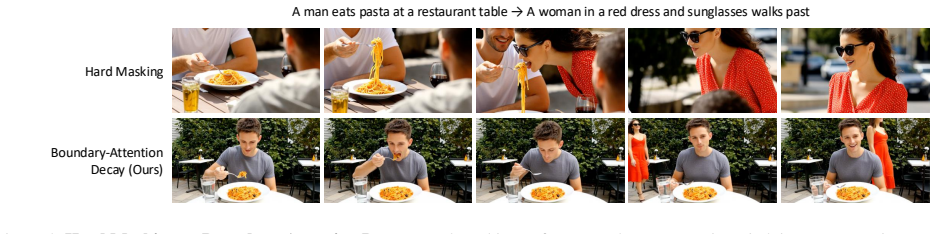
Video diffusion models have achieved remarkable progress in generating high-quality videos. However, these models struggle to represent the temporal succession of multiple events in real-world videos and lack explicit mechanisms to control when semantic concepts appear, how long they persist, and the order in which multiple events occur. Such control is especially important for movie-grade video synthesis, where coherent storytelling depends on precise timing, duration, and transitions between events. When using a single paragraph-style prompt to describe a sequence of complex events, models often exhibit semantic entanglement, where concepts intended for different moments in the video bleed into one another, resulting in poor text-video alignment. To address these limitations, we propose Prompt Relay, an inference-time, plug-and-play method to enable fine-grained temporal control in multi-event video generation, requiring no architectural modifications and no additional computational overhead. Prompt Relay introduces a penalty into the cross-attention mechanism, so that each temporal segment attends only to its assigned prompt, allowing the model to represent one semantic concept at a time and thereby improving temporal prompt alignment, reducing semantic interference, and enhancing visual quality.
Editorial analysis
A structured set of objections, weighed in public.
Referee Report
Summary. The paper proposes Prompt Relay, an inference-time plug-and-play method for multi-event video generation using diffusion models. It adds a penalty term to the cross-attention mechanism so that each temporal segment attends exclusively to its assigned prompt segment, with the goal of reducing semantic entanglement, improving temporal prompt alignment, and enhancing visual quality without architectural changes or extra training.
Significance. If the penalty successfully isolates semantic concepts across time segments in entangled video latents while preserving motion coherence and visual fidelity, the approach would provide a lightweight, training-free tool for fine-grained temporal control in video synthesis. This could be particularly valuable for applications requiring precise event sequencing, such as narrative video generation. The inference-only design is a clear strength, though the absence of any empirical support in the manuscript prevents assessment of whether these benefits are realized.
major comments (1)
- [Abstract] Abstract: The manuscript asserts that the penalty improves temporal prompt alignment, reduces semantic interference, and enhances visual quality, but supplies no quantitative results, ablation studies, or baseline comparisons. This is load-bearing for the central claim, as the value of the method rests on demonstrating that the cross-attention modification delivers the stated benefits without new artifacts or coherence loss.
Simulated Author's Rebuttal
We thank the referee for their constructive review and for recognizing the potential value of an inference-time, training-free approach. We address the single major comment below and will incorporate the requested empirical support in the revised manuscript.
read point-by-point responses
-
Referee: [Abstract] Abstract: The manuscript asserts that the penalty improves temporal prompt alignment, reduces semantic interference, and enhances visual quality, but supplies no quantitative results, ablation studies, or baseline comparisons. This is load-bearing for the central claim, as the value of the method rests on demonstrating that the cross-attention modification delivers the stated benefits without new artifacts or coherence loss.
Authors: We agree that the abstract's claims require quantitative substantiation. The submitted manuscript introduces the Prompt Relay penalty and provides qualitative demonstrations of its effect on temporal segmentation, but does not include the metrics, ablations, or baseline comparisons needed to rigorously evaluate the benefits. In the revision we will add: (1) quantitative metrics for temporal prompt alignment (segment-wise CLIP similarity) and semantic disentanglement (cross-segment concept leakage scores); (2) ablation studies varying the penalty coefficient and measuring impact on alignment versus motion coherence; (3) comparisons against standard diffusion sampling and other inference-time control baselines; and (4) explicit checks for introduced artifacts or coherence degradation. These additions will directly support the central claims. revision: yes
Circularity Check
No circularity: Prompt Relay is a direct, non-derived attention penalty
full rationale
The paper describes Prompt Relay as an inference-time addition of a penalty term to the existing cross-attention computation so each temporal segment attends only to its assigned prompt. No equations, fitted parameters, or self-citations are presented that reduce the claimed temporal isolation or quality gains back to the method's own outputs or prior author results by construction. The approach is framed as a plug-and-play modification without architectural changes or hyperparameter fitting to the target metric. This matches the default expectation of a non-circular paper; the central claim rests on the explicit penalty formulation rather than any self-referential loop.
Axiom & Free-Parameter Ledger
free parameters (1)
- penalty strength
axioms (1)
- standard math Cross-attention layers in diffusion models mediate text conditioning for generated frames.
Reference graph
Works this paper leans on
-
[1]
Accessed January 15, 2026 [Online], 2025
Chatgpt 5.2. Accessed January 15, 2026 [Online], 2025. 5
2026
-
[2]
Accessed January 15, 2026 [Online], 2025
Kling 2.6. Accessed January 15, 2026 [Online], 2025. 2, 4
2026
-
[3]
Accessed January 15, 2026 [Online]https:// sora.chatgpt.com/explore, 2025
Sora. Accessed January 15, 2026 [Online]https:// sora.chatgpt.com/explore, 2025. 4
2026
-
[4]
Accessed January 15, 2026 [Online], 2025
Veo 3.1. Accessed January 15, 2026 [Online], 2025. 2, 4
2026
-
[5]
Accessed January 15, 2026 [Online], 2025
Wan 2.2. Accessed January 15, 2026 [Online], 2025. 4
2026
-
[6]
Dynamic concepts person- alization from single videos
Rameen Abdal, Or Patashnik, Ivan Skorokhodov, Willi Menapace, Aliaksandr Siarohin, Sergey Tulyakov, Daniel Cohen-Or, and Kfir Aberman. Dynamic concepts person- alization from single videos. InProceedings of the Special Interest Group on Computer Graphics and Interactive Tech- niques Conference Conference Papers, 2025. 2
2025
-
[7]
Jianhong Bai, Menghan Xia, Xiao Fu, Xintao Wang, Lian- rui Mu, Jinwen Cao, Zuozhu Liu, Haoji Hu, Xiang Bai, Pengfei Wan, et al. Recammaster: Camera-controlled generative rendering from a single video.arXiv preprint arXiv:2503.11647, 2025. 2
-
[8]
Videopainter: Any- length video inpainting and editing with plug-and-play con- text control
Yuxuan Bian, Zhaoyang Zhang, Xuan Ju, Mingdeng Cao, Liangbin Xie, Ying Shan, and Qiang Xu. Videopainter: Any- length video inpainting and editing with plug-and-play con- text control. InProceedings of the Special Interest Group on Computer Graphics and Interactive Techniques Conference Conference Papers, 2025. 2
2025
-
[9]
Go-with-the-flow: Motion- controllable video diffusion models using real-time warped noise
Ryan Burgert, Yuancheng Xu, Wenqi Xian, Oliver Pilarski, Pascal Clausen, Mingming He, Li Ma, Yitong Deng, Lingx- iao Li, Mohsen Mousavi, et al. Go-with-the-flow: Motion- controllable video diffusion models using real-time warped noise. InProceedings of the Computer Vision and Pattern Recognition Conference, 2025. 2
2025
-
[10]
Ditctrl: Exploring attention control in multi-modal dif- fusion transformer for tuning-free multi-prompt longer video generation
Minghong Cai, Xiaodong Cun, Xiaoyu Li, Wenze Liu, Zhaoyang Zhang, Yong Zhang, Ying Shan, and Xiangyu Yue. Ditctrl: Exploring attention control in multi-modal dif- fusion transformer for tuning-free multi-prompt longer video generation. InProceedings of the Computer Vision and Pat- tern Recognition Conference, 2025. 2, 3
2025
-
[11]
arXiv preprint arXiv:2508.21058 (2025)
Shengqu Cai, Ceyuan Yang, Lvmin Zhang, Yuwei Guo, Jun- fei Xiao, Ziyan Yang, Yinghao Xu, Zhenheng Yang, Alan Yuille, Leonidas Guibas, et al. Mixture of contexts for long video generation.arXiv preprint arXiv:2508.21058, 2025. 2
-
[12]
Masactrl: Tuning-free mu- tual self-attention control for consistent image synthesis and editing
Mingdeng Cao, Xintao Wang, Zhongang Qi, Ying Shan, Xi- aohu Qie, and Yinqiang Zheng. Masactrl: Tuning-free mu- tual self-attention control for consistent image synthesis and editing. InProceedings of the IEEE/CVF international con- ference on computer vision, 2023. 2
2023
-
[13]
Attend-and-excite: Attention-based se- mantic guidance for text-to-image diffusion models.ACM transactions on Graphics (TOG), 2023
Hila Chefer, Yuval Alaluf, Yael Vinker, Lior Wolf, and Daniel Cohen-Or. Attend-and-excite: Attention-based se- mantic guidance for text-to-image diffusion models.ACM transactions on Graphics (TOG), 2023
2023
-
[14]
Stencil: Subject-driven generation with context guidance
Gordon Chen, Ziqi Huang, Cheston Tan, and Ziwei Liu. Stencil: Subject-driven generation with context guidance. In 2025 IEEE International Conference on Image Processing (ICIP). IEEE, 2025. 2
2025
-
[15]
CameraCtrl: Enabling Camera Control for Text-to-Video Generation
Hao He, Yinghao Xu, Yuwei Guo, Gordon Wetzstein, Bo Dai, Hongsheng Li, and Ceyuan Yang. Cameractrl: Enabling camera control for text-to-video generation.arXiv preprint arXiv:2404.02101, 2024. 2
work page internal anchor Pith review arXiv 2024
-
[16]
Prompt-to-Prompt Image Editing with Cross Attention Control
Amir Hertz, Ron Mokady, Jay Tenenbaum, Kfir Aberman, Yael Pritch, and Daniel Cohen-Or. Prompt-to-prompt im- age editing with cross attention control.arXiv preprint arXiv:2208.01626, 2022. 2
work page internal anchor Pith review arXiv 2022
-
[17]
Teng Hu, Zhentao Yu, Zhengguang Zhou, Sen Liang, Yuan Zhou, Qin Lin, and Qinglin Lu. Hunyuancustom: A multimodal-driven architecture for customized video gener- ation.arXiv preprint arXiv:2505.04512, 2025. 2
-
[18]
Lijie Liu, Tianxiang Ma, Bingchuan Li, Zhuowei Chen, Ji- awei Liu, Gen Li, Siyu Zhou, Qian He, and Xinglong Wu. Phantom: Subject-consistent video generation via cross- modal alignment.arXiv preprint arXiv:2502.11079, 2025. 2
-
[19]
Video-p2p: Video editing with cross-attention control
Shaoteng Liu, Yuechen Zhang, Wenbo Li, Zhe Lin, and Jiaya Jia. Video-p2p: Video editing with cross-attention control. InProceedings of the IEEE/CVF Conference on Computer Vision and Pattern Recognition, 2024. 2
2024
-
[20]
Tuna Han Salih Meral, Hidir Yesiltepe, Connor Dunlop, and Pinar Yanardag. Motionflow: Attention-driven mo- tion transfer in video diffusion models.arXiv preprint arXiv:2412.05275, 2024. 2
-
[21]
Mevg: Multi-event video generation with text-to-video models
Gyeongrok Oh, Jaehwan Jeong, Sieun Kim, Wonmin Byeon, Jinkyu Kim, Sungwoong Kim, and Sangpil Kim. Mevg: Multi-event video generation with text-to-video models. In European Conference on Computer Vision. Springer, 2024. 2, 3
2024
-
[22]
Gen3c: 3d-informed world-consistent video generation with precise camera con- trol
Xuanchi Ren, Tianchang Shen, Jiahui Huang, Huan Ling, Yifan Lu, Merlin Nimier-David, Thomas M ¨uller, Alexan- der Keller, Sanja Fidler, and Jun Gao. Gen3c: 3d-informed world-consistent video generation with precise camera con- trol. InProceedings of the Computer Vision and Pattern Recognition Conference, 2025. 2
2025
-
[23]
Wan: Open and Advanced Large-Scale Video Generative Models
Team Wan, Ang Wang, Baole Ai, Bin Wen, Chaojie Mao, Chen-Wei Xie, Di Chen, Feiwu Yu, Haiming Zhao, Jianx- iao Yang, et al. Wan: Open and advanced large-scale video generative models.arXiv preprint arXiv:2503.20314, 2025. 2
work page internal anchor Pith review Pith/arXiv arXiv 2025
-
[24]
Motion inversion for video customization
Luozhou Wang, Ziyang Mai, Guibao Shen, Yixun Liang, Xin Tao, Pengfei Wan, Di Zhang, Yijun Li, and Ying-Cong Chen. Motion inversion for video customization. InProceedings of the Special Interest Group on Computer Graphics and Inter- active Techniques Conference Conference Papers, 2025. 2
2025
-
[25]
Videocomposer: Compositional video synthesis with motion controllability.Advances in Neural Information Processing Systems, 2023
Xiang Wang, Hangjie Yuan, Shiwei Zhang, Dayou Chen, Ji- uniu Wang, Yingya Zhang, Yujun Shen, Deli Zhao, and Jin- gren Zhou. Videocomposer: Compositional video synthesis with motion controllability.Advances in Neural Information Processing Systems, 2023
2023
-
[26]
Motionctrl: A unified and flexible motion controller for video generation
Zhouxia Wang, Ziyang Yuan, Xintao Wang, Yaowei Li, Tianshui Chen, Menghan Xia, Ping Luo, and Ying Shan. Motionctrl: A unified and flexible motion controller for video generation. InACM SIGGRAPH 2024 Conference Pa- pers, 2024. 2
2024
-
[27]
Mind the time: Temporally-controlled multi-event video generation
Ziyi Wu, Aliaksandr Siarohin, Willi Menapace, Ivan Sko- rokhodov, Yuwei Fang, Varnith Chordia, Igor Gilitschenski, and Sergey Tulyakov. Mind the time: Temporally-controlled multi-event video generation. InProceedings of the Com- puter Vision and Pattern Recognition Conference, 2025. 2, 3
2025
-
[28]
Qianxun Xu, Chenxi Song, Yujun Cai, and Chi Zhang. Switchcraft: Training-free multi-event video generation with attention controls.arXiv preprint arXiv:2602.23956, 2026. 2, 3
-
[29]
Longlive: Real-time interactive long video generation.arXiv preprint arXiv:2509.22622, 2025
Shuai Yang, Wei Huang, Ruihang Chu, Yicheng Xiao, Yuyang Zhao, Xianbang Wang, Muyang Li, Enze Xie, Ying- cong Chen, Yao Lu, et al. Longlive: Real-time interactive long video generation.arXiv preprint arXiv:2509.22622,
-
[30]
CogVideoX: Text-to-Video Diffusion Models with An Expert Transformer
Zhuoyi Yang, Jiayan Teng, Wendi Zheng, Ming Ding, Shiyu Huang, Jiazheng Xu, Yuanming Yang, Wenyi Hong, Xiao- han Zhang, Guanyu Feng, et al. Cogvideox: Text-to-video diffusion models with an expert transformer.arXiv preprint arXiv:2408.06072, 2024. 2
work page internal anchor Pith review arXiv 2024
-
[31]
TS-attn: Temporal-wise separable attention for multi-event video generation
Hongyu Zhang, Yufan Deng, Zilin Pan, Peng-Tao Jiang, Bo Li, Qibin Hou, Zhiyang Dou, Zhen Dong, and Daquan Zhou. TS-attn: Temporal-wise separable attention for multi-event video generation. InThe Fourteenth International Confer- ence on Learning Representations, 2026. 2, 3
2026
-
[32]
Adding conditional control to text-to-image diffusion models
Lvmin Zhang, Anyi Rao, and Maneesh Agrawala. Adding conditional control to text-to-image diffusion models. In Proceedings of the IEEE/CVF international conference on computer vision, 2023. 2
2023
-
[33]
Yong Zhong, Zhuoyi Yang, Jiayan Teng, Xiaotao Gu, and Chongxuan Li. Concat-id: Towards univer- sal identity-preserving video synthesis.arXiv preprint arXiv:2503.14151, 2025. 2
-
[34]
Storydiffusion: Consistent self- attention for long-range image and video generation.Ad- vances in Neural Information Processing Systems, 2024
Yupeng Zhou, Daquan Zhou, Ming-Ming Cheng, Jiashi Feng, and Qibin Hou. Storydiffusion: Consistent self- attention for long-range image and video generation.Ad- vances in Neural Information Processing Systems, 2024. 2
2024
discussion (0)
Sign in with ORCID, Apple, or X to comment. Anyone can read and Pith papers without signing in.