Recognition: 2 theorem links
· Lean TheoremMirroring Minds: Asymmetric Linguistic Accommodation and Diagnostic Identity in ADHD and Autism Reddit Communities
Pith reviewed 2026-05-10 17:06 UTC · model grok-4.3
The pith
ADHD and autism Reddit users shift their linguistic style toward the other group when posting across community boundaries.
A machine-rendered reading of the paper's core claim, the machinery that carries it, and where it could break.
Core claim
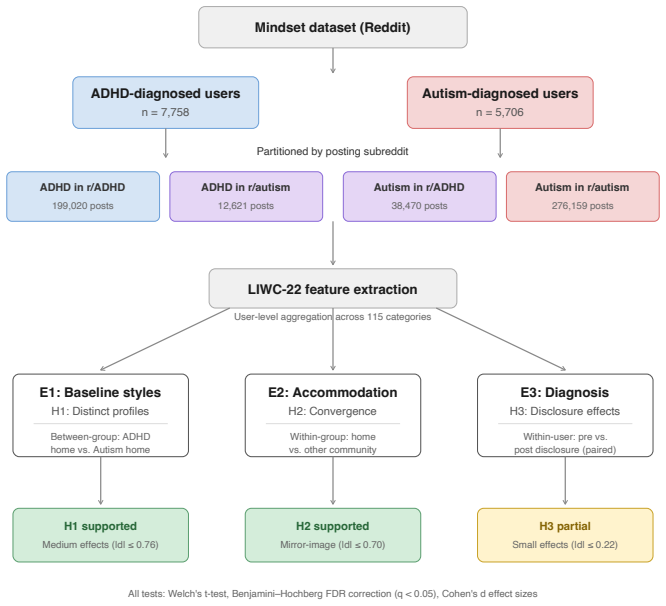
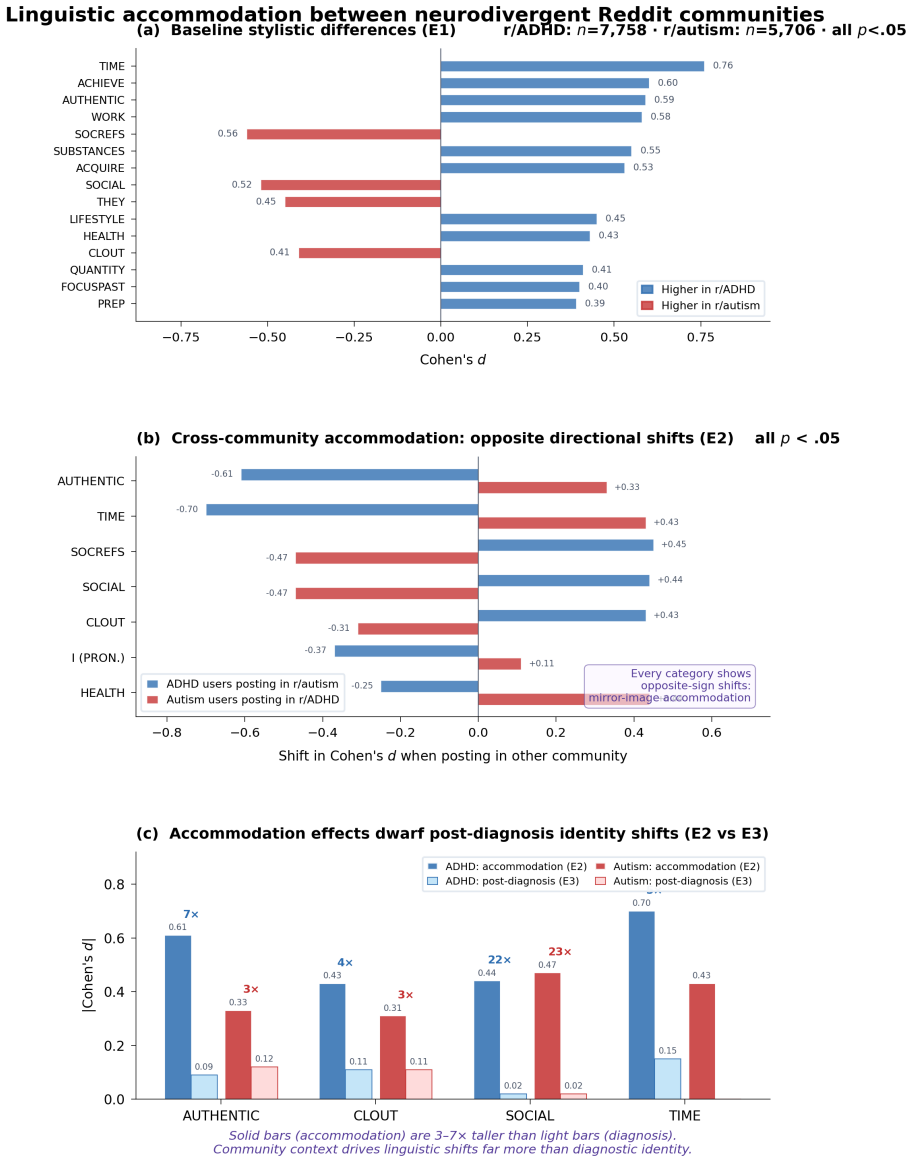
Each community maintains a distinct linguistic profile as measured by LIWC. These profiles shift in opposite directions when users cross community boundaries: features that are elevated in one group's home community decrease when its members post in the other group's space, and vice versa, consistent with convergent accommodation. The involvement of topic-independent summary variables provides partial evidence against a purely topical explanation. Effects of public diagnosis disclosure on linguistic style are small and, in some cases, directionally opposite to cross-community accommodation.
What carries the argument
LIWC lexicon applied to home-community versus cross-community posts to quantify directional feature shifts.
If this is right
- Audience adaptation rather than fixed identity-linked language patterns shapes online communication between these groups.
- Platform moderation practices could benefit from recognizing that language use varies with the immediate audience.
- Clinical interpretations of ADHD and autism language may need to separate short-term situational adaptation from longer-term identity processes.
- Public diagnosis disclosure appears to engage different mechanisms than immediate cross-group posting.
Where Pith is reading between the lines
- Comparable audience-driven language shifts may occur in other identity-divided online spaces.
- Automated detection of accommodation signals could help map fluid community boundaries on social platforms.
- Studies on additional forums or longitudinal data could test whether the pattern holds outside Reddit.
Load-bearing premise
Observed changes in word-use patterns when users cross communities mainly reflect audience-driven accommodation rather than shifts in topics or other unmeasured factors.
What would settle it
Finding that topic models or other controls fully account for the LIWC feature shifts, or that topic-independent variables such as Authentic and Clout show no corresponding movement.
Figures

read the original abstract
Social media research on mental health has focused predominantly on detecting and diagnosing conditions at the individual level. In this work, we shift attention to \emph{intergroup} behavior, examining how two prominent neurodivergent communities, ADHD and autism, adjust their language when engaging with each other on Reddit. Grounded in Communication Accommodation Theory (CAT), we first establish that each community maintains a distinct linguistic profile as measured by Language Inquiry and Word Count Lexicon (LIWC). We then show that these profiles shift in opposite directions when users cross community boundaries: features that are elevated in one group's home community decrease when its members post in the other group's space, and vice versa, consistent with convergent accommodation. The involvement of topic-independent summary variables (Authentic, Clout) in these shifts provides partial evidence against a purely topical explanation. Finally, in an exploratory longitudinal analysis around the moment of public diagnosis disclosure, we find that its effects on linguistic style are small and, in some cases, directionally opposite to cross-community accommodation, providing initial evidence that situational audience adaptation and longer-term identity processes may involve different mechanisms. Our findings contribute to understanding intergroup communication dynamics among neurodivergent populations online and carry implications for community moderation and clinical perspectives on these conditions.
Editorial analysis
A structured set of objections, weighed in public.
Referee Report
Summary. The paper applies Communication Accommodation Theory to Reddit posts from ADHD and autism communities. It first documents distinct LIWC-based linguistic profiles for each group, then reports that these profiles shift in opposite directions when the same users post across community boundaries, consistent with convergent accommodation. Partial protection against topical confounds is claimed via shifts in the topic-independent LIWC summary variables Authentic and Clout. An exploratory longitudinal analysis examines language changes around public diagnosis disclosure and finds small effects that are sometimes directionally opposite to the cross-community patterns.
Significance. If the accommodation interpretation survives stronger controls, the work would extend CAT to neurodivergent online intergroup settings and usefully separate short-term audience adaptation from longer-term diagnostic identity processes. The real-world data source and longitudinal component are assets; however, the central claim's evidential weight hinges on whether observed LIWC shifts can be isolated from topic and self-selection confounds.
major comments (2)
- [Methods] Methods: The manuscript does not describe user-level fixed effects, propensity matching on posting history, or topic-model covariates (e.g., LDA or similar) for the full set of LIWC categories. Only Authentic and Clout are invoked as topic-independent; the remaining dimensions remain vulnerable to content differences between subreddits, which directly undermines the claim that directional shifts reflect audience-driven accommodation rather than topic or self-selection.
- [Results] Results: The abstract and reported findings omit sample sizes for cross-community posters, statistical tests, effect sizes, and error estimates. Without these, it is impossible to evaluate whether the opposite directional shifts are reliable or whether they survive the partial topic controls already noted.
minor comments (2)
- [Abstract] Abstract: Key methodological details (N, exclusion criteria, statistical tests) are absent, reducing transparency even for a high-level summary.
- [Discussion] Discussion: The longitudinal diagnosis-disclosure analysis is labeled exploratory; clearer statements about its power and multiple-testing corrections would aid interpretation.
Simulated Author's Rebuttal
We thank the referee for their insightful comments. We respond to each major comment below and have revised the manuscript to improve methodological transparency and reporting.
read point-by-point responses
-
Referee: [Methods] Methods: The manuscript does not describe user-level fixed effects, propensity matching on posting history, or topic-model covariates (e.g., LDA or similar) for the full set of LIWC categories. Only Authentic and Clout are invoked as topic-independent; the remaining dimensions remain vulnerable to content differences between subreddits, which directly undermines the claim that directional shifts reflect audience-driven accommodation rather than topic or self-selection.
Authors: We concur that user-level fixed effects, propensity matching, and full topic-model covariates for all LIWC categories would strengthen the isolation of accommodation effects from confounds. Our analysis instead leverages Authentic and Clout as topic-independent indicators, providing partial safeguards. We have not applied LDA covariates or matching as the study emphasizes LIWC-based profiles. The revised manuscript expands the Methods to justify these choices and includes a new Limitations section discussing vulnerability of other dimensions to subreddit content differences and self-selection. revision: partial
-
Referee: [Results] Results: The abstract and reported findings omit sample sizes for cross-community posters, statistical tests, effect sizes, and error estimates. Without these, it is impossible to evaluate whether the opposite directional shifts are reliable or whether they survive the partial topic controls already noted.
Authors: Thank you for noting the omission of key statistical details. The revised manuscript now incorporates sample sizes for cross-community posters, statistical tests, effect sizes, and error estimates into the abstract and ensures they are clearly presented in the reported findings. This allows proper assessment of the reliability of the directional shifts and their relation to the topic controls. revision: yes
Circularity Check
No circularity: empirical LIWC comparisons are self-contained
full rationale
The paper performs direct empirical comparisons of pre-existing LIWC categories across Reddit communities and user cross-posting events. No parameters are fitted to the target accommodation result, no derivations reduce to self-referential definitions, and no load-bearing self-citations or uniqueness theorems are invoked. The central claim rests on observed directional shifts in feature values, with the authors themselves noting the partial nature of their controls for topical confounds. This is standard observational analysis without reduction to inputs by construction.
Axiom & Free-Parameter Ledger
axioms (1)
- domain assumption LIWC lexicon categories reliably measure linguistically meaningful differences relevant to accommodation
Lean theorems connected to this paper
-
IndisputableMonolith/Foundation/RealityFromDistinction.leanreality_from_one_distinction unclear?
unclearRelation between the paper passage and the cited Recognition theorem.
we show that these profiles shift in opposite directions when users cross community boundaries: features that are elevated in one group's home community decrease when its members post in the other group's space, and vice versa, consistent with convergent accommodation
-
IndisputableMonolith/Cost/FunctionalEquation.leanwashburn_uniqueness_aczel unclear?
unclearRelation between the paper passage and the cited Recognition theorem.
The involvement of topic-independent summary variables (Authentic, Clout) in these shifts provides partial evidence against a purely topical explanation
What do these tags mean?
- matches
- The paper's claim is directly supported by a theorem in the formal canon.
- supports
- The theorem supports part of the paper's argument, but the paper may add assumptions or extra steps.
- extends
- The paper goes beyond the formal theorem; the theorem is a base layer rather than the whole result.
- uses
- The paper appears to rely on the theorem as machinery.
- contradicts
- The paper's claim conflicts with a theorem or certificate in the canon.
- unclear
- Pith found a possible connection, but the passage is too broad, indirect, or ambiguous to say the theorem truly supports the claim.
Reference graph
Works this paper leans on
-
[1]
Iyad Ait Hou, Shrenik Borad, Harsh Sharma, Pooja Srinivasan, Rebecca Hwa, and Aya Zirikly. Parameter- efficient token embedding editing for clinical class-level unlearning.arXiv preprint arXiv:2603.19302,
-
[2]
BERTopic: Neural topic modeling with a class-based TF-IDF procedure
Maarten Grootendorst. BERTopic: Neural topic modeling with a class-based TF-IDF procedure.arXiv preprint arXiv:2203.05794,
work page internal anchor Pith review arXiv
-
[3]
Saad Mankarious, Ayah Zirikly, Daniel Wiechmann, Elma Kerz, Edward Kempa, and Yu Qiao. Mind- SET: Advancing mental health benchmarking through large-scale social media data.arXiv preprint arXiv:2511.20672,
-
[4]
12 A Quantitative Summary of All Experiments Figure 3 provides a three-panel quantitative summary. Panel (a) shows baseline stylistic differences (E1), panel (b) visualizes the mirror-image accommodation shifts (E2), and panel (c) compares E2 and E3 effect sizes, showing that situational accommodation is 3–23×stronger than post-diagnosis identity changes....
2018
-
[5]
Diagnosis timestamps.For E3, we used the timestamp of each user’s first public diagnosis disclosure from the Mindset dataset [Mankarious et al., 2025]
at q= 0.05acrossm= 115tests per experiment. Diagnosis timestamps.For E3, we used the timestamp of each user’s first public diagnosis disclosure from the Mindset dataset [Mankarious et al., 2025]. Users were included only if they had ≥3 posts in both pre- and post-disclosure periods. Median pre-disclosure posting span ≈ 14 months; post-disclosure ≈ 18 mont...
2025
discussion (0)
Sign in with ORCID, Apple, or X to comment. Anyone can read and Pith papers without signing in.