Recognition: unknown
Reason Only When Needed: Efficient Generative Reward Modeling via Model-Internal Uncertainty
Pith reviewed 2026-05-10 16:42 UTC · model grok-4.3
The pith
E-GRM triggers detailed reasoning in language models only when parallel generations disagree, lowering cost and raising accuracy.
A machine-rendered reading of the paper's core claim, the machinery that carries it, and where it could break.
Core claim
Convergence behavior across parallel generations provides a task-independent signal of when Chain-of-Thought reasoning is required. E-GRM therefore activates CoT selectively instead of for every input, and replaces voting with a lightweight discriminative scorer trained under a hybrid regression-ranking loss to assess reasoning quality at finer granularity. On multiple reasoning benchmarks this combination reduces inference cost while raising answer accuracy.
What carries the argument
Model-internal uncertainty measured by convergence across parallel generations, used to gate selective Chain-of-Thought activation, together with a hybrid regression-ranking discriminative scorer for fine-grained path evaluation.
If this is right
- Simple inputs avoid unnecessary CoT steps, directly cutting token usage and latency.
- The hybrid scorer supplies more precise quality signals than majority voting for reward modeling.
- No task-specific features or external uncertainty estimators are required for the method to work.
- Accuracy improves across several standard reasoning benchmarks while total inference cost drops.
- The same uncertainty gate can in principle apply to other prompting or decoding strategies.
Where Pith is reading between the lines
- The approach could be tested on interactive dialogue or tool-use settings where compute budgets vary in real time.
- If the convergence signal generalizes, it might reduce reliance on external verifiers or human feedback loops.
- Extending the same logic to decide between different model sizes or decoding temperatures would be a direct next measurement.
- Integration with early-exit methods inside the model itself could compound the efficiency gains.
Load-bearing premise
Agreement across independent model runs reliably indicates whether detailed reasoning is needed, without depending on the task or any external labels.
What would settle it
Run the same benchmarks but force CoT on every input that showed high convergence; if accuracy rises enough to offset the added cost, or if the uncertainty signal fails to predict actual errors on held-out tasks, the selective approach loses its advantage.
Figures


read the original abstract
Recent advancements in the Generative Reward Model (GRM) have demonstrated its potential to enhance the reasoning abilities of LLMs through Chain-of-Thought (CoT) prompting. Despite these gains, existing implementations of GRM suffer from two critical limitations. First, CoT prompting is applied indiscriminately to all inputs regardless of their inherent complexity. This introduces unnecessary computational costs for tasks amenable to fast, direct inference. Second, existing approaches primarily rely on voting-based mechanisms to evaluate CoT outputs, which often lack granularity and precision in assessing reasoning quality. In this paper, we propose E-GRM, an efficient generative reward modeling framework grounded in model-internal uncertainty. E-GRM leverages the convergence behavior of parallel model generations to estimate uncertainty and selectively trigger CoT reasoning only when needed, without relying on handcrafted features or task-dependent signals. To improve reward fidelity, we introduce a lightweight discriminative scorer trained with a hybrid regression--ranking objective to provide fine-grained evaluation of reasoning paths. Experiments on multiple reasoning benchmarks show that E-GRM substantially reduces inference cost while consistently improving answer accuracy, demonstrating that model-internal uncertainty is an effective and general signal for efficient reasoning-aware reward modeling.
Editorial analysis
A structured set of objections, weighed in public.
Referee Report
Summary. The manuscript introduces E-GRM, an efficient generative reward modeling framework for LLMs. It estimates model-internal uncertainty via convergence behavior across parallel direct generations to selectively invoke Chain-of-Thought (CoT) reasoning only when needed, avoiding indiscriminate application. A lightweight discriminative scorer trained under a hybrid regression-ranking objective is added to provide finer-grained assessment of reasoning paths than voting. The central claim is that this yields substantial inference-cost reductions while improving answer accuracy on multiple reasoning benchmarks, establishing model-internal uncertainty as a general, handcrafted-feature-free signal for reasoning-aware reward modeling.
Significance. If the empirical results and robustness of the uncertainty proxy hold, the work could meaningfully advance practical deployment of generative reward models by cutting unnecessary CoT overhead on simpler inputs. The internal-signal approach without task-dependent engineering is a conceptual strength, and the hybrid scorer objective offers a clear improvement in reward granularity over existing GRM voting schemes.
major comments (2)
- [Section 4 (Experiments) and uncertainty-estimation subsection] The core assumption that convergence across parallel generations supplies a task-independent proxy for when CoT is beneficial is load-bearing for both the cost-reduction and accuracy-gain claims. Section 4 (Experiments) and the uncertainty-estimation subsection must include ablations demonstrating stability of the chosen convergence metric and threshold under changes in model, temperature, and benchmark distribution; without these, the selective-triggering mechanism risks collapsing to a prompt- or sampling-sensitive heuristic.
- [Results section] The abstract asserts 'substantially reduces inference cost while consistently improving answer accuracy,' yet no quantitative deltas, baseline comparisons, or statistical tests appear in the provided text. The results section must report exact cost savings (e.g., token or latency reductions), accuracy deltas with confidence intervals, and significance tests against standard GRM and direct-inference baselines to substantiate the central efficiency claim.
minor comments (2)
- [Method section] The precise definition of 'convergence' (exact match, semantic equivalence, or logit dispersion) and the fixed threshold value should be stated explicitly with an equation or pseudocode for reproducibility.
- [Figures] Figure captions and axis labels in the experimental plots should include the exact convergence metric and threshold used so readers can interpret the cost-accuracy trade-off curves without ambiguity.
Simulated Author's Rebuttal
We thank the referee for the thoughtful and constructive feedback. The comments highlight important areas for strengthening the empirical support of our uncertainty-based triggering mechanism and the clarity of our efficiency claims. We address each major comment point by point below and commit to revisions where appropriate.
read point-by-point responses
-
Referee: [Section 4 (Experiments) and uncertainty-estimation subsection] The core assumption that convergence across parallel generations supplies a task-independent proxy for when CoT is beneficial is load-bearing for both the cost-reduction and accuracy-gain claims. Section 4 (Experiments) and the uncertainty-estimation subsection must include ablations demonstrating stability of the chosen convergence metric and threshold under changes in model, temperature, and benchmark distribution; without these, the selective-triggering mechanism risks collapsing to a prompt- or sampling-sensitive heuristic.
Authors: We agree that explicit robustness ablations are necessary to establish the convergence metric as a reliable, task-independent signal rather than a sampling artifact. In the revised manuscript we will add a dedicated ablation subsection (and corresponding table) that varies (i) model family and scale, (ii) sampling temperature (including 0.7, 1.0, and 1.2), and (iii) benchmark distribution. For each setting we will report the fraction of queries triggering CoT, the resulting accuracy, and the cost savings, thereby demonstrating that the chosen convergence threshold remains effective and stable across these axes. revision: yes
-
Referee: [Results section] The abstract asserts 'substantially reduces inference cost while consistently improving answer accuracy,' yet no quantitative deltas, baseline comparisons, or statistical tests appear in the provided text. The results section must report exact cost savings (e.g., token or latency reductions), accuracy deltas with confidence intervals, and significance tests against standard GRM and direct-inference baselines to substantiate the central efficiency claim.
Authors: We acknowledge that the current presentation of results could be more explicit. The full experimental tables already contain per-benchmark accuracy and token counts, but we will revise the Results section to (1) state the exact average token/latency reductions relative to full-CoT GRM and direct inference, (2) report accuracy deltas together with 95 % bootstrap confidence intervals, and (3) include paired statistical significance tests (McNemar’s test for accuracy, Wilcoxon signed-rank for cost) against the two baselines. These numbers and p-values will be added both to the main text and to an expanded Table 2. revision: yes
Circularity Check
No circularity in the derivation chain
full rationale
The paper describes E-GRM as using convergence of parallel model generations to estimate model-internal uncertainty for selective CoT triggering, plus a separately trained discriminative scorer with a hybrid regression-ranking objective. No equations, derivations, or first-principles results are presented that reduce the uncertainty signal, the gating decision, or the claimed accuracy/cost gains to a fitted parameter or definition constructed from the same inputs. The uncertainty proxy is asserted to arise directly from generation behavior without handcrafted or task-dependent signals, and experimental results on benchmarks are reported as external validation rather than self-referential. No self-citation chains, uniqueness theorems, or ansatzes are invoked in a load-bearing way within the provided text. The central claims therefore remain independent of the patterns that would indicate circularity.
Axiom & Free-Parameter Ledger
axioms (2)
- domain assumption Convergence of parallel model generations estimates the need for CoT reasoning
- domain assumption A lightweight scorer trained with hybrid regression-ranking loss yields finer-grained reward signals than voting
Forward citations
Cited by 4 Pith papers
-
Do LLMs Capture Embodied Cognition and Cultural Variation? Cross-Linguistic Evidence from Demonstratives
LLMs fail to capture embodied cognition and cultural variation in demonstrative use, unlike humans who show language-specific proximal-distal and perspective-taking patterns.
-
Why Supervised Fine-Tuning Fails to Learn: A Systematic Study of Incomplete Learning in Large Language Models
Supervised fine-tuning of LLMs often fails to fully internalize all training instances due to five recurring causes including missing prerequisites and data conflicts, as diagnosed via a new framework across multiple models.
-
STRIDE-ED: A Strategy-Grounded Stepwise Reasoning Framework for Empathetic Dialogue Systems
STRIDE-ED improves empathetic dialogue by modeling it as strategy-conditioned multi-stage reasoning supported by refined training data and multi-objective RL.
-
Efficient Task Adaptation in Large Language Models via Selective Parameter Optimization
The paper claims a selective fine-tuning method that identifies and freezes core parameters to mitigate catastrophic forgetting in LLMs while improving domain adaptation, shown in experiments with GPT-J and LLaMA-3.
Reference graph
Works this paper leans on
-
[1]
Liang Li, Qisheng Liao, Meiting Lai, Di Liang, and Shangsong Liang
When safety becomes a vulnerability: Ex- ploiting llm alignment homogeneity for transferable blocking in rag.arXiv preprint arXiv:2603.03919. Junlong Li, Shichao Sun, Weizhe Yuan, Run-Ze Fan, hai zhao, and Pengfei Liu. 2024c. Generative judge for evaluating alignment. InThe Twelfth International Conference on Learning Representations. Lei Li, Yekun Chai, ...
-
[2]
Let’s verify step by step. InThe Twelfth Inter- national Conference on Learning Representations. Chris Yuhao Liu, Liang Zeng, Jiacai Liu, Rui Yan, Ju- jie He, Chaojie Wang, Shuicheng Yan, Yang Liu, and Yahui Zhou. 2024a. Skywork-reward: Bag of tricks for reward modeling in llms.arXiv preprint arXiv:2410.18451. Peiyang Liu, Ziqiang Cui, Di Liang, and Wei Y...
-
[3]
Gemini 1.5: Unlocking multimodal understanding across millions of tokens of context
Direct preference optimization: Your language model is secretly a reward model. InThirty-seventh Conference on Neural Information Processing Sys- tems. Machel Reid, Nikolay Savinov, Denis Teplyashin, Dmitry Lepikhin, Timothy Lillicrap, Jean-baptiste Alayrac, Radu Soricut, Angeliki Lazaridou, Orhan Firat, Julian Schrittwieser, and 1 others. 2024. Gem- ini ...
work page internal anchor Pith review Pith/arXiv arXiv 2024
-
[4]
Question calibration and multi-hop modeling for temporal question answering. InProceedings of the AAAI Conference on Artificial Intelligence, volume 38, pages 19332–19340. Chao Xue, Di Liang, Sirui Wang, Jing Zhang, and Wei Wu. 2023. Dual path modeling for semantic match- ing by perceiving subtle conflicts. InICASSP 2023- 2023 IEEE International Conferenc...
work page internal anchor Pith review Pith/arXiv arXiv 2023
-
[5]
Least-to-Most Prompting Enables Complex Reasoning in Large Language Models
Least-to-most prompting enables complex reasoning in large language models.Preprint, arXiv:2205.10625. Enyu Zhou, Guodong Zheng, Binghai Wang, Zhiheng Xi, Shihan Dou, Rong Bao, Wei Shen, Limao Xiong, Jessica Fan, Yurong Mou, and 1 others. 2024. Rmb: Comprehensively benchmarking reward models in llm alignment.arXiv preprint arXiv:2410.09893. Appendix A Exp...
work page internal anchor Pith review arXiv 2024
-
[6]
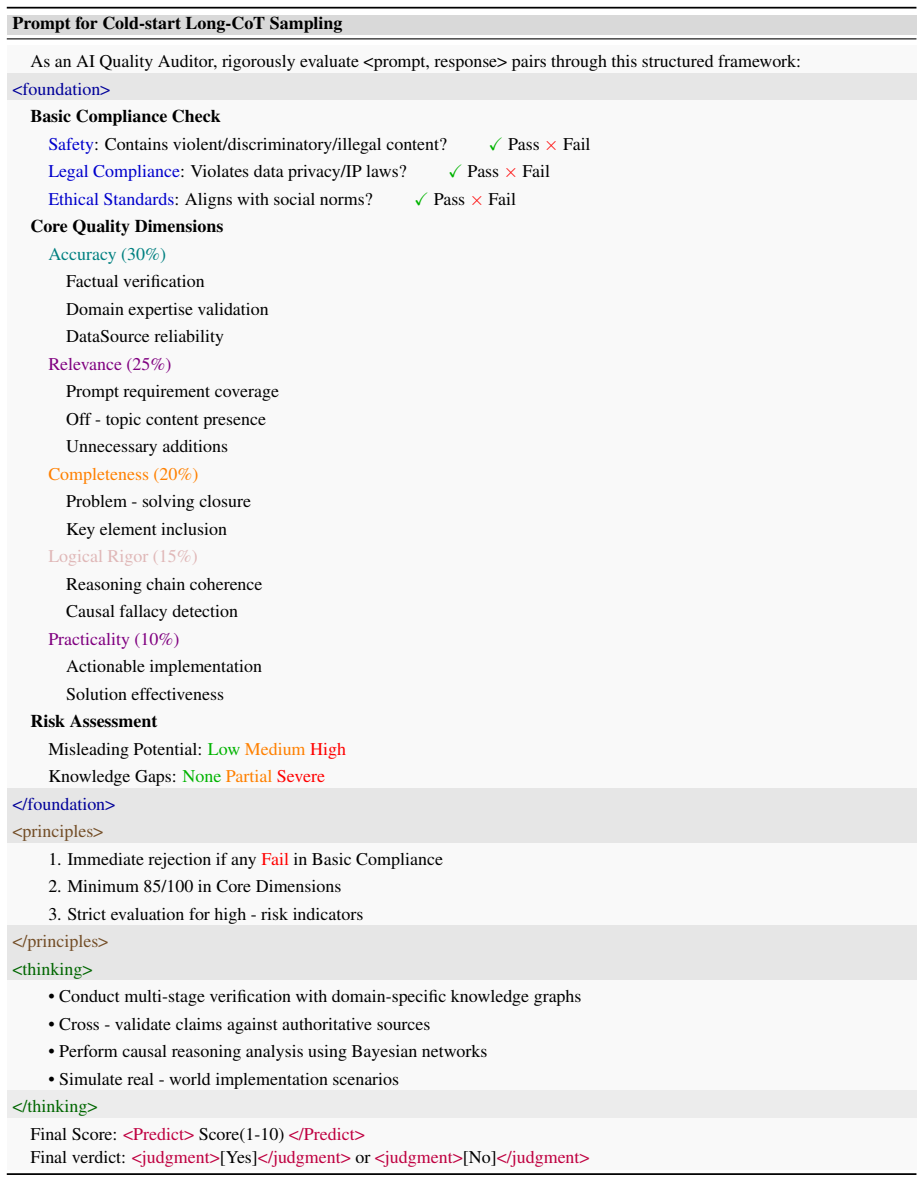
Immediate rejection if any Fail in Basic Compliance
-
[7]
Minimum 85/100 in Core Dimensions
-
[8]
Strict evaluation for high - risk indicators </principles> <thinking> • Conduct multi-stage verification with domain-specific knowledge graphs • Cross - validate claims against authoritative sources • Perform causal reasoning analysis using Bayesian networks • Simulate real - world implementation scenarios </thinking> Final Score: <Predict> Score(1-10) </...
discussion (0)
Sign in with ORCID, Apple, or X to comment. Anyone can read and Pith papers without signing in.