Recognition: unknown
Coarsening and Bifurcations in Wide-Range Two-Dimensional Totalistic Cellular Automata
Pith reviewed 2026-05-10 16:43 UTC · model grok-4.3
The pith
Wide-range frustrated majority vote cellular automata exhibit a bifurcation in asymptotic density above a critical interaction radius.
A machine-rendered reading of the paper's core claim, the machinery that carries it, and where it could break.
Core claim
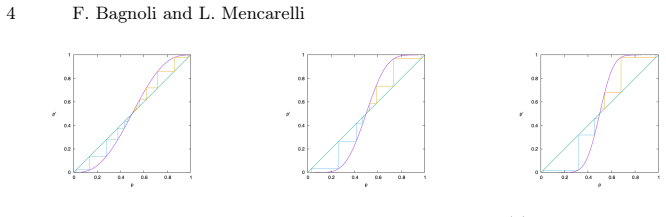
In the majority vote model, absorbing states appear with a bifurcation according to initial density, consistent with mean-field, but at initial density 0.5 the dynamics coarsen until clusters of definite curvature radius form. In the frustrated majority vote model, active patterns with stable density are observed instead of mean-field chaos or limit cycles, and above a critical interacting radius a bifurcation of the asymptotic density occurs as a function of the initial density.
What carries the argument
Variable-span totalistic cellular automata using majority or frustrated majority vote rules, which allow simulation of wide-range interactions on the lattice to reveal deviations from mean-field predictions.
If this is right
- The majority vote model develops stable clusters with fixed curvature after coarsening at half density.
- The frustrated model maintains active patterns rather than oscillating chaotically.
- A density bifurcation emerges in the frustrated model when the interaction radius surpasses a critical value.
- These behaviors differ from mean-field approximations due to the spatial structure in two dimensions.
Where Pith is reading between the lines
- This could imply that similar bifurcations might appear in other extended-interaction models like opinion dynamics or Ising systems with long-range coupling.
- The coarsening process suggests analogies to phase separation in physical systems where interface curvature drives evolution.
- Testing on larger lattices might confirm if the curvature radii and stable densities persist without finite-size effects.
Load-bearing premise
That the finite-size simulations with selected interaction ranges faithfully represent the behavior in infinite systems without artifacts from boundaries or synchronous updating.
What would settle it
Running simulations on significantly larger grids or with varied boundary conditions and observing whether the density bifurcation and stable curvature radii remain unchanged.
Figures



read the original abstract
We investigate Boolean, totalistic cellular automata with a majority or frustrated majority vote rule, and an interaction range of variable span. These two models show a behavior which differs from the mean-field one. The majority vote model is characterized by the presence of absorbing states, and there is a related bifurcation according to the initial density, in agreement with the mean-field approximation. For initial density equal to $0.5$, however, the dynamics is dominated by a coarsening process, which stops when clusters with a definite curvature radius are established. For the frustrated majority vote model, the mean-field approximation gives chaotic oscillations or a limit cycle. Instead, we observe active patterns, with stable density. Above a certain critical value for the interacting radius there is a bifurcation of the asymptotic density as a function of the initial one.
Editorial analysis
A structured set of objections, weighed in public.
Referee Report
Summary. The manuscript examines wide-range two-dimensional totalistic cellular automata using majority and frustrated majority vote rules. It reports that the majority vote model has absorbing states with a bifurcation in behavior based on initial density, aligning with mean-field predictions, but at initial density 0.5 exhibits coarsening that ceases at clusters of definite curvature radius. For the frustrated majority vote model, stable active patterns with constant density are observed instead of mean-field chaos or cycles, and above a critical interaction radius, the asymptotic density bifurcates depending on the initial density.
Significance. If substantiated, these findings demonstrate significant departures from mean-field approximations in cellular automata with extended neighborhoods, particularly the stabilization of densities in frustrated systems and the bifurcation phenomenon. This could have implications for understanding non-equilibrium dynamics, pattern formation, and phase transitions in discrete lattice models. The numerical exploration of variable range interactions adds to the literature on CA beyond small neighborhoods.
major comments (2)
- [Abstract and results section] Abstract and numerical results on the frustrated majority vote model: the central claim that above a critical interaction radius there is a bifurcation of the asymptotic density as a function of the initial density rests on finite-lattice simulations. No finite-size scaling analysis (e.g., density-vs-initial-density curves or critical-radius values for multiple L such as 64, 128, 256) is reported to demonstrate convergence to the infinite-system limit, leaving the bifurcation vulnerable to boundary or size artifacts as noted in the weakest assumption.
- [Abstract and majority vote results] Abstract and coarsening discussion for majority vote model at initial density 0.5: the claim that coarsening stops when 'clusters with a definite curvature radius are established' lacks a precise operational definition, measurement protocol, or quantitative criteria (including error estimates) for identifying this radius from post-simulation configurations, which is load-bearing for distinguishing the observed behavior from mean-field.
minor comments (2)
- [Abstract] The abstract refers to 'Boolean, totalistic cellular automata' but does not specify the exact totalistic threshold functions or neighborhood definitions used for the majority and frustrated rules.
- [Methods or numerical section] Simulation details such as lattice sizes, boundary conditions, update order, and number of runs should be stated explicitly in the methods to allow reproducibility of the reported stable densities and patterns.
Simulated Author's Rebuttal
We thank the referee for the careful reading of our manuscript and the constructive major comments. We address each point below and commit to revisions that will strengthen the claims.
read point-by-point responses
-
Referee: [Abstract and results section] Abstract and numerical results on the frustrated majority vote model: the central claim that above a critical interaction radius there is a bifurcation of the asymptotic density as a function of the initial density rests on finite-lattice simulations. No finite-size scaling analysis (e.g., density-vs-initial-density curves or critical-radius values for multiple L such as 64, 128, 256) is reported to demonstrate convergence to the infinite-system limit, leaving the bifurcation vulnerable to boundary or size artifacts as noted in the weakest assumption.
Authors: We agree that finite-size effects must be addressed to confirm the bifurcation is not an artifact. In the revised manuscript we will add simulations for L = 64, 128, 256 (and 512 where feasible), together with plots of asymptotic density versus initial density for each size. These will demonstrate convergence of both the bifurcation location and the critical radius with increasing L, including error bars obtained from multiple independent realizations. revision: yes
-
Referee: [Abstract and majority vote results] Abstract and coarsening discussion for majority vote model at initial density 0.5: the claim that coarsening stops when 'clusters with a definite curvature radius are established' lacks a precise operational definition, measurement protocol, or quantitative criteria (including error estimates) for identifying this radius from post-simulation configurations, which is load-bearing for distinguishing the observed behavior from mean-field.
Authors: We acknowledge that the current description is qualitative and requires a rigorous operational definition. We will revise the text to define the curvature radius explicitly: cluster boundaries are extracted via connected-component labeling and edge tracing; circular arcs are fitted to boundary segments by least-squares minimization; the reported radius is the ensemble-averaged value of these fits over the largest clusters, with standard-error estimates from independent runs. A new methods subsection and supporting figures will document the full protocol. revision: yes
Circularity Check
No circularity: claims are direct outputs of rule iteration on finite lattices
full rationale
The manuscript reports numerical observations from iterating totalistic cellular automaton rules (majority and frustrated majority vote) with variable interaction range. The central claim of a bifurcation in asymptotic density for the frustrated model above a critical radius is presented as an empirical outcome of the dynamics, not as an analytic derivation or fitted prediction. No equations are solved that reduce to their own inputs by construction, no parameters are tuned on a data subset and then called predictions, and no load-bearing steps rely on self-citations or imported uniqueness theorems. The results are therefore self-contained against external benchmarks (the rule definitions themselves) and receive the default non-circularity finding.
Axiom & Free-Parameter Ledger
axioms (2)
- standard math Cells update synchronously according to a totalistic Boolean function of the neighbor sum.
- domain assumption The lattice is two-dimensional with periodic or open boundaries (unspecified).
Reference graph
Works this paper leans on
-
[1]
Statistical mechanics of cellular automata
Stephen Wolfram. “Statistical mechanics of cellular automata”. In:Reviews of Modern Physics55.3 (July 1983), pp. 601–644.issn: 0034-6861.doi: 10 . 1103 / revmodphys . 55 . 601.url:http : / / dx . doi . org / 10 . 1103 / RevModPhys.55.601. [2]ACRI: International Conference on Cellular Automata for Research and Industry. Lecture Notes in Computer Science LN...
1983
-
[2]
Cartesian vs. Radial – A Comparative Evaluation of Two Visualization Tools
J. Myczkowski and G. Vichniac. “Critical Behavior in Cellular Automata Models of Growth”. In:Cellular Automata and Modeling of Complex Physi- cal Systems.SpringerBerlinHeidelberg,1989,pp.112–115.isbn:9783642752599. doi:10.1007/978- 3- 642- 75259- 9_10.url:http://dx.doi.org/10. 1007/978-3-642-75259-9_10
-
[3]
Ergodic theorems for weakly in- teracting infinite systems and the voter model
Richard A Holley and Thomas M Liggett. “Ergodic theorems for weakly in- teracting infinite systems and the voter model”. In:The annals of probability 3 (1975), pp. 643–663
1975
-
[4]
Theory of phase-ordering kinetics
A.J. Bray. “Theory of phase-ordering kinetics”. In:Advances in Physics43.3 (June1994),pp.357–459.issn:1460-6976.doi:10.1080/00018739400101505. url:http://dx.doi.org/10.1080/00018739400101505. Wide-Range Two-Dimensional Totalistic CA 11
-
[5]
Statistical Physics of Social Dynamics
ClaudioCastellano,SantoFortunato,andVittorioLoreto.“Statisticalphysics ofsocialdynamics”.In:Reviews of Modern Physics81.2(May2009),pp.591– 646.issn: 1539-0756.doi:10 . 1103 / revmodphys . 81 . 591.url:http : //dx.doi.org/10.1103/RevModPhys.81.591
-
[6]
org/wiki/Gauss_circle_problem
Wikipedia contributors.Gauss circle problem — Wikipedia, The Free Ency- clopedia.[Online;accessed4-April-2026].2026.url:https://en.wikipedia. org/wiki/Gauss_circle_problem
2026
-
[7]
Exact results for kinetics of catalytic reactions
L. Frachebourg and P. L. Krapivsky. “Exact results for kinetics of catalytic reactions”. In:Physical Review E53.4 (Apr. 1996), R3009–R3012.issn: 1095-3787.doi:10.1103/physreve.53.r3009.url:http://dx.doi.org/ 10.1103/PhysRevE.53.R3009
work page doi:10.1103/physreve.53.r3009.url:http://dx.doi.org/ 1996
discussion (0)
Sign in with ORCID, Apple, or X to comment. Anyone can read and Pith papers without signing in.